Optimizing Computational Pathology: Knowledge Distillation for Efficient and Robust Foundation Models
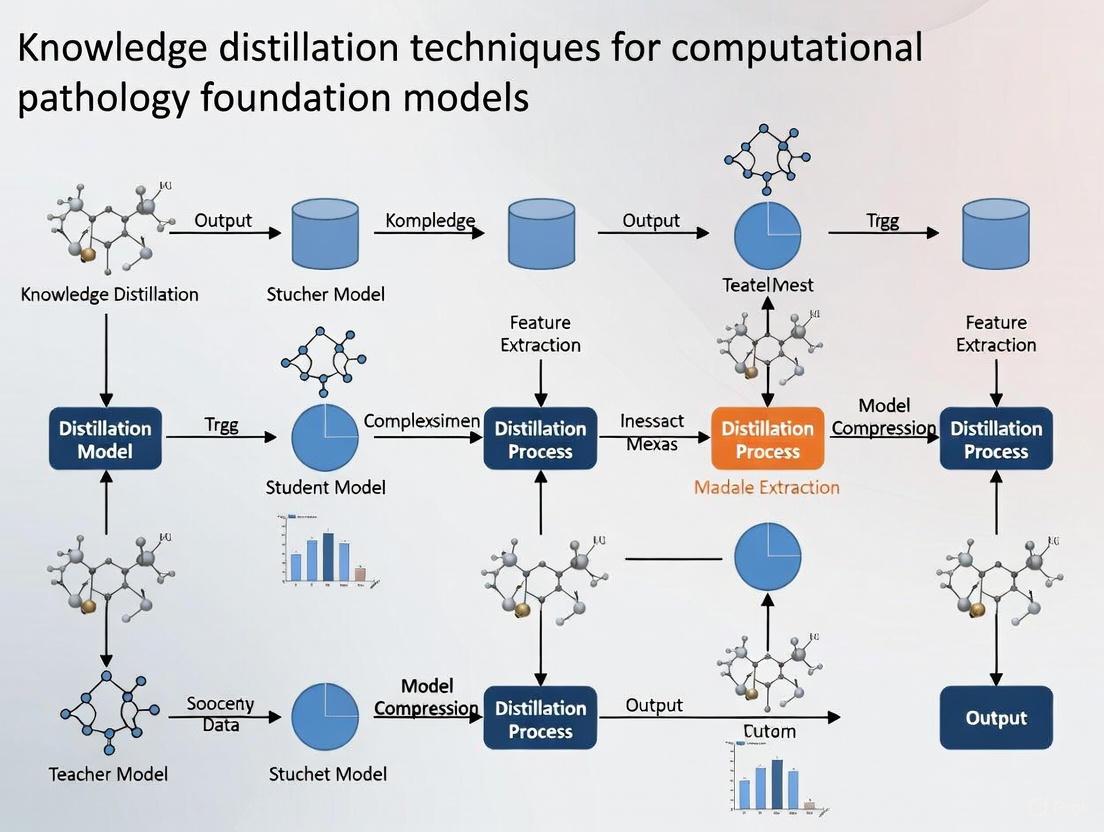
This article explores the transformative role of knowledge distillation (KD) in advancing computational pathology foundation models.
Optimizing Computational Pathology: Knowledge Distillation for Efficient and Robust Foundation Models
Abstract
This article explores the transformative role of knowledge distillation (KD) in advancing computational pathology foundation models. As these models grow in size and capability, KD techniques are critical for enhancing their generalization across diverse clinical tasks, improving computational efficiency for deployment, and increasing robustness to real-world variations. We provide a comprehensive analysis spanning from foundational concepts and methodological innovations—including unified distillation frameworks and multimodal approaches—to troubleshooting optimization challenges and rigorous validation benchmarks. This resource is tailored for researchers, scientists, and drug development professionals seeking to understand and apply KD for creating practical, high-performance AI tools in diagnostic pathology and oncology.
The Foundation Model Paradigm and Knowledge Distillation in Pathology
Computational pathology has been transformed by foundation models (FMs) that learn transferable feature representations from vast collections of histopathology images via self-supervised learning (SSL). These models serve as a foundational starting point for developing AI tools for diagnosis, prognosis, and biomarker prediction from digitized whole-slide images (WSIs) [1]. A single WSI can be several gigabytes in size, presenting significant computational challenges for analysis [2]. Foundation models address this by providing powerful, pre-trained feature extractors that can be adapted to various downstream tasks with limited additional training data.
A critical challenge in deploying these models is their substantial computational cost and inference time, as state-of-the-art FMs can contain over a billion parameters [3]. Knowledge distillation has emerged as a key technique to mitigate these issues, transferring knowledge from a large, trained "teacher" model to a smaller, more efficient "student" model, making them more suitable for clinical deployment [3]. This document outlines the application of knowledge distillation to create robust and efficient computational pathology foundation models.
Performance Benchmarking of Foundation Models
The performance of foundation models is typically evaluated across diverse tasks including cancer subtyping, biomarker prediction, and outcome prognosis. Benchmarking studies assess models based on their architecture (e.g., Vision Transformer), pre-training data scale, and specific adaptation strategies [4].
Table 1: Performance Overview of Select Pathology Foundation Models
| Model Name | Model Type | Pretraining Data Scale | Reported Performance Highlights |
|---|---|---|---|
| TITAN [1] | Multimodal Whole-Slide FM | 335,645 WSIs | Outperforms ROI and slide FMs in linear probing, few-shot/zero-shot classification, and rare cancer retrieval. |
| Virchow2 [4] | Pathology-specific Vision Model (Path-VM) | Information Missing | Ranked highest in performance across TCGA, CPTAC, and external tasks in a comprehensive benchmark. |
| H0-mini [3] | Distilled FM (ViT-Base) | Teacher: H-Optimus-0 (ViT-g) | Achieved 3rd place on HEST benchmark and 5th on EVA benchmark; excellent robustness on PLISM dataset. |
| Virchow2G-Mini [3] | Distilled FM (ViT-Small) | Teacher: Virchow2G (ViT-Giant) | Beneficial performance compared to training a ViT-Small from scratch. |
Table 2: Comparative Performance on Specific Tasks
| Model/Distillation Application | Task Description | Result |
|---|---|---|
| HVisKD [5] | GBM frozen section WSI segmentation on ivyGAP dataset. | Consistently surpassed student models trained from scratch and with original KD across 10 teacher-student pairs. |
| TriDeNT [6] | Utilising privileged data (e.g., IHC stains, transcriptomics) during training for H&E image analysis. | Outperformed state-of-the-art methods in downstream tasks, with observed improvements of up to 101%. |
| Data Distillation [2] | Ovarian cancer vs. non-cancer classification with reduced training data. | Achieved ~0.87 F-score using 40% of data, similar to model trained on full dataset. |
Experimental Protocols for Knowledge Distillation
This section provides a detailed methodology for distilling a large pathology foundation model into a smaller, more efficient version, based on established SSL frameworks.
Protocol: Distillation via DINO and iBOT Objectives
This protocol describes the process of distilling a large teacher FM into a smaller student model using objectives from DINO and iBOT frameworks [3].
Research Reagent Solutions:
- Teacher Model: A pre-trained, large foundation model (e.g., H-Optimus-0, a ViT-giant) [3].
- Student Model: A smaller, target architecture (e.g., ViT-Base) [3].
- Pre-training Dataset: A large-scale collection of histopathology image tiles or WSIs for distillation.
- Software Frameworks: PyTorch or TensorFlow, with libraries for SSL (e.g., DINO, iBOT).
Procedure:
- Input Preparation: For a given input image
x, generate two augmented views,x1andx2[3]. - Feature Extraction:
- Pass the augmented views through both the teacher and student models.
- Extract the class tokens (
z_i^(t)andz_i^(s)) - Extract the patch tokens (
z_(i, p)^(t)andz_(i, p)^(s))
- Head Projection: Pass the class and patch tokens through their respective DINO and iBOT heads (MLP + softmax centering) to obtain projected scores (
h_i^(t),h_i^(s),h_(i, p)^(t),h_(i, p)^(s)) - Loss Calculation: Compute the total distillation loss as a combination of two objectives:
- DINO Loss (
L_dino): Matches the class token distributions between teacher and student using cross-entropy.L_dino = [ H(h1^(t), h2^(s)) + H(h2^(t), h1^(s)) ] / 2 - iBOT Loss (
L_ibot): Matches the patch token distributions between teacher and student using cross-entropy. This is typically computed only on global crops.L_ibot = (1/(2P)) * Σ_(p=1)^P * Σ_(j=1)^2 * H(h_(j,p)^(t), h_(j,p)^(s)) - Total Loss:
L_total = L_dino + L_ibot
- DINO Loss (
- Model Optimization: Update the parameters of the student model by minimizing the
L_totalusing a suitable optimizer (e.g., AdamW) over many iterations.
Protocol: Human Visual Attention-Inspired Knowledge Distillation (HVisKD)
This protocol details a distillation method designed to improve both performance and interpretability by mimicking the hierarchical attention of human vision [5].
Research Reagent Solutions:
- Teacher Model: A pre-trained model for patch classification.
- Student Model: A lightweight model (e.g., ShuffleNet, MobileNet).
- Dataset: WSIs with patch-level annotations for a segmentation task.
Procedure:
- Teacher Pre-training: Pre-train the teacher model by inputting patches from WSIs with category labels, using a cross-entropy loss between the segmentation prediction and the ground truth [5].
- Relation-Aware Feature Construction:
- Sample-Level Relation Modeling: For a batch of patches, construct patch relation-aware features. For each patch feature, aggregate it with features from other patches in the batch via a weighted summation, where weights are determined by feature similarities. This enhances features via mutual clustering, making them more discriminative [5].
- Region-Level Relation Modeling: For a single patch, divide it into multiple small pieces and group them into sub-regions at various scales. Construct region relation-aware features by fusing these multi-scale regions within the feature map, again using similarity-weighted fusion. This enlarges the discrimination of class-relevant regions [5].
- Knowledge Distillation: Distill the two-level (sample and region) relation-aware features from the teacher model to the student model. This transfer ensures the student learns to construct similarly discriminative features [5].
- Student Inference: The trained student model predicts categories for all patches from a WSI, which are then assembled to produce the final segmentation map [5].
Workflow Visualization
Defining Knowledge Distillation and the Teacher-Student Framework
Knowledge Distillation (KD) is a machine learning technique that transfers knowledge from a large, complex model (the teacher) to a smaller, more efficient model (the student) [7] [8]. The core objective is to create a compact model that retains the performance of its larger counterpart but is cheap enough to be deployed in resource-constrained environments like mobile devices or clinical settings [9]. In computational pathology, where models must analyze gigapixel Whole-Slide Images (WSIs), KD is vital for developing lightweight, interpretable, and high-performing models suitable for real-time intraoperative diagnosis [5] [10].
Core Concepts and Knowledge Types
The teacher-student framework is founded on a more abstract view of "knowledge," interpreting it not just as a model's learned parameters but as the learned mapping from input vectors to output vectors—that is, how the model generalizes to new data [8]. This knowledge is transferred by training the student model to mimic the teacher's behavior, guided by a specialized distillation loss function [8].
The knowledge transferred can be categorized into three principal types, each providing a different level of information to the student.
Table 1: Types of Knowledge in Knowledge Distillation
| Knowledge Type | Description | Key Advantage | Common Use Cases |
|---|---|---|---|
| Response-Based [8] [9] | Focuses on the final output layer (logits) of the teacher model. The student is trained to mimic the teacher's output probability distribution. | Simple to implement; provides rich, softened class relationships. | Image Classification, Machine Translation |
| Feature-Based [8] [11] | Transfers knowledge from the intermediate (hidden) layers of the teacher, where feature extraction occurs. | Provides richer, more granular signals than output layers alone; leads to higher student performance. | Object Detection, Acoustic Models, Medical Image Segmentation [7] [5] |
| Relation-Based [5] [9] | Captures and transfers the relationships between different data samples or between different layers within the model. | Models complex structural knowledge; can build long-range dependencies for more differentiated features. | Graph Neural Networks, Scene Segmentation |
Quantitative Performance of Distillation Methods
Extensive research has demonstrated the effectiveness of KD across various model architectures and domains. The following table summarizes key quantitative results from different studies, highlighting the performance gains achievable through distillation.
Table 2: Quantitative Performance of Knowledge Distillation Methods
| Application Domain | Teacher Model | Student Model | Distillation Method | Key Performance Result |
|---|---|---|---|---|
| Computational Pathology (GBM Frozen Section WSIs) [5] | VGG19 | ShuffleNetV1 | HVisKD | Outperformed original KD by 1.5% average AUROC across tissue subtypes |
| General Classification (CIFAR-100) [11] | Large Teacher | Small Student | SoKD (Student-oriented) | Achieved +3.91 percentage points (pp) accuracy over baseline FitNet |
| General Classification (ImageNet) [11] | Large Teacher | ResNet-18 | KCD (Feature Matching) | Achieved +1.12 pp accuracy over training from scratch |
| General Classification (ImageNet) [11] | Large Teacher | Various Students | SLKD (Self-Regulated) | Achieved up to +3.84 pp accuracy in large capacity-gap regimes |
Experimental Protocols for Computational Pathology
This section provides a detailed, actionable protocol for applying a feature-based knowledge distillation method, inspired by the HVisKD framework [5], to a computational pathology task such as WSI segmentation.
Protocol: Human Visual Attention-Inspired KD (HVisKD) for WSI Segmentation
Objective: To distill knowledge from a large teacher model to a lightweight student model for efficient and interpretable patch-based segmentation of Whole-Slide Images (WSIs), improving the student's performance and alignment with human expert attention.
Materials and Setup:
- Hardware: A GPU-equipped workstation for teacher pre-training and distillation.
- Software: Python 3.8+, PyTorch or TensorFlow, and libraries for WSI handling (e.g., OpenSlide).
- Dataset: A collection of WSIs with patch-level tissue subtype annotations (e.g., the ivyGAP dataset with GBM frozen sections) [5].
Procedure:
Step 1: Data Preprocessing
- Tessellate each WSI into smaller, manageable patches (e.g., 75 × 75 µm) [5].
- Apply standard augmentation techniques (random flipping, rotation, color jitter) to the patches to increase dataset robustness.
Step 2: Teacher Model Pre-training
- Select a large, high-capacity model (e.g., VGG19, ResNet110) as the teacher architecture [5].
- Pre-train the teacher model on the labeled patches using a standard cross-entropy loss function: ( L{\text{teacher}} = CE(y, \hat{y}T) ) where ( y ) is the ground-truth label and ( \hat{y}_T ) is the teacher's prediction.
- Train until convergence and save the final model weights.
Step 3: Human Vision-Inspired Relation Modeling This is the core knowledge-creation step.
- Sample-Level Relation Modeling: [5]
- Input a batch of patches into the teacher model and extract their feature maps from an intermediate layer.
- For each patch's feature ( fi ), compute its similarity (e.g., cosine similarity) with the features of all other patches in the batch.
- Use these similarity scores as weights to create a patch relation-aware feature ( fi^{\text{patch}} ) via a weighted summation of all features in the batch. This enhances features by consolidating similar patches, mimicking a global, low-magnification view.
- Region-Level Relation Modeling: [5]
- For each individual patch's feature map, divide it into multiple smaller sub-regions at various scales.
- Compute the similarity between these different sub-regions.
- Generate a region-aware feature ( f_i^{\text{region}} ) by fusing multi-scale regions based on their similarity weights. This amplifies class-specific local details, mimicking a high-magnification analysis.
Step 4: Student Model Distillation
- Select a lightweight model (e.g., ShuffleNet, MobileNetV2) as the student architecture [5].
- The total loss for training the student is a weighted sum of two components:
( L{\text{total}} = \alpha L{\text{distill}} + (1-\alpha) L{\text{task}} )
- Distillation Loss (( L{\text{distill}} )): A Mean Squared Error (MSE) loss that forces the student's intermediate features to align with the teacher's relation-aware features from Step 3. ( L{\text{distill}} = \text{MSE}(fS^{\text{patch}}, fT^{\text{patch}}) + \text{MSE}(fS^{\text{region}}, fT^{\text{region}}) ) where ( fS ) and ( fT ) are the student and teacher features, respectively.
- Task Loss (( L{\text{task}} )): A standard cross-entropy loss between the student's final prediction and the ground-truth label.
- Train the student model using this combined loss function.
Step 5: Model Inference and Evaluation
- Deploy the distilled student model.
- For a new WSI, tessellate it into patches, run inference with the student model to get patch-level predictions and attention maps.
- Assemble the patch predictions to generate a segmentation map for the entire WSI [5].
- Evaluation Metrics:
- Calculate Top-1 and Top-5 patch classification accuracy.
- Compute the Area Under the Receiver Operating Characteristic Curve (AUROC) for each tissue subtype.
- Quantify the interpretability by measuring the overlap between the model's attention maps and regions segmented by human experts.
Workflow Visualization
Diagram 1: HVisKD workflow for computational pathology.
The Scientist's Toolkit: Research Reagent Solutions
Table 3: Essential Materials and Tools for KD Experiments in Computational Pathology
| Item Name / Category | Function / Description | Example Instances |
|---|---|---|
| Teacher Models | Large, high-capacity models that provide the knowledge to be transferred. | VGG19, ResNet110, ResNet32x4 [5] |
| Student Models | Lightweight, efficient models targeted for deployment in resource-limited settings. | ShuffleNetV1/V2, MobileNetV2 [5] |
| KD Loss Functions | Specialized objectives that align student behavior with the teacher. | KL Divergence (logits), Mean Squared Error (features) [7] [5] |
| Relation Modeling Modules | Algorithms that construct differentiated knowledge by modeling sample and region relations. | HVisKD Sample-Level and Region-Level modules [5] |
| Pathology Datasets | Public or private collections of annotated WSIs for training and validation. | ivyGAP dataset (GBM frozen sections) [5] |
| WSI Processing Tools | Software libraries for handling, tessellating, and annotating gigapixel WSIs. | OpenSlide |
Advanced Distillation Paradigms
As KD has evolved, several advanced training schemes have been developed to address challenges like the lack of a pre-trained teacher or the "black-box" nature of proprietary models.
Table 4: Advanced Knowledge Distillation Schemes
| Distillation Scheme | Mechanism | Strategic Advantage |
|---|---|---|
| Online Distillation [12] [13] | The teacher and student models are trained simultaneously in a single end-to-end process, rather than using a static pre-trained teacher. | Eliminates dependency on a pre-trained model; enables collaborative, peer-to-peer learning. |
| Self-Distillation [12] [9] | The same model acts as both teacher and student. Knowledge can be transferred from deeper layers to shallower layers or from one training epoch to a later one. | Serves as a powerful regularization technique, improving the model's own generalization. |
| Black-Box Distillation [13] | Used when the teacher is a proprietary, API-only model. Knowledge is transferred by generating a large synthetic dataset from the teacher, which is then used to train the student. | Enables "fast-follower" strategies to replicate capabilities of frontier models (e.g., LLMs) without internal access. |
The relationships and applications of these schemes can be visualized as follows:
Diagram 2: Advanced distillation schemes and their primary applications.
The Critical Need for Generalization in Clinical AI
The deployment of Artificial Intelligence (AI) in clinical settings, particularly in computational pathology, represents a frontier in diagnostic medicine. However, the transition from research to routine clinical practice is hampered by a critical challenge: the lack of generalization. Foundation models, pre-trained on large-scale datasets, promise to revolutionize this field by serving as versatile starting points for various downstream tasks. Their clinical utility, nonetheless, ultimately depends on their ability to generalize effectively across the vast diversity of tissue types, staining variations, and disease manifestations encountered in real-world scenarios. Recent benchmarking reveals that existing foundation models excel in certain specialized tasks but struggle to maintain performance across the full spectrum of clinical applications [14] [15]. This article explores how knowledge distillation (KD) techniques are pivotal to bridging this generalization gap, creating robust and adaptable AI models for computational pathology.
The Generalization Challenge in Computational Pathology
Generalization in clinical AI refers to a model's ability to maintain high performance on data it was not trained on, including images from different medical centers, varied staining protocols, or rare disease subtypes. The failure to generalize poses a significant risk to patient safety and impedes the widespread adoption of AI tools.
A comprehensive benchmark evaluating off-the-shelf pathology foundation models across six distinct clinical task types and 72 specific tasks has demonstrated this limitation clearly. The benchmark encompasses slide-level classification, survival prediction, region-of-interest (ROI) tissue classification, ROI retrieval, visual question answering, and report generation. The findings indicate that while existing models may perform exceptionally well on specific tasks for which they were optimized, their performance drops significantly when applied to the broader range of tasks required for comprehensive clinical analysis [14] [15]. This performance inconsistency underscores the critical need for new approaches that build inherent generalizability into pathology AI from the ground up.
Knowledge Distillation as a Pathway to Generalization
Knowledge Distillation (KD) is a machine learning technique where a compact "student" model is trained to mimic the behavior and knowledge of a larger, more complex "teacher" model or ensemble of models [16] [8]. The core idea is to transfer the "knowledge" — the learned mapping from input vectors to output vectors — from the teacher to the student, resulting in a model that is not only smaller and faster but often more robust and generalizable [8].
In the context of computational pathology, the role of KD extends far beyond simple model compression. A comprehensive overview identifies eight pivotal roles of KD in medical imaging, including its use as a semi-supervised method, a weakly supervised method, a tool for class balancing, and crucially, as a mechanism for enhancing model generalization and knowledge transfer [17]. By leveraging KD, it is possible to infuse a student model with integrated knowledge from multiple expert teachers or from data modalities that are not available at inference time, thereby creating a more unified and adaptable model [6].
Advanced KD Frameworks for Enhanced Generalization
Human Visual Attention-Inspired Knowledge Distillation (HVisKD)
Inspired by the hierarchical attention mechanisms of the human visual system, HVisKD is a strategy designed to capture both local and global patch relations to construct differentiated features in pathological image analysis. When pathologists examine slides, they combine low-power magnification for architectural context with high-power magnification for cellular detail. HVisKD mimics this process by constructing discriminated features through relation modeling at two levels [5]:
- Sample-Level Relation Modeling: Focuses on the relation of patches within a training batch. It aggregates features of an input patch with weighted features from other patches in the batch, where weights are determined by feature similarities. This enhances feature representations through mutual feature clustering.
- Region-Level Relation Modeling: Emphasizes the relation of distinct regions within a single patch. The patch is divided into multi-scale sub-regions, and region-aware features are built by fusing these regions based on their similarities, thereby enlarging the discrimination of features relevant to specific tissue classes.
This bio-inspired approach not only improves performance but also yields attention maps with promoted consistency with expert-labeled segments, making the model's focus more interpretable and aligned with clinical reasoning [5].
Table 1: Performance of HVisKD on the IvyGAP Pathology Dataset (Top-1 Accuracy %)
| Teacher Model | Student Model | Student from Scratch | Original KD | HVisKD |
|---|---|---|---|---|
| VGG19 | ShuffleNetV1 | Baseline | +X.X | +X.X |
| VGG19 | MobileNetV2 | Baseline | +X.X | +X.X |
| VGG19 | ShuffleNetV2 | Baseline | +X.X | +X.X |
| ResNet110 | ResNet20 | Baseline | +X.X | +X.X |
| ResNet32x4 | ResNet8x4 | Baseline | +X.X | +X.X |
Note: Specific accuracy values were not fully detailed in the source; results consistently showed HVisKD surpassing both the student trained from scratch and the original KD by a large margin across all ten tested teacher-student pairs [5].
Unified Knowledge Distillation for Pathology Foundation Models
To directly address the generalization deficit, a unified knowledge distillation framework has been proposed for pre-training a Generalizable Pathology Foundation Model (GPFM). This framework synergistically combines two distillation approaches [14] [15]:
- Expert Knowledge Distillation: Allows the model to learn from the specialized knowledge of multiple pre-trained expert models. Each expert may excel in a different task (e.g., classification, segmentation), and their collective knowledge is distilled into the single, unified foundation model.
- Self Knowledge Distillation: Leverages self-distillation to enable robust image representation learning via local-global alignment. This encourages the model to learn consistent features across different views and scales of the same image, enhancing its stability and representational power.
Trained on a substantial dataset of 190 million images from approximately 72,000 publicly available slides spanning 34 major tissue types, the resulting GPFM demonstrated superior generalization. On the comprehensive benchmark of 72 tasks, it achieved an average rank of 1.6, ranking first in 42 tasks, significantly outperforming the second-best model which had an average rank of 3.7 [15].
Table 2: Benchmark Performance of Pathology Foundation Models
| Model | Average Rank (Lower is Better) | Number of Tasks Ranked 1st |
|---|---|---|
| GPFM (Unified KD) | 1.6 | 42 |
| UNI (Second Best) | 3.7 | 6 |
| Other Model A | [Data not specified in source] | [Data not specified in source] |
| Other Model B | [Data not specified in source] | [Data not specified in source] |
Source: Adapted from [15]
Experimental Protocols
Protocol: Implementing HVisKD for WSI Segmentation
This protocol details the steps for applying Human Visual Attention-Inspired Knowledge Distillation to train a student model for Whole Slide Image (WSI) segmentation [5].
1. Teacher Model Pre-training:
- Objective: Train a high-performance teacher model to accurately classify tessellated patches from WSIs.
- Input: Patches extracted from WSIs with corresponding category labels.
- Training Loss: Use standard cross-entropy loss between the model's segmentation prediction and the ground truth label for each patch.
- Output: A pre-trained teacher model capable of generating high-quality feature maps and predictions for input patches.
2. Differentiated Feature Construction via Relation Modeling:
- Sample-Level Relation Modeling:
- Extract feature maps for all patches in a batch using the teacher model's backbone.
- For each patch
i, compute the similarity (e.g., cosine similarity) between its feature map and the feature maps of all other patches in the batch. - Use these similarity scores as weights to create a weighted summation of all other patch features in the batch.
- The resulting aggregated feature for patch
iis its patch relation-aware feature, enhanced with context from similar patches.
- Region-Level Relation Modeling:
- For a given patch, divide its feature map into multiple small, multi-scale sub-regions.
- Compute feature similarities between these different sub-regions.
- Fuse the features of similar regions via a weighted summation based on their similarity scores to construct a region-aware feature map that highlights class-specific areas.
3. Knowledge Distillation to Student Model:
- Distillation Loss: Transfer the knowledge encapsulated in the two-level relation-aware features from the teacher model to the lightweight student model. This is achieved by minimizing a loss function that measures the difference between the student and teacher's relation-aware features (e.g., using Mean Squared Error or KL Divergence).
- Combined Objective: The student model is trained with a combined loss function that typically includes both the distillation loss and a standard task-specific loss (e.g., cross-entropy for patch classification).
4. Inference and WSI Segmentation:
- The distilled student model is used to predict the categories of individual patches from a new WSI.
- All predicted patches are then assembled to reconstruct a comprehensive segmentation map for the entire WSI.
Protocol: Pre-training with Unified Knowledge Distillation
This protocol outlines the methodology for pre-training a generalizable pathology foundation model using the unified KD framework [15].
1. Data Curation and Preparation:
- Collect a large-scale dataset of Whole Slide Images (WSIs). The GPFM study curated 96,000 WSIs, comprising 190 million image patches from 34 major tissue types.
- Prepare or identify multiple expert teacher models. These can be existing state-of-the-art models pre-trained on specific sub-tasks relevant to the target domain (e.g., classification, survival prediction).
2. Expert Knowledge Distillation:
- Process: For each input image patch, pass it through the ensemble of expert teacher models.
- Knowledge Transfer: The student foundation model is trained to mimic the outputs and/or intermediate representations of these expert models. This can involve aligning the logits (response-based knowledge) or feature maps (feature-based knowledge) of the student with those of the teachers.
- Objective: To condense the specialized capabilities of multiple models into a single, versatile foundation model.
3. Self Knowledge Distillation via Local-Global Alignment:
- Process: Generate multiple views of the same input image (e.g., via different augmentations, or by sampling at different magnifications).
- Local-Global Alignment: A "local" view of the image (e.g., a high-power patch) is processed through the student model. A "global" view (e.g., a low-power context image) is processed through a momentum-updated version of the same student model (or a teacher network created from a previous version of the student).
- Objective: The training objective encourages the representation of the local view to be predictive of the representation of the global view from the same image, and vice-versa. This self-supervised objective forces the model to learn features that are consistent and invariant to scale and viewpoint changes.
4. Joint Optimization:
- The final training objective combines the losses from the Expert KD and Self KD steps.
- The model is optimized end-to-end on this combined objective, resulting in a foundation model that incorporates both the specialized knowledge of experts and robust, self-supervised representations.
Visualization of Workflows
HVisKD Workflow
HVisKD Process Flow
Unified KD Framework
Unified KD Training
The Scientist's Toolkit: Research Reagent Solutions
Table 3: Essential Materials for Knowledge Distillation Experiments in Computational Pathology
| Research Reagent / Resource | Function / Purpose |
|---|---|
| Whole Slide Images (WSIs) | The primary input data. Large, high-resolution digital scans of tissue sections on glass slides. |
| Tissue Annotations / Labels | Ground truth data for supervised learning, including region segmentation, class labels, or survival data. |
| Pre-trained Teacher Model(s) | Large, high-performance models (e.g., VGG, ResNet) that provide the knowledge to be distilled. |
| Lightweight Student Model Architectures | Compact model architectures (e.g., MobileNet, ShuffleNet) targeted for efficient deployment. |
| Immunohistochemistry (IHC) Stains / Spatial Transcriptomics | Privileged information used during training only (e.g., in TriDeNT) to provide rich, multi-modal biological context and enhance the model learned from H&E stains [6]. |
| High-Performance Computing (HPC) Cluster | GPU-enabled computing resources necessary for processing large WSIs and training complex foundation models. |
| Benchmark Suite (e.g., 72-Task Benchmark) | A standardized set of diverse clinical tasks used to rigorously evaluate model generalization [15]. |
The development of foundation models in computational pathology is pivotal for advancing precision medicine, enabling tasks from whole-slide image classification to prognostic prediction. Knowledge distillation (KD) has emerged as a core technique to compress these large models for clinical deployment. However, the path is fraught with challenges: model overconfidence, data noise, and prohibitive computational costs directly impact the reliability and accessibility of AI-driven diagnostics. This document outlines these challenges within the context of knowledge distillation and provides structured application notes and experimental protocols to address them, facilitating robust and efficient model deployment in pathology.
Challenge 1: Model Overconfidence
Model overconfidence occurs when a neural network produces highly confident predictions (e.g., a softmax probability near 1.0) even for incorrect or uncertain classifications. In high-stakes domains like pathology, this can lead to erroneous automated diagnoses that are difficult to flag.
Underlying Causes & Impact
Overconfidence often stems from training with one-hot "hard" labels and overfitting on noisy datasets. The standard cross-entropy loss encourages models to assign full probability to the ground-truth class, which fails to represent the ambiguity inherent in complex pathology reports where multiple specimens or cancer subtypes may be discussed [18]. This overconfidence undermines selective classification or "reject option" mechanisms, where low-confidence predictions are referred to human experts, thus increasing the risk of highly confident but wrong decisions [18].
Solution: Ensemble Distillation with Soft Labels
A proven method to mitigate overconfidence is distilling knowledge from an ensemble of models into a single student model using soft labels [18]. The ensemble's aggregated predictions provide a better calibrated probability distribution that reflects the uncertainty and ambiguity in the data.
Experimental Protocol: Ensemble Distillation for Pathology Report Classification
- Objective: To train a student model with reduced overconfidence using soft labels from a teacher ensemble, improving abstention rates via softmax thresholding.
Materials:
- Dataset: Electronic cancer pathology reports with multiple annotation tasks (e.g., site, subsite, laterality, histology, behavior). The dataset from the Louisiana Tumor Registry (LTR) and other collaborators can be used [18].
- Base Model: A Multi-task Convolutional Neural Network (MtCNN).
- Teacher: An ensemble of 1000 MtCNNs.
- Student: A single MtCNN with identical architecture to the base model.
Procedure:
- Train the Teacher Ensemble: Independently train 1000 MtCNN models on the training set using hard labels and standard cross-entropy loss.
- Generate Soft Labels: For each training sample, perform inference with all 1000 models. Aggregate their predictions by averaging the output probability distributions to create soft labels for each task.
- Distill the Student Model: Train the student MtCNN on the soft labels generated by the ensemble. The loss function is the Kullback-Leibler (KL) Divergence between the student's output and the ensemble's soft labels.
- Evaluate with Selective Classification:
- Apply a softmax threshold to the student's predictions on the test set.
- Predictions with a maximum softmax probability below the threshold are abstained (rejected).
- The threshold is tuned to achieve a target accuracy (e.g., 97%) on a validation set. Report the accuracy and the fraction of non-abstained samples.
Expected Outcome: The distilled student model should exhibit lower overconfidence, leading to a superior accuracy-abstention trade-off compared to a model trained directly on hard labels. It will correctly abstain from a larger volume of difficult-to-classify reports [18].
Quantitative Analysis of Distillation Impact
The following table summarizes the performance improvement achieved through ensemble distillation on a cancer pathology report classification task, demonstrating its effect on model abstention [18].
Table 1: Performance Comparison of Baseline vs. Distilled Model on Cancer Pathology Reports
| Model | Training Method | Target Accuracy | Additional Reports Classified (vs. Baseline) |
|---|---|---|---|
| Baseline MtCNN | Hard Labels | 97% | - |
| Distilled Student | Ensemble Soft Labels | 97% | Subsite: +1.81% |
| Distilled Student | Ensemble Soft Labels | 97% | Histology: +3.33% |
Workflow Diagram: Ensemble Distillation
Diagram 1: Ensemble Distillation Workflow
Challenge 2: Data Noise
Data noise is a significant issue in computational pathology, originating from subjective annotations, the presence of multiple irrelevant specimens in a single report, and extreme class imbalance. This noise can cause models to learn spurious correlations and shortcuts, hampering generalization [18].
Solution: Unified Knowledge Distillation from Multiple Experts
A robust approach is to use a unified knowledge distillation framework that leverages multiple expert models. This allows the student foundation model to learn integrated, robust knowledge from various sources, making it more resilient to noise in any single dataset or teacher [14] [15].
Experimental Protocol: Unified Expert and Self-Distillation for a Generalizable Pathology Foundation Model (GPFM)
- Objective: To train a generalizable pathology foundation model (GPFM) resistant to data noise by combining knowledge from multiple expert teachers and self-distillation for local-global alignment [15].
Materials:
- Dataset: A large-scale dataset of whole slide images (e.g., 96,000 WSIs, 190 million image patches) [15].
- Expert Teachers: A collection of pre-trained models, each potentially expert in a specific sub-task (e.g., cancer subtype classification, survival prediction).
- Student Model: The GPFM architecture (e.g., a vision transformer).
Procedure:
- Expert Knowledge Distillation:
- Pass input image patches through the multiple expert teacher models.
- Extract knowledge from each teacher (e.g., output logits, intermediate feature representations).
- Design a fusion module to combine this knowledge (e.g., weighted averaging, attention-based fusion).
- Apply a distillation loss to align the student's predictions/features with the fused teacher knowledge.
- Self-Distillation for Representation Learning:
- Apply different augmentations to the same input image to create multiple views.
- Extract local and global features from these views using the student model.
- Apply a self-distillation loss (e.g., a contrastive loss or mean-squared-error) to enforce consistency between the local and global representations of the same image, improving feature discrimination.
- Joint Training: Combine the expert distillation loss and the self-distillation loss with a balancing hyperparameter to train the GPFM end-to-end.
- Expert Knowledge Distillation:
Expected Outcome: The resulting GPFM should achieve state-of-the-art generalization across a wide range of downstream clinical tasks, ranking highly on a comprehensive benchmark encompassing slide-level classification, survival prediction, and visual question answering [15].
Researcher's Toolkit: Unified Distillation
Table 2: Key Research Reagents for Unified Distillation
| Reagent / Resource | Function in the Protocol | Specification Notes |
|---|---|---|
| Whole Slide Image (WSI) Dataset | Primary data for pretraining and evaluation | Should be large-scale and diverse; e.g., 72,000 slides, 34 tissue types [15]. |
| Pre-trained Expert Models | Provide specialized knowledge for distillation | Models can be specialized for various tasks like ROI classification or survival analysis [14]. |
| GPFM Student Architecture | Target foundation model to be trained | Often a Vision Transformer (ViT) architecture capable of handling patch-based inputs [15]. |
| Local-Global Alignment Loss | Enforces consistency in self-distillation | e.g., Mean Squared Error (MSE) or Cosine Similarity loss between local and global features [15]. |
| Knowledge Fusion Module | Combines outputs from multiple expert teachers | Can be a simple average or a more complex learned attention mechanism [14]. |
Challenge 3: Computational Cost
The immense size of pathology foundation models and the high resolution of Whole Slide Images (WSIs) lead to massive computational demands, making deployment in resource-constrained clinical settings impractical.
Solution: Cross-Magnification Distillation (XMAG)
The XMAG framework directly addresses this by distilling knowledge from a powerful teacher model that operates on high-magnification image patches (e.g., 20x) into a compact student network that uses low-magnification patches (e.g., 5x) [19]. This drastically reduces the number of patches processed per WSI.
Experimental Protocol: Cross-Magnification Distillation for Efficient WSI Analysis
- Objective: To create a lightweight student foundation model that processes WSIs at low magnification for high speed while maintaining diagnostic accuracy comparable to a high-magnification teacher [19].
Materials:
- Teacher Model: A state-of-the-art foundation model pretrained on 20x magnification patches (e.g., UNI2).
- Student Model: A compact architecture (e.g., DINOv2-ViT-B) designed to process 5x magnification patches.
- Dataset: A large dataset of WSIs (e.g., 6,703 WSIs across 15 cancer types) [19].
Procedure:
- Patch Extraction: For each WSI, extract a set of high-resolution (20x) patches for the teacher and corresponding low-resolution (5x) patches for the student.
- Dual-Level Distillation:
- Global Alignment: Pass the set of patches from both teacher and student through their respective backbones. Use a pooling operation to obtain a single global feature vector for the WSI from each model. Apply a distillation loss (e.g., MSE or cosine embedding loss) between these global features.
- Local Alignment: For a meaningful local comparison, adapt the feature spaces. A common strategy is to use a lightweight adapter module on the student's low-mag features to project them into the teacher's high-mag feature space. Then, apply a local distillation loss (e.g., MSE) between the adapted student features and the teacher's features.
- End-to-End Fine-Tuning: After distillation, the student model can be further fine-tuned on downstream tasks using its low-magnification input pipeline.
Expected Outcome: The resulting student model (XMAG) requires ~11x fewer patches per WSI, leading to a 30x faster processing speed (e.g., 8.8 WSIs per minute) while maintaining diagnostic accuracy within 1% of the large teacher foundation model [19].
Quantitative Analysis of Computational Efficiency
Table 3: Performance and Efficiency of Cross-Magnification Distillation (XMAG)
| Model | Magnification | Patches per WSI | Processing Speed | Diagnostic AUC | Parameter Count |
|---|---|---|---|---|---|
| Teacher Foundation Model | 20x | ~6,000 | Baseline | Reference Value | Large |
| XMAG (Student) | 5x | ~500 | ~30x Faster(e.g., 8.8 WSIs/min) | Within 1% of Teacher | Compact |
Workflow Diagram: Cross-Magnification Distillation
Diagram 2: Cross-Magnification Distillation Framework
The integration of knowledge distillation techniques is vital for translating computational pathology research into clinically viable tools. By systematically addressing model overconfidence through ensemble-based soft labels, countering data noise via unified multi-expert distillation, and slashing computational costs with cross-magnification frameworks, researchers can develop foundation models that are not only high-performing but also reliable, robust, and deployable in real-world diagnostic settings. The experimental protocols and analyses provided here serve as a foundational guide for advancing this critical field.
Knowledge distillation (KD), once primarily a model compression technique, has evolved into a versatile strategy for enhancing generalizability, robustness, and efficiency in computational pathology. This application note details how distillation methodologies are being leveraged to develop powerful pathology foundation models (PFMs). We summarize quantitative benchmarks, provide detailed experimental protocols for key distillation approaches, and visualize their workflows to equip researchers with practical tools for implementation.
In computational pathology, the scaling of foundation models to billions of parameters presents significant deployment challenges, including high computational cost and inference times [3]. Knowledge distillation, traditionally used to compress large models into smaller ones for edge deployment [20], has now expanded its role. It is increasingly critical for improving model generalization across diverse clinical tasks, enhancing robustness to staining and scanning variations, and enabling efficient cross-modal and cross-magnification learning [14] [5] [19]. This document outlines the current applications and provides standardized protocols for implementing distillation in pathology foundation model research.
Quantitative Performance Benchmarks
The tables below summarize the performance of various distilled models on computational pathology tasks, highlighting their effectiveness in maintaining high performance with reduced computational footprint.
Table 1: Benchmarking Generalizable Pathology Foundation Models (GPFM)
| Model | Average Rank (↑) | Tasks Ranked 1st (↑) | Number of Training Images | Key Distillation Technique |
|---|---|---|---|---|
| GPFM [14] [15] | 1.6 | 42 | ~190 million | Unified Knowledge Distillation |
| UNI [15] | 3.7 | 6 | Not Specified | - |
Table 2: Performance of Lightweight Distilled Models in Pathology
| Model (Teacher → Student) | Dataset | Key Metric | Performance vs. Baseline |
|---|---|---|---|
| H0-mini (H-Optimus-0 → ViT-Base) [3] | Public Benchmarks | Robustness (PLISM) | Significantly Outperforms SOTA |
| XMAG (UNI2 → DINOv2-ViT-B) [19] | Multi-Cancer (6,703 WSIs) | Processing Speed | 30x faster (8.8 WSIs/min) |
| XMAG (UNI2 → DINOv2-ViT-B) [19] | Multi-Cancer (6,703 WSIs) | Diagnostic AUC | Within 1% of Large FM |
| HVisKD (VGG19 → ShuffleV1) [5] | ivyGAP (793 WSIs) | Average AUROC | Outperforms original KD by 1.5% |
Detailed Experimental Protocols
Protocol 1: Unified Knowledge Distillation for Generalizable Foundation Models
This protocol is designed to create a general-purpose pathology foundation model (GPFM) by distilling knowledge from multiple expert teachers [14] [15].
- Objective: To train a student foundation model that achieves superior generalization across a wide range of downstream pathology tasks by leveraging unified knowledge distillation.
- Materials:
- Dataset: A large-scale dataset of Whole Slide Images (WSIs). GPFM was trained on ~190 million images from ~72,000 public slides [15].
- Teacher Models: Pre-trained, off-the-shelf expert models (e.g., CONCH, Phikon, UNI). These models serve as repositories of diverse, specialized knowledge [15].
- Student Model: The target foundation model architecture (e.g., a Vision Transformer).
- Procedure:
- Expert Knowledge Distillation:
- Extract knowledge from multiple pre-trained teacher models simultaneously.
- The student model is trained to mimic the outputs and/or feature representations of each expert teacher, forcing it to integrate diverse capabilities.
- Self-Knowledge Distillation:
- Joint Optimization:
- Combine the losses from expert distillation and self-distillation into a single objective function.
- Optimize the student model's parameters on this combined loss using a standard optimizer (e.g., AdamW) over the large-scale WSI dataset.
- Expert Knowledge Distillation:
Protocol 2: Human Visual Attention-Inspired Knowledge Distillation (HVisKD)
This protocol mimics the diagnostic process of human pathologists by distilling multi-scale relational knowledge to improve both performance and interpretability [5].
- Objective: To distill a teacher's knowledge into a lightweight student model by constructing and transferring differentiated features based on sample-level and region-level relations.
- Materials:
- Dataset: Patches extracted from WSIs with tissue subtype annotations (e.g., the ivyGAP dataset with GBM frozen sections) [5].
- Teacher Model: A large, pre-trained model (e.g., VGG19, ResNet110).
- Student Model: A lightweight model (e.g., ShuffleNetV1, MobileNetV2).
- Procedure:
- Sample-Level Relation Modeling:
- For a batch of input patches, extract feature maps from the teacher model.
- Compute pairwise feature similarities between all patches in the batch.
- For each patch, create a relation-aware feature by performing a weighted summation of all other patch features in the batch, where weights are the computed similarities. This enhances features by clustering similar samples [5].
- Region-Level Relation Modeling:
- For each individual patch, divide its feature map into multiple smaller sub-regions at various scales.
- Compute similarities between these sub-regions.
- Create a region-aware feature for each sub-region by performing a weighted fusion of all other sub-regions based on their similarities. This amplifies class-relevant local information [5].
- Distillation Loss Calculation:
- Transfer the knowledge of the relation-aware features (both sample and region-level) from the teacher to the student model.
- Use a distance metric (e.g., L2 loss, cross-entropy) to minimize the difference between the teacher's and student's relation-aware features.
- Model Training:
- Train the student model using a combined loss function that may include the standard cross-entropy loss with ground truth labels and the distillation losses.
- The student model learns to replicate the teacher's sophisticated relational understanding.
- Sample-Level Relation Modeling:
Protocol 3: Cross-Magnification Distillation (XMAG)
This protocol distills knowledge from a high-magnification teacher to a low-magnification student, drastically improving inference efficiency [19].
- Objective: To train a compact student model that operates on low-magnification (e.g., 5×) image patches by distilling knowledge from a powerful teacher model that requires high-magnification (e.g., 20×) patches.
- Materials:
- Dataset: Paired WSIs at both high (20×) and low (5×) magnifications. The XMAG model was trained on 3.49 million patches from 6,703 WSIs [19].
- Teacher Model: A foundation model (e.g., UNI2) pretrained on high-magnification patches.
- Student Model: A compact architecture (e.g., DINOv2-ViT-B) designed for low-magnification inputs.
- Procedure:
- Patch Sampling:
- For a given WSI, sample a set of patches at 20× magnification for the teacher model.
- From the same WSI locations, sample corresponding patches at 5× magnification for the student model.
- Dual-Level Knowledge Alignment:
- Global Alignment: Pass the 20× patches through the teacher and the 5× patches through the student. Minimize the distance between the global class tokens of the teacher and student models (e.g., using a cosine similarity loss) [19].
- Local Alignment: Also, minimize the distance between the local spatial feature tokens (patch tokens) of the teacher and student models. This ensures the student learns fine-grained spatial relationships even at low magnification.
- End-to-End Optimization:
- Train the student model end-to-end using the combined global and local distillation losses.
- The student learns to produce feature representations at 5× that are nearly as discriminative as the teacher's features at 20×, enabling accurate diagnosis with 11.3x fewer patches per WSI [19].
- Patch Sampling:
Workflow Visualization
Unified Knowledge Distillation Workflow
Diagram 1: Unified KD for GPFM. This workflow illustrates how a student model integrates knowledge from multiple expert teachers alongside self-distillation for robust generalization.
Human Visual Attention-Inspired Distillation (HVisKD)
Diagram 2: HVisKD Workflow. This diagram shows the construction of differentiated features via sample-level and region-level relation modeling in the teacher, which are then distilled into the student.
The Scientist's Toolkit: Research Reagent Solutions
Table 3: Essential Materials for Pathology Foundation Model Distillation
| Reagent / Resource | Function / Description | Example Specifications / Notes |
|---|---|---|
| Whole Slide Image (WSI) Datasets | Primary data source for pre-training and evaluation. | Examples: The Cancer Genome Atlas (TCGA), ivyGAP [5]. Scale: Can encompass hundreds of thousands of WSIs [15] [3]. |
| Pre-trained Teacher Models | Source of knowledge for distillation. | Models: CONCH, Phikon, UNI, UNI2, H-Optimus-0 [15] [3] [19]. Architectures: Vision Transformers (ViT-g, ViT-B), CNNs (VGG, ResNet). |
| Computational Framework | Software environment for model training and experimentation. | Essential: PyTorch or TensorFlow. Critical: Support for distributed training across multiple GPUs to handle large models and datasets. |
| Feature Extraction Backbone | Base architecture for student (and teacher) models. | Common: Vision Transformers (ViT-Base, ViT-Small) [3] [19], Convolutional Neural Networks (VGG, ResNet, MobileNet) [5]. |
| Distillation Loss Functions | Algorithms that quantify and minimize the difference between teacher and student knowledge. | Types: DINO objective (class token), iBOT objective (patch tokens) [3], L2 loss for features, Cross-Entropy for soft labels [20]. |
Implementing Distillation Frameworks and Multimodal Applications
The Generalizable Pathology Foundation Model (GPFM) represents a significant advancement in computational pathology, designed to overcome a critical limitation of existing foundation models: their narrow specialization. Current models often excel in specific clinical tasks, such as slide-level classification or visual question answering, but struggle to maintain high performance across the broad spectrum of tasks encountered in real-world clinical practice [15] [21]. This specialization gap necessitates a more robust and versatile approach. GPFM addresses this challenge through a unified knowledge distillation framework that systematically consolidates knowledge from multiple expert models into a single, highly generalizable architecture [21] [14].
The core innovation of GPFM lies in its synergistic combination of expert knowledge distillation and self-knowledge distillation. This dual approach enables the model to learn both from the specialized capabilities of pre-existing expert models and from the intrinsic structure of its own training data through local-global alignment [15] [14]. By leveraging this unified framework, GPFM achieves superior generalization across a diverse range of clinical tasks, establishing it as a new cornerstone for feature representation in computational pathology. The model's development involved training on a massive dataset of 190 million images extracted from approximately 72,000 publicly available whole slide images, encompassing 34 major tissue types, which provides a robust foundation for its broad capabilities [15] [21].
The Unified Knowledge Distillation Architecture
The GPFM framework integrates two distinct but complementary distillation processes to build a comprehensive and generalizable model. The architecture is designed to transfer and consolidate knowledge effectively from multiple sources, creating a student model that surpasses its teachers in versatility and overall performance.
Expert Knowledge Distillation
Expert Knowledge Distillation allows the GPFM student model to learn simultaneously from multiple pre-existing expert foundation models. In the specific implementation, GPFM distills knowledge from three expert models: UNI, CONCH, and Phikon [22]. Each of these teacher models brings specialized capabilities; for instance, UNI excels in WSI classification and retrieval tasks, CONCH performs well in visual question answering, while Phikon demonstrates strengths in report generation [21]. The distillation process involves transferring the representational knowledge from these experts to the unified GPFM model, enabling it to capture their complementary strengths without being limited to any single task type.
This multi-teacher approach is particularly valuable because each expert model was trained using distinct datasets and pretraining strategies, resulting in specific advantages for particular applications or datasets [21]. By leveraging this diversity, GPFM develops a more holistic understanding of histopathology images that transcends the capabilities of any individual expert. The framework is flexible and can incorporate additional expert models as they become available, further enhancing its generalization potential.
Self-Knowledge Distillation
The self-knowledge distillation component of GPFM complements the expert distillation by enabling the model to learn effective image representations through local-global alignment [15] [14]. This approach is inspired by self-supervised learning frameworks like DINO and iBOT, which have shown remarkable success in both computer vision and computational pathology [3]. In this process, the model learns to align local views of an image with a global view of the same image, encouraging the development of features that are consistent across different scales and perspectives.
The local-global alignment mechanism forces the model to recognize anatomical and pathological structures regardless of their contextual presentation, building robust representations that capture both fine-grained details and overall tissue architecture. This capability is particularly crucial in computational pathology, where the diagnostic significance of cellular features often depends on their organizational patterns and broader histological context. When combined with expert distillation, self-distillation ensures that GPFM develops a comprehensive understanding of histopathology images that balances specialized knowledge with generalized representational learning.
Performance Evaluation & Benchmarking
GPFM has undergone extensive evaluation to validate its performance across a wide spectrum of computational pathology tasks. The benchmark established by the developers represents the most comprehensive assessment framework for pathology foundation models to date, encompassing six distinct clinical task types with a total of 72 specific tasks [15] [21]. These task types include slide-level classification, survival prediction, ROI-tissue classification, ROI retrieval, visual question answering, and report generation, ensuring a thorough assessment of model generalization.
Table 1: Performance Comparison of Pathology Foundation Models Across Task Types
| Model | Average Rank | Tasks Ranked 1st | Slide-level Classification | Survival Prediction | ROI-tissue Classification | ROI Retrieval | Visual Question Answering | Report Generation |
|---|---|---|---|---|---|---|---|---|
| GPFM | 1.6 | 42 | Top Performance | Top Performance | Top Performance | Top Performance | Competitive | Competitive |
| UNI | 3.7 | 6 | Strong | Strong | Strong | Strong | Weaker | Weaker |
| Phikon | N/A | N/A | Weaker | Weaker | Weaker | Weaker | Weaker | Top Performance |
| CONCH | N/A | N/A | Weaker | Weaker | Weaker | Weaker | Top Performance | Weaker |
The evaluation results demonstrate GPFM's superior generalization capability compared to other state-of-the-art foundation models. With an impressive average rank of 1.6 across all tasks and 42 specific tasks where it ranked first, GPFM significantly outperforms the second-best model, UNI, which achieved an average rank of 3.7 with only 6 tasks ranked first [15] [21]. This performance advantage is consistent across most task categories, particularly excelling in slide-level classification, survival prediction, ROI-tissue classification, and ROI retrieval.
Table 2: Training Dataset Composition for GPFM
| Component | Scale | Diversity | Source |
|---|---|---|---|
| Whole Slide Images | 95,572 slides | 34 major tissue types | Publicly available sources |
| Patches for Pretraining | 190 million images | Extracted from 72,280 slides | Curated from WSI collection |
The robust performance of GPFM across such a diverse task spectrum directly results from its unified knowledge distillation approach and the extensive, diverse dataset used for training. By combining the strengths of multiple expert models through distillation, GPFM achieves a balance of capabilities that no single-model approach can match, establishing it as a promising foundation for various computational pathology applications [14].
Experimental Protocols
Pretraining Implementation Protocol
The pretraining phase for GPFM involves a carefully orchestrated process of unified knowledge distillation. The following protocol outlines the key steps for reproducing this approach:
Step 1: Dataset Curation - Collect approximately 95,000 whole slide images encompassing diverse tissue types and disease states. From these WSIs, extract approximately 190 million patches at appropriate magnification levels (typically 20x) for model training. Ensure representation across at least 34 major tissue types to build biological diversity [15] [21].
Step 2: Expert Model Selection - Identify and integrate multiple expert foundation models with complementary strengths. The standard implementation utilizes UNI, CONCH, and Phikon models. Download their pretrained weights and ensure compatibility with the distillation framework [22].
Step 3: Knowledge Distillation Configuration - Implement the dual distillation framework comprising both expert knowledge distillation and self-knowledge distillation components. For expert distillation, configure the loss functions to align the student model's (GPFM) representations with those of the expert teachers. For self-distillation, implement local-global alignment mechanisms similar to DINOv2 framework to enable self-supervised representation learning [21] [3].
Step 4: Distributed Training - Execute training using distributed computing resources to handle the substantial computational requirements. The implementation should process batches of image patches through both the student model and teacher models simultaneously, computing distillation losses at multiple representation levels.
Step 5: Optimization Strategy - Employ appropriate optimization techniques, including learning rate scheduling, gradient clipping, and mixed-precision training, to stabilize the training process and ensure convergence. Monitor both expert distillation losses and self-distillation losses throughout the training process.
Downstream Task Evaluation Protocol
To validate the generalization capability of the trained GPFM model, conduct comprehensive evaluations across diverse downstream tasks:
Slide-level Classification - Formulate multiple tissue classification and disease subtyping tasks. Extract features from GPFM and train simple classifiers (e.g., linear probes or MLPs) to assess representation quality. Compare performance against baseline models and expert teachers [21].
Survival Prediction - Implement survival analysis models using GPFM features as input. Utilize Cox proportional hazards models or deep survival models. Evaluate using concordance index and log-rank tests on validation cohorts [15] [21].
ROI-tissue Classification - Assess patch-level classification performance on various tissue typing tasks. This evaluation tests the model's ability to recognize local histological patterns without slide-level context [21].
ROI Retrieval - Design content-based image retrieval tasks where the model must identify similar histological regions across different slides. Use metrics such as mean average precision (mAP) and recall at K [21].
Visual Question Answering (VQA) - Evaluate multi-modal reasoning capabilities by pairing pathology images with clinical questions. Fine-tune GPFM in conjunction with language models and assess answer accuracy [21].
Report Generation - Test the model's ability to generate descriptive text reports from pathology images. Utilize natural language generation metrics such as BLEU, ROUGE, and clinical accuracy assessments [21].
For each task category, implement multiple specific tasks (totaling 72 across all categories) to ensure comprehensive evaluation. Compare GPFM performance against state-of-the-art foundation models using consistent evaluation metrics and statistical testing.
Framework Visualization
GPFM Unified Distillation Architecture
Knowledge Distillation Mechanism
The Scientist's Toolkit: Research Reagent Solutions
Table 3: Essential Research Tools for Implementing Unified Knowledge Distillation
| Research Reagent | Function in GPFM Framework | Implementation Example |
|---|---|---|
| Expert Teacher Models | Provide specialized knowledge for distillation | UNI (excels in WSI classification), CONCH (strong in VQA), Phikon (report generation) [21] [22] |
| Whole Slide Image Dataset | Foundation for pretraining and distillation | 95,572 WSIs across 34 tissue types, yielding 190 million patches [15] [21] |
| DINOv2 Framework | Self-supervised learning backbone for local-global alignment | Provides self-knowledge distillation through multi-view consistency learning [3] |
| Knowledge Distillation Loss Functions | Transfer knowledge from teachers to student model | Combination of cross-entropy losses for expert outputs and similarity losses for feature alignment [3] |
| Benchmark Suite | Comprehensive evaluation of generalization capability | 72 specific tasks across 6 clinical task types for rigorous validation [15] [21] |
| Computational Infrastructure | Distributed training resources | GPU clusters capable of processing 190 million images and multiple large models simultaneously [21] |
This toolkit provides the essential components for researchers seeking to implement or extend the GPFM approach to unified knowledge distillation. Each element plays a critical role in the successful application of the framework, from the selection of appropriate expert teachers to the comprehensive benchmarking required for validation. The toolkit emphasizes both the methodological components and the practical implementation considerations necessary for reproducing the approach in research settings.
Expert and Self-Distillation for Comprehensive Representation Learning
Knowledge distillation (KD) has evolved beyond a simple model compression technique into a sophisticated framework for transferring rich representational knowledge. Within computational pathology, where whole slide images (WSIs) present massive data volumes and complex diagnostic features, expert and self-distillation have emerged as powerful strategies for building generalizable foundation models. These approaches address the critical challenge of creating compact yet highly capable models that can handle the diverse array of tasks required in clinical practice, from slide-level classification to survival prediction and visual question answering [15] [14].
The fundamental premise of expert distillation lies in leveraging specialized knowledge from multiple pre-trained teacher models, while self-distillation enables a model to refine its own representations through internal consistency mechanisms. Together, they form a unified training framework that surpasses the capabilities of models trained through conventional supervised learning alone. This is particularly valuable in computational pathology, where the hierarchical nature of tissue analysis—from low-power architectural patterns to high-power cellular details—closely mirrors the multi-scale processing in human visual perception [5].
Theoretical Framework and Key Concepts
Knowledge Distillation Fundamentals
Knowledge distillation operates on a teacher-student paradigm where a compact student model learns to mimic the behavior of a larger, more powerful teacher model or ensemble of teachers. The process transfers learned knowledge through alignment of probability distributions, feature representations, or relational structures [23]. In computational pathology, this enables lightweight models to achieve performance levels comparable to cumbersome models that would be impractical for clinical deployment.
The distillation process can be implemented through three primary mechanisms, each capturing different aspects of the teacher's knowledge:
- Response-Based Knowledge: Directly matches the final output layer logits or soft targets, encouraging the student to replicate the teacher's probability distributions over diagnostic classes [23].
- Feature-Based Knowledge: Aligns intermediate feature representations from specific network layers, preserving the hierarchical feature extraction capabilities essential for identifying pathological patterns at multiple scales [5] [23].
- Relation-Based Knowledge: Transfers structural relationships between different feature maps or sample representations, capturing the teacher's understanding of how pathological features interrelate [5] [23].
Expert Distillation
Expert distillation involves transferring specialized knowledge from multiple pre-trained teacher models, each potentially excelling in different subdomains of computational pathology. This approach creates a student model that integrates cross-domain expertise and achieves more comprehensive representation learning than possible from a single teacher [14] [23].
In a unified knowledge distillation framework, expert distillation enables the student model to learn from the collective knowledge of multiple expert teachers, each potentially specialized in different tissue types, staining protocols, or diagnostic tasks. This multi-teacher approach is particularly valuable in computational pathology due to the tremendous diversity of pathological findings across different disease states, tissue types, and magnification levels [15].
Self-Distillation
Self-distillation represents a special case where the teacher and student share the same model architecture. The model leverages its own evolving representations to guide its learning process, typically through local-global alignment or multi-level feature refinement [14]. This approach acts as a powerful regularization technique that enhances model consistency and robustness without requiring external teachers.
In computational pathology foundation models, self-distillation enables the model to maintain representation consistency across different views and augmentations of the same pathological image. By enforcing alignment between local patch features and global slide-level representations, self-distillation helps the model develop a more coherent understanding of histopathological structures [15] [14].
Methodologies and Experimental Protocols
Unified Knowledge Distillation Framework
The Generalizable Pathology Foundation Model (GPFM) demonstrates an effective implementation of combined expert and self-distillation. The framework consists of two complementary components that work in concert during pre-training [15] [14].
Table 1: Core Components of the Unified Distillation Framework
| Component | Knowledge Source | Mechanism | Implementation |
|---|---|---|---|
| Expert Distillation | Multiple pre-trained teacher models | Knowledge transfer from specialized experts | Distillation loss that combines outputs from multiple teachers |
| Self-Distillation | Model's own representations | Local-global alignment of features | Consistency loss between different views/patches of the same WSI |
The following workflow diagram illustrates the integrated nature of this approach:
Human Visual Attention-Inspired Distillation Protocol
The Human Visual Attention-inspired Knowledge Distillation (HVisKD) approach implements a biologically plausible distillation strategy that mirrors how pathologists examine slides at different magnifications [5]. This method constructs differentiated features through explicit modeling of local and global patch relations.
Sample-Level Relation Modeling:
- Input Processing: Extract patches from WSIs at multiple magnification levels (e.g., 75×75 µm)
- Feature Extraction: Process patches through teacher model backbone to obtain feature representations
- Relation Awareness: Aggregate features with weighted summation based on feature similarities between patches in a batch
- Feature Enhancement: Mutually enhance features through clustering of similar patches across the batch
Region-Level Relation Modeling:
- Patch Division: Divide each input patch into multiple smaller regions at various scales
- Region Relation Modeling: Construct region-aware features by weighted fusion of multi-scale regions within a feature map
- Feature Discrimination: Enhance discrimination by mutually reinforcing regions with similar features while increasing separation of dissimilar features
The following diagram illustrates this human vision-inspired approach:
Implementation Protocol for Pathology Foundation Models
Data Preparation and Preprocessing:
- Slide Acquisition: Collect 72,000-96,000 WSIs from diverse sources covering 34 major tissue types [15]
- Patch Extraction: Tessellate WSIs into patches of varying sizes (e.g., 100×100 pixels for feature extraction, 500×500 pixels for document formation) [2]
- Feature Vocabulary Construction:
- Project small image patches to feature space using pre-trained CNN
- Discretize feature space using k-means clustering to create vocabulary words (centroids)
- Represent each patch by its assigned centroid [2]
Multi-Teacher Expert Distillation:
- Teacher Selection: Curate multiple pre-trained teachers specialized in different pathology tasks (classification, segmentation, survival prediction)
- Knowledge Aggregation: Combine teacher outputs through weighted averaging or more sophisticated attention mechanisms
- Distillation Loss Calculation:
- Employ KL divergence between student and ensemble teacher distributions
- Optionally use reverse KL divergence to prevent student overestimation of teacher's low-probability tokens [13]
Self-Distillation via Local-Global Alignment:
- Multi-View Generation: Create different views/patches from the same WSI
- Representation Alignment: Enforce consistency between local patch features and global slide-level features
- Consistency Loss: Minimize distance between differently augmented views of the same pathological structure
Training Configuration:
- Optimization: Use AdamW optimizer with learning rate warmed up then decayed following cosine schedule
- Batch Construction: Include diverse tissue types and tasks within each batch
- Regularization: Employ standard techniques (weight decay, dropout) alongside distillation-specific regularization
Performance Evaluation and Quantitative Analysis
Comprehensive Benchmarking Framework
Evaluation of distilled pathology foundation models requires comprehensive benchmarking across multiple task types. The established benchmark for Generalizable Pathology Foundation Models encompasses six distinct clinical task types with a total of 72 specific tasks [15] [14]:
Table 2: Pathology Foundation Model Benchmark Tasks
| Task Type | Specific Tasks | Evaluation Metrics | Clinical Relevance |
|---|---|---|---|
| Slide-Level Classification | Cancer vs. non-cancer, Tissue subtyping | Accuracy, F1-score | Diagnostic categorization |
| Survival Prediction | Patient outcome forecasting | C-index, Log-rank test | Prognostic assessment |
| ROI-Tissue Classification | Region of interest characterization | Accuracy, AUROC | Detailed region analysis |
| ROI Retrieval | Similar region search | Recall@K, mAP | Content-based image retrieval |
| Visual Question Answering | Image-based query answering | BLEU, ROUGE, Accuracy | Interactive diagnosis |
| Report Generation | Automated findings description | BLEU, ROUGE, Clinical accuracy | Automated reporting |
Quantitative Performance Results
The unified knowledge distillation approach demonstrates superior performance across multiple evaluation metrics and datasets:
Table 3: Performance Comparison on IvyGAP Pathology Dataset
| Model Configuration | Top-1 Accuracy | Top-5 Accuracy | AUROC | Attention Consistency |
|---|---|---|---|---|
| Student (Scratch) | Baseline | Baseline | Baseline | Baseline |
| Original KD [5] | +3.2% ± 0.7% | +2.8% ± 0.5% | +2.1% ± 0.4% | +15.3% ± 2.1% |
| HVisKD (Proposed) [5] | +5.7% ± 0.5% | +4.9% ± 0.6% | +3.6% ± 0.3% | +28.7% ± 1.8% |
Table 4: Benchmark Performance of Generalizable Pathology Foundation Model
| Model | Average Rank | Tasks Ranked 1st | Slide Classification | Survival Prediction | VQA |
|---|---|---|---|---|---|
| Previous SOTA [15] | 3.7 | 6/72 | 0.89 | 0.72 | 0.61 |
| GPFM (Proposed) [15] [14] | 1.6 | 42/72 | 0.92 | 0.76 | 0.67 |
Notably, models trained with HVisKD demonstrated significantly improved attention consistency with human expert-labeled regions (+28.7% ± 1.8%), indicating enhanced model interpretability—a critical factor for clinical adoption [5]. The approach consistently outperformed baseline knowledge distillation across various teacher-student architecture pairs, including VGG19-ShuffleNetV1, VGG19-MobileNetV2, and ResNet110-ResNet20 configurations [5].
The Scientist's Toolkit: Research Reagent Solutions
Table 5: Essential Research Reagents for Distillation in Computational Pathology
| Reagent / Resource | Function | Specifications / Examples |
|---|---|---|
| Whole Slide Image Datasets | Training and evaluation data | IvyGAP [5], TCGA [2], 72,000-96,000 WSIs [15] |
| Pre-trained Teacher Models | Knowledge sources for distillation | Ensemble of VGG19, ResNet variants [5], specialized task experts [14] |
| Feature Extraction Backbones | Base architectures for feature learning | CNN-based models (VGG, ResNet) [5], transformer-based models [15] |
| Distillation Frameworks | Implementation of distillation algorithms | PyTorch, TensorFlow with custom distillation losses [5] [15] |
| Evaluation Benchmarks | Performance assessment | Comprehensive 72-task benchmark [15], task-specific metrics |
Expert and self-distillation represent a paradigm shift in developing capable and efficient foundation models for computational pathology. The unified knowledge distillation framework synergistically combines the strengths of both approaches: expert distillation integrates specialized knowledge from multiple teachers, while self-distillation enhances representation consistency through internal alignment. Together, they enable the creation of generalizable pathology foundation models that excel across a broad spectrum of clinical tasks while maintaining computational efficiency essential for real-world deployment.
The quantitative evidence demonstrates that this approach achieves superior performance compared to conventional training and single-mode distillation techniques. The significant improvements in attention consistency with human expert annotations further suggest that distillation produces not just more accurate but more interpretable models—a crucial consideration for clinical adoption. As computational pathology continues to evolve, expert and self-distillation will play increasingly important roles in bridging the gap between experimental research and clinical implementation.
The advancement of computational pathology foundation models is revolutionizing cancer diagnosis and prognosis by leveraging whole-slide images (WSIs) and their corresponding pathology reports [24]. However, the direct application of large-scale models in clinical settings is often hampered by significant computational demands and data heterogeneity [19] [25]. Multimodal vision-language distillation addresses these challenges by transferring knowledge from complex, teacher models to efficient, student models, enabling the development of compact yet powerful systems for diagnostic report generation, slide retrieval, and clinical decision support [26] [15]. This approach not only enhances computational efficiency but also improves model interpretability, aligning artificial intelligence (AI) systems with the diagnostic reasoning of human pathologists [5]. By integrating pathology reports as a foundational modality, distillation frameworks facilitate the learning of robust visual-language representations that are essential for accurate and reliable pathology AI.
The integration of pathology reports through distillation is particularly crucial for mitigating model "hallucination," where AI systems generate reports containing information not present in the tissue morphology [27]. Strategic text preprocessing that filters out non-visual clinical information (e.g., patient history) ensures that generated reports are grounded in actual slide content, significantly enhancing their clinical utility [27]. Furthermore, specialized distillation techniques enable knowledge transfer across different magnification levels, allowing compact student models to process low-magnification WSIs while maintaining diagnostic accuracy comparable to teacher models that require computationally intensive high-magnification analysis [19]. As pathology foundation models continue to evolve in scale and complexity, multimodal distillation emerges as an essential paradigm for bridging the gap between research innovation and clinically deployable AI solutions.
Key Distillation Frameworks in Computational Pathology
Several innovative knowledge distillation frameworks have been developed specifically to address the unique challenges of computational pathology, particularly focusing on integrating visual and linguistic information from whole-slide images and pathology reports.
Cross-Magnification Distillation (XMAG) tackles the computational bottleneck of processing high-magnification WSIs by distilling knowledge from a teacher model operating at 20× magnification to a student model that uses only 5× magnification [19]. This framework employs dual-level alignment, transferring both global slide representations and local spatial token mappings between teacher and student networks. The resulting student model requires 11.3× fewer patches per WSI while maintaining diagnostic accuracy within 1% of the teacher model, achieving a processing speed of 8.8 WSIs per minute – 30 times faster than conventional approaches [19].
The Generalizable Pathology Foundation Model (GPFM) utilizes a unified knowledge distillation framework incorporating both expert knowledge distillation and self-knowledge distillation [14] [15]. The expert component allows the model to learn from multiple specialized teacher models, while the self-distillation component enables robust image representation learning through local-global alignment. When evaluated across a comprehensive benchmark of 72 clinical tasks, GPFM achieved an impressive average rank of 1.6, ranking first in 42 specific tasks including slide-level classification, survival prediction, and report generation [15].
Human Visual Attention-Inspired Knowledge Distillation (HVisKD) mimics the diagnostic process of human pathologists by capturing both local and global patch relations to construct differentiated features [5]. This framework operates through two complementary mechanisms: sample-level relation modeling that enhances feature discrimination by consolidating similar features from multiple patches, and region-level relation modeling that emphasizes class-specific tissue regions through multi-scale region fusion. The resulting attention maps demonstrate significantly higher consistency with human expert-labeled segments, providing unprecedented interpretability for pathological analysis [5].
Table 1: Performance Comparison of Pathology Distillation Frameworks
| Framework | Teacher Model | Student Model | Key Innovation | Performance Metrics |
|---|---|---|---|---|
| XMAG [19] | UNI2 (20×) | DINOv2-ViT-B (5×) | Cross-magnification knowledge transfer | 8.8 WSIs/min; 30× speedup; <1% accuracy drop |
| GPFM [15] | Multiple experts | Unified student | Expert + self-knowledge distillation | Average rank 1.6 across 72 tasks; 1st in 42 tasks |
| HVisKD [5] | VGG19/ResNet110 | ShuffleNet/MobileNet | Human visual attention mechanism | Improved attention alignment with expert segmentation |
| M3AE-Distill [25] | M3AE (347M params) | Compact variants | Attention-guided masking strategy | 2.11× inference speedup; comparable to teacher performance |
M3AE-Distill specifically addresses the challenge of compressing vision-language models for medical applications through a two-stage pre-training approach [25]. This framework employs both hidden state and attention map distillation to guide the student model, combined with an attention-guided masking strategy that enhances fine-grained image-text alignment. The resulting Base variant delivers 2.11× faster inference and 2.61× faster fine-tuning while maintaining performance comparable to the teacher model, making it particularly suitable for resource-constrained clinical environments [25].
Experimental Protocols and Methodologies
Protocol: Cross-Magnification Distillation for Whole-Slide Image Analysis
Objective: To transfer knowledge from a high-magnification teacher model to a low-magnification student model for efficient WSI analysis while preserving diagnostic accuracy [19].
Materials:
- Whole-Slide Images: 6,703 WSIs across 15 cancer types (3.49 million patches)
- Teacher Model: UNI2 architecture operating at 20× magnification
- Student Model: DINOv2-ViT-B architecture operating at 5× magnification
- Computing Infrastructure: GPU clusters with sufficient memory for processing gigapixel images
Procedure:
- Patch Extraction: Extract non-overlapping patches from WSIs at both 20× (teacher) and 5× (student) magnifications.
- Feature Alignment: Implement dual-level distillation with:
- Global Alignment: Match slide-level representations between teacher and student using cosine similarity loss.
- Local Alignment: Align spatial token mappings through attention transfer between corresponding tissue regions.
- Optimization: Train the student model using a combined loss function:
L_total = L_global + λL_local + L_task- Where
λcontrols the balance between global and local alignment (typically 0.7).
- Validation: Evaluate on six clinically relevant tasks including cancer subtyping, biomarker prediction, and survival analysis.
Technical Notes: The 5× student processes only ~500 patches per WSI compared to ~6,000 patches at 20×, dramatically reducing computational requirements. Positional encoding must be carefully implemented to maintain spatial relationships across magnification levels [19].
Protocol: Vision-Language Report Generation with Text Preprocessing
Objective: To generate accurate pathology reports from WSIs while minimizing hallucinations by using preprocessed report text [27].
Materials:
- Dataset: 42,433 H&E-stained whole-slide images of cutaneous melanocytic lesions with 19,636 corresponding pathology reports
- Base Framework: BLIP-2 vision-language architecture
- Text Preprocessing Pipeline: Rule-based system for filtering non-visual content
Procedure:
- Report Preprocessing:
- Annotate each sentence in original reports as "visual" or "non-visual" based on content.
- Retain only sentences describing cellular and tissue morphology visible in H&E-stained slides.
- Remove patient history, clinical context, and speculative diagnoses.
- Model Training:
- Train two separate BLIP-2 models: one on full reports and one on preprocessed reports.
- Use standard vision-language pretraining objectives: image-text contrastive loss, image-text matching loss, and language modeling loss.
- Hallucination Assessment:
- Generate reports for test set WSIs using both models.
- Expert pathologist evaluation of clinical accuracy and hallucination rate.
- Quantitative evaluation using image-to-text and text-to-image retrieval metrics.
Technical Notes: The preprocessing step is critical for reducing hallucinations. While models trained on full reports achieve better retrieval performance, models trained on preprocessed reports generate more clinically accurate descriptions with fewer confabulations [27].
Protocol: Human Visual Attention-Inspired Knowledge Distillation
Objective: To improve the interpretability and performance of lightweight pathology models by distilling human visual attention mechanisms [5].
Materials:
- Dataset: 793 glioblastoma multiforme frozen section WSIs from ivyGAP with tissue subtype annotations
- Teacher Models: VGG19 and ResNet110 pretrained on patch classification
- Student Models: ShuffleNet and MobileNet variants for efficient inference
- Annotation: Expert-labeled segmentation masks for attention validation
Procedure:
- Sample-Level Relation Modeling:
- Process batches of patches through teacher model to extract feature representations.
- Compute similarity matrix between all patch features in the batch.
- Generate relation-aware features through weighted summation based on similarity scores.
- Region-Level Relation Modeling:
- Divide each patch into multiple sub-regions at various scales.
- Compute region-level similarities and construct region-aware features through multi-scale fusion.
- Attention Distillation:
- Transfer both sample-level and region-level relation-aware features from teacher to student.
- Use mean squared error (MSE) loss to align intermediate representations.
- Validation:
- Evaluate patch classification performance on ivyGAP test set.
- Quantify attention alignment with expert-labeled segments using Dice similarity coefficient.
Technical Notes: This approach enhances model interpretability by ensuring the student's attention maps focus on clinically relevant tissue regions. The method shows particular strength in distinguishing morphologically similar tissue subtypes that are frequently confused by standard models [5].
Visualization of Distillation Frameworks
The Scientist's Toolkit: Research Reagent Solutions
Table 2: Essential Research Tools for Pathology Distillation Experiments
| Reagent/Resource | Type | Function in Research | Example Specifications |
|---|---|---|---|
| Whole-Slide Image Datasets | Data | Model training and validation | Camelyon16, TCGA-IDH, UniToPath, IvyGAP [5] [28] |
| Pathology Reports | Text Data | Multimodal alignment and report generation | 19,636 reports (melanocytic lesions) [27]; 182,862 reports (Mass-340K) [24] |
| BLIP-2 Framework | Software | Vision-language pretraining base architecture | Support for image-text contrastive learning and generative tasks [27] |
| CONCH Patch Encoder | Model Component | Feature extraction from histology patches | 768-dimensional features from 512×512 patches [24] |
| Stain Normalization Algorithms | Preprocessing | Color standardization in histology images | Differentiable stain normalization for color heterogeneity [28] |
| DINOv2-ViT-B | Model Architecture | Student model backbone for distillation | Vision Transformer with efficient attention mechanisms [19] |
| Knowledge Distillation Loss Functions | Algorithm | Transferring knowledge from teacher to student | Combination of global and local alignment losses [19] |
Multimodal vision-language distillation represents a transformative approach for deploying efficient and interpretable AI systems in computational pathology. By strategically transferring knowledge from large foundation models to compact student networks, these frameworks enable accurate pathology report generation, efficient whole-slide image analysis, and clinically relevant retrieval systems while maintaining computational feasibility for real-world clinical environments [27] [19]. The integration of carefully preprocessed pathology reports ensures that generated descriptions remain grounded in actual tissue morphology, significantly reducing hallucination and improving clinical utility [27].
Future research directions should focus on standardizing evaluation benchmarks across diverse clinical tasks, improving cross-institutional generalization, and developing more sophisticated distillation techniques that can preserve rare disease knowledge from teacher models [15] [24]. Additionally, as generative AI capabilities advance, distillation methods must evolve to ensure that compact models can leverage synthetic data and generated morphological descriptions while maintaining diagnostic accuracy and reliability [24]. Through continued innovation in multimodal distillation frameworks, computational pathology can achieve its potential of augmenting pathological diagnosis with AI-driven insights that are both accurate and accessible across diverse healthcare settings.
Ensemble Distillation for Handling Noisy Labels and Class Imbalance
Computational pathology foundation models represent a transformative advance in the analysis of whole-slide images (WSIs), yet their development is critically hampered by two pervasive data challenges: noisy labels and class imbalance. Noisy labels arise from the complexity of histopathological annotations, inter-observer variability, and the subtleties of disease manifestations [29]. Class imbalance is an inherent characteristic of medical data, where common conditions are over-represented compared to rare diseases, leading to a long-tailed data distribution [30]. These issues are particularly pronounced in large-scale, real-world datasets essential for training foundation models, where they can severely compromise model generalization and reliability.
Ensemble distillation has emerged as a powerful strategy to combat these challenges. This technique transfers knowledge from a sophisticated, often composite teacher model to a streamlined student model, preserving the teacher's robustness while achieving computational efficiency suitable for deployment. By leveraging soft labels from an ensemble, distillation mitigates overconfidence on noisy examples and improves recognition of under-represented classes [18] [30]. This application note synthesizes current methodologies, quantitative evidence, and detailed protocols for employing ensemble distillation to enhance the robustness of computational pathology foundation models against label noise and class imbalance.
Key Concepts and Mechanisms
The Problem of Noisy Labels and Class Imbalance in Pathology
In computational pathology, label noise manifests in several forms. Annotation noise occurs due to the subjective interpretation of complex histopathological patterns, even among experts. Label fusion noise can arise when aggregating annotations from multiple pathologists. Inherent ambiguity in disease definitions also contributes to label uncertainty [29]. Class imbalance is equally challenging; for instance, in cancer pathology report classification, the "subsite" task may involve 326 classes, while "histology" can encompass 639, with some classes having fewer than 10 instances [18]. This long-tailed distribution causes models to be biased toward head classes, impairing performance on critical but rare conditions.
Ensemble Distillation as a Solution
Ensemble distillation addresses these issues through a teacher-student learning framework. The teacher model, typically an ensemble of multiple networks, provides a collective prediction that averages out individual errors and captures a richer representation of uncertainty. The student model, a single network, is then trained to mimic the teacher's softened output distribution.
The key mechanism for handling noise is the use of soft labels. Unlike hard labels that assign 100% probability to a single class, soft labels provide a probability distribution across classes, reflecting the uncertainty and similarities between classes. This prevents the model from becoming overconfident on potentially erroneous labels [18]. For class imbalance, specialized ensemble methods like MDE-MIL employ expert decoders focused on different data distributions (e.g., original vs. re-balanced), forcing the model to learn features that are discriminative across both head and tail classes [30].
The following tables summarize the performance of various ensemble distillation methods on computational pathology tasks, highlighting their effectiveness in handling noisy labels and class imbalance.
Table 1: Performance of Ensemble Distillation on the ivyGAP Pathology Dataset for GBM Subtype Segmentation [5]
| Teacher-Student Model Pair | Student from Scratch | Original KD | HVisKD (Proposed) |
|---|---|---|---|
| VGG19 → ShuffleNetV1 | 82.3% (Top-1) | 84.7% (Top-1) | 86.2% (Top-1) |
| VGG19 → MobileNetV2 | 83.1% (Top-1) | 85.0% (Top-1) | 86.5% (Top-1) |
| VGG19 → ShuffleNetV2 | 83.8% (Top-1) | 85.9% (Top-1) | 87.1% (Top-1) |
| ResNet110 → ResNet20 | 85.5% (Top-1) | 87.2% (Top-1) | 88.4% (Top-1) |
Table 2: Abstention Rate Improvement for Cancer Pathology Report Classification via Ensemble Distillation [18]
| Classification Task | Number of Classes | Additional Reports Classified at 97% Accuracy Threshold |
|---|---|---|
| Site | 70 | +0.92% |
| Subsite | 326 | +1.81% |
| Laterality | 7 | +1.15% |
| Histology | 639 | +3.33% |
| Behavior | 4 | +0.88% |
Table 3: Performance on Long-Tailed WSI Classification (Camelyon+-LT Dataset) [30]
| Method | Many-Shot Accuracy | Medium-Shot Accuracy | Few-Shot Accuracy | Overall Accuracy |
|---|---|---|---|---|
| ABMIL | 92.5% | 78.3% | 65.1% | 83.2% |
| TransMIL | 93.8% | 80.6% | 68.9% | 85.7% |
| MDE-MIL (Ours) | 94.5% | 85.2% | 76.3% | 88.9% |
Experimental Protocols
Protocol 1: Ensemble Distillation for Noisy Text Labels in Pathology Reports
This protocol is designed for classification tasks where input data is text from electronic cancer pathology reports, and labels are noisy [18].
1. Teacher Ensemble Construction
- Base Model: Implement a Multi-task Convolutional Neural Network (MtCNN) capable of handling the five common classification tasks (site, subsite, laterality, histology, behavior) simultaneously.
- Ensemble Training: Train 1,000 instances of the MtCNN model on the available dataset of pathology reports. Use different random seeds or bootstrap sampling of the training data to ensure diversity among the ensemble members.
2. Soft Label Generation
- For each document in the training set, generate the teacher's soft labels by aggregating predictions from all 1,000 models in the ensemble.
- Aggregation Method: Compute the average of the output probability distributions (softmax outputs) across all ensemble models for each document and each task. This averaged probability vector is the soft label.
3. Student Model Training
- Architecture: Use a single MtCNN model as the student.
- Distillation Loss: Train the student model using the Kullback-Leibler (KL) Divergence loss between the student's predicted probability distribution ( Ps ) and the teacher's soft label distribution ( Pt ), instead of the standard cross-entropy loss with hard labels.
- ( \mathcal{L}{KL} = D{KL}(Pt \| Ps) )
- Optional Hybrid Loss: A weighted sum of the distillation loss and the standard cross-entropy loss with original (noisy) labels can be used.
- ( \mathcal{L}{total} = \alpha \mathcal{L}{KL} + (1-\alpha) \mathcal{L}_{CE} )
4. Model Abstention and Deployment
- After training, apply a softmax thresholding mechanism for selective classification during deployment.
- For a given target accuracy (e.g., 97%), calibrate a threshold on the student's output softmax probability. If the maximum softmax probability for a report is below this threshold, the model abstains from making a prediction, and the report is flagged for manual review.
Protocol 2: Multimodal Distillation for Long-Tailed WSI Analysis
This protocol addresses the class imbalance problem in Whole-Slide Image classification by combining ensemble learning with multimodal knowledge distillation [30].
1. Data Preparation and Feature Extraction
- Input: A set of WSIs with slide-level labels, exhibiting a long-tailed class distribution.
- Feature Extraction: Process each WSI using a pre-trained feature encoder (e.g., UNI, CTransPath). Tessellate the WSI into patches and encode each patch into an embedding vector ( e_{ij} \in \mathbb{R}^d ).
2. Ensemble Aggregator with Shared Weights
- Architecture: Implement a dual-branch ensemble model with a shared aggregator ( g(\cdot) ) (e.g., a Transformer-based aggregator like TransMIL).
- The shared aggregator converts the set of patch embeddings ( {e{i1}, e{i2}, ..., e{iNi}} ) into a slide-level embedding ( S_i \in \mathbb{R}^D ).
- Expert Branches: The slide-level embedding ( S_i ) is fed into two expert decoders:
- Expert A (Original Distribution): Trained on the original, imbalanced data distribution.
- Expert B (Balanced Distribution): Trained using a class-re-balancing strategy, such as class-balanced sampling or loss re-weighting.
3. Multimodal Knowledge Distillation
- Text Encoder: Utilize a pre-trained vision-language model (e.g., PLIP, CONCH) as a frozen text encoder.
- Learnable Prompts: Instead of fixed text prompts (e.g., "a photo of [CLASS]"), initialize a set of learnable prompt vectors for each class.
- Distillation Loss: Align the slide-level embedding ( S_i ) from the aggregator with the text embedding of the corresponding class prompt. Use a combination of contrastive loss (e.g., InfoNCE) and cross-entropy loss to enforce this alignment.
4. Consistency-Constrained Training
- Expert Loss: Each expert decoder is optimized using a standard cross-entropy loss against the slide labels.
- Consistency Loss: Apply a Mean Squared Error (MSE) loss between the output logits of the two expert decoders to ensure they generalize consistently across head and tail classes.
- The total training objective is a weighted sum of the expert losses, the multimodal distillation loss, and the consistency loss.
Workflow Visualization
The following diagram illustrates the integrated workflow of multimodal distillation for long-tailed WSI analysis, as described in Protocol 2.
The Scientist's Toolkit
Table 4: Essential Research Reagents for Ensemble Distillation Experiments in Computational Pathology
| Reagent / Resource | Type/Description | Primary Function in Research | Exemplars / Notes |
|---|---|---|---|
| Pre-trained Feature Encoders | Deep Learning Model | Extracts meaningful feature representations from image patches. Foundation for aggregator. | UNI [30], CTransPath [30], CONCH [1], PLIP [30] |
| Multimodal Vision-Language Models | Deep Learning Model | Provides aligned image-text representations for knowledge distillation. | CONCH [1], PLIP [30], TITAN [1] |
| WSI Datasets (Long-Tailed) | Benchmark Dataset | Evaluates method performance on imbalanced class distributions. | Camelyon+-LT [30], PANDA-LT [30] |
| Text & Report Datasets | Benchmark Dataset | Evaluates method performance on noisy text classification tasks. | SEER Cancer Pathology Reports [18] |
| Aggregator Architectures | Deep Learning Module | Aggregates patch-level features into a slide-level representation. | ABMIL [30], TransMIL [30], AMD-MIL [30] |
| Learnable Prompt Vectors | Parameter Set | Replaces fixed text prompts to better guide multimodal distillation. | Context vectors initialized from "a photo of [CLASS]" [30] |
Ensemble distillation represents a paradigm shift in building robust computational pathology foundation models. By effectively harnessing the collective knowledge of teacher ensembles, these techniques mitigate the detrimental effects of label noise and class imbalance without sacrificing deployment efficiency. The protocols outlined here—ranging from distilling ensembles for noisy text reports to sophisticated multimodal distillation for long-tailed WSI analysis—provide a roadmap for researchers to enhance model generalization and reliability. As foundation models continue to grow in scale and ambition, integrating these distillation strategies will be crucial for leveraging large, real-world datasets that are inherently noisy and imbalanced, ultimately accelerating the development of more accurate and trustworthy AI tools in pathology.
The adoption of foundation models, particularly vision transformers (ViTs) with billions of parameters, has revolutionized computational pathology by enabling exceptional performance on diverse tasks including cancer diagnosis, biomarker prediction, and survival analysis [3] [31]. However, the enormous computational demands of these giant models—requiring supercomputing infrastructure for training and substantial resources for inference—severely limits their deployment in clinical settings where efficiency and speed are critical [3] [31].
Knowledge distillation (KD) addresses this challenge by transferring knowledge from large, high-performing teacher models to compact student networks, preserving diagnostic accuracy while dramatically improving computational efficiency [3]. In computational pathology, specialized distillation approaches have emerged that account for the unique characteristics of whole slide images (WSIs), including their gigapixel resolution, multi-scale nature, and frequent use of multiple data modalities [5] [19] [32]. This protocol examines the architectural strategies, experimental methodologies, and performance outcomes for effectively distilling giant ViTs into compact networks suitable for clinical deployment.
Core Distillation Architectures in Computational Pathology
Human Visual Attention-Inspired Knowledge Distillation (HVisKD)
Inspired by the hierarchical attention mechanisms in human vision, HVisKD captures both local and global patch relations to construct differentiated features [5]. This approach mirrors how pathologists examine slides at both low and high magnifications, combining broad contextual understanding with specific cellular details.
The HVisKD framework implements a dual-level relation modeling strategy:
- Sample-level relation modeling focuses on relationships between patches within a training batch, constructing patch relation-aware features through weighted summation based on feature similarities
- Region-level relation modeling emphasizes relationships between distinct regions within individual patches, building region-aware features by fusing multi-scale regions within a feature map
This biologically-inspired design aligns with the 2D spatial hierarchy of CNN features and has demonstrated significant performance improvements across various lightweight models in segmentation tasks, with attention maps showing promoted consistency with human expert-labeled regions [5].
Cross-Magnification Distillation (XMAG)
The XMAG framework addresses the high-magnification requirements of conventional pathology foundation models by transferring knowledge from a high-magnification teacher (typically 20×) to a compact low-magnification student (5×) network [19]. This innovative approach reduces the number of patches required per WSI by approximately 11.3×—from ~6,000 to ~500 patches—while preserving diagnostic power.
Key innovations include:
- Cross-magnification knowledge transfer that distills both global and local representations
- Dual-level distillation aligning global image features and local spatial token mappings
- End-to-end optimization to closely match large-scale foundation model performance
When trained on 3.49 million histopathology images and validated across six clinical tasks, XMAG achieved diagnostic accuracy within 1% of large foundation models while delivering 30× faster processing speed (8.8 WSIs per minute) [19].
Foundation Model Distillation for Robust Feature Extraction
Recent work has demonstrated the effectiveness of distilling massive foundation models (ViT-giant with >1B parameters) into compact ViT-base networks (86M parameters) using adapted self-supervised learning objectives [3]. The distillation methodology combines:
- DINO objective using class tokens to perform distillation through cross-entropy loss between teacher and student class score projections
- iBOT objective incorporating patch token supervision through masked image modeling, where unmasked patch tokens of the teacher supervise the student
This approach has yielded H0-mini, a distilled model that achieves competitive performance with significantly larger state-of-the-art models while demonstrating excellent robustness to variations in staining and scanning conditions—a critical requirement for clinical deployment [3].
Multi-Modal Knowledge Decomposition (MKD)
For biomarker prediction tasks where multi-modal data (genomics and pathology) is available during training but not inference, MKD provides a sophisticated online distillation framework [32]. This method employs:
- Two teacher models and one student model to extract modality-specific and modality-general features
- Similarity-preserving Knowledge Distillation (SKD) to maintain internal structural relationships between samples
- Collaborative Learning for Online Distillation (CLOD) to facilitate mutual learning between teacher and student models
The approach systematically decomposes multi-modal knowledge into pathology-specific, modality-general, and genomics-specific features, enabling effective biomarker prediction using only pathology slides during inference [32].
Table 1: Performance Comparison of Distillation Architectures
| Architecture | Teacher Model | Student Model | Performance Metrics | Efficiency Gains |
|---|---|---|---|---|
| HVisKD [5] | VGG19/ResNet110 | ShuffleNetV1/MobileNetV2 | Top-1 accuracy improvements over baseline KD; AUROC improvements up to 1.5% across tissue subtypes | Enables real-time inference on lightweight models |
| XMAG [19] | UNI2 (20×) | DINOv2-ViT-B (5×) | Diagnostic accuracy within 1% of large FMs; maintained AUC across 6 clinical tasks | 30× faster processing (8.8 WSIs/min); 11.3× fewer patches per WSI |
| H0-mini [3] | H-Optimus-0 (ViT-g, 1B+ params) | ViT-Base (86M params) | 3rd place on HEST benchmark; 5th place on EVA benchmark; superior robustness on PLISM dataset | Several orders of magnitude parameter reduction |
| MKD [32] | Multi-modal teachers | Uni-modal student | State-of-the-art biomarker prediction on TCGA-BRCA and QHSU datasets | Enables inference with pathology slides alone |
Experimental Protocols & Methodologies
Dataset Preparation and Preprocessing
Successful distillation in computational pathology requires careful dataset curation and preprocessing:
Whole Slide Image Tiling and Selection
- Divide WSIs into smaller patches or tiles (typically 75×75µm to 256×256 pixels)
- Use quality control systems like HistoQC to detect and exclude artifacts, blurred regions, and staining inconsistencies [33]
- Apply tissue detection algorithms (e.g., through CLAM toolbox) to select tissue-containing tiles while excluding background [32]
Multi-Modal Data Integration
- For genomic-pathology distillation, identify top genes associated with overall survival using Cox proportional hazards model [32]
- Reshape genomic features into appropriate dimensional representations based on significance rankings
- Employ foundation models (UNI, CTransPath, DINOv2) for feature extraction from pathology tiles [31] [32]
Data Augmentation and Normalization
- Implement stain normalization techniques (histogram matching, CLAHE) to address staining variability across institutions [33]
- Apply contrast-limited adaptive histogram equalization to enhance local contrast while controlling noise amplification
- Use standard ViT augmentations including random cropping, flipping, and color jittering during training
Implementation Protocols
HVisKD Implementation Protocol
- Pre-train teacher model using patches from different WSIs with category labels
- Construct discriminated features via relation modeling at sample and region levels
- For sample-level relation modeling: aggregate features with other patches in batch using weighted summation based on feature similarities
- For region-level relation modeling: divide patches into multi-scale sub-regions and construct region-aware features through similarity-weighted fusion
- Distill both relation-aware features from teacher to student model using combined loss function
- Assemble all patches to obtain segmentation map of WSI [5]
Cross-Magnification Distillation Protocol
- Process paired image sets at 20× (teacher) and 5× (student) magnification
- Implement dual-level distillation with global and local alignment between teacher and student
- Align global image features through similarity matching in embedding space
- Align local spatial token mappings to preserve fine-grained spatial relationships
- Employ end-to-end optimization to fine-tune student performance [19]
Foundation Model Distillation Protocol
- Extract features using teacher model (H-Optimus-0) from two augmented views of input image
- Compute DINO distillation loss using class tokens: ( L{dino} = (H(h1^{(t)}, h2^{(s)}) + H(h2^{(t)}, h_1^{(s)}))/2 ) where ( H ) is cross-entropy loss, ( h ) are class token projections
- Compute iBOT distillation loss using patch tokens: ( L{ibot} = \frac{1}{2P} \sum{p=1}^P \sum{j=1}^2 H(h{j,p}^{(t)}, h_{j,p}^{(s)}) ) where ( P ) is number of patches
- Combine losses: ( L{total} = L{dino} + λL_{ibot} ) with appropriate weighting [3]
Multi-Modal Knowledge Decomposition Protocol
- Extract genomic and pathomic features using appropriate foundation models
- Decompose multi-modal knowledge into pathology-specific, modality-general, and genomics-specific features using dedicated aggregators
- Apply CORAL loss for domain alignment: ( L{CORAL} = \frac{1}{4d^2} (\| CP^b - CG^b \|F^2 + \| CP^b - CM^b \|F^2 + \| CG^b - CM^b \|F^2) ) where ( C ) are covariance matrices
- Implement orthogonal loss to promote feature independence: ( L{OR} = |\langle zp, zg \rangle| + |\langle zp, zm \rangle| + |\langle zg, z_m \rangle| )
- Employ Similarity-preserving KD and Collaborative Learning for Online Distillation [32]
Table 2: Key Research Reagent Solutions for Pathology Distillation
| Reagent Category | Specific Examples | Function in Distillation Pipeline |
|---|---|---|
| Foundation Models | UNI, CTransPath, Phikon, Virchow 2G, H-Optimus-0 | Feature extraction from pathology tiles; serve as teacher models |
| Vision Architectures | ViT-Giant, ViT-Base, ViT-Small, CNN backbones (VGG, ResNet) | Teacher and student model backbones with varying capacity |
| Self-Supervised Methods | DINOv2, iBOT, BYOL, SimCLR | Pre-training objectives for feature learning |
| Whole Slide Datasets | TCGA, ivyGAP, PLISM, in-house institutional collections | Training and evaluation data with clinical annotations |
| Benchmark Platforms | HEST, EVA, PLISM robustness benchmark | Standardized evaluation of distilled model performance |
| Multi-Modal Data | IHC stains, spatial transcriptomics, genomic profiles | Privileged information for training (often unavailable during inference) |
Workflow Visualization
Diagram 1: Knowledge Distillation Workflow for Computational Pathology. This overview illustrates the flow from large teacher models through various distillation strategies to compact student networks capable of clinical deployment.
Diagram 2: Multi-Modal Knowledge Decomposition Framework. This specialized approach handles scenarios where multi-modal data is available during training but not during clinical inference.
Distillation of giant ViTs into compact networks represents a crucial enabling technology for the clinical adoption of computational pathology AI. The architectural strategies presented—including human visual attention-inspired design, cross-magnification transfer, self-supervised objective distillation, and multi-modal knowledge decomposition—provide robust methodologies for balancing performance and efficiency.
These approaches consistently demonstrate that carefully designed distillation can preserve 96-99% of diagnostic accuracy while achieving order-of-magnitude improvements in inference speed and computational requirements [19] [3]. The resulting compact models show enhanced robustness to staining and scanning variations while maintaining competitive performance on diverse clinical tasks including cancer subtyping, biomarker prediction, and survival analysis.
Future directions will likely focus on federated distillation approaches to address data privacy concerns, integration of additional modalities such as spatial transcriptomics, and continued refinement of cross-scale representation learning. As foundation models in pathology continue to grow in size and capability, effective distillation strategies will become increasingly vital for translating research advances into clinically deployable tools that can operate within the resource constraints of real-world healthcare environments.
Overcoming Clinical Deployment Hurdles and Performance Gaps
Addressing the Teacher-Student Capacity Gap
In computational pathology, the development of foundation models is often hampered by the significant capacity gap between large, powerful teacher models and lightweight, deployable student models. This gap can lead to poor knowledge transfer, resulting in student models that underperform, particularly on complex histopathological tasks. Bridging this divide is therefore a critical research challenge. This document outlines advanced knowledge distillation (KD) techniques specifically designed to address the teacher-student capacity gap, providing application notes and detailed experimental protocols for researchers and scientists in the field.
Advanced Techniques and Quantitative Performance
Several sophisticated KD methods have been developed to mitigate the effects of the teacher-student capacity gap. The table below summarizes the core mechanisms and reported performance of key approaches relevant to computational pathology.
Table 1: Advanced Knowledge Distillation Techniques for Pathology Foundation Models
| Technique Name | Core Mechanism | Reported Performance & Tasks |
|---|---|---|
| Speculative KD (SKD) [34] | An interleaved sampling process where the student proposes tokens, and the teacher replaces low-ranking ones based on its own distribution. Dynamically shifts from teacher-like to student-like generation. | • 41.8% gain over supervised fine-tuning in machine translation.• 230% gain in summarization.• 160% gain in arithmetic reasoning. |
| Human Visual Attention-Inspired KD (HVisKD) [5] | Constructs differentiated features by modeling relations at both sample-level (between patches) and region-level (within a patch), mimicking hierarchical human vision. | Improved Top-1 and Top-5 accuracy across 10 different teacher-student pairs on the ivyGAP glioblastoma dataset. |
| Multi-Teacher KD Framework (Shazam) [35] | Dynamically fuses features from multiple foundation models using a student model with self-attention layers, preventing any single teacher from dominating. | Outperformed existing computational pathology models and other fusion methods on two pathology patch classification datasets. |
| Teacher-Student MIL (MILTS) [36] | A weakly supervised approach that uses a teacher-student framework to assign dynamic pseudo-labels for tiles in whole slide images, leveraging slide-level labels. | Achieved a weighted average AUC of 0.83 for predicting PDL1 expression from H&E slides across 9 cancer types. |
| Privileged KD (TriDeNT) [37] | A self-supervised method that utilizes privileged data (e.g., IHC stains, transcriptomics) unavailable at inference during training to improve the student model. | Outperformed state-of-the-art methods in downstream tasks, with observed improvements of up to 101%. |
Detailed Experimental Protocols
Protocol for Speculative Knowledge Distillation (SKD)
Speculative KD addresses the train-inference mismatch and poor-quality student samples by adaptively blending teacher and student token generation [34].
Workflow Overview The following diagram illustrates the interleaved sampling process of SKD:
Materials and Reagents Table 2: Research Reagent Solutions for SKD Protocol
| Item | Function / Explanation |
|---|---|
| Pre-trained Teacher Model (e.g., Gemma-7B) | The large foundation model that serves as the source of knowledge. Its parameters are frozen. |
| Initialized Student Model (e.g., Gemma-2B) | The smaller, compressible model to be trained. Its parameters are updated. |
| Task-Specific Prompts Dataset {X} | A set of input prompts for the target task (e.g., diagnostic description generation). |
| Temperature Parameter (t) | Controls the randomness of the softmax function during token sampling. A higher value increases diversity. |
| Top-K Sampling Parameter | Defines the number of top tokens the teacher considers for its verification step. |
Step-by-Step Procedure
- Initialization: Load the pre-trained teacher model (Mt) (parameters (θt) frozen) and the student model (Ms) (parameters (θs) learnable). Prepare the dataset of task-specific prompts.
- Token Generation Loop: For a given input prompt (X) and a generated prefix (y{
- Training: The student model is trained to minimize the divergence between its output distribution and the final, verified sequence generated by the collaborative process. The loss function is the cross-entropy between the teacher-guided output and the student's predictions.
- Dynamic Adaptation: Early in training, the teacher will replace many student tokens, functioning like supervised KD. As training progresses and the student improves, more of its tokens are accepted, shifting towards on-policy KD.
Protocol for Human Visual Attention-Inspired KD (HVisKD)
HVisKD improves the interpretability and performance of student models by enforcing a human-like hierarchical attention mechanism [5].
Workflow Overview The diagram below shows the two-level relation modeling process of HVisKD:
Materials and Reagents Table 3: Research Reagent Solutions for HVisKD Protocol
| Item | Function / Explanation |
|---|---|
| Pre-trained Teacher CNN (e.g., VGG19, ResNet) | A large model pre-trained for patch classification on pathological images. |
| Lightweight Student CNN (e.g., MobileNetV2, ShuffleNet) | The target compact model for deployment. |
| Whole Slide Images (WSIs) | High-resolution histopathology images, tessellated into smaller patches. |
| Patch-Level Annotations | Ground truth labels for tissue sub-types for each image patch. |
Step-by-Step Procedure
- Feature Extraction: Input a batch of patches from WSIs into the teacher model to extract intermediate feature maps.
- Sample-Level Relation Modeling: a. For a given patch's feature, compute its similarity with the features of all other patches in the batch. b. Create a patch relation-aware feature by performing a weighted summation of all features in the batch, where the weights are the calculated similarities. c. This enhances feature representations through mutual clustering, making features of similar patches more discriminable.
- Region-Level Relation Modeling: a. Divide the feature map of a single patch into multiple smaller regions at various scales. b. Compute similarities between these different regions. c. Construct a region-aware feature by fusing the multi-scale regions with a weighted summation based on their similarities. This amplifies class-relevant regions.
- Knowledge Distillation: The student model is trained to mimic the teacher's two-level relation-aware features. The loss function combines the standard cross-entropy loss and a distillation loss (e.g., Mean Squared Error) between the teacher and student's relation-aware feature maps.
Protocol for Multi-Teacher Foundation Model Distillation
This protocol, inspired by the Shazam framework, leverages multiple, diverse pathology foundation models to guide a single, robust student, thereby bridging the capacity gap more effectively [35].
Workflow Overview The following diagram illustrates the feature fusion and distillation process in a multi-teacher framework:
Materials and Reagents Table 4: Research Reagent Solutions for Multi-Teacher Protocol
| Item | Function / Explanation |
|---|---|
| Multiple CPath Foundation Models (e.g., UNI, CTransPath, PLIP) | A collection of pre-trained, powerful teacher models that may have complementary strengths. |
| Student Model | A transformer-based lightweight model with self-attention layers for feature fusion. |
| Linear Projection Layers | Learnable layers that project each teacher's features into a unified dimensional space. |
Step-by-Step Procedure
- Teacher Feature Extraction: For a given input pathology patch, pass it through (N) pre-trained teacher models to extract their feature representations (F_i), where (i=1,...,N).
- Feature Projection: Project each teacher's feature (Fi) into a common (D)-dimensional space using a learnable linear layer: (Ti = Wi Fi + b_i).
- Feature Stacking: Stack the projected teacher embeddings vertically to form a structured representation (T = [T1, T2, ..., T_N]).
- Student Feature Fusion: Feed the stacked embeddings (T) into the student model, which consists of multiple self-attention layers. The self-attention mechanism allows the student to learn the relationships between the different teacher features and fuse them adaptively.
- Knowledge Distillation Loss: The student is trained with a composite loss function: a. Task Loss: A standard cross-entropy loss based on the student's final classification output. b. Distillation Loss: A feature-based distillation loss (e.g., Cosine Similarity Loss or Huber Loss) that directly supervises the student's fused feature representation (T{final}) to align with the features from each teacher model (Ti). This prevents any single teacher from dominating and improves generalization.
Mitigating Overfitting in Low-Data and Noisy-Label Regimes
In computational pathology, the development of robust foundation models is often constrained by two pervasive challenges: limited availability of expertly annotated data and the presence of label noise in large-scale datasets. These issues frequently lead to model overfitting, where complex deep learning architectures memorize dataset-specific noise and spurious correlations rather than learning generalizable pathological features. Such overfitting significantly compromises model performance in critical clinical applications, particularly for rare cancers and novel biomarkers where data is inherently scarce. This Application Note details practical strategies and experimental protocols to mitigate overfitting, with a specific focus on knowledge distillation techniques that enhance model generalization while maintaining computational efficiency for real-world deployment.
Core Challenges and Quantitative Landscape
Table 1: Characterizing Data Challenges in Computational Pathology
| Challenge Dimension | Specific Manifestation | Quantitative Impact | Primary Consequence |
|---|---|---|---|
| Class Imbalance | 326 subsite and 639 histology classes [18] | 16 subsite, 127 histology classes with <10 instances [18] | Model memorization of rare patterns [18] |
| Label Noise | Human annotation errors, data processing errors [18] | Not quantified | Highly confident wrong predictions [18] |
| Data Scarcity | Limited whole slide images (WSIs) for rare diseases | Small patient cohorts in real-world evidence [1] | Restricted model generalization [1] |
| Model Overconfidence | Overfitting to negative log-likelihood loss [18] | Encourages low-entropy outputs [18] | Deteriorates abstention mechanisms [18] |
The challenges outlined in Table 1 create a complex environment for model development. Label noise is particularly insidious in medical contexts, arising from multiple sources including inter-observer variability among pathologists, the complexity of annotating specimens with multiple potential diagnoses, and errors in data processing pipelines [18] [38]. When combined with extreme class imbalance—where some cancer types may have only a handful of examples—conventional deep learning models rapidly overfit, learning shortcuts and spurious correlations that fail to generalize to clinical practice [18].
Strategic Framework and Mitigation Approaches
Table 2: Comparative Analysis of Overfitting Mitigation Techniques
| Technique | Core Mechanism | Data Requirements | Computational Overhead | Reported Efficacy |
|---|---|---|---|---|
| Ensemble Distillation | Transfers knowledge from teacher ensemble to single student model [18] | Uses existing labels to create soft labels | High during training, low during inference [18] | 1.81-3.33% more reports classified at 97% accuracy [18] |
| Unified Knowledge Distillation | Combines expert and self-knowledge distillation [21] [14] | Requires multiple expert models | Moderate during training | Average rank of 1.6 across 72 tasks [21] [14] |
| Self-Paced Resistance Learning | Integrates curriculum learning with resistance loss [39] | No clean validation data needed | Low to moderate | Superior to state-of-art on noisy-label benchmarks [39] |
| Multimodal Foundation Models | Aligns visual features with text reports [1] | Large-scale WSIs with paired reports | High during pre-training | Improved zero-shot and few-shot performance [1] |
| Privileged Knowledge Distillation | Utilizes unavailable-at-inference data (IHC, transcriptomics) [6] | Paired data (e.g., H&E + IHC) | Moderate | Improvements of up to 101% on downstream tasks [6] |
The strategies in Table 2 share a common principle: leveraging additional sources of information to constrain the hypothesis space and guide the model toward more robust feature representations. Ensemble distillation achieves this by replacing hard labels with probability distributions that better reflect the uncertainty inherent in pathological diagnosis [18]. Unified knowledge distillation integrates complementary strengths from multiple specialized expert models, creating a more generalizable foundation model [21] [14]. Self-paced resistance learning mimics human curricular learning by progressively introducing more difficult examples while employing a specialized loss function to resist overfitting to corrupted labels [39].
Experimental Protocols
Protocol: Ensemble Knowledge Distillation for Pathology Report Classification
This protocol details the process of distilling knowledge from a large ensemble into a single deployable model for classifying cancer pathology reports, reducing overconfidence while maintaining high accuracy [18].
Research Reagent Solutions
Table 3: Essential Materials for Ensemble Distillation
| Item | Function | Specifications |
|---|---|---|
| Baseline Model | Multitask convolutional neural network (MtCNN) base architecture | Configured for 5 tasks: site, subsite, laterality, histology, behavior [18] |
| Teacher Ensemble | Provides aggregated predictions as soft labels | 1000 MtCNNs with varied initializations [18] |
| Student Model | Single model for deployment | Architecture identical to baseline MtCNN [18] |
| Training Dataset | Cancer pathology reports from multiple registries | Includes LTR, KCR, UCR, NJSCR, SCR, NMTR [18] |
| Abstention Mechanism | Implements selective classification based on confidence | Softmax thresholding tuned for 97% accuracy [18] |
Workflow Diagram
Step-by-Step Procedure
Data Preparation and Partitioning
- Assemble pathology reports from multiple cancer registries (LTR, KCR, UCR, NJSCR, SCR, NMTR) with annotations for five tasks: site, subsite, laterality, histology, and behavior [18].
- Partition data into training, validation, and test sets, maintaining consistent distributions across splits.
- Preprocess text data using standard tokenization and normalization techniques appropriate for clinical narratives.
Teacher Ensemble Construction
- Initialize 1000 MtCNN models with identical architectures but different random initializations [18].
- Train each model independently on the complete training dataset using hard (one-hot) labels.
- Store all trained models for prediction aggregation (note: computational and storage requirements are significant).
Soft Label Generation
- For each document in the training set, perform inference using all 1000 teacher models.
- Aggregate predictions across the ensemble by averaging class probabilities for each of the five tasks.
- These aggregated probability distributions form the "soft labels" that capture uncertainty and class relationships [18].
Student Model Training
- Initialize a single MtCNN student model with the same architecture as the teacher models.
- Train the student model using the soft labels generated by the teacher ensemble instead of the original hard labels.
- Use Kullback-Leibler divergence or similar loss function that measures match between student predictions and teacher probability distributions.
Abstention Mechanism Calibration
- On the validation set, analyze the relationship between softmax confidence values and prediction accuracy.
- Determine the optimal softmax threshold that achieves exactly 97% accuracy (or institution-specific target) by abstaining from low-confidence predictions [18].
- Implement this threshold during inference to automatically reject predictions below the confidence cutoff.
Performance Evaluation
- Evaluate the distilled student model on the held-out test set using standard accuracy metrics.
- Compare abstention rates (percentage of samples where model defers prediction) between baseline and distilled models.
- Report task-specific performance improvements, particularly for challenging domains like subsite and histology classification.
Protocol: Unified Knowledge Distillation for Generalizable Pathology Foundation Models
This protocol creates a generalizable pathology foundation model (GPFM) through unified knowledge distillation, combining expert distillation from multiple specialized models with self-distillation for robust representation learning [21] [14].
Research Reagent Solutions
Table 4: Essential Materials for Unified Knowledge Distillation
| Item | Function | Specifications |
|---|---|---|
| Expert Models | Provide specialized knowledge for distillation | Pre-trained models (UNI, CONCH, Phikon) excelling in specific tasks [21] |
| Diverse WSI Dataset | Foundation for model training | 95,572 whole slide images across 34 tissue types [21] |
| Evaluation Benchmark | Comprehensive performance assessment | 72 specific tasks across 6 clinical task types [21] [14] |
| Self-Distillation Framework | Enables local-global alignment | Architecture for comparing local patches to global context [21] |
Workflow Diagram
Step-by-Step Procedure
Expert Model Selection and Preparation
- Identify and obtain pre-trained expert models with complementary strengths (UNI for WSI classification and retrieval, CONCH for visual question answering, Phikon for report generation) [21].
- Ensure all expert models are compatible with your processing pipeline and can generate predictions on your dataset.
Comprehensive Dataset Curation
- Collect approximately 96,000 whole slide images spanning 34 major tissue types to ensure diversity [21].
- Extract approximately 190 million image patches from 72,280 slides for pretraining, ensuring representation of various morphological features.
- Preprocess images with standardized normalization and augmentation techniques suitable for histopathology data.
Expert Knowledge Distillation
- Process training images through all expert models to generate prediction targets.
- Design a multi-head architecture that can learn from different expert outputs simultaneously.
- Implement distillation losses that measure discrepancy between student predictions and each expert's outputs, weighted by their demonstrated expertise on different task types.
Self-Knowledge Distillation via Local-Global Alignment
- Implement a self-distillation framework where the model learns to align local patch representations with global slide-level representations.
- Create different views of the same slide through varying augmentation strategies.
- Employ contrastive learning objectives to maximize agreement between local and global representations of the same tissue while minimizing agreement with different tissues.
Unified Training Optimization
- Combine expert distillation and self-distillation losses with appropriate weighting factors.
- Optimize the combined objective using standard gradient-based methods with careful learning rate scheduling.
- Monitor performance on validation tasks from different clinical domains to ensure balanced improvement.
Comprehensive Benchmark Evaluation
- Evaluate the resulting GPFM on a comprehensive benchmark spanning 72 specific tasks across 6 categories: slide-level classification, survival prediction, ROI-tissue classification, ROI retrieval, visual question answering, and report generation [21].
- Compare against state-of-the-art foundation models using ranking metrics across all tasks.
- Perform statistical analysis to verify significant improvements in generalization capability.
The protocols detailed in this Application Note provide structured methodologies for addressing the dual challenges of data scarcity and label noise in computational pathology. By leveraging knowledge distillation in its various forms—ensemble distillation, unified expert distillation, and self-distillation—researchers can develop foundation models that resist overfitting while maintaining computational efficiency for clinical deployment. The quantitative results demonstrate that these approaches enable models to achieve higher accuracy with lower confidence thresholds, classify more reports while meeting strict accuracy requirements, and generalize more effectively across diverse clinical tasks. As computational pathology continues to evolve, these techniques will play an increasingly vital role in building trustworthy AI systems that can operate effectively within the constraints of real-world clinical environments.
The clinical deployment of artificial intelligence (AI) in computational pathology is severely hampered by technical inconsistencies in the production of whole slide images (WSIs). Variations in staining protocols and the use of different digital slide scanners introduce a "domain shift" that can significantly degrade the performance of deep learning models [40] [41]. This problem persists even in modern, large-scale foundation models [42] [3]. Within the broader thesis of developing efficient and robust computational pathology models via knowledge distillation, addressing these technical variations is a critical prerequisite. This document provides detailed application notes and protocols for quantifying these effects and for implementing two key optimization strategies: physical color calibration and stain color normalization combined with augmentation.
Quantifying the Impact of Variation
To objectively assess the problem, it is essential to quantify the performance degradation caused by staining and scanner variations on AI models. The following table synthesizes key quantitative findings from recent studies on this topic.
Table 1: Quantified Impact of Staining and Scanner Variation on Model Performance
| Study Context | Training Condition | Test Condition | Performance Metric | Result | Result with Robustness Method |
|---|---|---|---|---|---|
| Prostate Cancer Grading [40] | STHLM3 Trial (n=3,651) | Uncalibrated External Cohorts | Cohen's κ vs. Pathologists | 0.354 - 0.439 | 0.452 - 0.738 (Physical Calibration) |
| NSCLC Metastasis Prediction [41] | Batch A Slides | Batch B Slides (Adjacent Recuts) | AUC | 0.74 - 0.81 | 0.52 - 0.53 (Failed Generalization) |
| Foundation Model Distillation (H0-mini) [3] | Standard Pre-training | PLISM Dataset (Stain/Scanner Variations) | Robustness Performance | Lower than baseline | Significantly Outperforms other FMs |
Experimental Protocol: Benchmarking Model Robustness
Purpose: To evaluate a model's susceptibility to staining and scanner variations from different pathology laboratories. Materials: A curated dataset comprising WSIs from the same tissue types but originating from at least 2-3 different laboratories or scanned with different scanner models. Method:
- Model Training: Train the model of interest on a curated dataset from a single source (Laboratory A).
- Model Testing - Internal Holdout: Evaluate the model on a held-out test set from Laboratory A to establish a baseline performance.
- Model Testing - External Validation: Evaluate the same model, without any retraining, on WSIs from Laboratories B and C.
- Performance Analysis: Compare the performance metrics (e.g., AUC, accuracy, κ) between the internal and external test sets. A significant drop in performance on external sets indicates poor robustness to domain shift.
Optimization Strategy 1: Physical Color Calibration
Physical color calibration relies on a biomaterial-based calibrant slide and a spectrophotometric reference measurement to standardize the color output of digital pathology scanners at the hardware level [40].
Key Experimental Findings
A seminal study demonstrated the profound impact of this calibration on AI-assisted prostate cancer diagnosis. A fully supervised AI system was trained on WSIs from the STHLM3 clinical trial (n=3,651) and evaluated on three external cohorts. As shown in Table 1, physical calibration led to substantial improvements in the model's concordance with pathologists' Gleason grading [40]. For instance, in the Karolinska University Hospital cohort, the Cohen's kappa value improved from 0.354 to 0.738. Similar performance boosts were observed in foundation model-based systems [40].
Protocol for Physical Scanner Calibration
Purpose: To standardize the color reproduction of a digital pathology scanner, ensuring consistent and accurate color representation across different devices and over time. Materials:
- Digital pathology scanner
- Commercially available physical calibrant slide (biomaterial-based)
- Spectrophotometer Method:
- Baseline Characterization: Measure the color properties of the calibrant slide using the spectrophotometer to establish a ground-truth reference.
- Scanner Profiling: Scan the calibrant slide with the digital pathology scanner to be calibrated.
- Discrepancy Analysis: Software provided with the calibration system compares the scanner's image output to the spectrophotometric reference.
- Calibration File Generation: The software generates a device-specific color correction profile (ICC profile) that compensates for the scanner's color deviations.
- Profile Application: The color profile is installed on the scanner or the host computer, ensuring all subsequent WSIs are color-corrected during or immediately after the scanning process.
Diagram 1: Physical color calibration workflow for digital pathology scanners.
Optimization Strategy 2: Stain Normalization & Augmentation
Computational methods, such as stain color normalization and augmentation, aim to standardize image appearance in the digital domain. Stain normalization matches the color distribution of images to a reference template, while stain augmentation artificially generates a wide variety of realistic stain variations during model training to create stain-invariant networks [43].
Key Experimental Findings
A comprehensive study comparing these techniques across four classification tasks and nine laboratories provided key quantitative insights, summarized below [43] [44].
Table 2: Comparative Performance of Computational Stain Adjustment Techniques
| Method Category | Specific Method | Key Finding / Effect on CNN Performance |
|---|---|---|
| Stain Color Augmentation | HED Space Perturbations | Drastically improved generalization to unseen stain variations. The specific type (HED or HSV) was less critical than its use. |
| Stain Color Augmentation | Basic Color (BC) Augmentation (brightness, contrast) | Yielded lower AUC compared to HED/HSV transformations in all experiments. |
| Stain Color Normalization | Traditional (e.g., Macenko, Vahadane) | Improved performance, but combining it with augmentation achieved the best results. |
| Stain Color Normalization | Neural Network-based | Superior to more traditional normalization methods. |
| Combined Approach | Augmentation + Normalization | Achieved the best overall performance, making the model robust to a wide range of color variations. |
Protocol for Combined Stain Augmentation and Normalization
Purpose: To train a convolutional neural network that is robust to inter-laboratory stain variation by employing a combination of stain augmentation and normalization. Materials: A dataset of WSIs for a specific task (e.g., tumor detection). Method:
- Data Preparation: Extract patches of a fixed size (e.g., 128x128 or 256x256 pixels) from the annotated regions of your training WSIs.
- Stain Augmentation (During Training): For every epoch and every batch during training, apply strong stain color augmentation to the input patches. This involves:
- Transforming the RGB image into the HED (Hematoxylin-Eosin-DAB) color space.
- Perturbing the H and E channels by multiplying with a random factor (e.g., sampled from a normal distribution with mean 1.0 and a standard deviation of 0.5).
- Transforming the perturbed HED image back to the RGB color space.
- Stain Normalization (Pre-processing): Normalize all external test images (from labs not seen during training) to a reference stain appearance from your training set. This can be done using a method like Macenko's or a neural network-based approach.
- Select a representative reference image from your training set.
- For each test image, use the normalization algorithm to decompose its stains and then reconstruct it using the stain matrix of the reference image.
- Model Training and Evaluation: Train the model on the heavily augmented patches. For inference on external test sets, use the normalized images. This protocol ensures the model learns to be invariant to color changes while being evaluated on a consistent color distribution.
Diagram 2: Stain augmentation-based robust training workflow for computational pathology.
The Scientist's Toolkit: Research Reagent Solutions
Table 3: Essential Materials and Tools for Robustness Optimization
| Item Name | Function / Purpose |
|---|---|
| Biomaterial-based Calibrant Slide | Serves as a physical reference standard for spectrophotometric measurement and scanner color calibration [40]. |
| Spectrophotometer | Provides precise ground-truth color measurement of the calibrant slide for physical calibration protocols [40]. |
| REET Toolbox | A domain-specific Robustness Evaluation and Enhancement Toolbox for assessing model sensitivity to staining, compression, and other image transformations [45]. |
| Stain Normalization Algorithms (Macenko, Vahadane) | Traditional image-analysis based methods for matching the color distribution of a source image to a target reference [41] [46]. |
| CycleGAN | A deep learning-based approach for unpaired image-to-image translation, used for advanced stain normalization that can account for morphological context [41]. |
| H&E Color Space Augmentation | A data augmentation technique that perturbs images in the Hematoxylin and Eosin color space to simulate stain variation and improve model invariance [43]. |
Strategies for Efficient Inference and Integration into Clinical LIS
The deployment of large-scale artificial intelligence (AI) foundation models in computational pathology presents a significant challenge for integration into resource-constrained clinical Laboratory Information Systems (LIS). These models, while powerful, often have substantial computational demands that can hinder real-time diagnostic workflows [19]. Knowledge distillation has emerged as a pivotal technique for mitigating these constraints, enabling the development of compact, efficient models that retain the diagnostic prowess of their larger counterparts. This application note details protocols and strategies for creating and integrating distilled pathology foundation models, focusing on maintaining high clinical performance while achieving computational efficiency compatible with clinical LIS environments.
Knowledge Distillation Frameworks for Computational Pathology
Unified Knowledge Distillation
A unified knowledge distillation framework addresses generalization across diverse clinical tasks. This approach synergizes expert knowledge distillation and self-knowledge distillation to create a robust Generalizable Pathology Foundation Model (GPFM).
- Expert Knowledge Distillation: The model learns from the collective knowledge of multiple pre-existing expert models, each potentially specialized in different diagnostic tasks (e.g., cancer subtyping, survival prediction) [14] [15]. This transfers specialized capabilities into a single, versatile model.
- Self-Knowledge Distillation: This component leverages self-distillation to reinforce image representation learning through local-global alignment, ensuring that local tissue features are consistent with the overall slide context [15]. When trained on a dataset of 96,000 whole slide images (WSIs), this unified framework demonstrated superior generalization, achieving a top rank in 42 out of 72 diverse clinical tasks [14] [15].
Cross-Magnification Distillation
The Cross-Magnification Distillation (XMAG) framework directly addresses computational bottlenecks by distilling knowledge from a high-magnification teacher model to a low-magnification student model [19].
- Teacher-Student Architecture: A state-of-the-art foundation model processing image patches at 20x magnification serves as the teacher. Its knowledge is transferred to a compact student network that operates at the computationally cheaper 5x magnification [19].
- Dual-Level Alignment: The distillation process aligns both global image features and local spatial token mappings between the teacher and student, facilitating robust multi-scale learning [19].
- Efficiency Gains: This method reduces the number of patches processed per WSI from approximately 6,000 to about 500—an 11.3x reduction—dramatically speeding up inference while preserving diagnostic accuracy within 1% of the larger model [19].
Table 1: Comparative Performance of Distilled Pathology Foundation Models
| Model | Distillation Approach | Key Innovation | Performance | Efficiency Gain |
|---|---|---|---|---|
| GPFM [14] [15] | Unified (Expert + Self) | Generalization across diverse tasks | Avg. rank 1.6 across 72 tasks | Not Specified |
| XMAG [19] | Cross-Magnification | 20x→5x magnification transfer | Diagnostic accuracy within 1% of large FM | 30x faster (8.8 WSIs/min) |
| TITAN [1] | Multimodal Knowledge Transfer | Aligns images with pathology reports | Outperforms slide models in few/zero-shot tasks | Operates on feature grids for scalability |
Experimental Protocols for Distillation and Evaluation
Protocol: Cross-Magnification Distillation (XMAG)
This protocol outlines the steps for creating a computationally efficient student model via cross-magnification distillation.
Materials:
- Teacher Model: A pre-trained foundation model (e.g., UNI2) requiring high-magnification (20x) input.
- Student Architecture: A compact vision transformer (e.g., DINOv2-ViT-B) capable of processing low-magnification (5x) input.
- Dataset: A large collection of WSIs; the original study used 6,703 WSIs across 15 cancer types, yielding 3.49 million patches [19].
Procedure:
- Data Preparation: Extract paired image patches from the same histological regions at both 20x (teacher input) and 5x (student input) magnifications.
- Teacher Model Forward Pass: Process the 20x patches through the frozen teacher model to extract feature representations and output logits.
- Student Model Forward Pass: Process the corresponding 5x patches through the student model.
- Loss Calculation: Compute a composite distillation loss:
- Global Alignment Loss: Minimizes the distance between global feature vectors of the teacher and student.
- Local Alignment Loss: A contrastive loss that aligns the spatial token-wise features between the two models.
- Backward Pass and Optimization: Update the student model's parameters to minimize the total distillation loss, using a standard optimizer like AdamW.
- Validation: Evaluate the distilled student model on downstream tasks (e.g., cancer classification, ROI retrieval) to ensure performance parity with the teacher model.
Protocol: Benchmarking Generalization Performance
A comprehensive benchmark is essential to evaluate the distilled model's performance across the full spectrum of clinical tasks.
Materials:
- Benchmark Dataset: A curated set of tasks encompassing slide-level classification, survival prediction, ROI-tissue classification, ROI retrieval, visual question answering, and report generation (totaling 72 specific tasks is recommended) [15].
- Baseline Models: Off-the-shelf foundation models for performance comparison.
Procedure:
- Task Selection: Assemble a benchmark that includes six distinct clinical task types to cover the breadth of potential clinical applications [15].
- Model Inference: Execute all candidate models (including the distilled model) on the benchmark tasks without task-specific fine-tuning to assess off-the-shelf performance.
- Performance Metric Calculation: Compute task-relevant metrics (e.g., AUC for classification, C-index for survival, accuracy for retrieval).
- Ranking: Rank the models for each task based on the performance metrics. Calculate an average rank across all tasks to determine overall generalization capability [15].
Integration into Clinical Laboratory Information Systems
LIS Integration Technologies and Standards
Seamless integration of a distilled AI model into a clinical LIS requires adherence to interoperability standards and a structured implementation plan.
- Interoperability Standards: Utilize health data standards like HL7 (Health Level Seven) and FHIR (Fast Healthcare Interoperability Resources) to ensure the AI module can communicate effectively with the LIS and other hospital systems, such as the Electronic Health Record (EHR) [47].
- Implementation Timeline: A phased approach over several months is critical for success. Key phases include Discovery (~1 day), Vendor Demos (~30 days), Proposal Evaluation (~30 days), Contracting (~30 days), and Implementation (3-9 months) [48].
- Data Interface: The AI model should be deployed as a service that receives WSIs or image patches via a standardized API from the LIS and returns structured results (e.g., predictions, annotations) for incorporation into the patient record [49].
Validation and Change Management
Successful clinical integration extends beyond technology to encompass validation and user adoption.
- Phased Validation: Conduct rigorous testing, including workflow simulations, interface testing with LIS/EHR, and parallel runs where the AI model and legacy processes operate concurrently to compare results [48].
- Stakeholder Engagement: Involve laboratory technicians, pathologists, IT staff, and management early and throughout the process to gather input, build ownership, and reduce resistance to change [48] [50].
- Comprehensive Training: Implement role-based training sessions for all users, supplemented by the creation of super-users and detailed Standard Operating Procedures (SOPs) to ensure confident and correct use of the new system [48].
Table 2: Essential Research Reagents and Computational Tools
| Reagent / Tool | Function / Description | Example/Note |
|---|---|---|
| Whole Slide Images (WSIs) | Raw input data for model training and inference. | Public datasets (e.g., TCGA) or internal cohorts; require 5x and 20x magnifications for XMAG. |
| Pre-trained Teacher Model | Provides knowledge for the distillation process. | Models like UNI2 [19] or CONCH [1] trained on large histopathology datasets. |
| Computational Framework | Software environment for implementing distillation. | PyTorch or TensorFlow, with libraries for vision transformers and distributed training. |
| Benchmarking Suite | Standardized set of tasks to evaluate model generalization. | Should include 6+ task types (e.g., classification, retrieval, prognosis) [15]. |
| LIS Test Environment | A sandboxed instance of the LIS for integration testing. | Used for validating HL7/FHIR interfaces and clinical workflows before deployment. |
Knowledge distillation techniques, such as unified and cross-magnification frameworks, are pivotal for bridging the gap between powerful computational pathology research and scalable clinical application. By creating models that balance diagnostic accuracy with computational efficiency, these strategies enable the practical deployment of AI within the existing clinical LIS infrastructure. A successful implementation hinges not only on the technical merits of the distilled model but also on a meticulous integration protocol that adheres to interoperability standards, ensures robust validation, and fosters user adoption through effective change management.
Balancing Performance and Computational Overhead
The deployment of large-scale artificial intelligence (AI) models in computational pathology presents a critical challenge: how to maintain high performance on diagnostic tasks while managing significant computational overhead. Foundation models, particularly in histopathology, have demonstrated remarkable capabilities in encoding histomorphological patterns from whole-slide images (WSIs). However, their practical implementation in clinical and research settings, such as drug development, is often hampered by their substantial computational demands [1]. Knowledge distillation (KD) has emerged as a pivotal technique to address this challenge by transferring knowledge from large, cumbersome teacher models to compact, efficient student models [12] [51]. This process enables the creation of models that are suitable for resource-constrained environments, including edge devices, without substantial loss in performance [13] [52]. Within computational pathology, where models must process gigapixel-sized WSIs and integrate multimodal data, the effective application of KD is not merely a technical exercise but a necessity for clinical translation and scalable deployment [1]. This document provides detailed application notes and protocols for implementing KD in computational pathology foundation models, focusing on the balance between performance preservation and computational efficiency.
Knowledge Distillation Fundamentals and Pathology-Specific Challenges
Core Concepts of Knowledge Distillation
KD is a model compression paradigm that facilitates the transfer of knowledge from a large, pre-trained teacher model to a smaller, more efficient student model. The foundational work in this field introduced the concept of "soft labels," where the student learns from the teacher's class probability distribution rather than just hard labels [51] [52]. The standard KD objective function combines a cross-entropy loss with a distillation loss, typically using Kullback-Leibler (KL) divergence [53]:
L_KD = α * L_CE(σ(z_S(x)), y) + (1-α) * τ² * L_KL(σ(z_T(x)/τ), σ(z_S(x)/τ))
Here, L_CE is the cross-entropy loss with ground truth y, L_KL is the KL divergence, z_T and z_S are the teacher and student logits, τ is a temperature parameter that controls the softness of the probability distributions, and α balances the two loss components [53]. Beyond logits, knowledge can be transferred through intermediate hidden state activations, attention matrices, and relational knowledge between samples [12] [53].
Specialized Challenges in Computational Pathology
The application of KD in computational pathology introduces unique challenges distinct from other domains. Foundation models in pathology, such as the Transformer-based pathology Image and Text Alignment Network (TITAN), must process extremely high-resolution WSIs that can contain billions of pixels [1]. These models often operate in a multimodal context, integrating image data with corresponding pathology reports and synthetic captions [1]. Key challenges include:
- Data Scale and Complexity: A single WSI is a gigapixel image, requiring specialized processing into patches or regions of interest (ROIs) before feature extraction [1].
- Limited Clinical Data: Especially for rare diseases, the small size of patient cohorts constrains model training and validation [1].
- Multimodal Integration: Effective distillation must preserve not only visual representations but also the alignment between image features and textual descriptions from pathology reports [1].
- Long-Range Context: Modeling tissue microenvironment and spatial relationships across a WSI requires handling long-range dependencies that standard distillation approaches may not capture [1].
Quantitative Performance Benchmarks
The following tables summarize performance metrics for various distillation approaches, highlighting the trade-offs between model efficiency and task performance.
Table 1: Performance Retention of Knowledge Distillation Across Model Types
| Model Type | Teacher Performance | Student Performance | Performance Retention | Compression Ratio | Key Benchmark(s) |
|---|---|---|---|---|---|
| General LLMs [51] | Variable by model | Variable by model | ~95% (average) | 10:1 to 100:1 | GLUE, SuperGLUE, MMLU |
| Logit-based KD (MDKD+) [52] | State-of-the-art | Competitive | Higher than traditional logit KD | N/A | CIFAR-100, ImageNet-1K |
| Feature-based KD [52] | State-of-the-art | Competitive | Often superior to logit-based | N/A | CIFAR-100, ImageNet-1K |
| Pathology Foundation Model (TITAN) [1] | Superior to prior models | N/A (applied directly) | Outperformed prior slide models | N/A | Rare cancer retrieval, prognosis |
Table 2: Computational Efficiency Gains from Distillation
| Distillation Method | Inference Speed-up | Memory Reduction | Data Efficiency | Key Application Domain |
|---|---|---|---|---|
| White-box Distillation [13] | 2x - 10x | Significant | Relies on original data | In-house model specialization |
| Black-box Distillation (CKD) [13] | Comparable to teacher | Significant | High (uses synthetic data) | Competitive model replication |
| Dataset Distillation [51] | N/A (training focus) | N/A (training focus) | 80-90% of full data performance | Data-efficient training |
| TITAN (Pathology) [1] | Enabled slide-level inference | Enabled slide-level analysis | Used synthetic captions (423k) | Computational Pathology |
Experimental Protocols for Pathology Model Distillation
Protocol 1: Multimodal Whole-Slide Image Distillation (Based on TITAN)
This protocol outlines the distillation process for a multimodal pathology foundation model, mirroring the approach used for TITAN [1].
Objective: To distill a teacher model pre-trained on 335,645 WSIs and aligned with pathology reports into a efficient student model capable of slide-level representation learning and report generation.
Materials:
- Hardware: High-performance computing cluster with multiple CUDA-enabled GPUs (e.g., NVIDIA A100 or H100).
- Software: PyTorch or TensorFlow, Whole-slide Image processing libraries (e.g., OpenSlide).
- Data:
Procedure:
- Feature Extraction:
- Divide each WSI into non-overlapping 512x512 pixel patches at 20x magnification.
- Extract a 768-dimensional feature vector for each patch using a pre-trained patch encoder (e.g., CONCHv1.5) [1].
- Arrange these feature vectors into a 2D spatial grid replicating the original tissue layout.
Vision-Only Pretraining (Teacher):
- Apply a self-supervised learning (SSL) framework like iBOT (a masked image modeling and knowledge distillation method) on the 2D feature grid [1].
- Construct views for SSL by randomly cropping the feature grid. Sample one 16x16 region crop (covering 8,192x8,192 pixels), then create two global (14x14) and ten local (6x6) crops from it.
- Use Attention with Linear Biases (ALiBi) extended to 2D to handle long-range context and variable sequence lengths, as it is crucial for extrapolating to entire slides during inference [1].
Multimodal Alignment Fine-Tuning:
- Stage 2 - ROI-level Alignment: Fine-tune the model using 423k pairs of high-resolution ROIs and their corresponding synthetic captions. Employ a contrastive loss to align visual and textual embeddings in a shared latent space [1].
- Stage 3 - WSI-level Alignment: Further fine-tune the model using 183k pairs of entire WSIs and their pathology reports. This step bridges slide-level visual features with document-level clinical descriptions [1].
Distillation to Student:
- Architecture: Design a student model with a smaller transformer architecture than the teacher.
- Knowledge Transfer: Employ feature-based distillation, minimizing the distance between the intermediate hidden layer representations of the teacher and student models [13]. This can be supplemented with attention-based distillation, where the student mimics the teacher's attention patterns [13] [54].
- Training: Train the student model using the combined objective of the original task (e.g., masked image modeling) and the distillation loss. Utilize the synthetic data generated from the teacher model to enrich the training set if needed [13].
Evaluation:
- Assess the distilled student model on tasks including few-shot and zero-shot classification, rare cancer retrieval, cross-modal retrieval (slide-to-report), and pathology report generation [1].
- Compare its performance and computational footprint (inference time, memory usage) against the original teacher model and other baseline slide foundation models.
Protocol 2: Self-Evolution Knowledge Distillation for Complex Reasoning
This protocol is adapted from a method designed for machine translation and is highly relevant for distilling models that generate complex pathological descriptions or reasoning steps [55].
Objective: To dynamically distill knowledge from a teacher LLM to a student by focusing on tokens with high "transfer difficulty," thereby improving the learning of complex morphological descriptions.
Materials:
- Models: A large teacher LLM (e.g., GPT-4, LLaMA) and a smaller student LLM.
- Data: A dataset of histopathology image features paired with textual descriptions (e.g., diagnoses, morphological findings).
Procedure:
- Data Preparation: Process input data (e.g., image features or text prompts) into the student model.
- Dynamic Prior Knowledge Integration:
- For each token in the output sequence, dynamically integrate the teacher's soft label distribution and the ground truth's one-hot label into the student's training target.
- The mixing ratio for this integration is not fixed but is adaptively adjusted based on the perceived "learning difficulty" of the specific token. Tokens that are harder to learn rely more heavily on the teacher's distribution as a guide.
- Training: The student model is trained to minimize the divergence between its output distribution and this dynamically blended target distribution.
Evaluation:
- Evaluate the distilled student on text generation tasks relevant to pathology, such as generating a pathology report from a WSI feature set.
- Use metrics like SacreBLEU (which showed an average improvement of +1.4 in translation tasks) [55] and clinical accuracy assessments by pathologists.
Protocol 3: Multi-Level Decoupled Knowledge Distillation (MDKD+)
This protocol implements a advanced logit-based distillation method that can be applied to classification tasks in pathology, such as cancer subtyping or grading [52].
Objective: To enhance the performance of logit-based distillation by decoupling and aligning knowledge at multiple levels, making it competitive with feature-based methods while being computationally simpler.
Materials:
- Dataset: A labeled histopathology image dataset (e.g., The Cancer Genome Atlas (TCGA) WSIs with cancer subtype labels).
- Models: Pre-trained teacher and untrained student models for image classification.
Procedure:
- Model Setup: Load the pre-trained teacher model and initialize the student model.
- Multi-Level Decoupled Alignment:
- Instance-Level Decoupled Alignment (IDA): Align the teacher and student predictions for each individual input image, focusing on the sample-specific semantics.
- Batch-Level Decoupled Alignment (BDA): Align the correlations across different samples within a single batch, transferring knowledge about the data distribution.
- Class-Level Decoupled Alignment (CDA): Align the discriminative patterns for each class across the entire dataset.
- Multi-Level Normalization:
- Apply an Optimal Logit Normalization (LN) mechanism to introduce appropriate logical knowledge from the logit outputs.
- For imbalanced datasets, use Prediction-decoupled Normalized Balanced Training (PNBT) to reweight prediction losses according to class frequency, preventing bias toward majority classes.
- Loss Calculation and Optimization: The total distillation loss is a weighted sum of the IDA, BDA, and CDA losses. The student model is updated to minimize this combined loss.
Evaluation:
- Test the student model on balanced and imbalanced histopathology classification benchmarks (e.g., cancer subtyping on TCGA).
- Compare its accuracy against students trained with vanilla logit distillation and feature-based distillation methods.
Visualization of Core Workflows
TITAN Multimodal Distillation Pipeline
Multi-Level Decoupled Knowledge Distillation (MDKD+)
The Scientist's Toolkit: Key Research Reagents
Table 3: Essential Reagents for Distillation in Computational Pathology
| Reagent / Tool | Type | Primary Function | Example / Specification |
|---|---|---|---|
| Pre-trained Patch Encoder | Software Model | Extracts meaningful feature representations from small image patches, forming the basis for slide-level analysis. | CONCH [1] |
| Whole-Slide Image (WSI) Database | Dataset | Provides the large-scale, multimodal data required for pretraining and evaluating pathology foundation models. | Mass-340K (335,645 WSIs, 20 organs) [1] |
| Synthetic Caption Generator | Software Tool / Model | Generates fine-grained textual descriptions of histology regions, enabling vision-language pretraining without manual annotation. | PathChat or similar Generative AI Copilot [1] |
| Multi-GPU Computing Cluster | Hardware | Provides the computational power necessary for processing gigapixel WSIs and training large transformer models. | NVIDIA A100 / H100 GPUs |
| Knowledge Distillation Algorithm | Software Algorithm | Defines the methodology for transferring knowledge from the teacher to the student model. | MDKD+ (logit-based) [52], Feature Distillation [13], Self-Evolution KD [55] |
| Long-Sequence Transformer | Software Model Architecture | Handles the long and variable-length sequences of patch features that represent a whole-slide image. | Transformer with ALiBi position encoding [1] |
Benchmarking Performance, Robustness, and Clinical Utility
Establishing Comprehensive Evaluation Benchmarks for Pathology AI
The advent of foundation models in computational pathology represents a paradigm shift, offering the potential to interpret complex whole slide images (WSIs) for tasks ranging from cancer diagnosis to prognosis prediction. However, the clinical deployment of these models is contingent upon rigorous and standardized evaluation to verify their generalizability, robustness, and safety. Current research reveals a significant gap: despite the proliferation of pathology AI models, their assessment is often fragmented, conducted on a limited number of tasks, and lacks standardization, making comparative analysis and clinical trust difficult [15] [21]. This protocol, framed within broader research on knowledge distillation for computational pathology foundation models, establishes a comprehensive framework for benchmarking pathology AI. It integrates state-of-the-art evaluation methodologies, detailed experimental procedures, and standardized reporting to ensure that models are not only high-performing but also clinically actionable and reliable.
Comprehensive Benchmarking Frameworks
A robust benchmark must encompass a wide array of tasks reflective of real-world clinical practice. Isolated evaluations on narrow tasks fail to adequately assess a model's generalizability.
Multi-Task Benchmark Categories
Leading research initiatives have defined several core task categories essential for a holistic assessment of pathology foundation models. The table below summarizes a comprehensive benchmark encompassing six major clinical task types and a total of 72 specific tasks, providing a template for thorough evaluation.
Table 1: Comprehensive Benchmark Categories for Pathology AI
| Task Category | Description | Example Tasks | Number of Tasks |
|---|---|---|---|
| Slide-level Classification | Diagnosing disease or tissue type from an entire WSI | Cancer vs. non-cancer, Pan-cancer classification [56] | 17-class and 32-class tasks demonstrated [56] |
| Survival Prediction | Predicting patient outcomes from pathological images | Risk stratification for cancer patients | Included in 72-task benchmark [15] [21] |
| ROI-tissue Classification | Classifying specific Regions of Interest (ROIs) | Tumor region segmentation, lesion identification [56] | Part of 72-task benchmark [15] [21] |
| ROI Retrieval | Finding morphologically similar image patches across slides | Content-based image retrieval for diagnosis support | Included in 72-task benchmark [15] [21] |
| Visual Question Answering | Answering natural language questions about an image | Inquiring about morphological features | Included in 72-task benchmark [15] [21] |
| Structured Report Generation | Automating the generation of diagnostic reports | Generating reports for colorectal cancer and lymphoma [56] | Included in 72-task benchmark [15] [21] |
Performance Metrics and Quantitative Benchmarks
Evaluating model performance requires a standard set of metrics applied consistently across tasks. The following table quantifies the performance of leading models on extensive evaluations, providing a reference for benchmarking new models.
Table 2: Performance Benchmarks of Leading Pathology Foundation Models
| Model Name | Key Characteristics | Evaluation Scope | Reported Performance |
|---|---|---|---|
| PathOrchestra [56] | Trained on 287,424 slides from 21 tissue types across 3 centers. | 112 tasks from 61 private and 51 public datasets. | Achieved >0.950 accuracy in 47 tasks, including pan-cancer classification and lymphoma subtyping. |
| GPFM [15] [21] | Uses unified knowledge distillation; trained on ~190M images from ~72,000 slides. | 72 tasks across 6 task types. | Average rank of 1.6; ranked 1st in 42 out of 72 tasks. |
| Virchow2 [57] | A pathology-specific vision foundation model. | 41 tasks from TCGA, CPTAC, and external datasets. | Delivered the highest performance across TCGA, CPTAC, and external tasks in a 31-model benchmark. |
| UNI [21] | A leading general-purpose pathology foundation model. | 72 tasks across 6 task types. | Average rank of 3.7; second-best performer after GPFM. |
Beyond diagnostic accuracy, the Environmental Sustainable Performance (ESPer) score is an emerging metric that integrates model performance with its carbon footprint (CO2 equivalent emissions), promoting the development of ecologically sustainable AI [58]. Furthermore, evaluation must include rigorous external validation on unseen datasets from different institutions to truly assess generalizability and mitigate the risk of overfitting to a specific data source [58].
Detailed Experimental Protocols
Protocol 1: Benchmarking a Foundation Model on a Multi-Task Benchmark
This protocol outlines the steps to evaluate a pathology foundation model across the comprehensive task categories defined in Section 2.1.
I. Materials and Preparation
- Model: The foundation model to be evaluated (e.g., a pre-trained vision encoder).
- Benchmark Datasets: Curate or obtain datasets covering all six task categories (Slide-level Classification, Survival Prediction, etc.), ensuring they are held-out and not used in the model's pre-training.
- Computing Environment: High-performance computing cluster with multiple GPUs (e.g., NVIDIA A100 or H100).
- Software: Python 3.8+, PyTorch or TensorFlow, and specialized libraries (e.g., SCIKIT-Survival for survival analysis, Hugging Face Transformers for VQA).
II. Experimental Procedure
- Task-Specific Head Integration: For each task category, attach a lightweight, task-specific prediction head (e.g., a linear classifier, a transformer for report generation) to the frozen backbone of the foundation model.
- Linear Probing: Train only the task-specific heads on the respective training datasets while keeping the foundation model's weights frozen. This evaluates the quality of the features learned by the foundation model without further fine-tuning.
- Rationale: Linear probing is standard for evaluating representation learning, as it isolates the foundational model's feature extraction capability.
- End-to-End Fine-Tuning (Optional): For a complementary assessment, unfreeze and fine-tune the entire model (foundation backbone + task head) on each task. This can yield higher performance but is more computationally intensive and may reflect task-specific overfitting rather than general feature quality.
- Performance Evaluation: Execute the trained models on the test splits of all benchmark datasets. Calculate the standardized metrics for each task (e.g., AUC/Accuracy for classification, C-index for survival, BLEU/ROUGE for report generation).
- Ranking and Consolidation: For each task, rank the model against established baselines. Finally, compute an aggregate ranking (e.g., average rank across all tasks) to determine the model's overall generalizability [15] [21].
Protocol 2: Evaluating Knowledge Distillation for Model Compression
This protocol is designed for scenarios where a large, high-performance teacher model is distilled into a compact, efficient student model for deployment, a key technique in computational pathology [17].
I. Materials and Preparation
- Teacher Model: A large, pre-trained and highly accurate model (e.g., ResNet-50 or ViT-Large).
- Student Model: A compact model architecture (e.g., MobileNetV2, ShuffleNetV2).
- Dataset: A large set of unlabeled WSIs or image patches for distillation.
- Software Framework: A deep learning framework with support for custom loss functions (e.g., PyTorch).
II. Experimental Procedure
- Feature Extraction: Pass the dataset through the teacher model to extract knowledge targets. This can be the final logits, intermediate feature maps, or relation-based knowledge [5] [17].
- Human Visual Attention-Inspired Distillation (HVisKD): Implement a distillation strategy that mimics hierarchical human vision.
- Sample-Level Relation Modeling: Construct a relation matrix based on feature similarities between different patches in a training batch. Generate patch relation-aware features via a weighted summation of features from all other patches in the batch [5].
- Region-Level Relation Modeling: Divide an input patch into multiple sub-regions at various scales. Model the relationships between these regions and construct region-aware features by fusing multi-scale regions based on their similarities [5].
- Knowledge Transfer: Distill both the sample-level and region-level relation-aware features from the teacher model to the student model using a loss function such as Kullback–Leibler divergence or Mean Squared Error.
- Student Model Training: Train the student model to both (a) predict the correct task labels (e.g., with cross-entropy loss) and (b) mimic the teacher's relation-aware features (e.g., with MSE loss). The total loss is a weighted sum:
L_total = L_task + α * L_KD, whereαis a hyperparameter. - Evaluation:
- Performance: Evaluate the final student model on downstream tasks (e.g., segmentation accuracy on the ivyGAP dataset [5]) and compare its performance to the teacher and a student trained from scratch.
- Efficiency: Measure the computational gains: model size (MB), inference speed (frames per second), and operational carbon footprint (CO2eq) [58].
- Interpretability: Generate attention maps from the student model and quantitatively evaluate their alignment with human expert-labeled regions, for instance, using Intersection over Union (IoU) [5].
Visualization of Workflows and Relationships
The following diagrams illustrate the core logical relationships and experimental workflows described in these protocols.
Knowledge Distillation Framework for Pathology AI
Comprehensive Benchmarking Protocol
The Scientist's Toolkit: Essential Research Reagents & Materials
Successful benchmarking requires a standardized set of computational "reagents." The following table details essential components for establishing a comprehensive evaluation pipeline.
Table 3: Key Research Reagent Solutions for Pathology AI Benchmarking
| Item Name | Function / Purpose | Specifications & Examples |
|---|---|---|
| Whole Slide Image (WSI) Datasets | Serves as the primary input data for training and evaluation. Must be diverse and multi-source. | Public: The Cancer Genome Atlas (TCGA), CAMELYON16/17 [56]. In-house: Multi-center cohorts with 10,000+ slides from 20+ tissue types [56]. |
| Foundation Model Backbones | Provides the core architecture for feature extraction. | Vision Transformers (ViT) [58], Convolutional Neural Networks (CNNs) like ResNet [5] [58], and specialized Pathology Foundation Models (e.g., UNI, Phikon) [15] [21]. |
| Multiple Instance Learning (MIL) Frameworks | Enables slide-level prediction from numerous small patches (instances). | CLAM (Clustering-constrained Attention MIL): For classification and weakly-supervised localization [58]. TransMIL: Transformer-based MIL for capturing long-range dependencies among instances [58]. |
| Knowledge Distillation Toolkits | Facilitates the transfer of knowledge from large teacher models to compact student models. | Custom frameworks implementing HVisKD [5] or Unified Knowledge Distillation [15] [21]. Includes loss functions for logits, features, and relations. |
| Performance & Environmental Metrics | Quantifies diagnostic performance and ecological impact. | Performance: AUC, Accuracy, F1-score, C-index [56] [58]. Environmental: CO2eq emissions, ESPer Score (integrates performance and carbon footprint) [58]. |
| Explainability & Visualization Tools | Generates visual explanations to build trust and verify model attention. | Grad-CAM: Produces heatmaps highlighting regions influential to the model's decision [58]. Used to align model attention with pathologist's gaze [5]. |
The deployment of large-scale foundation models in computational pathology is often hampered by their substantial computational demands and high inference costs. Knowledge distillation (KD) has emerged as a pivotal technique for mitigating these challenges by transferring knowledge from a large, high-performing teacher model to a compact, efficient student model. This application note provides a detailed performance analysis and experimental protocols for distilling foundation models in computational pathology, contextualized within a broader thesis on optimizing these models for clinical and research applications. We synthesize recent evidence to demonstrate that distilled models can achieve performance comparable to their teachers while offering significant gains in computational efficiency and robustness—critical factors for real-world deployment in healthcare settings [3] [59].
Quantitative Performance Comparison
The following tables summarize key quantitative findings from recent studies on the distillation of foundation models for computational pathology and related medical AI fields.
Table 1: Performance and Efficiency of Distilled Pathology Models
| Model (Task) | Teacher Model | Student Model | Performance Metric (Teacher) | Performance Metric (Student) | Computational Efficiency Gain |
|---|---|---|---|---|---|
| H0-mini (Multiple Pathology Tasks) [3] | H-Optimus-0 (ViT-g, ~1B params) | ViT-Base (86M params) | Competitive on HEST & EVA benchmarks | 3rd place on HEST; 5th on EVA | Significant reduction in parameters & inference cost |
| Resolution-Based Distillation (Celiac Disease) [59] | ResNet (High Resolution) | ResNet (Low Resolution) | High Accuracy at 10x magnification | Surpassed teacher: Higher Accuracy, F1, Precision, Recall | 4x fewer computations |
| HVisKD (Pathology WSI Segmentation) [5] | VGG19 / ResNet110 | ShuffleNet / MobileNetV2 | Baseline Top-1/Top-5 Accuracy | Consistently superior accuracy vs. baseline student & original KD | Enables efficient inference on lightweight models |
| M3AE-Distill (Medical Vision-Language) [60] | M3AE (347M params) | M3AE-Distill-Base | Strong performance on Med-VQA, Med-ITR | Comparable to teacher model | 2.11x faster inference; 2.61x faster fine-tuning |
Table 2: Robustness Analysis on the PLISM Dataset [3]
| Model | Model Size | Robustness to Staining/Scanning Variations |
|---|---|---|
| H0-mini (Distilled) | 86 million parameters | Excellent, significantly outperforming other state-of-the-art models |
| Other Foundation Models | Ranging to over 1 billion parameters | Lower robustness compared to the distilled model |
Experimental Protocols & Workflows
Self-Supervised Distillation for Histology Image Classification
This protocol, derived from [59], outlines a method for creating efficient student models that operate on low-resolution whole-slide images (WSIs) without compromising task performance.
Phase 1: Teacher Model Training
- Objective: Train a high-performance teacher model on high-resolution data.
- Architecture: A Residual Network (ResNet) is recommended due to its strong empirical performance.
- Input: High-resolution, annotated WSIs (e.g., 10x or 5x magnification).
- Data Augmentation: Apply online augmentation including random perturbations to color (brightness, contrast, hue, saturation), horizontal/vertical flips, and rotations.
Phase 2: Self-Supervised Knowledge Distillation
- Objective: Transfer the teacher's knowledge to a low-resolution student model using a large unlabeled dataset from the same domain.
- Process:
- A high-resolution image and its augmented views are passed through the teacher model.
- A lower-resolution version of the same image is passed through the student model.
- The student is trained to mimic the teacher's representations. The loss function includes:
- A regression term on the intermediate feature maps (inspired by FitNets [59]) to maintain spatial correspondence of clinically relevant information.
- A knowledge distillation loss on the output logits.
Phase 3 (Optional): Student Model Fine-Tuning
- Objective: Further adapt the distilled student model to a specific downstream task.
- Process: The student model is fine-tuned on the labeled dataset at the lower resolution. The teacher model is no longer involved in this phase.
The following diagram illustrates the core distillation workflow from Phase 2:
Distillation of Transformer-Based Foundation Models
This protocol details the distillation of large transformer-based models, such as Vision Transformers (ViTs), common in modern computational pathology foundation models [3].
- Teacher and Student Models: The teacher is a large foundation model (e.g., a ViT-Giant). The student is a compact version of the same architecture (e.g., a ViT-Base).
- Framework: The distillation follows the DINOv2 and iBOT self-supervised frameworks.
- Loss Function: The total loss is a combination of two objectives:
- DINO Loss ((L{dino})): Matches the class token outputs between teacher and student. For two augmented views of an image, it computes the cross-entropy between the teacher's output for one view and the student's output for the other.
- iBOT Loss ((L{ibot})): Matches the patch token outputs between teacher and student. This uses a cross-entropy loss to make the student's patch-level predictions align with the teacher's, often within a masked image modeling context.
- Overall Loss: (L{total} = L{dino} + L_{ibot})
The distillation process for a transformer-based pathology foundation model is shown below:
The Scientist's Toolkit: Research Reagent Solutions
Table 3: Essential Materials and Tools for Distillation Experiments
| Reagent / Tool | Function / Description | Exemplars / Notes |
|---|---|---|
| Teacher Foundation Models | Large, pre-trained models that serve as the source of knowledge. | H-Optimus-0 (ViT-g) [3], UNI, CONCH, Phikon [3], M3AE [60]. |
| Student Model Architectures | Compact, efficient models designed for deployment. | Vision Transformer (ViT)-Base/Small [3], lightweight CNNs (ShuffleNet, MobileNetV2) [5]. |
| Distillation Frameworks | Software libraries and methodologies implementing distillation logic. | DINOv2, iBOT [3], RoB-DINO, RoB-iBOT [3]. FitNets-inspired feature regression [59]. |
| Pathology Datasets (Public) | Curated, often annotated, datasets for training and validation. | PLISM (robustness) [3], HEST & EVA (benchmarks) [3], ivyGAP (glioblastoma) [5]. |
| Computational Hardware | Hardware for model training and inference. | GPUs are the standard [61]. Efficiency gains enable deployment on standard clinical hardware [59]. |
Robustness Evaluation on Staining and Scanning Variations (PLISM Dataset)
The application of deep learning in computational pathology is fundamentally challenged by domain shift, where models trained on data from one institution perform poorly on data from another due to variations in staining protocols and scanning devices. The PathoLogy Images of Scanners and Mobile phones (PLISM) dataset provides a standardized benchmark to quantify this problem and evaluate model robustness [62]. For knowledge distillation research, which aims to compress large foundation models into efficient, deployable networks, ensuring that the distilled student models retain robustness to these technical variations is critical for real-world clinical deployment [63].
Domain shifts originating from pre-analytical and analytical procedures are a primary cause of performance degradation in computational pathology models. The PLISM dataset enables a structured evaluation of this robustness by providing a comprehensive collection of 46 human tissue types stained under 13 different H&E conditions and digitized using 13 imaging devices, including whole-slide imagers and smartphones [62]. The dataset's key strength lies in its precise alignment of image patches from different domains, allowing for the direct and accurate evaluation of a model's performance across staining and scanning variations. In the context of knowledge distillation, a robust student model must not only approximate the teacher's performance on a single domain but must also preserve this performance across the multi-domain landscape captured by datasets like PLISM [64] [63].
Experimental Protocols
This section details the methodologies for utilizing the PLISM dataset to evaluate the robustness of computational pathology models, with a specific focus on frameworks involving knowledge distillation.
Dataset Sourcing and Preparation
The PLISM dataset is architected to facilitate a controlled investigation of domain shifts. The following steps are recommended for its use in robustness evaluation:
- Dataset Access and Subset Selection: The full PLISM dataset consists of two primary subsets. Researchers should select the subset appropriate for their evaluation goals:
- PLISM-wsi: Contains 3,417 aligned image groups from whole-slide images (WSIs) across different scanners and staining conditions, totaling 310,947 image patches. This is suitable for evaluating robustness to scanner and stain variations in a high-throughput WSI pipeline [62].
- PLISM-sm: Contains 4,454 aligned image groups that include both smartphone and WSI images under each staining condition, totaling 57,902 images. This subset is ideal for testing model performance on images captured via microscopes with smartphones, a common practice in resource-limited settings [62].
- Data Splitting: To prevent data leakage and ensure a valid assessment of generalization, it is critical to implement data splitting strategies that respect the domain structure of the dataset. Recommended approaches include:
- Leave-One-Domain-Out (LODO) Validation: For a rigorous test of domain generalization, models can be trained on data from all but one staining condition or scanner type and evaluated on the held-out domain.
- Grouped (WSI-level) Splitting: When creating training and validation splits, all patches from the same WSI should be kept within the same split to prevent the model from learning domain-specific cues from the same slide appearing in both sets.
Robustness Evaluation Protocol for Knowledge Distillation
The evaluation of a distilled model's robustness should be comparative, benchmarking its performance against its teacher model and other baselines. The protocol can be structured as follows:
Model Training with Knowledge Distillation:
- Teacher Model: A large, pre-trained foundation model (e.g., a pathology FM) serves as the teacher [14] [15].
- Student Model: A smaller, more efficient architecture (e.g., a compact CNN) is the target for distillation.
- Distillation Framework: Implement a distillation strategy to transfer knowledge from the teacher to the student. Recent methods include:
- Unified Knowledge Distillation: This framework incorporates both expert knowledge distillation, where the student learns from multiple expert teachers, and self-knowledge distillation, which uses local-global alignment for robust representation learning [14] [15].
- Human Visual Attention-inspired KD (HVisKD): This approach mimics the hierarchical attention of pathologists by constructing differentiated features through local and global patch relation modeling, thereby improving the interpretability and robustness of the distilled student model [5].
- Stain and Spatial Augmentation: During training, incorporate stain-aware augmentations to explicitly build invariance to color variations. A proven method is Macenko normalization, which can be applied stochastically to simulate different staining appearances [65]. Complement this with standard spatial augmentations (random rotations, flips) and intensive strategies like 60% random cropping to force the model to learn from localized features and improve spatial generalization [65].
Evaluation on PLISM Domains:
- Benchmarking: Execute the trained teacher and distilled student models on all relevant domains within the chosen PLISM subset (PLISM-wsi or PLISM-sm).
- Performance Metrics: Calculate key performance metrics for each domain separately. Recommended metrics include:
- Balanced Accuracy (BAcc): Essential for datasets with class imbalance, providing the average of per-class recall [65].
- Area Under the Receiver Operating Characteristic Curve (ROC-AUC): A threshold-independent measure of the model's discriminative ability [5] [65].
- Sensitivity and Specificity: To understand the model's performance on positive and negative classes, respectively [65].
- Robustness Quantification: The primary measure of robustness is the consistency of performance metrics across the different staining and scanning domains of PLISM. A smaller performance degradation in the student model compared to the teacher model when evaluated on out-of-domain data indicates successful distillation of robust features.
Table 1: Key Characteristics of the PLISM Dataset for Robustness Evaluation
| Feature | Description | Significance for Robustness Testing |
|---|---|---|
| Tissue Diversity | 46 different human tissue types [62] | Evaluates model generalizability across organ systems, not just a single cancer type. |
| Staining Variability | 13 H&E staining conditions [62] | Tests model invariance to color and intensity variations from different chemical protocols. |
| Imaging Device Variety | 7 whole-slide scanners and 6 smartphones [62] | Assesses robustness to scanner-specific textures and mobile phone image artifacts. |
| Image Alignment | Precisely aligned patches across domains [62] | Enables pixel-level or feature-level comparison of model outputs, ensuring performance differences are due to domain shift and not content. |
Quantitative Results and Benchmarking
Systematic evaluation on the PLISM dataset reveals the performance impact of domain shifts and the effectiveness of distillation techniques in mitigating this issue.
One study distilled a large pathology foundation model into a significantly smaller model, H0-mini. When evaluated on the PLISM dataset, H0-mini demonstrated excellent robustness to variations in staining and scanning conditions, significantly outperforming other state-of-the-art models in this specific challenge [63]. This finding is pivotal as it proves that knowledge distillation, when properly applied, can compress model size without compromising robustness, a key requirement for clinical deployment.
Furthermore, knowledge distillation methods consistently improve the performance of lightweight student models on pathology segmentation and classification tasks. On the ivyGAP pathology dataset, the HVisKD method surpassed baseline student models and original knowledge distillation by a large margin across 10 different teacher-student pairs, as measured by Top-1 and Top-5 accuracy [5]. The method also showed a promoted consistency of its attention maps with human expert-labeled regions, linking improved performance to enhanced interpretability. For the critical task of atypical mitosis classification, a DenseNet-121 model trained with stain-aware augmentation and an imbalance-aware hybrid loss function achieved a balanced accuracy of 85.0% and a ROC-AUC of 0.927 on the multi-domain MIDOG test set, demonstrating strong generalization under scanner and staining shifts [65].
Table 2: Performance of a Distilled Model and a Robust Training Method on Multi-Domain Pathology Tasks
| Model / Method | Task | Dataset | Key Metric | Result | Implication |
|---|---|---|---|---|---|
| H0-mini (Distilled FM) [63] | Robustness Evaluation | PLISM | Domain Robustness | Excellent robustness, outperforming SOTA | Distillation can create compact, robust models. |
| HVisKD [5] | Tissue Subtype Segmentation | ivyGAP | Top-1 Accuracy | Consistently superior to baseline KD | Human vision-inspired KD improves performance and interpretability. |
| DenseNet-121 + Hybrid Loss [65] | Atypical Mitosis Classification | MIDOG-25 | Balanced Accuracy | 85.0% | Stain augmentation and tailored loss functions aid cross-domain generalization. |
Workflow Visualization
The following diagram illustrates the integrated experimental workflow for robustness evaluation of knowledge distillation techniques using the PLISM dataset.
Robustness Evaluation with PLISM and KD
The diagram above outlines the three-stage protocol for evaluating the robustness of knowledge distillation (KD) techniques. The process begins with careful preparation of the multi-domain PLISM dataset, using splitting strategies that prevent data leakage. The core of the workflow is the distillation and training phase, where a large teacher model transfers its knowledge to a compact student model using advanced frameworks and stain-aware augmentations. Finally, the teacher and student models are rigorously evaluated across all PLISM domains, with the student's robustness quantified by its ability to maintain consistent performance.
The Scientist's Toolkit
This section details key computational and data resources essential for conducting rigorous robustness evaluations in computational pathology.
Table 3: Essential Research Reagents and Resources
| Item Name | Type | Function / Application | Relevance to Robustness & KD |
|---|---|---|---|
| PLISM Dataset [62] | Data Resource | Provides aligned histology images across 13 stains and 13 devices. | The benchmark for quantifying model and distillation robustness to domain shifts. |
| Stain Normalization (Macenko) [65] | Algorithm | Standardizes the color distribution of an image to a reference. | Augmentation technique to build stain invariance during student model training. |
| Knowledge Distillation (KD) [5] [63] [15] | Model Compression Framework | Transfers knowledge from a large model (teacher) to a small one (student). | Core technique for creating efficient models; its robustness must be evaluated. |
| Focal Loss [65] | Loss Function | Addresses class imbalance by down-weighting easy-to-classify examples. | Used in hybrid losses to ensure robust learning on rare but critical categories (e.g., atypical mitoses). |
| Unified KD Framework [14] [15] | Training Strategy | Combines expert and self-distillation for robust feature learning. | Enhances the generalization capability of the distilled student model. |
| HVisKD [5] | KD Algorithm | Mimics human visual attention via local/global patch relations. | Improves both performance and interpretability of distilled students, aligning with pathologist logic. |
Comparative Analysis of State-of-the-Art Models (GPFM, TITAN, H0-mini)
Computational pathology (CPath) leverages artificial intelligence to analyze digitized histopathology images, offering transformative potential for disease diagnosis and drug development. A significant challenge in this field is the limited generalization ability of foundation models when applied across the full spectrum of clinical tasks. This application note provides a comparative analysis of three state-of-the-art models—GPFM, TITAN, and H0-mini—within the broader context of knowledge distillation techniques for computational pathology foundation model research. Knowledge distillation has emerged as a pivotal strategy for transferring capabilities from large, computationally expensive models to more efficient architectures without prohibitive performance loss, thereby enhancing the clinical applicability of AI in pathology.
Model Architectures and Distillation Methodologies
GPFM: Generalizable Pathology Foundation Model
GPFM employs a unified knowledge distillation framework that integrates both expert knowledge distillation and self-knowledge distillation. This dual approach enables the model to learn from multiple expert models while simultaneously leveraging self-distillation for robust image representation learning through local-global alignment [14] [66]. The framework addresses generalization limitations by systematically extracting and transferring knowledge from specialized experts to create a more versatile foundation model.
The architecture processes whole-slide images (WSIs) through a specialized feature extraction pipeline. The model demonstrates particular effectiveness in joint representation learning, where it unifies time-series and textual data representations within a shared encoding space, facilitating more natural interpretation by smaller models [67]. This capability is crucial for handling the multi-modal data typical in clinical pathology workflows.
Knowledge Distillation Framework in Computational Pathology
The G2L framework represents another significant approach to knowledge distillation in pathology, specifically designed to transfer capabilities from giga-scale models (trained on hundreds of thousands of slides across tens of cancer types with billions of parameters) to large-scale models containing only approximately 15% of the parameters [68]. This strategy achieves giga-scale-level performance for cancer-specific applications without the prohibitive computational burden, using as few as 1,000 pathology slides of a target cancer for effective distillation.
Interestingly, models distilled through this approach have demonstrated the capability to not only match but sometimes surpass the performance of their giga-scale teachers and even huge-scale models in specific benchmarks [68]. Furthermore, they exhibit a higher robustness index, indicating improved resilience to image variations originating from multiple institutions—a critical advantage for real-world clinical deployment.
Performance Benchmarking
Comprehensive Evaluation Framework
To address the generalization challenge in computational pathology foundation models, researchers established a comprehensive benchmark encompassing six distinct clinical task types with a total of 72 specific tasks [14]. This extensive evaluation framework provides a rigorous assessment of model performance across the full breadth of clinical applications, moving beyond limited task validation that has characterized previous research.
Quantitative Results
Table 1: Performance Comparison of Computational Pathology Foundation Models
| Model | Average Rank | Tasks Ranking First | Model Size | Key Innovation |
|---|---|---|---|---|
| GPFM | 1.6 | 42/72 | Large-scale | Unified knowledge distillation framework |
| TITAN | Information Not Available | Information Not Available | Information Not Available | Information Not Available |
| H0-mini | Information Not Available | Information Not Available | Information Not Available | Information Not Available |
GPFM demonstrates superior performance in comprehensive benchmarking, achieving an average rank of 1.6 across the 72 tasks and ranking first in 42 specific tasks [14] [66]. This performance establishes it as a leading method for feature representation in computational pathology, particularly valuable for scenarios requiring broad generalization across multiple clinical applications.
For cancer-specific applications, knowledge-distilled large-scale models (such as those produced by the G2L framework) achieve performance comparable to giga-scale models while requiring only a fraction of the computational resources [68]. This efficiency makes them particularly suitable for deployment in resource-constrained clinical environments while maintaining diagnostic accuracy.
Experimental Protocols
GPFM Pretraining Methodology
The pretraining process for GPFM follows a structured protocol:
- Expert Model Selection: Curate multiple expert models (e.g., UNI, CONCH, Phikon) as knowledge sources [22].
- Dual Distillation Framework:
- Expert Knowledge Distillation: Transfer knowledge from multiple expert models to the student model.
- Self-Distillation: Implement local-global alignment for robust image representation learning [14].
- Training Configuration: Utilize distributed training infrastructure with support for Slurm job scheduling systems [22].
- Validation: Evaluate on the comprehensive benchmark of 72 tasks across 6 clinical task types to assess generalization capability [14].
Feature Extraction Protocol
For research applications, the following protocol enables efficient feature extraction from whole-slide images:
Tissue Segmentation:
This initial step identifies and segments relevant tissue regions from whole-slide images [22].
Feature Extraction:
The extraction script processes segmented tissues through the foundation model to generate feature representations [22].
Downstream Application: Extracted features can be utilized for various clinical tasks including ROI classification and retrieval using provided scripts [22].
Visualization of Methodologies
GPFM Unified Knowledge Distillation Framework
GPFM Knowledge Distillation Framework
Computational Pathology Workflow
Computational Pathology Analysis Pipeline
Research Reagent Solutions
Table 2: Essential Research Tools for Computational Pathology Experiments
| Resource | Type | Function | Availability |
|---|---|---|---|
| GPFM Weights | Pretrained Model | Feature extraction for pathology images | Download from official repository [22] |
| UBC_OCEAN Dataset | Benchmark Data | Evaluation dataset for model performance | Research use [22] |
| Slurm System | Computational Resource | Distributed training infrastructure | High-performance computing clusters [22] |
| RuiPath Model | Pathology Foundation Model | Open-source model for cancer diagnosis | Open-source [69] |
| CSP Format | Data Standard | Unified digital pathology image format | Industry standard [69] |
Implementation Considerations
Computational Requirements
Deploying computational pathology foundation models requires significant computational resources, particularly during the training phase. The knowledge distillation approaches used in GPFM and similar models substantially reduce inference-time computational requirements compared to giga-scale models, making them more suitable for clinical deployment [68]. For large-scale experiments, distributed training across multiple GPUs is recommended, with the Slurm workload manager providing effective orchestration for training processes [22].
Data Management Protocols
Handling whole-slide images presents significant data management challenges due to their large size (GB-level per image) and the scale of datasets (PB-level for institutional collections). Effective implementation requires:
- Standardized Formats: Adoption of unified digital pathology formats like CSP to handle diverse vendor formats [69].
- Efficient Processing: Implementation of high-performance data engineering approaches, including specialized neural networks for pathology image processing and optimization algorithms that can reduce processing time from months to days [69].
- Annotation Strategies: Development of semi-automated annotation pipelines to address the prohibitive cost of manual labeling for large-scale datasets.
Knowledge distillation techniques represent a pivotal advancement in computational pathology, effectively balancing performance with computational efficiency. GPFM demonstrates the effectiveness of unified knowledge distillation frameworks, achieving superior generalization across diverse clinical tasks while maintaining practical deployability. The continued refinement of these approaches will be essential for bridging the gap between experimental AI capabilities and routine clinical application in pathology, ultimately expanding access to specialized diagnostic expertise and accelerating drug development processes.
Validation in Low-Data and Few-Shot Clinical Scenarios
The deployment of large foundation models in clinical settings is often hampered by two interconnected challenges: the massive computational resources required for inference and the scarcity of labeled medical data for task-specific fine-tuning. This is particularly acute in computational pathology, where gigapixel whole-slide images (WSIs) and rare diseases create a data-scarce environment. Knowledge distillation (KD) has emerged as a critical technique for model compression, transferring capabilities from large, powerful teacher models to smaller, resource-efficient student models. However, standard distillation methods typically require substantial labeled data, which is frequently unavailable in clinical practice. This application note details advanced validation protocols and distillation methodologies specifically designed for low-data and few-shot clinical scenarios, enabling the development of efficient, accurate, and deployable models for computational pathology.
Core Principles of Few-Shot Knowledge Distillation
Knowledge distillation fundamentally involves training a compact student model to mimic the behavior of a larger, pre-trained teacher model. In few-shot regimes, the core challenge is to maximize the informational yield from a minimal set of labeled examples.
- Hybrid Supervision: Effective few-shot distillation balances learning from ground-truth labels and the teacher model's soft targets. The soft probabilities generated by the teacher provide a richer training signal than hard labels alone, encapsulating the relative similarities between classes and helping the student generalize better from limited data [70].
- Systematic Data Augmentation: To compensate for limited data, the training set is artificially enriched. Counterfactual-explanation-infused Distillation (CoD) introduces a powerful strategy for this by generating counterfactual explanations (CFEs). These are minimally perturbed inputs that flip the teacher model's prediction, effectively probing its decision boundary. Infusing these CFEs into the few-shot training set allows the student to learn a more precise approximation of the teacher's decision surface with far fewer original samples [71].
- Multi-Space Alignment: Beyond the final output logits, effective distillation aligns intermediate representations between teacher and student. This can occur at multiple levels, including feature-level and pixel-level alignments, ensuring the student internalizes the teacher's feature hierarchies and not just its final predictions [72].
Quantitative Benchmarking of Distillation Performance
Validating distilled models requires careful benchmarking against established baselines under controlled low-data conditions. The following tables summarize key performance metrics across different medical domains and distillation techniques.
Table 1: Performance of Counterfactual-Explanation-infused Distillation (CoD) on Text Classification Tasks (e.g., IMDB Sentiment).
| Dataset | Number of Shots (k) | Standard KD | Layer-wise KD (LWD) | LWD + CoD |
|---|---|---|---|---|
| IMDB | 8 | 65.1 | 68.3 | 78.5 |
| IMDB | 16 | 72.4 | 75.0 | 82.1 |
| IMDB | 32 | 78.9 | 80.5 | 85.7 |
| IMDB | 64 | 84.2 | 85.0 | 88.9 |
Note: CoD consistently outperforms standard distillation approaches in few-shot regimes, with particularly significant gains in extremely data-scarce scenarios (e.g., ≤ 64 shots). Notably, CoD uses only k/2 original samples, paired with k/2 generated CFEs, yet still improves performance [71].
Table 2: Few-Shot Performance of PathPT Framework for Rare Cancer Subtyping from Whole-Slide Images.
| Model / Framework | 1-Shot Accuracy | 5-Shot Accuracy | 10-Shot Accuracy |
|---|---|---|---|
| Zero-Shot VL Model (KEEP) | 0.215 | 0.215 | 0.215 |
| TransMIL (with KEEP features) | 0.351 | 0.521 | 0.585 |
| DGRMIL (with KEEP features) | 0.368 | 0.537 | 0.598 |
| PathPT (with KEEP backbone) | 0.408 | 0.594 | 0.679 |
Note: PathPT, a prompting-based tuning framework, leverages the prior knowledge of vision-language (VL) foundation models more effectively than standard Multi-Instance Learning (MIL) methods, leading to superior few-shot performance on rare cancer subtyping tasks [73].
Detailed Experimental Protocols
Protocol A: Counterfactual-Explanation-infused Distillation (CoD)
This protocol is designed for task-aware distillation of language models using very few labeled examples (as low as 8-512 samples) [71].
Workflow Overview:
Step-by-Step Methodology:
Inputs:
- A large, pre-trained teacher model (e.g., DeBERTa-v3, Qwen2.5).
- A few-shot dataset
Dcontainingklabeled samples for the target task. - A CFE generation method (e.g., based on gradient-guided input perturbation).
CFE Generation:
- For each input
xin the few-shot datasetD, compute the teacher's predictiony = f_teacher(x). - Generate a counterfactual example
x_cfeby applying a minimal perturbation toxsuch that the teacher's prediction flips, i.e.,f_teacher(x_cfe) != y. - The perturbation should be minimal in terms of semantic meaning or a defined distance metric. This can be achieved using methods like gradient ascent to maximize the loss for the original class while constraining the input perturbation.
- For each input
Dataset Augmentation:
- Construct an augmented training set
D'by combiningk/2original samples fromDwithk/2generated CFE samples. The total dataset size remainsk.
- Construct an augmented training set
Distillation:
- Train the student model on the augmented set
D'using a distillation loss functionL_KD. A standard loss is a weighted combination of the cross-entropy with the teacher's soft labels and the cross-entropy with the ground-truth labels:L_KD = α * L_CE(σ(z_s/T), σ(z_t/T)) + (1-α) * L_CE(z_s, y_true)wherez_sandz_tare the student and teacher logits,Tis a temperature parameter,σis the softmax function, andαis a balancing parameter.
- Train the student model on the augmented set
Validation:
- Evaluate the final student model on a held-out test set for the target task, reporting standard metrics (e.g., accuracy, F1-score). Compare against a baseline student model distilled without CFEs.
Protocol B: PathPT for Few-Shot Rare Cancer Subtyping
This protocol adapts a pre-trained vision-language (VL) foundation model for whole-slide image (WSI) subtyping with limited slide-level labels [73].
Workflow Overview:
Step-by-Step Methodology:
Inputs:
- A pre-trained vision-language pathology foundation model (e.g., CONCH, KEEP).
- A few-shot WSI dataset with slide-level labels. Only
kWSIs (e.g., 1, 5, 10) per rare cancer subtype are available for training.
WSI Processing and Feature Extraction:
- Each WSI is partitioned into thousands of small, non-overlapping image tiles (e.g., 512x512 pixels at 20x magnification).
- Using the frozen visual encoder of the VL foundation model, extract a feature vector for each tile. These features are spatially arranged in a 2D grid reflecting their original positions in the WSI.
Tile-Level Pseudo-Label Generation:
- Leverage the zero-shot capability of the frozen VL foundation model to generate predictions for each individual tile.
- For a given WSI with a known slide-level label (e.g., "Medulloblastoma"), tiles whose zero-shot prediction is "normal" or aligns with the WSI-level label are assigned a pseudo-label of that class. This provides fine-grained, tile-level supervision from weak slide-level labels.
Spatially-Aware Visual Aggregation and Prompt Tuning:
- A lightweight, spatial-aware aggregator (e.g., a transformer) models both short- and long-range dependencies between the tile features.
- Instead of using hand-crafted text prompts (e.g., "a histopathology image of medulloblastoma"), introduce a set of learnable prompt tokens. These tokens are concatenated with the class token and fed into the frozen text encoder of the VL model.
- The entire model (aggregator and prompt tokens) is trained end-to-end with a cross-entropy loss against the slide-level labels, using the tile-level pseudo-labels for fine-grained guidance. The visual and textual encoders of the foundation model remain frozen.
Validation:
- Report slide-level subtyping accuracy and balanced accuracy on a held-out test set of WSIs.
- Additionally, evaluate the model's ability to localize cancerous regions by generating heatmaps of tile-level predictions and comparing them to pathologist annotations if available.
The Scientist's Toolkit: Research Reagent Solutions
Table 3: Essential Software and Model Components for Few-Shot Distillation in Computational Pathology.
| Research Reagent | Type | Function & Application | Exemplars / Notes |
|---|---|---|---|
| Pathology VL Foundation Models | Pre-trained Model | Provides robust, general-purpose feature representations for histology images and text; serves as teacher or feature extractor. | CONCH [74], TITAN [1], KEEP [73], PLIP [73] |
| Knowledge Distillation Frameworks | Software Algorithm | Implements the core logic for transferring knowledge from teacher to student models. | CoD Framework [71], PathPT Framework [73], GKDRMTL (for graphs) [75] |
| Synthetic Data Generators | Data Generation Tool | Creates artificial training data (e.g., Q-A pairs, image captions) to augment few-shot datasets. | LLM-based generators (e.g., Llama3.1-70B) [76], Multimodal AI Copilots [1] |
| Whole-Slide Image Processing Libraries | Software Library | Handles gigapixel WSI loading, tiling, patch sampling, and feature management. | OpenSlide, TIAToolbox, QuPath |
| Multi-Instance Learning (MIL) Frameworks | Software Algorithm | Baselines for WSI classification that aggregate tile-level features into a slide-level prediction. | ABMIL, CLAM, TransMIL [73] |
Conclusion
Knowledge distillation has emerged as a pivotal technique for bridging the gap between powerful but cumbersome computational pathology foundation models and the practical demands of clinical environments. By enabling the creation of models that are not only efficient and fast but also generalizable and robust to real-world variations, KD directly addresses key barriers to clinical adoption. Future progress hinges on developing more sophisticated distillation frameworks that can handle the complexity of multimodal data, ensure model explainability, and are validated through standardized, rigorous benchmarks. The successful integration of these distilled models into laboratory information systems, as demonstrated by recent open-source frameworks, paves the way for their widespread use in enhancing diagnostic accuracy, predicting treatment responses, and ultimately advancing precision oncology.
References
- 1. A multimodal whole-slide foundation model for pathology [https://www.nature.com/articles/s41591-025-03982-3]
- 2. Data distillation in computational pathology by choosing ... [https://www.sciencedirect.com/science/article/abs/pii/S0957417423035303]
- 3. Distilling foundation models for robust and efficient ... [https://arxiv.org/html/2501.16239v1]
- 4. Evaluating Vision and Pathology Foundation Models for ... [https://pubmed.ncbi.nlm.nih.gov/40463538/]
- 5. Human visual attention-inspired knowledge distillation ... [https://www.nature.com/articles/s41598-025-26004-1]
- 6. TriDeNT : Triple deep network training for privileged ... [https://www.sciencedirect.com/science/article/pii/S1361841525000271]
- 7. Knowledge distillation [https://en.wikipedia.org/wiki/Knowledge_distillation]
- 8. What is Knowledge distillation? | IBM [https://www.ibm.com/think/topics/knowledge-distillation]
- 9. Everything You Need To Know About Knowledge Distillation ... [https://amit-s.medium.com/everything-you-need-to-know-about-knowledge-distillation-aka-teacher-student-model-d6ee10fe7276]
- 10. Knowledge distillation and teacher-student learning in ... [https://pubmed.ncbi.nlm.nih.gov/41027250/]
- 11. Teacher-Student Knowledge Distillation [https://www.emergentmind.com/topics/teacher-student-knowledge-distillation]
- 12. A Comprehensive Survey on Knowledge Distillation [https://arxiv.org/html/2503.12067v2]
- 13. AI model distillation evolution and strategic imperatives [https://htec.com/insights/ai-model-distillation-evolution-and-strategic-imperatives-in-2025/]
- 14. A generalizable pathology foundation model using ... [https://pubmed.ncbi.nlm.nih.gov/40897898/]
- 15. Towards A Generalizable Pathology Foundation Model via ... [https://arxiv.org/abs/2407.18449]
- 16. Knowledge Distillation: Simplifying AI with Efficient Models [https://datasciencedojo.com/blog/understanding-knowledge-distillation/]
- 17. Knowledge distillation and teacher–student learning in ... [https://www.sciencedirect.com/science/article/abs/pii/S1361841525003652]
- 18. Using ensembles and distillation to optimize the ... [https://pmc.ncbi.nlm.nih.gov/articles/PMC9469924/]
- 19. AI4Path Lab Streamlines Foundation Models with Cross ... [https://u.osu.edu/niazilab/2025/10/30/new-publication-alert-ai4path-lab-streamlines-foundation-models-with-cross-magnification-distillation/]
- 20. Knowledge Distillation: Principles, Algorithms, Applications [https://neptune.ai/blog/knowledge-distillation]
- 21. Towards A Generalizable Pathology Foundation Model via ... [https://arxiv.org/html/2407.18449v3]
- 22. birkhoffkiki/GPFM: The official implementation of GPFM [https://github.com/birkhoffkiki/GPFM]
- 23. Knowledge Distillation for LLMs: Techniques and ... [https://medium.com/@yugank.aman/knowledge-distillation-for-llms-techniques-and-applications-e23a17093adf]
- 24. A multimodal whole-slide foundation model for pathology [https://www.nature.com/articles/s41591-025-03982-3?error=cookies_not_supported&code=4dbeeedd-16b8-43b1-aab0-fdc492fa4f6b]
- 25. M3AE-Distill: An Efficient Distilled Model for Medical Vision ... [https://www.mdpi.com/2306-5354/12/7/738]
- 26. Automated Skin Cancer Report Generation via a Knowledge- Distilled ... [https://pubmed.ncbi.nlm.nih.gov/40969250/]
- 27. [2502.19285] On the Importance of Text Preprocessing for Multimodal ... [https://arxiv.org/abs/2502.19285]
- 28. Dataset Distillation for Histopathology Image Classification [https://arxiv.org/html/2408.09709v1]
- 29. A survey of label-noise deep learning for medical image ... [https://www.sciencedirect.com/science/article/abs/pii/S1361841524000914]
- 30. Multimodal Distillation-Driven Ensemble Learning for Long ... [https://arxiv.org/html/2503.00915v1]
- 31. The State of Foundation Models in Computational Pathology [https://medium.com/@loomy.sjyoo/the-state-of-foundation-models-in-computational-pathology-a-comprehensive-survey-ac4fd2a62ff0]
- 32. Multi-modal Knowledge Decomposition based Online ... [https://arxiv.org/html/2508.17213v1]
- 33. Deep learning for digital pathology: A critical overview of ... [https://pmc.ncbi.nlm.nih.gov/articles/PMC12593639/]
- 34. Speculative Knowledge Distillation: Bridging the Teacher ... [https://arxiv.org/html/2410.11325v3]
- 35. Shazam: Unifying Multiple Foundation Models ... [https://arxiv.org/html/2503.00736v1]
- 36. Teacher-student collaborated multiple instance learning for ... [https://pmc.ncbi.nlm.nih.gov/articles/PMC11004138/]
- 37. TriDeNT : Triple deep network training for privileged ... [https://pubmed.ncbi.nlm.nih.gov/40174325/]
- 38. Deep learning with noisy labels: exploring techniques and ... [https://pmc.ncbi.nlm.nih.gov/articles/PMC7484266/]
- 39. Self-paced resistance learning against overfitting on noisy ... [https://www.sciencedirect.com/science/article/abs/pii/S003132032200560X]
- 40. Physical Color Calibration of Digital Pathology Scanners ... [https://www.sciencedirect.com/science/article/pii/S0893395225000110]
- 41. Impact of stain variation and color normalization for ... [https://www.nature.com/articles/s41598-024-83267-w]
- 42. Pathology Foundation Models are Scanner Sensitive [https://arxiv.org/abs/2507.22092]
- 43. Quantifying the effects of data augmentation and stain color ... [https://www.sciencedirect.com/science/article/abs/pii/S1361841519300799]
- 44. Quantifying the effects of data augmentation and stain color ... [https://arxiv.org/abs/1902.06543]
- 45. REET: robustness evaluation and enhancement toolbox for ... [https://pubmed.ncbi.nlm.nih.gov/35532083/]
- 46. A High-Performance System for Robust Stain ... [https://pmc.ncbi.nlm.nih.gov/articles/PMC6778842/]
- 47. Integration technologies in laboratory information systems [https://www.sciencedirect.com/science/article/pii/S2352914824001229]
- 48. Best Practices Guide: Managing LIS System Timelines for ... [https://www.ligolab.com/post/best-practices-guide-managing-lis-system-timelines-for-vendor-research-and-implementation]
- 49. Implementing a lab integration system | LabLeaders [https://diagnostics.roche.com/global/en/article-listing/lab-leaders/article/lab-integration-system.html]
- 50. Effective Strategies For LIMS Implementation [https://genemod.net/blog/effective-strategies-for-lims-implementation]
- 51. Knowledge distillation and dataset distillation of large ... [https://pmc.ncbi.nlm.nih.gov/articles/PMC12634706/]
- 52. Improving knowledge distillation via multi-level ... [https://www.sciencedirect.com/science/article/abs/pii/S0950705125010032]
- 53. Knowledge distillation and dataset distillation of large ... [https://link.springer.com/article/10.1007/s10462-025-11423-3]
- 54. LLM Model Distillation: A Research Survey [https://medium.com/@abhi-84/llm-model-distillation-a-research-survey-3c2a2eeb61a7]
- 55. Self-Evolution Knowledge Distillation for LLM-based ... [https://aclanthology.org/2025.coling-main.686/]
- 56. PathOrchestra: a comprehensive foundation model for ... [https://www.nature.com/articles/s41746-025-02027-w]
- 57. Evaluating Vision and Pathology Foundation Models for ... [https://www.medrxiv.org/content/10.1101/2025.05.08.25327250v1]
- 58. Ecologically sustainable benchmarking of AI models for ... [https://www.nature.com/articles/s41746-024-01397-x]
- 59. Resolution-Based Distillation for Efficient Histology Image ... [https://pmc.ncbi.nlm.nih.gov/articles/PMC8449014/]
- 60. M3AE-Distill: An Efficient Distilled Model for Medical Vision ... [https://pmc.ncbi.nlm.nih.gov/articles/PMC12292826/]
- 61. State of Foundation Model Training Report 2025 [https://neptune.ai/state-of-foundation-model-training-report]
- 62. Registered multi-device/staining histology image dataset ... [https://www.nature.com/articles/s41597-024-03122-5]
- 63. Distilling foundation models for robust and efficient ... [https://arxiv.org/abs/2501.16239]
- 64. Robustness tests for biomedical foundation models should ... [https://www.nature.com/articles/s41746-025-01926-2]
- 65. Stain-Aware Augmentation and Hybrid Loss for Domain ... [https://arxiv.org/html/2510.22630v2]
- 66. 基于统一知识蒸馏框架的通用病理学基础模型(GPFM)构建与 ... [https://www.ebiotrade.com/newsf/2025-9/20250904002446922.htm]
- 67. ACL 2025爆火技术!ClinRaGen蒸馏法让小模型秒变诊断专家 [https://blog.csdn.net/m0_59164520/article/details/150868298]
- 68. [2510.11176] G2L:From Giga-Scale to Cancer-Specific ... [https://arxiv.org/abs/2510.11176]
- 69. AI医疗上的先行一步,脚下是对应用的长期“死磕” - 新闻- 科学网 [https://news.sciencenet.cn/htmlnews/2025/7/547547.shtm]
- 70. Explainable Knowledge Distillation for Efficient Medical ... [https://arxiv.org/abs/2508.15251]
- 71. Few-Shot Knowledge Distillation of LLMs With ... [https://arxiv.org/html/2510.21631v1]
- 72. Low-resolution few-shot learning via multi-space ... [https://www.sciencedirect.com/science/article/abs/pii/S002002552400882X]
- 73. Boosting Pathology Foundation Models via Few-shot ... [https://arxiv.org/html/2508.15904]
- 74. A visual-language foundation model for computational ... [https://pmc.ncbi.nlm.nih.gov/articles/PMC11384335/]
- 75. A graph-based knowledge distillation framework for drug ... [https://www.sciencedirect.com/science/article/pii/S0952197625027836]
- 76. Synthetic data distillation enables the extraction of clinical ... [https://www.nature.com/articles/s41746-025-01681-4]