ddPCR for TKI Response Monitoring: A Precision Tool for Guiding Treatment-Free Remission in CML
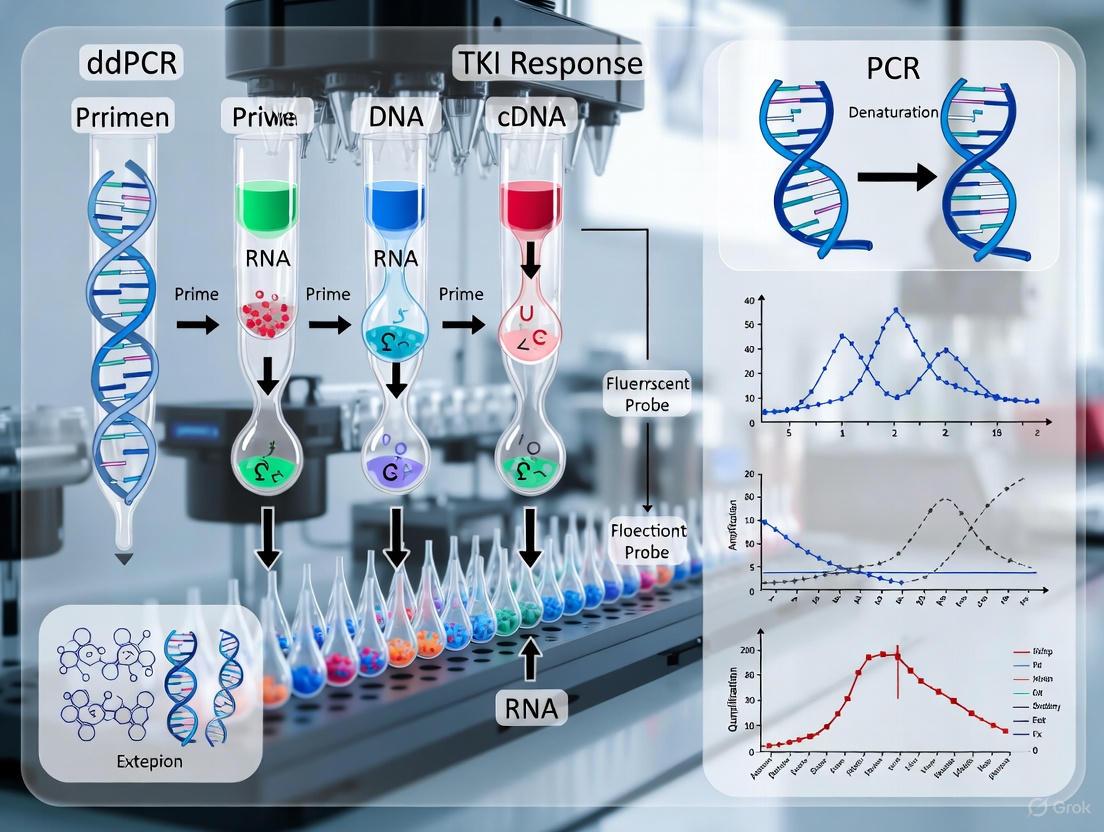
This article explores the transformative role of droplet digital PCR (ddPCR) in monitoring tyrosine kinase inhibitor (TKI) response, with a specific focus on chronic myeloid leukemia (CML).
ddPCR for TKI Response Monitoring: A Precision Tool for Guiding Treatment-Free Remission in CML
Abstract
This article explores the transformative role of droplet digital PCR (ddPCR) in monitoring tyrosine kinase inhibitor (TKI) response, with a specific focus on chronic myeloid leukemia (CML). It covers the foundational principles that give ddPCR an advantage in sensitivity and absolute quantification over traditional qPCR. The piece details methodological workflows, from the first FDA-cleared assay to clinical applications in guiding treatment discontinuation. It further addresses troubleshooting for technical challenges and provides a comparative analysis of ddPCR against other molecular and sequencing techniques. Finally, the article validates ddPCR's clinical utility through performance data and discusses its emerging role in personalized treatment strategies and regulatory landscapes, providing a comprehensive resource for researchers and drug development professionals.
The Digital Revolution: Core Principles of ddPCR and Its Necessity in TKI Monitoring
Digital PCR (dPCR) represents the third generation of polymerase chain reaction technology, succeeding conventional PCR and real-time quantitative PCR (qPCR). This transformative method is based on the partitioning of a PCR mixture into thousands to millions of parallel nanoscale reactions, allowing individual nucleic acid molecules to be amplified in isolation [1]. Following amplification, the fraction of positive partitions is counted via endpoint measurement, enabling absolute quantification of target molecules through Poisson statistics without the need for standard curves [1] [2]. This core principle provides dPCR with significant advantages over qPCR, including enhanced sensitivity, superior accuracy and reproducibility, and a rapid turnaround time [1].
The historical development of dPCR began with foundational work in the 1990s. In 1992, Morley and Sykes combined limiting dilution PCR with Poisson statistics to isolate, detect, and quantify single nucleic acid molecules [1]. The term "digital PCR" was formally coined in 1999 by Bert Vogelstein and colleagues, who developed a workflow using limiting dilution on 96-well plates combined with fluorescence readout to detect RAS oncogene mutations in colorectal cancer patients [1]. The technology has since evolved significantly, driven by advances in microfabrication and microfluidics, leading to the commercial platforms available today [1].
For researchers monitoring tyrosine kinase inhibitor (TKI) response in conditions like chronic myeloid leukemia (CML), the evolution to dPCR has been particularly impactful. The technology's ability to provide absolute quantification of minimal residual disease (MRD) without external calibrators addresses critical limitations in qPCR methodology, especially when assessing deep molecular responses essential for guiding treatment decisions [3] [4].
Principle and Advantages of ddPCR
Fundamental Workflow
Droplet digital PCR (ddPCR) operates through a defined four-step process that enables single-molecule sensitivity:
- Partitioning: The PCR reaction mixture containing the sample is partitioned into approximately 20,000 nanoliter-sized water-in-oil droplets, effectively creating millions of individual reaction chambers [3].
- Amplification: PCR amplification is performed to endpoint within each droplet, with target-containing droplets generating amplified products while those without target remain inactive.
- Detection: Following thermal cycling, droplets are analyzed one-by-one using a droplet reader that measures fluorescence intensity in each droplet.
- Quantification: The fraction of positive droplets is used to calculate the absolute concentration of the target molecule based on Poisson distribution statistics [3] [2].
This workflow enables direct counting of individual DNA molecules, eliminating the reliance on calibration curves that introduces variability in qPCR measurements [2].
Comparative Advantages over qPCR
The unique approach of ddPCR provides several critical advantages for sensitive molecular detection applications:
Table 1: Key Advantages of ddPCR over qPCR
| Feature | ddPCR | Traditional qPCR |
|---|---|---|
| Quantification Method | Absolute counting via Poisson statistics | Relative to standard curve |
| Sensitivity | Higher sensitivity for rare targets [5] | Limited by amplification efficiency |
| Precision | High precision, especially at low target concentrations [3] [6] | Variable precision dependent on standard curve quality |
| Effect of PCR Inhibitors | Less susceptible due to endpoint detection [2] | More susceptible, affects amplification efficiency |
| Requirements for Calibration | Calibration-free absolute quantification [3] | Requires reference standards and calibration curves |
For TKI response monitoring, ddPCR demonstrates particular value in detecting minimal residual disease (MRD) at extremely low levels. Studies have shown that ddPCR can anticipate deep molecular response (DMR) achievement compared to qPCR, potentially enabling earlier clinical decisions regarding treatment continuation or discontinuation [4]. The technology's reduced variability between laboratories and operators further enhances its utility for standardized monitoring across treatment centers [3].
Application in TKI Response Monitoring
BCR-ABL1 Monitoring in Chronic Myeloid Leukemia
In chronic myeloid leukemia (CML), the BCR-ABL1 fusion gene serves as the primary molecular marker for disease monitoring and assessment of TKI therapy response [3] [4]. The ability to accurately quantify BCR-ABL1 transcript levels is particularly crucial in the era of treatment-free remission (TFR), where patients with sustained deep molecular responses may consider discontinuing TKI therapy [3] [4].
Recent multicenter studies have demonstrated that ddPCR shows good agreement with RT-qPCR while providing improved precision for BCR-ABL1 transcript quantification [3]. This enhanced precision is especially valuable at low disease levels, where accurate assessment is essential for evaluating eligibility for TKI discontinuation [3]. One comprehensive study of 79 CML patients found that dPCR either anticipated or coincided with DMR achievement compared to RT-qPCR in 69 patients (87.3%), with statistical significance (p = 0.0012) [4].
The clinical implications of these findings are substantial, as ddPCR's ability to provide more sensitive MRD monitoring can better identify candidates for TFR and potentially predict relapse earlier than conventional methods [4]. Furthermore, ddPCR overcomes technical limitations of RT-qPCR in accurately quantifying different BCR-ABL1 transcript types (e.g., e13a2 and e14a2), which may have previously influenced response assessment [4].
Performance Data for Clinical Decision-Making
Comparative studies have generated quantitative data highlighting ddPCR's performance characteristics for BCR-ABL1 monitoring:
Table 2: Performance Comparison of ddPCR vs. qPCR in BCR-ABL1 Monitoring
| Parameter | ddPCR Performance | qPCR Performance | Clinical Implications |
|---|---|---|---|
| Detection Sensitivity | Can detect BCR-ABL1 transcript levels at MR4.5 (≤0.0032% IS) and below [3] [4] | Limited sensitivity at very low disease burdens | Better identification of candidates for TKI discontinuation |
| Precision at Low Levels | Higher precision for BCR-ABL1% IS values [3] | Higher variability in low copy number detection | More reliable monitoring of deep molecular response |
| Inter-laboratory Reproducibility | Lower variability between different laboratories [3] | Requires strict standardization and conversion factors | Facilitates standardized monitoring across treatment centers |
| Rare Transcript Detection | Effectively detects atypical BCR-ABL1 variants [7] | May miss or inaccurately quantify rare variants | Comprehensive disease monitoring for all patient subtypes |
These performance advantages make ddPCR particularly valuable for assessing deep molecular response (DMR), defined as BCR-ABL1 levels ≤ 0.01% IS (MR4.0), ≤ 0.0032% IS (MR4.5), or ≤ 0.001% IS (MR5.0) [4]. The technology's ability to provide absolute quantification rather than relative measurements allows for more precise tracking of molecular response over time, offering enhanced guidance for therapeutic decision-making in TKI-treated patients [4] [8].
Experimental Protocols
ddPCR Protocol for BCR-ABL1 Detection
The following protocol provides a detailed methodology for BCR-ABL1 transcript detection and quantification using droplet digital PCR, optimized for monitoring TKI response in CML patients [3] [7].
Sample Preparation and RNA Extraction
- Sample Collection: Collect peripheral blood samples in EDTA tubes. Process within 24-48 hours of collection.
- Leukocyte Isolation: Isolate peripheral blood leukocytes using Buffy Coat procedure or density gradient centrifugation.
- RNA Extraction: Extract total RNA using approved kits (e.g., Maxwell 16 LEV simplyRNA Blood Kit, Promega) following manufacturer's instructions.
- RNA Quantification and Quality Assessment: Quantify RNA using spectrophotometric methods (e.g., NanoDrop). Ensure RNA integrity numbers (RIN) >8.0 for optimal results.
- cDNA Synthesis: Convert 1 μg of total RNA to cDNA using reverse transcriptase (e.g., Superscript I or II), 1 mM dNTPs, 10 mM DTT, 25 μM random hexamers, and RNase inhibitor in a 20 μL reaction volume. Use the following cycling conditions: 70°C for 10 min, 25°C for 10 min, 42°C for 45 min, and 99°C for 3 min [4].
ddPCR Reaction Setup
- Reaction Preparation: Prepare ddPCR reaction mix containing:
- 11 μL of 2× ddPCR Supermix for Probes (No dUTP)
- 1.1 μL of BCR-ABL1 primer/probe mix (FAM-labeled)
- 1.1 μL of reference gene (e.g., ABL1) primer/probe mix (HEX-labeled)
- 5-100 ng of cDNA template
- Nuclease-free water to 22 μL total volume
- Droplet Generation: Transfer 20 μL of the reaction mix to the DG8 cartridge. Add 70 μL of droplet generation oil to the appropriate well. Generate droplets using the QX200 Droplet Generator.
- PCR Amplification: Transfer generated droplets to a 96-well PCR plate. Seal the plate and perform amplification on a thermal cycler using the following parameters:
- Enzyme activation: 95°C for 10 minutes
- 40 cycles of:
- Denaturation: 95°C for 30 seconds
- Annealing/Extension: 60°C for 60 seconds
- Enzyme deactivation: 98°C for 10 minutes
- Hold at 4°C
- Droplet Reading: Place the plate in the QX200 Droplet Reader. Analyze droplets using the default settings for the target assays.
- Data Analysis: Use QuantaSoft software (version 1.7.4 or higher) to analyze results. Set appropriate thresholds for positive/negative droplet discrimination. Calculate BCR-ABL1/ABL1 ratio as percentage based on copies/μL measurements.
Quality Control Considerations
- Droplet Count: Ensure adequate droplet generation (>10,000 droplets per sample) for reliable quantification [3].
- Limit of Blank (LoB): Establish LoB using negative control samples to determine the threshold for positive detection [3].
- Threshold Setting: Use negative controls to set fluorescence thresholds that distinguish positive and negative droplets clearly.
- Sample Analysis: Perform testing in at least duplicate to ensure result reproducibility.
Diagram 1: ddPCR Workflow for BCR-ABL1 Monitoring. This diagram illustrates the complete process from sample preparation to result reporting for monitoring TKI response in CML patients.
Assay Optimization and Troubleshooting
Successful implementation of ddPCR for TKI response monitoring requires careful assay optimization and attention to potential technical challenges:
Primer/Probe Optimization:
- Test multiple primer/probe sets to identify optimal combinations
- Verify specificity using conventional PCR and sequencing
- Adjust primer concentrations (typical range: 400-900 nM)
- Optimize probe concentrations (typical range: 200-250 nM)
Thermal Cycling Optimization:
- Perform temperature gradients for annealing/extension steps (58-64°C)
- Adjust cycle numbers based on target abundance (35-45 cycles)
- For difficult targets, consider two-step amplification with different temperatures (e.g., 5 cycles at 60°C followed by 35 cycles at 64°C) [7]
Partitioning Quality Control:
- Monitor droplet generation quality - poor formation indicates issues with oil or sample composition
- Ensure consistent droplet volume and count across samples
- Use appropriate surfactants in oil phase to prevent droplet coalescence during thermal cycling [1]
Data Interpretation Guidelines:
- Apply Poisson correction to account for multiple targets per partition
- Establish cutoff values for positive detection (e.g., ≥3 positive droplets for low-abundance targets)
- Implement quality thresholds for minimum partition numbers
Diagram 2: ddPCR Troubleshooting Guide. This diagram outlines common challenges in ddPCR assays and recommended optimization strategies to ensure reliable results.
Research Reagent Solutions
Successful implementation of ddPCR for TKI response monitoring requires specific reagents and platforms optimized for sensitive molecular detection. The following table details essential materials and their functions:
Table 3: Essential Research Reagents for ddPCR Applications in TKI Monitoring
| Reagent Category | Specific Examples | Function | Application Notes |
|---|---|---|---|
| ddPCR Systems | QX200 System (Bio-Rad), QIAcuity (Qiagen) | Partitioning, amplification, and detection | QIAcuity offers integrated nanoplate-based system; QX200 uses droplet generation [1] [9] |
| Nucleic Acid Extraction | Maxwell 16 LEV simplyRNA Blood Kit (Promega) | RNA extraction from blood samples | Maintains RNA integrity for accurate reverse transcription [3] |
| Reverse Transcription | Superscript I/II Reverse Transcriptase | cDNA synthesis from RNA templates | Use random hexamers for comprehensive transcript coverage [4] |
| ddPCR Master Mix | ddPCR Supermix for Probes (No dUTP) | Provides enzymes, dNTPs, and buffer for PCR | Optimized for droplet stability and efficient amplification [3] |
| Target-Specific Assays | QXDx BCR-ABL %IS Kit (Bio-Rad) | BCR-ABL1 and reference gene detection | Provides standardized detection of major BCR-ABL1 transcripts [3] |
| Reference Gene Assays | ABL1, GUSB, BCR | Normalization controls | ABL1 is preferred reference gene for CML monitoring [3] [4] |
| Droplet Generation Oil | DG Oil for Probes (Bio-Rad) | Creates water-in-oil emulsion | Contains surfactants to stabilize droplets during thermal cycling [1] |
The selection of appropriate restriction enzymes can significantly impact assay performance, particularly for targets with complex structures or high GC content. Studies have demonstrated that enzyme selection affects precision, with HaeIII generally providing higher precision compared to EcoRI, especially for the QX200 system [6]. This optimization is particularly important when analyzing genetic material from protists or organisms with complex genomes, but also applies to human genetic targets in clinical research settings.
For laboratories establishing ddPCR for TKI monitoring, the QIAcuity Digital PCR System offers a fully integrated workflow where partitioning, thermal cycling, and imaging all occur on a single instrument, simplifying the experimental process [9]. This platform uses nanoplates rather than droplets, providing an alternative partitioning mechanism that can offer higher reproducibility and ease of automation, though with a fixed number of partitions [1].
The evolution from qPCR to ddPCR represents a significant advancement in molecular detection technology, particularly for monitoring TKI response in oncology applications. The single-molecule sensitivity of ddPCR, combined with its absolute quantification capabilities and reduced susceptibility to inhibitors, provides researchers and clinicians with a powerful tool for assessing minimal residual disease at unprecedented levels [1] [3] [2].
In the context of TKI response monitoring, studies have consistently demonstrated that ddPCR offers enhanced precision and the ability to anticipate deep molecular response achievement compared to conventional qPCR [4]. This capability has direct clinical implications, particularly for identifying appropriate candidates for treatment-free remission in CML patients [3] [4]. Furthermore, the technology's performance advantages extend beyond CML to include monitoring of various fusion transcripts and mutations across haematological malignancies [7].
As ddPCR technology continues to evolve, further standardization of methodologies and analytical approaches will enhance its utility in both research and clinical settings [4] [6]. The growing evidence supporting its superior performance characteristics suggests that ddPCR will play an increasingly important role in precision oncology and therapeutic monitoring, ultimately contributing to more personalized treatment approaches for patients receiving targeted therapies.
Droplet Digital PCR (ddPCR) represents a fundamental shift in nucleic acid quantification, moving beyond the relative measurements of quantitative PCR (qPCR) to provide true absolute quantification without reliance on standard curves. This third-generation PCR technology achieves superior precision by combining sample partitioning with Poisson distribution statistics, making it particularly valuable for monitoring treatment response in precision oncology applications such as tyrosine kinase inhibitor (TKI) therapy [10].
The core innovation of ddPCR lies in its partitioning process, where each sample is divided into approximately 20,000 nanoliter-sized droplets, creating independent micro-reactors that each undergo PCR amplification. Through endpoint detection and Poisson statistical analysis, researchers can achieve absolute quantification of target sequences with exceptional sensitivity and precision, even for rare targets present at very low frequencies [10] [1]. This technical advantage makes ddPCR ideally suited for detecting minimal residual disease and emerging resistance mutations during TKI treatment monitoring.
Theoretical Foundation: Poisson Distribution in Digital PCR
The Partitioning Principle and Statistical Analysis
The mathematical foundation of ddPCR's absolute quantification capability rests on Poisson distribution statistics, which describe the probability of target molecule distribution when randomly partitioned into thousands of individual droplets. This statistical model accounts for the random distribution of template molecules across the partitions, enabling precise back-calculation of the original target concentration [10].
The partitioning process effectively converts a continuous concentration measurement into a binary readout (positive or negative droplets), conferring the technology's characteristic robustness and sensitivity. According to Poisson statistics, when a sample with an average of λ target molecules per partition is distributed, the probability of any partition containing k targets follows the equation: P(k) = (λ^k * e^-λ)/k!. For quantification, the critical value is the fraction of partitions containing zero targets (P(0) = e^-λ), which allows direct calculation of the target concentration from the proportion of negative partitions [10] [1].
Advantages Over Standard Curve-Based Quantification
Traditional qPCR quantification depends on amplification kinetics and requires a standard curve for relative quantification, introducing potential variability through amplification efficiency differences between standards and samples [10]. In contrast, ddPCR's absolute quantification approach eliminates these sources of error by providing direct counting of target molecules without extrapolation from reference standards [11].
This statistical foundation provides ddPCR with several key advantages: reduced effects of inhibitors (which are diluted into individual partitions), linear dynamic range from single copies to high concentrations, and significantly lower coefficients of variation due to the analysis of thousands of individual data points per sample [10]. The technology is particularly powerful for detecting low-frequency variants below 0.1%, which represents a critical threshold for early detection of treatment resistance in TKI therapy [12].
Application in TKI Response Monitoring: Experimental Validation
Clinical Study Design and Methodology
The superior sensitivity and absolute quantification capabilities of ddPCR have been clinically validated in multiple studies monitoring TKI response in Philadelphia chromosome-positive acute lymphoblastic leukemia (Ph+ ALL). A 2021 study established a duplex ddPCR assay for BCR-ABL1 fusion transcript quantification using the Bio-Rad QX200 system [13].
Table 1: Clinical Validation of ddPCR for TKI Response Monitoring
| Study Parameter | Implementation Details | Performance Metrics |
|---|---|---|
| Patient Cohort | 10 R/R Ph+ ALL patients receiving CD19/22 CAR-T cell cocktail therapy | 95 bone marrow samples collected retrospectively |
| ddPCR Platform | Bio-Rad QX200 with QuantaSoft software v1.7.4 | Minimum 10,000 droplets per well required for valid results |
| Target Genes | BCR-ABL1 fusion transcripts (P210 e13a2, e14a2; P190 e1a2) with ABL1 reference | Sensitivity detection limit of 10-5 (0.001%) |
| Comparative Method | qPCR with international scale (IS) calibration | ddPCR showed superior accuracy for MRD <10-4 |
The clinical methodology involved monthly bone marrow biopsies for the first six months post-treatment, with RNA extraction using the QIAamp RNA Blood Kit and reverse transcription to cDNA following standardized protocols [13]. The ddPCR reaction conditions consisted of 40 cycles of amplification with annealing/extension at 60°C for 1 minute, utilizing primer/probe sets optimized for the BCR-ABL1 fusion variants present in each patient.
Key Findings and Clinical Implications
The study introduced the concept of Sequential Molecular Remission for more than 3 months (SMR3), defined as sustained negative minimal residual disease (MRD) status for at least three consecutive months as determined by ddPCR monitoring. This parameter proved to be a significant indicator of treatment response and prognosis [13].
Table 2: Clinical Outcomes Based on ddPCR Monitoring
| Patient Group | SMR3 Status | Treatment Received | Relapse Incidence | Clinical Outcome |
|---|---|---|---|---|
| Group A (n=6) | Achieved SMR3 | CAR-T only (n=2) or CAR-T + allo-HSCT (n=4) | 0% | No recurrence observed |
| Group B (n=4) | Did not achieve SMR3 | CAR-T only | 100% | All patients relapsed |
Critically, the study demonstrated that failure to achieve SMR3 served as an early warning of potential relapse following CAR-T therapy, indicating the need for additional treatment interventions such as allogeneic hematopoietic stem cell transplantation (allo-HSCT) [13]. The ddPCR-based monitoring provided the sensitivity and precision necessary to identify these at-risk patients earlier than conventional methods.
Comparative Performance Data
Sensitivity and Precision Across Applications
The analytical performance of ddPCR has been systematically evaluated across multiple applications, demonstrating consistent advantages over qPCR-based approaches, particularly for low-abundance targets relevant to TKI response monitoring.
Table 3: Analytical Performance Comparison of ddPCR vs. qPCR
| Application Domain | Performance Metric | ddPCR Performance | qPCR Performance |
|---|---|---|---|
| CNV Analysis [11] | Concordance with PFGE (gold standard) | 95% (38/40 samples) | 60% (24/40 samples) |
| CNV Analysis [11] | Average difference from PFGE | 5% | 22% |
| Viral Load Quantification [14] | Sensitivity for medium viral loads | Superior accuracy for Influenza A/B, RSV, SARS-CoV-2 | Reduced accuracy in medium Ct range (25.1-30) |
| Phytoplasma Detection [15] | Sensitivity in complex matrices | 10-fold improvement vs. qPCR | Limited by inhibitors in plant tissues |
| Rare Mutation Detection [12] | Detection sensitivity for EGFR L858R | 0.0001% (1 mutant in 106 wild-type) | Limited to ~1% sensitivity |
These comparative data highlight ddPCR's exceptional performance in rare target detection and precision measurement, both critical requirements for monitoring emerging resistance mutations during TKI therapy. The technology's reduced susceptibility to inhibition in complex biological matrices further enhances its utility for direct analysis of clinical specimens [10] [15].
Impact on Detection of Rare Mutations
In oncology applications, the ability to detect rare mutations against a high background of wild-type sequences is particularly valuable for early identification of treatment resistance. A specialized ddPCR microfluidic platform demonstrated unprecedented sensitivity for detecting EGFR L858R mutations at a ratio of 0.0001% (1 mutant in 10^6 wild-type copies) [12]. This sensitivity threshold significantly surpasses conventional qPCR methods and enables detection of resistance mechanisms much earlier than traditional approaches.
The platform utilized a double-layer glass reservoir integrated with a PDMS chip containing T-junction droplet generators, producing approximately one million uniform droplets of 4.187 pL volume within 10 minutes. This massive partitioning capability provided the foundation for the exceptional sensitivity achieved, with linear quantification across a range of 10^1 to 10^6 copies/μL for the EGFR wild-type gene (R² = 0.9998) [12].
Detailed Experimental Protocols
Core ddPCR Workflow for Gene Expression Analysis
The standard ddPCR protocol for gene quantification applications, such as BCR-ABL1 monitoring in TKI response research, follows a systematic workflow with optimized conditions for precision and reproducibility [16].
Sample Preparation and Reaction Setup:
- Extract RNA/DNA using validated kits (e.g., QIAamp RNA Blood Kit)
- Synthesize cDNA for RNA targets using reverse transcriptase with standardized protocols
- Prepare 20μL reaction mixture containing:
- Primers and probes should be designed following manufacturer guidelines with amplicon size typically <200bp
Droplet Generation and Thermal Cycling:
- Load reaction mixture into droplet generator cartridge with 70μL droplet generation oil
- Generate approximately 20,000 droplets per sample using QX200 Droplet Generator
- Transfer 40μL of generated droplets to a 96-well PCR plate
- Seal plate with pierceable foil heat seal
- Perform PCR amplification with the following conditions:
Droplet Reading and Data Analysis:
- Load plate onto QX200 Droplet Reader
- Analyze droplets using instrument software (QuantaSoft)
- Set thresholds to distinguish positive and negative droplets based on fluorescence amplitude
- Apply Poisson correction to calculate absolute target concentration (copies/μL)
- For gene expression applications, normalize to reference gene(s) (e.g., ABL1 for BCR-ABL1 monitoring) [13]
Specialized Protocol for Rare Mutation Detection
For detection of rare mutations present at very low frequencies (<0.1%), such as TKI resistance mutations, specialized protocols with enhanced sensitivity are required.
Enhanced Sensitivity Workflow:
- Utilize microfluidic chips capable of generating >1,000,000 droplets (nanoliter to picoliter volume)
- Implement double-layer glass reservoir design to prevent droplet evaporation during thermal cycling
- Optimize primer/probe combinations with gradient temperature testing (58-68°C)
- Include restriction enzyme digestion step when necessary to improve allele discrimination
- Apply viscosity breakdown protocols when using crude lysates to improve droplet generation efficiency [17] [12]
Assay Validation Parameters:
- Determine Limit of Blank (LOB) using negative control samples
- Establish Limit of Detection (LOD) through serial dilution studies
- Define Limit of Quantification (LOQ) with precision profiles
- Assess linearity across expected concentration range (typically 0.001%-100% variant allele frequency)
- Verify specificity against samples with known mutation status [7] [12]
Research Reagent Solutions
Table 4: Essential Reagents and Materials for ddPCR Experiments
| Reagent/Material | Manufacturer/Example | Function in Workflow | Application Notes |
|---|---|---|---|
| ddPCR Supermix | Bio-Rad (186-3010) | Provides optimized buffer, enzymes, dNTPs for droplet PCR | 2× concentration for 20μL reactions; inhibitor-resistant formulations available |
| Droplet Generation Oil | Bio-Rad (186-3005) | Creates water-in-oil emulsion for partitioning | Specific to platform; contains surfactants for droplet stability |
| Primer/Probe Sets | Custom-designed or commercial | Target-specific amplification | FAM/HEX labeling for multiplexing; optimal amplicon size <200bp |
| Nucleic Acid Extraction Kits | QIAGEN QIAamp series | Isolate high-quality DNA/RNA from clinical samples | Optimized for blood, tissue, or cell-free DNA samples |
| Droplet Generator Cartridges | Bio-Rad (186-3008) | Microfluidic chamber for droplet generation | 8-sample capacity per cartridge |
| Pierceable Foil Heat Seals | Bio-Rad (181-4040) | Seals plates for thermal cycling | Prevents evaporation and cross-contamination |
| Restriction Enzymes | Various suppliers | Digests wild-type sequences in mutation assays | Improves discrimination in rare allele detection |
| Microfluidic Chips | Custom or commercial platforms | Generates picoliter droplets for ultra-sensitive detection | Enables >1,000,000 partitions for rare target detection [12] |
The integration of Poisson distribution statistics with nanoliter-scale sample partitioning establishes ddPCR as a powerful platform for absolute quantification of nucleic acids without standard curves. This technical advantage translates directly to improved monitoring of TKI treatment response through sensitive detection of minimal residual disease and emerging resistance mutations. The standardized protocols and reagent systems now available support robust implementation in clinical research settings, providing researchers with a precise tool for tracking dynamic molecular changes during targeted therapy. As ddPCR technology continues to evolve with increased partitioning density and automated workflows, its role in precision oncology and treatment response monitoring is poised to expand significantly.
Chronic Myeloid Leukemia (CML) is a well-characterized oncological disease driven by the BCR::ABL1 oncogene, generated from a translocation between chromosomes 9 and 22. This genetic alteration represents a milestone in molecular oncology, serving as both a diagnostic marker and therapeutic target. The accurate quantification of BCR::ABL1 transcript levels has become a cornerstone of modern CML management, providing an essential tool for therapeutic decision-making, response assessment, and long-term monitoring. As treatment paradigms evolve to include treatment-free remission (TFR) goals, the precision of molecular monitoring has never been more clinically relevant. This article explores the critical importance of precise BCR::ABL1 quantification, with particular emphasis on the emerging role of digital PCR technologies in advancing CML care standards.
The Clinical Significance of Molecular Response Monitoring in CML
Molecular monitoring of BCR::ABL1 levels provides crucial prognostic information for CML patients undergoing tyrosine kinase inhibitor (TKI) therapy. Current international guidelines establish time-dependent treatment milestones that correlate with long-term outcomes, including Early Molecular Response (EMR), Major Molecular Response (MMR), and Deep Molecular Response (DMR) [18]. These milestones are defined by specific thresholds on the International Scale (IS), which standardizes BCR::ABL1 measurement across laboratories worldwide [18].
The clinical implications of these response categories are profound. EMR, defined as ≤10% BCR::ABL1IS at 3-6 months of therapy, predicts superior progression-free survival. MMR (also known as MR3, corresponding to ≤0.1% BCR::ABL1IS) represents a 3-log reduction from standardized baseline and is associated with excellent long-term outcomes [18]. Perhaps most significantly, DMR (≤0.01% BCR::ABL1IS or MR4) has emerged as a prerequisite for attempting TFR, where approximately half of eligible patients can successfully discontinue TKI therapy without disease recurrence [18].
Beyond transcript quantification, mutation analysis of the ABL1 kinase domain represents another critical component of molecular monitoring. Several point mutations in ABL1 are responsible for TKI resistance, often necessitating treatment modification [19]. The integration of both quantitative assessment and mutation profiling provides a comprehensive molecular picture essential for individualized CML management.
Table 1: Key Molecular Response Milestones in CML Management
| Response Category | BCR::ABL1IS Level | Clinical Significance |
|---|---|---|
| Early Molecular Response (EMR) | ≤10% at 3-6 months | Predicts superior progression-free survival |
| Major Molecular Response (MMR/MR3) | ≤0.1% | Associated with excellent long-term outcomes |
| Deep Molecular Response (MR4) | ≤0.01% | Prerequisite for treatment-free remission attempts |
| Deeper Molecular Response (MR4.5) | ≤0.0032% | Higher likelihood of successful treatment-free remission |
Standardization of BCR::ABL1 Testing: The International Scale and Reference Panels
The accurate quantification of BCR::ABL1 transcripts requires rigorous standardization to ensure consistency across testing laboratories. The International Scale (IS) was established to address this need, with 100% BCR::ABL1IS corresponding to the standardized baseline derived from pre-treatment chronic phase CML cases in the IRIS trial [18]. This standardization allows for uniform reporting of molecular response levels regardless of the testing methodology or laboratory.
Two primary approaches exist for achieving IS-calibrated results: using commercially available kits pre-calibrated to the World Health Organization (WHO) International Genetic Reference Panel, or applying laboratory-specific conversion factors (CFs) with laboratory-developed tests [18]. The process of establishing and validating these CFs has traditionally involved sample exchange with reference laboratories, a method that is time-consuming, complex, and expensive [18].
Recent advancements have introduced lyophilized, cell-based secondary reference panels traceable to the WHO primary reference material. These panels incorporate cellular RNA extraction into the calibration process and include samples corresponding to various response levels, including MR4.5 [18]. The European Treatment and Outcome Study (EUTOS) for CML demonstrated that these panels can effectively assign and validate CFs in a manner equivalent to sample exchange while additionally monitoring quality assurance aspects [18]. Between 2016 and 2021, this initiative significantly improved the percentage of EUTOS reference laboratories with validated CFs from 67.5% to 97.6% for ABL1 and from 36.4% to 91.7% for GUSB reference genes [18].
Digital PCR: Advancing the Precision of Molecular Monitoring
Droplet Digital PCR (ddPCR) represents a significant technological advancement in molecular monitoring, offering exceptional sensitivity and precision for nucleic acid quantification. This technology partitions PCR reactions into thousands of nanoliter-sized droplets, allowing for absolute quantification without the need for standard curves [20]. The exceptional precision of ddPCR is particularly valuable at low target concentrations, making it ideally suited for monitoring deep molecular responses in CML [20].
The technical advantages of ddPCR over traditional quantitative PCR (qPCR) include superior sensitivity and precision, especially at low DNA levels [20]. In the context of BCR::ABL1 monitoring, ddPCR has demonstrated enhanced capability for detecting minimal residual disease at levels critical for TFR decisions. Studies have shown that 98% of laboratories using appropriate methods could detect MR4.5 in most samples, though some laboratories exhibited a limit of blank greater than zero, potentially affecting accurate DMR reporting [18].
ddPCR has also shown promise in ABL1 mutation detection, identifying resistance mutations that may not be detected by conventional methods [19]. The ability to simultaneously provide precise quantification and mutation screening positions ddPCR as a comprehensive platform for CML management.
Table 2: Analytical Performance of ddPCR in Molecular Diagnostics
| Performance Parameter | Capability | Significance for CML Monitoring |
|---|---|---|
| Limit of Detection (LOD) | Approximately 3 copies per reaction [20] | Enables detection of very low-level residual disease |
| Limit of Quantification (LOQ) | 0.038% (35 copies/reaction) [20] | Provides accurate quantification at DMR levels |
| Precision | Exceptional for low DNA levels [20] | Allows confident assessment of molecular trends |
| Sensitivity for EGFR T790M mutation (meta-analysis) | 70.1% (95% CI, 62.7%-76.7%) [21] | Demonstrates utility in mutation detection across cancers |
Experimental Protocols for BCR::ABL1 Monitoring
Sample Collection and RNA Extraction
- Blood Collection: Collect peripheral blood in appropriate collection tubes (e.g., Cell-Free DNA BCT tubes when using ddPCR for mutation detection). Process samples within one hour of collection by centrifugation to separate plasma from cells [20].
- RNA Extraction: Extract RNA from patient samples using standardized methodologies. Incorporate the RNA extraction step when using cell-based reference panels to mirror the IS calibration process [18].
- Quality Control: Assess RNA quality and quantity through spectrophotometric or microfluidic methods to ensure sample integrity before proceeding with reverse transcription.
Reverse Transcription and PCR Amplification
- cDNA Synthesis: Perform reverse transcription using random hexamers or gene-specific primers under standardized conditions.
- Reference Gene Selection: Include at least one reference gene (typically ABL1, GUSB, or BCR) in the reaction to control for variation in sample quality and quantity [18].
- qPCR Protocol: For laboratory-developed tests using qPCR, perform amplification with efficiency calculations. The rtpcr R package provides statistical analysis capabilities incorporating the Pfaffl method, which accounts for differences in amplification efficiencies between target and reference genes [22].
- ddPCR Protocol: For digital PCR applications, partition reactions into approximately 20,000 droplets followed by endpoint PCR amplification. Analyze using droplet readers to quantify positive and negative droplets for absolute quantification [20].
Data Analysis and International Scale Reporting
- Conversion Factor Application: Apply laboratory-specific conversion factors to align results with the International Scale. Validate CFs regularly using secondary reference panels [18].
- Statistical Analysis: Utilize specialized software packages like the rtpcr package in R, which accommodates efficiency-weighted ΔCT calculations and provides fold change statistics with confidence intervals [22].
- Mutation Analysis: For patients with suboptimal response or loss of response, perform ABL1 kinase domain mutation screening using ddPCR or sequencing methodologies to identify resistance mutations [19].
Essential Research Reagents and Materials
Table 3: Research Reagent Solutions for BCR::ABL1 Monitoring
| Reagent/Material | Function | Application Notes |
|---|---|---|
| Cell-Free DNA BCT Tubes | Preserves cell-free DNA in blood samples | Enables standardized plasma separation for ddPCR analysis [20] |
| Secondary Reference Panels | Lyophilized cell-based standards for IS calibration | Traceable to WHO primary reference; includes MR4.5 level [18] |
| Reverse Transcriptase Enzyme | Converts RNA to complementary DNA (cDNA) | Essential for RT-qPCR and RT-ddPCR methodologies |
| TaqMan Probes | Sequence-specific fluorescence probes for detection | Provides specific detection of BCR::ABL1 transcripts and reference genes |
| ddPCR Supermix | Reaction mixture for droplet digital PCR | Enables partitioning into nanoliter droplets for absolute quantification [20] |
| RNA Extraction Kits | Isolate high-quality RNA from patient samples | Critical first step in BCR::ABL1 monitoring workflow |
| ABL1 Mutation Detection Assays | Identify kinase domain resistance mutations | Guides TKI selection when resistance suspected [19] |
Precise BCR::ABL1 quantification represents a critical component in the modern management of CML, directly influencing therapeutic decisions and long-term patient outcomes. The standardization of molecular monitoring through the International Scale, validated conversion factors, and reference materials has established a robust framework for response assessment. Emerging technologies, particularly droplet digital PCR, offer enhanced sensitivity and precision for detecting minimal residual disease at levels significant for treatment-free remission decisions. Furthermore, the integration of ABL1 mutation detection provides a comprehensive molecular profile essential for addressing TKI resistance. As CML management continues to evolve toward more personalized approaches, the precision of molecular monitoring will remain fundamental to optimizing patient care and achieving the ultimate goal of treatment-free survival for eligible patients.
Digital PCR (dPCR) represents a third-generation PCR technology that enables absolute quantification of nucleic acids by partitioning a sample into thousands of individual reactions [1]. This partitioning step is fundamental to dPCR's precision, as it allows for the binary detection of target sequences (positive or negative) in each partition, followed by absolute quantification using Poisson statistics [1] [6]. The two predominant partitioning methodologies are droplet-based dPCR (ddPCR), which utilizes a water-oil emulsion to create nanoliter-sized droplets, and chip-based dPCR, which distributes the sample across a plate containing thousands of fixed micro-wells or nanopores [23] [1]. The choice between these partitioning strategies significantly impacts workflow efficiency, precision, and suitability for specific applications, particularly in sensitive research contexts such as monitoring response to tyrosine kinase inhibitors (TKIs) in cancer therapy [4] [24].
Core Partitioning Technologies: A Comparative Analysis
Droplet-Based dPCR (ddPCR)
Droplet digital PCR employs microfluidics to partition PCR samples into thousands to millions of monodisperse, nanoliter-sized water-in-oil droplets [1]. This system typically involves multiple instruments: a droplet generator, a thermal cycler, and a droplet reader [23]. The process relies on precise emulsification and requires surfactants to stabilize droplets against coalescence, especially during thermal cycling [1]. The random distribution of nucleic acid molecules follows Poisson statistics, enabling absolute quantification after end-point fluorescence analysis of each droplet [1] [6].
Chip-Based dPCR
Chip-based or nanoplate-based dPCR utilizes microfabricated chips containing fixed arrays of micro-wells [23] [25]. These systems create physically separated reaction chambers without emulsion, offering a more streamlined workflow. Modern integrated platforms, such as the QIAcuity and QuantStudio Absolute Q systems, incorporate partitioning, thermal cycling, and imaging within a single instrument [23] [25]. The partitions are defined by precise micromolding, ensuring consistent volume and number across runs, which enhances reproducibility and reduces subsampling error [25].
Table 1: Technical Comparison of Partitioning Methodologies
| Parameter | Droplet-Based dPCR (ddPCR) | Chip-Based dPCR |
|---|---|---|
| Partitioning Mechanism | Water-oil emulsion droplets [23] | Fixed array of micro-wells or nanopores [23] [25] |
| Typical Partition Number | ~20,000 (or more) droplets [23] | ~20,000 fixed wells [23] |
| Partition Volume | Picoliter to nanoliter scale [1] | ~500 pL per well (e.g., MAP consumable) [25] |
| Workflow | Multiple instruments (generator, cycler, reader) [23] | Integrated "sample-to-result" in one instrument [23] [25] |
| Assay Time | >2 hours (standard protocol) [26] | <90 minutes [23] |
| Throughput Flexibility | High in research environments [23] | Ideal for standardized QC workflows [23] |
Table 2: Performance and Application Considerations
| Aspect | Droplet-Based dPCR (ddPCR) | Chip-Based dPCR |
|---|---|---|
| Multiplexing Capability | Limited in standard systems, newer models can detect up to 12 targets [23] | Available in 4-12 targets, often with higher efficiency [23] |
| Sample Utilization | Variable; often 55-80% of loaded sample analyzed [25] | High; >95% of input sample utilized [25] |
| Precision & Reproducibility | High precision, but can be affected by droplet uniformity [6] [25] | High reproducibility due to fixed partition geometry [25] |
| Key Application Strength | Rare mutation detection, liquid biopsy [26] [27] | Routine monitoring, clinical QC, regulated environments [23] [4] |
Application in TKI Response Monitoring: BCR-ABL1 Quantification
Monitoring minimal residual disease (MRD) in chronic myeloid leukemia (CML) patients undergoing tyrosine kinase inhibitor (TKI) therapy is a critical application where dPCR's precision is paramount [4] [24]. The accurate quantification of the BCR-ABL1 fusion transcript down to levels of MR4.5 (≤0.0032% IS) or deeper is essential for evaluating treatment efficacy and guiding decisions regarding treatment-free remission (TFR) [24] [28]. dPCR platforms demonstrate superior sensitivity and reproducibility for this application compared to traditional RT-qPCR, with studies showing dPCR can anticipate the achievement of deep molecular response (DMR) [4].
Detailed Protocol: BCR-ABL1 Quantification via Chip-Based dPCR
This protocol is adapted for the monitoring of TKI response in CML research using an integrated chip-based system.
I. Sample Preparation and cDNA Synthesis
- RNA Extraction: Using PAXgene or Tempus blood RNA tubes, extract total RNA from patient peripheral blood samples. For chip-based dPCR, the required RNA input can be lower than for ddPCR. Use the NucleoSpin RNA plus kit (Macherey Nagel) or equivalent [4].
- Quality Control: Quantify RNA using a Qubit RNA High Sensitivity Kit (Thermo Fisher Scientific). Ensure RNA Integrity Number (RIN) >8.0 for reliable results.
- Reverse Transcription: Convert 1 µg of total RNA to cDNA in a 20 µL reaction using random hexamers and reverse transcriptase (e.g., Superscript II). Use the following cycling conditions: 25°C for 10 min, 42°C for 45 min, 99°C for 3 min, and hold at 4°C [4].
- cDNA Quantification: Quantify the resulting single-stranded cDNA using a Qubit ssDNA kit to normalize input across samples [4].
II. Chip-Based dPCR Assay Setup
- Reaction Mix Preparation: Prepare a 10.5 µL reaction mixture containing:
- 5.5 µL of 2x ddPCR Supermix for Probes (no dUTP).
- 0.9 µL each of forward and reverse primers (10 µM each) for BCR-ABL1 (e.g., e13a2 or e14a2 transcript-specific) and ABL1 reference gene.
- 0.25 µL of each FAM-labeled BCR-ABL1 probe and HEX/VIC-labeled ABL1 probe (10 µM each).
- 1.0 µL of cDNA template.
- 1.7 µL of DNase-free water.
- Partitioning and Loading: Pipette the reaction mix into the inlet of a microfluidic array plate (MAP). Overlay with 5 µL of silicone oil. Cap the inlet and load the consumable into the integrated dPCR instrument [25].
- Thermal Cycling: The instrument automatically performs partitioning and runs the following cycling protocol:
- Enzyme activation: 95°C for 60 seconds.
- 40 cycles of: Denaturation at 95°C for 4 seconds, Annealing/Extension at 60°C for 15 seconds [25].
- Signal stabilization: 98°C for 10 minutes (optional, depending on platform).
- Imaging and Analysis: The integrated imager performs end-point fluorescence detection in each partition. Analysis software automatically calculates the absolute copy numbers of BCR-ABL1 and ABL1 based on the fraction of positive partitions, applying Poisson correction [25].
III. Data Analysis and Interpretation
- Calculating MRD: The result is expressed as a ratio of BCR-ABL1 copies/µL to ABL1 copies/µL. This ratio can be converted to the International Scale (IS) using a conversion factor if necessary.
- Key Thresholds: In CML research, DMR is defined as BCR-ABL1 ≤ 0.01% IS (MR4.0). dPCR's enhanced sensitivity can reliably detect and quantify transcript levels down to MR5.0 (≤0.001% IS), which is valuable for assessing eligibility for TKI discontinuation trials [24].
Chip-Based dPCR Workflow for BCR-ABL1 Quantification
Research Reagent Solutions for TKI Monitoring
Table 3: Essential Materials for dPCR in TKI Response Research
| Reagent/Material | Function/Description | Example Product(s) |
|---|---|---|
| RNA Extraction Kit | Isolation of high-quality total RNA from blood or cells; critical for assay sensitivity. | NucleoSpin RNA Plus (Macherey Nagel) [4] |
| Reverse Transcription Kit | Synthesis of cDNA from RNA template; use of random hexamers is recommended. | Superscript II/III (Thermo Fisher) [4] |
| dPCR Supermix | Optimized buffer containing DNA polymerase, dNTPs, and stabilizers for partitioning. | ddPCR Supermix for Probes (no dUTP) (Bio-Rad) [29] |
| Primers & Probes | Target-specific assays for detection of mutant and reference genes. | TaqMan Assays for BCR-ABL1 & ABL1 [24] [27] |
| Microfluidic Chip/Plate | Consumable containing nanoscale wells for chip-based partitioning. | QIAcuity Nanoplate, MAP Consumable [23] [25] |
| Droplet Generation Oil | For ddPCR, creates stable water-in-oil emulsion for partitioning. | Droplet Generation Oil for Probes (Bio-Rad) |
The choice between droplet-based and chip-based dPCR partitioning is application-dependent. Droplet-based systems offer great flexibility and are powerful tools for research and development, particularly for rare mutation detection [26] [27]. In contrast, chip-based systems, with their integrated workflows, speed, and consistency, are increasingly suited for environments requiring standardized, reproducible results, such as in longitudinal monitoring of TKI response in clinical research settings [23] [4] [25]. Understanding the fundamental differences in how these technologies partition a sample is crucial for selecting the optimal tool to advance precision medicine in oncology.
From Lab to Clinic: Implementing ddPCR Assays for TKI Response and Treatment Discontinuation
The accurate monitoring of minimal residual disease (MRD) via BCR–ABL1 transcript levels is the cornerstone of managing chronic myeloid leukemia (CML) patients, especially in the era of treatment-free remission (TFR). The droplet digital PCR (ddPCR) technology represents a significant advancement in this field, offering a method for absolute quantification without the need for a standard curve [3]. The QXDx BCR-ABL %IS Kit (Bio-Rad) is an FDA-cleared assay that leverages this technology, providing a standardized and precise tool for monitoring molecular response in CML patients undergoing tyrosine kinase inhibitor (TKI) therapy. This document details its performance characteristics and provides application protocols, contextualizing its use within broader research on ddPCR for monitoring TKI response.
Performance Characteristics and Comparative Data
A multicentric study was conducted to evaluate the QXDx BCR-ABL %IS Kit against LabNet-approved RT-qPCR methodologies, analyzing 37 RNA samples from CML patients and 5 from healthy donors across three independent laboratories [3]. The results demonstrate that ddPCR offers a more precise quantification of BCR–ABL1 transcript levels, particularly at low copy numbers, which is critical for assessing deep molecular response (DMR).
Table 1: Key Performance Characteristics of the QXDx BCR-ABL %IS Kit (ddPCR) vs. RT-qPCR
| Performance Metric | QXDx BCR-ABL %IS Kit (ddPCR) | Standard RT-qPCR |
|---|---|---|
| Quantification Method | Absolute quantification without a standard curve [3] | Relative quantification requiring a standard curve [3] |
| Precision | High precision, especially for low BCR–ABL1 levels [3] | More variable at low transcript levels [3] |
| Sensitivity | Suitable for monitoring deep molecular response (DMR) [3] | Limitations in quantification at MR4.5 and beyond [3] |
| Inter-laboratory Reproducibility | High reproducibility across different testing sites [3] | Subject to greater inter-laboratory variability |
| Sample Throughput | No difference found between duplicate or quadruplicate analysis [3] | Typically requires replicates for reliable quantification |
| Key Advantage in CML Monitoring | More precise and reliable for MRD monitoring in the TKI discontinuation era [3] | Established standard, but with limitations for DMR assessment |
The Bland-Altman analysis from the study showed a good agreement between the two methods. However, ddPCR demonstrated superior precision, with a lower coefficient of repeatability and reproducibility compared to RT-qPCR [3]. This is paramount for confidently classifying patients into molecular response categories like MR4 and MR4.5, a prerequisite for attempting TKI discontinuation.
Experimental Protocol: BCR-ABL1 Monitoring with the QXDx Kit
The following protocol is adapted from the multicentric validation study [3].
Sample Collection and RNA Extraction
- Collection: Collect peripheral blood (PB) from CML patients. Isolate leukocytes using the Buffy Coat procedure.
- Extraction: Extract total RNA using a dedicated kit, such as the Maxwell 16 LEV simplyRNA Blood kit (Promega), following the manufacturer's instructions.
- Quantification & Quality Control: Quantify the extracted RNA using a UV-Vis spectrophotometer (e.g., NanoDrop One). Ensure RNA integrity and purity (A260/A280 ratio ~2.0).
ddPCR Reaction Setup and Analysis
- Kit Components: Use the QXDx BCR-ABL %IS Kit (Bio-Rad), which contains all necessary primers, probes, and reaction mix for the multiplexed detection of BCR–ABL1 fusion and ABL1 transcripts in a single well.
- Partitioning: Set up the reaction according to the kit instructions. Use the QX200 Droplet Generator (Bio-Rad) to partition each sample replicate into approximately 20,000 nanodroplets.
- Amplification: Perform PCR amplification on a thermal cycler using the recommended cycling conditions.
- Reading and Analysis: Load the amplified plate onto the QX200 Droplet Reader (Bio-Rad). Analyze the data using QuantaSoft software (version 1.7.4 or higher). The software automatically calculates the target concentration as BCR–ABL1/ABL1 %IS.
Diagram 1: BCR-ABL1 ddPCR Monitoring Workflow
The Scientist's Toolkit: Research Reagent Solutions
Table 2: Essential Materials for ddPCR-based BCR-ABL1 Monitoring
| Item | Function/Description | Example Product |
|---|---|---|
| ddPCR System | Instrumentation for droplet generation, thermal cycling, and fluorescence reading. | QX200 System (Bio-Rad) [3] |
| BCR-ABL %IS Kit | FDA-cleared assay containing optimized primers, probes, and master mix for standardized IS results. | QXDx BCR-ABL %IS Kit (Bio-Rad) [3] |
| RNA Extraction Kit | For isolation of high-quality, inhibitor-free total RNA from peripheral blood leukocytes. | Maxwell 16 LEV simplyRNA Blood Kit (Promega) [3] |
| Spectrophotometer | For accurate quantification and purity assessment of nucleic acids. | NanoDrop One (Thermo Fisher Scientific) [3] |
| Analysis Software | Software for absolute quantification, ratio calculation, and data visualization. | QuantaSoft Software (Bio-Rad) [3] |
The QXDx BCR-ABL %IS Kit establishes a new standard for the precise and reproducible quantification of BCR-ABL1 transcript levels in CML patients. Its absolute quantification method, which eliminates the need for external standard curves, coupled with its enhanced precision at low disease levels, makes it particularly suitable for monitoring deep molecular responses. The integration of this FDA-cleared ddPCR assay into clinical and research protocols provides a robust tool for guiding TKI therapy management and supporting eligibility assessments for treatment-free remission, thereby advancing the personalized management of CML.
Droplet Digital PCR (ddPCR) represents a significant advancement in nucleic acid quantification technology, enabling absolute quantification of target sequences without the need for standard curves. This precision is particularly transformative in clinical research, such as monitoring response to tyrosine kinase inhibitors (TKIs) in chronic myeloid leukemia (CML). In CML, the accurate detection of BCR::ABL1 transcript levels is critical for assessing minimal residual disease (MRD) and making informed therapeutic decisions, including the potential for treatment-free remission [30] [31]. The ddPCR workflow partitions a sample into thousands of nanoliter-sized droplets, performing an endpoint PCR amplification within each independent reaction chamber. The subsequent counting of positive and negative droplets, governed by Poisson statistics, allows for the absolute quantification of the target nucleic acid, offering unparalleled sensitivity and reproducibility, especially at low target concentrations [32] [33].
The ddPCR Workflow: A Step-by-Step Guide
The complete workflow, from sample preparation to absolute quantification, involves several critical stages. The diagram below provides a visual overview of this process.
Step 1: Sample and Reaction Mixture Preparation
The process begins with the preparation of the nucleic acid template and the ddPCR reaction mix.
- Template Preparation: Extract DNA or cDNA (reverse-transcribed from RNA). For formalin-fixed, paraffin-embedded (FFPE) samples, which often contain degraded DNA and inhibitors, concentrating the DNA before amplification is recommended [33].
- Reaction Assembly: Prepare a PCR reaction mix analogous to qPCR, containing:
- Template DNA/cDNA: The optimal input for human genomic DNA is between 3.3 pg and 350 ng per well, with a "sweet spot" of ~30,000 total copies for lowest variance [33].
- Primers and Probes: Sequence-specific primers and hydrolysis probes (e.g., FAM or HEX labeled).
- ddPCR Supermix: A master mix containing DNA polymerase, dNTPs, and buffers optimized for droplet generation and stability.
Table 1: Recommended DNA Input for ddPCR
| Template Type | Recommended Input (per well) | Notes |
|---|---|---|
| Human Genomic DNA | 3.3 pg – 350 ng | Optimal input is ~30,000 copies (≈100 ng) [33] |
| FFPE DNA | Concentrated sample | Loading more DNA compensates for low amplifiability; less volume may reduce inhibition [33] |
| Plasmid DNA | Linearized via restriction digest | Improves access to supercoiled DNA for accurate quantification [33] |
| Bacteria/Virus | May not require DNA isolation | Serial dilutions often needed to get within dynamic range [33] |
Step 2: Droplet Generation
The reaction mix is loaded into a droplet generator. This instrument uses an immiscible oil to partition the sample into 20,000 nanoliter-sized droplets [31], creating a water-in-oil emulsion. Each droplet functions as an individual micro-reactor, randomly encapsulating zero, one, or a few target nucleic acid molecules. This step is the foundation of the "digital" nature of the assay.
Step 3: Endpoint PCR Amplification
The entire emulsion is transferred to a PCR plate and placed in a thermal cycler for a standard PCR amplification. Key considerations for cycling conditions include:
- Ramp Rate: Lowering the ramp rate to 2°C per second ensures uniform thermal transfer to all droplets, resulting in cleaner data [33].
- Protocol Adjustments:
- For long amplicons (>400 bp), switch to a three-step protocol with a 72°C extension step.
- For GC-rich templates, initiate denaturation at 96°C instead of 94°C.
- For direct detection of bacteria/viruses without DNA isolation, a 10-minute 98°C step can lyse the pathogens within the droplets [33].
Amplification continues to endpoint, and droplets containing the target sequence will accumulate fluorescent reporter dye.
Step 4: Droplet Reading and Analysis
The cycled emulsion is loaded into a droplet reader. This instrument functions as a flow cytometer, aspirating droplets one by one and passing them through a two-color fluorescence detector (typically for FAM and HEX dyes) [34]. The reader records the fluorescence amplitude for each droplet in each channel.
Step 5: Absolute Quantification
The fluorescence data is analyzed using dedicated software (e.g., Bio-Rad's QuantaSoft or the open-source ddpcr R package [34]) to assign each droplet to a population (e.g., FAM-positive, HEX-positive, double-positive, or double-negative). The software applies Poisson statistics to the ratio of positive to total droplets to calculate the absolute concentration of the target in copies per microliter (copies/μL) of the original reaction [33] [35].
Application Note: Detecting TKI-Resistant Mutations in CML
Background and Objective
In CML, a primary mechanism of treatment failure is the emergence of mutations in the BCR::ABL1 kinase domain that confer resistance to TKIs [30]. The objective is to use a multiplex ddPCR assay for the sensitive detection and quantification of specific mutations (e.g., T315I) that confer resistance to second-generation TKIs, enabling timely clinical intervention.
Detailed Protocol
- Sample Type: Patient peripheral blood or bone marrow aspirate.
- RNA to cDNA: Extract total RNA and perform reverse transcription to generate cDNA.
- ddPCR Reaction:
- Assay: Multiplex assay designed to detect wild-type BCR::ABL1 and the mutant T315I allele.
- Probes: Use a FAM-labeled probe for the mutant allele and a HEX-labeled probe for the wild-type allele.
- Setup: Prepare a 20 μL reaction containing 1X ddPCR Supermix, primers, probes, and ~50 ng of cDNA. Include a no-template control (NTC) to determine the false-positive rate.
- Droplet Generation: Follow the manufacturer's instructions to generate droplets.
- PCR Amplification:
- Use a lowered ramp rate of 2°C/sec.
- Cycling conditions: 95°C for 10 min, followed by 40 cycles of 94°C for 30 sec and 60°C for 60 sec, and a final 98°C for 10 min for enzyme deactivation.
- Analysis:
- Analyze the plate on the droplet reader.
- Use the software to set thresholds for mutant-positive, wild-type-positive, and double-positive droplets.
- Express the result as the percentage of mutation-positive transcripts relative to the total BCR::ABL1 transcripts [(mutant-positive droplets / total BCR::ABL1-positive droplets) * 100] [30].
Expected Results and Interpretation
This method demonstrates high accuracy, with mutations detectable down to an allele frequency of 0.5% across a wide range of BCR::ABL1 levels [30]. This sensitivity is crucial for identifying emerging resistance before clinical relapse. A sample showing a measurable percentage of mutant alleles would indicate resistance to specific TKIs, prompting a switch to an alternative TKI, such as ponatinib or asciminib [30].
Table 2: Key Performance Metrics of ddPCR in CML Research
| Parameter | Performance in CML | Clinical/Research Utility |
|---|---|---|
| Detection Sensitivity | Can detect mutations at 0.5% allele frequency [30] | Early identification of resistant clones before clinical progression. |
| Quantification | Absolute quantification without a standard curve [32] | Simplifies standardization across laboratories. |
| Precision | Coefficient of variation (CV) 37-86% lower than qPCR [32] | Essential for reliable monitoring of minimal residual disease. |
| Limit of Detection (LOD) | 100 CFU/mL in bacterial models; highly sensitive for low-level BCR::ABL1 [36] | Predicts successful treatment discontinuation (TFR) [31]. |
The Scientist's Toolkit: Essential Reagents and Materials
Table 3: Research Reagent Solutions for ddPCR
| Item | Function | Example/Note |
|---|---|---|
| ddPCR Supermix | Provides polymerase, nucleotides, and optimized buffers for droplet formation and stability. | Must be compatible with droplet generation. |
| Sequence-Specific Primers | Amplify the target region of interest. | Designed to be mutation-specific for TKI resistance assays [30]. |
| Hydrolysis Probes | Sequence-specific detection of amplified target (e.g., wild-type vs. mutant). | Typically labeled with FAM or HEX; must be spectrally distinct [34]. |
| Restriction Enzymes | Digest complex genomic or plasmid DNA for more accurate quantification. | Use high-fidelity enzymes that do not cut within the amplicon [33]. |
| Droplet Generation Oil | Immiscible fluid used to partition the aqueous PCR reaction into droplets. | Critical for consistent droplet formation and stability. |
| No-Template Control (NTC) | Reaction mixture without DNA template to determine false-positive rate. | Essential for validating assay specificity via the "Rule of 3" [33]. |
The ddPCR workflow provides a robust and precise method for the absolute quantification of nucleic acids. Its application in monitoring TKI response in CML, from detecting low-level resistance mutations to guiding treatment discontinuation, underscores its critical value in modern translational research and personalized medicine. The step-by-step protocol and application note outlined here provide a framework for researchers to implement this powerful technology in their laboratories.
Chronic Myeloid Leukemia (CML) management has undergone a transformative shift with the development of BCR::ABL1 Tyrosine Kinase Inhibitors (TKIs). From a once fatal disease, CML is now an indolent disorder for most patients, with an estimated prevalence rising to approximately 150,000 cases in the US in 2025 and about 5 million cases worldwide [37]. A major advancement in this field is the concept of Treatment-Free Remission (TFR)—the safe discontinuation of TKI therapy in eligible patients who have sustained a Deep Molecular Response (DMR) [38]. Achieving TFR is now a key therapeutic goal, as it eliminates drug-related side effects and reduces long-term healthcare costs [37].
However, a significant challenge remains: only 40%–60% of patients who discontinue TKIs after sustained DMR maintain their remission, while the remainder experience molecular relapse (MolR), requiring treatment re-initiation [38]. Predicting which patients will succeed is therefore critical. This application note explores how Droplet Digital PCR (ddPCR), a third-generation PCR technology, provides the sensitivity and precision necessary to quantify ultralow levels of BCR::ABL1, establishing itself as an essential tool for predicting successful TKI discontinuation.
Technical Advantages of ddPCR for Monitoring Deep Molecular Response
The Principle of ddPCR
Droplet Digital PCR is a nucleic acid quantification method that operates on a fundamentally different principle than quantitative real-time PCR (qPCR). The core process involves partitioning a PCR reaction mixture into thousands to millions of nanoliter-sized water-in-oil droplets, effectively creating a massive array of individual reactions [1]. Following end-point PCR amplification, the droplets are analyzed one-by-one in a flow-based reader [1]. The fraction of positive droplets is then used in a Poisson statistical algorithm to calculate the absolute concentration of the target molecule without the need for a standard curve [1].
ddPCR vs. qPCR in a Clinical Context
For patients approaching TFR, BCR::ABL1 transcript levels approach the limit of detection (LOD) of conventional qPCR assays, leading to measurement variability and uncertain clinical calls [38]. The enhanced partitioning of ddPCR provides superior performance characteristics crucial for this application, as summarized in the table below.
Table 1: Comparative Analysis of qPCR and ddPCR for BCR::ABL1 Monitoring in TFR
| Feature | Quantitative PCR (qPCR) | Droplet Digital PCR (ddPCR) |
|---|---|---|
| Principle | Real-time fluorescence monitoring against a standard curve [39] | End-point counting of positive/negative partitions using Poisson statistics [1] |
| Quantification | Relative | Absolute, calibration-free [1] |
| Sensitivity | Lower, limited by the efficiency of the standard curve | Higher, enhances sensitivity by at least one 10-log [38] |
| Precision at Low Target Levels | Lower, high variability near the LOD | Higher, more accurate and reproducible at ultralow levels [40] [38] |
| Key TFR Application | Routine monitoring of molecular response | Reliable quantification around the critical TFR prediction cutoff of 0.0023%IS [41] [38] |
A recent multicenter study demonstrated this advantage conclusively: ddPCR was able to detect and quantify the BCR::ABL construct in 68% of samples that were below the limit of detection of standard qPCR [41].
Establishing a Clinically Validated ddPCR Cutoff for TFR Prediction
The precision of ddPCR has enabled the identification of specific BCR::ABL1 thresholds that predict TFR success. A pivotal, prospectively analyzed clinical cohort in the Netherlands validated a prediction cutoff of 0.0023% on the International Scale (IS) [38]. In this study, patients with a ddPCR result below this cutoff had a significantly lower probability of molecular relapse (MolR) compared to those above it.
The following workflow diagram illustrates the clinical decision-making pathway based on this validated cutoff:
The clinical impact of this cutoff is profound. The Dutch study found that the overall MolR probability for patients discontinuing below the cutoff was 50%. However, this probability was heavily influenced by treatment duration. For patients treated for more than 6 years, the MolR probability dropped to 36%, whereas those attempting "early" discontinuation (less than 6 years of treatment) had a high MolR probability of 76% [38]. This underscores that a low ddPCR result is necessary but not sufficient; treatment duration remains a critical co-factor.
Table 2: Molecular Relapse (MolR) Probability Based on ddPCR Result and TKI Treatment Duration [38]
| Patient Group | ddPCR Result | TKI Treatment Duration | Probability of MolR at 12 Months |
|---|---|---|---|
| All Patients | ≥ 0.0023% IS | Any | 70% |
| All Patients | < 0.0023% IS | Any | 50% |
| Early Discontinuation | < 0.0023% IS | < 6 years | 76% |
| Standard Discontinuation | < 0.0023% IS | ≥ 6 years | 36% |
Detailed Experimental Protocol for BCR::ABL1 ddPCR Testing
This protocol is adapted from the methodology used in the recent Dutch clinical study and is designed for the Bio-Rad QX200 Droplet Digital PCR Dx System [38].
Sample Preparation and RNA Isolation
- Sample Collection: Collect 24 mL of peripheral blood in EDTA tubes from CML patients considered for TKI discontinuation.
- RNA Isolation: Isolate total RNA using a standardized system such as the QIAsymphony SP (QIAGEN). This step is critical for obtaining high-quality, intact RNA.
- Reverse Transcription (cDNA synthesis): Convert RNA into complementary DNA (cDNA) using a reverse transcriptase enzyme. To achieve the required sensitivity, the protocol mandates using two separate cDNA syntheses, each derived from an independently isolated RNA sample.
Droplet Digital PCR Setup and Run
- Reaction Assembly: Prepare a duplex ddPCR reaction using the CE IVD certified QxDx BCR-ABL%IS Kit (Bio-Rad). The reaction mixture should contain:
- cDNA template (from both cDNA syntheses, run in duplicate)
- BCR::ABL1 and ABL1 primer/probe mix
- ddPCR Supermix for Probes (no dUTP)
- Droplet Generation: Load the reaction mixture into a DG8 cartridge and generate droplets using the QX200 Droplet Generator. This partitions each sample into approximately 20,000 nanoliter-sized droplets.
- PCR Amplification: Transfer the droplets to a 96-well PCR plate and run the endpoint PCR amplification on a thermal cycler using the manufacturer's recommended cycling conditions.
- Droplet Reading: After amplification, place the plate in the QX200 Droplet Reader. The reader flows the droplets single-file past a fluorescent detector, which classifies each droplet as positive or negative for BCR::ABL1 and ABL1.
Quality Control and Data Analysis
- Sensitivity Control: The target sensitivity is set at MR5.0, which requires reliable detection of one BCR::ABL1 transcript in a background of at least 100,000 ABL1 transcripts [38]. The run is valid only if the total ABL1 count meets or exceeds this threshold.
- Control Samples: Include calibrators, positive controls, negative controls, and no-template controls (NTC) provided in the kit to ensure assay specificity and lack of contamination.
- Concentration Calculation: The QX200 software uses Poisson statistics to calculate the absolute copy numbers of BCR::ABL1 and ABL1 in the original sample based on the fraction of positive droplets.
- International Scale (IS) Reporting: The software applies a lot-specific conversion factor to report the final result as a BCR::ABL1/ABL1 percentage on the International Scale (IS).
The Scientist's Toolkit: Essential Reagents and Equipment
Table 3: Key Research Reagent Solutions for BCR::ABL1 ddPCR
| Item | Function/Description | Example Product/Catalog |
|---|---|---|
| ddPCR System | Instrument platform for droplet generation, thermal cycling, and droplet reading. | Bio-Rad QX200 Droplet Digital PCR Dx System [38] |
| BCR::ABL1 Assay Kit | CE-IVD certified reagent set containing optimized primers and probes for specific BCR::ABL1 and ABL1 target detection. | QxDx BCR-ABL%IS Kit (Bio-Rad) [38] |
| ddPCR Supermix | Optimized master mix containing DNA polymerase, dNTPs, and buffer, critical for accurate partitioning and amplification. | ddPCR Supermix for Probes (no dUTP) [40] |
| RNA Isolation System | Automated or manual system for the extraction of high-quality, DNA-free total RNA from whole blood. | QIAsymphony SP (QIAGEN) [38] |
| Restriction Enzymes | Optional. May be used to digest long genomic DNA fragments to reduce sample viscosity and improve droplet generation efficiency. | -- |
Implementation in Clinical Practice and Future Outlook
Integrating ddPCR into the CML treatment pathway provides a data-driven tool for clinical decision-making. The Dutch model, where a central laboratory provides a "stop advice" based on the 0.0023%IS cutoff, demonstrates the feasibility of this approach in a nationwide, multicenter setting [38]. The use of a commercially available, FDA-approved assay (QxDx BCR-ABL%IS Kit) facilitates broader implementation [41].
An additional advantage of ddPCR is its ability to identify the BCR::ABL1 transcript type (e.g., e13a2 or e14a2) even in patients with deep molecular responses, a feat difficult with standard qPCR once transcripts become undetectable [41]. This is clinically relevant, as transcript type is an emerging risk factor for relapse after discontinuation.
In conclusion, ddPCR represents a significant leap forward in the management of CML. By providing a highly sensitive and accurate measurement of residual disease below the threshold of qPCR, it enables clinicians and patients to make informed decisions about TKI discontinuation, moving the field closer to the goal of safe and durable treatment-free remission for a greater number of patients.
The emergence of resistance to tyrosine kinase inhibitors (TKIs) presents a significant challenge in oncology, often driven by heterogeneous mutant subclones. Monitoring this dynamic evolution is critical for guiding treatment decisions. While single-plex droplet digital PCR (ddPCR) assays are highly sensitive for detecting individual mutations, they provide a limited view of the complex resistance landscape. Multiplex ddPCR—the simultaneous quantification of multiple somatic mutations in a single reaction—offers a transformative approach for comprehensive therapy monitoring. This application note details the implementation of multiplex ddPCR assays to track the emergence of resistance mutations during TKI therapy, enabling a more complete molecular response assessment.
The core principle of ddPCR involves partitioning a PCR reaction into thousands of nanoliter-sized droplets, effectively creating a massive array of individual PCR reactions. After amplification, droplets are analyzed to provide an absolute quantification of target DNA molecules without the need for standard curves, offering high precision and sensitivity for detecting rare variants [1] [42]. Multiplexing builds upon this by allowing researchers to probe for several mutations concurrently from a single, often limited, patient sample such as liquid biopsy-derived cell-free DNA (cfDNA).
Key Applications in TKI Response Monitoring
Multiplex ddPCR is uniquely positioned to address specific clinical needs in the management of patients on targeted therapies. The table below summarizes two prototypical applications in different hematological and solid malignancies.
Table 1: Key Clinical Applications of Multiplex ddPCR in TKI Response Monitoring
| Cancer Type | Genes & Mutations Monitored | Clinical Utility | Reported Performance |
|---|---|---|---|
| Chronic Myeloid Leukemia (CML) | BCR::ABL1 kinase domain mutations (e.g., T315I, F317L, V299L) conferring resistance to 2nd-gen TKIs [43]. | Guides TKI selection upon treatment failure or suboptimal response; quantifies mutant allelic fraction. | Accurate mutation calling down to 0.5% variant allele frequency (VAF) across a 3-log dynamic range of BCR::ABL1 levels [43]. |
| Non-Small Cell Lung Cancer (NSCLC) | EGFR-sensitizing (e.g., Ex19Del, L858R) and resistance (e.g., T790M, C797S) mutations [44]. | Monitors response to EGFR TKIs and identifies the mechanism of resistance at relapse. | Reliable detection of all mutations with a minimum fractional abundance of 0.1% using a pentaplex (screening) and triplex (monitoring) assay [44]. |
These applications demonstrate how multiplex ddPCR moves beyond single-plex approaches by providing a panel-based view of resistance, which is crucial given that multiple mutations can arise simultaneously or sequentially under therapeutic pressure.
The superior analytical performance of multiplex ddPCR is evident when compared to other common molecular techniques. The following table synthesizes key performance metrics from validation studies.
Table 2: Comparative Analytical Performance of ddPCR vs. Other Methods
| Methodology | Sensitivity (Limit of Detection) | Precision & Accuracy | Key Advantage | Key Limitation |
|---|---|---|---|---|
| Multiplex ddPCR | 0.1% VAF for EGFR mutations [44]; 0.5% VAF for BCR::ABL1 mutations [43]; ~2 copies/μL for pathogens [45]. | High concordance with gold standards (e.g., 95% with PFGE for CNV [11]); high precision for low-abundance targets [46]. | Absolute quantification without standards; high sensitivity in multiplex; robust to inhibitors [40] [45]. | Cannot discover novel mutations; limited multiplex scale versus NGS. |
| Quantitative PCR (qPCR) | ~10 copies/μL (approx. 10x less sensitive than ddPCR in one pathogen study) [45]. | Weaker correlation with PFGE (r=0.57) for CNV; underestimates high copy numbers [11]. | Widely available; high-throughput. | Requires standard curves; lower precision for rare targets and high CNV [11] [46]. |
| Next-Generation Sequencing (NGS) | Varies; ~1-5% VAF for common panels; can be lower with ultra-deep sequencing. | Can detect novel and compound mutations [43]. | Unbiased discovery of known and novel variants. | Higher cost; more complex data analysis; longer turnaround time. |
Experimental Protocol: A Multiplexed ddPCR Workflow for Mutation Detection in cfDNA
This protocol outlines the steps for using a multiplex ddPCR assay to monitor EGFR T790M and C797S resistance mutations alongside a sensitizing mutation (e.g., L858R) in the plasma of NSCLC patients on EGFR TKI therapy [44].
Pre-Analytical Steps
- Sample Collection and Processing: Collect patient peripheral blood into EDTA or Cell-Free DNA BCT tubes. Process plasma within 2-6 hours by double-centrifugation to remove residual cells.
- Cell-free DNA (cfDNA) Extraction: Extract cfDNA from 1-4 mL of plasma using a commercially available cfDNA extraction kit. Elute in a low-EDTA TE buffer or nuclease-free water. A minimum elution volume of 20-50 μL is recommended to maintain target concentration.
- DNA Quantification: Quantify the extracted cfDNA using a fluorometric method suitable for low DNA concentrations.
Multiplex ddPCR Assay Setup
- Reaction Mixture: Prepare the ddPCR reaction mix on ice as follows. A no-template control (NTC) using nuclease-free water is essential for every run.
- ddPCR Supermix for Probes (no dUTP): 11 μL. The choice of master mix is critical for assay accuracy [40].
- Primer/Probe Mix (20X): 1.1 μL of a custom multiplex assay containing primers and fluorescent probes (FAM, HEX/VIC) for EGFR L858R, T790M, and C797S.
- Restriction Enzyme (Optional): 1-2 Units (e.g., HaeIII) to digest high-molecular-weight DNA and reduce background [40].
- Template cfDNA: Up to 8.9 μL (recommended input 10-100 ng).
- Total Reaction Volume: 22 μL.
- Droplet Generation: Transfer the 22 μL reaction mix to a DG8 cartridge. Add 70 μL of Droplet Generation Oil for Probes to the appropriate well. Generate droplets using the QX200 Droplet Generator.
- PCR Amplification: Carefully transfer 40 μL of the generated droplets to a semi-skirted 96-well PCR plate. Seal the plate with a foil heat seal. Perform PCR amplification in a thermal cycler using the following profile:
- Enzyme Activation: 95°C for 10 minutes.
- Amplification (40 cycles): Denature at 94°C for 30 seconds; anneal/extend at 55-60°C (assay-specific) for 60 seconds. Use a ramp rate of 2°C/second.
- Enzyme Deactivation: 98°C for 10 minutes.
- Hold: 4°C ∞.
- Post-amplification, cool the plate at 4°C overnight. This step has been shown to improve droplet stability and statistical power for analysis [40].
Data Acquisition and Analysis
- Droplet Reading: Place the plate in the QX200 Droplet Reader. The reader will aspirate each sample and flow individual droplets past a two-color (FAM and HEX/VIC) optical detection system.
- Analysis with QuantaSoft Software:
- The software analyzes the fluorescence amplitude of each droplet and displays the data in a 1-D or 2-D plot.
- Set appropriate thresholds to distinguish positive and negative droplet populations for each channel based on the NTC.
- For a triplex assay detecting three mutations, the software will provide the absolute copy number (in copies/μL) for each target in the reaction.
- Calculate the variant allele frequency (VAF) for each resistance mutation as:
VAF (%) = (Copies of Mutant Allele / Copies of Reference [or Total BCR::ABL1] Allele) * 100[43].
Diagram 1: Multiplex ddPCR workflow for mutation detection.
The Scientist's Toolkit: Essential Research Reagents and Materials
Successful implementation of a multiplex ddPCR assay for response monitoring requires the following key reagents and instruments.
Table 3: Essential Research Reagent Solutions for Multiplex ddPCR
| Item | Function/Description | Example Products / Notes |
|---|---|---|
| ddPCR System | Instrumentation for droplet generation, thermal cycling, and droplet reading. | Bio-Rad QX200 Droplet Digital PCR System [40]; Qiagen QIAcuity [1]. |
| ddPCR Supermix | Optimized PCR master mix containing DNA polymerase, dNTPs, and buffer, formulated for droplet stability. | Bio-Rad ddPCR Supermix for Probes (no dUTP). Critical for accurate quantification [40]. |
| Custom Primer/Probe Assays | Target-specific oligonucleotides for multiplex detection. Probes are labeled with different fluorophores (e.g., FAM, HEX). | PrimePCR ddPCR Mutation Assays; Custom TaqMan Assays. Must be validated for multiplexing [44] [46]. |
| Droplet Generation Oil & Cartridges | Consumables for creating a stable water-in-oil emulsion. | DG8 Cartridges and Droplet Generation Oil for Probes (Bio-Rad). |
| cfDNA Extraction Kit | For isolation of high-quality, inhibitor-free cfDNA from plasma samples. | QIAamp Circulating Nucleic Acid Kit (Qiagen); cfDNA extraction kits from other manufacturers. |
| Restriction Enzymes | Optional. Used to fragment genomic DNA, reducing background and non-specific amplification. | HaeIII or other frequent cutters [40]. |
Multiplex ddPCR represents a significant advancement over single-plex methods for monitoring TKI response. By enabling the simultaneous, sensitive, and absolute quantification of multiple therapy-relevant mutations from liquid biopsies, it provides a comprehensive and dynamic view of tumor evolution and resistance mechanisms. The robust protocols and validated performance metrics detailed in this application note provide a framework for researchers and clinical scientists to implement this powerful technology, ultimately contributing to more personalized and effective cancer therapy.
The t(9;22)(q34;q11) translocation, resulting in the BCR::ABL1 fusion gene, is the hallmark of Chronic Myelogenous Leukemia (CML) and a subset of Acute Lymphoblastic Leukemia (ALL) [47] [48]. The location of the breakpoint within the major breakpoint cluster region (M-BCR) of the BCR gene determines the resulting transcript type, with e13a2 (b2a2) and e14a2 (b3a2) being the most common isoforms, together accounting for over 98% of CML cases [47] [49]. These transcripts both encode a p210 kDa oncoprotein with constitutive tyrosine kinase activity, yet they differ by 75 nucleotides (25 amino acids) [47] [48]. A growing body of evidence indicates that the specific transcript type expressed by a patient is not merely a diagnostic descriptor but a significant prognostic factor influencing the speed and depth of molecular response to Tyrosine Kinase Inhibitor (TKI) therapy and the potential for achieving Treatment-Free Remission (TFR) [47] [50] [48]. This case study explores the technical challenges in accurately discriminating and quantifying these transcripts and details the experimental protocols essential for understanding their distinct clinical impacts within research on TKI response monitoring.
Clinical Impact of BCR::ABL1 Transcript Types
The differential impact of e13a2 and e14a2 transcripts on therapy response is a key consideration for personalized CML management. Research consistently shows that the transcript type can influence response rates to various TKIs and the likelihood of achieving sustained deep molecular response (DMR), a prerequisite for attempting TKI discontinuation.
Table 1: Comparative Clinical Outcomes for e13a2 and e14a2 Transcripts in CML
| Clinical Parameter | e13a2 Transcript | e14a2 Transcript | References |
|---|---|---|---|
| Response to Imatinib | Lower and slower cytogenetic and molecular responses | Faster and deeper molecular responses | [47] [48] |
| Response to Nilotinib | Lower optimal response rates at 6 & 12 months | Higher optimal response rates at 6 & 12 months | [48] |
| Response to Dasatinib | No significant difference in response rates reported | No significant difference in response rates reported | [47] [48] |
| Achievement of DMR | Lower rate of stable Deep Molecular Response (s-DMR) | Higher rate of stable Deep Molecular Response (s-DMR); favorable for TFR | [47] [50] |
| Long-Term Survival (PFS/OS) | No significant difference in long-term outcomes reported | No significant difference in long-term outcomes reported | [47] [48] |
Implications for Treatment-Free Remission (TFR)
Achieving TFR is a primary goal in modern CML therapy. The e14a2 transcript has been consistently identified as a favorable predictive factor for successful TFR. A 2023 prospective study utilizing droplet digital PCR (ddPCR) found that the e14a2 transcript type and a longer DMR duration (≥48 months) prior to TKI discontinuation were independently associated with prolonged molecular relapse-free survival [50]. Patients with the e13a2 transcript who also had detectable BCR::ABL1 levels by ddPCR at the time of TKI discontinuation experienced the shortest duration of molecular relapse-free survival [50]. This underscores the value of the transcript type, combined with highly sensitive molecular monitoring, in stratifying patients for TKI discontinuation attempts.
Technical Challenges in Transcript Detection and Quantification
The Amplification Efficiency Bias in RT-qPCR
The gold standard for molecular monitoring in CML has been reverse transcription quantitative PCR (RT-qPCR). The widely used Europe Against Cancer (EAC) assay employs a single primer pair to amplify both major transcript types in one reaction [49]. However, a critical technical artifact confounds this approach: the e14a2 amplicon is 149 bp, while the e13a2 amplicon is only 74 bp [49]. This inherent difference in amplicon size leads to a transcript-dependent bias in amplification efficiency.
A multi-laboratory technical study revealed that the amplification ratio of the e13a2 amplicon was 38% greater than that of e14a2, and its amplification efficiency was also slightly higher [49]. This means that for samples containing an identical number of RNA molecules, RT-qPCR will yield a higher calculated transcript level for e13a2 than for e14a2. This bias can lead to an overestimation of the disease burden in e13a2 patients and an underestimation in e14a2 patients, potentially explaining the apparently "inferior" response kinetics historically attributed to the e13a2 transcript type [49].
The Solution: Droplet Digital PCR (ddPCR)
Droplet digital PCR (ddPCR) offers a transformative solution to the limitations of RT-qPCR. Unlike qPCR, which relies on amplification kinetics and a standard curve for quantification, ddPCR is a end-point measurement that partitions a sample into thousands of individual nanoliter-sized droplets [50] [51]. The results are absolute copy number quantification, which is largely independent of amplification efficiency variations [49]. This makes ddPCR relatively insensitive to the amplicon size differences that plague RT-qPCR assays.
When patient samples were analyzed at diagnosis, RT-qPCR showed significantly higher BCR::ABL1/GUSB levels for e13a2 patients compared to e14a2 patients. In contrast, ddPCR showed no such difference, confirming that the observed disparity was a technical artifact of the RT-qPCR method [49]. This positions ddPCR as a superior tool for the accurate baseline quantification of disease burden and for monitoring deep molecular responses where precision is paramount for TFR decisions.
Experimental Protocols for Transcript Analysis
Protocol 1: Determination of BCR::ABL1 Transcript Type at Diagnosis
Objective: To identify the BCR::ABL1 transcript type (e13a2, e14a2, or co-expression) in a newly diagnosed CML patient using endpoint PCR and gel electrophoresis.
- RNA Extraction: Extract total RNA from peripheral blood or bone marrow aspirate using a standardized method (e.g., column-based or automated Maxwell MDx technology). Ensure RNA integrity and purity [52].
- cDNA Synthesis: Reverse transcribe 1 µg of total RNA into cDNA using a high-fidelity reverse transcriptase (e.g., SuperScript IV) and either random hexamers or target-specific primers [52]. The reaction volume is typically 20-25 µL [50].
- PCR Amplification:
- Primers: Use primers specific for e11 of the BCR gene and a3 of the ABL1 gene to detect both e14a2 and e13a2 transcripts [50].
- Reaction Setup: Prepare a 25 µL PCR mixture containing 1 µL of cDNA, 1X PCR buffer, 1.5 mM MgCl2, 0.2 mM dNTPs, 2.5 U of Taq DNA polymerase, and the forward and reverse primers [50].
- Cycling Conditions:
- Pre-denaturation: 94°C for 3 minutes.
- 30 cycles of: 94°C for 30 seconds, 60°C for 30 seconds, 72°C for 30 seconds.
- Final extension: 72°C for 5 minutes.
- Visualization: Analyze the amplified products by electrophoresis on an ethidium bromide-stained agarose gel.
Protocol 2: Absolute Quantification of BCR::ABL1 Transcript Levels by ddPCR
Objective: To precisely quantify BCR::ABL1 transcript levels in a patient sample, independent of amplification efficiency biases, for sensitive monitoring of treatment response.
- RNA Extraction and cDNA Synthesis: Perform as described in Protocol 1. For ddPCR, 1 µg of total RNA is reverse-transcribed in a 25 µL reaction, and 8 µL of this cDNA is used per ddPCR reaction [50].
- Droplet Generation:
- Prepare a 45 µL PCR mixture containing the cDNA, ddPCR Master Mix, and primers/probes (e.g., from the QXDx BCR::ABL1 %IS Kit, Bio-Rad) [50].
- Load the mixture into a droplet generator to create ~20,000 nanoliter-sized droplets per sample.
- PCR Amplification: Transfer the droplet emulsion to a 96-well plate and perform PCR amplification on a thermal cycler using the manufacturer's recommended protocol.
- Droplet Reading and Analysis:
- Read the plate on a droplet reader (e.g., QX200 Droplet Reader, Bio-Rad).
- Analyze the data using specialized software (e.g., QuantaSoft, Bio-Rad). The software counts the number of positive (fluorescent) and negative droplets for both BCR::ABL1 (FAM signal) and the reference control gene, typically ABL1 (HEX signal) [50].
- Calculation: The software calculates the absolute copy numbers and concentration of the targets based on Poisson statistics. The result is reported as % BCR::ABL1/ABL1 on the International Scale (IS), applying any necessary correlation factor provided with the assay kit [50] [53].
Table 2: Key Research Reagent Solutions for BCR::ABL1 Analysis
| Reagent / Kit | Function | Key Feature |
|---|---|---|
| QXDx BCR::ABL1 %IS Kit (Bio-Rad) | ddPCR for absolute quantification of BCR::ABL1 | Provides reagents and validated probes for BCR::ABL1 and ABL1; includes conversion factor for IS reporting [50] |
| SuperScript IV Reverse Transcriptase | cDNA synthesis from RNA template | High fidelity and stability; improves sensitivity of BCR::ABL1 monitoring [52] |
| Acrometrix BCR::ABL1 Reference Panel | Process control and standardization | Calibrates and harmonizes BCR::ABL1 measurements across different laboratories and platforms [52] |
| EAC BCR::ABL1 Primers/Probes | RT-qPCR amplification | Standardized assay for monitoring transcript levels, though subject to transcript-type bias [49] |
Integrated Analysis and Clinical Decision Pathway
The following diagram synthesizes the technical and clinical data into a cohesive workflow for patient management, from diagnosis to therapy decisions.
Accurate discrimination and quantification of BCR::ABL1 transcript types are critical in CML management. The e14a2 transcript is a consistent favorable prognostic factor for achieving deep molecular responses and successful treatment-free remission, particularly with imatinib and nilotinib therapy. For patients with the e13a2 transcript, frontline treatment with a second-generation TKI (e.g., dasatinib) may be advantageous to optimize outcomes [47] [48].
Crucially, standard RT-qPCR methods introduce a significant technical bias, overestimating disease burden in e13a2 patients due to higher amplification efficiency. The adoption of ddPCR technology is essential to overcome this limitation, providing amplification-efficiency-independent quantification that is more accurate for determining baseline disease burden and for guiding TFR decisions with high sensitivity [50] [49]. Integrating transcript type information with highly sensitive molecular monitoring methods like ddPCR enables a more precise, personalized approach to CML therapy, ultimately improving a patient's chance of achieving a successful long-term outcome, including treatment-free remission.
Navigating Technical Challenges: Strategies for Robust and Reproducible ddPCR Results
The reliability of Droplet Digital PCR (ddPCR) data in monitoring tyrosine kinase inhibitor (TKI) response is fundamentally dependent on the quality and quantity of the input nucleic acids. ddPCR's exceptional sensitivity for detecting low-frequency mutations, such as those in BTK and PLCG2 genes associated with TKI resistance, makes it particularly vulnerable to artifacts introduced by suboptimal sample preparation [54] [55]. Effective nucleic acid isolation is therefore not merely a preliminary step but a critical determinant of experimental success. This protocol details best practices for obtaining high-quality nucleic acids from various sample types relevant to TKI research, ensuring that subsequent ddPCR data are both accurate and reproducible.
Understanding Sample Types and Their Challenges in TKI Research
The choice of sample material directly impacts the strategy for nucleic acid isolation and the potential applications in resistance monitoring. The table below summarizes the key sample types, their characteristics, and primary uses in ddPCR-based TKI response studies.
Table 1: Sample Types for Nucleic Acid Isolation in TKI Response Monitoring
| Sample Type | Characteristics & Relevance | Primary Analytes | Key Challenges in Isolation |
|---|---|---|---|
| Peripheral Blood (Liquid Biopsy) | Enables non-invasive monitoring of resistance mutations; contains cell-free DNA (cfDNA) and peripheral blood mononuclear cells (PBMCs) [1]. | Genomic DNA (gDNA) from PBMCs; cfDNA | For cfDNA: Low abundance of tumor-derived DNA, fragmentation, and high background of wild-type DNA. |
| Tissue Biopsies | The traditional source for tumor material; allows for assessment of tumor heterogeneity [1]. | gDNA, total RNA | Sample fixation and embedding (e.g., FFPE) can cause nucleic acid cross-linking and degradation. |
| Single Cells | Provides the highest resolution for understanding cellular heterogeneity and the emergence of resistant clones [2]. | gDNA, total RNA | Extremely low starting material requires specialized isolation and pre-amplification methods. |
| Cultured Cells | Model systems for in vitro studies of TKI resistance mechanisms. | gDNA, total RNA, mRNA | Standardized isolation is possible; consistency in cell number and lysis is key. |
Pre-Isolation Sample Handling and Quality Assessment
Proper handling of samples immediately after collection is paramount to preserve nucleic acid integrity.
Key Protocols for Sample Preservation
- Whole Blood Collection: Collect blood in cell-stabilizing tubes (e.g., EDTA, Streck, or PAXgene tubes). For cfDNA analysis, process plasma within 2-6 hours of collection by a double-centrifugation protocol (e.g., 1,600 × g for 10 minutes, followed by 16,000 × g for 10 minutes) to remove all cellular debris. Store plasma at -80°C [54].
- Tissue Samples: For FFPE tissues, standard fixation in 10% neutral buffered formalin for 6-24 hours is critical. Prolonged fixation leads to excessive fragmentation. For RNA work, flash-freezing in liquid nitrogen and storage at -80°C is preferred.
- Cell Cultures: Harvest cells during logarithmic growth. Wash pellets with phosphate-buffered saline (PBS) to remove culture media contaminants. Pellets can be flash-frozen and stored at -80°C.
Initial Quality Control Checks
- Tissue/Cells: Assess cell viability and count before lysis.
- FFPE Sections: Evaluate tissue morphology and cellularity by reviewing a hematoxylin and eosin (H&E) stained section prior to macrodissection or microdissection.
Nucleic Acid Isolation Methodologies
The following protocols are optimized for ddPCR applications, focusing on purity, yield, and integrity.
Protocol A: Genomic DNA (gDNA) Isolation from PBMCs
This protocol is suitable for detecting mutations in gDNA from blood samples of patients with CLL or other hematologic malignancies [54].
- Sample Preparation: Isolate PBMCs from whole blood using a density gradient medium (e.g., Lymphoprep).
- Cell Lysis: Resuspend the PBMC pellet in a cell lysis buffer containing a chaotropic salt (e.g., guanidine hydrochloride), a detergent (e.g., SDS), and a chelating agent (e.g., EDTA). Proteinase K (≥ 800 mAU/mL) must be added to digest nucleases and histones. Incubate at 56°C for 1-3 hours with agitation.
- Binding: Bind the DNA to a silica membrane or magnetic beads in the presence of a binding buffer, typically containing chaotropic salts and alcohol.
- Washing: Perform two wash steps. The first wash buffer contains a chaotropic salt to remove proteins and other contaminants. The second is an ethanol-based wash to remove salts and residual contaminants.
- Elution: Elute the purified gDNA in a low-ionic-strength buffer such as Tris-EDTA (TE) buffer or nuclease-free water. Pre-heat the elution buffer to 65°C to increase elution efficiency.
Protocol B: Cell-Free DNA (cfDNA) Isolation from Plasma
This protocol is critical for liquid biopsy applications to detect low-frequency mutations.
- Plasma Preparation: Use freshly isolated plasma (see 3.1) or thawed plasma previously frozen at -80°C. Centrifuge at 16,000 × g for 10 minutes to remove any residual debris.
- cfDNA Capture: Use a commercial cfDNA extraction kit designed for small fragments. These kits typically use a higher volume of plasma and a larger ratio of binding beads to solution to maximize the recovery of low-abundance cfDNA.
- Washing and Elution: Follow kit-specific wash procedures. Elute in a small volume (e.g., 20-30 µL) of the provided elution buffer to concentrate the cfDNA, which is crucial for detecting rare mutations.
Protocol C: Nucleic Acid Isolation from Single Cells
This protocol is for high-resolution analysis of cellular heterogeneity [2].
- Single-Cell Isolation: Isolate individual cells using fluorescence-activated cell sorting (FACS), limited serial dilution, or microfluidic devices.
- Lysis: Transfer a single cell directly into a lysis buffer. A chemical lysis buffer containing a non-ionic detergent (e.g., Triton X-100) and RNase inhibitors (for RNA work) is preferred over mechanical methods to minimize nucleic acid shearing [2].
- Whole Genome/Transcriptome Amplification (Optional): For downstream applications requiring more material, perform pre-amplification using a whole genome or transcriptome amplification kit. Note that this can introduce bias and is not always required for ddPCR, which is highly sensitive.
Diagram: Single-Cell Analysis Workflow
Post-Isolation Quality Control and Quantification
Rigorous QC is non-negotiable for ddPCR. The presence of inhibitors or inaccurate quantification is a major source of variability [55].
Table 2: Post-Isolation Quality Control Methods
| Method | What It Measures | Optimal Results for ddPCR | Notes |
|---|---|---|---|
| UV Spectrophotometry (NanoDrop) | Nucleic acid concentration; Purity via A260/A280 and A260/A230 ratios. | A260/A280: ~1.8 (DNA), ~2.0 (RNA). A260/A230 > 2.0. | Fast but can overestimate concentration and is insensitive to degradation. Best for a quick purity check. |
| Fluorometry (Qubit) | Dye-based quantification specific to DNA or RNA. | Provides highly accurate concentration. | The gold standard for ddPCR input quantification. Does not assess purity or integrity. |
| Automated Electrophoresis (Bioanalyzer, TapeStation) | Nucleic acid integrity and size distribution. | DNA Integrity Number (DIN) > 7 for gDNA; RIN > 7 for RNA. | Essential for assessing FFPE DNA and RNA quality, and for confirming cfDNA fragment size. |
The Scientist's Toolkit: Research Reagent Solutions
Table 3: Essential Reagents for Nucleic Acid Isolation in ddPCR Workflows
| Reagent / Kit | Function | Key Considerations |
|---|---|---|
| Proteinase K | A broad-spectrum serine protease that digests nucleases and histones, protecting nucleic acids and enabling lysis. | Essential for efficient cell lysis. Use a high-quality, PCR-grade enzyme. |
| Silica-Membrane Columns / Magnetic Beads | Solid-phase carriers that bind nucleic acids in the presence of chaotropic salts and alcohol, allowing for purification from contaminants. | Magnetic beads are more amenable to automation and can handle larger sample volumes (e.g., for cfDNA). |
| Chaotropic Salts (e.g., Guanidine HCl) | Denature proteins, inactivate nucleases, and promote binding of nucleic acids to silica surfaces. | A key component of lysis and binding buffers. |
| RNase Inhibitors | Protect RNA from degradation by ribonucleases during and after isolation. | Critical for any RNA-based ddPCR assay (e.g., gene expression). |
| cfDNA-Specific Isolation Kits | Optimized to maximize the yield of short, fragmented cfDNA from large-volume plasma samples. | Often include specialized magnetic beads and buffers. Essential for liquid biopsy. |
| Carrier RNA | RNA molecules (e.g., poly-A RNA) added to improve the recovery of low-concentration nucleic acids like viral RNA or cfDNA. | Can be problematic for subsequent RNA sequencing but is generally compatible with ddPCR. |
Optimizing Input for ddPCR and Troubleshooting
The absolute quantity and quality of DNA input into a ddPCR reaction are critical parameters.
- Optimal DNA Input: Studies have demonstrated that the precision of ddPCR is dependent on the number of copies of the target molecule. An optimal input for mutation detection assays is often determined empirically but generally falls within a range that provides 10,000 to 100,000 total genomic copies per reaction to ensure a sufficient number of partitions for reliable Poisson statistics [54]. For the Naica system, one study found an optimal concentration of 108 ng/PCR (approximately 36,000 haploid genome copies) [54].
- Dealing with Inhibitors: If sample dilution is not possible due to low target concentration, consider using a digital PCR platform, as it is more tolerant of common inhibitors (e.g., from reverse transcription reactions) compared to qPCR [55]. Alternatively, perform a second clean-up step on the isolated nucleic acids using a bead-based clean-up kit.
- Addressing Low Yield: For precious samples with low yield, the entire eluate can be used in a single, concentrated ddPCR reaction. Ensure the elution volume is minimal (e.g., 20 µL) to avoid diluting the sample.
Diagram: TKI Resistance Detection Pathway
Meticulous attention to nucleic acid isolation is the foundation upon which reliable ddPCR data is built, especially in the context of TKI response monitoring where detecting rare resistance mutations is paramount. By selecting the appropriate sample type, adhering to optimized isolation protocols, and implementing rigorous quality control, researchers can ensure that their ddPCR assays achieve the high levels of sensitivity and reproducibility required to accurately track the evolution of treatment resistance and inform clinical decision-making.
The reliability of data generated from clinical samples, particularly within sensitive applications like monitoring tyrosine kinase inhibitor (TKI) response in chronic myeloid leukaemia (CML) using droplet digital PCR (ddPCR), is fundamentally dependent on sample quality. The pre-analytical phase—encompassing all procedures from sample collection to processing—is a critical determinant of data integrity. Inconsistencies during this phase are not uncommon and account for a significant majority of laboratory errors, potentially compromising sample integrity and leading to inaccurate data and invalid study outcomes [56]. For ddPCR-based monitoring of BCR::ABL1 transcripts, pre-analytical variables can directly impact the detection sensitivity required for assessing deep molecular response, a key treatment goal in CML [57] [7]. This document outlines the major pre-analytical challenges and provides standardized protocols to safeguard data integrity in research focused on TKI response.
Quantitative Impact of Pre-Analytical Errors
The table below summarizes the primary sources and reported frequencies of pre-analytical errors, which constitute the majority of total laboratory errors [56] [58].
Table 1: Sources and Distribution of Pre-Analytical Errors
| Category of Error | Specific Examples | Reported Frequency (%) | Primary Impact on Sample Quality |
|---|---|---|---|
| Blood Sample Quality | Hemolysis; Clotted sample; Insufficient volume; Wrong container [58] | 80-90% of pre-analytical errors [58] | Degradation of RNA/DNA; erroneous release of intracellular analytes; spectral interference [56] [58] |
| Sample Collection | Patient misidentification; Improper tube labeling; Collection from IV site; Incorrect order of draw [58] | Up to 56% from labeling errors [58] | Sample misidentification; contamination; activation of coagulation |
| Sample Handling & Transport | Processing delays; Inappropriate temperatures; Excessive agitation [56] | Not Quantified | Breakdown of nucleic acids; loss of cell viability; hemolysis |
| Test Request & Patient Prep | Non-fasting; Recent biotin supplement; Improper test order [58] | Inappropriate tests: 11-70% [58] | Lipemia; physiological interference; drug-test interactions |
The consequences of these errors are profound. For instance, hemolysis can cause spurious release of intracellular analytes and interfere with spectrophotometric methods, while lipemia can lead to volume displacement and pseudo-hyponatremia [58]. In the context of ddPCR for BCR::ABL1, these variables can affect RNA integrity, ultimately impacting the precision and accuracy of transcript quantification [7].
Experimental Protocols for Pre-Analytical Phase Management
Protocol: Collection and Processing of Whole Blood for RNA Extraction in ddPCR
This protocol is designed for the stabilization of RNA from whole blood for subsequent ddPCR analysis of fusion transcripts like BCR::ABL1.
- Objective: To obtain high-quality total RNA from whole blood suitable for sensitive ddPCR analysis.
Principle: Immediate stabilization of RNA is crucial to prevent degradation by RNases released during sample collection and handling. This ensures the accurate quantification of low-abundance transcripts for minimal residual disease (MRD) monitoring.
Materials:
- PAXgene Blood RNA Tubes: Contain additives that immediately stabilize intracellular RNA for gene expression analysis [56].
- Tourniquet: Applied for minimal time (less than one minute) to prevent hemoconcentration and hemolysis.
- Vacuum Evacuation System or Safety Needle and Syringe
- Alcohol Swabs and Gauze
- Personal Protective Equipment (PPE)
- Labels and Waterproof Pen
- Biohazard Bag and Sturdy Transport Container
Procedure:
- Patient Identification & Preparation: Confirm patient identity using two independent identifiers. Verify patient has fasted if required and document any biotin supplements or recent medications [58].
- Venipuncture: Perform venipuncture and draw blood directly into a PAXgene Blood RNA tube. Invert the tube 8-10 times immediately after collection to ensure proper mixing with the stabilizing agent.
- Labeling: Label the tube in the presence of the patient with required identifiers, date, and time of collection.
- Transport: Place the tube in a biohazard bag and transport at room temperature to the laboratory within 2 hours of collection. Avoid exposure to extreme temperatures.
- RNA Extraction: Process the PAXgene tube according to the manufacturer's instructions. This typically involves centrifugation to pellet nucleic acids, followed by washing steps and final elution of purified RNA.
- RNA Quality Assessment: Determine the concentration and purity (A260/A280 ratio) using a spectrophotometer. Assess RNA integrity, for example, via an RNA Integrity Number (RIN) using a bioanalyzer. High-quality RNA (RIN > 8.0) is recommended for ddPCR [7].
- Storage: Aliquot the extracted RNA and store at -80°C to prevent freeze-thaw cycles, which can degrade RNA [56].
Protocol: ddPCR Assay Setup and Optimization for BCR::ABL1 Detection
This protocol details the critical steps for setting up a robust ddPCR assay, based on methodologies applied for monitoring BCR::ABL1 and other rare fusion transcripts [57] [7].
- Objective: To establish a sensitive and specific ddPCR assay for the absolute quantification of a target transcript (e.g., BCR::ABL1).
Principle: The sample is partitioned into thousands of nanoliter-sized droplets, allowing for target amplification in individual partitions. End-point fluorescence detection enables absolute quantification without the need for a standard curve, enhancing sensitivity for low-abundance targets [57] [7].
Materials:
- ddPCR Supermix for Probes (no dUTP): Optimized for digital PCR applications.
- Primers and FAM/HEX-labeled Probes: Designed following manufacturer guidelines (e.g., amplicon size < 200 bp). Specificity should be confirmed by conventional PCR and sequencing [7].
- Reverse Transcription Kit: For synthesizing cDNA from extracted RNA.
- Droplet Generator Cartridge and Gasket
- DG8 Cartridges and Droplet Generation Oil
- PX1 PCR Plate Sealer
- Thermal Cycler
- Droplet Reader
Procedure:
- cDNA Synthesis: Convert 100 ng - 1 µg of high-quality total RNA to cDNA using a reverse transcription kit.
- Reaction Mix Preparation: Prepare a 20-22 µL reaction mix per sample containing:
- ddPCR Supermix
- cDNA template
- Target-specific primers and FAM-labeled probe (e.g., for BCR::ABL1)
- Reference gene primers and HEX-labeled probe (e.g., for ABL1)
- Droplet Generation: Load the reaction mix and droplet generation oil into a DG8 cartridge. Place the cartridge in the droplet generator to create an emulsion of ~20,000 droplets per sample.
- PCR Amplification: Transfer the droplets to a 96-well PCR plate. Seal the plate and run the PCR with optimized thermal cycling conditions. A typical two-step protocol may include 5 cycles of annealing/extension at 60°C followed by 35-40 cycles at 64°C to ensure yield and specificity [7].
- Droplet Reading and Analysis: Place the plate in the droplet reader. Analyze the data using companion software to quantify the copies/µL of the target and reference genes. Results are often reported as %BCR::ABL1/ABL1IS [57].
Troubleshooting and Optimization:
- Rain (Poor Cluster Separation): Can be caused by suboptimal PCR efficiency. Adjust annealing temperature, increase denaturation temperature, or modify primer/probe concentrations [7].
- Low Copy Number: Ensure input cDNA quality and quantity are sufficient.
- Probe Interference: If positive and negative clusters are indistinguishable, run FAM and HEX probes in separate wells [7].
Workflow Visualization: From Sample to Data
The following diagram illustrates the complete workflow from sample collection to data analysis, highlighting critical control points for managing pre-analytical variables.
Sample to Data Workflow with Control Points
Research Reagent Solutions for ddPCR MRD Monitoring
The table below details essential materials and their functions for establishing a reliable ddPCR workflow for MRD monitoring in haematological malignancies.
Table 2: Essential Research Reagents and Materials for ddPCR-based MRD Monitoring
| Item | Function/Application | Key Considerations |
|---|---|---|
| PAXgene Blood RNA Tubes | In-vivo stabilization of intracellular RNA immediately upon blood draw, preserving the transcriptome profile at collection [56]. | Critical for preventing RNA degradation by RNases during transport; ensures accurate baseline for quantitative analysis. |
| ddPCR Supermix for Probes | Provides the optimal buffer, enzymes, and dNTPs for probe-based digital PCR amplification within droplets. | Must be free of dUTP if uracil-DNA glycosylase (UDG) carryover prevention is not required. |
| Sequence-Specific Probes (FAM/HEX) | Hydrolysis probes (e.g., TaqMan) provide sequence-specific detection of target (BCR::ABL1) and reference (e.g., ABL1) genes. | Design for amplicons <200 bp; avoid sequence homology; test for cross-reactivity [7]. |
| Droplet Generation Oil | Creates a stable water-in-oil emulsion, partitioning the sample into ~20,000 nanoliter-sized droplets for digital amplification. | Must be matched to the supermix and cartridge type to ensure uniform droplet formation. |
| DG8 Cartridges & Gaskets | Microfluidic consumables used in conjunction with the droplet generator to partition samples in a reproducible manner. | Single-use items; proper sealing is essential to prevent cross-contamination and ensure correct droplet formation. |
| Droplet Reader Oil | A specific oil that allows droplets to flow in a stable, single file past the optical detector in the droplet reader. | Not interchangeable with droplet generation oil. |
Pre-analytical variables represent the most significant, yet controllable, threat to data integrity in research monitoring TKI response via ddPCR. A commitment to rigorous, standardized protocols for sample collection, handling, and processing is non-negotiable. By implementing the detailed application notes and protocols provided here—from proper patient preparation and RNA stabilization to optimized ddPCR assay setup—researchers can significantly mitigate these risks. This ensures the generation of reliable, high-quality data capable of detecting the deep molecular responses necessary for guiding clinical decisions in CML and beyond.
Droplet Digital PCR (ddPCR) technology represents a significant advancement in nucleic acid quantification by partitioning samples into thousands of nanoliter-sized droplets, enabling absolute quantification without standard curves. This partitioning process follows Poisson statistics, which describes the probability of target molecule distribution across partitions. The fundamental principle dictates that at low target concentrations, the random distribution of molecules into discrete partitions introduces inherent statistical noise known as Poisson noise. This noise manifests as quantification uncertainty, particularly impacting the precision of low-abundance target measurement—a critical consideration in monitoring minimal residual disease (MRD) in chronic myeloid leukemia (CML) patients undergoing tyrosine kinase inhibitor (TKI) therapy.
In the context of TKI response research, precise monitoring of BCR-ABL1 transcript levels down to MR4.5 (0.0032% IS) is essential for evaluating treatment efficacy and guiding therapy discontinuation decisions. Poisson-derived partitioning inefficiency directly affects the reliability of these measurements, potentially obscuring true molecular response status. Understanding and mitigating these effects is therefore paramount for clinical applications where detection sensitivity at extreme dilution boundaries determines successful treatment-free remission (TFR) strategies.
Theoretical Foundation of Poisson Statistics in Partitioning
Poisson Distribution Principles
Digital PCR, including ddPCR, operates on the principle that a sample is partitioned into numerous small containers such that each partition contains a discrete number (0, 1, 2, 3, …) of biological entities [59]. The Poisson distribution governs this random partitioning process and is described by the equation:
P(X=k) = (λ^k × e^(-λ)) / k!
Where:
- P(X=k) is the probability that a partition contains exactly k target molecules
- λ is the average number of target molecules per partition
- e is the base of the natural logarithm (~2.71828)
- k! is the factorial of k
The Poisson model enables calculation of the initial number of targets from the number of positive and negative partitions [59]. A key implication is that as λ approaches zero (low target concentrations), the relative statistical uncertainty increases, directly impacting measurement precision for low-level BCR-ABL1 transcripts in CML patients with deep molecular response.
Impact on Quantification Precision
The precision of ddPCR quantification is fundamentally constrained by Poisson statistics. The relative uncertainty in target concentration measurement is inversely proportional to the square root of the number of positive partitions. This relationship becomes particularly problematic when monitoring CML patients attempting treatment-free remission, where BCR-ABL1 transcript levels often hover near the detection limit. Studies comparing ddPCR with RT-qPCR for BCR-ABL1 monitoring have demonstrated that ddPCR provides earlier detection of molecular relapse, with one study reporting detectable BCR-ABL1 by ddPCR an average of 2.98 months earlier than RT-qPCR [60]. This enhanced sensitivity is nonetheless subject to Poisson-derived variance that must be accounted for in clinical interpretation.
Table 1: Poisson Distribution Impact on Target Detection
| Average Target Copies per Partition (λ) | Percentage of Partitions with ≥1 Copy | Coefficient of Variation | Impact on Low Abundance Targets |
|---|---|---|---|
| 0.01 | ~1% | >100% | Severe under-sampling bias |
| 0.10 | ~9.5% | ~31.6% | Substantial quantification variance |
| 0.50 | ~39.3% | ~14.1% | Moderate imprecision |
| 1.00 | ~63.2% | ~10.0% | Acceptable for most applications |
Experimental Protocols for Assessing Partitioning Efficiency
Determination of Partitioning Efficiency Metrics
Objective: To quantitatively evaluate partitioning efficiency and Poisson noise impact on BCR-ABL1 transcript quantification in CML patient samples.
Materials:
- QXDx BCR-ABL %IS Kit (Bio-Rad) [3]
- QX200 Droplet Digital PCR System (Bio-Rad) [60]
- Peripheral blood samples from CML patients with established deep molecular response
- RNA extraction kit (e.g., Maxwell 16 LEV simplyRNA Blood Kit) [3]
- Thermal cycler with deep-well block compatible with ddPCR plates
Methodology:
- RNA Extraction and Quality Control: Extract total RNA from peripheral blood leukocytes isolated via Buffy Coat procedure. Quantify RNA using spectrophotometric methods (e.g., NanoDrop) and assess purity (A260/280 ratio 1.8-2.1) [3].
- cDNA Synthesis: Convert 200ng RNA to cDNA using M-Mulv reverse transcriptase with random hexamers or specific primers [60].
- Droplet Generation:
- Prepare reaction mixture according to QXDx BCR-ABL %IS Kit protocol
- Include no-template controls (NTC) and positive controls spanning MR4 to MR4.5
- Partition samples into approximately 20,000 droplets using the QX200 Droplet Generator [3]
- PCR Amplification:
- Utilize a two-step PCR protocol: 5 cycles at 60°C followed by 35 cycles at 64°C for annealing/extension [7]
- Adjust thermal cycling conditions as needed for specific BCR-ABL1 variants
- Droplet Reading and Analysis:
- Read plates on QX200 Droplet Reader
- Analyze using QuantaSoft software (version 1.7.4 or higher)
- Record the number of positive and negative droplets for both BCR-ABL1 and reference gene (ABL1)
Calculation of Partitioning Efficiency:
- Calculate λ (mean copies per partition) for both target and reference genes using Poisson correction: λ = -ln(1 - p) where p is the fraction of positive partitions
- Determine confidence intervals for concentration measurements using Poisson distribution properties
- Assess technical reproducibility through intra-assay and inter-assay coefficient of variation
Diagram 1: Partitioning Efficiency Workflow (47 characters)
Multiplex ddPCR Optimization for BCR-ABL1 Monitoring
Objective: To establish optimized multiplex ddPCR conditions for simultaneous detection of BCR-ABL1 fusion transcripts and ABL1 reference gene while minimizing partitioning-derived errors.
Materials:
- FAM-labeled BCR-ABL1 probes and HEX-labeled ABL1 probes [7]
- Bio-Rad QX200 system or equivalent
- Thermal cycler with precise temperature control
- Restriction enzymes (e.g., EcoRI-HF) for complex mutation assays [7]
Optimization Procedure:
- Primer/Probe Titration:
- Test varying primer (50-900nM) and probe (50-250nM) concentrations
- Identify concentrations yielding distinct cluster separation in 2D plots
- For problematic assays (e.g., CBFB::MYH11), consider separate wells for FAM and HEX probes [7]
Thermal Cycling Optimization:
- Test gradient annealing temperatures (58-68°C)
- Assess extension time variations (1-2 minutes)
- For CEBPA mutation detection, increase denaturation temperature to 96°C to reduce "raindrop" formation [7]
Partition Quality Assessment:
- Verify droplet integrity and uniformity
- Ensure >10,000 partitions per reaction are analyzed
- Monitor for merged or empty droplets indicating emulsion instability
Data Validation:
- Compare results with RT-qPCR using Bland-Altman analysis [3]
- Determine Limit of Blank (LoB) and Limit of Detection (LoD) using Poisson statistics
- Establish laboratory-specific conversion factors for international scale alignment
Mitigation Strategies for Poisson Noise in TKI Response Monitoring
Technical Optimization Approaches
Partition Density Enhancement: Increasing the number of partitions analyzed directly reduces Poisson-derived uncertainty. For low-abundance BCR-ABL1 targets (<0.01% IS), utilizing multiple wells with 200ng DNA each and pooling droplets statistically enhances precision without causing system saturation [61]. This approach is particularly valuable when monitoring CML patients with MR4.5 during TKI discontinuation attempts.
Input DNA Optimization: The amount of DNA used significantly impacts quantification precision, especially for low-level targets. Studies demonstrate that using 400-600ng DNA improves detection of 0.01% GM events compared to 50-100ng, though excessive DNA can cause partition saturation [61]. For BCR-ABL1 monitoring, titration experiments should establish the optimal input that maximizes precision while maintaining linearity.
Reaction Condition Refinement: Tailoring thermal cycling parameters to specific targets reduces suboptimal partitioning effects. For instance:
- Lowering annealing temperature to 58°C improved PCR efficiency for PICALM::MLLT10 fusion detection [7]
- Increasing denaturation temperature to 96°C enhanced amplification efficiency for CEBPA deletion assays [7]
- Implementing a two-temperature approach (5 cycles at 60°C + 35 cycles at 64°C) improved signal separation for BCR-ABL1 variants [7]
Table 2: Poisson Noise Mitigation Strategies and Applications
| Mitigation Strategy | Protocol Implementation | Expected Impact on Poisson Noise | Application in CML Monitoring |
|---|---|---|---|
| Increased Partition Number | Multi-well analysis with droplet pooling | Reduction of CV by 15-30% | Enhanced detection of MR4.5 levels |
| Optimal DNA Input | Titration of 50-600ng DNA with saturation monitoring | Improved LoD by 0.5-1 log | More reliable TFR eligibility assessment |
| Thermal Profile Optimization | Gradient annealing (58-68°C) with touchdown approaches | Reduction of "raindrop" events by 40-60% | Better precision for rare BCR-ABL1 variants |
| Probe Concentration Balancing | FAM/HEX probe titration (50-250nM range) | Enhanced cluster separation in 2D plots | More accurate BCR-ABL1/ABL1 ratio calculation |
| Reference Gene Strategy | ABL1 extrapolation from 2 wells to multiple wells [7] | Conservation of sample without precision loss | Longitudinal monitoring with limited sample |
Data Analysis and Interpretation Frameworks
Poisson-Aware Confidence Interval Calculation: Implementing statistical methods that explicitly account for Poisson distribution properties provides more realistic uncertainty estimates for clinical decision-making. The coefficient of variation (CV) derived from Poisson statistics should be reported alongside BCR-ABL1/ABL1 %IS values, particularly for results near critical thresholds like MMR (0.1% IS) or MR4.5 (0.0032% IS).
Limit of Blank (LoB) Determination: Establishing assay-specific LoB using negative controls analyzed with the same partitioning approach provides a statistical basis for distinguishing true low-level signals from background. Multicenter studies of ddPCR for BCR-ABL1 monitoring have demonstrated that proper LoB determination is essential for interpreting results in the DMR range [3].
Longitudinal Trend Analysis: Given the inherent Poisson noise at low concentrations, single timepoint measurements should be interpreted cautiously. Instead, trend analysis across multiple timepoints provides more reliable assessment of molecular response dynamics during TKI therapy or treatment-free remission.
Diagram 2: Noise Mitigation Framework (42 characters)
Application in TKI Response Research: Case Studies and Data Analysis
Real-World Clinical Validation
In a study monitoring treatment-free remission in CML patients with deep molecular response, ddPCR demonstrated superior sensitivity compared to RT-qPCR, detecting BCR-ABL1 transcripts approximately 2.98 months earlier on average [60]. This enhanced detection capability directly impacts TKI discontinuation strategies, though the Poisson-derived uncertainty must be incorporated into clinical interpretation.
The clinical value of addressing partitioning inefficiency is evident in studies where only 22.2% (2 of 9) patients attempting planned TKI discontinuation maintained treatment-free remission at 12 months [60]. The ability to distinguish true molecular relapse from Poisson-derived measurement variation is thus critical for appropriate clinical management.
Multicenter Performance Data
A multicenter comparison of ddPCR and RT-qPCR for BCR-ABL1 monitoring demonstrated that ddPCR provides precise quantification across different laboratories, with good agreement between methods but improved precision for ddPCR, particularly in the DMR range [3]. The coefficient of repeatability and reproducibility were favorable for ddPCR, supporting its incorporation into routine diagnostic practice as a complement to RT-qPCR.
Table 3: Comparative Performance of ddPCR vs. RT-qPCR in CML Monitoring
| Performance Metric | ddPCR | RT-qPCR | Clinical Implications |
|---|---|---|---|
| Detection Timeline | 2.98 months earlier [60] | Standard reference | Earlier intervention opportunity |
| Success Rate in TFR | 22.2% at 12 months [60] | Comparable | Better patient selection needed |
| Inter-laboratory Reproducibility | High [3] | Variable between labs | More consistent results across centers |
| Precision in DMR Range | Superior [3] | Limited by standard curve | More reliable MR4.5 confirmation |
| Absolute Quantification | Yes, without standard curve [59] | Requires standard curve | Simplified workflow |
The Scientist's Toolkit: Essential Research Reagent Solutions
Table 4: Key Reagents and Materials for ddPCR in TKI Response Research
| Reagent/Material | Function/Application | Specification Notes |
|---|---|---|
| QX200 Droplet Digital PCR System | Partition generation, PCR amplification, and droplet reading | Enables ~20,000 droplets per sample; essential for Poisson-based quantification [60] |
| QXDx BCR-ABL %IS Kit | Multiplex detection of BCR-ABL1 fusion transcripts and ABL1 reference | Provides standardized reagents for clinical monitoring [3] |
| Maxwell 16 LEV simplyRNA Blood Kit | RNA extraction from peripheral blood leukocytes | Ensves high-quality RNA for sensitive detection [3] |
| M-Mulv Reverse Transcriptase | cDNA synthesis from RNA templates | Used with 200ng RNA input for optimal results [60] |
| FAM and HEX-labeled Probes | Target-specific detection in multiplex reactions | Require concentration optimization for different BCR-ABL1 variants [7] |
| EcoRI-HF Restriction Enzyme | Digestion step for mutation detection assays | Enhances specificity in complex mutation panels [7] |
| Droplet Generation Oil | Creation of water-in-oil emulsion for partitioning | Critical for consistent droplet formation and integrity |
| QSG BCR-ABL Positive Control | Assay validation and quality control | Verifies assay performance across multiple runs |
Droplet Digital PCR (ddPCR) represents a transformative technology for monitoring molecular response in patients undergoing Tyrosine Kinase Inhibitor (TKI) therapy for Chronic Myeloid Leukemia (CML). This method provides absolute quantification of BCR::ABL1 transcript levels without requiring standard curves, offering superior sensitivity and precision for detecting minimal residual disease compared to traditional RT-qPCR [1]. In TKI response research, accurate measurement of BCR::ABL1 levels is critical for assessing treatment efficacy, guiding therapy changes, and evaluating eligibility for treatment-free remission attempts [28] [62]. However, the presence of ambiguous clusters, known as "rain," between positive and negative droplet populations presents significant challenges for data interpretation and threshold setting, potentially affecting the accuracy of molecular response classification [63] [64].
The clinical implications of precise BCR::ABL1 quantification are substantial. Molecular responses at 3, 6, and 12 months of TKI therapy serve as critical predictors of long-term outcomes, with specific thresholds (BCR::ABL1IS ≤10% at 3 months, ≤1% at 6 months, and ≤0.1% at 12 months) defining favorable responses according to European LeukemiaNet (ELN) recommendations [62]. ddPCR offers particular advantages for detecting deep molecular responses necessary for treatment discontinuation trials, but these benefits depend entirely on robust data analysis protocols that effectively address the challenge of ambiguous clusters.
Understanding Ambiguous Clusters (Rain) in ddPCR
Nature and Causes of Rain
In ddPCR analysis, "rain" refers to droplets exhibiting intermediate fluorescence intensity that do not clearly cluster with definitively positive or negative populations [63]. This phenomenon manifests as a scatter of droplets between the primary clusters in one-dimensional amplitude plots, complicating threshold placement and subsequent quantification. The presence of rain is not merely an analytical nuisance but represents fundamental assay issues that must be addressed for reliable clinical interpretation.
Multiple technical and biological factors contribute to rain formation, including:
- Suboptimal PCR amplification efficiency resulting from imperfect reaction conditions, which generates incomplete amplicons and intermediate fluorescence signals [63]
- Partial PCR inhibition from sample matrix components such as heme, heparin, or humic acids (in environmental samples) that delay or reduce amplification efficiency [64]
- Fragmented or degraded template DNA that produces shorter amplicons with different fluorescence kinetics [64]
- Droplet coagulation or irregular droplet size creating volume inconsistencies that affect fluorescence intensity [63]
- Non-specific amplification or primer-dimer formation generating background fluorescence [63]
- Sequence variances in target regions that reduce primer/probe binding efficiency and amplification yield [63]
In the specific context of BCR::ABL1 monitoring, additional considerations include the natural sequence diversity of clinical samples and the challenge of detecting rare targets against a high background of wild-type sequences, particularly in patients achieving deep molecular responses [65].
Impact on TKI Response Monitoring
Ambiguous clusters directly affect the accuracy of BCR::ABL1 quantification, potentially leading to misclassification of molecular response levels that guide critical treatment decisions. For instance, the distinction between BCR::ABL1IS ≤0.1% (MR4) and >0.1-1% determines whether a patient maintains an optimal response at 12 months according to ELN criteria [62]. Rain-induced quantification errors could incorrectly categorize patients, potentially leading to premature therapy changes or missed opportunities for treatment discontinuation trials.
The problem intensifies at low target concentrations characteristic of deep molecular responses, where the ratio of positive to negative droplets becomes small and rain represents a proportionally larger fraction of the total signal [66]. This effect is particularly relevant for TKI discontinuation studies, where sustained MR4 or deeper responses (MR4.5, MR5) are prerequisites for attempting treatment-free remission [37] [28].
Threshold Setting Strategies
Manual vs. Automated Thresholding
Establishing appropriate fluorescence thresholds for distinguishing positive and negative droplets represents a fundamental step in ddPCR data analysis. Two primary approaches exist for this determination:
Manual thresholding relies on researcher judgment to set the threshold based on visual inspection of the droplet amplitude plot. This method provides flexibility for addressing assay-specific patterns but introduces subjectivity and reduces reproducibility between experiments and analysts. Manual adjustment may be necessary when automated algorithms clearly misclassify droplets, but any modifications must be thoroughly documented to maintain analytical transparency.
Automated thresholding algorithms embedded in instrument software (e.g., Bio-Rad's QuantaSoft) objectively determine threshold positions based on statistical analysis of droplet fluorescence distributions. These methods ensure consistency and eliminate analyst bias but may perform poorly with suboptimal cluster separation. Some studies recommend manual verification of automated thresholds, particularly for samples with significant rain or those approaching critical clinical decision points [63].
Table 1: Comparison of Threshold Determination Methods
| Method | Advantages | Limitations | Best Applications |
|---|---|---|---|
| Fully Automated | Consistent, fast, eliminates analyst bias | Performs poorly with ambiguous clusters | High-quality assays with clear separation |
| Manual Adjustment | Adaptable to challenging samples | Subjective, reduces reproducibility | Problematic samples requiring expert judgment |
| Software-Assisted Manual | Balances consistency with flexibility | Still requires analyst training | Routine clinical monitoring |
| Multi-threshold Approaches | Can account for different droplet subpopulations | Complex to implement and validate | Multiplex assays with varying probe efficiencies |
Practical Guidelines for Threshold Determination
Based on published methodologies and technical recommendations, the following practices support robust threshold setting:
Establish baseline fluorescence using true negative controls (no-template controls and BCR::ABL1-negative samples) to define the negative cluster position and variability [64].
Use positive controls with known BCR::ABL1 concentrations to characterize the positive cluster location and spread, acknowledging that very high concentrations may exhibit "saturation" effects with reduced fluorescence [66].
Place thresholds midway between clusters when separation is clear, as this approach minimizes misclassification errors from both positive and negative populations.
Implement consistent thresholding across all samples within an experiment to enable valid comparisons, adjusting only when justified by clear assay artifacts.
Document all threshold decisions thoroughly, including any deviations from automated settings, to ensure methodological transparency and reproducibility.
For challenging samples with extensive rain, some experts recommend using specialized software tools (e.g., ddpcRquant, definetherain) that employ advanced statistical approaches to improve threshold accuracy or exclude intermediate droplets from analysis [63]. However, these methods require validation against established protocols before implementation in clinical monitoring.
Optimization Strategies to Minimize Ambiguous Clusters
Reaction Condition Optimization
Assay optimization represents the most effective approach for reducing rain and improving cluster separation. Methodical investigation of reaction parameters can significantly enhance data quality and analytical performance.
Table 2: Optimization Parameters for Reducing Rain
| Parameter | Optimal Range/Conditions | Impact on Rain | Supporting Evidence |
|---|---|---|---|
| Annealing Temperature | Gradient testing recommended; 60°C optimal for DEFB assay [66] | Critical: improves specificity | Temperature optimization essential for cluster separation [63] |
| Cycle Number | 40-45 cycles; increased cycles may help [63] | Moderate: enhances endpoint signal | Additional cycles improve positive cluster formation |
| Primer/Probe Concentration | 500-900nM primers, 250nM probes [66] | Moderate: balances efficiency/specificity | Concentrations affect amplification kinetics |
| Template Amount | 20ng optimal for DEFB CN; avoid extremes [66] | Significant: reduces volume effects | High or low template causes ambiguous results |
| DNA Quality | High molecular weight, undegraded | Critical: prevents incomplete amplification | Fragmentation increases intermediate signals [64] |
| Thermal Cycler Conditions | Extended times, adjusted temperatures | Moderate: improves efficiency | Program modifications can reduce rain [63] |
The optimization process should follow a systematic approach, modifying one parameter at a time while holding others constant to isolate specific effects. For BCR::ABL1 monitoring, particular attention should focus on probe design and selection, as the sequence composition directly influences hybridization efficiency and fluorescence yield. Incorporation of modified nucleotides (e.g., locked nucleic acids) in probe sequences can improve binding specificity and signal intensity, as demonstrated in multiplex HIV reservoir assays [65].
Experimental Design Considerations
Beyond reaction conditions, several methodological approaches can minimize ambiguous clusters in ddPCR experiments:
Template DNA preparation: DNA fragmentation through restriction enzyme digestion (e.g., Msel) can improve amplification efficiency by ensuring uniform template accessibility, particularly for complex genomic regions [66]. However, digestion conditions must be optimized to avoid over-digestion that might destroy target sequences.
Inhibition assessment: Include internal controls to detect PCR inhibition that might cause rain. For clinical samples, process known positive controls through identical extraction procedures to identify inhibition introduced during sample preparation.
Partition quality control: Monitor droplet generation and integrity throughout the workflow. Droplet coagulation or merging during thermal cycling can create aberrant partitions with intermediate fluorescence [63] [64]. Proper handling and storage of droplet emulsions is essential.
Multi-target normalization: For copy number variation studies, simultaneous quantification of reference genes (e.g., RPP30) in the same reaction provides internal standardization and improves quantification accuracy [66]. This approach is particularly valuable for BCR::ABL1 quantification relative to control genes.
Systematic Workflow for Handling Challenging Samples
Despite optimization efforts, some clinical samples may still exhibit challenging cluster patterns. The following workflow provides a structured approach for analyzing such samples:
Step-by-Step Protocol for Ambiguous Samples
Step 1: Initial Quality Assessment
- Visualize the one-dimensional amplitude plot for both target (BCR::ABL1) and reference gene channels
- Evaluate cluster separation using positive and negative controls processed in the same run
- Quantify the percentage of droplets falling between clear positive and negative populations
Step 2: Threshold Application and Validation
- Apply the automated thresholding algorithm
- Manually verify threshold placement, adjusting if clear misclassification is evident
- Document any manual adjustments with justification
- Compare sample classification against run controls to identify potential issues
Step 3: Troubleshooting and Re-analysis
- If ambiguity prevents confident classification, investigate potential causes:
- Assess DNA quality (degradation, contamination)
- Review extraction methodology for potential inhibitors
- Verify reagent integrity and preparation
- Based on findings, repeat analysis with modified conditions:
- Template amount adjustment (typically 10-50ng total DNA)
- Annealing temperature optimization (±2-3°C gradient)
- Alternative probe lots or formulations
- If problems persist, consider re-extracting DNA from original specimens
This systematic approach ensures consistent handling of challenging samples while maintaining methodological rigor essential for clinical monitoring applications.
The Scientist's Toolkit: Essential Reagents and Materials
Table 3: Research Reagent Solutions for ddPCR in TKI Monitoring
| Reagent/Category | Specific Examples | Function/Application | Technical Notes |
|---|---|---|---|
| ddPCR Master Mix | ddPCR Supermix for Probes (Bio-Rad) | Provides optimized reaction environment | Contains DNA polymerase, dNTPs, buffer; selection affects sensitivity |
| Primer/Probe Sets | BCR::ABL1 fusion-specific assays | Target-specific amplification | Design spanning fusion junctions improves specificity; dual-labeled probes recommended |
| Reference Assays | ABL1, GUSB, RPP30 assays | Normalization control | Essential for copy number quantification; should be stable across samples |
| Partitioning Oil | Droplet Generation Oil | Creates water-in-oil emulsion | Formulation affects droplet stability during thermal cycling |
| Restriction Enzymes | Msel, BamHI, other cutters | DNA digestion for uniform access | Improves amplification efficiency; must not cut within target amplicon |
| Positive Controls | Plasmid standards, reference materials | Assay calibration and QC | Certified reference materials ideal for standardization between labs |
| Sample Preparation | DNA extraction kits, clean-up kits | Nucleic acid isolation | Quality critical; silica membrane methods often preferred |
| Droplet Readers | QX200, QIAcuity | Partition analysis | Platform choice affects throughput, multiplexing capability |
Data Interpretation and Reporting in TKI Response Context
Clinical Correlation and Decision Points
In TKI response monitoring, ddPCR data must be interpreted within established clinical frameworks. The 2025 ELN recommendations provide specific molecular milestones at defined treatment timepoints that guide therapeutic decisions [28] [62]:
- 3 months: BCR::ABL1IS ≤10% defines a favorable response, while >10% indicates warning or unfavorable response requiring closer monitoring
- 6 months: BCR::ABL1IS ≤1% represents optimal response, with >1-10% suggesting potential resistance development
- 12 months: BCR::ABL1IS ≤0.1% (MMR) is the target, with deeper responses (MR4, MR4.5) enabling consideration of treatment discontinuation
When reporting ddPCR results, clearly indicate the confidence of measurements, especially when rain or ambiguous clusters might affect precision near these clinical thresholds. For borderline cases, repeat testing or confirmation with alternative methods may be warranted before making significant treatment modifications.
Quality Assurance and Validation
Implement comprehensive quality assurance measures to ensure reliable ddPCR data:
- Run controls: Include no-template controls, negative controls, and positive controls with known BCR::ABL1 concentrations in every experiment
- Replication: Perform technical replicates (minimum duplicates) for each clinical sample
- Blinded analysis: When feasible, analyze samples without knowledge of clinical status to prevent interpretation bias
- Interlaboratory comparison: Participate in proficiency testing programs to verify assay performance against reference laboratories
For laboratories implementing ddPCR for CML monitoring, method validation against established RT-qPCR protocols is essential, with particular attention to concordance around critical clinical decision thresholds [62].
Effective management of threshold setting and ambiguous clusters is paramount for reliable ddPCR application in TKI response monitoring. Through systematic optimization of reaction conditions, implementation of robust thresholding strategies, and adherence to standardized workflows for challenging samples, researchers can maximize the analytical performance of ddPCR for BCR::ABL1 quantification. The exceptional sensitivity and precision of ddPCR position this technology as an invaluable tool for advancing CML management, particularly for assessing deep molecular responses necessary for treatment-free remission attempts. By addressing the technical challenges associated with data analysis and interpretation, the research community can further strengthen the role of ddPCR in personalized therapy approaches for CML patients.
The efficacy of Tyrosine Kinase Inhibitors (TKI) in cancer treatment is highly variable, necessitating precise molecular monitoring to identify responding patients. Droplet Digital PCR (ddPCR) has emerged as a vital technology for this application due to its absolute quantification capabilities without requiring standard curves, enhanced sensitivity for detecting low-abundance targets, and superior robustness to PCR inhibitors compared to traditional qPCR [67]. These attributes make it particularly suitable for inter-laboratory studies where reproducibility is paramount. In TKI response research, ddPCR enables researchers to track minute changes in biomarker expression and resistance mutations, providing critical insights into drug mechanism and patient stratification. The precision of ddPCR allows for detection of minimal residual disease and early molecular changes following TKI administration, often before anatomical changes are apparent on radiographic imaging [68].
Experimental Validation: A Multi-Laboratory Framework
Performance Metrics and Acceptance Criteria
Rigorous validation across multiple laboratories is essential to establish ddPCR as a reliable method for TKI response monitoring. International standards mandate specific performance parameters that must be met for method acceptance. Based on the validation framework for genetically modified organism analysis, which shares similar technical requirements with TKI biomarker monitoring, the following performance criteria should be applied [69]:
Table 1: Validation Performance Parameters for ddPCR in TKI Monitoring
| Parameter | Acceptance Criterion | Experimental Demonstration |
|---|---|---|
| Trueness (Bias) | Relative bias < 25% across dynamic range | Bias well below 25% in MON810 quantification [69] |
| Precision (Repeatability) | Relative standard deviation (RSD) from 1.8% to 15.7% | RSD of 1.8%-15.7% in duplex ddPCR for MON810 [69] |
| Precision (Reproducibility) | RSD between 2.1% and 16.5% | RSD of 2.1%-16.5% across laboratories [69] |
| Dynamic Range | >3 logarithms of concentration | Demonstrated across 1.0-99 g/kg MON810 samples [69] |
| Limit of Detection | Adequate for clinical decision point | Single copy detection per cell in CAR-T monitoring [70] |
The collaborative validation study organized according to international standards demonstrated that these acceptance criteria are achievable with ddPCR technology. The study involved multiple laboratories performing repeated measurements on standardized samples across a dynamic range relevant to clinical applications [69]. The resulting data on trueness and precision satisfied the acceptance criteria stipulated in EU and international guidance, providing a template for validating ddPCR assays in TKI response monitoring.
DNA Quality Assessment and Sample Processing
The accuracy of ddPCR measurements begins with proper sample handling and DNA extraction. Experimental data indicates that the DNA extraction step adds only limited contribution to the variability of measurement results when performed under controlled conditions [69]. Key considerations include:
- DNA Quality Verification: Assess DNA purity and integrity using spectrophotometric methods and gel electrophoresis prior to ddPCR analysis [69]
- Inhibition Testing: Perform real-time PCR inhibition checks to confirm absence of PCR inhibitors that could affect partitioning efficiency [69]
- Standardized Extraction Protocols: Implement uniform DNA extraction kits and protocols across participating laboratories to minimize inter-lab variability
- Sample Storage Considerations: Address DNA loss due to degradation or binding to storage tubes, which ddPCR can sensitively detect [67]
The decreasing amount of target ingredient content may decrease the level of precision of the method, although within the acceptance range of performance parameters established for molecular diagnostic assays [69].
Standardized Protocol for ddPCR Analysis in TKI Studies
Reagent Preparation and Partitioning
Materials and Equipment:
- QX ONE Droplet Generator or equivalent ddPCR system [67]
- ddPCR Supermix for Probes (or appropriate chemistry for assay design)
- Target-specific primers and dual-labeled hydrolysis probes [70]
- DG8 Cartridges and droplet generation oil
- Thermal sealer and sealing foil
- PCR plate centrifuge
Procedure:
- Reaction Setup: Prepare 20-22μL reactions containing ddPCR supermix, primers at optimized concentrations (typically 900nM each), probe (250nM), and DNA template (recommended 1-100ng/μL depending on target abundance) [70]
- Droplet Generation: Transfer reaction mix to DG8 cartridge wells, add 70μL droplet generation oil, and generate droplets using QX ONE Droplet Generator according to manufacturer's protocols [67]
- Transfer and Seal: Carefully transfer emulsified samples to a 96-well PCR plate, seal with thermal sealer at 180°C for 5 seconds
- PCR Amplification: Perform amplification using the following cycling conditions:
- 95°C for 10 minutes (enzyme activation)
- 40 cycles of:
- 94°C for 30 seconds (denaturation)
- 55-60°C (assay-specific) for 60 seconds (annealing/extension)
- 98°C for 10 minutes (enzyme deactivation)
- 4°C hold (optional 12°C for overnight storage)
Data Acquisition and Analysis
Post-Amplification Processing:
- Droplet Reading: Place plate in QX ONE Droplet Reader or equivalent instrument to measure fluorescence in each droplet [67]
- Threshold Setting: Use manufacturer's software to establish fluorescence thresholds distinguishing positive and negative droplets
- Copy Number Calculation: Apply Poisson statistics to calculate absolute copy numbers using the formula: [ \text{Copies/μL} = -\ln(1 - p) \times \frac{\text{total droplets}}{\text{volume analyzed (μL)}} ] where ( p ) is the fraction of positive droplets [69]
- Normalization: For cellular biomarkers, normalize to reference genes (e.g., RPP30 for human cells) to account for cell number variability [67]
Diagram Title: ddPCR Workflow for TKI Response Monitoring
Quality Control Implementation Strategy
Inter-laboratory Standardization Framework
Successful multi-center implementation requires systematic quality control measures:
Table 2: Essential Quality Control Measures for Inter-laboratory Studies
| QC Component | Implementation | Frequency |
|---|---|---|
| Reference Materials | Certified standards with known copy numbers | Each run |
| Negative Controls | No-template controls to assess contamination | Each run |
| Positive Controls | Samples with known copy numbers to verify sensitivity | Each run |
| Personnel Training | Standardized protocols and cross-training | Quarterly |
| Instrument Calibration | Performance verification with reference standards | Monthly |
| Data Review | Cross-laboratory result comparison and outlier assessment | Each analysis |
Implementation of these QC measures was demonstrated in a CAR-T cell monitoring study, where three different technicians and two different laboratories generated the same results for the same samples, indicating minimal intralaboratory and interlaboratory variability for the ddPCR method [70].
Research Reagent Solutions
Table 3: Essential Research Reagents for ddPCR in TKI Studies
| Reagent/Material | Function | Application Notes |
|---|---|---|
| Droplet Generation Oil | Creates water-in-oil emulsion for partitioning | Must be compatible with instrument system [67] |
| ddPCR Supermix | Optimized buffer for digital PCR amplification | Select probe-based or EvaGreen chemistry based on assay [70] |
| Target-specific Probes | Sequence-specific detection with fluorescent reporters | Dual-labeled hydrolysis probes provide specific detection [70] |
| Certified Reference Materials | Quantification standards for assay validation | Essential for inter-laboratory comparability [69] |
| Primer Sets | Target amplification | Optimize concentration to minimize background [70] |
| DNA Extraction Kits | Standardized nucleic acid isolation | Minimize variability in sample quality [69] |
Data Interpretation and Normalization Strategies
Conversion to Biological Units
For clinical relevance, ddPCR results expressed as copy number ratios must often be converted to more biologically meaningful units:
- Mass Fraction Conversion: Apply harmonized conversion factors (CFs) specific to each biomarker to transform copy number ratios into mass fractions, as demonstrated for GMO quantification [69]
- Cell Number Normalization: Use reference genes (e.g., RPP30) as internal controls to normalize target concentration to cell number, correcting for variations in sample input [67]
- Dynamic Range Considerations: Account for subsampling uncertainty, particularly in samples with low target amounts, by ensuring adequate numbers of partitions are analyzed [69]
Diagram Title: Data Normalization Pathway for Clinical Interpretation
The integration of ddPCR into TKI response monitoring requires meticulous attention to standardization protocols, validation procedures, and quality control measures. The technology's inherent precision and absolute quantification capabilities make it uniquely suited for multi-center trials when implemented within the framework described herein. By adopting standardized reagents, protocols, and analytical approaches, researchers can ensure that ddPCR data generated across different laboratories provides reproducible, reliable results capable of informing clinical decisions in TKI therapy. The validation studies and methodologies outlined provide a roadmap for implementing ddPCR in inter-laboratory settings, ultimately advancing personalized cancer treatment through more precise monitoring of therapeutic response.
ddPCR in the Diagnostic Landscape: Benchmarking Performance Against qPCR and NGS
In the era of targeted cancer therapies, particularly tyrosine kinase inhibitors (TKIs) for conditions such as chronic myeloid leukemia (CML), the precise monitoring of treatment response is paramount. The detection of minimal residual disease (MRD)—the small population of residual cancer cells that persist after treatment—serves as a critical biomarker for predicting relapse and guiding clinical decisions, including therapy discontinuation. For over two decades, real-time quantitative PCR (qPCR) has been the gold standard for MRD detection due to its reliability and widespread standardization [71] [72]. However, the need for a standard curve and its limitations in precise quantification at very low target levels have prompted the exploration of more advanced technologies.
Droplet Digital PCR (ddPCR), a third-generation PCR technology, has emerged as a powerful alternative. By partitioning a sample into thousands of nanoliter-sized droplets and performing an end-point PCR analysis, ddPCR allows for the absolute quantification of nucleic acids without the need for a standard curve [1] [3]. This Application Note provides a detailed, evidence-based comparison of the analytical sensitivity and precision of ddPCR versus qPCR for MRD detection. We place special emphasis on its application in monitoring response to TKIs, synthesizing findings from recent, rigorous clinical studies to support laboratory protocol development.
Digital PCR (dPCR), including its droplet-based format (ddPCR), represents a fundamental shift from quantitative PCR. The core principle involves partitioning a PCR reaction mixture into a large number of individual reactions so that each compartment contains either zero, one, or a few target molecules [1]. Following PCR amplification, the platform counts the number of positive (fluorescent) and negative partitions. The absolute concentration of the target molecule in the original sample is then calculated using Poisson statistics, based on the fraction of negative partitions [1]. This calibration-free methodology is the source of its key advantages for absolute quantification.
Modern ddPCR workflows typically involve four key steps:
- Partitioning: The PCR mixture containing the sample is dispersed into thousands to millions of droplets within an immiscible oil phase, using microfluidic systems.
- Amplification: The droplets undergo standard PCR thermal cycling, amplifying the target molecules within each partition.
- Reading: The fluorescence of each droplet is measured using an in-line detector or planar imaging system.
- Analysis: Software analyzes the fluorescence data to discriminate positive from negative droplets and calculates the absolute target concentration using Poisson models [1].
This partitioning approach allows ddPCR to achieve a superior sensitivity and precision, particularly at very low target concentrations, making it exceptionally well-suited for MRD detection where cancer-associated mutations or fusion genes exist in a vast background of wild-type nucleic acids.
Comparative Data: Sensitivity and Precision of ddPCR vs. qPCR
Multiple independent studies have directly compared the performance of ddPCR and qPCR for MRD monitoring across various hematologic malignancies. The collective evidence consistently highlights the technical advantages of ddPCR.
Key Performance Metrics from Clinical Studies
Table 1: Comparative Analytical Performance of ddPCR vs. qPCR in MRD Detection
| Study & Malignancy | Key Finding on Sensitivity | Key Finding on Precision/Quantification | Applicability/Success Rate |
|---|---|---|---|
| Acute Lymphoblastic Leukemia (ALL) [71] | ddPCR outperformed qPCR with a "significantly better quantitative limit of detection and sensitivity." The number of samples below the quantitative limit was reduced by 3 to 6-fold. | Concordance of quantitative values between ddPCR and flow cytometry (another absolute method) was higher than between qPCR and flow cytometry. | - |
| Multiple Myeloma, Mantle Cell Lymphoma, Follicular Lymphoma [72] [73] | Sensitivity was comparable between the two methods. | A good concordance was observed (r=0.94, P<0.0001), with 85.1% of samples being fully concordant. | ddPCR was successful in 100% of cases, whereas qPCR failed to provide a reliable standard curve in 3 out of 69 patients. |
| Chronic Myeloid Leukemia (CML) [3] | ddPCR demonstrated high precision for quantifying BCR-ABL1 transcript levels at deep molecular response (DMR) levels, crucial for TKI discontinuation. | ddPCR was "more precise" than RT-qPCR in quantifying BCR-ABL1 %IS, with no differences found between duplicate or quadruplicate analyses. | The study concluded that ddPCR has good agreement with RT-qPCR and can be confidently introduced into diagnostic routine. |
| Acute Myeloid Leukemia (AML) [74] | The median sensitivity of validated ddPCR assays was 0.0089%. In the absence of superior targets like NPM1, ddPCR is a promising alternative. | For patients without high-quality qPCR targets, ddPCR detected relapse a median of 34.5 days earlier than qPCR targeting WT1 overexpression. | The applicability of ddPCR was high (92.9%), and no false-positive MRD relapses were observed in non-relapsing patients. |
Advantages of ddPCR in MRD Workflows
The data from these studies coalesce around several critical advantages for ddPCR:
- Absolute Quantification: Unlike qPCR, which relies on a standard curve for relative quantification, ddPCR provides an absolute count of target molecules, eliminating variability associated with curve construction and interpolation [1] [3].
- Enhanced Precision at Low Concentrations: ddPCR exhibits superior reproducibility and lower coefficient of variation for samples with very low target abundance, such as those at MR4.0 or MR4.5 levels in CML [3]. This is vital for assessing eligibility for TKI discontinuation.
- Improved Applicability: ddPCR assays can be successfully deployed in a wider range of patients, as they do not fail due to an inability to generate a reliable standard curve, a noted limitation of qPCR [72] [73].
- Operational Efficiency: The ddPCR workflow is less labor-intensive as it removes the need for creating and running standard curves with every assay [72] [73].
Experimental Protocol for MRD Detection in CML Using ddPCR
The following protocol details the steps for monitoring BCR-ABL1 transcript levels in CML patients, a key application for assessing TKI response, based on the methodology described in the literature [3].
Sample Preparation and Nucleic Acid Extraction
- Sample Collection: Collect peripheral blood (PB) from CML patients. The volume should be according to local standard operating procedures (e.g., 5-10 mL).
- Leukocyte Isolation: Isolate PB leukocytes using a Buffy Coat procedure or density gradient centrifugation.
- RNA Extraction: Extract total RNA using a commercial kit (e.g., Maxwell 16 LEV simplyRNA Blood kit, Promega) following the manufacturer's instructions.
- RNA Quantification and Quality Control: Quantify the extracted RNA using a UV-Vis spectrophotometer (e.g., NanoDrop). Assess RNA integrity, for example, via the A260/A280 ratio (acceptable range ~1.8-2.1).
Droplet Digital PCR (ddPCR) Assay
- Reverse Transcription (if required): If using a one-step RT-ddPCR kit, this step is integrated. For two-step kits, synthesize cDNA from total RNA using a reverse transcription kit with random hexamers or gene-specific primers.
- Reaction Setup:
- Use a commercially available ddPCR kit validated for BCR-ABL1 quantification, such as the QXDx BCR-ABL %IS Kit (Bio-Rad).
- Assemble the reaction mix in a 22 μL volume according to the kit instructions. This typically includes ddPCR Supermix, primers and probes for BCR-ABL1 and a reference gene (e.g., ABL1, GUSB), and the RNA/cDNA template.
- Note: The kit uses a multiplex approach, with BCR-ABL1 and the reference gene detected in the same well using different fluorophores.
- Droplet Generation:
- Load the reaction mixture into a DG8 cartridge along with droplet generation oil.
- Place the cartridge in the QX200 Droplet Generator to generate approximately 20,000 nanoliter-sized droplets per sample.
- PCR Amplification:
- Carefully transfer the generated emulsion to a 96-well PCR plate.
- Seal the plate and perform PCR amplification on a conventional thermal cycler using the manufacturer-recommended cycling conditions. A typical protocol may involve: reverse transcription at 50°C for 60 min (if one-step), enzyme activation at 95°C for 10 min, followed by 40 cycles of denaturation at 94°C for 30 sec and annealing/extension at 55-60°C for 60 sec, with a final enzyme deactivation step at 98°C for 10 min.
- Droplet Reading and Analysis:
- After amplification, place the plate in the QX200 Droplet Reader.
- The reader aspirates each sample and streams the droplets past a two-color optical detection system.
- Use the instrument's software (e.g., QuantaSoft, Bio-Rad) to analyze the data. The software plots the fluorescence amplitude of each droplet, allowing for the discrimination of BCR-ABL1-positive, reference gene-positive, double-positive, and negative droplets.
- The software automatically calculates the target concentration as a ratio of BCR-ABL1 to the reference gene, expressed as a percentage on the International Scale (%IS), using Poisson statistics.
Data Interpretation and Quality Control
- Limit of Blank (LoB): Establish the LoB by testing samples from healthy donors. Any result above the LoB is considered positive.
- Sensitivity: The sensitivity of the assay is determined by the total number of droplets analyzed. For MRD, a sensitivity of at least 0.01% (MR4.0) is required, which is readily achievable with ddPCR.
- Reproducibility: Include control samples with known low concentrations of BCR-ABL1 in each run to monitor intra- and inter-assay precision.
The Scientist's Toolkit: Essential Reagents and Equipment
Table 2: Key Research Reagent Solutions for ddPCR-based MRD Detection
| Item | Function/Description | Example Product/Catalog |
|---|---|---|
| ddPCR System | Integrated instrument for droplet generation, thermal cycling, and droplet reading. | QX200 Droplet Digital PCR System (Bio-Rad); QuantStudio 3D Digital PCR System (Thermo Fisher) |
| BCR-ABL1 %IS Kit | Pre-optimized assay for the specific quantification of major BCR-ABL1 transcripts (e.g., e13a2, e14a2) against a reference gene, reporting directly in %IS. | QXDx BCR-ABL %IS Kit (Bio-Rad) |
| ddPCR Supermix | Optimized reaction mix containing DNA polymerase, dNTPs, and buffer, formulated for the digital PCR environment. | ddPCR Supermix for Probes (No dUTP) (Bio-Rad) |
| Droplet Generation Oil | Immiscible oil used to create the water-in-oil emulsion for partitioning. | DG Droplet Generation Oil for Probes (Bio-Rad) |
| RNA Extraction Kit | For the purification of high-quality, intact total RNA from whole blood or buffy coat. | QIAamp RNA Blood Mini Kit (Qiagen); Maxwell RSC simplyRNA Blood Kit (Promega) |
| Nuclease-Free Water | Water certified to be free of nucleases, used to reconstitute and dilute reagents and samples. | - |
The body of evidence from recent clinical studies solidly positions ddPCR as a superior technology for MRD detection when compared to the established qPCR methods. Its core advantages of absolute quantification, enhanced sensitivity and precision at very low target levels, and streamlined workflow make it an invaluable tool for monitoring treatment response, especially in the context of TKI therapy for CML. The ability of ddPCR to provide precise data at deep molecular response levels is particularly relevant for guiding decisions regarding treatment discontinuation. As molecular diagnostics continue to evolve, ddPCR is poised to become an indispensable component of the clinical and research toolkit for achieving personalized and precise cancer management.
The efficacy of Tyrosine Kinase Inhibitors (TKIs) in oncology is intrinsically linked to the presence of specific genomic alterations. Digital Droplet PCR (ddPCR) has emerged as a powerful technology for monitoring treatment response due to its exceptional sensitivity and absolute quantification capabilities for these biomarkers [1] [75]. This application note details a standardized protocol for the multi-site clinical validation of a ddPCR assay designed to monitor circulating tumor DNA (ctDNA) in patients undergoing TKI therapy. The focus is on establishing robust reproducibility across laboratories and demonstrating a definitive correlation between ctDNA dynamics and patient outcomes.
Digital Droplet PCR (ddPCR) is a third-generation PCR technology that enables absolute quantification of nucleic acids without the need for a standard curve [1]. The workflow is summarized in Figure 1.
Figure 1. ddPCR Workflow for ctDNA Analysis
The core principle involves partitioning a single PCR reaction into thousands of nanoliter-sized water-in-oil droplets, effectively creating numerous individual reactions [1] [76]. Following end-point PCR amplification, droplets are analyzed for fluorescence to count the number of positive (target-containing) and negative (target-lacking) partitions [1]. The absolute concentration of the target molecule is then calculated using Poisson statistics [76]. This technology is particularly suited for detecting rare mutations and subtle changes in ctDNA concentration, which are critical for assessing early response or resistance to TKI therapy [1] [77] [75].
Clinical Validation Study Design
Objectives and Endpoints
A successful clinical validation must demonstrate that the ddPCR assay is not only technically robust but also clinically meaningful. The primary objectives and endpoints are outlined in Table 1.
Table 1. Key Objectives and Endpoints for Clinical Validation
| Validation Objective | Primary Endpoint | Secondary Endpoints |
|---|---|---|
| Multi-Site Reproducibility | Inter-site concordance rate for variant calls (>98%) | Coefficient of variation (CV) for ctDNA concentration across sites (<10%) |
| Correlation with Outcomes | Significant association between ctDNA reduction and Progression-Free Survival (PFS) | Hazard Ratio (HR) for progression based on ctDNA status; Odds Ratio (OR) for objective response |
| Analytical Sensitivity | Limit of Detection (LOD) determined at 0.1% Variant Allele Frequency (VAF) with 95% confidence | Sensitivity and specificity for target mutations against an orthogonal method (e.g., NGS) |
Patient Cohort and Sample Processing
The validation study should enroll a minimum of 120 patients with advanced non-small cell lung cancer (NSCLC) harboring an EGFR sensitizing mutation and initiating first-line TKI therapy (e.g., Osimertinib). This sample size provides adequate power for survival analyses.
- Sample Collection: Plasma samples must be collected at three critical time points: Baseline (Day 0), Early-Therapy (Cycle 2, Day 1), and Disease Progression.
- Sample Processing: A standardized protocol for plasma separation and cell-free DNA (cfDNA) extraction is critical. Plasma should be separated from whole blood via a double-centrifugation method within 2 hours of collection and stored at -80°C. cfDNA is extracted using a silica-membrane based kit and quantified using a fluorometer [77] [75].
Experimental Protocol: ddPCR Assay for TKI Monitoring
Research Reagent Solutions
Table 2. Essential Reagents and Materials for ddPCR Assay
| Item | Function/Description | Example |
|---|---|---|
| ddPCR Supermix | Provides optimized buffer, dNTPs, and polymerase for droplet formation and amplification. | Bio-Rad ddPCR Supermix for Probes |
| Mutation-Specific Assay | FAM-labeled TaqMan probe/primers to detect the target TKI-sensitizing mutation (e.g., EGFR Ex19del). | 20X Primer/Probe Mix |
| Reference Assay | VIC/HEX-labeled TaqMan probe/primers for a reference gene (e.g., RPP30) for normalization and copy number calculation. | 20X RPP30 Primer/Probe Mix |
| Restriction Enzyme | Reduces DNA viscosity to ensure unbiased droplet partitioning; chosen to not cut within the amplicon. | AluI (or equivalent) |
| Droplet Generation Oil & Cartridges | Microfluidic consumables for creating stable, monodisperse droplets. | DG8 Cartridges & DG Oil |
| CtDNA Sample | Input of 10-50 ng of extracted cfDNA per reaction. | Patient-derived cfDNA |
Step-by-Step Workflow
The following protocol is adapted for the Bio-Rad QX system and is designed for the absolute quantification of an EGFR mutation [76].
DNA Digestion (Optional but Recommended)
- Combine in a PCR tube: 8.9 µL of cfDNA (up to 50 ng), 1.0 µL of 10X restriction enzyme buffer, and 0.1 µL of AluI enzyme.
- Incubate at 37°C for 1 hour.
- Stop the reaction by adding 10 µL of nuclease-free water, creating a 1:2 dilution [76].
Reaction Assembly
- Assemble the 25 µL PCR reaction on ice as follows:
- 12.5 µL of 2X ddPCR Supermix for Probes
- 1.25 µL of 20X Mutation-Specific Assay (FAM)
- 1.25 µL of 20X Reference Assay (VIC/HEX)
- 10 µL of diluted, digested cfDNA
- Mix thoroughly by pipetting. Centrifuge briefly to collect the reaction at the bottom of the tube [76].
- Assemble the 25 µL PCR reaction on ice as follows:
Droplet Generation
- Transfer 20 µL of the reaction mix into a DG8 cartridge well.
- Add 70 µL of Droplet Generation Oil to the adjacent oil well.
- Place a DG8 gasket and run the cartridge in the Droplet Generator.
- Carefully transfer the generated droplets (~40 µL) to a clean 96-well PCR plate.
- Seal the plate with a foil heat seal using a plate sealer (180°C for 5 seconds).
PCR Amplification
- Run the following thermal cycling protocol on a standard thermal cycler:
- Step 1: Enzyme activation at 95°C for 10 minutes.
- Step 2: 40 cycles of:
- Denaturation: 94°C for 30 seconds.
- Annealing/Extension: 55-60°C (assay-specific) for 60 seconds.
- Step 3: Enzyme deactivation at 98°C for 10 minutes.
- Step 4: Hold at 4°C.
- Note: Use a ramp rate of 2°C/second.
- Run the following thermal cycling protocol on a standard thermal cycler:
Droplet Reading and Analysis
- Place the plate in the Droplet Reader.
- The reader will stream each droplet past a two-color (FAM and VIC/HEX) optical detection system.
- Analyze the data using the instrument's software (e.g., QuantaSoft). Set the fluorescence threshold for positive/negative droplets manually based on clear clusters of negative and positive droplet populations.
- The software will provide the concentration in copies/µL for both the mutant and reference targets, applying Poisson correction [76].
Data Analysis and Statistical Methods
Quantification and Normalization
The mutant allele frequency is calculated as follows: Mutant VAF (%) = [Mutant Concentration (copies/µL) / Reference Concentration (copies/µL)] * 100
For longitudinal monitoring, the ctDNA Dynamism Score is a key metric: % Change in Mutant Concentration = [(C2 - C1) / C1] * 100, where C1 is the baseline concentration and C2 is the concentration at a subsequent time point.
Statistical Analysis for Validation
- Reproducibility: Calculate the concordance rate for qualitative (positive/negative) calls between sites. Determine the inter-site coefficient of variation (CV) for quantitative mutant concentration measurements.
- Correlation with Outcomes:
- Progression-Free Survival (PFS): Use the Kaplan-Meier method and Log-rank test to compare PFS between patients with a significant reduction (e.g., >50% decrease) in ctDNA at Cycle 2 versus those without. Calculate the Hazard Ratio (HR) using a Cox proportional-hazards model [77].
- Radiographic Response: Use Fisher's exact test to assess the association between ctDNA reduction and objective response (OR) as per RECIST criteria.
Anticipated Results and Data Presentation
Successful validation will yield data that clearly demonstrates analytical robustness and clinical utility. The following table and diagram summarize expected outcomes.
Table 3. Anticipated Performance Data from Multi-Site Validation
| Validation Metric | Target Performance | Clinical Implication |
|---|---|---|
| Inter-site Concordance | >98% for VAF > LOD | Ensures reliable results regardless of testing location. |
| Limit of Detection (LOD) | 0.1% VAF with 95% confidence | Enables detection of minimal residual disease and early resistance. |
| Coefficient of Variation (CV) | <8% for mutant concentration | Allows for confident assessment of small, biologically relevant changes in ctDNA. |
| Hazard Ratio (HR) for PFS | HR = 0.4 for "ctDNA responders" | A 60% reduction in risk of progression/death for patients with early ctDNA clearance. |
The relationship between ctDNA dynamics and clinical outcomes is conceptualized in Figure 2.
Figure 2. Correlation of ctDNA Dynamics with Clinical Trajectory
As shown in Table 3 and Figure 2, patients with a significant reduction in ctDNA levels early during therapy are expected to have significantly longer PFS, demonstrating the prognostic value of the assay [77] [75]. In contrast, patients with stable or increasing ctDNA levels are likely to experience early disease progression, potentially indicating primary resistance.
This application note provides a comprehensive framework for the clinical validation of a ddPCR assay for monitoring TKI response. The detailed protocol ensures technical rigor and multi-site reproducibility, which are foundational for generating reliable data. The integrated analysis plan directly links quantitative ctDNA measurements to key patient outcomes like PFS, establishing the clinical validity and utility of the assay.
The ability of ddPCR to provide absolute quantification of ctDNA with high sensitivity and precision makes it an ideal tool for tracking minute changes in tumor burden, often ahead of radiographic imaging [1] [77] [75]. Validating this association in a multi-site setting is a critical step towards potential adoption as a companion diagnostic or for guiding treatment decisions in clinical practice. This protocol establishes a foundation for using ddPCR as a robust and clinically actionable tool in precision oncology.
In the field of tyrosine kinase inhibitor (TKI) research, particularly for chronic myeloid leukemia (CML), the accurate monitoring of treatment response is paramount. The detection and quantification of BCR::ABL1 transcripts at minimal residual disease (MRD) levels has emerged as a critical biomarker for guiding therapeutic decisions, including treatment discontinuation [31]. Digital PCR (dPCR) technologies provide the exceptional sensitivity and absolute quantification required for this application, surpassing the limitations of traditional real-time quantitative PCR (RQ-PCR) [57] [7].
This application note provides a detailed comparative analysis of two principal dPCR platforms: droplet digital PCR (ddPCR) and chip-based dPCR. We focus specifically on their workflow efficiency, throughput capabilities, and cost considerations within the context of TKI response monitoring research. Understanding these practical differences enables researchers to select the most appropriate technology for their specific experimental and operational requirements.
The fundamental principle of dPCR involves partitioning a sample into thousands of individual reactions, allowing for the absolute quantification of nucleic acid targets without the need for a standard curve [78]. The method of partitioning defines the key differences between platforms.
- Droplet Digital PCR (ddPCR): This method employs a water-oil emulsion system to partition the sample into tens of thousands to millions of nanoliter-sized droplets [79] [23]. The sample is partitioned using a droplet generator, followed by endpoint PCR amplification, and finally, the droplets are read one-by-one using a flow-cytometry-based droplet reader [79].
- Chip-Based Digital PCR (cdPCR): This approach utilizes a microfluidic chip or nanoplate containing a fixed array of nanoliter-volume wells [79] [23]. The sample is partitioned into these wells via capillary action or active fluidic control. The entire chip is then thermally cycled, and fluorescence is detected using a high-powered camera or scanner [79].
Figure 1: Core Workflow Principles of ddPCR and Chip-Based dPCR. Both methods share the common goal of absolute quantification but differ significantly in their procedural steps and hardware requirements.
Platform Comparison: Workflow, Throughput, and Cost
Workflow and Practical Handling
The workflow differences between ddPCR and chip-based dPCR have significant implications for laboratory practice, especially in a regulated research environment.
- ddPCR Workflow: The traditional ddPCR workflow is often multi-step and instrument-heavy. It typically requires sample transfer between a droplet generator, a thermal cycler, and a droplet reader [79]. This process involves multiple pipetting and transfer steps, which increases the hands-on time and exposes reactions to a higher risk of cross-contamination and errors [79]. Furthermore, data quality can be compromised by droplet variability in size and shape, or by issues such as droplet coalescence and the appearance of "rain" (droplets with intermediate fluorescence), which complicates data interpretation [79].
- Chip-Based dPCR Workflow: Systems like the QIAGEN QIAcuity offer a streamlined, integrated workflow that closely resembles qPCR. The process involves pipetting the master mix and sample directly into a dedicated nanoplate, which is then placed into an all-in-one instrument that handles partitioning, thermocycling, and imaging [79] [23]. This "sample-to-result" approach reduces manual steps, minimizes contamination risk, and decreases the required hands-on time and technical training [79] [23].
Throughput and Multiplexing Capabilities
Throughput is a critical factor for laboratories processing large sample batches, such as in clinical research or longitudinal monitoring studies.
Table 1: Throughput and Multiplexing Comparison of Representative Platforms
| Platform (Example) | Partitioning Method | Number of Partitions | Throughput (Reactions/Run) | Run Time | Multiplexing Capacity |
|---|---|---|---|---|---|
| Bio-Rad QX One [79] | Droplet | ~20,000 | 480 (across 5 plates) | ~21 hours | 4-plex [23] |
| RainDrop Plus [79] | Droplet | Up to 80 million | 8 | ~8 hours | 2-plex [79] |
| QIAGEN QIAcuity [79] | Nanoplate | 8,500 - 26,000 | 312 - 1,248 | ~2 hours for a 96-well plate | 5-plex [79] [23] |
| Thermo Fisher QuantStudio Absolute Q [23] | Chip | ~20,000 | 16 - 24 | ~2.5 hours | Information missing |
The data reveals a trade-off between the sheer number of partitions and overall throughput. While some ddPCR systems can generate an exceptionally high number of partitions (e.g., RainDrop), their sample throughput per run is low. Chip-based systems like the QIAGEN QIAcuity offer a balanced combination of a high partition count, high sample throughput, and faster turnaround times [79]. For multiplexing, chip-based systems generally support a higher number of targets simultaneously, which is advantageous for complex assays [23].
Cost Analysis and Operational Considerations
A comprehensive cost analysis must consider both initial capital investment and recurring per-sample costs.
Table 2: Cost and Operational Considerations for dPCR Platforms
| Parameter | Droplet Digital PCR (ddPCR) | Chip-Based Digital PCR |
|---|---|---|
| Instrument Cost | High (multiple modules may be needed) [79] | Generally high, but all-in-one systems can be cost-efficient [79] |
| Consumable Cost | Recurring cost for droplet generation oils and cartridges [80] | Recurring cost for proprietary nanoplates or chips [80] |
| Hands-on Time | High due to multi-step workflow [79] [23] | Low due to integrated, automated workflow [79] [23] |
| Required Lab Space | Multiple instruments require significant bench space [79] | Consolidated, all-in-one instrument saves space [79] |
| Personnel Training | Requires trained personnel for operation and troubleshooting [79] | qPCR-like workflow reduces training needs [79] |
The market data indicates that consumables and reagents dominate the ongoing costs, holding over 57% of the market share in 2024 [80]. While ddPCR systems have an established presence and a vast body of validation literature, chip-based systems are growing at a faster rate (CAGR of 17.78% for microfluidic chips versus ddPCR's market leadership) due to advantages in ease of use and potential cost savings in labor and space [80] [81].
Application Protocol: BCR::ABL1 Monitoring in CML
The following protocol is adapted from published studies that successfully implemented ddPCR for monitoring BCR::ABL1 transcripts in CML patients on TKI therapy [57] [7].
Sample Preparation and RNA Extraction
- Sample Type: Peripheral blood or bone marrow aspirates.
- RNA Extraction: Use standardized RNA extraction kits. The integrity and quantity of RNA should be verified (e.g., using RIN >7). Convert RNA to cDNA using reverse transcriptase kits with random hexamers or gene-specific primers.
dPCR Reaction Setup
- Assay Design: Use commercially available, FDA-approved assays for BCR::ABL1 (e.g., the Bio-Rad QXDx BCR-ABL %IS Kit) or rigorously validated in-house assays [57]. The reference gene (ABL1, GUSB, or BCR) must be included.
- Reaction Master Mix:
- 11 μL of ddPCR Supermix for Probes (or equivalent for chip-based systems)
- 1.8 μL of BCR::ABL1 Primer/Probe Mix (FAM-labeled)
- 1.8 μL of Reference Gene Primer/Probe Mix (HEX/VIC-labeled)
- 50-100 ng of cDNA
- Nuclease-free water to a final volume of 20-22 μL (adjust based on platform).
Partitioning and Thermocycling
- Droplet Generation: Load the reaction mix into the droplet generator. Follow manufacturer's instructions to generate ~20,000 droplets per sample. Transfer the emulsion to a 96-well PCR plate [79].
- Chip-Based Partitioning: Pipette the reaction mix directly into the designated wells of the nanoplate. The instrument will perform partitioning automatically [79].
- PCR Amplification:
- Enzyme Activation: 95°C for 10 minutes.
- 40-50 Cycles:
- Denaturation: 94°C for 30 seconds.
- Annealing/Extension: Optimize temperature (e.g., 5 cycles at 60°C followed by 35-40 cycles at 64°C) for 60 seconds [7].
- Enzyme Deactivation: 98°C for 10 minutes.
- Hold: 4-12°C.
Note: Thermal cycling conditions, especially the annealing/extension temperature, may require optimization for different fusion transcript types or platforms to minimize "rain" and ensure tight cluster formation [7].
Data Acquisition and Analysis
- Reading: For ddPCR, process the plate in the droplet reader. For chip-based dPCR, the integrated imager scans the plate.
- Analysis: Use the manufacturer's software to analyze the data. The software will apply Poisson statistics to calculate the absolute concentration (copies/μL) of both the BCR::ABL1 target and the reference gene.
- Normalization: Express the results as the percentage BCR::ABL1/ABL1 (or other reference gene) according to the International Scale (IS) using the formula:
(%BCR::ABL1/ABL1) = (Concentration of BCR::ABL1 / Concentration of ABL1) × 100[57]. A batch-specific conversion factor may be required for IS normalization [57].
The Scientist's Toolkit: Essential Reagents and Materials
Table 3: Key Research Reagent Solutions for dPCR in TKI Monitoring
| Item | Function | Example Products / Notes |
|---|---|---|
| dPCR Master Mix | Provides DNA polymerase, dNTPs, and optimized buffers for amplification in partitions. | ddPCR Supermix for Probes (Bio-Rad), QIAcuity Probe PCR Kit (QIAGEN). Must be compatible with the partitioning technology. |
| Assay-specific Probes & Primers | Enables specific detection and quantification of the BCR::ABL1 fusion transcript and reference gene. | FDA-approved QXDx BCR-ABL %IS Kit (Bio-Rad) or lab-validated in-house assays [57]. |
| Partitioning Consumables | Physical media for creating reaction partitions. | DG8 Cartridges and Gaskets (Bio-Rad ddPCR), QIAcuity Nanoplates (QIAGEN). These are platform-specific. |
| Reverse Transcription Kit | Converts extracted RNA into stable cDNA for PCR amplification. | High-Capacity cDNA Reverse Transcription Kit (Thermo Fisher). |
| RNA Extraction Kit | Isolves high-quality, intact total RNA from blood or bone marrow samples. | PAXgene Blood RNA Kit (Qiagen). Sample integrity is critical for accurate quantification. |
| Nuclease-Free Water | Serves as a diluent to adjust reaction volume without degrading nucleic acids. | Certified nuclease-free water is essential to prevent sample degradation. |
| Restriction Enzymes | (Optional) Used in some mutation detection assays to digest wild-type sequences and improve specificity. | EcoRI-HF (NEB) [7]. |
The choice between ddPCR and chip-based dPCR for TKI response monitoring is not a matter of one technology being universally superior, but rather of selecting the right tool for the specific research context.
- For maximum sensitivity and established protocols: Droplet digital PCR remains a powerful choice, with a proven track record in peer-reviewed literature for detecting rare BCR::ABL1 transcripts [57] [31]. Its ability to generate millions of partitions is a key advantage for ultra-rare target detection.
- For routine monitoring, efficiency, and streamlined operations: Chip-based dPCR offers compelling benefits. Its integrated workflow, faster turnaround times, higher multiplexing capacity, and reduced contamination risk make it highly suitable for laboratories with high sample volumes or those operating in regulated environments like GMP manufacturing or clinical diagnostics [79] [23].
In conclusion, ddPCR continues to be a gold-standard for ultimate sensitivity in research, while chip-based dPCR is increasingly recognized for its operational efficiency and robustness, making it an excellent fit for the evolving needs of translational research and drug development in the field of TKI monitoring.
The success of tyrosine kinase inhibitors (TKIs) in managing malignancies and other diseases is often compromised by the emergence of drug resistance. Monitoring this resistance requires technologies capable of detecting minute genetic changes with precision and reliability. Within this context, Droplet Digital PCR (ddPCR) has emerged as a powerful, targeted complement to the broader screening capabilities of Next-Generation Sequencing (NGS). While NGS offers a comprehensive, hypothesis-free approach for discovering novel resistance mechanisms, ddPCR provides superior sensitivity, precision, and turnaround time for tracking specific, known mutations. This application note, framed within broader thesis research on ddPCR for monitoring TKI response, delineates the specific clinical and research scenarios where ddPCR is the superior tool for resistance monitoring. We provide a definitive comparison of the two technologies, supported by quantitative data and detailed protocols, to guide researchers and drug development professionals in optimizing their resistance monitoring strategies.
Comparative Performance: ddPCR vs. NGS in Resistance Monitoring
The choice between ddPCR and NGS is not a matter of which technology is universally better, but which is optimal for a specific application. The table below summarizes the key characteristics of each technology in the context of resistance monitoring.
Table 1: A direct comparison of ddPCR and NGS for key parameters in resistance monitoring.
| Parameter | Droplet Digital PCR (ddPCR) | Next-Generation Sequencing (NGS) |
|---|---|---|
| Primary Strength | Absolute quantification of known targets; superior sensitivity and precision for low-frequency variants [82]. | Discovery of novel and unknown mutations; comprehensive profiling [83]. |
| Sensitivity | Can reliably detect variants at 0.001%–0.01% allele frequency [84] [85]. | Typically detects variants at 0.1%–1% allele frequency with standard depths [86] [83]. |
| Quantification | Absolute quantification without a standard curve; direct count of target molecules [76] [82]. | Relative quantification; dependent on sequencing depth and bioinformatic normalization. |
| Throughput | Lower throughput for multiplexing (typically 2-6 plex per well). | Very high multiplexing capacity; can screen entire genomes or panels of genes. |
| Turnaround Time | Fast (~1 day); streamlined workflow with minimal data analysis [85]. | Slow (5-15 days); involves complex library preparation and extensive bioinformatic analysis [85]. |
| Cost per Sample | Lower for targeted analysis of a few mutations. | Higher, though cost-effective when interrogating many targets simultaneously. |
| Ease of Use & Accessibility | Simple workflow; minimal bioinformatics expertise required. | Complex workflow; requires significant bioinformatics infrastructure and expertise. |
Quantitative Data Supporting ddPCR's Niche
Recent studies underscore the performance advantages of ddPCR in specific monitoring scenarios:
- In Chronic Myeloid Leukemia (CML): A multi-centric study found that ddPCR demonstrated significantly greater precision than RT-qPCR in quantifying BCR-ABL1 transcript levels, particularly at low levels of minimal residual disease (MR4 and MR4.5), which is critical for guiding treatment discontinuation decisions [85].
- In Acute Lymphoblastic Leukemia (ALL): For monitoring the p190 BCR-ABL1 transcript, ddPCR showed a reliability, sensitivity, and precision of up to 0.001%. Furthermore, it was able to predict molecular relapse months before hematological relapse [84].
- In HIV Drug Resistance: A 2025 study demonstrated that the combination of ddPCR with NGS detected more low-frequency variants than conventional bulk PCR followed by NGS. ddPCR's amplification method reduced biases, leading to a more accurate representation of the virus population [86].
The following diagram illustrates the decision-making pathway for selecting between ddPCR and NGS based on the clinical or research question.
Application Notes: Implementing ddPCR for TKI Resistance Monitoring
Use Case 1: Ultra-Sensitive Monitoring of Minimal Residual Disease (MRD) in Leukemia
Achieving a deep molecular response (DMR) is a critical goal in CML treatment, as it is a prerequisite for attempting treatment-free remission. ddPCR's precision at low levels of disease makes it ideal for confirming and monitoring DMR.
- Protocol: BCR-ABL1 Transcript Quantification by ddPCR
- Sample Preparation: Collect peripheral blood and isolate total RNA from mononuclear cells. Convert RNA to cDNA using a reverse transcriptase kit (e.g., SuperScript III) [87].
- Reaction Setup: Prepare a 20-25 µL ddPCR reaction mixture containing:
- 1x ddPCR EvaGreen Supermix (or a TaqMan probe-based master mix for higher specificity).
- Primers and Probes: Forward and reverse primers for the BCR-ABL1 fusion transcript (e.g., e13a2 or e14a2) and for a reference gene (e.g., ABL1, GUSB, or BCR). Use a final primer concentration of 150-900 nM [87] [76].
- Droplet Generation: Load the reaction mixture into a DG8 cartridge with droplet generation oil. Use a QX200 Droplet Generator to create ~20,000 nanoliter-sized droplets [87] [76].
- PCR Amplification: Transfer the droplets to a 96-well PCR plate and seal. Perform PCR amplification in a thermal cycler with standard cycling conditions optimized for the primer sets.
- Droplet Reading and Analysis: Place the plate in a Droplet Reader, which counts the fluorescent-positive and negative droplets for each channel. Use vendor software (e.g., QuantaSoft) to calculate the absolute concentration of BCR-ABL1 and the reference gene in copies/µL. The result is expressed as the BCR-ABL1/Reference Gene ratio on the International Scale (IS) [87].
Use Case 2: Rapid Screening for On-Target TKI Resistance Mutations
When a patient shows signs of treatment failure, rapidly identifying the presence of a specific resistance mutation can immediately guide therapy switching. A multiplexed ddPCR assay can screen for key mutations in days.
- Protocol: Multiplex ddPCR for BCR-ABL1 Kinase Domain Mutations
- Assay Design: Design or purchase validated TaqMan probe-based assays for known resistance mutations (e.g., T315I, E255K/V, F317L, Y253H). Each probe for a specific mutant allele should be labeled with a distinct fluorophore (e.g., FAM, HEX, VIC) [85].
- DNA/RNA Input: Use patient cDNA (for RNA transcripts) or genomic DNA.
- Multiplex Reaction Setup: Combine the multiple probe assays into a single ddPCR reaction. Careful optimization of primer and probe concentrations is required to ensure no signal suppression occurs.
- Droplet Generation and PCR: Follow the same droplet generation and amplification steps as in the previous protocol.
- Analysis: The droplet reader will classify droplets based on their fluorescence signature, allowing for the simultaneous quantification of multiple mutant alleles and the wild-type sequence. The result is a digital count of each mutation present, even at very low frequencies (<1%) [85].
Table 2: Key research reagents for implementing ddPCR in resistance monitoring.
| Reagent / Solution | Function | Example Products / Components |
|---|---|---|
| ddPCR Supermix | Provides the core components (polymerase, dNTPs, buffer) for PCR, optimized for droplet stability and fluorescence signal. | Bio-Rad ddPCR EvaGreen Supermix; Bio-Rad ddPCR Supermix for Probes [76]. |
| TaqMan Probe Assays | Sequence-specific fluorescent probes that enable target detection and quantification with high specificity. Ideal for multiplexing and SNP detection. | Custom or commercially designed FAM, HEX, or VIC-labeled probes [76] [85]. |
| Droplet Generation Oil & Cartridges | Consumables required for the microfluidic partitioning of the PCR reaction into thousands of nanoliter droplets. | DG8 Cartridges, DG8 Gaskets, ddPCR Droplet Generation Oil [76]. |
| Reference Gene Assay | Essential for normalizing sample input and quality, ensuring accurate quantification of the target of interest. | Primers/probes for ABL1, BCR, GUSB, or RPP30 [87] [76]. |
| Restriction Enzyme (Optional) | Digesting genomic DNA reduces viscosity and can prevent interference with droplet generation, especially for copy number variation analysis. | AluI [76]. |
The experimental workflow for a typical ddPCR assay, from sample to result, is summarized below.
A Complementary Workflow: Integrating ddPCR and NGS
The most powerful resistance monitoring strategy often involves using ddPCR and NGS as complementary tools. NGS can be deployed at the time of treatment failure to perform a broad, unbiased screen for the resistance mechanism. Once a specific mutation is identified, ddPCR becomes the tool of choice for frequent, highly sensitive monitoring of that specific mutation to assess the effectiveness of subsequent therapies.
For example, in EGFR-mutated lung cancer, one study found that plasma NGS had higher sensitivity for initial detection of EGFR mutations at diagnosis. However, for monitoring the clearance of these mutations during treatment, ddPCR and NGS showed strong concordance, making ddPCR a reliable and potentially more accessible tool for longitudinal tracking [88]. This synergistic approach maximizes the strengths of both platforms for optimal patient management.
In the precise world of TKI resistance monitoring, ddPCR has secured a critical niche. Its unparalleled sensitivity for detecting low-frequency variants, ability for absolute quantification without standard curves, rapid turnaround time, and technical accessibility make it the superior choice for monitoring known, defined mutations in both clinical and research settings. While NGS remains the undisputed champion for discovery, the integration of ddPCR for targeted surveillance creates a comprehensive and robust framework for understanding and overcoming drug resistance, ultimately accelerating drug development and improving patient outcomes.
Droplet Digital PCR (ddPCR) represents a transformative technology for absolute nucleic acid quantification in advanced therapy medicinal products (ATMPs) manufacturing and clinical monitoring. Unlike quantitative real-time PCR (RQ-PCR) that relies on standard curves, ddPCR utilizes Poisson distribution statistics to provide absolute target quantification by partitioning samples into thousands of nanoliter-sized water-oil emulsion droplets [89] [23]. This technology offers exceptional precision and sensitivity, making it particularly valuable for monitoring treatment response in patients undergoing tyrosine kinase inhibitor (TKI) therapy for chronic myeloid leukemia (CML) and for quality control (QC) in ATMP manufacturing [57] [7].
The regulatory landscape in 2025 increasingly recognizes ddPCR's value, with the updated European Pharmacopoeia (Ph. Eur.) emphasizing science-based flexibility and supporting risk-based approaches to testing [90]. General Chapter 5.34 and Monograph 3186, implemented in 2025, now explicitly permit manufacturers to use ddPCR instead of traditional qPCR for impurity testing, and even allow omission of replication-competent virus (RCV) testing from final lots if adequately performed at earlier stages [90]. This regulatory evolution positions ddPCR as a compliant, GMP-ready technology for critical quality attribute assessment throughout the therapeutic product lifecycle.
Regulatory Framework and Compliance
Current Regulatory Expectations
Implementing ddPCR in GMP environments requires understanding of evolving regulatory expectations across multiple jurisdictions. The Food and Drug Administration (FDA) classifies droplet digital PCR systems as Class II medical devices with product code PHG, defined as "in vitro diagnostic amplification and detection test systems" for nucleic acid samples partitioned into nanoliter or smaller droplets [91]. These systems are 510(k) exempt but not GMP exempt, requiring manufacturers to establish robust quality systems around their implementation [91].
The 2023 update to Annex 1 explicitly encourages closed systems and risk-based environmental classification, principles that align well with ddPCR implementation strategies [90]. Meanwhile, the Ph. Eur. updates demonstrate a shift toward performance-based standards, where manufacturers must provide scientific justification for their testing approaches rather than simply adhering to prescriptive numerical limits [90]. For TKI response monitoring, this means laboratories must validate ddPCR assays according to recognized guidelines like the dMIQE (Minimum Information for Publication of Quantitative Digital PCR Experiments) standards, which provide a comprehensive framework for conducting high-quality dPCR experiments [89].
Contamination Control Strategies
A robust Contamination Control Strategy (CCS) is no longer merely a regulatory recommendation but a firm expectation, with inspectors focusing heavily on its integration throughout the product lifecycle [90]. ddPCR supports CCS implementation through its closed-system potential and reduced contamination risk compared to multi-step conventional PCR methods [23]. The technology is particularly valuable for ATMPs, which have higher contamination risks than traditional small-molecule or monoclonal antibody products due to their larger size, instability, and similarity to potential bacterial or viral contaminants [90].
ddPCR Implementation in Quality Control
Platform Selection Considerations
Choosing between ddPCR and alternative digital PCR platforms requires careful evaluation of technical and regulatory considerations. The key difference lies in partitioning methodology: ddPCR employs water-oil emulsion to create approximately 20,000 or more nanoliter-sized droplets, while chip-based dPCR distributes samples across fixed micro-wells [23].
Table 1: Comparison of dPCR Platform Capabilities for GMP Environments
| Parameter | ddPCR | Chip-Based dPCR |
|---|---|---|
| Partitioning Mechanism | Water-oil emulsion droplets | Fixed array or nanoplate |
| Throughput Time | Multiple steps (6-8 hours) | Integrated system (<90 minutes) |
| Multiplexing Capability | Limited (newer models up to 12 targets) | Available (4-12 targets) |
| Ease of Use | Multiple steps and instruments | Integrated automated system |
| GMP Compliance Features | Extensive validation literature available | Built-in 21 CFR Part 11 compliance features |
| Ideal Setting | Process development laboratories | QC release testing environments |
For critical QC release assays in cell and gene therapy manufacturing, chip-based dPCR platforms offer distinct advantages through streamlined workflow, reduced hands-on time, and minimized contamination risk [23]. However, ddPCR maintains advantages for research and development applications, particularly those requiring the extensive validation literature and established protocols available for platforms like Bio-Rad's QX series [23].
Quality Control Application Areas
ddPCR delivers exceptional value across multiple QC application areas in ATMP manufacturing and therapeutic monitoring:
- Vector Copy Number (VCN) Quantification: Absolute quantification of viral vector copies in gene-modified transduced cells without standard curves [23]
- Residual DNA Detection: Sensitive detection of residual plasmid DNA post-electroporation in transfected cells [23]
- Transgene Expression Quantification: Precise measurement of CAR and TCR construct expression levels [23]
- Genome Edit Detection: Absolute quantification of genome editing events generated by CRISPR-Cas9 [23]
- Microbial Contamination Screening: Highly sensitive detection of microbial contaminants where sensitivity is paramount [23]
For TKI response monitoring, ddPCR enables highly sensitive minimal residual disease (MRD) detection in CML patients. Studies demonstrate ddPCR can detect BCR::ABL1 transcripts in 21.21% of samples that were undetectable by traditional RQ-PCR, representing significantly enhanced sensitivity for quantifying low abundance targets [57].
Experimental Protocols and Methodologies
ddPCR Assay Protocol for BCR::ABL1 Monitoring in CML
Principle: This protocol describes a validated droplet digital PCR method for monitoring BCR::ABL1 p210 transcripts in CML patients undergoing tyrosine kinase inhibitor therapy, based on established methodologies with demonstrated concordance with FDA-approved assays [57].
Sample Preparation:
- Extract RNA from patient whole blood samples using GMP-compatible, closed-system extraction kits
- Convert RNA to cDNA using reverse transcription kits with validated performance characteristics
- Aliquot cDNA for immediate testing or storage at -65°C to -85°C with controlled freeze-thaw cycles
Reaction Setup:
- Prepare reaction mix containing:
- 11μL ddPCR Supermix for Probes (no dUTP)
- 1.8μL primer-probe mix (FAM-labeled for BCR::ABL1, HEX-labeled for reference gene ABL1)
- 7.2μL nuclease-free water
- 4μL cDNA template (approximately 50-100ng)
- Total reaction volume: 22μL
Droplet Generation and PCR Amplification:
- Transfer 20μL reaction mix to DG8 cartridge well
- Add 70μL droplet generation oil to appropriate well
- Place cartridge in droplet generator for nanodroplet formation (approximately 20,000 droplets per sample)
- Transfer generated droplets to 96-well PCR plate
- Seal plate with pierceable foil heat seal
- Perform amplification using optimized thermal cycling conditions:
Table 2: Thermal Cycling Protocol for BCR::ABL1 ddPCR Assay
| Step | Temperature | Time | Cycles | Purpose |
|---|---|---|---|---|
| Enzyme Activation | 95°C | 10 minutes | 1 | Polymerase activation |
| Denaturation | 94°C | 30 seconds | 40-45 cycles | Template denaturation |
| Annealing/Extension | 58-64°C* | 1-1.5 minutes* | 40-45 cycles | Primer hybridization and extension |
| Enzyme Deactivation | 98°C | 10 minutes | 1 | Enzyme inactivation |
| Droplet Stabilization | 4°C | ∞ | 1 | Signal stabilization |
*Optimal annealing temperature requires empirical determination based on specific assay performance [7]
Droplet Reading and Data Analysis:
- Place PCR plate in droplet reader for automated counting of positive and negative droplets
- Analyze using manufacturer's software with thresholding based on negative controls
- Calculate transcript concentration using Poisson distribution statistics
- Express results as %BCR::ABL1/ABL1IS after normalization with batch-specific conversion factors
Validation Parameters:
- Limit of Blank (LoB): Assess with no-template controls
- Limit of Detection (LoD): Determine with serial dilutions of positive control
- Limit of Quantification (LoQ): Establish through linear regression of dilution series
- Precision: Evaluate through intra-run and inter-run % coefficient of variation
GMP-Compliant Method Validation
For implementation in clinical manufacturing, ddPCR assays require rigorous validation following ICH guidelines:
- Specificity: Demonstrate no cross-reactivity with related genetic targets
- Linearity: Establish over clinically relevant dynamic range (typically 4-5 logs)
- Accuracy: Compare with reference methods or standardized materials
- Robustness: Evaluate under deliberate variations in reaction conditions
- Precision: Determine repeatability (within-run) and intermediate precision (between-run, between-analysts)
Workflow Visualization and Technical Requirements
Experimental Workflow
The following diagram illustrates the complete ddPCR workflow for GMP-compliant TKI response monitoring:
Essential Research Reagent Solutions
Successful implementation requires carefully selected reagents and materials with appropriate quality documentation:
Table 3: Essential Research Reagent Solutions for ddPCR Implementation
| Reagent/Material | Function | GMP Considerations |
|---|---|---|
| ddPCR Supermix | Provides optimized buffer, enzymes, and dNTPs for amplification | Requires Certificate of Analysis (CoA) with purity and performance specifications |
| Sequence-Specific Primers | Target-specific amplification | Must be HPLC-purified with documentation of sequence verification |
| Fluorescent Probes (FAM/HEX) | Target detection with different fluorophores | Require validation of specificity, fluorescence efficiency, and minimal cross-talk |
| Droplet Generation Oil | Creates water-oil emulsion for partitioning | Must demonstrate consistent droplet formation and minimal inhibition |
| Positive Control Plasmids | Assay validation and performance monitoring | Should be sequence-verified with documented lineage and stability |
| Nuclease-Free Water | Reaction preparation | Must be validated for absence of contaminating nucleases and background DNA/RNA |
Technical Optimization and Troubleshooting
Assay Optimization Strategies
Implementing robust ddPCR assays requires careful optimization to address common technical challenges:
- Temperature Optimization: Gradient temperatures (58-68°C) for annealing/extension should be empirically determined for each assay [7]. Lower temperatures (58-60°C) often improve PCR efficiency and signal intensity for challenging targets [7]
- Partitioning Quality: Ensure consistent droplet formation by verifying oil and reagent temperatures, freshness of consumables, and proper droplet generator maintenance
- Signal Separation: Optimize probe design and concentration to maximize separation between positive and negative clusters, reducing "rain" (droplets with intermediate fluorescence) [89] [7]
- Multiplexing Validation: When detecting multiple targets, verify absence of cross-reactivity between probes and ensure all targets amplify with similar efficiency [7]
Troubleshooting Common Issues
- High Background Signal: Implement restriction enzyme digestion steps to improve specificity for mutation detection assays [7]
- Low Copy Number Precision: Increase number of partitions or sample volume through digital pooling to enhance sensitivity for low-abundance targets [89]
- Inconsistent Droplet Generation: Verify reagent volumes, check cartridge integrity, and ensure proper storage conditions for droplet generation oil
- Poor Cluster Separation: Adjust annealing temperature, modify probe sequences or concentrations, and consider adding enhancers for difficult templates
Implementation of ddPCR in GMP environments represents a significant advancement in quality control and therapeutic monitoring capabilities. The technology's exceptional sensitivity and absolute quantification capabilities make it particularly valuable for monitoring TKI response in CML patients, where detecting minimal residual disease at very low levels directly impacts treatment decisions [57] [7].
The evolving regulatory landscape in 2025 supports ddPCR implementation through science-based frameworks that prioritize demonstrated performance over prescriptive methodologies [90]. Successful integration requires careful attention to assay validation, technical optimization, and quality system alignment with regulatory expectations.
Future developments will likely focus on increased automation, enhanced multiplexing capabilities, and standardized reference materials to further streamline ddPCR implementation in regulated environments. As the technology continues to mature, its role in quality control and clinical manufacturing will expand, offering unprecedented precision for critical quality attribute assessment throughout the therapeutic product lifecycle.
Conclusion
Droplet digital PCR has unequivocally established itself as a cornerstone of precision oncology for monitoring TKI response in CML. Its superior sensitivity, accuracy, and ability to provide absolute quantification without standard curves make it indispensable for assessing deep molecular responses required for treatment-free remission. By reliably detecting BCR::ABL1 transcript types and quantifying ultralow disease levels beyond the capability of qPCR, ddPCR empowers more informed clinical decision-making. Future directions will focus on the broader integration of ddPCR into standardized clinical guidelines, the expansion of multiplexed assays for concurrent biomarker detection, and its growing application in regulatory-compliant quality control for advanced therapy development. As the goal of CML therapy increasingly shifts toward cure and treatment cessation, ddPCR will remain a vital tool for achieving these outcomes, with potential applications expanding to other malignancies treated with targeted therapies.
References
- 1. Digital PCR: from early developments to its future application ... [https://pubs.rsc.org/en/content/articlehtml/2025/lc/d5lc00055f]
- 2. Digital PCR for Single-Cell Analysis - PMC - PubMed Central [https://pmc.ncbi.nlm.nih.gov/articles/PMC10886679/]
- 3. Droplet Digital PCR for BCR–ABL1 Monitoring in ... [https://pmc.ncbi.nlm.nih.gov/articles/PMC8582412/]
- 4. Digital PCR (dPCR) is able to anticipate the achievement of ... [https://pmc.ncbi.nlm.nih.gov/articles/PMC11868186/]
- 5. Comparison of Digital PCR and Quantitative PCR with ... [https://pmc.ncbi.nlm.nih.gov/articles/PMC9705847/]
- 6. Comparing the precision of two digital PCR applications for ... [https://www.nature.com/articles/s41598-025-13143-8]
- 7. Application of droplet digital PCR in minimal residual ... [https://www.nature.com/articles/s41598-024-57016-y]
- 8. Comparison of Real-Time Quantitative PCR and Digital ... [https://www.sciencedirect.com/science/article/pii/S1525157819304039]
- 9. Digital PCR workflow and products [https://www.qiagen.com/us/applications/digital-pcr/workflow-and-products]
- 10. Droplet Digital PCR: Advantages and Applications in ... [https://www.labx.com/resources/droplet-digital-pcr-advantages-and-applications-in-molecular-diagnostics/5581]
- 11. Digital droplet PCR is an accurate and precise method to ... [https://www.nature.com/articles/s41598-025-20944-4]
- 12. Detection of EGFR gene with a droplet digital PCR chip ... [https://www.sciencedirect.com/science/article/abs/pii/S0003269722003372]
- 13. Clinical Utility of Droplet Digital PCR to Monitor BCR-ABL1 ... [https://pmc.ncbi.nlm.nih.gov/articles/PMC8059437/]
- 14. Comparative Performance of Digital PCR and Real-Time RT ... [https://pmc.ncbi.nlm.nih.gov/articles/PMC12474457/]
- 15. Droplet Digital PCR Assay for Detection and Quantification ... [https://pmc.ncbi.nlm.nih.gov/articles/PMC12467802/]
- 16. dPCR Protocol [https://www.sigmaaldrich.com/US/en/technical-documents/protocol/genomics/qpcr/dpcr?srsltid=AfmBOor1pAG58frylTCfXvMViyawB8cXjRiL_E5aEnJCWYD4xQMLz97k]
- 17. Absolute quantification of rare gene targets in limited ... [https://www.nature.com/articles/s41598-025-94115-w]
- 18. Standardization of molecular monitoring of CML [https://www.nature.com/articles/s41375-022-01607-z]
- 19. Molecular BCR::ABL1 Quantification and ABL1 Mutation ... [https://pubmed.ncbi.nlm.nih.gov/37373266/]
- 20. Droplet digital PCR-based testing for donor-derived cell-free ... [https://journals.plos.org/plosone/article?id=10.1371/journal.pone.0282332]
- 21. Diagnostic accuracy of droplet digital PCR for detection ... [https://pmc.ncbi.nlm.nih.gov/articles/PMC5962302/]
- 22. rtpcr: a package for statistical analysis and graphical ... [https://pmc.ncbi.nlm.nih.gov/articles/PMC12530193/]
- 23. dPCR vs. ddPCR: Why Precision Matters in Cell and Gene ... [https://www.roslinct.com/insights/dpcr-vs-ddpcr/]
- 24. Digital PCR for BCR-ABL1 Quantification in CML [https://pmc.ncbi.nlm.nih.gov/articles/PMC7710259/]
- 25. Precision cancer monitoring using a novel, fully integrated ... [https://www.nature.com/articles/s41598-019-55872-7]
- 26. Ultra-Rapid Droplet Digital PCR Enables Intraoperative Tumor ... [https://pmc.ncbi.nlm.nih.gov/articles/PMC11160868/]
- 27. Digital PCR for Rare Mutation Detection [https://www.thermofisher.com/us/en/home/life-science/pcr/digital-pcr/mutation-detection.html]
- 28. 2025 European LeukemiaNet recommendations for the ... [https://www.nature.com/articles/s41375-025-02664-w]
- 29. Clinical diagnostic performance of droplet digital PCR for ... [https://pmc.ncbi.nlm.nih.gov/articles/PMC11702014/]
- 30. ABL1 kinase domain mutations in chronic myeloid leukemia [https://pubmed.ncbi.nlm.nih.gov/35908105/]
- 31. Digital droplet PCR as a predictive tool for successful ... [https://www.sciencedirect.com/science/article/abs/pii/S1040842820302997]
- 32. Absolute quantification by droplet digital PCR versus ... [https://www.nature.com/articles/nmeth.2633]
- 33. Helpful Tips When Using Droplet Partitioning Digital PCR ... [https://www.bioradiations.com/digital-pcr-helpful-tips-when-using-droplet-partitioning-technology/]
- 34. ddpcr: an R package and web application for analysis ... [https://pmc.ncbi.nlm.nih.gov/articles/PMC5031129/]
- 35. Droplet digital PCR for absolute quantification of pathogens [https://pubmed.ncbi.nlm.nih.gov/25981265/]
- 36. Droplet digital PCR method for the absolute quantitative ... [https://www.sciencedirect.com/science/article/pii/S0740002023000527]
- 37. Management of Chronic Myeloid Leukemia in 2025 - PMC [https://pmc.ncbi.nlm.nih.gov/articles/PMC12529753/]
- 38. ABL1 Digital PCR Selected Clinical Cohort of CML Patients [https://pmc.ncbi.nlm.nih.gov/articles/PMC11976696/]
- 39. Droplet digital PCR vs. quantitative real time ... [https://pmc.ncbi.nlm.nih.gov/articles/PMC10440704/]
- 40. In-house validation of a droplet digital PCR system using a ... [https://www.sciencedirect.com/science/article/pii/S0003267025005665]
- 41. Treatment Discontinuation in Patients With CML [https://ascopost.com/news/april-2025/treatment-discontinuation-in-patients-with-cml-role-of-digital-pcr/]
- 42. Digital PCR: from early developments to its future application ... [https://pmc.ncbi.nlm.nih.gov/articles/PMC12278255/]
- 43. Droplet digital PCR for the detection of second-generation tyrosine ... [https://www.nature.com/articles/s41375-022-01660-8?error=cookies_not_supported&code=738d5dce-a68e-4e19-827e-94ba8a51d590]
- 44. Therapy Monitoring of EGFR-Positive Non-Small-Cell Lung Cancer... [https://pubmed.ncbi.nlm.nih.gov/33486072/]
- 45. Multiplex droplet digital PCR for the detection and ... [https://www.frontiersin.org/journals/cellular-and-infection-microbiology/articles/10.3389/fcimb.2025.1548492/full]
- 46. Multiplex ddPCR Offers Superior Sensitivity Over qPCR [https://www.technologynetworks.com/analysis/blog/multiplex-ddpcr-offers-new-precision-for-gene-expression-analysis-406631]
- 47. Prognostic Significance of Transcript-Type BCR - ABL1 in ... [https://pmc.ncbi.nlm.nih.gov/articles/PMC7485470/]
- 48. ABL1 e14a2 and e13a2 transcripts in chronic myeloid leukemia [https://pmc.ncbi.nlm.nih.gov/articles/PMC9530867/]
- 49. Impact of BCR::ABL1 transcript type on RT-qPCR ... [https://www.nature.com/articles/s41375-022-01612-2]
- 50. Effect of BCR::ABL1 transcript type and droplet digital ... [https://pmc.ncbi.nlm.nih.gov/articles/PMC10624046/]
- 51. Detection and Quantification of BCR-ABL1 Fusion ... [https://www.sciencedirect.com/science/article/pii/S1525157813002523]
- 52. ABL1 Quantitative Real-Time RT-PCR - PMC [https://pmc.ncbi.nlm.nih.gov/articles/PMC10417499/]
- 53. 480481: BCR-ABL1 Transcript Detection for Chronic ... [https://www.labcorp.com/tests/480481/bcr-abl1-transcript-detection-for-chronic-myelogenous-leukemia-cml-and-acute-lymphocytic-leukemia-all-quantitative]
- 54. Multiplex digital PCR enables sensitive detection of ... [https://pmc.ncbi.nlm.nih.gov/articles/PMC12141416/]
- 55. Droplet Digital PCR versus qPCR for gene expression ... [https://www.nature.com/articles/s41598-017-02217-x]
- 56. Expert Pre-Analytical Work Processing - Sampled [https://sampled.com/the-critical-role-of-pre-analytical-work/]
- 57. ABL1 transcripts in tyrosine kinase inhibitor treated CML [https://pubmed.ncbi.nlm.nih.gov/37695125/]
- 58. Preanalytical Errors in Clinical Laboratory Testing at a ... [https://pmc.ncbi.nlm.nih.gov/articles/PMC10981510/]
- 59. Digital Assays Part I: Partitioning Statistics and Digital PCR [https://www.sciencedirect.com/science/article/pii/S2472630322013334]
- 60. Monitoring Treatment-Free Remission by Droplet Digital ... [http://www.annclinlabsci.org/content/50/5/591.full]
- 61. Considerations for the Successful Detection and ... [https://pmc.ncbi.nlm.nih.gov/articles/PMC11719948/]
- 62. Advances in diagnosis and treatment of chronic myeloid ... [https://journals.viamedica.pl/acta_haematologica_polonica/article/view/108325/85771]
- 63. Reduction of Ambiguous Results in ddPCR | PLOS One [https://journals.plos.org/plosone/article?id=10.1371/journal.pone.0168179]
- 64. Challenges Using Droplet Digital PCR for Environmental ... [https://www.mdpi.com/2673-8007/1/1/7]
- 65. A highly multiplexed droplet digital PCR assay to measure the ... [https://pmc.ncbi.nlm.nih.gov/articles/PMC8080125/]
- 66. Development and Evaluation of a Droplet Digital PCR ... [https://pmc.ncbi.nlm.nih.gov/articles/PMC8320422/]
- 67. A quality control revolution for droplet digital PCR [https://www.nature.com/articles/d42473-020-00123-x]
- 68. Assessment of tumor response to tyrosine kinase inhibitors [https://pmc.ncbi.nlm.nih.gov/articles/PMC4416055/]
- 69. Single and multi-laboratory validation of a droplet digital ... [https://pmc.ncbi.nlm.nih.gov/articles/PMC9231119/]
- 70. ddPCR: Improved Quality Control for CAR-T [https://www.bioprocessintl.com/cell-therapies/making-safe-and-effective-car-t-cells-how-droplet-digital-pcr-can-improve-their-quality-control]
- 71. A New View on Minimal Residual Disease Quantification in ... [https://www.sciencedirect.com/science/article/pii/S1525157822001453]
- 72. Minimal Residual Disease Detection by Droplet Digital ... [https://pubmed.ncbi.nlm.nih.gov/26319783/]
- 73. Minimal Residual Disease Detection by Droplet Digital ... [https://www.sciencedirect.com/science/article/pii/S1525157815001476]
- 74. Droplet digital PCR for sensitive relapse detection in acute ... [https://pubmed.ncbi.nlm.nih.gov/38197567/]
- 75. Clinical applications of cell-free DNA-based liquid biopsy ... [https://www.sciencedirect.com/science/article/pii/S1936523325002505]
- 76. Digital Droplet PCR: CNV Analysis and Other Applications [https://pmc.ncbi.nlm.nih.gov/articles/PMC4355013/]
- 77. Validation of a liquid biopsy assay with increased sensitivity ... [https://pmc.ncbi.nlm.nih.gov/articles/PMC12447423/]
- 78. The Role of Digital PCR in Enhancing Diagnostic Power ... [https://pmc.ncbi.nlm.nih.gov/articles/PMC11311727/]
- 79. Comparison of digital PCR methods [https://www.qiagen.com/us/knowledge-and-support/knowledge-hub/bench-guide/pcr/digital-pcr/comparison-of-digital-pcr-methods]
- 80. Digital PCR Market Size, Forecast Report [https://www.mordorintelligence.com/industry-reports/digital-pcr-market]
- 81. Digital PCR Market Share, Growth Analysis | Forecast [2032] [https://www.fortunebusinessinsights.com/digital-pcr-market-102014]
- 82. Droplet-based digital PCR (ddPCR) and its applications [https://www.sciencedirect.com/science/article/abs/pii/S0165993622003806]
- 83. Next-generation sequencing for BCR-ABL1 kinase domain ... [https://jhoonline.biomedcentral.com/articles/10.1186/s13045-019-0815-5]
- 84. Droplet Digital PCR Is a Robust Tool for Monitoring ... [https://www.sciencedirect.com/science/article/pii/S1525157817305974]
- 85. Scientists highlight the benefits of Droplet Digital PCR ... [https://www.news-medical.net/news/20191210/Scientists-to-highlight-the-benefits-of-Droplet-Digital-PCR-technology-at-the-2019-ASH-meeting.aspx]
- 86. Improved Detection of HIV-1 Drug Resistance With Droplet ... [https://pubmed.ncbi.nlm.nih.gov/40568005/]
- 87. Use of Droplet Digital Polymerase Chain Reaction for ... [https://pmc.ncbi.nlm.nih.gov/articles/PMC6899155/]
- 88. Droplet Digital Polymerase Chain Reaction Versus Plasma ... [https://www.sciencedirect.com/science/article/pii/S266636432300142X]
- 89. Mastering dMIQE Guidelines for the Publication of dPCR ... [https://www.thermofisher.com/us/en/home/life-science/pcr/digital-pcr/education/basic-research/mastering-dmiqe-guidelines.html]
- 90. Regulatory Landscape and the Evolution of Contamination ... [https://progress-lifesciences.nl/publicaties/regulatory-landscape-and-the-evolution-of-contamination-control-in-2025/]
- 91. droplet digital PCR system - Product Classification - FDA [https://www.accessdata.fda.gov/scripts/cdrh/cfdocs/cfpcd/classification.cfm?id=PHG]