Decoding Cancer Complexity: A Comprehensive Guide to Single-Cell Multi-Oomics Integration
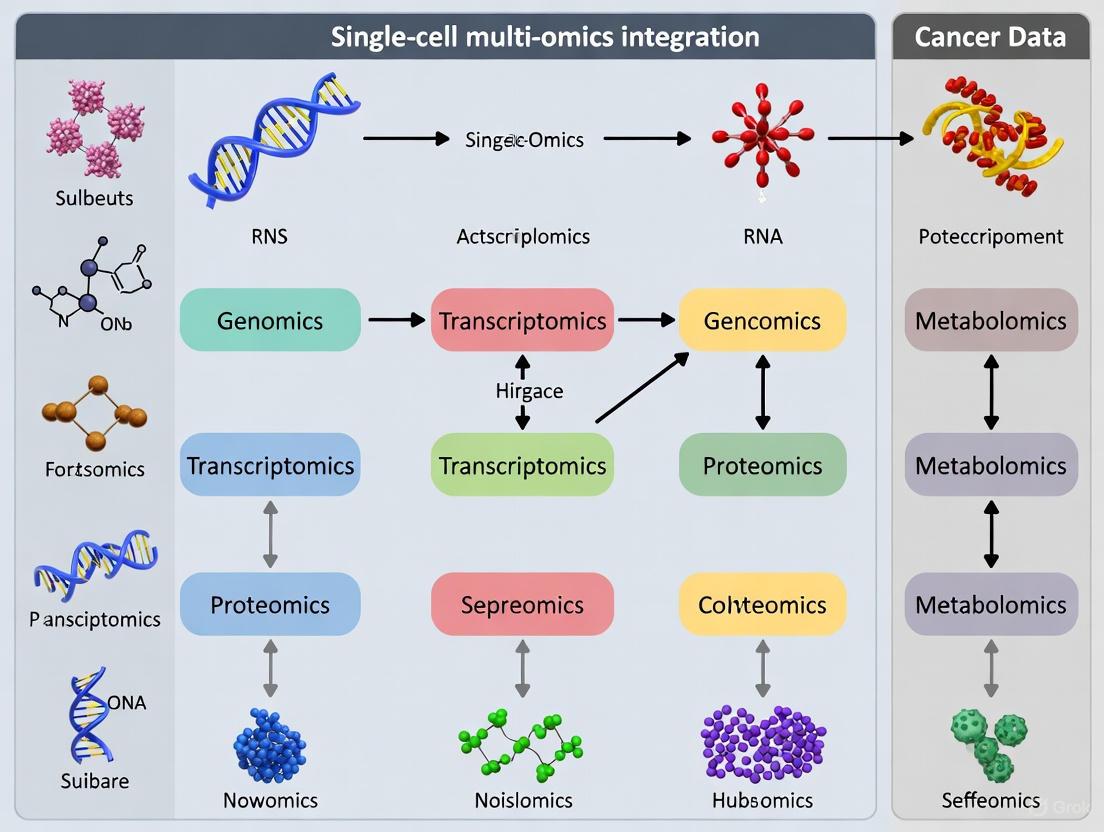
Single-cell multi-omics technologies are revolutionizing cancer research by enabling the simultaneous measurement of genomic, transcriptomic, epigenomic, and proteomic layers within individual cells.
Decoding Cancer Complexity: A Comprehensive Guide to Single-Cell Multi-Oomics Integration
Abstract
Single-cell multi-omics technologies are revolutionizing cancer research by enabling the simultaneous measurement of genomic, transcriptomic, epigenomic, and proteomic layers within individual cells. This article provides a comprehensive overview for researchers and drug development professionals, covering the foundational principles of tumor heterogeneity, the methodological landscape of data integration, solutions for common analytical challenges, and the validation of biological insights. By exploring both current applications and future trends, we highlight how these approaches are advancing personalized oncology, from uncovering novel therapeutic targets to monitoring minimal residual disease, ultimately paving the way for more precise and effective cancer therapies.
Unraveling Tumor Heterogeneity: The Core Principles of Single-Cell Multi-Omics
Single-cell multi-omics technologies have revolutionized cancer biology research by enabling the simultaneous analysis of multiple molecular layers within individual cells. This approach transcends the limitations of bulk sequencing, which averages signals across heterogeneous cell populations, thereby masking critical cellular nuances. By integrating genomic, transcriptomic, epigenomic, and proteomic data at single-cell resolution, researchers can now dissect tumor heterogeneity, characterize the tumor microenvironment, identify rare cell populations, and unravel mechanisms of therapeutic resistance with unprecedented clarity. This technical guide explores the core principles, methodologies, and applications of single-cell multi-omics, providing cancer researchers with the analytical frameworks needed to leverage these transformative technologies in precision oncology.
Conventional bulk sequencing methods provide population-averaged data that obscures the cellular heterogeneity inherent in complex biological systems like tumors. While invaluable for identifying common molecular signatures, these approaches cannot resolve distinct cellular subpopulations, rare cell types, or continuous transitional states that drive cancer progression and therapeutic resistance [1]. The averaging effect of bulk sequencing is particularly problematic in oncology, where tumor ecosystems comprise malignant cells, immune populations, stromal components, and vascular elements interacting within a dynamic microenvironment.
Single-cell multi-omics technologies overcome these limitations by enabling correlated measurements of multiple molecular modalities within the same cell. This capacity has revealed unprecedented insights into cellular heterogeneity, transcriptional dynamics, and regulatory mechanisms operating in cancer systems [2]. The integrated analysis of these multimodal datasets provides a more comprehensive understanding of tumor biology, facilitating the development of targeted therapies and personalized treatment approaches [3].
Core Methodologies in Single-Cell Multi-Omics
Single-Cell Isolation and Barcoding Strategies
The foundation of single-cell analysis lies in the effective isolation of individual cells from complex tissues. Several high-throughput methods have been developed for this purpose:
- Magnetic-activated cell sorting (MACS) employs antibody-conjugated magnetic beads to selectively isolate cell populations based on surface markers [1].
- Fluorescence-activated cell sorting (FACS) enables multiparameter analysis and sorting based on size, granularity, and fluorescence characteristics, though it requires sufficient cell density and may impact cell viability [1].
- Microfluidic technologies utilize nanoliter-scale reaction chambers or droplet-based systems to process thousands of cells in parallel, significantly reducing reagent costs while increasing throughput [1].
Following isolation, cell barcoding allows libraries from multiple cells to be sequenced simultaneously while preserving cellular identity. Plate-based techniques add barcodes during final PCR steps, while microfluidics-based methods incorporate barcodes earlier in the workflow, processing entire library pools in single tubes [1].
Multimodal Profiling Technologies
Single-cell multi-omics encompasses diverse technologies that profile different molecular layers:
- Single-cell RNA sequencing (scRNA-seq) characterizes gene expression profiles, identifying cell types, states, and transcriptional dynamics. Common methods include 10X Genomics Chromium, Drop-seq, and full-length transcript sequencing approaches [1].
- Single-cell ATAC-seq (scATAC-seq) maps accessible chromatin regions using Tn5 transposase-mediated tagmentation, identifying active regulatory elements across the genome [4].
- Single-cell epigenomic profiling extends beyond chromatin accessibility to include DNA methylation (bisulfite sequencing) and histone modifications (scCUT&Tag) [2].
- Cellular indexing of transcriptomes and epitopes (CITE-seq) enables simultaneous measurement of transcriptome and surface protein expression using antibody-derived tags [5].
Table 1: Comparison of Single-Cell Omics Modalities
| Modality | Molecular Features | Key Technologies | Primary Applications in Cancer |
|---|---|---|---|
| Transcriptomics | Gene expression | scRNA-seq, CEL-seq2, MARS-seq2.0 | Cell type identification, differential expression, trajectory inference |
| Epigenomics | Chromatin accessibility | scATAC-seq | Regulatory element identification, TF binding dynamics |
| DNA Methylation | CpG methylation | scBS-seq, scRRBS | Epigenetic silencing, gene regulation |
| Proteomics | Surface protein expression | CITE-seq, REAP-seq | Immune profiling, cell surface marker validation |
| Multiomics | Combined modalities | 10X Multiome, TEA-seq | Integrated regulatory network analysis |
Analytical Frameworks for Data Integration
Computational Integration Strategies
The integration of multimodal single-cell data presents significant computational challenges due to differing data structures, scales, and noise characteristics across modalities. Several integration strategies have been developed:
- Matched integration (vertical integration) combines data from different omics layers profiled from the same cell, using the cell itself as an anchor. Tools such as Seurat v4, MOFA+, and totalVI employ weighted nearest-neighbor, factor analysis, and deep generative approaches respectively for this purpose [6].
- Unmatched integration (diagonal integration) merges data from different omics layers profiled from different cells, requiring co-embedding in a shared space. Methods like GLUE use graph variational autoencoders with prior biological knowledge to anchor features [6].
- Mosaic integration handles experimental designs where different samples have varying combinations of omics measurements, with tools such as COBOLT and MultiVI creating unified representations across partially overlapping datasets [6].
Dimensionality Reduction and Visualization
The high-dimensional nature of single-cell multi-omics data necessitates effective dimensionality reduction techniques. While linear methods like PCA and LSI offer computational efficiency, they often struggle to capture complex nonlinear relationships. Nonlinear methods such as spectral embedding (implemented in SnapATAC2) better preserve intrinsic data geometry while maintaining scalability [7]. SnapATAC2 utilizes a matrix-free spectral embedding algorithm with linear time and space complexity relative to cell numbers, enabling efficient processing of large-scale datasets [7].
Table 2: Performance Comparison of Dimensionality Reduction Methods
| Method | Algorithm Type | Scalability | Memory Usage (200K cells) | Processing Time (200K cells) |
|---|---|---|---|---|
| SnapATAC2 | Nonlinear (spectral) | Linear | 21 GB | 13.4 minutes |
| ArchR/Signac | Linear (LSI) | Linear | Moderate | Fast |
| cisTopic | Nonlinear (LDA) | Poor | High | Slow (>10 hours) |
| PeakVI | Deep neural network | Linear (with GPU) | Feature-dependent | ~4 hours |
| Original SnapATAC | Nonlinear (spectral) | Quadratic | >500 GB (out of memory) | N/A |
Workflow for Multi-Omics Data Analysis
A standardized analytical workflow for single-cell multi-omics data includes:
- Quality Control and Preprocessing: Filtering low-quality cells based on metrics like UMI counts, mitochondrial gene percentage, and TSS enrichment [5].
- Normalization and Batch Correction: Addressing technical variations using methods such as total count normalization, harmony, or Seurat's integration functions [5].
- Dimensionality Reduction: Projecting high-dimensional data into lower-dimensional space using PCA, UMAP, or specialized algorithms [5].
- Clustering and Cell Type Identification: Partitioning cells into biologically meaningful groups using graph-based clustering followed by annotation with marker genes [5].
- Differential Analysis and Functional Enrichment: Identifying molecular features associated with specific conditions and interpreting their biological significance [5].
The following workflow diagram illustrates the key steps in single-cell multi-omics data generation and analysis:
Experimental Protocols in Cancer Multi-Omics
Integrated scATAC-seq and scRNA-seq Protocol
A comprehensive protocol for simultaneous profiling of chromatin accessibility and gene expression in carcinoma tissues involves the following key steps [4]:
Tissue Dissociation and Nuclei Isolation
- Obtain approximately 50mg of frozen tumor tissue and place in pre-chilled Dounce homogenizer with 2mL homogenization buffer (320mM sucrose, 0.1mM EDTA, 0.1% NP40, 5mM CaCl₂, 3mM Mg(Ac)₂, 10mM Tris-HCl pH 7.8, 167μM β-mercaptoethanol, protease inhibitors).
- Homogenize with 15 strokes using loose pestle, filter through 70μm nylon mesh, then 20 strokes with tight pestle.
- Filter through 40μm mesh, centrifuge at 350 rcf for 5 minutes.
- Resuspend pellet in 400μL homogenization buffer, add equal volume of 50% iodixanol.
- Layer 600μL of 29% iodixanol underneath, followed by 600μL of 35% iodixanol.
- Centrifuge in swinging-bucket rotor at 3000 rcf for 35 minutes, collect nuclei from 29%/35% interface.
Library Preparation and Sequencing
- Wash 500,000 nuclei in buffer (10mM Tris-HCl pH 7.4, 10mM NaCl, 3mM MgCl₂, 1% BSA, 0.1% Tween-20, 1mM DTT, RNase Inhibitor).
- Resuspend in Diluted Nuclei Buffer, count nuclei concentration.
- Aliquot 15,000 nuclei for library construction using Chromium Next GEM Chip J and Single Cell Multiome ATAC + Gene Expression kits (10X Genomics).
- Sequence on Illumina Novaseq6000 with minimum 50,000 reads per cell using paired-end 150bp strategy.
Computational Processing of Multiome Data
- Identify accessible chromatin regions using MACS2 peak calling on fragment files.
- Filter low-quality cells (nCount_peaks >2000 and <30,000, nucleosome signal <4, TSS enrichment >2).
- Calculate gene activity matrix using GeneActivity function in Signac.
- Remove batch effects using Harmony algorithm.
- Annotate genomic regions with ChIPSeeker and UCSC hg38 database.
Quality Control Metrics
Rigorous quality control is essential for reliable single-cell multi-omics data:
- scATAC-seq QC: Remove cells with extreme fragment counts (>2000 and <30,000), high nucleosome signal (>4), or low TSS enrichment (<2) [4].
- scRNA-seq QC: Filter cells based on UMI counts (>500 and <50,000), feature counts (>500 and <6,000), and mitochondrial percentage (<25%) [4].
- Doublet Detection: Apply DoubletFinder or similar tools with increasing doublet rates (approximately 0.8% per 1000-cell increment) [4].
The Scientist's Toolkit: Essential Research Reagents and Materials
Table 3: Essential Research Reagents for Single-Cell Multi-Omics
| Reagent/Kit | Function | Application Notes |
|---|---|---|
| Chromium Next GEM Chip J (10X Genomics) | Single-cell partitioning | Enables capture of thousands of single cells in nanoliter droplets |
| Single Cell Multiome ATAC + Gene Expression Kit | Simultaneous chromatin accessibility and transcriptome profiling | Optimized for co-assay of nuclear RNA and accessible chromatin |
| Nuclei Buffer with Sucrose/EDTA/NP40 | Tissue homogenization and nuclei isolation | Maintains nuclear integrity while disrupting cellular membranes |
| Iodixanol Density Gradient Medium | Nuclei purification | Separates intact nuclei from cellular debris and damaged cells |
| RNase Inhibitor | RNA degradation prevention | Critical for preserving RNA integrity during nuclei isolation |
| Protease Inhibitor Cocktail | Protein degradation prevention | Preserves nuclear proteins and chromatin structure |
| Tn5 Transposase | Chromatin tagmentation | Simultaneously fragments and tags accessible genomic regions |
| Unique Molecular Identifiers (UMIs) | Molecule counting | Distinguishes biological duplicates from PCR amplification artifacts |
| Cell Barcodes | Cell identity tracking | Enables multiplexing of thousands of cells in single sequencing run |
| DTT (Dithiothreitol) | Reducing agent | Maintains reducing environment to prevent molecular degradation |
Cancer Biology Applications and Findings
Dissecting Tumor Heterogeneity and Regulatory Networks
Single-cell multi-omics analyses have revealed extensive heterogeneity within carcinomas, identifying distinct cellular subpopulations with unique regulatory programs. A comprehensive study integrating scATAC-seq and scRNA-seq across eight carcinoma types (breast, skin, colon, endometrium, lung, ovary, liver, kidney) identified extensive open chromatin regions and constructed peak-gene link networks that reveal cancer-specific gene regulation [4]. This approach identified cell-type-associated transcription factors that regulate key cellular functions, including the TEAD family which widely controls cancer-related signaling pathways in tumor cells [4].
In colon cancer, multi-omics analysis revealed tumor-specific transcription factors with significantly higher activation in tumor cells compared to normal epithelial cells, including CEBPG, LEF1, SOX4, TCF7, and TEAD4 [4]. These factors drive malignant transcriptional programs and represent potential therapeutic targets, as validated through single-cell sequencing data from multiple sources and in vitro experiments.
Elucidating Therapy Resistance Mechanisms
Single-cell multi-omics enables the identification of cellular states and molecular pathways associated with treatment resistance in cancer. By simultaneously profiling gene expression and chromatin accessibility in individual cells, researchers can identify epigenetic priming toward resistant states and transcriptional programs that enable survival under therapeutic pressure [2]. These insights are particularly valuable in cancer immunotherapy, where single-cell approaches have identified immune cell subsets and states associated with immune evasion and therapy resistance [2].
The following diagram illustrates how multi-omics data integration reveals regulatory mechanisms driving cancer heterogeneity and therapy resistance:
Future Perspectives in Cancer Research
The field of single-cell multi-omics is rapidly evolving, with several emerging trends poised to transform cancer research:
- Foundation models pretrained on millions of cells, such as scGPT and scPlantFormer, demonstrate exceptional capabilities in cross-species cell annotation, in silico perturbation modeling, and gene regulatory network inference [8].
- Spatial multi-omics technologies integrate molecular profiling with spatial context, preserving architectural relationships within the tumor microenvironment that are critical for understanding cellular interactions [8].
- Multi-omic pharmacogenomics combines single-cell profiling with drug response data to identify molecular determinants of treatment efficacy and resistance mechanisms [9].
- Computational ecosystems like BioLLM and CZ CELLxGENE Discover are developing standardized frameworks for benchmarking analysis methods and aggregating data from millions of cells across studies [8].
As these technologies mature and computational methods become more sophisticated, single-cell multi-omics will increasingly bridge the gap between basic cancer biology and clinical applications, ultimately enabling truly personalized therapeutic interventions based on comprehensive molecular characterization of individual patient tumors.
The Central Challenge of Tumor Heterogeneity and the Tumor Microenvironment (TME)
Tumor heterogeneity and the tumor microenvironment (TME) represent the most significant challenges in modern oncology research and therapeutic development. Intra-tumoral heterogeneity (ITH) manifests through dynamic variations across genetic, epigenetic, transcriptomic, proteomic, metabolic, and microenvironmental factors, which collectively drive tumor evolution, therapeutic resistance, and metastatic progression [10]. The TME comprises a complex ecosystem of malignant cells embedded with diverse non-malignant components, including immune cells, cancer-associated fibroblasts (CAFs), vascular endothelial cells, pericytes, and tissue-resident stromal cells, all situated within a remodeled extracellular matrix (ECM) [11]. In many tumor types, these non-malignant elements may constitute the majority of the tumor mass, creating a dynamic network of cellular interactions that significantly influence disease progression and treatment outcomes [11]. The profound spatial and temporal heterogeneity within this ecosystem underlies key clinical obstacles, including therapeutic resistance, diagnostic inaccuracy, and inter-patient variability in treatment response [2] [10].
Conventional bulk sequencing approaches, while valuable for population-level molecular profiling, fundamentally mask cellular heterogeneity by capturing averaged signals across diverse cell populations [2]. This averaging effect obscures clinically relevant rare cellular subsets, including cancer stem cells, resistant subclones, and critical immunomodulatory populations, thereby limiting advances in personalized cancer therapy [2]. The integration of single-cell multi-omics technologies has revolutionized our capacity to dissect this complexity, enabling high-resolution mapping of tumor ecosystems at unprecedented resolution and dimensional depth [2] [12]. This technical guide examines the central challenge of tumor heterogeneity and the TME within the context of single-cell multi-omics integration, providing researchers with advanced methodological frameworks for probing these complex biological systems.
Molecular Dimensions of Tumor Heterogeneity
Genetic and Genomic Instability
Cancer genomes exhibit substantial instability at multiple levels, generating diversity that fuels tumor evolution. Driver mutations confer selective growth advantages and are directly implicated in oncogenesis, typically occurring in genes regulating critical cellular processes including cell growth, apoptosis, and DNA repair [13]. Notable examples include TP53 mutations, present in approximately 50% of all human cancers, and ALK alterations in neuroblastoma and other malignancies [13] [12]. Copy number variations (CNVs), involving duplications or deletions of large DNA regions, alter gene dosage to facilitate oncogene overexpression or tumor suppressor underexpression [13]. The amplification of the HER2 gene in approximately 20% of breast cancers, leading to aggressive tumor behavior, stands as a clinically significant example that has been successfully targeted with trastuzumab [13]. Single-nucleotide polymorphisms (SNPs) represent another common genetic variation form; while most have minimal biological impact, specific SNPs in genes such as BRCA1 and BRCA2 significantly increase cancer susceptibility and can predict therapeutic response and toxicity [13].
Non-Genetic Heterogeneity Layers
Beyond genetic alterations, tumors exhibit extensive heterogeneity across epigenetic, transcriptomic, proteomic, and metabolic layers. Epigenetic modifications, including DNA methylation, histone modifications, and chromatin accessibility alterations, create heritable changes in gene expression without altering the underlying DNA sequence [13] [12]. These modifications respond to environmental cues and demonstrate remarkable tissue specificity and dynamism [13]. Transcriptomic diversity enables functional specialization within tumor populations, with single-cell RNA sequencing (scRNA-seq) revealing distinct cellular states along differentiation continua, such as the adrenergic-mesenchymal axis in neuroblastoma [12]. Proteomic and metabolic reprogramming further diversify tumor phenotypes, supporting adaptation to nutrient deprivation, hypoxic stress, and therapeutic interventions [10] [14]. Metabolic plasticity, evidenced by shifts in glycolytic, oxidative phosphorylation, and lipid metabolic pathways, represents a key resistance mechanism and therapeutic target [12] [14].
Table 1: Omics Technologies for Dissecting Tumor Heterogeneity
| Omics Layer | Analytical Focus | Key Technologies | Clinical Applications |
|---|---|---|---|
| Genomics | DNA sequences, mutations, CNVs | scDNA-seq, NGS, WGS | Identification of driver mutations, clonal evolution tracing [2] [12] |
| Transcriptomics | RNA expression patterns | scRNA-seq, snRNA-seq | Cellular state identification, lineage tracing, differential expression [2] [12] |
| Epigenomics | Chromatin accessibility, DNA methylation | scATAC-seq, scCUT&Tag, bisulfite sequencing | Regulatory element mapping, transcriptional network inference [2] [12] |
| Proteomics | Protein expression, modifications | CITE-seq, cytometry | Functional effector analysis, surface marker profiling [15] [14] |
| Metabolomics | Metabolic pathway activity | Mass spectrometry, LC-MS | Nutrient utilization analysis, metabolic vulnerability identification [13] [14] |
| Spatial Omics | Tissue architecture, cellular neighborhoods | MERFISH, seqFISH, Visium | Spatial niche characterization, cell-cell communication mapping [15] [11] |
Tumor Microenvironment Composition and Dynamics
The TME constitutes a complex ecosystem wherein malignant cells coexist and interact with diverse non-malignant elements. Immune populations within the TME span adaptive and innate compartments, including T lymphocytes, B cells, natural killer cells, and myeloid-derived suppressor cells, with specific subsets such as regulatory T cells (Tregs) and M2-polarized macrophages exerting potent immunosuppressive effects through checkpoint molecule expression (PD-1, CTLA-4) and inhibitory cytokine secretion (IL-10, TGF-β) [11]. Stromal components, particularly CAFs, contribute to desmoplasia through ECM component secretion and establish physical and biochemical barriers that impede drug penetration [11]. Vascular networks within the TME exhibit abnormal structure and function, contributing to hypoxic gradients that shape tumor evolution and therapeutic resistance [10]. The metabolic TME reflects nutrient competition and waste product accumulation, creating additional selective pressures that influence cellular behavior and therapeutic efficacy [14].
Single-Cell Multi-Omics Technologies: Methodological Frameworks
Single-Cell Isolation and Preparation
Efficient and accurate single-cell isolation represents the critical first step in single-cell multi-omics workflows. Current methodologies offer distinct advantages and limitations suited to different experimental requirements and sample types. Fluorescence-activated cell sorting (FACS) enables high-throughput isolation of specific cell populations using antibody-conjugated fluorescent markers, achieving exceptional purity through hydrodynamic focusing and electrostatic droplet deflection [2]. Magnetic-activated cell sorting (MACS) provides a simpler, more cost-effective alternative using magnetic bead-conjugated affinity ligands, though with lower resolution and specificity [2]. Microfluidic technologies leverage laminar flow principles within microscale channels to achieve highly efficient cell separation with minimal cellular stress, albeit at higher operational costs [2]. For spatially-resolved analyses, laser capture microdissection (LCM) permits precise isolation of histologically-defined regions from tissue sections, preserving spatial context while maintaining tissue architecture information [2]. Sample preservation method selection significantly impacts experimental outcomes; fresh tissues generally yield highest quality molecular data, while formalin-fixed paraffin-embedded (FFPE) specimens—though suboptimal for some applications—provide access to vast archival tissue repositories [16].
Single-Cell Sequencing Modalities
Single-Cell RNA Sequencing (scRNA-seq)
scRNA-seq has emerged as the most widely adopted single-cell modality, enabling comprehensive transcriptome profiling of individual cells through sophisticated barcoding strategies. The core technological principle involves capturing polyadenylated RNA molecules using barcoded oligonucleotides, reverse transcribing them to cDNA, amplifying libraries, and performing high-throughput sequencing [2]. Unique molecular identifiers (UMIs) incorporated into barcodes enable accurate molecule counting and distinguish biological signal from technical amplification noise [2]. High-throughput platforms such as 10x Genomics Chromium and BD Rhapsody facilitate parallel processing of thousands to millions of cells, making large-scale atlas projects feasible [2]. The recently released 10x Genomics Chromium X and BD Rhapsody HT-Xpress platforms now enable profiling of over one million cells per run with improved sensitivity and multimodal compatibility [2]. Analytical workflows typically encompass quality control (mitochondrial content, detected genes per cell), normalization, feature selection, dimensionality reduction (PCA, UMAP), clustering, and differential expression analysis [15].
Single-Cell Epigenomic Profiling
Single-cell epigenomic technologies map regulatory landscapes governing cellular identity and plasticity. Single-cell assay for transposase-accessible chromatin sequencing (scATAC-seq) leverages Tn5 transposase-mediated insertion to label accessible chromatin regions, generating high-resolution maps of regulatory element activity [2] [12]. DNA methylation profiling at single-cell resolution typically employs bisulfite sequencing, wherein chemical conversion of unmethylated cytosines to uracils enables methylation status determination, though enzyme-based conversion strategies are emerging as gentler alternatives that reduce DNA degradation [2]. Histone modification mapping utilizes antibody-guided approaches such as single-cell CUT&Tag to profile post-translational modifications that influence chromatin structure and gene expression [2]. Nucleosome positioning patterns can be resolved through single-cell micrococcal nuclease sequencing (scMNase-seq), providing insights into higher-order chromatin organization [2].
Single-Cell Multi-Omics Integration
True multimodal single-cell profiling enables simultaneous capture of multiple molecular layers from the same cell, providing unprecedented insights into regulatory mechanisms. Cellular indexing of transcriptomes and epitopes by sequencing (CITE-seq) concurrently profiles transcriptome and surface protein expression using antibody-derived tags [15]. 10x Multiome simultaneously assesses gene expression and chromatin accessibility from the same nucleus [15]. The Genotyping of Transcriptomes (GoT) platform and its enhanced version GoT-Multi enable mutation profiling alongside transcriptomic characterization, recently demonstrated in studies of chronic lymphocytic leukemia transformation to aggressive lymphoma [16]. Computational integration of multimodal datasets presents substantial analytical challenges, with methods such as Seurat Weighted Nearest Neighbors (WNN), MOFA+, and Graph Convolutional Network (GCN-SC) approaches enabling holistic cellular characterization across modalities [15] [17].
Spatial Transcriptomics and Multi-Omics
Spatial transcriptomic technologies preserve architectural context while capturing molecular information, bridging a critical gap in dissociation-based single-cell methods. Image-based approaches, including multiplexed error-robust fluorescence in situ hybridization (MERFISH) and sequential FISH (seqFISH), use fluorescently labeled probes to directly visualize RNA transcripts within intact tissues, achieving subcellular resolution [11]. Barcode-based methods, such as 10x Genomics Visium, employ spatially-encoded oligonucleotide arrays to capture transcriptomic data while retaining positional information [11]. Emerging platforms like 10x Genomics Xenium now offer subcellular resolution with high-plex capability, significantly enhancing spatial mapping precision [15]. Spatial data analysis encompasses distinct computational challenges, including spatial clustering, cell-type deconvolution, and cell-cell communication inference within histological contexts [15] [11]. Integration with scRNA-seq data significantly enhances spatial analyses by enabling robust cell type identification and resolving expression patterns beyond the spatial technology's gene detection limit [11].
Diagram 1: Experimental workflow for single-cell and spatial multi-omics analysis, encompassing sample processing, molecular profiling, and computational integration stages.
Computational Integration of Multi-Omics Data
Data Integration Methodologies
The effective integration of multimodal single-cell data represents one of the most significant computational challenges in contemporary cancer biology. Integration methodologies can be categorized into three primary approaches based on their anchor selection strategies. Horizontal integration methods identify cell-pairs between datasets using common gene sets, while vertical approaches leverage common cell sets to establish connections [17]. Diagonal methods, including popular algorithms such as Seurat, LIGER, Harmony, and GLUER, perform integration without requiring common genes or cells, instead identifying mutual nearest neighbors (MNN) in shared low-dimensional representations [17]. The Graph Convolutional Network for Single-Cell data (GCN-SC) framework represents a recent advance that constructs mixed graphs incorporating both intra-dataset and inter-dataset cell-pairs, then applies graph convolutional networks to adjust count matrices before dimension reduction via non-negative matrix factorization [17]. Benchmarking studies demonstrate that GCN-SC outperforms existing methods in integrating data across different sequencing technologies, species, and omics modalities [17].
Analytical Frameworks and Platforms
User-friendly computational platforms have emerged to make sophisticated single-cell analyses accessible to researchers without extensive bioinformatics expertise. ezSingleCell provides an interactive web-based interface encompassing five specialized modules for scRNA-seq, data integration, spatial transcriptomics, multi-omics, and scATAC-seq analysis [15]. This platform integrates top-performing algorithms including Seurat, Harmony, scVI, MOFA+, and Signac within a unified environment, enabling comprehensive analyses from quality control to advanced downstream applications such as differential expression, gene set enrichment, cell-cell communication, and trajectory inference [15]. The platform supports analysis of large-scale datasets through geometric sketching, which subsamples millions of cells while preserving rare cell states, significantly accelerating clustering, visualization, and integration workflows [15]. Crucially, ezSingleCell enables crosstalk between analysis modules, allowing processed scRNA-seq data to inform cell type deconvolution in spatial datasets or label transfer in scATAC-seq analyses [15].
Table 2: Computational Tools for Single-Cell Multi-Omics Integration
| Tool Name | Primary Function | Integration Method | Advantages | Limitations |
|---|---|---|---|---|
| Seurat [15] [17] | Multi-modal integration | Diagonal (CCA + MNN) | Comprehensive toolkit, extensive documentation | Requires programming knowledge (R) |
| Harmony [15] [17] | Batch correction | Diagonal (soft clustering) | Fast, handles large datasets | Limited to transcriptomics |
| scVI [15] | Probabilistic modeling | Variational autoencoder | Scalable to millions of cells | Complex model interpretation |
| MOFA+ [15] | Multi-omics factor analysis | Dimension reduction | Identifies latent factors across modalities | Requires matched measurements |
| GCN-SC [17] | Graph-based integration | Graph convolutional networks | Preserves intra-dataset relationships | Computationally intensive |
| ezSingleCell [15] | Comprehensive platform | Multiple methods included | User-friendly interface, no coding required | Web-based, limited customization |
Advanced Analytical Applications
Sophisticated computational methods enable extraction of biologically meaningful insights from complex multi-omics datasets. Trajectory inference and RNA velocity analyses reconstruct developmental dynamics and cellular transition probabilities, revealing lineage relationships and state transitions during tumor evolution and therapeutic response [2]. Cell-cell communication inference tools, such as CellPhoneDB, leverage ligand-receptor interaction databases to map intercellular signaling networks within the TME, identifying autocrine and paracrine pathways that sustain tumor growth and immune evasion [15]. Regulatory network reconstruction integrates scATAC-seq and scRNA-seq data to connect transcription factor binding motifs with target gene expression, elucidating the mechanistic links between chromatin accessibility and transcriptional outputs [12]. Spatial neighborhood analysis identifies recurrent cellular communities within tumor architectures, revealing functionally specialized niches such as immune exclusion zones or interface regions characterized by specific stromal-epithelial interactions [11].
Diagram 2: Computational workflow for multi-omics data integration, showing sequential steps from raw data processing through integration methods to biological interpretation.
Experimental Protocols for Key Applications
Protocol 1: Integrated scRNA-seq and scATAC-seq Analysis
This protocol describes a comprehensive workflow for joint profiling of gene expression and chromatin accessibility from matched single-cell populations, enabling multidimensional characterization of tumor heterogeneity and regulatory mechanisms.
Sample Preparation and Sequencing:
- Tissue Processing: Obtain fresh tumor tissue and process immediately for optimal viability. Mechanically dissociate using gentleMACS Dissociator followed by enzymatic digestion with collagenase/hyaluronidase cocktail (37°C, 30-45 minutes) to generate single-cell suspensions [2]. Filter through 40μm strainers and assess viability (>85% required) using trypan blue or calcein-AM/propidium iodide staining.
- Cell Sorting: Isolate live single cells using FACS with forward/side scatter gating and viability dye exclusion. Alternatively, use magnetic bead-based negative selection to deplete dead cells and enrich for target populations [2].
- Multiome Library Preparation: Process cells using the 10x Genomics Chromium Next GEM Single Cell Multiome ATAC + Gene Expression kit according to manufacturer specifications [15]. This technology simultaneously captures RNA and accessible DNA from the same nuclei using microfluidic partitioning in gel beads-in-emulsion (GEMs). The transposase complex (Tn5) inserts adapters into accessible chromatin regions while poly-dT beads capture mRNA molecules.
- Sequencing: Construct libraries using recommended cycles and perform quality control with Agilent Bioanalyzer. Sequence on Illumina platforms with recommended read lengths (ATAC: 50+50 paired-end; RNA: 28+90 paired-end) and target sequencing depth of ≥20,000 reads per cell for RNA and ≥10,000 fragments per cell for ATAC [15].
Computational Analysis:
- Preprocessing: Process RNA data using Cell Ranger (10x Genomics) or kallisto|bustools with default parameters. Process ATAC data using Cell Ranger ATAC, performing peak calling, counting fragments in peaks, and generating peak-barcode matrices [15].
- Quality Control: Retain cells with 500-5,000 RNA features, <20% mitochondrial content, and >1,000 ATAC fragments. Remove cells with high nucleosome signal (>4) or low transcription start site enrichment (<2) in ATAC data [15].
- Integration: Use Signac or Seurat WNN to jointly analyze RNA and ATAC modalities. Perform weighted nearest neighbor analysis to construct integrated graphs that represent both transcriptional and epigenetic similarity [15].
- Peak-to-Gene Linkage: Identify putative regulatory connections by correlating peak accessibility with gene expression across the integrated dataset, considering genomic distances (<500kb typically) and chromatin interaction data if available [15].
- Motif and TF Activity: Scan accessible regions for enriched transcription factor motifs using Homer or chromVAR. Infer TF activity by comparing observed accessibility of target sites to expected background [12].
Protocol 2: Spatial Transcriptomics with scRNA-seq Integration
This protocol details the combination of high-resolution spatial transcriptomics with single-cell RNA sequencing to map cellular organization and interactions within intact tumor tissues.
Sample Processing and Data Generation:
- Tissue Preparation: For spatial transcriptomics, embed fresh tumor tissue in OCT compound and snap-freeze in liquid nitrogen-cooled isopentane. Alternatively, for FFPE compatibility, fix tissue in neutral-buffered formalin for 24 hours followed by standard processing and embedding [11].
- Sectioning: Cryosection frozen tissue at 5-10μm thickness directly onto Visium slides. For FFPE tissues, section at 5μm and mount onto charged slides [11].
- Spatial Library Preparation: Follow 10x Genomics Visium spatial protocol for tissue permeabilization, cDNA synthesis, and library construction. Optimize permeabilization time using the Tissue Optimization slide to maximize RNA capture efficiency [11].
- scRNA-seq Reference: From adjacent tumor regions, generate single-cell suspensions as described in Protocol 1. Process using 10x Genomics Single Cell 3' Reagent Kit v3.1 to generate complementary scRNA-seq data [11].
- Sequencing: Sequence spatial libraries targeting 50,000-200,000 reads per spot and scRNA-seq libraries targeting 20,000-50,000 reads per cell on Illumina platforms [11].
Computational Integration:
- Spatial Data Processing: Process spatial data using Space Ranger (10x Genomics) including tissue alignment, barcode processing, and count matrix generation [15].
- scRNA-seq Processing: Process reference scRNA-seq data using standard workflows in Seurat including normalization, variable feature selection, scaling, and clustering [15].
- Integration and Deconvolution: Use integration methods such as Seurat's anchor-based integration or robust cell type decomposition (RCTD) to map scRNA-seq-derived cell types onto spatial data [15] [11].
- Spatial Analysis: Perform spatially-aware clustering using GraphST or BayesSpace to identify histologically meaningful domains. Analyze cell-cell communication patterns with spatial context using CellPhoneDB or NICHES [15] [11].
- Spatial Visualization: Visualize cell type distributions, gene expression gradients, and ligand-receptor interactions in spatial context using integrated visualization tools [15].
The Scientist's Toolkit: Essential Research Reagents and Platforms
Table 3: Essential Research Reagent Solutions for Single-Cell Multi-Omics
| Category | Product/Platform | Key Features | Applications |
|---|---|---|---|
| Cell Isolation | Fluorescence-Activated Cell Sorting (FACS) | High-purity cell isolation, multi-parameter sorting | Isolation of specific immune/tumor subpopulations [2] |
| Magnetic-Activated Cell Sorting (MACS) | Simpler workflow, cost-effective, high recovery | Bulk immune cell enrichment/depletion [2] | |
| Single-Cell Platforms | 10x Genomics Chromium | High-throughput, multimodal compatibility | Large-scale atlas generation, multi-omics studies [2] [15] |
| BD Rhapsody | Lower cell input requirements, flexible panel design | Targeted transcriptomics, rare sample analysis [2] | |
| Spatial Technologies | 10x Genomics Visium | Whole transcriptome, standard histology compatible | Spatial mapping of cellular neighborhoods [15] [11] |
| 10x Genomics Xenium | Subcellular resolution, high-plex targeted panels | Precise cellular localization, rare transcript detection [15] | |
| MERFISH/seqFISH | Highest resolution, imaging-based detection | Single-molecule RNA localization, spatial organization [11] | |
| Multi-Omics Assays | CITE-seq | Simultaneous RNA and surface protein measurement | Immune phenotyping, cell state characterization [15] |
| 10x Multiome | Concurrent gene expression and chromatin accessibility | Regulatory mechanism elucidation [15] | |
| GoT-Multi | Genotype-specific transcriptomic profiling | Mutation-functional relationships, clonal evolution [16] | |
| Computational Tools | ezSingleCell | User-friendly web interface, comprehensive workflows | Accessible analysis for non-bioinformaticians [15] |
| Seurat | Extensive analytical toolkit, active development | Flexible, customizable analysis pipelines [15] [17] | |
| GCN-SC | Graph-based integration, preserves relationships | Complex multi-omics data integration [17] |
Clinical Translation and Therapeutic Applications
Biomarker Discovery and Patient Stratification
Single-cell multi-omics approaches are revolutionizing biomarker discovery by moving beyond population-level signatures to identify clinically relevant rare cell populations and dynamic state transitions. In breast cancer, integrated single-cell analyses of patient-derived xenografts have identified subclonal driver mutations (MCL1, MYC, CCNE) and secondary alterations (RAD18, RAB18) associated with therapeutic resistance and disease progression [10]. Lymphoma studies leveraging single-cell approaches have revealed that combination therapies targeting intratumoral CpG sites with low-dose radiotherapy and systemic ibrutinib induce robust systemic antitumor immune responses, providing mechanistic insights for rational combination therapy design [10]. Pancreatic adenocarcinoma analyses have identified CXCL12-CXCR4 as a critical interaction axis between inflammatory cancer-associated fibroblasts (iCAFs) and tumor-associated macrophages (TAMs), representing a promising therapeutic target in this treatment-resistant malignancy [10]. These approaches enable patient stratification based not only on static molecular features but also on dynamic ecosystem properties, including immune contexture, stromal composition, and spatial organization patterns that predict treatment response and clinical outcomes [2] [10].
Therapy Resistance Mechanisms and Overcoming Strategies
Multi-omics profiling at single-cell resolution has uncovered diverse, co-occurring resistance mechanisms within individual tumors, explaining the limited efficacy of monotherapies and sequential treatment approaches. In neuroblastoma, single-cell analyses have revealed how MYCN-driven chromatin remodeling, super-enhancer reorganization, bypass signaling activation, quiescent persister programs, immune checkpoint engagement, and metabolic rewiring collectively enable therapeutic escape [12]. Critically, these studies demonstrate that resistance mechanisms are frequently reversible, highlighting tumor plasticity as both a fundamental challenge and a potential therapeutic vulnerability [12]. Acute myeloid leukemia (AML) research employing integrated scRNA-seq and scATAC-seq has shown that LSD1 inhibition promotes PU.1 interaction with cofactor IRF8, induces enhancer activation (H3K4me1/2 and H3K27ac), and stabilizes epigenetic states that overcome resistance programs [10]. These findings underscore the potential of epigenetic therapies to reprogram tumor cell states and reverse therapeutic resistance when appropriately timed and combined with complementary agents.
Neoantigen Discovery and Immunotherapy Personalization
Single-cell multi-omics enables comprehensive neoantigen discovery by integrating genomic variant information with transcriptomic and proteomic data to identify patient-specific immunogenic targets. The GoT-Multi platform exemplifies this approach by enabling simultaneous tracking of numerous gene mutations while recording gene activity patterns in individual cancer cells, including from FFPE specimens that comprise vast clinical archives [16]. Application of this technology to chronic lymphocytic leukemia transforming to aggressive lymphoma (Richter Transformation) revealed how specific mutations correlate with distinct transcriptional programs—some cells exhibiting accelerated growth while others promote inflammation—during malignant progression [16]. Such detailed mapping of genotype-phenotype relationships at single-cell resolution provides the foundation for selecting optimal neoantigen targets and designing personalized immunotherapeutic approaches, including cancer vaccines and adoptive cell therapies, tailored to the unique clonal architecture of individual tumors [2] [16].
The integration of single-cell multi-omics technologies has fundamentally transformed our understanding of tumor heterogeneity and the tumor microenvironment, revealing unprecedented complexity across molecular, cellular, and spatial dimensions. These approaches have illuminated the dynamic interplay between genetic, epigenetic, and metabolic factors that drive tumor evolution, therapeutic resistance, and metastatic progression. While significant challenges remain in clinical translation, including standardization of analytical pipelines, computational scalability, and validation in prospective clinical trials, the field is rapidly advancing toward routine clinical application. The continuing development of spatially-resolved multimodal technologies, combined with increasingly sophisticated computational integration methods and accessible analysis platforms, promises to accelerate the conversion of multidimensional molecular profiles into clinically actionable insights. Ultimately, single-cell multi-omics approaches are poised to realize the full potential of precision oncology by guiding therapeutic strategies that account for the unique cellular composition, spatial organization, and evolutionary dynamics of each patient's tumor ecosystem.
Single-cell multi-omics technologies have revolutionized cancer biology by enabling simultaneous profiling of multiple molecular layers within individual cells. This technical guide provides a comprehensive overview of the core molecular layers—genomics, transcriptomics, epigenomics, and proteomics—within the context of single-cell integration for cancer research. We detail experimental methodologies for simultaneous measurement, data analysis pipelines for multi-omics integration, and specific applications in understanding tumor heterogeneity, the tumor microenvironment, and therapy resistance. By synthesizing current technologies and analytical approaches, this whitepaper serves as a resource for researchers and drug development professionals seeking to implement single-cell multi-omics in precision oncology.
The characterization of genomic, transcriptomic, epigenomic, and proteomic layers at single-cell resolution has transformed our understanding of cancer biology. Traditional bulk sequencing approaches average signals across heterogeneous cell populations, obscuring rare subpopulations and critical cellular dynamics that drive tumor progression, metastasis, and therapeutic resistance [2]. Single-cell multi-omics technologies overcome these limitations by simultaneously measuring multiple types of molecules from the same cell, enabling the identification of cell-type-specific gene regulatory networks and functional states within complex tumor ecosystems [18] [19]. This integrated approach is particularly powerful in cancer research, where cellular heterogeneity plays a crucial role in disease progression and treatment response.
The fundamental molecular layers provide complementary insights into cellular states in cancer. The genome represents the complete set of DNA sequences, including mutations and copy number variations that may drive oncogenesis. The epigenome encompasses reversible chemical modifications to DNA and histones that regulate gene accessibility without altering the DNA sequence itself. The transcriptome represents the complete set of RNA transcripts that reflect the dynamic gene expression programs activated in response to both genetic and epigenetic regulation. The proteome comprises the entire set of proteins that execute cellular functions, serving as the ultimate effectors of cellular phenotype [2] [19]. In cancer, the integrated analysis of these layers enables researchers to connect driver mutations to downstream transcriptional programs, epigenetic adaptations, and ultimately protein-level functional changes that underlie malignant transformation and progression.
Core Molecular Layers: Technologies and Methodologies
Genomics and Epigenomics
Single-cell genomics focuses on characterizing DNA sequences and variations at the cellular level. Single-cell DNA sequencing (scDNA-seq) enables the detection of somatic mutations, copy number variations (CNVs), and structural rearrangements within individual tumor cells, providing insights into clonal architecture and tumor evolution [20]. However, scDNA-seq faces technical challenges including limited DNA template (only two copies per cell), amplification biases, and artifacts such as allele dropout [20]. Whole-genome amplification methods have been developed to address these challenges, with PCR-based approaches (e.g., DOP-PCR, MALBAC) better suited for CNV detection, and isothermal methods (e.g., MDA, PTA) preferred for single nucleotide variant identification due to higher fidelity [20].
Single-cell epigenomics characterizes the molecular mechanisms that regulate gene expression without altering DNA sequence. Key epigenetic features include:
- Chromatin accessibility: measured by scATAC-seq (Assay for Transposase-Accessible Chromatin using Sequencing), which uses Tn5 transposase to label accessible genomic regions [4] [2]
- DNA methylation: profiled using bisulfite sequencing or enzymatic conversion methods that distinguish methylated cytosines [2]
- Histone modifications: mapped through antibody-guided techniques like scCUT&Tag [2]
- Chromatin conformation: analyzed using methods that capture three-dimensional genome architecture [21]
In cancer research, scATAC-seq has revealed cell-type-specific regulatory elements and transcription factor activities driving malignant phenotypes [4]. For example, integrated analysis of chromatin accessibility and gene expression has identified tumor-specific transcription factors (e.g., CEBPG, LEF1, SOX4, TCF7, TEAD4) in colon cancer that represent potential therapeutic targets [4].
Table 1: Single-Cell Genomics and Epigenomics Technologies
| Technology | Molecular Target | Key Applications in Cancer | Considerations |
|---|---|---|---|
| scDNA-seq | Genomic DNA | Clonal evolution, CNV analysis, mutation tracing | Low genomic coverage, amplification artifacts |
| scATAC-seq | Accessible chromatin | Regulatory landscape, TF activity, enhancer identification | Sparse data, complex analysis |
| scCUT&Tag | Histone modifications | Epigenetic states, chromatin regulation | Antibody quality dependent |
| Bisulfite sequencing | DNA methylation | Promoter methylation, epigenetic silencing | DNA degradation concerns |
Transcriptomics and Proteomics
Single-cell RNA sequencing (scRNA-seq) profiles the complete set of RNA molecules in individual cells, capturing dynamic gene expression programs that define cellular identity and state [22]. scRNA-seq protocols vary in transcript coverage, with 3' or 5' end-focused methods (e.g., 10x Genomics) providing cost-effective high-throughput analysis, while full-length methods (e.g., Smart-seq2/3) enable isoform detection and variant analysis [20]. A critical technical advancement in scRNA-seq is the incorporation of Unique Molecular Identifiers (UMIs), which label individual mRNA molecules to enable accurate quantification and account for amplification biases [20]. In cancer research, scRNA-seq has revealed previously obscured tumor subpopulations, including rare cell states with clinical significance such as drug-resistant precursors or metastatic initiators [2] [22].
Single-cell proteomics characterizes protein expression and post-translational modifications, bridging the gap between genomic information and functional phenotype. While mass spectrometry-based proteomics at single-cell resolution remains challenging, antibody-based methods have enabled robust protein measurement. CITE-seq (Cellular Indexing of Transcriptomes and Epitopes by Sequencing) uses oligonucleotide-tagged antibodies to simultaneously quantify surface protein expression and transcriptomes in thousands of single cells [19]. This approach is particularly valuable in immunology and cancer research, where protein expression often does not directly correlate with mRNA levels due to post-transcriptional regulation [19].
Table 2: Single-Cell Transcriptomics and Proteomics Technologies
| Technology | Molecular Target | Key Applications in Cancer | Throughput |
|---|---|---|---|
| 3'/5' scRNA-seq | mRNA (biased) | Cell type identification, differential expression | High (thousands- millions of cells) |
| Full-length scRNA-seq | mRNA (unbiased) | Isoform expression, mutation detection | Medium (hundreds of cells) |
| CITE-seq | Surface proteins + mRNA | Immune profiling, cell state validation | High (thousands of cells) |
| REAP-seq | Surface proteins + mRNA | Cellular phenotyping, activation states | High (thousands of cells) |
Experimental Design and Workflow Integration
Single-Cell Isolation and Library Preparation
The initial critical step in single-cell multi-omics is the effective isolation of individual cells from tumor tissues. Multiple approaches exist, each with specific advantages and limitations:
- Microfluidic platforms (e.g., 10x Genomics, BD Rhapsody): Enable high-throughput processing of thousands of cells using droplet-based or microwell-based isolation [20] [2]
- Fluorescence-Activated Cell Sorting (FACS): Allows precise selection of specific cell populations based on surface markers but requires larger cell inputs [2]
- Laser Capture Microdissection (LCM): Permits isolation of cells while preserving spatial context but is low-throughput and labor-intensive [2]
- Combinatorial indexing: Avoids physical separation of single cells by using unique barcode combinations, increasing throughput while reducing cost [20]
For multi-omics library preparation, several integrated methods have been developed to concurrently profile multiple molecular layers from the same cell:
- G&T-seq: Physically separates genomic DNA and mRNA through oligo-dT bead capture for parallel sequencing [18]
- scTrio-seq: Simultaneously profiles genome, transcriptome, and DNA methylome from individual cells [18]
- TEA-seq: Enables trimodal measurement of transcripts, epitopes (proteins), and chromatin accessibility from the same cell [19]
- 10x Genomics Multiome: Commercially available platform for concurrent scRNA-seq and scATAC-seq from single nuclei [19]
Figure 1: Integrated Workflow for Single-Cell Multi-Omics Analysis in Cancer Research
Detailed Methodologies for scATAC-seq and scRNA-seq Integration
A representative integrated single-cell multi-omics protocol for cancer samples, as described in [4], involves the following key steps:
Tissue Processing and Nuclei Isolation:
- Obtain fresh tumor tissue and adjacent normal tissue (e.g., colon cancer samples)
- Mechanically dissociate tissue fragments in pre-chilled homogenization buffer (320 mM sucrose, 0.1 mM EDTA, 0.1% NP40, 5 mM CaCl₂, 3 mM Mg(Ac)₂, 10 mM Tris-HCl pH 7.8, 167 μM β-mercaptoethanol, protease inhibitors)
- Perform sequential homogenization with loose and tight pestles in a Dounce homogenizer
- Filter through 70-μm and 40-μm nylon mesh to remove debris
- Purify nuclei using iodixanol density gradient centrifugation (25%, 29%, 35% layers) at 3000 r.c.f for 35 minutes
- Collect nuclei from the 29%/35% interface and count using trypan blue
Library Preparation and Sequencing:
- Wash 500,000 nuclei in buffer (10 mM Tris-HCl pH 7.4, 10 mM NaCl, 3 mM MgCl₂, 1% BSA, 0.1% Tween-20, 1 mM DTT, RNase Inhibitor)
- Resuspend nuclei in Diluted Nuclei Buffer for concentration determination
- Load 15,000 nuclei for library construction using Chromium Next GEM Chip J and Single Cell Multiome ATAC + Gene Expression kits (10x Genomics)
- Sequence libraries on Illumina Novaseq6000 with minimum 50,000 reads per cell using paired-end 150 bp strategy
Data Processing and Quality Control:
- Identify accessible chromatin regions using MACS2 peak calling
- Process scATAC-seq data with Signac R package, filtering low-quality cells (nCount_peaks >2000 and <30,000, nucleosome signal <4, TSS enrichment >2)
- Annotate clusters using differential accessible regions associated with marker genes (e.g., LGR5, EPCAM for tumor cells; CD247 for T cells)
- Process scRNA-seq data with Seurat R package, filtering low-quality cells (nCountRNA <50,000 and >500, nFeatureRNA >500 and <6,000, mitochondrial content <25%)
- Remove doublets using DoubletFinder R package with increasing doublet rate of 0.8% per 1000-cell increment
- Harmonize datasets and remove batch effects using Harmony algorithm [4]
Data Analysis and Computational Integration
Preprocessing and Quality Control
The analysis of single-cell multi-omics data begins with rigorous quality control and preprocessing. For raw sequencing data in FASTQ format, initial quality assessment uses tools like FASTQC and MultiQC to evaluate read quality, adapter contamination, and other technical metrics [5]. Following quality assessment, preprocessing steps include:
- Read trimming: Remove adapter sequences and low-quality bases using Trimmomatic, Cutadapt, or fastp
- Alignment: Map reads to reference genomes (for genomic/epigenomic data) or transcriptomes (for RNA-seq) using aligners like STAR
- Quantification: Generate count matrices for features (genes, peaks, proteins) per cell
- Quality filtering: Remove low-quality cells based on metrics including UMI counts per cell, features per cell, mitochondrial percentage, and doublet detection [5]
For scATAC-seq data specifically, quality metrics include fragment size distribution (indicating nucleosome positioning), transcription start site (TSS) enrichment, and fraction of reads in peaks (FRiP) [4]. For scRNA-seq data, additional normalization methods include total count normalization and log transformation, with algorithms like RSEC and DBEC used for UMI adjustment to correct counting errors [5].
Multi-Omics Data Integration and Interpretation
The integration of multiple molecular modalities requires specialized computational approaches to leverage complementary information. Key methods include:
- Dimensionality reduction: Principal Component Analysis (PCA), t-distributed Stochastic Neighbor Embedding (t-SNE), and Uniform Manifold Approximation and Projection (UMAP) project high-dimensional data into lower dimensions for visualization and exploration [22] [5]
- Batch correction: Algorithms like Harmony, Mutual Nearest Neighbors (MNN), and Seurat's integration methods address technical variations between samples or experiments [4] [22]
- Multi-omics integration frameworks: Tools such as Seurat and Scanpy provide built-in functions for integrating transcriptomic, epigenomic, and proteomic data, while specialized methods like MOFA+ infer latent factors that explain variation across modalities [19] [5]
- Explainable AI approaches: Emerging multimodal models like Vec3D use pseudo-image representations to identify structured molecular landscapes from integrated single-cell data [23]
Following integration, key analytical steps include:
- Clustering and cell type identification: Graph-based clustering algorithms partition cells into distinct populations, with cell types annotated using marker genes from reference databases (e.g., PanglaoDB, CellMarker) or automated annotation tools (e.g., Azimuth, scType) [5]
- Differential expression analysis: Statistical tests (Wilcoxon rank-sum test, negative binomial regression) identify features varying between conditions or cell types
- Regulatory network inference: Tools like SCENIC (Single-Cell Regulatory Network Inference and Clustering) reconstruct gene regulatory networks from integrated transcriptomic and epigenomic data [22]
- Trajectory analysis: Algorithms such as Monocle3, Slingshot, and RNA velocity (Velocyto, ScVelo) model dynamic processes like differentiation, tumor progression, or drug response [22] [5]
Figure 2: Computational Workflow for Single-Cell Multi-Omics Data Analysis
The Scientist's Toolkit: Essential Research Reagents and Platforms
Key Research Reagent Solutions
Successful single-cell multi-omics experiments require carefully selected reagents and platforms optimized for preserving molecular integrity while enabling multimodal profiling.
Table 3: Essential Research Reagents and Platforms for Single-Cell Multi-Omics
| Category | Product/Platform | Key Function | Application Notes |
|---|---|---|---|
| Nuclei Isolation | Homogenization Buffer (Sucrose/EDTA/NP40) | Maintain nuclear integrity during tissue dissociation | Critical for preserving chromatin accessibility and RNA quality [4] |
| Library Preparation | 10x Genomics Chromium Next GEM Kits | Single-cell partitioning and barcoding | Optimized for simultaneous ATAC + Gene Expression profiling [4] [19] |
| Protein Detection | Oligo-conjugated Antibodies (CITE-seq) | Simultaneous protein and RNA measurement | Enables surface protein quantification alongside transcriptome [19] |
| Epigenetic Profiling | Tn5 Transposase (scATAC-seq) | Tags accessible genomic regions | Identifies active regulatory elements without specific antibody requirement [4] [2] |
| Cell Sorting | Fluorescence-Activated Cell Sorting (FACS) | High-precision cell isolation | Enables pre-enrichment of rare cell populations from tumors [2] |
| Sample Multiplexing | Cell Hashing Antibodies | Labels cells with sample barcodes | Allows pooling of multiple samples, reducing batch effects and costs [20] |
| Whole Genome Amplification | Multiple Displacement Amplification (MDA) | Amplifies genomic DNA from single cells | Preferred for single nucleotide variant detection due to high fidelity [20] |
Analytical Tools and Software Platforms
The analysis of single-cell multi-omics data relies on a robust ecosystem of computational tools and pipelines:
- Primary Analysis Pipelines: Cell Ranger (10x Genomics), BD Rhapsody Pipeline, and STAR for alignment and initial quantification [5]
- Comprehensive Analysis Suites: Seurat (R) and Scanpy (Python) provide end-to-end solutions for quality control, normalization, integration, and visualization [4] [22] [5]
- Specialized Integration Tools: Harmony for batch correction [4], MOFA+ for multi-omics factor analysis [19], and Vec3D for explainable multimodal integration [23]
- Trajectory Analysis: Monocle3, Slingshot, and RNA velocity tools (Velocyto, ScVelo) for reconstructing dynamic biological processes [22] [5]
Applications in Cancer Biology and Therapeutic Development
Single-cell multi-omics approaches have generated transformative insights into cancer biology with direct implications for therapeutic development:
Tumor Heterogeneity and Evolution: Single-cell multi-omics has revealed the extensive cellular diversity within tumors, identifying distinct subpopulations with varied functional states, genetic alterations, and epigenetic configurations. For example, integrated DNA and RNA sequencing of breast cancer cells uncovered contrasting transcriptional states (MITF-high vs. AXL-high) within the same tumor, with implications for targeted therapy response [18]. Similarly, in chronic lymphocytic leukemia (CLL), combined transcriptome and DNA methylome analysis reconstructed lineage relationships and identified transcriptional transitions associated with ibrutinib treatment resistance [18].
Tumor Microenvironment (TME) Characterization: Multimodal single-cell profiling has enabled comprehensive characterization of the cellular composition and functional states within the TME. Studies integrating transcriptomics, proteomics, and epigenomics have revealed immunosuppressive stromal populations, exhausted T cell states, and macrophage polarization states that contribute to immune evasion [2] [3]. For instance, in nasopharyngeal carcinoma, combined transcriptomic and proteomic analysis identified immune subtypes with distinct prognostic significance and therapeutic implications [19].
Therapy Resistance Mechanisms: Single-cell multi-omics has illuminated dynamic adaptation processes underlying treatment resistance. In colon cancer, integrated scATAC-seq and scRNA-seq analysis identified tumor-specific transcription factors (CEBPG, LEF1, SOX4, TCF7, TEAD4) that drive malignant transcriptional programs and represent potential therapeutic targets [4]. Similarly, in melanoma, combined genetic and transcriptomic profiling revealed pre-existing resistant subpopulations that expanded under targeted therapy [18].
Immunotherapy Biomarker Discovery: Multi-omics approaches are accelerating the identification of predictive biomarkers for immunotherapy response. By simultaneously profiling T cell receptor sequences (TCR), transcriptomes, and surface proteins, researchers have identified clonally expanded T cell populations with distinct functional states associated with clinical response [2] [3]. These integrated profiles provide a more comprehensive view of antitumor immunity than any single molecular modality alone.
Single-cell multi-omics technologies have fundamentally transformed cancer research by enabling unprecedented resolution in characterizing the molecular layers that drive tumor biology. The integration of genomic, transcriptomic, epigenomic, and proteomic data from individual cells has revealed previously unappreciated heterogeneity within tumors, elucidated mechanisms of therapy resistance, and identified novel therapeutic targets. As these technologies continue to evolve, several emerging trends promise to further advance the field.
Future developments will likely focus on enhancing spatial context through spatial transcriptomics and multi-omics, capturing temporal dynamics through improved live-cell imaging and time-resolved sequencing, and increasing accessibility through reduced costs and simplified workflows. Additionally, the integration of artificial intelligence and machine learning approaches will be crucial for extracting biologically meaningful patterns from increasingly complex multi-dimensional datasets. As single-cell multi-omics technologies mature and become more widely implemented in clinical research, they hold immense potential to guide personalized cancer therapy by identifying patient-specific molecular features that predict treatment response and resistance mechanisms, ultimately advancing precision oncology and improving patient outcomes.
The integration of single-cell multi-omics technologies has revolutionized cancer biology by enabling simultaneous measurement of molecular layers—genomics, transcriptomics, epigenomics, and proteomics—within individual cells. This technical guide examines the complete analytical workflow from experimental design and data generation to computational analysis and clinical translation. By synthesizing recent advances in single-cell sequencing technologies, computational foundation models, and multimodal integration strategies, this whitepaper provides researchers with a comprehensive framework for leveraging single-cell multi-omics to unravel tumor heterogeneity, identify therapeutic targets, and advance personalized cancer treatment strategies.
Single-cell multi-omics technologies represent a paradigm shift in cancer research, moving beyond bulk tissue analysis to resolve the complex cellular heterogeneity within tumors. These approaches simultaneously capture multiple molecular dimensions from individual cells, enabling the reconstruction of regulatory networks and cellular trajectories driving tumor evolution. The fundamental workflow connects molecular measurements across the central dogma—from DNA accessibility and chromatin conformation to RNA expression and protein abundance—within the spatial context of the tumor microenvironment [2] [8].
The analytical pipeline begins with tissue dissociation and single-cell isolation, followed by library preparation using platforms such as 10x Genomics Multiome, which concurrently profiles scRNA-seq and scATAC-seq from the same nuclei [4]. Subsequent computational steps involve quality control, batch correction, dimensional reduction, and clustering to identify cell populations. Advanced algorithms then integrate these multimodal measurements to construct gene regulatory networks and predict cellular behaviors [8]. The power of this approach is exemplified by recent studies identifying tumor-specific transcription factors in colon cancer and mapping clonal evolution in cutaneous squamous cell carcinoma [4] [24].
Core Multi-Omics Technologies and Methodologies
Experimental Workflows and Platform Selection
The foundation of single-cell multi-omics analysis begins with robust experimental design and sample preparation. For nuclei isolation from frozen tissues, the optimized protocol involves homogenizing approximately 50mg of tissue in a sucrose-based buffer containing NP-40 detergent, EDTA, and protease inhibitors. The homogenate is filtered through 70μm and 40μm meshes before centrifugation and purification through a iodixanol density gradient, collecting nuclei at the 29%-35% interface [4]. Critical quality control steps include assessing nuclei integrity and concentration before loading onto single-cell platforms.
Table 1: Single-Cell Sequencing Platform Comparison
| Platform/Method | Cell Separation | Cell Capture | Transcript Capture | Multimodal Capacity | Cost per Cell |
|---|---|---|---|---|---|
| 10x Genomics Multiome | Droplet-based | ~65% | ~14% | scRNA-seq + scATAC-seq | ~$0.10 |
| DropSeq | Droplet-based | ~5% | ~10.7% | scRNA-seq | ~$0.06 |
| SCI-Seq | FACS + combinatorial indexing | 5%-10% | 10%-15% | scRNA-seq | $0.05-$0.14 |
| Fluidigm C1 | Microfluidic chambers | Size-dependent | ~6,606 genes/cell | scRNA-seq | ~$1.70 |
Platform selection depends on research goals, with 10x Genomics providing robust multimodal capability while DropSeq offers cost-effectiveness for high-throughput transcriptomic studies [25]. For experiments requiring simultaneous chromatin accessibility and gene expression profiling, the 10x Genomics Multiome platform uses nuclei suspensions with 15,000 nuclei typically loaded per channel. Library preparation follows manufacturer specifications with sequencing recommended at minimum 50,000 reads per cell using paired-end 150bp strategy on Illumina platforms [4].
Quality Control and Data Preprocessing
Rigorous quality control is essential for reliable single-cell data. For scRNA-seq data, exclude cells with nCountRNA < 500 or >50,000, nFeatureRNA < 500 or >6,000, and mitochondrial percentage >25% [4] [25]. For scATAC-seq data, apply thresholds of nCount_peaks >2,000 and <30,000, nucleosome signal <4, and TSS enrichment >2 [4]. Doublet identification using tools like DoubletFinder is critical, with the doublet rate increasing by 0.8% per 1,000-cell increment [4].
Technical noise from batch effects represents a major challenge in single-cell analysis. Computational harmonization using algorithms like Harmony effectively removes technical variation while preserving biological signals [4]. For large datasets, computational efficiency can be improved through strategic subsampling—for example, randomly selecting 30,000 cells for initial processing [4].
Analytical Framework: From Raw Data to Biological Insight
Multimodal Data Integration and Regulatory Network Inference
The integration of scRNA-seq and scATAC-seq data enables the construction of peak-gene link networks that reveal cell-type-specific regulatory elements. The Signac toolkit in R provides a comprehensive framework for this analysis, employing the GeneActivity function to calculate gene scores from chromatin accessibility data [4]. Cluster annotation is performed by identifying differential accessible regions associated with marker genes—EPCAM for epithelial cells, CD247 for T cells, JCHAIN for plasma cells, and PDGFRA for fibroblasts [4].
Advanced algorithms like SComatic enable de novo detection of somatic mutations directly from scRNA-seq and scATAC-seq data without matched DNA sequencing. This approach uses statistical filters parameterized on non-neoplastic samples to distinguish true somatic mutations from polymorphisms, RNA-editing events, and technical artifacts [24]. Validation against whole-exome sequencing demonstrates high concordance, with mutation rates in epithelial cells from cutaneous squamous cell carcinoma measuring 12.8 mutations per Mb compared to 3.7 mutations per Mb in normal skin [24].
Table 2: Single-Cell Multi-Omics Computational Tools
| Tool | Function | Key Features | Performance Metrics |
|---|---|---|---|
| SComatic | Somatic mutation detection | Beta-binomial test; Panel of Normals; No DNA-seq required | F1 scores: 0.6-0.7 vs. 0.2-0.4 for other methods |
| scGPT | Foundation model | Pretrained on 33M+ cells; Zero-shot annotation | Superior multi-omic integration and perturbation prediction |
| Signac | scATAC-seq analysis | Chromatin peak calling; Gene activity calculation | Compatible with Seurat for multimodal integration |
| Harmony | Batch correction | Iterative clustering integration | Preserves biological variance while removing technical noise |
| Nicheformer | Spatial omics | Graph transformer architecture | Trained on 53M spatially resolved cells |
Foundation Models and Advanced Computational Approaches
Recent advances in foundation models have transformed single-cell data analysis. Models like scGPT, pretrained on over 33 million cells, demonstrate exceptional capability for zero-shot cell type annotation and in silico perturbation modeling [8]. These models employ self-supervised pretraining objectives including masked gene modeling and contrastive learning to capture hierarchical biological patterns. The scPlantFormer model exemplifies this approach, achieving 92% cross-species annotation accuracy by integrating phylogenetic constraints into its attention mechanism [8].
For spatial context integration, Nicheformer utilizes graph transformers to model cellular niches across millions of spatially resolved cells [8]. Multimodal alignment frameworks like PathOmCLIP connect histology images with spatial transcriptomics through contrastive learning, validated across five tumor types [8]. These approaches enable the discovery of context-specific regulatory networks, such as chromatin accessibility patterns governing lineage commitment in hematopoiesis.
Visualization and Data Interpretation Strategies
Effective visualization is critical for interpreting high-dimensional single-cell data. The following workflow diagram illustrates the core analytical pipeline from sample processing to biological insight:
Chromatin conformation analysis provides critical insights into gene regulation, with innovative methods capturing spatial organization alongside transcriptional activity:
Research Reagent Solutions and Essential Materials
Table 3: Essential Research Reagents for Single-Cell Multi-Omics
| Reagent/Category | Specific Examples | Function | Technical Notes |
|---|---|---|---|
| Nuclei Isolation | Sucrose-EDTA-NP40 buffer; Iodixanol density gradient | Tissue dissociation and nuclei purification | Maintain at 4°C; Include protease inhibitors and RNase inhibitor |
| Single-Cell Platform | 10x Genomics Chromium Next GEM Chip J; Single Cell Multiome ATAC + Gene Expression Reagent Kits | Partitioning cells and barcoding | 15,000 nuclei per channel; Sequence minimum 50,000 reads/cell |
| Enzymes | Tn5 transposase; Micrococcal nuclease (MNase) | Chromatin tagmentation; Nucleosome digestion | Tn5 for scATAC-seq; MNase for Micro-C |
| Computational Tools | Signac; Seurat; SComatic; scGPT | Data analysis and interpretation | Signac for scATAC-seq; SComatic for mutation calling |
| Antibodies | ACTA2 (myofibroblasts); EPCAM (epithelial); CD247 (T cells) | Cell type identification | Used for cluster annotation in integrated analysis |
Clinical Translation and Therapeutic Applications
Single-cell multi-omics approaches have identified clinically actionable targets across carcinomas. In colon cancer, tumor-specific transcription factors including CEBPG, LEF1, SOX4, TCF7, and TEAD4 demonstrate significantly higher activation in tumor cells compared to normal epithelium [4]. These factors drive malignant transcriptional programs and represent promising therapeutic targets. The TEAD family of transcription factors emerges as a master regulator controlling cancer-related signaling pathways across multiple tumor types [4].
In cancer immunotherapy, single-cell technologies dissect mechanisms of treatment resistance and immune evasion. Integrated analysis reveals how tumor heterogeneity shapes the tumor microenvironment, influencing T-cell exhaustion and dysfunction [2]. These insights guide combination therapy strategies and patient stratification approaches. The application of single-cell multi-omics to minimal residual disease monitoring and neoantigen discovery further illustrates the clinical potential of these technologies for guiding personalized treatment decisions [2].
The workflow from central dogma to clinical insight represents a fundamental advance in cancer biology, providing an unprecedented window into the regulatory programs operating in specific cell types within tumors. As single-cell technologies continue to evolve alongside computational methods, they promise to become central to precision oncology, enabling truly personalized therapeutic interventions based on a comprehensive understanding of the regulatory dynamics underlying carcinomas.
Historical Context and Technological Evolution of Single-Cell Analysis
The advent of single-cell analysis represents a paradigm shift in biological sciences, transforming our understanding of cellular heterogeneity and complex biological systems. Traditional bulk sequencing methods, which measure average signals across thousands to millions of cells, inevitably mask the fundamental differences between individual cells—differences that underlie critical processes in development, physiology, and disease pathogenesis [26]. The emergence of single-cell technologies has empowered researchers to dissect this cellular heterogeneity at unprecedented resolution, revealing new cell types, states, and dynamic transitions that were previously invisible [27]. This technical evolution has been particularly transformative in cancer biology, where tumor heterogeneity represents a major challenge for diagnosis and treatment [2]. This review traces the historical development of single-cell analysis technologies, details current methodological approaches, and highlights their revolutionary impact on cancer research through multi-omics integration.
Historical Milestones in Single-Cell Analysis
The journey of single-cell analysis began with pioneering work in the early 1990s using single-cell qPCR to measure a small number of genes in individual cells [27]. However, the true breakthrough came in 2009 with the landmark study by Tang et al., which reported the first bona fide single-cell transcriptome analysis of mouse blastomeres [28] [27]. This work demonstrated the feasibility of whole-transcriptome analysis at single-cell resolution, overcoming the profound technical challenge of amplifying minute quantities of RNA from individual cells (approximately 10 pg total RNA per mammalian cell, with only 1-5% being transcriptomic RNA) [28].
The subsequent decade witnessed exponential advancement in single-cell technologies, following what has been described as a "Moore's Law" of single-cell genomics [27]. Early plate-based methods including STRT-seq, CEL-seq, and SMART-seq established different approaches for transcript capture and amplification [28] [27]. A significant leap forward came with the development of high-throughput nanodroplet and picowell technologies around 2015, enabling parallel analysis of tens of thousands of cells [27]. Technologies like Drop-seq, inDrop, and the commercial 10x Genomics platform dramatically increased cell throughput while reducing costs per cell [28] [26]. The period from 2017 onward has been characterized by the rise of multi-modal single-cell methodologies that simultaneously measure multiple molecular layers (RNA, DNA, protein, epigenetics) from the same cell, providing unprecedented insights into the regulatory networks governing cell identity [27] [8].
Table 1: Historical Evolution of Key Single-Cell RNA-Seq Technologies
| Technology | Release Year | Throughput | Transcript Coverage | Key Innovation |
|---|---|---|---|---|
| Tang Method | 2009 | Low (single digits) | 3' end | First single-cell transcriptome |
| SMART-seq | 2012 | Low (96 cells) | Full-length | Higher sensitivity for low-abundance transcripts |
| Fluidigm C1 | 2013 | Medium (up to 800 cells) | Full-length | Automated microfluidics platform |
| Drop-seq | 2015 | High (thousands of cells) | 3' end | Droplet-based high-throughput analysis |
| 10x Genomics | 2016 | High (thousands to millions) | 3' end | Commercial scalable droplet platform |
| SMART-seq3 | 2020 | Low to medium | Full-length | Improved quantification with UMIs |
The timeline of technological development has been accompanied by parallel advances in computational methods for data processing, quality control, and interpretation [27]. These computational innovations were essential for extracting biological meaning from the high-dimensional, sparse, and noisy data generated by single-cell technologies [26]. The development of specialized tools for cell type identification, trajectory inference, and spatial mapping has enabled researchers to reconstruct developmental pathways and cellular ecosystems from single-cell data [27].
Core Technological Approaches and Methodologies
Single-Cell Isolation Strategies
The initial critical step in any single-cell analysis workflow is the effective isolation of individual cells from tissue or culture while maintaining cell viability and molecular integrity. Multiple approaches have been developed, each with distinct advantages and limitations:
- Fluorescence-Activated Cell Sorting (FACS): Uses antibody-conjugated fluorescent labels to sort cells based on specific surface markers. Provides high precision but requires specialized equipment and expertise [2].
- Magnetic-Activated Cell Sorting (MACS): Employs magnetic beads conjugated with affinity ligands for cell separation. Simpler and more cost-effective than FACS but offers lower resolution [28] [2].
- Microfluidic Technologies: Utilizes microscale fluidics to isolate cells in nanoliter droplets or chambers. Offers high throughput, low technical noise, and minimal cellular stress, though often at higher operational cost [28] [2].
- Laser Capture Microdissection (LCM): Enables precise isolation of cells from tissue sections while preserving spatial context. Particularly valuable for spatial omics studies but is time-consuming and low-throughput [2].
- Combinatorial Indexing Methods: Techniques such as SPLiT-seq and sci-RNA-seq use combinatorial barcoding to label cells without physical separation. Enable massive scalability (profiling millions of cells) and eliminate the need for specialized isolation equipment [26] [29].
Single-Cell Sequencing Modalities
The core strength of modern single-cell analysis lies in the diverse array of sequencing modalities that probe different molecular layers:
- Single-Cell RNA Sequencing (scRNA-seq): Profiles the transcriptome to reveal gene expression patterns. Key variations include full-length transcript protocols (e.g., SMART-seq2) for isoform analysis and 3' end-counting methods (e.g., 10x Genomics) for high-throughput cell typing [28] [26].
- Single-Cell Assay for Transposase-Accessible Chromatin (scATAC-seq): Identifies accessible chromatin regions to map active regulatory elements. Based on Tn5 transposase-mediated tagmentation of open chromatin regions [4] [2].
- Single-Cell DNA Sequencing (scDNA-seq): Detects genomic alterations including single nucleotide variants and copy number variations at single-cell resolution. Multiple displacement amplification has largely replaced PCR for whole-genome amplification due to better coverage and lower error rates [2].
- Single-Cell Epigenomic Profiling: Includes methods for mapping DNA methylation (bisulfite sequencing) and histone modifications (scCUT&Tag) to reveal the epigenetic landscape governing cellular identity [2].
- Multimodal Single-Cell Analysis: Next-generation technologies such as 10x Genomics Multiome and GoT-Multi enable simultaneous profiling of multiple molecular modalities from the same cell, revealing direct connections between genotype and phenotype [16].
Table 2: Comparison of Major Single-Cell Sequencing Protocols
| Protocol | Isolation Method | Amplification Method | UMI Usage | Transcript Coverage | Key Applications |
|---|---|---|---|---|---|
| STRT-seq | FACS/Microfluidics | PCR-based | No | 5' end | Transcription start site mapping |
| SMART-seq2 | FACS | PCR-based | No | Full-length | Isoform analysis, mutation detection |
| CEL-seq2 | FACS/Microfluidics | IVT | Yes | 3' end | High reproducibility, sensitive detection |
| Drop-seq | Droplet-based | PCR-based | Yes | 3' end | High-throughput, low cost per cell |
| 10x Genomics | Droplet-based | PCR-based | Yes | 3' end | High cell throughput, commercial robustness |
| MATQ-seq | FACS | PCR-based | Yes | Full-length | Precise quantification, rare transcript detection |
The Scientist's Toolkit: Essential Research Reagents and Solutions
Successful single-cell experimentation requires careful selection of specialized reagents and materials:
- Unique Molecular Identifiers (UMIs): Short nucleotide barcodes that label individual mRNA molecules before amplification, enabling accurate quantification by correcting for PCR amplification bias [26] [2].
- Cell Barcodes: Oligonucleotide sequences that tag all molecules from a single cell, allowing multiplexing of thousands of cells in a single reaction [2].
- Tn5 Transposase: Engineered enzyme used in scATAC-seq to fragment and tag accessible chromatin regions [4].
- Poly(T) Primers: Oligonucleotides that capture polyadenylated mRNA molecules, selectively enriching for messenger RNA while minimizing ribosomal RNA contamination [26].
- Template-Switching Oligos: Enable full-length cDNA synthesis in protocols like SMART-seq by facilitating strand switching during reverse transcription [28].
- Magnetic Beads: Used for cDNA purification and size selection in library preparation, crucial for removing contaminants and reaction components [4].
- Partitioning Reagents: For droplet-based systems, specialized surfactants and oils that create stable nanoliter reactors for individual cell barcoding [28].
Analysis Frameworks and Computational Tools
The complexity and scale of single-cell data have driven the development of sophisticated computational frameworks. Traditional analytical pipelines typically involve quality control, normalization, dimensionality reduction, clustering, and differential expression analysis [26]. However, the field is currently undergoing a paradigm shift with the emergence of foundation models—large neural networks pretrained on massive single-cell datasets that demonstrate exceptional generalization capabilities [8].
Models such as scGPT (pretrained on over 33 million cells) enable zero-shot cell type annotation and in silico perturbation prediction [8]. scPlantFormer extends this approach with phylogenetic constraints, achieving 92% cross-species annotation accuracy [8]. For spatial data, Nicheformer employs graph transformers to model spatial cellular niches across millions of spatially resolved cells [8]. These foundation models represent a significant advance over traditional single-task analytical approaches.
Multimodal data integration presents particular computational challenges. Innovative solutions such as StabMap's mosaic integration enable alignment of datasets with non-overlapping features [8]. PathOmCLIP connects histology images with spatial gene expression through contrastive learning, while GIST integrates histology with multi-omic profiles for 3D tissue modeling [8]. Platforms including DISCO and CZ CELLxGENE Discover aggregate over 100 million cells for federated analysis, facilitating large-scale comparative studies [8].
Single-Cell Multi-Omics Analysis Workflow
Applications in Cancer Biology and Immunotherapy
Single-cell technologies have profoundly transformed cancer research by enabling detailed dissection of the tumor ecosystem. The application of single-cell multi-omics has revealed unprecedented insights into tumor heterogeneity, cancer evolution, and the tumor microenvironment (TME) [2].
Dissecting Tumor Heterogeneity and Evolution
Single-cell analysis has demonstrated that tumors are complex ecosystems composed of malignant cells with diverse molecular features coexisting with various non-malignant cell types [2]. A striking application of multi-omics approaches is exemplified by GoT-Multi, a technology that enables simultaneous tracking of multiple gene mutations while recording gene activity in individual cancer cells [16]. Applied to chronic lymphocytic leukemia transforming to aggressive lymphoma, this approach revealed how specific mutations correlate with cellular behaviors such as rapid growth or inflammation stoking during cancer evolution [16].
Integrated analysis of scATAC-seq and scRNA-seq data across eight carcinoma types has identified tumor-specific transcription factors (including CEBPG, LEF1, SOX4, TCF7, and TEAD4) that are highly activated in tumor cells compared to normal epithelial cells [4]. These factors drive malignant transcriptional programs and represent potential therapeutic targets [4].
Unraveling the Tumor Microenvironment and Immunotherapy Response
The tumor microenvironment contains diverse immune and stromal cells that critically influence cancer progression and therapy response [2]. Single-cell technologies have enabled comprehensive mapping of these cellular components and their functional states. In cancer immunotherapy, single-cell approaches have identified immune cell subsets associated with immune evasion and therapy resistance [2].
Studies comparing healthy and diseased tissues at single-cell resolution have revealed altered cell states in disease. For example, analysis of asthmatic lung uncovered novel mucosal ciliated cell states and pathogenic Th2 cells not present in healthy tissue [27]. Similarly, single-cell analysis of the maternal-fetal interface revealed new immune cell states involved in maternal tolerance [27]. These findings provide frameworks for understanding pathological mechanisms and identifying therapeutic targets.
Single-Cell Analysis of Tumor Ecosystems
Future Perspectives and Challenges
As single-cell technologies continue to evolve, several emerging trends and challenges will shape their future application in cancer biology and beyond. The integration of spatial information with single-cell multi-omics data represents a critical frontier [27]. Spatial transcriptomic methods are approaching single-cell resolution, enabling researchers to map gene expression patterns within the architectural context of tissues [27]. This is particularly valuable for studying complex tissue organizations such as the tumor microenvironment and brain circuitry.
The development of foundation models for single-cell data analysis is rapidly advancing, but challenges remain in standardization, interpretability, and clinical translation [8]. Technical variability across platforms, batch effects, and limited model interpretability present significant hurdles [8]. Future efforts will need to focus on standardized benchmarking, multimodal knowledge graphs, and collaborative frameworks that integrate artificial intelligence with biological expertise [8].
From a clinical perspective, single-cell technologies hold immense promise for precision oncology but face barriers to routine implementation. The high cost of sequencing, methodological complexities, and computational demands currently limit widespread clinical adoption [2]. However, ongoing technological innovations are steadily reducing costs and improving accessibility. As these trends continue, single-cell multi-omics analysis is poised to become an integral component of cancer diagnostics and therapeutic decision-making, ultimately fulfilling the promise of truly personalized cancer therapy [2].
In conclusion, the historical evolution of single-cell analysis has transformed our ability to interrogate biological systems at their fundamental unit—the individual cell. The convergence of technological innovations in cell isolation, molecular profiling, and computational analysis has enabled unprecedented insights into cellular heterogeneity, particularly in complex diseases such as cancer. As single-cell multi-omics approaches continue to mature and integrate with spatial profiling and artificial intelligence, they will undoubtedly uncover new biological principles and accelerate the development of targeted therapeutic interventions.
From Data to Discovery: Methodologies and Translational Applications in Cancer
The profound molecular, genetic, and phenotypic heterogeneity inherent in cancer presents one of the most significant challenges in clinical oncology. This heterogeneity exists not only across different patients but also among multiple tumors within the same individual and even within distinct cellular components of the tumor microenvironment (TME) [2]. Conventional bulk-tissue sequencing approaches, by averaging signals across heterogeneous cell populations, often fail to resolve clinically relevant rare cellular subsets, thereby limiting the advancement of personalized cancer therapies [2]. The advent of single-cell sequencing technologies has revolutionized our ability to dissect this tumor complexity with unprecedented resolution, enabling multi-dimensional single-cell omics analyses that include genomics, transcriptomics, epigenomics, and proteomics [2]. This technical guide provides an in-depth examination of four core single-cell technologies—scRNA-seq, scATAC-seq, scDNA-seq, and CITE-seq—framed within the context of cancer biology research and multi-omics integration.
Technology-Specific Methodologies and Workflows
Single-Cell RNA Sequencing (scRNA-seq)
Experimental Protocol: The foundational scRNA-seq workflow begins with preparing a single-cell suspension from tumor tissue, a critical step that requires careful optimization to maintain cell viability and integrity. Individual cells are then isolated using microfluidic chips, microdroplets, or microwell-based approaches [30]. Following isolation, cellular mRNA is captured, reverse-transcribed with primers containing cell-specific barcodes and Unique Molecular Identifiers (UMIs), and amplified to construct sequencing libraries. The commercially available 10x Genomics Chromium X and BD Rhapsody HT-Xpress platforms represent state-of-the-art systems capable of profiling over one million cells per run with improved sensitivity and multimodal compatibility [2].
Key Analytical Workflow: Analysis of scRNA-seq data typically involves quality control (filtering doublets, cells with high mitochondrial content), normalization, feature selection of highly variable genes, and dimensionality reduction using Principal Component Analysis (PCA), followed by visualization with t-distributed Stochastic Neighbor Embedding (t-SNE) or Uniform Manifold Approximation and Projection (UMAP). Subsequent analysis includes clustering for cell type identification, differential expression analysis, and advanced techniques such as trajectory inference (pseudotime analysis) using tools like Monocle3, RNA velocity, and cell-cell communication inference [30].
Single-Cell Assay for Transposase-Accessible Chromatin with Sequencing (scATAC-seq)
Experimental Protocol: scATAC-seq leverages the Tn5 transposase enzyme, which simultaneously fragments and tags accessible chromatin regions with sequencing adapters. Intact nuclei are first isolated from fresh or frozen tissue samples. The Tn5 transposase is then activated within these nuclei to insert adapters into open chromatin regions. Following tagmentation, the DNA is purified, amplified, and prepared for sequencing. The 10X Genomics Chromium System and platforms like ArchR provide scalable solutions for processing thousands of cells in parallel [31].
Key Analytical Workflow: The analysis of scATAC-seq data involves aligning sequencing reads to a reference genome, calling peaks to identify accessible chromatin regions, and creating a cell-by-peak matrix. Dimensionality reduction is typically performed using latent semantic indexing (LSI), followed by clustering and visualization with UMAP. Cicero and ArchR can predict gene-regulatory links by co-accessibility analysis, while tools like ChromVAR quantify transcription factor motif activity. A critical application in cancer is the inference of copy number variations (CNVs) from scATAC-seq data to distinguish malignant from non-malignant cells [31].
Single-Cell DNA Sequencing (scDNA-seq)
Experimental Protocol: scDNA-seq focuses on directly profiling the genomic landscape of individual cells. After single-cell isolation, typically by fluorescence-activated cell sorting (FACS) or microfluidics, the genomic DNA undergoes whole-genome amplification (WGA). Multiple displacement amplification (MDA) has largely replaced PCR-based methods due to its superior genomic coverage and lower error rate [2]. The amplified DNA is then fragmented, library-prepared, and sequenced. Methods such as G&T-seq, SIDR-seq, DNTR-seq, and DR-seq have been developed based on different DNA isolation and amplification techniques [2].
Key Analytical Workflow: Analysis pipelines for scDNA-seq data are designed to identify single nucleotide variants (SNVs), copy number alterations (CNAs), and structural variants (SVs) at single-cell resolution. This involves aligning reads to a reference genome, followed by variant calling and filtering. A particularly powerful application is the reconstruction of phylogenetic trees to model tumor evolution and subclonal architecture, providing insights into cancer progression and therapeutic resistance.
Cellular Indexing of Transcriptomes and Epitopes by Sequencing (CITE-seq)
Experimental Protocol: CITE-seq simultaneously quantifies gene expression and protein abundance in individual cells. The key reagent is an antibody-oligo conjugate, where a DNA barcode is attached to an antibody targeting a specific cell surface protein [32]. In a typical workflow, a single-cell suspension is first stained with a panel of these antibody-derived tags (ADTs). The stained cells are then loaded into a single-cell partitioning system (e.g., droplet-based 10X Genomics or microwell-based BD Rhapsody). Within each partition, both cellular mRNA and the ADT oligos are captured by barcoded beads, reverse-transcribed, and prepared into separate sequencing libraries for transcriptome and surface proteome [32].
Key Analytical Workflow: The analysis of CITE-seq data involves demultiplexing the ADT and mRNA reads using their respective barcodes. ADT counts are normalized using methods like centered log-ratio (CLR) transformation to account for the compositional nature of the data. The integrated protein and RNA measurements are then analyzed jointly, often using the same dimensionality reduction and clustering frameworks as scRNA-seq (e.g., Seurat), to define cell states based on both molecular layers. This is particularly valuable in immunooncology for deep immune phenotyping within the TME.
Quantitative Performance Comparison
Table 1: Key Performance Metrics and Applications of Core Single-Cell Technologies
| Technology | Molecular Target | Primary Application in Cancer Research | Key Strengths | Throughput (Typical Cell Numbers) | Challenges |
|---|---|---|---|---|---|
| scRNA-seq | mRNA transcriptome | Cell type identification, tumor heterogeneity, differential expression, trajectory inference | Unbiased profiling of gene expression programs, detection of rare cell types | 10,000 - 1,000,000+ cells [2] | Captures only polyadenylated RNA, limited by RNA capture efficiency |
| scATAC-seq | Accessible chromatin regions | Epigenetic regulation, enhancer activity, transcription factor binding, regulatory landscape | Maps active regulatory elements, identifies cell-type-specific cis-regulation | 10,000 - 100,000+ cells [31] | Sparse data, indirect measure of regulation, complex data analysis |
| scDNA-seq | Genomic DNA | Somatic mutations, copy number variations, tumor evolution, subclonal architecture | Direct detection of mutations, comprehensive genomic characterization | 100 - 10,000 cells | Whole-genome amplification biases, high cost per cell |
| CITE-seq | mRNA + Surface proteins | Immune profiling, cellular phenotyping, validation of protein expression | Direct protein measurement, complements transcriptomic data | 1,000 - 100,000 cells | Limited to surface proteins, antibody quality dependency, background noise [32] |
Table 2: Multi-Omic Integration Methods and Their Applications in Cancer Biology
| Integration Method | Technologies Combined | Cancer Research Application | Key Findings/Strengths |
|---|---|---|---|
| scMKL [33] | scRNA-seq + scATAC-seq | Classification of healthy/cancerous cells across multiple cancer types | Identifies key transcriptomic and epigenetic features; outperforms existing methods in breast, lymphatic, prostate, and lung cancers |
| CITE-seq [32] | scRNA-seq + Protein abundance | Tumor microenvironment characterization, immune cell profiling | Overcomes limitations of transcriptomics alone; useful when mRNA-protein correlation is poor |
| 10x Genomics Multiome | scRNA-seq + scATAC-seq | Linked gene expression and regulatory programs in same cell | Provides direct correlation between chromatin accessibility and gene expression |
| Neural Network Models [31] | scATAC-seq + Genetic variants | Interpretation of non-coding mutations in cancer | Identifies functional non-coding mutations disrupting cancer-specific gene regulation |
The Scientist's Toolkit: Essential Research Reagents and Materials
Table 3: Key Research Reagent Solutions for Single-Cell Multi-Omics
| Reagent/Material | Function | Example Application | Technical Considerations |
|---|---|---|---|
| Antibody-Oligo Conjugates (ADTs) [32] | Simultaneous detection of surface proteins in CITE-seq | Immune phenotyping in the tumor microenvironment | Require titration to optimize concentration and minimize background; clone compatibility must be considered |
| Cell Hashing Reagents [32] | Sample multiplexing using barcoded antibodies | Pooling multiple patient samples in one run to reduce batch effects | Can target universal surface markers or nuclear membrane proteins; binding efficiency varies |
| Tn5 Transposase | Fragments and tags accessible chromatin in scATAC-seq | Mapping regulatory landscapes in tumor subpopulations | Enzyme activity and concentration critically impact data quality |
| Barcoded Beads | Capture mRNA and ADT oligos in partitioning systems | All high-throughput single-cell workflows (10X, BD Rhapsody) | Bead loading efficiency critical for cell multiplexing; determine capture rate |
| Fc Block Reagent [32] | Reduces nonspecific antibody binding | Essential for samples containing myeloid/B cells in CITE-seq | Prevents false positive protein signals |
| Viability Dye | Distinguishes live/dead cells | Critical for all single-cell preparations | Dead cells cause nonspecific binding and reduce data quality |
| Nuclei Isolation Kit | Extracts intact nuclei from frozen tissue | scATAC-seq from archived specimens or difficult-to-dissociate tissues | Maintains nuclear integrity while removing cytoplasmic RNA |
Integrated Workflows and Multi-Omic Analysis in Cancer
The true power of single-cell technologies emerges when they are integrated to form a comprehensive view of tumor biology. Multi-omics integration allows researchers to connect genomic alterations with their functional consequences in gene regulation and cellular phenotype.
Integrative Analysis of scRNA-seq and scATAC-seq Data
The scMKL (single-cell Multiple Kernel Learning) framework represents a significant advancement for integrative analysis of single-cell multiomics data. This method merges the predictive capabilities of complex models with the interpretability of linear approaches, overcoming key scalability and interpretability limitations of traditional kernel-based approaches [33]. scMKL uses random Fourier features (RFF) to reduce computational complexity and group Lasso (GL) regularization for sparse, modality-aware feature selection. Unlike conventional approaches that first select variable features then perform downstream analysis, scMKL combines these steps to find underlying cross-modal interactions between transcriptomics and epigenomics that opaque methods fail to capture [33].
In practice, scMKL utilizes prior biological knowledge such as Hallmark gene sets from the Molecular Signature Database for RNA and transcription factor binding sites from JASPAR and Cistrome databases for ATAC to guide kernel construction. This approach has demonstrated superior performance in classifying healthy and cancerous cell populations across multiple cancer types, including breast, lymphatic, prostate, and lung cancers, while identifying key transcriptomic and epigenetic features [33].
CITE-seq for Integrated Proteogenomic Analysis in Immunotherapy
CITE-seq provides a powerful approach for linking transcriptomic and proteomic measurements in cancer immunology. This technology is particularly valuable when mRNA levels do not correlate well with protein expression, when post-translational changes are critical, or when mRNA transcript levels are low [32]. For example, CITE-seq can detect protein isoforms such as CD45RA and CD45RO, offering a solution to overcome the inherent limitations of single-cell transcriptomics [32].
Panel design for CITE-seq requires careful consideration of antibody clone compatibility to avoid steric hindrance, and titration is essential since high concentrations of ADTs can generate high background and sequester sequencing reads [32]. In cancer applications, targeted panels of 30-40 markers are often more meaningful than high-plex panels, as they can be optimized for specific biological questions while minimizing sequencing costs [32].
Diagram 1: CITE-seq Integrated Workflow for Simultaneous RNA and Protein Profiling
Advanced Applications in Cancer Biology
Dissecting Tumor Heterogeneity and Microenvironment
Single-cell multi-omics technologies have dramatically enhanced our ability to dissect the complex cellular ecosystem of tumors. A comprehensive single-cell chromatin accessibility atlas spanning 74 cancer samples comprising 227,063 nuclei from eight human cancer types demonstrated how scATAC-seq can deconvolve the tumor microenvironment into cancerous, immune, and stromal components [31]. This approach revealed that chromatin accessibility landscapes in cancer are strongly influenced by copy number alterations, which can also be used to identify subclones, yet underlying cis-regulatory landscapes retain strong cancer type-specific features [31].
By comparing cancer cells to their nearest-healthy cell types, researchers can identify malignant epigenetic changes. For example, this analysis demonstrated that the epigenetic signature of basal-like subtype breast cancer is most similar to secretory-type luminal epithelial cells rather than healthy basal-like cells, providing insights into cell of origin [31].
Enhancing Personalized Immunotherapy
Single-cell multi-omics plays a transformative role in advancing cancer immunotherapy by resolving the cellular and molecular determinants of treatment response and resistance. These approaches have illuminated tumor biology, immune escape mechanisms, treatment resistance, and patient-specific immune response mechanisms, thereby substantially advancing precision oncology strategies [2].
The integration of scRNA-seq with scTCR-seq enables researchers to simultaneously capture T-cell phenotype and clonality, revealing how specific T-cell clones expand in response to immunotherapy and their functional states within the tumor microenvironment. Similarly, CITE-seq provides deep immunophenotyping capacity by measuring both transcriptomic states and surface protein expression of immune cells, offering critical insights for biomarker discovery and therapeutic targeting [2].
Future Perspectives and Concluding Remarks
The rapid evolution of single-cell technologies continues to push the boundaries of cancer research. Emerging methods such as single-cell nascent RNA sequencing (scGRO-seq) now enable the investigation of transcriptional dynamics at an unprecedented temporal resolution, unveiling the coordinated nature of global transcription and the relationship between enhancer and gene activity [34]. The integration of artificial intelligence and machine learning algorithms with single-cell multi-omics data offers promising avenues for overcoming current analytical challenges and extracting biologically meaningful patterns from these complex datasets [35].
As these technologies mature and become more accessible, they are poised to transform clinical oncology by enabling truly personalized therapeutic interventions based on a comprehensive understanding of individual tumor ecosystems. The ongoing development of scalable and integrative computational methods will be crucial for translating single-cell multi-omics insights into clinical applications that improve cancer diagnosis, treatment selection, and patient outcomes.
The fundamental unit of biological organisms, the cell, exists within complex heterogeneous systems where even the same cell line or tissue can present different genomes, transcriptomes, and epigenomes during division and differentiation [36]. This cellular heterogeneity is particularly pronounced in cancer, manifesting not only among different patients but also within individual tumors, presenting substantial challenges to achieving broad therapeutic efficacy with conventional treatments [2]. Tumor heterogeneity encompasses intricate structures consisting of numerous cell types that may be spatially separated, including cancer cells themselves and various non-cancerous stromal cells such as endothelial cells, fibroblasts, macrophages, immune cells, and stem cells [36].
Conventional bulk sequencing approaches, which measure average responses from cell populations, inevitably mask cellular heterogeneity and obscure molecular features of rare or distinct cell populations [2]. This averaging effect can cause critical information about small but biologically relevant subpopulations to be lost, particularly when those subpopulations determine the behavior of the whole population—a common scenario in cancer progression and therapeutic resistance [36]. Single-cell technologies have revolutionized our ability to dissect this complexity with unprecedented resolution, offering novel insights into cancer biology [2].
The integration of single-cell multi-omics analyses—encompassing genomics, transcriptomics, epigenomics, proteomics, and spatial omics—has significantly enhanced our ability to construct high-resolution cellular atlases of tumors, delineate tumor evolutionary trajectories, and unravel intricate regulatory networks within the tumor microenvironment [2]. However, all single-cell analyses share an essential prerequisite: the efficient and accurate isolation of individual cells from complex tissues [36] [2]. The performance of cell isolation technology directly impacts downstream analyses and is typically characterized by three parameters: efficiency or throughput (cells isolated per unit time), purity (fraction of target cells collected), and recovery (fraction of obtained target cells compared to initially available targets) [36]. This technical guide examines three cornerstone single-cell isolation strategies—Fluorescence-Activated Cell Sorting (FACS), Magnetic-Activated Cell Sorting (MACS), and Microfluidics—within the context of their application to cancer multi-omics research.
Core Single-Cell Isolation Technologies
Fluorescence-Activated Cell Sorting (FACS)
Principles and Workflow
FACS represents a specialized type of flow cytometry with sorting capacity that enables simultaneous quantitative and qualitative multi-parametric analyses of single cells based on size, granularity, and fluorescence characteristics [36] [37]. The technology operates through a sophisticated orchestration of optical, fluidic, and electrostatic systems. Before separation, researchers prepare a cell suspension and label target cells with fluorescent probes, most commonly fluorophore-conjugated monoclonal antibodies (mAbs) that recognize specific surface markers on target cells [36].
The sorting process begins as the cell suspension is hydrodynamically focused into a single-cell stream that passes sequentially through a laser interrogation zone [2]. When cells matching pre-set parameters are detected, the system generates charged droplets via high-frequency vibration, and an external electric field deflects these droplets to sort target cells into designated collection devices [2]. Modern FACS instruments can utilize up to 18 surface markers and are theoretically capable of measuring up to 70-100 parameters with advanced "post-fluorescence" mass cytometry technology [36].
Experimental Protocol for Cancer Cell Isolation
Sample Preparation:
- Begin with a single-cell suspension obtained through tissue dissociation using appropriate enzymatic (e.g., collagenase, trypsin) or mechanical methods [38].
- For tumor tissues, use gentle dissociation protocols with instruments like the gentleMACS Dissociator with predefined enzyme mixes to preserve cell viability and surface markers [38].
- Filter the suspension through 30-40μm cell strainers to remove aggregates and debris [39].
- Resuspend cells at optimal density (typically 5-10×10^6 cells/mL) in FACS buffer (e.g., PBS with 0.5-1% BSA and 2mM EDTA) [39].
Staining Procedure:
- Aliquot cell suspension (approximately 8×10^6 cells) and centrifuge at 300-400g for 5 minutes [39].
- Resuspend pellet in 100μL of 1:11 dilution of fluorescently-conjugated antibody solution (e.g., anti-ALPL-APC) and incubate for 10 minutes at 4°C protected from light [39].
- Wash cells with excess FACS buffer, centrifuge, and resuspend in 500μL buffer with 0.5% BSA for sorting [39].
Instrument Configuration and Sorting:
- Use a stream-in-air sorter fitted with appropriate nozzle size (70-100μm) and lasers matched to fluorochromes [39].
- Establish forward scatter (FSC) and side scatter (SSC) gates using unlabeled and single-color controls [39].
- Set droplet delay using calibration beads or test samples (typical frequency: 38.15kHz) [39].
- Collect sorted populations in tubes containing culture medium or buffer to preserve viability [39].
Applications in Cancer Multi-Omics
FACS has become indispensable in cancer research, particularly for immunology and oncology applications. It enables isolation of human immune cells (T cells, natural killer cells) for cancer immunotherapy and vaccine research [40]. In genomic studies, FACS provides highly purified cell populations for single-cell RNA sequencing, allowing researchers to deconvolute bulk tissues into individual cells and appreciate gene expression differences between healthy and diseased cell types [38]. The technology also facilitates cell cycle analysis by detecting cellular functions including proliferation, apoptosis, and differentiation [40].
Magnetic-Activated Cell Sorting (MACS)
Principles and Workflow
MACS technology employs a fundamentally different approach based on magnetic separation rather than fluidics and optics. This method utilizes magnetic beads conjugated with antibodies, enzymes, lectins, or streptavidin to bind specific proteins on target cells [36]. When a mixed population of cells is placed in an external magnetic field, the magnetic beads become activated, causing labeled cells to be retained while unlabeled cells are washed away [36] [37]. The remaining labeled cells can subsequently be eluted after removing the magnetic field [36].
The technology offers two primary selection methods: positive selection, where target cells with labels are preserved and harvested, and negative selection, where unwanted cells are eliminated while the target population remains unlabeled [40]. MACS systems have demonstrated capability to isolate specific cell populations with purity exceeding 90% purification [36], and recent advancements include automated systems like the autoMACS Pro Separator for higher throughput applications [40].
Experimental Protocol for Cancer Cell Isolation
Sample Preparation:
- Generate single-cell suspension following similar dissociation protocols as for FACS [38].
- For blood samples or liquid biopsies, use density gradient centrifugation to isolate peripheral blood mononuclear cells (PBMCs) [36].
- Count cells and adjust concentration to 10^7-10^8 cells in 1-2mL of MACS buffer (e.g., autoMACS rinsing solution with 0.5% BSA) [39].
Magnetic Labeling:
- Centrifuge cell suspension and resuspend in 80μL buffer per 10^7 cells [36].
- Add 20μL of MACS MicroBeads conjugated with specific antibodies (e.g., CD34 beads for hematopoietic stem cells) per 10^7 cells [39].
- Mix well and incubate for 15 minutes at 4°C [36].
- Wash cells by adding 10-20x labeling volume of buffer and centrifuge at 300g for 10 minutes [39].
Magnetic Separation:
- Place MACS separation column in the magnetic field of the separator [36].
- Prepare column by applying buffer according to manufacturer instructions [39].
- Apply cell suspension to the column, allowing unlabeled cells to pass through [36].
- Wash column with buffer multiple times (3x column volume) to remove unlabeled cells completely [39].
- Remove column from magnetic field and elute labeled cells with buffer using the provided plunger [36].
Applications in Cancer Multi-Omics
MACS technology has found critical applications in translational cancer research, particularly in T-cell therapy where it enriches T-cells for immunotherapy and research into autoimmune diseases [40]. In hematological malignancies, MACS efficiently enhances hematopoietic stem cells for bone marrow transplants [40]. The technique also serves as a valuable pre-enrichment step for FACS, reducing sample complexity and improving target cell population purity before more sophisticated sorting [40]. For single-cell DNA sequencing, which identifies somatic or germline mutations in specific cellular populations, MACS provides efficiently isolated cells for investigating cancer, ageing and neurodegeneration [38].
Microfluidics
Principles and Workflow
Microfluidic technology represents the most recent advancement among the three isolation strategies, leveraging precise fluid control within microscale channels to achieve highly efficient cell separation [2]. Unlike FACS and MACS, microfluidic approaches often exploit intrinsic physical properties of cells—such as size, shape, density, deformability, electric polarizability/impedance, and other hydrodynamic properties—enabling label-free isolation in many implementations [37]. The technology operates through principles including laminar flow, capillary effects, and microvolume manipulation to achieve high-throughput cell separation with minimal technical noise and cellular stress [2].
Various microfluidic chip designs have been developed for isolating single cells, with common approaches including cell-affinity chromatography, hydrodynamic sorting, dielectrophoresis, and acoustic sorting [41]. These systems provide significant advantages in terms of high throughput, low sample consumption, low technical noise, and minimal cellular stress, though they often involve higher operational costs [2]. Commercially available platforms like the CellGem system utilize microfluidics to capture single cells in microwells with corresponding culture wells for long-term culture, enabling stable cell line development and cell heterogeneity studies [37].
Experimental Protocol for Cancer Cell Isolation
Chip Preparation:
- Select appropriate microfluidic device based on isolation principle (e.g., droplet-based, hydrodynamic, affinity-based).
- For affinity-based chips, pre-treat channels with appropriate coatings (e.g., PLL, BSA) to prevent non-specific adhesion [41].
- Prime device with compatible buffer solution to remove air bubbles and ensure proper fluidic function.
Sample Preparation and Loading:
- Prepare single-cell suspension following standard dissociation protocols [38].
- Adjust cell density to optimal concentration for specific microfluidic device (typically 10^5-10^6 cells/mL) to avoid clogging and ensure single-cell occupancy [37].
- Load cell suspension into designated inlet reservoir.
- For droplet-based systems, prepare oil phase and aqueous phase according to manufacturer specifications.
On-Chip Operation:
- Connect chip to pressure-controlled pumps or syringe pumps for precise fluid control [41].
- Set flow rates according to manufacturer recommendations (typically 1-100μL/min depending on channel dimensions).
- For droplet generators, adjust flow rates of aqueous and oil phases to control droplet size and cell encapsulation efficiency [38].
- Monitor cell distribution and sorting efficiency visually if chip incorporates microscopy compatibility.
Collection and Recovery:
- Collect output fractions from designated outlet ports.
- For droplet-based systems, break emulsion if necessary to recover cells for downstream analysis.
- Assess cell viability and purity through standard methods (trypan blue exclusion, flow cytometry).
Applications in Cancer Multi-Omics
Microfluidic platforms have enabled groundbreaking applications in single-cell analysis, particularly through commercial implementations like the 10x Genomics Chromium system that allows profiling of over one million cells per run with improved sensitivity and multimodal compatibility [2]. These systems have become workhorses for single-cell RNA sequencing (scRNA-seq), enabling unbiased characterization of gene expression programs and detection of rare cell types in the tumor microenvironment [38]. The technology also facilitates integrative single-cell multi-omics analyses, with platforms like Mission Bio's Tapestri enabling simultaneous targeted DNA and RNA sequencing from the same cell, directly linking mutations to their functional consequences in cancer [42]. For circulating tumor cell (CTC) analysis, microfluidic devices provide rare cell capture capabilities from liquid biopsies that would be challenging with conventional technologies [36].
Comparative Analysis of Single-Cell Isolation Techniques
Technical Performance Metrics
Table 1: Performance Comparison of Single-Cell Isolation Techniques
| Parameter | FACS | MACS | Microfluidics |
|---|---|---|---|
| Throughput | High (can process millions of cells) [36] | High [36] | Very High (up to millions of cells with droplet-based systems) [38] |
| Purity | High (>90% with optimized protocols) [39] | High (>90% with specific antibodies) [36] | Variable (depends on design; can achieve >90%) [37] |
| Cell Recovery/Yield | Low (~70% cell loss reported) [39] | High (only 7-9% cell loss reported) [39] | Medium-High (technology-dependent) [2] |
| Viability | >83% (can be impacted by rapid flow) [39] | >83% (gentler process) [39] | High (minimal cellular stress) [2] |
| Multiplexing Capacity | High (up to 18 parameters simultaneously) [36] | Low (typically limited to 1-2 markers per sort) [40] | Medium (depends on chip design) [37] |
| Rare Cell Detection | Efficient for populations >0.1% [40] | Limited by non-specific binding [36] | Excellent (especially droplet-based) [38] |
| Sample Volume | Large (requires substantial starting material) [37] | Flexible (works with various volumes) [40] | Very Low (minimal sample consumption) [37] |
| Cost | High (equipment and reagents) [40] | Cost-effective [40] | Variable (chip costs can be substantial) [2] |
Technology Selection Guidelines
Table 2: Application-Based Selection of Single-Cell Isolation Methods
| Research Application | Recommended Technology | Rationale | Considerations |
|---|---|---|---|
| High-Purity Immune Cell Isolation | FACS | Superior multiplexing for complex immunophenotyping [40] | Requires significant cell numbers; operator skill dependent [36] |
| Stem Cell Enrichment for Therapy | MACS | Gentle processing maintains viability and function [40] | Limited resolution for phenotypically similar cells [40] |
| Large-scale scRNA-seq Studies | Microfluidics | Unmatched throughput for population discovery [38] | Higher operational costs; fixed panel designs [2] |
| Rare Cell Population Studies | Sequential MACS then FACS | Pre-enrichment improves rare population detection [40] | Increased processing time; potential cell loss [39] |
| Single-cell Multi-omics | Microfluidics (commercial platforms) | Integrated workflow for simultaneous DNA+RNA analysis [42] | Platform-specific limitations in targeted content [42] |
| Spatial Transcriptomics Correlation | Laser Capture Microdissection | Preserves spatial information from tissue context [2] | Lower throughput; specialized equipment needed [36] |
| Clinical Cell Processing | MACS | Closed systems available; regulatory compatibility [40] | Limited complexity in separation schemes [40] |
| Intracellular Signaling Studies | FACS | Capability for phospho-protein profiling [36] | Requires fixation/permeabilization affecting viability [39] |
Integration with Single-Cell Multi-Omics workflows
Workflow Integration Strategies
The true value of single-cell isolation technologies emerges when they are strategically integrated into comprehensive multi-omics workflows. A typical single-cell sequencing workflow begins with tissue procurement, followed by generation of single-cell suspension through gentle tissue dissociation, individual cell isolation in well-plates or contained reaction vesicles, cell lysis, RNA capture, conversion to cDNA, and finally standard NGS library preparation, sequencing and analysis [38]. Each isolation technology interfaces with this workflow at the cell isolation step while imposing specific requirements and generating particular outputs that influence downstream processes.
For cancer research, the integration of single-cell multi-omics—encompassing genomics, transcriptomics, epigenomics, proteomics, and spatial omics—has transformed our understanding of tumor biology [2]. These approaches have illuminated tumor heterogeneity, immune escape mechanisms, treatment resistance, and patient-specific immune response mechanisms, thereby substantially advancing precision oncology strategies [2]. The recent development of platforms like Mission Bio's Tapestri Single-Cell Targeted DNA + RNA Assay, which measures both genotypic and transcriptional readouts within the same cell, exemplifies how microfluidic isolation can be seamlessly integrated with downstream molecular analysis to directly link mutations to their functional consequences [42].
Research Reagent Solutions for Single-Cell Isolation
Table 3: Essential Research Reagents and Platforms for Single-Cell Isolation
| Reagent/Platform | Function | Application Context |
|---|---|---|
| gentleMACS Dissociator | Benchtop instrument for semi-automatic tissue dissociation using predefined programs [38] | Generation of single-cell suspensions from tumor tissues with high viability |
| MACS Tissue Dissociation Kits | Predefined enzyme mixes optimized for specific tissue types [38] | Standardized dissociation of difficult tissues (e.g., breast, brain, pancreas) |
| MACS MicroBeads | Superparamagnetic beads conjugated to specific antibodies [36] | Magnetic labeling of target cells for MACS separation |
| BD FACSAria Cell Sorter | High-speed cell sorter with multi-laser configuration [36] | Complex multiparameter sorting for deep immunophenotyping |
| 10x Genomics Chromium | Microfluidic platform for single-cell partitioning [38] | High-throughput single-cell RNA-seq and multi-ome studies |
| Mission Bio Tapestri | Microfluidic platform for targeted DNA and DNA+RNA sequencing [42] | Single-cell multi-omics to link genotypes to transcriptional phenotypes |
| MMI CellCut LCM System | Laser capture microdissection with Zeiss Axio Observer [41] | Spatial omics with preservation of tissue architecture context |
| Singulator Platform | Automated single cell and nuclei isolation system [38] | Standardized preparation of nuclei from fresh/frozen tissue for snRNA-seq |
| PythoN Tissue Dissociation | Integrated heating, mechanical and enzymatic dissociation system [38] | Reproducible single-cell suspension generation across 200+ tissue types |
| CellGem Platform | Microfluidic single-cell isolation and culture device [37] | Single-cell cloning and long-term culture for heterogeneity studies |
Single-cell isolation technologies represent foundational enabling tools for modern cancer research, particularly as the field increasingly embraces multi-omics approaches to dissect tumor heterogeneity. FACS, MACS, and microfluidics each offer distinct advantages and limitations that make them suitable for different research scenarios and applications. FACS provides unparalleled multiparametric resolution for complex phenotyping, MACS offers simplicity and efficiency for specific enrichment tasks, and microfluidics enables unprecedented scale for comprehensive atlas-building studies. The strategic integration of these isolation methods with downstream molecular analyses has already transformed our understanding of cancer biology, revealing previously inaccessible insights into tumor evolution, therapeutic resistance, and immune microenvironment dynamics.
Looking forward, the convergence of single-cell isolation technologies with advanced multi-omics platforms will continue to drive innovations in precision oncology. Future advancements will likely focus on increasing throughput while reducing costs, improving integration of spatial information, and developing more sophisticated multi-modal analyses from limited clinical samples. As these technologies become more accessible and standardized, they will increasingly transition from research tools to clinical diagnostics, ultimately fulfilling their potential to guide personalized cancer therapy based on the unique cellular composition and molecular architecture of each patient's tumor. The ongoing refinement of single-cell isolation strategies will remain essential for unlocking the full promise of single-cell multi-omics in cancer research and treatment.
The advent of high-throughput technologies has enabled the profiling of multiple molecular layers—genomics, transcriptomics, epigenomics, proteomics, and metabolomics—in cancer studies, providing unprecedented insights into tumor heterogeneity and biology. Multi-omics integration strategies are essential for a holistic understanding of cancer mechanisms, moving beyond the limitations of single-omics analyses that capture only one dimension of complex pathological processes [43]. These computational frameworks aim to disentangle the intricate molecular relationships that drive cancer initiation, progression, and therapeutic resistance, ultimately supporting the discovery of novel biomarkers and personalized treatment strategies [43].
In single-cell multi-omics studies, which profile multiple molecular layers from the same individual cells, integration methods face unique challenges including high dimensionality, technical noise, and complex data structures [44] [33]. The computational frameworks discussed in this review—MOFA+, DIABLO, and Similarity Network Fusion (SNF)—represent distinct philosophical and methodological approaches to these challenges, each with specific strengths for particular research questions in cancer biology. MOFA+ provides an unsupervised factorization approach, DIABLO offers supervised classification capabilities, and SNF enables network-based integration, collectively forming a powerful toolkit for cancer researchers investigating molecular mechanisms across omics layers.
Core Methodological Frameworks
MOFA+: Unsupervised Multi-Omics Factor Analysis
MOFA+ (Multi-Omics Factor Analysis v2) is a statistical framework for the comprehensive and scalable integration of single-cell multi-modal data using a Bayesian group factor analysis model [44]. It reconstructs a low-dimensional representation of the data using computationally efficient variational inference and supports flexible sparsity constraints, allowing researchers to jointly model variation across multiple sample groups and data modalities [44]. MOFA+ builds on the original MOFA framework but extends it with enhanced scalability through stochastic variational inference that enables analysis of datasets with potentially millions of cells, and incorporates priors for flexible structure regularization [44] [45].
The model operates on multiple datasets where features are aggregated into non-overlapping sets of modalities (views, e.g., RNA expression, DNA methylation) and cells are aggregated into non-overlapping sets of groups (e.g., experiments, batches, conditions) [44]. During training, MOFA+ infers K latent factors with associated feature weight matrices that explain the major axes of variation across datasets. It employs Automatic Relevance Determination (ARD) priors to account for structure between views of the data, combined with sparsity-inducing priors to encourage interpretable solutions [44]. A key innovation in MOFA+ is its extended group-wise prior hierarchy, where the ARD prior acts on both model weights and factor activities, enabling simultaneous integration of multiple data modalities and sample groups [44].
Table 1: MOFA+ Technical Specifications
| Aspect | Specification |
|---|---|
| Core Methodology | Bayesian group factor analysis with variational inference |
| Integration Type | Unsupervised, multi-modal |
| Scalability | GPU-accelerated; supports datasets with hundreds of thousands to millions of cells |
| Key Features | Automatic Relevance Determination priors, sparsity constraints, handling of multiple sample groups |
| Input Data | Multiple matrices with features in non-overlapping modalities and cells in non-overlapping groups |
| Output | Latent factors capturing shared and specific variation across modalities and groups |
DIABLO: Supervised Integration for Biomarker Discovery
DIABLO (Data Integration Analysis for Biomarker discovery using Latent cOmponents) is a multi-omics integrative method that seeks common information across different data types through selection of a subset of molecular features while discriminating between multiple phenotypic groups [46]. As a supervised method, DIABLO extends sparse generalized canonical correlation analysis (sGCCA) to a classification framework by substituting one omics dataset in the optimization function with a dummy indicator matrix Y that indicates class membership of each sample [46] [47].
The core optimization function for each dimension h=1,…,H in DIABLO is:
max‖aʰ⁽¹⁾‖²=1,‖aʰ⁽q⁾‖₁≤λ⁽q⁾ ∑ cᵢⱼ cov(Xʰ⁽ⁱ⁾aʰ⁽ⁱ⁾, Xʰ⁽ʲ⁾aʰ⁽ʲ⁾) i,j=1,i≠j
where aʰ⁽q⁾ is the variable coefficient or loading vector on dimension h associated with the residual matrix Xʰ⁽q⁾ of dataset X⁽q⁾, and C={cᵢⱼ} is a design matrix specifying whether datasets should be connected [46] [47]. DIABLO applies ℓ₁ penalization on the coefficients of linear combinations to select variables that are most correlated within and between modalities, facilitating the identification of multi-omics biomarker panels that discriminate between predefined phenotypic groups such as cancer subtypes [46].
Table 2: DIABLO Framework Overview
| Aspect | Specification |
|---|---|
| Core Methodology | Sparse Generalized Canonical Correlation Analysis (sGCCA) |
| Integration Type | Supervised, multi-group classification |
| Objective | Find correlated features across omics datasets that discriminate sample groups |
| Variable Selection | ℓ₁ penalization for sparse loading vectors |
| Input Data | Multiple omics datasets from same samples + class labels |
| Output | Multi-omics signature for group discrimination, prediction model |
Similarity Network Fusion (SNF) and INF Framework
Similarity Network Fusion (SNF) is a network-based integration method that constructs sample similarity networks for each data type and fuses them into a single network using non-linear fusion techniques [48] [49]. SNF computes a sample similarity network for each omics data type and then iteratively fuses these networks to exploit their complementary nature, effectively capturing both shared and complementary information from different omics modalities [49].
The Integrative Network Fusion (INF) pipeline builds upon SNF by combining multiple omics layers using SNF within a machine learning predictive framework [48]. INF includes a feature ranking scheme (rSNF) on SNF-integrated features, which is used by a classifier over juxtaposed multi-omics features (juXT) [48]. The pipeline generates a compact model trained on the intersection of top-ranked biomarkers from both juXT and rSNF approaches, effectively integrating multiple data levels in oncogenomics classification tasks while providing compact signature sizes [48].
Comparative Analysis of Methodological Approaches
Technical Comparisons and Performance Benchmarks
A comprehensive 2024 benchmark study comparing integrative classification methods provides valuable insights into the relative performance of these frameworks [47]. The evaluation compared six methods representing main families of intermediate integrative approaches (matrix factorization, multiple kernel methods, ensemble learning, and graph-based methods) against non-integrative controls (random forest on concatenated and separated data types) across simulated and real-world datasets covering various medical applications including oncology [47].
Table 3: Method Performance Comparison on Real Multi-Omics Data
| Method | Classification Performance | Feature Selection | Interpretability | Scalability |
|---|---|---|---|---|
| MOFA+ | High for unsupervised tasks | Good with sparsity constraints | High (factor interpretation) | Excellent (GPU acceleration) |
| DIABLO | Superior in supervised tasks | Excellent (biomarker discovery) | High (loading inspection) | Good |
| SNF/INF | Good for clustering tasks | Moderate | Moderate (network-based) | Moderate |
| Random Forest | Good but may lack integration | Limited for multi-omics | Moderate | Good |
The benchmark results demonstrated that on real data, integrative approaches generally performed better or equally well compared to non-integrative counterparts [47]. However, in supervised classification scenarios across majority of simulation scenarios, DIABLO and random forest alternatives outperformed other methods [47]. This suggests that the choice of integration framework should be guided by the specific research question—whether it requires unsupervised exploration (MOFA+), supervised classification (DIABLO), or network-based clustering (SNF).
Application-Specific Considerations
Each integration framework exhibits distinct strengths for particular research scenarios in cancer biology. MOFA+ excels in exploratory analysis of single-cell multi-omics data where the objective is to identify major axes of variation across modalities without predefined sample groups [44] [45]. Its ability to disentangle shared and modality-specific factors makes it particularly valuable for characterizing novel cellular states and developmental trajectories in cancer progression [44].
DIABLO is optimally suited for supervised classification tasks where the goal is to identify multi-omics biomarker panels that discriminate known cancer subtypes or predict clinical outcomes [46] [47]. Its sparse modeling approach yields compact, interpretable biomarker signatures that can potentially translate to clinical applications. The method has been successfully applied to classify breast cancer subtypes using mRNA, miRNA, and proteomics data from TCGA [50].
SNF and its extension INF are particularly effective for cancer subtyping through network-based integration, where the objective is to identify molecular subtypes that may not align with conventional classifications [48] [49]. The network fusion approach can capture complex, non-linear relationships across omics layers that might be missed by linear factorization methods.
Experimental Protocols and Implementation
MOFA+ Analysis Workflow for Single-Cell Multi-Omics
The standard MOFA+ workflow for single-cell multi-omics data involves several key steps. First, data preprocessing requires normalizing each omics modality appropriately for its data distribution (e.g., log transformation for RNA counts, M-values for methylation data) [44]. Each modality should be stored as a separate view, with cells grouped by biological or technical factors (e.g., patient, batch, condition) as groups [44].
MOFA+ Single-Cell Analysis Workflow
Model training requires specifying the number of factors, which can be determined using heuristics or by comparing the explained variance across different values [44]. For large datasets (>10,000 cells), stochastic variational inference should be enabled for computational efficiency [44]. The training process includes:
- Initialization: Model parameters are initialized, typically with factors set to explain equal variance [44]
- Evidence Lower Bound (ELBO) optimization: The model iteratively maximizes the ELBO using coordinate ascent [44]
- Convergence checking: Training stops when ELBO changes minimally between iterations [44]
Downstream analysis involves interpreting factors through visualization (factor values across cells/groups), inspection of feature weights (genes/peaks with highest absolute weights), and association with external covariates [44]. Factors can also be used as input for trajectory inference or clustering algorithms to identify cell states [44].
DIABLO Protocol for Multi-Omics Classification
Implementing DIABLO for cancer subtype classification requires careful experimental design. The protocol begins with data preparation where multiple omics datasets are collected from the same samples, normalized appropriately for each platform, and centered and scaled [46] [47]. The phenotype outcome is coded as a factor indicating class membership, which is internally transformed into a dummy matrix [46].
DIABLO Classification Workflow
Critical steps in DIABLO implementation include:
- Design matrix specification: Defining which datasets should be connected, which can be set based on prior biological knowledge or learned from data correlations [47]
- Parameter tuning: Determining the number of components and number of variables to select per dataset and component through cross-validation [46] [50]
- Model training: Iterative optimization of the sGCCA objective function for each dimension [46]
- Performance evaluation: Using cross-validation to assess classification accuracy and avoid overfitting [46] [47]
- Biomarker identification: Selecting features with non-zero loadings across components to form multi-omics signatures [46]
For the number of components, K-1 components are sufficient to discriminate K classes in a similar way to linear discriminant analysis [47]. The final model can classify new samples based on their similarity in the latent space with training set classes using a predefined distance, with predictions generated at the view level and combined through a weighted majority vote [47].
Research Reagent Solutions for Multi-Omics Integration
Table 4: Essential Research Reagents for Multi-Omics Computational Experiments
| Reagent/Resource | Function | Implementation Examples |
|---|---|---|
| Multi-omics Data | Input datasets for integration | TCGA, DepMap, single-cell multi-ome datasets [48] [43] |
| Biological Knowledge Bases | Prior information for feature grouping | Hallmark gene sets, JASPAR TFBS, Cistrome databases [33] |
| Normalization Tools | Data preprocessing and scaling | Platform-specific normalization (e.g., RSEM for RNA, beta values for methylation) [46] [48] |
| Cross-Validation Frameworks | Model tuning and validation | k-fold cross-validation for parameter selection [46] [47] |
| Performance Metrics | Method evaluation | AUROC, Matthews Correlation Coefficient, cross-validation error [48] [47] |
Applications in Cancer Biology and Single-Cell Research
Cancer Subtype Discovery and Characterization
These integration frameworks have demonstrated significant utility in cancer subtype discovery. MOFA+ has been applied to chronic lymphocytic leukemia (CLL), identifying major dimensions of disease heterogeneity including immunoglobulin heavy-chain variable region status, trisomy of chromosome 12, and previously underappreciated drivers such as response to oxidative stress [45]. In single-cell studies of mouse embryogenesis, MOFA+ successfully disentangled stage-specific variation from shared variation across developmental stages, identifying factors corresponding to extra-embryonic cell types and the transition of epiblast cells to nascent mesoderm [44].
DIABLO has been extensively applied to classify breast cancer subtypes using TCGA data encompassing mRNA, miRNA, and proteomics, identifying predictive multi-omics signatures that discriminate Basal, Her2, and LumA subtypes [50]. Similarly, the INF framework (building on SNF) has demonstrated robust performance in predicting estrogen receptor status and breast cancer subtypes using gene expression, protein expression, and copy number variants, as well as predicting overall survival in acute myeloid leukemia and renal clear cell carcinoma using gene expression, miRNA expression, and methylation data [48].
Emerging Applications in Single-Cell Multi-Omics
Recent advancements have extended these integration frameworks to increasingly complex single-cell multi-omics scenarios. The scMKL method incorporates multiple kernel learning with random Fourier features and group Lasso formulation for integrative analysis of single-cell multiomics data, demonstrating superior classification of healthy and cancerous cell populations across multiple cancer types while providing interpretable feature weights [33]. Similarly, deep learning approaches like SMMSN (Self-supervised Multi-fusion Strategy Network) utilize graph convolutional networks and autoencoders to fuse multi-level data representations for cancer subtype discovery [49].
Unsupervised deep learning models like MOSA (Multi-Omic Synthetic Augmentation) have been developed to integrate and augment multi-omic datasets using variational autoencoders, successfully generating molecular and phenotypic profiles that increase statistical power for identifying associations with drug resistance and refining cancer cell line clustering [51]. These approaches address the critical challenge of data sparsity common in multi-omics studies, particularly for rare cell types or conditions in cancer biology.
Future Perspectives and Development
The field of multi-omics integration continues to evolve rapidly, with several emerging trends shaping future development. There is growing emphasis on interpretable machine learning approaches that balance predictive power with biological insight, addressing the "black box" limitation of complex models [33]. Additionally, methods are increasingly being designed to incorporate prior biological knowledge through pathway information, network structures, or functional annotations to guide feature selection and enhance biological relevance of findings [47] [33].
Scalability remains a critical challenge as single-cell datasets grow to encompass millions of cells. While MOFA+ has made significant advances through stochastic variational inference, further development is needed to efficiently handle the scale of emerging multi-omics datasets [44]. Similarly, there is increasing interest in spatial multi-omics integration, requiring novel computational approaches that incorporate spatial relationships alongside molecular measurements [43].
As these frameworks mature, we anticipate greater emphasis on method benchmarking and standardization of evaluation metrics to enable rigorous comparison across approaches [47]. Furthermore, the translation of multi-omics signatures into clinically actionable biomarkers will require enhanced robustness, reproducibility, and validation across diverse patient populations [43]. The continued development of MOFA+, DIABLO, SNF, and related integration frameworks will play a crucial role in advancing cancer systems biology and precision oncology.
The integration of single-cell multi-omics technologies is revolutionizing precision oncology by providing unprecedented resolution in characterizing tumor heterogeneity and the tumor microenvironment. These approaches—encompassing genomics, transcriptomics, epigenomics, proteomics, and spatial omics—enable researchers to dissect cancer biology at single-cell resolution with multi-layered depth [2]. This technological advancement is pivotal for two critical applications in personalized cancer therapy: neoantigen discovery and minimal residual disease (MRD) monitoring. Single-cell sequencing has significantly enhanced our ability to resolve clinically relevant rare cellular subsets that conventional bulk-tissue sequencing often misses due to signal averaging across heterogeneous cell populations [2]. By constructing high-resolution cellular atlases of tumors, delineating evolutionary trajectories, and unraveling intricate regulatory networks within the tumor microenvironment, single-cell multi-omics provides the foundational data necessary for advancing both neoantigen discovery and MRD detection, ultimately bridging the gap between molecular alterations and their functional consequences in the tumor ecosystem [2] [52].
Table: Key Single-Cell Multi-Omics Technologies in Precision Oncology
| Omics Layer | Key Technologies | Primary Applications in Oncology |
|---|---|---|
| Genomics | scDNA-seq, G&T-seq, SIDR-seq | Identification of somatic mutations, CNVs, SNVs at single-cell level [2] |
| Transcriptomics | scRNA-seq, Drop-seq, 10x Genomics | Characterization of gene expression programs, rare cell types, intermediate states [2] |
| Epigenomics | scATAC-seq, scCUT&Tag, scMNase-seq | Mapping chromatin accessibility, histone modifications, nucleosome positioning [2] |
| Proteomics | Antibody-derived tags, Mass cytometry | Quantifying surface protein markers, intracellular signaling proteins [53] |
| Spatial Omics | Spatial transcriptomics, imaging mass cytometry | Preserving spatial context of tumor-immune interactions [2] |
Neoantigen Discovery: From Single-Cell Data to Personalized Immunotherapy
Neoantigens are tumor-specific peptides generated by malignant cells that can be presented to T cells to elicit immune responses. Owing to their tumor-specific properties, neoantigens have emerged as among the most promising biomarkers and targets for cancer immunotherapy [54]. These antigens can be derived from various genomic alterations, each with distinct immunogenic potential:
- Single Nucleotide Variations (SNVs): These nonsynonymous mutations represent the most extensively investigated source of neoantigens, directly contributing to tumor mutation burden (TMB) calculation. While readily identifiable through DNA sequencing, their derivation from single amino acid changes may limit specificity and pose challenges in immune recognition [54].
- Insertions and Deletions (INDELs): Frameshift peptides generated by INDELs create more extensive alterations in amino acid sequences compared to SNVs, resulting in proteins with lower similarity to original proteins and potentially greater immunogenicity [54].
- Gene Fusions: Chromosomal rearrangements that create chimeric proteins can generate novel amino acid sequences with potentially higher immunogenicity due to more potential T-cell epitopes compared to SNVs and INDELs [54].
- Structural Variations (SVs): Changes involving more than 50 base pairs can fragment genomic regions or fuse distinct gene regions, potentially creating highly immunogenic neoantigens due to their substantial impact on the genome [54].
Advanced Computational Pipelines and Experimental Workflows
Integrated computational pipelines have been developed to leverage multi-omics data for neoantigen discovery. The NeoDisc pipeline represents an end-to-end clinical proteogenomic framework that combines immunopeptidomics, genomics, and transcriptomics with in silico tools for identifying, predicting, and prioritizing tumor-specific antigens [55]. This pipeline integrates mass spectrometry-based immunopeptidomics data, which can uncover antigenic peptides derived from various canonical and noncanonical sources that are naturally processed and presented by cancer cells [55].
For enhanced sensitivity in neoantigen detection, NeoDiscMS extends this approach through real-time mutanome-guided immunopeptidomics. This spike-in-free, targeted-DDA hybrid acquisition immunopeptidomic workflow enhances sensitivity and accuracy for target peptide detection while minimizing the trade-off against loss of global immunopeptidome coverage [56]. The method uses NGS-inferred in silico prioritized antigenic peptide candidates to guide MS data acquisition by leveraging real-time peptide-to-spectrum matching filters that selectively trigger time-intensive, high-sensitivity scans for precursors with target-like features [56].
Diagram Title: Neoantigen Discovery and Validation Workflow
Machine Learning and Prioritization Strategies
The prioritization of clinically relevant neoantigens from thousands of candidates represents a significant computational challenge. NeoDisc incorporates both rule-based approaches and machine learning classifiers specifically trained on complex matrices of tens of features to prioritize likely immunogenic HLA-I neoantigens [55]. When benchmarked against existing tools, NeoDisc's ML prioritization algorithm demonstrated superior performance, successfully ranking six immunogenic peptides within the top ten candidates in validation studies, compared to traditional methods [55]. For HLA-II neoantigens and other classes of tumor-specific antigens, rule-based approaches currently remain the standard, though ML approaches are anticipated once sufficient immunogenicity data become available [55].
Table: Experimental Protocols for Neoantigen Validation
| Method | Key Steps | Applications | Considerations |
|---|---|---|---|
| Mass Spectrometry Immunopeptidomics | 1. HLA-peptide isolation from tumor tissue2. Liquid chromatography separation3. Mass spectrometry analysis4. Database searching against personalized proteome | Direct identification of naturally presented peptides [55] [56] | Confirms natural presentation but requires sufficient tumor material |
| ELISpot Assay | 1. In vitro transcription of minigenes expressing mutations2. Transfection into antigen-presenting cells3. Coculture with TILs4. IFNγ spot quantification [55] | High-throughput immunogenicity screening of predicted neoantigens | Measures T-cell response but may miss context-dependent factors |
| NeoDiscMS | 1. Generate inclusion list of 1500 HLA-I-restricted predicted neoantigens2. Divide MS acquisition into targeted and discovery branches3. Apply real-time spectrum matching4. Use chimeric spectrum deconvolution [56] | Enhanced sensitivity for detecting low-abundance neoantigens | Improves detection confidence while maintaining global immunopeptidome coverage |
MRD Monitoring: Single-Cell Approaches to Detect Residual Disease
Technological Platforms for MRD Detection
Measurable residual disease (MRD) testing attempts to quantify residual cancer cells when cancer is no longer detectable by conventional methods including blood tests, biopsy, or radiological studies [57]. In the context of single-cell multi-omics, MRD monitoring has evolved beyond simple detection to comprehensive molecular characterization of residual disease. The primary technological platforms include:
- Next-Generation Sequencing (NGS): Detects cell-free DNA released by normal or cancer cells that undergo apoptosis or necrosis, or DNA extracted from live cells. NGS-based approaches can identify cancer-related mutations with high sensitivity and are particularly valuable in solid cancers [57].
- Multi-parameter Flow Cytometry (MPFC): Enumerates mostly live cells one-by-one based on surface marker expression, allowing for immunophenotypic characterization of residual tumor cells in hematological malignancies [57] [58].
- PCR-based Methods: Include real-time quantitative PCR (qPCR) and digital PCR (dPCR) of RNA or DNA molecules, offering highly sensitive detection of specific molecular targets but requiring prior knowledge of relevant alterations [57] [58].
Clinical Utility and Predictive Value
MRD status has near-universal prognostic significance across hematological malignancies, with MRD positivity signifying residual disease and worse outcomes, while MRD negativity suggests lower disease burden and better prognosis [58]. A comprehensive analysis of 1510 publications on MRD revealed that the estimated average odds ratio for likelihood of relapse/recurrence in subjects with positive MRD compared with those with negative MRD was 3.5 in haematological cancers and 9.1 in solid cancers [57]. The greater accuracy of MRD-testing in predicting relapse/recurrence in solid cancers possibly reflects that detection in blood samples implies these persons may already have metastases [57].
The clinical applications of MRD monitoring extend beyond prognosis to include evaluation of treatment response, guidance for therapy personalization (including escalation, de-escalation, or optimization of therapy duration), and disease monitoring in both pre- and post-transplant settings [58]. In diseases such as chronic myeloid leukemia (CML) and acute promyelocytic leukemia (APL), MRD assessment has been successfully integrated into treatment algorithms to guide therapy decisions based on well-defined molecular alterations [58].
Diagram Title: MRD Monitoring Integrated Workflow
Integration with Single-Cell Multi-Omics for Enhanced Monitoring
The integration of MRD monitoring with single-cell multi-omics approaches enables not only detection but also molecular characterization of residual disease, providing insights into the biological properties of treatment-resistant clones. Single-cell technologies allow researchers to investigate the clonal architecture of MRD, identify rare resistant subpopulations, and understand the molecular mechanisms underlying treatment failure [2] [52]. This comprehensive approach is particularly valuable for:
- Understanding Resistance Mechanisms: Single-cell multi-omics can reveal alterations in the antigen presentation machinery, epigenetic reprogramming, or emergence of resistant subclones that contribute to immune evasion and treatment failure [2] [55] [52].
- Tracking Clonal Evolution: By reconstructing phylogenetic trees of cancer evolution from single-cell data, researchers can track the origins of resistant clones and their evolutionary trajectories under therapeutic pressure [2].
- Identifying Novel Therapeutic Targets: Characterization of MRD at single-cell resolution may reveal new targetable vulnerabilities in treatment-resistant populations that persist after therapy [2] [52].
Table: MRD Testing Modalities and Performance Characteristics
| Technology | Detection Sensitivity | Analytes | Primary Applications | Advantages |
|---|---|---|---|---|
| Next-Generation Sequencing (NGS) | 10^-5 - 10^-6 [57] | cfDNA/ctDNA, genomic DNA | Solid tumors, hematologic malignancies | Broad target discovery, ability to detect novel mutations |
| Multiparameter Flow Cytometry (MFC) | 10^-4 - 10^-5 [57] [58] | Surface proteins, intracellular markers | Hematologic malignancies (ALL, AML, MM) | Rapid results, functional assessment of viable cells |
| Digital PCR (dPCR) | 10^-5 - 10^-6 [57] | DNA, RNA | Diseases with known molecular targets (CML, APL) | Absolute quantification, high sensitivity and precision |
| Single-Cell Multi-Omics | Varies by approach | DNA, RNA, protein, epigenetic marks | Characterization of resistant clones in MRD | Comprehensive molecular profiling of residual cells |
The Scientist's Toolkit: Essential Research Reagents and Platforms
Table: Key Research Reagent Solutions for Neoantigen Discovery and MRD Monitoring
| Category | Essential Tools/Reagents | Function | Example Platforms/Assays |
|---|---|---|---|
| Single-Cell Isolation | Microfluidic devices, FACS, MACS | Efficient and accurate isolation of individual cells from tumor tissues [2] | 10x Genomics Chromium, BD Rhapsody |
| Sequencing Reagents | scRNA-seq kits, scATAC-seq kits, WES/WGS kits | Molecular profiling at single-cell resolution across omics layers [2] [55] | 10x Genomics Chromium X, Smart-seq2 |
| Mass Spectrometry | Liquid chromatography systems, HLA-peptide elution kits | Identification of naturally presented antigenic peptides [55] [56] | NeoDiscMS, LC-MS/MS systems |
| Computational Tools | NeoDisc, scMODAL, pVACtools | Data integration, neoantigen prediction, and prioritization [55] [53] | NeoDisc pipeline, scMODAL framework |
| MRD Detection Assays | NGS panels, dPCR assays, multiparametric flow panels | Sensitive detection and monitoring of residual disease [57] [58] | EuroFlow protocols, cloneSEQ |
The integration of single-cell multi-omics technologies with neoantigen discovery and MRD monitoring represents a paradigm shift in precision oncology. These approaches provide complementary insights that collectively enable a more comprehensive understanding of tumor biology, therapeutic resistance, and disease persistence. Single-cell multi-omics reveals the cellular heterogeneity and molecular networks underlying both antigen presentation patterns and treatment-resistant clones, while neoantigen discovery and MRD monitoring translate these insights into clinically actionable biomarkers and therapeutic targets [2] [52]. As these technologies continue to evolve and computational integration methods become more sophisticated, we anticipate their increasing translation into clinical practice, ultimately enabling truly personalized therapeutic interventions tailored to the unique molecular landscape of each patient's cancer [2] [43].
In cancer biology, cellular identity and malignant state are not dictated by individual molecules but by complex, interconnected regulatory networks. Sequence-specific transcription factors (TFs) orchestrate gene expression programs that define cell identity in both physiological and pathological conditions [59]. In cancer, these transcriptional programs are frequently hijacked, where a clique of self-regulated core TFs form interconnected feed-forward transcriptional loops to establish and reinforce cancerous gene-expression programs [59]. The ensemble of these core TFs and their regulatory loops constitutes what is known as a core transcriptional regulatory circuitry (CRC). Understanding these circuitries is fundamental to unraveling the molecular basis of transcriptional addiction in cancer cells and provides critical insights for developing novel therapeutic strategies [59].
The emergence of single-cell multi-omics technologies has revolutionized our ability to dissect these networks at unprecedented resolution. By integrating genomic, transcriptomic, and epigenomic data from individual cells, researchers can now identify cell-type-specific TFs and reconstruct their hierarchical relationships within the tumor microenvironment [60] [61]. This technical guide examines cutting-edge methodologies and case studies demonstrating how single-cell multi-omics integration enables the identification of cell-type-specific transcription factors and regulatory networks in cancer research, providing a framework for researchers and drug development professionals to implement these approaches in their investigations.
Methodological Foundations: Single-Cell Multi-Omics Approaches
Technological Platforms for Multi-Omics Profiling
Single-cell multi-omics technologies enable simultaneous profiling of multiple molecular layers from the same cell, revealing how genetic, epigenetic, and transcriptional regulators coordinate to define cellular states in cancer [61]. These approaches provide distinct advantages over traditional mono-omics analyses by directly linking regulatory elements to transcriptional outcomes within individual cells.
Table 1: Single-Cell Multi-Omics Assays for Transcriptional Network Analysis
| Assay Type | Profiled Modalities | Key Applications in Network Biology | Example Methods |
|---|---|---|---|
| Genome + Transcriptome | DNA mutations + RNA expression | Linking copy number variations to transcriptomic changes; identifying expressed mutations | G&T-seq, DR-seq, SIDR-seq, TARGET-seq |
| Transcriptome + Chromatin Accessibility | RNA expression + chromatin landscape | Uncovering how chromatin remodeling influences gene expression; connecting TFs to target genes | Paired-seq, 10x Multiome, ScISOr-ATAC |
| Multiome + Spatial Context | RNA + ATAC + spatial localization | Mapping regulatory networks within tissue architecture | 10x Visium, spatial transcriptomics |
The simultaneous profiling of chromatin accessibility and the transcriptome in single cells is particularly valuable for reconstructing gene regulatory networks. This approach helps uncover how chromatin remodeling influences gene expression, potentially providing insights into regulatory networks, tumor evolution, and identifying epigenetic and transcriptional drivers of tumor heterogeneity and drug resistance [61]. Methods like Paired-seq use a ligation-based combinatorial indexing platform, while the 10x Multiome platform encapsulates nuclei in Gel Beads-in-Emulsion (GEMs) after tagmentation, with each containing a unique barcode for simultaneous RNA and ATAC profiling [61].
Computational Approaches for Network Reconstruction
Computational analysis of single-cell multi-omics data requires specialized methods that can integrate multiple modalities while maintaining biological interpretability. The scMKL framework represents an innovative approach that merges the predictive capabilities of complex models with the interpretability of linear approaches for single-cell analysis [62]. This method uses Multiple Kernel Learning with random Fourier features and group Lasso formulation to enable transparent and joint modeling of transcriptomic and epigenomic modalities [62].
Other computational tools specifically designed for CRC identification include:
- CRC Mapper: Identifies self-regulated and interconnected TFs by scanning TF motifs inside super enhancer regions to reconstruct regulatory circuitries [59].
- Coltron: Quantifies the degree of inward and outward regulation of super enhancer-regulated TFs across putative nucleosome-free regions of their constituent enhancers [59].
- Network Biology Framework: Utilizes a compendium of expression data to elucidate core TFs and gene regulatory networks for multiple cancer types, generating a network influence score for TFs [63].
These computational approaches leverage the principle that core TFs frequently bind in close proximity to cis-regulatory elements of their target genes, producing a "co-occupancy" pattern of genomic binding that reveals their substantial co-operation in gene regulation [59].
Figure 1: The scMKL Analytical Framework for Multi-Omics Data Integration
Case Study 1: HPV-Associated Immune Microenvironments in Cervical Cancer
Experimental Design and Methodological Approach
An integrated multi-omics study of cervical cancer (CC) employed single-cell RNA sequencing and spatial transcriptomics to analyze distinct cell subtypes and characterize their spatial distribution in HPV-positive and HPV-negative tumors [64]. The experimental workflow incorporated:
Sample Collection and Preparation:
- Fresh samples from pathologically diagnosed squamous cell carcinoma of the cervix were collected from patients with written informed consent [64].
- HPV status determination was performed using a commercial HPV Genotyping Diagnosis Kit with parallel analysis via HPV genotype DNA microarray reader system [64].
- Single-cell suspensions were stained with fluorescent dyes (Calcein AM and Draq7) to determine cell concentration and viability before proceeding with single-cell multiplexing labeling [64].
Single-Cell RNA Sequencing Protocol:
- Single-cell suspensions were sequentially labeled with the BD Human Single-Cell Multiplexing Kit before pooling [64].
- The BD Rhapsody Express system using a micro-well cartridge captured the single-cell transcriptome, with approximately 18,000 cells captured across more than 200,000 micro-wells in each batch [64].
- Cells were lysed with cell lysis buffer, releasing polyadenylated RNA molecules that hybridized with the beads [64].
- Sequencing libraries were prepared through double-strand cDNA synthesis, ligation, and general amplification involving 13 PCR cycles [64].
Spatial Transcriptomics Sequencing:
- The 10x Genomics Visium platform was used for spatial transcriptomics of FFPE tissues [64].
- Tissues underwent deparaffinization, staining, and application of human whole-transcriptome probe panels [64].
- Spatially barcoded oligonucleotides captured ligated probe products, and libraries were generated through PCR-based amplification and purification [64].
Key Findings and Regulatory Networks
The integrated analysis revealed distinct HPV-associated immune microenvironment features:
Table 2: Cell-Type-Specific Differences in Cervical Cancer Microenvironments
| Cell Population | HPV-Positive Feature | HPV-Negative Feature | Regulatory Mechanism |
|---|---|---|---|
| CD4+ T cells | Elevated proportions | Reduced proportions | Epithelial cell regulation via ANXA1-FPR1/3 pathway |
| cDC2s | Increased abundance | Decreased abundance | Primary regulation by epithelial cells |
| CD8+ T cells | Interferon-related subtypes | Increased infiltration | Distinct epithelial cell interactions |
| Monocytes/Macrophages | Limited influence | Increased epithelial influence | Recruitment via MDK-LRP1 interaction |
The study identified that in HPV-positive CC, epithelial cells acted as primary regulators of cDC2s via the ANXA1-FPR1/3 pathway, with cDC2s subsequently modulating CD4+ T cells and interferon-related CD8+ T cell subtypes [64]. In contrast, HPV-negative CC featured epithelial cells predominantly influencing monocytes and macrophages, which then interacted with CD8+ T cells [64]. Notably, the MDK-LRP1 ligand-receptor interaction emerged as a potential key mechanism for recruiting immunosuppressive cells into CC tumors, fostering an immunosuppressive microenvironment [64].
Based on epithelial cells as the source of differences in cell communication, researchers constructed a prognostic signature through an epithelial cell-related signature, which demonstrated significant potential in predicting CC patient prognosis and assessing immunotherapy response [64].
Case Study 2: Pan-Cancer Analysis of Transcriptional Networks
Network Biology Framework and Methodology
A comprehensive pan-cancer study utilized a network biology framework to identify cancer type-specific gene regulatory networks across 17 cancer types, including adrenal, breast, cervical, esophageal, colon, lung, brain/glioma, leukemia, lymphoid, melanoma, pancreatic, prostate, stomach/gastric, thyroid, uterine, and uveal cancers [63]. The methodological approach included:
Training the Cancer Cellnet Model:
- Generation of metadata files containing sample identifiers, raw data file names, and experimental group annotations [63].
- Pre-processing of training data involving retrieval of raw expression files, extraction, and normalization [63].
- Gene regulatory network construction, training, and validation by dividing training data equally into two sections—one for training the CellNet model and the other for validation [63].
Classification and Network Analysis:
- Generation of classification scores indicating the extent to which query samples resemble reference cancer/tumor types [63].
- Assessment of GRN status as a metric to evaluate the level of establishment of cancer/tumor-specific GRN within the sample [63].
- Calculation of network influence scores representing a ranked list of TFs whose expression modulation has the greatest probability of driving desired fate change [63].
Survival and Functional Analysis:
- Kaplan-Meier plots assessed clinical outcomes, including survival of cancer patients with high and low expression of network influencing score TFs [63].
- Gene ontology functional annotation using Enrichr with integrated gene-set libraries, including ChEA 2022 for analyzing expression data through gene-list enrichment analysis [63].
Key Findings and Clinical Implications
The pan-cancer analysis demonstrated that the expression of key network-influencing TFs can be utilized as a survival prognostic indicator for a diverse cohort of cancer patients [63]. The study identified:
- Core TFs and GRNs for multiple cancer types, providing a resource for exploring cancer type-specific networks across a broad range of cancer types [63].
- Comparison of normal tissues and cells to cancer type-specific GRNs revealed candidate oncogenic reprogramming factors, potential therapeutic targets, and biomarkers [63].
- The platform successfully identified cancer type-specific GRNs comprised of multiple TFs, demonstrating that cancer cells can be reprogrammed to an iPSC-like state, cancer stem cell state, or benign fate following forced expression of TFs [63].
This approach highlighted the value of comparing gene networks in normal cells with those in cancer cells to identify cancer type-specific genes, offering a resource for understanding transcriptional networks across various cancer types and facilitating the development of more effective therapeutic strategies [63].
The Scientist's Toolkit: Essential Research Reagents and Platforms
Table 3: Key Research Reagent Solutions for Single-Cell Multi-Omics Studies
| Reagent/Platform | Specific Function | Application Context |
|---|---|---|
| BD Human Single-Cell Multiplexing Kit | Single-cell multiplexing labeling | Cell hashing and sample multiplexing in scRNA-seq |
| BD Rhapsody Express System | Single-cell capture using micro-well cartridge | High-throughput single-cell transcriptome profiling |
| 10x Genomics Visium Platform | Spatial transcriptomics sequencing | Mapping transcriptional profiles in tissue context |
| HPV Genotyping Diagnosis Kit | HPV status determination | Patient stratification in cervical cancer studies |
| Smart-seq3 | Full-length transcript sequencing | Isoform-level resolution in scRNA-seq |
| 10x Multiome Kit | Simultaneous RNA + ATAC profiling | Integrated transcriptome and epigenome analysis |
| Assay for Transposase-Accessible Chromatin (ATAC) | Chromatin accessibility mapping | Identifying regulatory elements and TF binding sites |
Analytical Workflow for Regulatory Circuitry Identification
The identification of core transcriptional regulatory circuitries follows a systematic workflow that integrates experimental and computational approaches:
Figure 2: Workflow for Identifying Core Transcriptional Regulatory Circuitries
Key Principles in CRC Identification
Inspired from embryonic stem cell studies, self-regulation and interconnection are two important mechanisms that stabilize TF networks [59]. Key features of CRC include:
- Self-regulated expression of each core TF [59]
- Direct regulation among core factors [59]
- Feed-forward transcriptional control that stabilizes the network [59]
Core TFs commonly bind to cis-regulatory elements and open chromatin regions, including promoters, enhancers, DNase I hypersensitive sites, and super enhancers [59]. Since TF motifs are overrepresented in genomic regions occupied by respective TFs, systematic identification of TF motifs across the cis-regulatory elements of a given sample provides raw materials to reconstruct a regulatory network [59].
The integration of single-cell multi-omics technologies represents a transformative approach for identifying cell-type-specific transcription factors and regulatory networks in cancer biology. The case studies presented demonstrate how these methods can reveal previously unappreciated heterogeneity in tumor microenvironments, identify key transcriptional regulators of cancer cell identity, and provide insights into mechanisms of therapy resistance.
Future developments in this field will likely focus on improving computational methods for network inference, enhancing spatial multi-omics technologies, and developing targeted therapeutic strategies that disrupt oncogenic transcriptional circuitries. As these technologies become more accessible and analytical methods more sophisticated, our understanding of the hierarchical organization of transcriptional regulation in cancer will continue to deepen, potentially revealing novel vulnerabilities that can be targeted for more effective and personalized cancer treatments.
The ability to map core transcriptional regulatory circuitries across different cancer types and states provides not only fundamental insights into molecular carcinogenesis but also opportunities for developing novel therapeutic interventions that specifically target the transcriptional dependencies of cancer cells.
Navigating Technical Challenges and Optimizing Multi-Omics Workflows
The successful application of single-cell multi-omics in cancer biology research hinges entirely on the initial pre-analytical phases of cell isolation, viability assessment, and sample preparation. These foundational steps determine the quality and reliability of all subsequent molecular profiling, data integration, and clinical interpretations [2]. Cancer tissues present unique challenges due to their inherent complexity and heterogeneity, comprising not only malignant cells but also diverse immune, stromal, and endothelial components within the tumor microenvironment (TME) [65]. The intricate molecular interactions within this ecosystem significantly influence cancer progression, therapeutic resistance, and patient outcomes [66]. This technical guide provides a comprehensive framework for navigating the critical pre-analytical hurdles in single-cell multi-omics research, offering detailed methodologies and practical solutions to ensure the generation of high-quality, clinically relevant data in cancer studies.
Core Cell Isolation Technologies
Selecting an appropriate cell isolation strategy is paramount, as it directly influences cell yield, viability, and representation of original tumor heterogeneity. The choice depends on specific research goals, sample type, and available resources [2].
Table 1: Comparison of Major Single-Cell Isolation Technologies
| Technology | Throughput | Principle | Key Advantages | Major Limitations | Viability Concerns |
|---|---|---|---|---|---|
| Microfluidic Platforms [1] | High (Tens of thousands of cells) | Nanolitre-scale droplets or valves isolate single cells. | High throughput, low reagent volumes, minimal cellular stress, automated. | High initial cost, potential for channel clogging. | Generally high viability due to gentle processing. |
| FACS [2] [1] | High | Hydrodynamic focusing and fluorescent antibody labeling. | High speed, multiparameter analysis, high purity. | Requires large cell input, operator-dependent, mechanical and fluorescence stress. | Cell viability can be compromised by rapid flow and laser exposure. |
| MACS [2] [1] | Medium to High | Magnetic bead-based labeling and separation via external field. | Simple, cost-effective, gentle on cells. | Limited to separations based on available surface markers. | Generally high viability; gentle process. |
| Laser Capture Microdissection (LCM) [2] | Low | Direct microscopic visualization and laser-based excision. | Preserves spatial context, precise for specific regions. | Low-throughput, labor-intensive, requires fixed/frozen tissue. | Not applicable to live cell isolation. |
| Micromanipulation [2] | Very Low | Manual cell picking under a microscope. | High precision for individual cells. | Extremely low throughput, labor-intensive, risk of mechanical damage. | High risk of mechanical damage to cells. |
Workflow for Cell Isolation from Solid Tumors
The following diagram outlines a generalized workflow for processing solid tumor tissues to single-cell suspensions, a critical first step for most high-throughput isolation methods.
Detailed Protocol for Tissue Dissociation (e.g., Colon Cancer) [4]:
- Sample Acquisition: Obtain primary tumor and adjacent normal tissues following surgical resection. All samples must be collected with appropriate ethical approval and patient consent.
- Initial Processing: Place a frozen tissue fragment (~50 mg) into a pre-chilled Dounce homogenizer containing 2 mL of cold homogenization buffer (e.g., 320 mM sucrose, 0.1 mM EDTA, 0.1% NP-40, 5 mM CaCl₂, 3 mM Mg(Ac)₂, 10 mM Tris-HCl pH 7.8, 167 μM β-mercaptoethanol, 1x protease inhibitor cocktail, 1 U/μL RNase inhibitor).
- Mechanical Homogenization: Gently homogenize the tissue with ~15 strokes using a loose 'A' pestle. Filter the homogenate through a 70-μm nylon mesh to remove large debris.
- Further Dissociation: Perform an additional 20 strokes with a tight 'B' pestle. Filter the suspension again through a 40-μm nylon mesh filter.
- Centrifugation: Centrifuge the filtered suspension at 350 r.c.f. for 5 minutes. Carefully aspirate the supernatant.
- Nuclei Isolation (for certain omics): Resuspend the pellet in homogenization buffer, mix with iodixanol solution, and layer onto a density gradient. Centrifuge in a swinging-bucket rotor at 3000 r.c.f. for 35 minutes. Collect the nuclei from the interface of the 29% and 35% iodixanol solutions.
- Washing and Counting: Wash the isolated cells/nuclei in an appropriate buffer (e.g., 10 mM Tris-HCl pH 7.4, 10 mM NaCl, 3 mM MgCl₂, 1% BSA, 0.1% Tween-20, 1 mM DTT, 1 U/μL RNase Inhibitor). Count and assess viability.
Assessing and Ensuring Cell Viability
Cell viability is a critical quality control metric. Low viability not only reduces yield but also introduces significant technical noise from ambient RNA released by dead cells, compromising data quality [65].
Viability Assessment Techniques
- Trypan Blue Exclusion: A standard, rapid method where non-viable cells with compromised membranes take up the blue dye. Viability should typically exceed 80% for robust single-cell sequencing [65].
- Flow Cytometry: A more precise method that uses fluorescent dyes to distinguish live, apoptotic, and dead cells. Propidium Iodide (PI) is commonly used to identify dead cells, while Annexin V can detect early apoptosis.
Table 2: Critical Factors Impacting Cell Viability and Mitigation Strategies
| Factor | Impact on Viability | Mitigation Strategy |
|---|---|---|
| Isolation Method | FACS and micromanipulation impose mechanical/light stress [1]. | Choose gentler methods like MACS or microfluidics where possible. Optimize FACS pressure and nozzle size. |
| Enzymatic Digestion | Over-digestion can damage surface epitopes and induce stress/lysis [65]. | Titrate enzyme concentrations (Collagenase/Dispase) and incubation times. Use enzyme inhibitors in wash steps. |
| Time from Collection to Processing | Viability decreases with extended cold ischemia time [2]. | Minimize processing delay. Use specialized transport media like HypoThermosol. |
| Temperature & Handling | Repeated centrifugation and temperature fluctuations cause stress. | Maintain consistent cold temperature (4°C). Use low-binding tubes and gentle pipetting. |
The Scientist's Toolkit: Essential Reagents and Materials
The following table details key reagents and materials crucial for successful pre-analytical workflows in single-cell cancer research.
Table 3: Research Reagent Solutions for Pre-analytical Workflows
| Item | Function | Specific Example / Note |
|---|---|---|
| Collagenase/Hyaluronidase Mix | Enzymatic breakdown of the extracellular matrix in solid tumors. | Critical for dissociating complex carcinomas; concentration and time must be optimized per tissue type [65]. |
| DNase I | Degrades free DNA released by dead cells, reducing clumping. | Essential for preventing cell aggregates that can clog microfluidic chips or FACS nozzles [4]. |
| RNase Inhibitor | Protects RNA integrity during the isolation process. | Must be added to all buffers post-lysis to prevent RNA degradation, crucial for transcriptomics [4]. |
| Protease Inhibitor Cocktail | Prevents protein degradation during cell isolation. | Vital for preserving cell surface antigens for FACS/MACS and for downstream proteomic analyses [4]. |
| Fluorescently-labelled Antibodies | Cell surface marker identification for FACS/MACS. | Enable selection of specific cell populations (e.g., CD45+ for immune cells, EpCAM+ for epithelial cells) [2] [66]. |
| Magnetic Bead-Conjugated Antibodies | Label target cells for isolation via MACS. | A cost-effective alternative to FACS for positive or negative selection of cell types [2] [1]. |
| Viability Dyes (e.g., PI, 7-AAD) | Distinguish live from dead cells during flow cytometry. | Used for gating out dead cells during FACS sorting to improve data quality [65]. |
| BSA/PBS Buffer | Base for creating wash and resuspension buffers. | BSA helps block non-specific binding and maintains cell stability. |
| Unique Molecular Identifiers (UMIs) | Barcodes for individual RNA molecules during library prep. | Not a pre-analytical reagent per se, but incorporated early in workflows to correct for PCR bias and quantify absolute molecule counts [2] [1]. |
Technology Selection Pathway
The decision-making process for choosing an appropriate isolation technology is multifaceted. The following flowchart guides researchers through this critical decision based on their specific experimental requirements and sample constraints.
Concluding Remarks
Navigating the pre-analytical hurdles of cell isolation, viability, and sample preparation is a non-trivial yet foundational endeavor in single-cell multi-omics cancer research. The choices made at the bench during these initial stages fundamentally dictate the biological insights that can be gleaned from sophisticated downstream analyses. As the field progresses towards greater clinical translation, standardization and rigorous optimization of these protocols will be paramount. By adhering to detailed methodologies, understanding the capabilities and limitations of each technology, and implementing robust quality control, researchers can reliably dissect the complex tapestry of the tumor microenvironment, ultimately accelerating the discovery of novel therapeutic targets and advancing the frontier of precision oncology.
The advent of single-cell multi-omics technologies has revolutionized cancer biology by enabling researchers to dissect tumor heterogeneity at unprecedented resolution. These technologies facilitate simultaneous profiling of genomic, transcriptomic, epigenomic, and proteomic layers within individual cells, providing a comprehensive view of the molecular intricacies governing tumor behavior and therapeutic responses [2]. However, the integration of these complex datasets presents substantial computational and analytical challenges that can obstruct biological discovery and clinical translation.
Three interconnected bottlenecks dominate the landscape of single-cell data integration: batch effects, technical noise, and high dimensionality. Batch effects, defined as technical variations introduced by differences in experimental conditions, sequencing platforms, or processing times, represent a particularly pervasive challenge [67] [68]. These unwanted variations can confound data analysis, mask true biological signals, and potentially lead to incorrect conclusions if not properly addressed [68]. The problem is compounded in single-cell data due to low RNA input, high dropout rates, and substantial cell-to-cell variation [68]. Simultaneously, the high-dimensional nature of single-cell data—where each cell is characterized by thousands of features—creates additional analytical hurdles that require sophisticated computational approaches for effective resolution.
Understanding the Core Bottlenecks
The Pervasive Challenge of Batch Effects
Batch effects constitute one of the most formidable obstacles in multi-omics data integration. These technical biases arise from variations in experimental conditions and can significantly impact data quality and interpretation. In the context of single-cell sequencing, batch effects are particularly pronounced due to the technology's sensitivity to technical variations [68]. The fundamental cause of batch effects can be partially attributed to the basic assumptions of data representation in omics data, where the relationship between instrument readout and actual analyte concentration may fluctuate across different experimental conditions [68].
The negative impacts of batch effects are profound and far-reaching. In benign cases, they increase variability and decrease statistical power for detecting real biological signals. In more severe scenarios, batch effects can actively mislead analysis when correlated with biological outcomes of interest [68]. Alarmingly, batch effects have been identified as a paramount factor contributing to the reproducibility crisis in scientific research, sometimes resulting in retracted articles and discredited findings [68]. For example, in one clinical trial, a change in RNA-extraction solution introduced batch effects that led to incorrect classification outcomes for 162 patients, 28 of whom subsequently received incorrect or unnecessary chemotherapy regimens [68].
Table 1: Common Sources of Batch Effects in Single-Cell Multi-Omics Studies
| Stage | Source | Impact | Common Omics Types |
|---|---|---|---|
| Study Design | Flawed or confounded design | Confounds technical with biological variation | All omics types |
| Sample Preparation | Protocol procedure variations | Alters molecular composition | Transcriptomics, Proteomics, Metabolomics |
| Sample Storage | Storage conditions, freeze-thaw cycles | Degrades sample quality | All omics types |
| Library Preparation | Reagent batches, personnel differences | Introduces technical biases | scRNA-seq, scATAC-seq |
| Sequencing | Platform differences, lane effects | Creates platform-specific artifacts | All sequencing-based omics |
| Data Analysis | Different processing pipelines | Generates inconsistent results | All omics types |
Technical Noise in Single-Cell Data
Technical noise presents a distinct challenge from batch effects, primarily stemming from the inherent limitations of single-cell technologies. Unlike batch effects, which systematically affect groups of samples, technical noise often manifests as stochastic variations that can obscure biological signals. Single-cell RNA sequencing methods suffer from specific technical artifacts including low RNA input, high dropout rates (where genes expressed in a cell fail to be detected), a high proportion of zero counts, and challenges in detecting low-abundance transcripts [68]. These factors collectively contribute to what is often termed the "zero-inflation" problem in single-cell data, where excess zeros in the data matrix can reflect both biological absence and technical failures.
The distinction between technical noise and true biological variability is particularly crucial in cancer research, where rare cell populations—such as cancer stem cells or resistant clones—may drive tumor progression and therapeutic response but can be easily obscured by technical artifacts. Methods that can preserve these biologically relevant rare populations while removing technical noise are therefore essential for meaningful analysis.
The Curse of High Dimensionality
Single-cell multi-omics data epitomize high-dimensional data, where the number of features (genes, chromatin accessibility peaks, protein markers) vastly exceeds the number of observations (cells). This high-dimensional space creates multiple analytical challenges, including increased computational demands, the need for specialized statistical methods, and the risk of overfitting models to noise rather than signal [69]. The "curse of dimensionality" also means that as the number of dimensions increases, data points become increasingly sparse and distant from each other in high-dimensional space, making meaningful clustering and pattern recognition more difficult.
In cancer research, high dimensionality is compounded by tumor heterogeneity, where multiple molecularly distinct subpopulations coexist within the same tumor. Effectively resolving this heterogeneity requires analytical approaches that can reduce dimensionality while preserving biologically relevant information about these distinct subpopulations and their functional states.
Methodological Approaches for Overcoming Bottlenecks
Batch Effect Correction Strategies
Batch effect correction has evolved significantly with the advent of single-cell technologies. Initial approaches inappropriately applied methods designed for bulk RNA-seq, such as ComBat and limma, to single-cell data, but these were quickly surpassed by algorithms specifically developed for the unique characteristics of single-cell datasets [67]. Current batch effect correction strategies can be broadly categorized into several classes:
Deep Learning-Based Methods: Recently, deep learning approaches have shown considerable promise in batch effect correction. Autoencoders—a type of artificial neural network that learns reduced-dimensional representations of complex data—have been particularly successful [67]. These methods learn nonlinear projections of high-dimensional gene expression data into lower-dimensional embedded spaces representing biological states, effectively disentangling technical artifacts from biological signals [67]. For example, the BDACL (Biological-noise Decoupling Autoencoder and Central-cross Loss) model reconstructs raw data using an autoencoder, conducts preliminary clustering, and employs a novel loss function to encourage compact cluster formation in the embedding space, thereby mitigating batch differences while preserving rare cell types [70].
Anchor-Based Integration Methods: These approaches identify overlapping populations of identical cell types across different batches, using these "anchors" to relate shared cell populations between datasets. Methods like Harmony, Seurat, and SCALEX fall into this category and have demonstrated effectiveness in integrating diverse single-cell datasets [67].
Matrix Integration Methods: For multi-omics integration, methods like MANCIE (matrix analysis and normalization by concordant information enhancement) take a distinct approach by integrating two data matrices and adjusting one using the other as a reference [71]. This method operates on the principle that pairwise sample distances as measured by different platforms should be similar, and discordance largely arises from technical biases. MANCIE has shown utility in improving tissue-specific clustering in ENCODE data and enhancing prognostic prediction in breast cancer cohorts [71].
Table 2: Comparison of Batch Effect Correction Methods for Single-Cell Data
| Method | Underlying Approach | Strengths | Limitations | Applicable Omics |
|---|---|---|---|---|
| ComBat | Empirical Bayes | Effective for bulk RNA-seq; preserves biological variance | Can over-correct when batch and biology are confounded | Bulk transcriptomics |
| Harmony | Anchor-based integration | Fast, scalable; good for large datasets | May struggle with highly dissimilar batches | scRNA-seq, scATAC-seq |
| MANCIE | Matrix integration | Leverages multiple data types; improves concordance | Requires matched samples across platforms | Multi-omics integration |
| BDACL | Deep learning (autoencoder) | Preserves rare cell types; unsupervised | Computational intensity; parameter sensitivity | scRNA-seq |
| BERMUDA | Deep transfer learning | Reveals hidden cellular subtypes | Complex implementation | scRNA-seq |
| scVI | Probabilistic modeling | Handers uncertainty; good for complex designs | Requires substantial computational resources | scRNA-seq, multi-omics |
Experimental Design and Quality Control
Proper experimental design represents the first line of defense against batch effects. Strategic planning can significantly reduce the impact of technical variations before data generation begins. Key considerations include:
Randomization: Ensuring that samples from different experimental conditions are randomly distributed across processing batches prevents confounding between biological variables and technical factors. For cancer studies comparing tumor subtypes, samples from each subtype should be evenly distributed across processing dates and sequencing lanes.
Reference Standards: Incorporating control samples or reference materials across batches provides a means to technically monitor and correct for batch variations. These standards can be commercial reference materials or well-characterized internal control samples processed alongside experimental samples.
Balanced Design: When collecting samples across multiple centers or over extended time periods, maintaining balanced distributions of key biological variables (e.g., age, sex, cancer stage) within each batch minimizes the risk of confounding.
Quality control metrics specific to single-cell assays provide crucial information for identifying potential batch effects and technical noise. These include:
- Sequencing depth (reads per cell)
- Number of genes detected per cell
- Percentage of mitochondrial reads (indicating cell viability)
- TSS enrichment scores (for scATAC-seq)
- Doublet detection rates
- Distribution of housekeeping gene expression
Systematic monitoring of these metrics across batches enables early detection of technical issues and informs subsequent correction strategies.
Computational Frameworks for Dimensionality Reduction
Dimensionality reduction techniques are essential for making high-dimensional single-cell data computationally manageable and analytically tractable. These methods project data into lower-dimensional spaces while preserving meaningful biological structure:
Principal Component Analysis (PCA): This traditional linear method remains widely used for initial data exploration and as input for downstream analyses like clustering. PCA identifies orthogonal axes of maximum variance in the data, effectively capturing major sources of variation while reducing dimensionality [72].
Autoencoder-Based Approaches: As mentioned previously, autoencoders have emerged as powerful nonlinear alternatives to PCA. These neural network models learn compressed representations of data by training the network to reconstruct its input through a bottleneck layer, forcing it to capture the most salient features of the data [67] [70].
Multidimensional Scaling (MDS) and UMAP: These nonlinear techniques are particularly valuable for visualization and exploratory analysis. UMAP (Uniform Manifold Approximation and Projection) has gained popularity in single-cell analysis for its ability to preserve both local and global data structure, often revealing meaningful biological patterns in two or three dimensions.
The choice of dimensionality reduction method significantly impacts downstream clustering performance and biological interpretation. Studies have shown that the optimal approach varies depending on data characteristics, including sample size, distribution of subtypes, and data heterogeneity [69]. For some datasets, clustering performance was substantially higher when analysis was performed on homogeneous subsets (e.g., separating males and females) rather than mixed populations, suggesting that the benefit of increased homogeneity can outweigh the disadvantage of reduced sample size [69] [73].
Experimental Protocols for Robust Data Integration
Protocol: Single-Cell Multi-Ome Library Preparation
The following protocol outlines the recommended procedure for generating high-quality single-cell multi-ome data, based on established methodologies from recent cancer studies [4]:
Materials:
- Fresh or frozen tumor tissue samples (approximately 50 mg)
- Pre-chilled Dounce homogenizer with loose 'A' and tight 'B' pestles
- 1× homogenization buffer (320 mM sucrose, 0.1 mM EDTA, 0.1% NP40, 5 mM CaCl₂, 3 mM Mg(Ac)₂, 10 mM Tris-HCl pH 7.8, 167 μM β-mercaptoethanol)
- Protease inhibitor cocktail
- RNase inhibitor (1 U/μL)
- Iodixanol density gradient solutions (25%, 29%, 35%)
- Chromium Next GEM Chip J Single Cell Kit (10× Genomics)
- Chromium Next GEM Single Cell Multiome ATAC + Gene Expression Reagent Kits (10× Genomics)
- Illumina sequencing platform
Procedure:
- Tissue Dissociation: Place frozen tissue fragment into pre-chilled Dounce homogenizer containing 2 mL homogenization buffer. Homogenize with approximately 15 strokes using the loose 'A' pestle.
- Filtration and Further Dissociation: Filter homogenate through 70-μm nylon mesh to remove debris, then apply 20 strokes with the tight 'B' pestle.
- Debris Removal: Filter through 40-μm nylon mesh and centrifuge at 350 rcf for 5 minutes.
- Nuclei Isolation: Resuspend pellet in 400 μL homogenization buffer, add equal volume of 50% iodixanol. Layer underneath 600 μL of 29% iodixanol solution, then 600 μL of 35% iodixanol solution. Centrifuge in swinging-bucket rotor at 3000 rcf for 35 minutes.
- Nuclei Collection: Collect nuclei from the interface between 29% and 35% iodixanol solutions.
- Nuclei Washing and Counting: Wash nuclei in buffer (10 mM Tris-HCl pH 7.4, 10 mM NaCl, 3 mM MgCl₂, 1% BSA, 0.1% Tween-20, 1 mM DTT, 1 U/μL RNase Inhibitor), centrifuge at 500 rcf for 5 minutes, and count using trypan blue.
- Library Preparation: Prepare libraries according to manufacturer's instructions using 15,000 nuclei per sample.
- Sequencing: Sequence libraries on Illumina platform with paired-end 150 bp strategy, targeting at least 50,000 reads per cell.
Protocol: Computational Pipeline for Multi-Omics Integration
Software Requirements:
- R packages: Signac (v1.6.0), Seurat (v4.1.0), DoubletFinder (v2.0.3), Harmony
- Python packages: scVI, scANVI
Procedure:
- Data Preprocessing:
Dimensionality Reduction:
- For scATAC-seq: Run latent semantic indexing (LSI)
- For scRNA-seq: Perform PCA on highly variable genes
Batch Effect Correction:
- Apply Harmony algorithm to integrate datasets from different batches
- Alternatively, use scVI for probabilistic integration of multiple batches
Multi-Omics Integration:
- Identify integration anchors between RNA and ATAC assays using FindMultiModalAssays in Seurat
- Transfer cell type annotations from scRNA-seq to scATAC-seq data
Downstream Analysis:
- Perform clustering on integrated space
- Identify differentially accessible regions and differentially expressed genes
- Conduct gene regulatory network analysis linking TF motifs to target genes
Visualization and Workflow Diagrams
The Scientist's Toolkit: Essential Research Reagents and Computational Tools
Table 3: Essential Research Reagents and Computational Tools for Single-Cell Multi-Omics
| Category | Item | Function | Application Notes |
|---|---|---|---|
| Wet Lab Reagents | Chromium Next GEM Single Cell Multiome ATAC + Gene Expression Kits | Simultaneous profiling of gene expression and chromatin accessibility | Enables correlated analysis of transcriptome and epigenome from same cell |
| DNase I | Chromatin accessibility profiling | Critical for scATAC-seq protocols | |
| Protease Inhibitor Cocktail | Preserves protein integrity during sample processing | Essential for maintaining sample quality | |
| RNase Inhibitor | Prevents RNA degradation | Crucial for maintaining RNA integrity in single-cell workflows | |
| Computational Tools | Seurat R package | Single-cell data analysis and integration | Comprehensive toolkit for single-cell analysis; supports multi-omics integration |
| Signac R package | Analysis of single-cell chromatin data | Specialized for scATAC-seq data; integrates with Seurat | |
| Harmony algorithm | Batch effect correction | Fast, scalable integration of multiple datasets | |
| scVI | Probabilistic modeling of single-cell data | Handles complex batch effect structures; useful for multi-batch studies | |
| MANCIE | Matrix integration across platforms | Useful when integrating genetically matched samples from different platforms |
As single-cell multi-omics technologies continue to evolve, addressing the bottlenecks of batch effects, technical noise, and high dimensionality remains critical for advancing cancer research. The field is moving toward increasingly sophisticated computational approaches, with deep learning methods showing particular promise for disentangling complex technical artifacts from biologically meaningful signals [67]. However, methodological development must be paired with rigorous experimental design and quality control to ensure that corrections reflect biological reality rather than computational artifacts.
Future directions will likely include the development of more robust reference standards for cross-platform normalization, improved methods for preserving rare cell populations during data integration, and standardized frameworks for benchmarking batch effect correction performance. As these technical challenges are addressed, single-cell multi-omics approaches will increasingly fulfill their potential to transform cancer biology, revealing novel therapeutic targets and enabling truly personalized treatment strategies based on comprehensive molecular profiling of individual tumors [2] [13].
The integration of single-cell multi-omics data represents both a formidable challenge and tremendous opportunity in cancer research. By systematically addressing the bottlenecks of batch effects, noise, and high dimensionality through integrated experimental and computational strategies, researchers can unlock the full potential of these transformative technologies to advance our understanding of cancer biology and improve patient outcomes.
In the field of cancer biology, single-cell multi-omics technologies have revolutionized our ability to probe the molecular underpinnings of tumor heterogeneity, progression, and therapeutic resistance. These technologies enable the simultaneous measurement of multiple molecular layers—such as the genome, epigenome, transcriptome, and proteome—from individual cells. However, the immense potential of this data is unlocked only through sophisticated computational integration algorithms that can harmonize these disparate, high-dimensional modalities. The central challenge lies in designing methods that not only achieve technical integration but also provide biologically interpretable insights, a need particularly acute in translational cancer research and drug development. This guide provides a comparative analysis of state-of-the-art integration algorithms, detailing their core methodologies, performance, and practical application within oncology-focused studies.
Major Algorithmic Paradigms for Multi-omics Integration
The computational landscape for single-cell multi-omics integration can be broadly categorized into several paradigms, each with distinct strengths and limitations. The following table summarizes the core methodologies.
Table 1: Core Methodologies for Single-Cell Multi-omics Integration
| Methodology Category | Representative Algorithms | Core Algorithmic Principle | Key Advantages | Key Limitations |
|---|---|---|---|---|
| Multiple Kernel Learning | scMKL [33] | Combines multiple pathway-induced kernels with group Lasso regularization for sparse, interpretable feature selection. | High interpretability; Identifies key biological pathways; Superior classification accuracy. | Performance can depend on quality of prior biological knowledge. |
| Graph-linked Neural Networks | GLUE [74] | Uses a knowledge-based guidance graph to link features across omics layers within a variational autoencoder framework. | Highly accurate and robust; Explicitly models regulatory interactions; Scalable to millions of cells. | May suffer from undertraining on very small datasets (<1,000 cells). |
| Matrix Factorization | MOFA+ [75], scAI [75] | Decomposes multi-omics data matrices into lower-dimensional factors representing shared sources of variation. | Captures co-variation across omics layers; Scalable to large datasets. | Primarily captures linear relationships; Limited ability to model complex non-linearities. |
| (Multi-modal) Autoencoders | BABEL [75], totalVI [75], scMVAE [75] | Learns a shared latent representation of cells across different modalities using neural networks. | Flexible framework for cross-modal prediction; Can impute missing modalities. | "Black-box" nature can limit interpretability; May require extensive fine-tuning. |
| Similarity Network Fusion | citeFUSE [75] | Constructs and fuses similarity networks from each omics layer to create a combined cell-cell network. | Computationally scalable; Enables doublet detection. | Performance can be dependent on the structure of the input graphs. |
Quantitative Performance Benchmarking
Algorithm performance is critically evaluated through systematic benchmarking on real and simulated datasets. Key metrics include area under the receiver operating characteristic curve (AUROC) for classification, and metrics like the fraction of samples closer than the true match (FOSCTTM) for alignment quality.
Table 2: Comparative Algorithm Performance on Key Tasks
| Algorithm | Classification (AUROC)e.g., Cancer vs. Normal* | Single-cell Alignment (FOSCTTM)(Lower is Better)* | Scalability(Number of Cells) | Interpretability |
|---|---|---|---|---|
| scMKL [33] | ~0.99 (Superior to MLP, XGBoost, SVM) | Information not available in search results | Tens of thousands | High (Directly outputs feature group weights) |
| GLUE [74] | Information not available in search results | 0.06 (SNARE-seq), ~0.08 (SHARE-seq), ~0.05 (10X Multiome) | Millions of cells | Medium (Regulatory inferences from guidance graph) |
| MOFA+ [75] | Information not available in search results | Information not available in search results | Millions of cells [75] | Medium (Factor loadings require post-hoc analysis) |
| BABEL [75] | Information not available in search results | Information not available in search results | Information not available in search results | Low (Black-box model) |
| Seurat v4 [75] | Information not available in search results | Information not available in search results | Information not available in search results | Medium (Modality weights are interpretable) |
*Performance is dataset-dependent. Values are approximate and derived from cited benchmarking studies.
Beyond integration, clustering is a critical downstream task. A 2025 benchmark of 28 clustering algorithms on paired transcriptomic and proteomic data identified scAIDE, scDCC, and FlowSOM as top performers across both modalities [76]. For integrating features prior to clustering, methods like totalVI and MOFA+ are widely used [76].
Detailed Experimental Protocols for Key Algorithms
Protocol for scMKL-based Classification
Application: Classifying cell states (e.g., healthy vs. cancerous, low-grade vs. high-grade tumor) from single-cell multi-omics data [33].
Input Data Preprocessing:
- Data: Unimodal (scRNA-seq or scATAC-seq) or multimodal (RNA + ATAC) count matrices from single-cell technologies (e.g., 10x Multiome).
- Feature Selection (RNA): Instead of using highly variable genes, use all genes belonging to pre-defined gene sets (e.g., MSigDB Hallmark pathways) as features.
- Feature Selection (ATAC): Use ATAC-seq peaks that overlap the genomic regions (e.g., promoter, enhancer) of genes in the pre-defined gene sets, or peaks associated with specific transcription factor binding sites (TFBS) from databases like JASPAR.
Kernel Construction:
- Construct a separate pathway-induced kernel for each pre-defined biological group (e.g., one kernel per Hallmark pathway). This groups features based on prior biological knowledge.
Model Training and Validation:
- Training Scheme: Perform 100 iterations of an 80/20 train-test split to ensure robust performance estimation.
- Regularization: Use cross-validation to optimize the Group Lasso (GL) regularization parameter
λ. A higherλincreases model sparsity, leading to the selection of fewer, more critical pathways and enhancing interpretability. - Output: The model outputs a weight for each feature group, directly indicating its importance in the classification task.
Protocol for GLUE-based Integration and Regulatory Inference
Application: Integrating unpaired single-cell multi-omics data (e.g., from different cells) and inferring regulatory interactions [74].
Input Data:
- Data: Unpaired datasets from different omics layers (e.g., scRNA-seq from one set of cells and scATAC-seq from another).
- Feature Spaces: RNA features (genes) and ATAC features (accessible chromatin peaks).
Guidance Graph Construction:
- Vertices: Represent features from each omics layer (e.g., genes and ATAC peaks).
- Edges: Represent putative regulatory interactions. A standard approach is to link an ATAC peak to a gene if it overlaps the gene's promoter or body. Edges can be signed (positive for enhancer, negative for repressor effects, such as with gene body methylation).
Model Training and Alignment:
- Architecture: Each omics layer is processed by a separate variational autoencoder with a modality-specific probabilistic model.
- Adversarial Alignment: An iterative procedure aligns the cell embeddings from different modalities, guided by the feature embeddings from the guidance graph.
- Batch Correction: Include batch as a covariate in the decoders to correct for technical batch effects.
Regulatory Inference:
- Upon convergence, the model provides integrated cell embeddings and refined feature embeddings, which can be used for data-oriented inference of regulatory relationships, moving beyond the initial prior knowledge.
Visualizing Algorithmic Architectures and Workflows
scMKL Workflow for Cancer Cell Classification
GLUE Architecture for Multi-omics Integration
Table 3: Key Research Reagent Solutions for Single-Cell Multi-omics Experiments
| Item Name | Function / Description | Example Use Case in Research |
|---|---|---|
| 10x Genomics Multiome | Commercial platform for simultaneous scRNA-seq and scATAC-seq from the same single cell. | Generating paired transcriptome and epigenome data from patient tumor biopsies for integrated analysis [33]. |
| CITE-seq | Technology for simultaneous measurement of single-cell transcriptomes and surface proteins. | Profiling the tumor immune microenvironment by quantifying both gene expression and immune cell marker proteins [76]. |
| SHARE-seq | Simultaneous high-throughput ATAC and RNA expression sequencing from single cells. | Mapping open chromatin and gene expression to infer gene regulatory networks in cancer cell lines [74]. |
| MSigDB Hallmark Gene Sets | Curated collection of molecular signatures representing well-defined biological states and processes. | Providing prior biological knowledge for interpretable models like scMKL to identify pathways dysregulated in cancer [33]. |
| JASPAR / Cistrome | Databases of transcription factor binding profiles and chromatin accessibility data. | Informing the construction of guidance graphs (e.g., in GLUE) by linking ATAC peaks to putative target genes in regulatory networks [33]. |
Strategies for Effective Data Pre-processing and Normalization
In contemporary cancer biology research, single-cell multi-omics technologies have revolutionized our ability to decipher tumor heterogeneity, cellular ecosystems, and molecular mechanisms driving oncogenesis at unprecedented resolution. These technologies simultaneously profile multiple molecular layers—including transcriptomics, epigenomics, proteomics, and metabolomics—from individual cells within complex tumor microenvironments. However, the analytical power of these approaches hinges critically on appropriate data pre-processing and normalization strategies that transform raw instrument outputs into biologically meaningful data suitable for integration and interpretation.
The fundamental challenge in single-cell multi-omics analysis stems from multiple sources of technical and biological variability. Innovative multi-omics frameworks integrate diverse datasets from the same patients to enhance our understanding of the molecular and clinical aspects of cancers [77]. Without meticulous pre-processing, technical artifacts can obscure biological signals, leading to erroneous conclusions about cancer subtypes, cellular states, or treatment responses. This technical guide provides comprehensive methodologies for effective data pre-processing and normalization, specifically framed within the context of single-cell multi-omics integration in cancer biology research.
Foundational Concepts: Technical Variability in Multi-Omics Data
Single-cell technologies introduce multiple layers of technical variability that must be addressed during pre-processing. These include platform-specific artifacts, batch effects, and molecular confounding factors that vary across omics layers. The inherent sources of variability of scRNA-seq datasets include an unusually high abundance of zeros, an increased cell-to-cell variability, and complex expression distributions. This high intercellular variability of read counts or overdispersion is derived from biological and technical factors [78].
For transcriptomic data, key technical variability sources include:
- Amplification bias: PCR amplification efficiency varies across transcripts
- UMI counting errors: Inaccurate unique molecular identifier quantification
- Batch effects: Technical variations between experimental runs
- Library size differences: Varying sequencing depths across cells
- Cell viability impacts: Differences in RNA quality from compromised cells
Epigenomic data from assays such as scATAC-seq face distinct challenges including region-specific accessibility biases, transcription factor binding affinity variations, and chromatin conformation artifacts. Multi-omics technologies that jointly profile modalities (CITE-seq, SHARE-seq, TEA-seq) introduce additional integration-specific normalization requirements [79].
Normalization Objectives in Cancer Biology Context
Effective normalization strategies for cancer multi-omics data must achieve multiple objectives: removing technical variability while preserving biological signals relevant to oncology, enabling integration across molecular layers, and maintaining computational efficiency for large-scale datasets. The selection of a normalization method has a direct impact on downstream analysis, for example differential gene expression and cluster identification [78]. In cancer research specifically, normalization must preserve signals related to tumor heterogeneity, rare cell populations, and clinically relevant molecular subtypes while removing technical artifacts that could confound biological interpretation.
Normalization Methodologies for Single-Cell Multi-Omics Data
Mathematical Frameworks for Normalization
According to the correction performed, normalization methods can be broadly classified as within and between-sample algorithms. Moreover, with respect to the mathematical model used, normalization methods can further be classified into: global scaling methods, generalized linear models, mixed methods, and machine learning-based methods. Each of these methods depict pros and cons and make different statistical assumptions [78].
Global scaling methods operate under the assumption that any differences in scale between cells are technical in origin. These include:
- Counts per million (CPM): Normalizes by total counts per cell
- Upper quartile normalization: Scales based on upper quartile of counts
- DESeq2-size factors: Uses the median of ratios method for scaling
Generalized linear models explicitly model the count data using statistical distributions:
- Poisson models: Appropriate for UMI-based data with minimal technical variability
- Negative binomial models: Account for overdispersion common in scRNA-seq data
- Zero-inflated models: Specifically address excess zeros in single-cell data
Machine learning-based approaches have emerged more recently:
- Deep count autoencoder (DCA): Denoises scRNA-seq data using autoencoders
- scVI: Uses variational autoencoders for probabilistic normalization
- scTransform: Regularized negative binomial regression with pearson residuals
Multi-Omics Specific Integration Normalization
For integrated analysis of multiple modalities, specialized normalization approaches are required. Multi-omics data integration methods can be categorized into four prototypical patterns based on input data structure and modality combination: 'vertical', 'diagonal', 'mosaic' and 'cross' integration [79]. Each pattern requires distinct normalization strategies to ensure comparability across modalities.
The scMKL framework employs multiple kernel learning to integrate RNA and ATAC data at the single-cell level, overcoming key scalability and interpretability limitations of traditional kernel-based approaches [33]. This method uses random Fourier features to reduce complexity and group Lasso regularization for sparse, modality-aware feature selection, enabling effective normalization across modalities.
Bridge integration methods use an existing multi-omics dataset as a reference to normalize and integrate unimodal datasets. The scPairing method leverages a deep learning model inspired by contrastive language-image pre-training (CLIP), which embeds different modalities from the same single cells onto a common embedding space for effective cross-modality normalization [80].
Performance Evaluation of Normalization Methods
Table 1: Evaluation Metrics for Normalization Method Performance
| Metric Category | Specific Metrics | Interpretation | Ideal Value |
|---|---|---|---|
| Batch Correction | kBET, LISI | Measures batch mixing | Higher values indicate better correction |
| Biological Preservation | ASW_cellType, NMI | Maintains cell type separation | Higher values indicate better preservation |
| Feature Selection | HVG overlap, marker correlation | Identifies biologically relevant features | Higher values indicate better selection |
| Computational Efficiency | Runtime, memory usage | Practical implementation feasibility | Lower values indicate better efficiency |
There is no universally best performing normalization method. Instead, metrics such as silhouette width, K-nearest neighbor batch-effect test, or Highly Variable Genes are recommended to assess the performance of normalization methods [78]. Evaluation should be tailored to the specific cancer research application, considering whether the priority is identifying subtle subpopulations, detecting rare cells, or preserving strong transcriptional programs.
Experimental Protocols for Normalization Benchmarking
Protocol 1: Systematic Comparison of Normalization Methods
Objective: To evaluate and select the optimal normalization method for a specific single-cell multi-omics cancer dataset.
Materials:
- Raw count matrices from single-cell multi-omics experiment
- Computational environment with R/Python and necessary packages
- Ground truth information (if available) such as cell labels or spike-ins
Methodology:
- Data Preparation: Load raw count matrices for all modalities (RNA, ATAC, ADT, etc.)
- Quality Control: Apply consistent filtering across methods (remove low-quality cells/features)
- Normalization Application: Implement 3-5 different normalization methods appropriate for data type
- Dimensionality Reduction: Apply consistent reduction (PCA, UMAP) to normalized data
- Metric Calculation: Compute evaluation metrics from Table 1 for each method
- Biological Validation: Assess preservation of known biological signals (cell markers, pathways)
- Method Selection: Choose method that balances technical correction and biological preservation
Interpretation: The normalization method achieving the highest scores in biological preservation metrics while sufficiently correcting for technical artifacts should be selected for downstream analysis.
Protocol 2: Multi-Omics Integration-Specific Normalization
Objective: To normalize data from multiple modalities for integrated analysis in cancer biology.
Materials:
- Processed data matrices from individual modalities
- Multi-omics integration tool (e.g., Seurat WNN, Multigrate, scMKL)
- Validation data (pathway databases, cell type markers)
Methodology:
- Modality-Specific Normalization: Normalize each modality using optimal method from Protocol 1
- Feature Selection: Identify variable features for each modality
- Cross-Modality Linking: Identify mutual nearest neighbors or anchor features across modalities
- Joint Normalization: Apply integration method (e.g., CCA, MKL, DIABLO) to align distributions
- Low-Dimensional Embedding: Generate joint representation (WNN, UMAP) for visualization
- Cluster Validation: Assess whether integrated clusters correspond to biological truth
Interpretation: Successful normalization should yield integrated clusters that align with known biological states while revealing novel cellular subpopulations relevant to cancer biology.
Visualization of Multi-Omics Normalization Workflows
Multi-Omics Normalization Workflow
Table 2: Research Reagent Solutions for Multi-Omics Experiments
| Resource Type | Specific Examples | Function in Pre-processing | Application Context |
|---|---|---|---|
| Spike-in Controls | ERCC RNA Spike-in Mix | Normalization standard for technical variation | scRNA-seq experiments with known input RNA |
| Cell Hashing | MULTI-seq, CITE-seq antibodies | Multiplexing samples, batch effect correction | Multi-sample experiments needing demultiplexing |
| UMI Barcodes | 10x Barcodes, inDrops Barcodes | Molecular counting, PCR duplicate removal | Accurate quantification in droplet-based platforms |
| Bioinformatics Tools | Seurat, Signac, SCENIC | Data integration, normalization, visualization | End-to-end analysis of single-cell multi-omics data |
| Reference Databases | MSigDB, JASPAR, Cistrome | Biological validation of normalization | Contextualizing results in known biological pathways |
Normalization Impact on Cancer Biology Applications
Case Study: Breast Cancer Subtyping via Radiogenomics
In breast cancer studies, combining quantitative radiomic with genomic signatures can help identify and characterize radiogenomic phenotypes based on molecular receptor status. A study evaluating normalization approaches to automatically predict receptor status found that appropriate normalization significantly improved prediction accuracy for estrogen receptor (ER), progesterone receptor (PR), human epidermal growth factor receptor 2 (HER2), and triple-negative status [81].
The research demonstrated that with proper normalization, machine learning models achieved area under the ROC curve values of 86%, 93%, 91%, and 91% for prediction of ER+ versus ER-, PR+ versus PR-, HER2+ versus HER2-, and triple-negative status, respectively. This highlights how effective normalization enables connecting imaging features to molecular cancer subtypes, facilitating non-invasive diagnostic approaches.
Case Study: Transfer Learning Across Cancer Types
The scMKL approach demonstrates how normalized, integrated multi-omics data can transfer insights across cancer types. By leveraging normalized data from breast cancer cell lines, the method successfully identified key regulatory pathways in prostate and lung cancers [33]. This cross-cancer applicability depends critically on robust normalization that removes platform-specific technical artifacts while preserving biologically relevant signals.
Specifically, scMKL utilized normalized data to identify estrogen response pathways in breast cancer and then applied these insights to uncover tumor subtype-specific signaling mechanisms in prostate cancer, differentiating low-grade from high-grade tumors based on normalized scATAC-seq data.
Effective data pre-processing and normalization strategies form the critical foundation for meaningful biological insights from single-cell multi-omics cancer studies. The selection of appropriate methods must be guided by the specific research question, technology platform, and analytical goals. As multi-omics technologies continue to evolve, normalization approaches must similarly advance to address new computational challenges.
The translational potential of single-cell multi-omics in clinical oncology—for discovering novel biomarkers, understanding therapy resistance, and identifying new therapeutic targets—depends fundamentally on rigorous data pre-processing. By implementing the strategies outlined in this technical guide, cancer researchers can ensure their analytical workflows yield robust, biologically valid results that accelerate progress against this complex disease.
Initiatives promoting the standardization of sample processing and analytical pipelines, as well as multidisciplinary training for experts in data analysis and interpretation, are crucial for translating theoretical findings into practical applications [77]. Through continued refinement and application of these pre-processing strategies, the cancer research community can fully leverage the transformative potential of single-cell multi-omics technologies.
Addressing Computational Limitations and Resource Demands
The integration of single-cell multi-omics data has revolutionized cancer biology research by enabling unprecedented resolution in dissecting tumor heterogeneity, cellular ecosystems, and molecular regulatory networks. However, this transformative potential is constrained by significant computational limitations and resource demands that create bottlenecks across the analytical workflow. The enormous volume and high-dimensional nature of single-cell data, combined with inherent technical noise and biological complexity, require sophisticated computational frameworks that challenge conventional research infrastructure [8] [2]. As technologies advance to profile millions of cells across multiple molecular layers—including genomics, transcriptomics, epigenomics, and proteomics—researchers face critical hurdles in data processing, integration, and interpretation that must be overcome to fully realize the promise of single-cell multi-omics in precision oncology.
The computational challenges manifest across multiple dimensions: data storage and management, processing requirements for integrating disparate feature spaces, algorithmic scalability for massive cell numbers, and specialized hardware needs for training complex models. Foundation models pretrained on over 33 million cells, such as scGPT, demonstrate exceptional capabilities but require substantial computational resources for both training and deployment [8]. Similarly, graph-linked embedding approaches like GLUE (Graph-Linked Unified Embedding) must reconcile distinct omics feature spaces while modeling regulatory interactions, creating complex computational graphs that demand optimized memory management and processing strategies [74]. This technical guide addresses these limitations through structured methodologies, resource-aware workflows, and practical solutions tailored to cancer research applications.
Computational Bottlenecks in Data Processing and Storage
Data Volume and Heterogeneity Challenges
Single-cell multi-omics technologies generate extraordinarily large and complex datasets that present immediate computational bottlenecks from the initial data acquisition stage. A typical single-cell RNA sequencing experiment profiling 10,000 cells generates approximately 50-100 GB of raw data, while multi-ome assays that simultaneously measure transcriptomics and epigenomics can produce 200-500 GB per experiment [2]. When extended to millions of cells—as with platforms like 10x Genomics Chromium X and BD Rhapsody HT-Xpress—data volumes can exceed several terabytes, creating significant challenges for data transfer, storage, and preprocessing [8]. The Sequence Read Archive (SRA) and other public repositories contain thousands of such datasets, but their heterogeneous formats, inconsistent metadata, and varying experimental protocols complicate large-scale integrative analyses [82].
The technical noise inherent in single-cell technologies further compounds these computational challenges. Batch effects introduced by different library preparation protocols, sequencing platforms, and experimental conditions require specialized computational correction methods that themselves demand substantial resources. For example, the systematic benchmarking of integration methods like GLUE involves processing datasets from multiple technologies (SNARE-seq, SHARE-seq, 10X Multiome) while accounting for platform-specific artifacts [74]. Tools such as StabMap address the "mosaic integration" challenge where datasets contain non-overlapping features, but require robust computational infrastructure to align cells across different feature spaces [8]. These preprocessing steps, while essential for data quality, create significant computational overhead that researchers must account for in their resource planning.
Table 1: Computational Requirements for Single-Cell Multi-Omics Data Types
| Data Type | Typical Volume per 10K Cells | Primary Processing Challenges | Recommended Storage Solution |
|---|---|---|---|
| scRNA-seq | 50-100 GB | Batch effect correction, ambient RNA removal | Distributed file systems with compression |
| scATAC-seq | 70-150 GB | Peak calling, chromatin accessibility quantification | High-performance storage with fast I/O |
| Multi-ome (RNA+ATAC) | 200-500 GB | Diagonal integration, modality alignment | Tiered storage with frequent access tier |
| Spatial Transcriptomics | 100-300 GB | Image processing, spatial coordinates alignment | Hybrid cloud storage for large image files |
| CITE-seq (RNA+Protein) | 80-120 GB | Protein count normalization, surface marker integration | Standard network-attached storage |
Metadata Management and Standardization
Beyond the primary molecular data, metadata quality and curation present additional computational hurdles. Inconsistent metadata annotation across studies, non-standardized experimental descriptions, and missing clinical data complicate the integration of datasets from different sources [82]. Natural language processing (NLP) approaches have been deployed to extract structured information from unstructured metadata, but these pipelines require significant computational overhead and specialized expertise. The application of relational database construction combined with text mining and network analysis has shown promise in navigating SRA metadata complexities, as demonstrated in colorectal cancer and acute lymphoblastic leukemia case studies that grouped 2,737 and 3,655 samples respectively [82]. However, these approaches demand careful computational design to scale effectively across larger sample collections.
Methodological Frameworks for Resource-Aware Data Integration
Graph-Based Integration with Explicit Regulatory Modeling
Graph-linked unified embedding (GLUE) represents a computationally efficient approach for integrating unpaired single-cell multi-omics data by explicitly modeling regulatory interactions across omics layers. The GLUE framework employs a modular design where each omics layer is processed through a separate variational autoencoder tailored to its specific feature space, then aligned through adversarial multimodal alignment guided by a knowledge-based graph of regulatory interactions [74]. This approach bypasses the computationally expensive feature conversion step used by earlier methods, instead maintaining the biological integrity of each modality while learning a shared cell embedding space.
The computational advantage of GLUE lies in its iterative optimization procedure that simultaneously refines cell embeddings and regulatory graphs. Systematic benchmarking demonstrates that GLUE achieves superior performance with greater robustness to inaccuracies in prior knowledge—maintaining integration quality even when 90% of regulatory interactions are corrupted [74]. This robustness reduces the computational resources needed for manual curation of guidance graphs. For cancer research applications, GLUE has been successfully extended to triple-omics integration, combining gene expression, chromatin accessibility, and DNA methylation data from neuronal cells in the adult mouse cortex, demonstrating its scalability to complex multi-modal integration tasks relevant to cancer biology.
Diagram 1: GLUE Framework for Multi-Omics Integration. This graph-linked unified embedding approach uses modality-specific autoencoders combined with knowledge-based guidance for computationally efficient integration.
Foundation Models and Transfer Learning
Single-cell foundation models (scFMs) represent a paradigm shift in addressing computational limitations through transfer learning. Models like scGPT, pretrained on over 33 million cells, provide powerful base representations that can be fine-tuned for specific cancer research applications with significantly reduced computational cost compared to training from scratch [8]. The key computational advantage lies in their cross-task generalization capabilities, enabling zero-shot cell type annotation and perturbation response prediction without task-specific training. Similarly, scPlantFormer achieves 92% cross-species annotation accuracy while maintaining a lightweight architecture that reduces inference-time resource demands [8].
For cancer researchers with limited computational resources, leveraging these pretrained models through platforms like BioLLM provides a computationally efficient pathway to state-of-the-art analysis. BioLLM offers a universal interface for benchmarking over 15 foundation models, allowing researchers to select the optimal architecture for their specific computational constraints and analytical needs [8]. When fine-tuning is necessary, parameter-efficient methods like adapter modules or low-rank adaptation (LoRA) can achieve performance comparable to full fine-tuning while using only 1-5% of trainable parameters, dramatically reducing memory requirements and training time.
Adaptive Integration with Evolutionary Optimization
Genetic programming offers an alternative approach for resource-constrained multi-omics integration by evolving optimal feature combinations rather than exhaustively evaluating all possibilities. In breast cancer survival analysis, adaptive multi-omics integration frameworks employing genetic programming have achieved a concordance index (C-index) of 78.31 during cross-validation while maintaining computational efficiency [83]. The evolutionary approach selectively explores the vast feature space of integrated omics data, prioritizing combinations with the highest predictive power for survival outcomes.
The computational efficiency of genetic programming stems from its population-based optimization strategy, which can be distributed across multiple compute nodes for parallel evaluation. In practice, this approach reduces the computational time for feature selection from exponential to polynomial complexity relative to the number of features. For breast cancer applications, this has enabled integration of genomics, transcriptomics, and epigenomics data from The Cancer Genome Atlas while identifying robust biomarkers associated with progression and survival [83]. The method provides a flexible and scalable approach that can be extended to other cancer types with similar computational constraints.
Experimental Protocols for Resource-Constrained Environments
Benchmarking Protocol for Integration Methods
Selecting appropriate integration methods requires systematic benchmarking tailored to available computational resources. The following protocol, adapted from comprehensive evaluations of single-cell multi-omics tools, provides a standardized approach for assessing method performance under resource constraints:
Data Subsampling Strategy: Begin with stratified subsampling of reference datasets to create evaluation benchmarks of 2,000, 5,000, and 10,000 cells that reflect the biological diversity of the full dataset. GLUE maintains robust performance with as few as 2,000 cells, though alignment error increases steeply below 1,000 cells [74].
Performance Metrics Calculation: Compute multiple alignment quality metrics including:
- Biology conservation score (measured by cell type purity)
- Omics mixing score (quantified by local neighborhood composition)
- Single-cell alignment error (using FOSCTTM metric for datasets with ground truth)
- Runtime and memory consumption tracking
Robustness Assessment: Evaluate method performance with progressively corrupted prior knowledge by randomly replacing 10%, 30%, 50%, and 70% of existing regulatory interactions with nonexistent ones. GLUE demonstrates minimal performance degradation even at 90% corruption rates [74].
Scalability Profiling: Measure computational time and memory usage as functions of cell numbers, feature dimensions, and omics layers. Most methods show linear time complexity with cell numbers but vary significantly in memory requirements.
This protocol enables researchers to select methods that provide the best tradeoff between integration quality and computational demands for their specific experimental setup and available infrastructure.
Cross-Species Annotation with Lightweight Models
For projects with limited labeled data or computational resources, cross-species annotation with lightweight foundation models provides an efficient alternative to full-scale model training:
Model Selection: Choose specialized lightweight models like scPlantFormer (for plant biology) or similar architectures pretrained on relevant cell types. These models typically have 10-100 million parameters compared to 500+ million in larger foundation models [8].
Feature Alignment: Map species-specific gene orthologs using standardized databases, focusing on conserved marker genes with established cross-species homology.
Transfer Learning: Fine-tune the pretrained model using limited target species data (100-500 cells) with a reduced learning rate (0.0001-0.001) for 50-100 epochs.
Validation: Assess annotation accuracy using independently validated cell type markers and compute confidence scores for each prediction.
This approach achieves 92% cross-species annotation accuracy in plant systems while requiring only 15-20% of the computational resources needed for full model training [8].
Table 2: Computational Benchmarks for Single-Cell Multi-Omics Integration Methods
| Method | Integration Approach | Time Complexity | Memory Scaling | Optimal Dataset Size | Cancer Biology Applications |
|---|---|---|---|---|---|
| GLUE | Graph-linked embedding | O(n log n) | Linear with features | 2,000-1M cells | Triple-omics integration, regulatory inference |
| scGPT | Foundation model | O(n²) with attention | Quadratic with features | 10,000-10M cells | Pan-cancer atlas, perturbation modeling |
| Genetic Programming | Evolutionary optimization | O(population × generations) | Linear with features | 500-100,000 cells | Survival analysis, biomarker discovery |
| MOFA+ | Bayesian factor analysis | O(n factors²) | Linear with cells | 1,000-100,000 cells | Patient stratification, subtype identification |
| StabMap | Mosaic integration | O(n log n) | Linear with features | 5,000-500,000 cells | Cross-platform integration, metadata mining |
Computational Infrastructure and Resource Management
Federated Analysis and Distributed Computing
Federated computational platforms address resource limitations by enabling decentralized analysis without centralizing data. Platforms such as DISCO and CZ CELLxGENE Discover aggregate over 100 million cells for federated analysis, allowing researchers to access and analyze large-scale data without local storage and processing burdens [8]. The computational architecture of these systems employs containerized analysis modules that can be executed across distributed computing environments, with results aggregated through standardized APIs.
For cancer research consortia and multi-institutional projects, federated learning approaches enable model training across distributed datasets while preserving data privacy. In this framework, local models are trained on institutional data and only model parameters are shared for aggregation, significantly reducing data transfer requirements. Implementation requires:
- Containerization: Package analysis pipelines using Docker or Singularity for consistent execution across environments
- Standardized APIs: Implement RESTful APIs for data and parameter exchange between nodes
- Differential Privacy: Apply privacy-preserving techniques during parameter aggregation to prevent data leakage
- Fault Tolerance: Implement checkpointing and recovery mechanisms for distributed training across heterogeneous infrastructure
Cloud Computing and Resource Allocation Strategies
Cloud computing provides flexible infrastructure for single-cell multi-omics analyses, with cost-effective strategies for managing computational demands:
Spot Instance Utilization: Leverage preemptible cloud instances for fault-tolerant workloads like genetic programming, reducing costs by 60-80% compared to on-demand instances [83].
Tiered Storage Architecture: Implement multi-tier storage with high-performance SSDs for active processing, standard block storage for intermediate results, and object storage for long-term archiving.
Auto-scaling Configurations: Deploy containerized analysis pipelines with automatic scaling based on workload demands, ensuring sufficient resources during peak processing while minimizing idle time.
Memory-Optimized Instances: Select instance types with high memory-to-CPU ratios (e.g., 8 GB RAM per vCPU) for integration methods like GLUE that benefit from large memory allocation.
For typical cancer biology projects, a balanced approach combining on-premises computing for sensitive data and cloud bursting for peak demands provides the most cost-effective infrastructure while addressing computational limitations.
The Scientist's Toolkit: Research Reagent Solutions
Table 3: Essential Computational Tools for Single-Cell Multi-Omics Integration
| Tool/Platform | Primary Function | Computational Requirements | Implementation Complexity |
|---|---|---|---|
| GLUE | Unpaired multi-omics integration | GPU recommended (8GB+ VRAM), 16GB+ RAM | Moderate (Python expertise required) |
| scGPT | Foundation model for single-cell analysis | High-end GPU (24GB+ VRAM), 32GB+ RAM | High (command-line interface) |
| BioLLM | Benchmarking interface for foundation models | Standard CPU, 16GB RAM | Low (web interface available) |
| DISCO/CZ CELLxGENE | Federated analysis platforms | Standard CPU, 8GB RAM minimum | Low to moderate (web-based) |
| Genetic Programming Frameworks | Evolutionary feature selection | Multi-core CPU, 16GB+ RAM | High (programming expertise needed) |
| MOFA+ | Bayesian factor analysis | Standard CPU, 16GB+ RAM | Moderate (R/Python packages) |
| StabMap | Mosaic integration | Standard CPU, 16GB+ RAM | Moderate (R package) |
Addressing computational limitations in single-cell multi-omics integration requires strategic prioritization based on research objectives and available resources. For most cancer biology applications, a phased approach provides the most practical pathway: beginning with established methods like MOFA+ for initial exploration, progressing to graph-based approaches like GLUE for detailed regulatory inference, and leveraging foundation models through accessible interfaces like BioLLM for specialized annotation tasks. The continuing development of more efficient algorithms, combined with decentralized computing platforms and optimized resource management strategies, is progressively lowering the barriers to single-cell multi-omics integration in cancer research. By adopting the methodologies, protocols, and tools outlined in this technical guide, researchers can effectively navigate computational constraints while advancing our understanding of cancer biology through integrated multi-omics approaches.
Validating Insights and Comparative Analysis for Clinical Translation
The progression of cancer is governed by complex molecular interactions within the tumor microenvironment, characterized by significant heterogeneity that extends across genomic, transcriptomic, epigenomic, and proteomic layers. Single-cell multi-omics technologies have emerged as transformative tools capable of dissecting this complexity by simultaneously measuring multiple molecular modalities within individual cells [2]. These technologies—including CITE-seq (measuring RNA and protein), SHARE-seq (RNA and chromatin accessibility), and 10x Multiome (RNA and ATAC-seq)—generate data landscapes of unprecedented resolution, enabling the identification of rare cell populations, delineation of cancer evolution trajectories, and uncovering of mechanisms underlying therapy resistance [84] [79].
The true potential of single-cell multi-omics in advancing cancer research hinges on effective data integration methods that can harmonize these disparate molecular measurements into a unified analytical framework. Integration allows researchers to connect regulatory elements with gene expression patterns, surface protein abundance with transcriptional states, and genomic alterations with their functional consequences [4]. However, the rapid development of computational integration approaches has created a challenging landscape for researchers and drug development professionals to navigate. Dozens of methods with varied algorithmic strategies, input requirements, and performance characteristics are now available, making method selection a critical yet non-trivial decision [79]. This technical review provides a comprehensive benchmarking analysis of integration methods, focusing on their performance, reproducibility, and practical utility within cancer biology research, to guide scientists in selecting optimal approaches for their specific research contexts.
Methodological Landscape of Single-Cell Multi-Omics Integration
Categorization of Integration Approaches
Single-cell multi-omics integration methods can be systematically classified based on their input data structures and analytical objectives into four primary categories [79]:
- Vertical Integration: Also termed "multi-omic profiling," this approach integrates multiple data modalities (e.g., RNA, ATAC, ADT) measured within the same set of cells. The objective is to construct a unified representation that captures shared biological signals across molecular layers while leveraging the complementary nature of different data types.
- Diagonal Integration: This strategy addresses the challenge of integrating datasets that profile different modalities across different cells, typically from related biological contexts. It aims to transfer knowledge or align cellular states across partially overlapping feature spaces.
- Mosaic Integration: Considered one of the most flexible frameworks, mosaic integration handles scenarios where different batches of cells are assayed for potentially different, partially overlapping sets of modalities. This approach is particularly valuable for integrating datasets from multiple sources or technologies.
- Cross Integration: This category encompasses specialized approaches for integrating single-cell data with external data types, such as histology images or bulk sequencing data, to contextualize cellular measurements within tissue architecture or population-level observations.
The performance characteristics of integration methods vary significantly across these categories, as each addresses distinct technical challenges and biological questions. Understanding these categorical distinctions is fundamental to selecting appropriate benchmarking strategies and evaluation metrics.
Integration methods employ diverse algorithmic approaches to harmonize multi-omics data. Matrix factorization techniques, such as those implemented in MOFA+, decompose multi-omic measurements into shared factors representing biological signals and technical noise [79]. Neural network-based approaches, including scVI and totalVI, utilize deep generative models to learn latent representations that capture shared biological variation while accounting for batch effects and measurement noise [84] [85]. Graph-based methods, exemplified by Seurat's Weighted Nearest Neighbors (WNN) approach, construct cell similarity networks that integrate information across modalities to refine cellular identities [79]. Anchor-based methods, initially popularized in Seurat v3, identify mutually similar cells ("anchors") across datasets or modalities to guide integration [85].
More recently, foundation models pretrained on massive single-cell datasets have emerged as powerful tools for integration tasks. Models such as scGPT (pretrained on over 33 million cells) and scPlantFormer demonstrate exceptional capabilities in cross-species annotation, perturbation modeling, and multi-omic integration through transfer learning [8]. These models leverage self-supervised pretraining objectives, including masked gene modeling and contrastive learning, to capture universal biological patterns that facilitate robust integration even in challenging low-signal scenarios.
Benchmarking Frameworks and Performance Metrics
Evaluation Metrics for Integration Performance
Comprehensive benchmarking of integration methods requires multifaceted evaluation strategies that assess both technical correction and biological fidelity. Established metrics focus on two primary aspects: batch effect removal and biological conservation [85].
Batch effect removal metrics quantify the extent to which technical artifacts have been successfully mitigated:
- kBET (k-nearest-neighbor batch effect test): Measures the local mixing of batches by comparing the observed batch distribution in a cell's neighborhood to the expected distribution [85] [86].
- iLISI (integration Local Inverse Simpson's Index): Assesses the effective number of batches represented in local neighborhoods, with higher values indicating better batch mixing [85] [86].
- Batch ASW (Average Silhouette Width): Computes the compactness of batches in the integrated space, where values closer to 0 indicate successful batch mixing [86].
- Graph Connectivity: Evaluates whether the integration preserves connections between cells from the same biological group across different batches [85].
Biological conservation metrics evaluate the preservation of meaningful biological variation:
- cLISI (cell-type Local Inverse Simpson's Index): Measures the effective number of cell-type labels in local neighborhoods, with higher values indicating better separation of cell types [85] [86].
- Label ASW (Average Silhouette Width): Assesses the compactness of cell-type identities in the integrated space [85].
- Isolated Label F1 Score: Evaluates how well rare cell populations are preserved after integration [85].
- Trajectory Conservation: Quantifies the preservation of developmental trajectories or continuous biological processes [85].
Additional specialized metrics assess performance in specific application scenarios, such as query mapping quality for atlas construction and differential expression reproducibility for biomarker discovery [86].
Benchmarking Study Designs
Robust benchmarking requires diverse datasets that present different integration challenges. Large-scale benchmarking efforts typically incorporate multiple integration tasks with varying complexities [85]:
- Simple integration tasks with few batches and clear biological signals
- Complex atlas-level tasks with nested batch effects (e.g., multiple donors, protocols, laboratories)
- Simulation tasks with known ground truth for controlled evaluation
- Modality-specific challenges addressing unique characteristics of different data types (e.g., sparsity in scATAC-seq)
The preprocessing decisions, particularly feature selection strategies, significantly impact integration performance [86]. Highly variable gene selection generally improves integration quality, though the specific number of features and batch-aware selection strategies can further optimize results. Scaling transformations may push methods to prioritize batch removal over biological conservation, requiring careful consideration based on the analytical objectives [85].
Performance Benchmarking Results
Multi-Omic Prediction and Integration
A comprehensive benchmark evaluating 14 protein abundance/chromatin accessibility prediction algorithms and 18 single-cell multi-omics integration algorithms using 47 datasets revealed distinct performance patterns across methodological categories [84].
Table 1: Performance Leaders in Multi-omic Prediction and Integration
| Task Category | Top-Performing Methods | Key Strengths |
|---|---|---|
| Protein Abundance Prediction | totalVI, scArches | Joint probabilistic modeling; handles technical noise effectively |
| Chromatin Accessibility Prediction | LS_Lab | Accurate prediction of accessible chromatin regions from transcriptome |
| Vertical Integration | Seurat, MOJITOO, scAI | Effective integration of matched multi-omic measurements from same cells |
| Horizontal & Mosaic Integration | totalVI, UINMF | Robust performance across batches with complex nested structures |
For vertical integration of paired RNA+ADT data, Seurat WNN, sciPENN, and Multigrate demonstrated consistently strong performance in preserving biological variation while effectively integrating modalities [79]. In the more challenging RNA+ATAC integration scenario, methods specifically designed for epigenomic-transcriptomic integration, such as MIRA and UnitedNet, showed advantages in capturing regulatory relationships [79].
Large-Scale Data Integration Benchmark
A landmark benchmarking study evaluating 68 method and preprocessing combinations across 85 batches from 23 publications (>1.2 million cells) provided robust insights into method performance across diverse integration scenarios [85]. The study revealed that method performance is highly dependent on task complexity. While simpler methods like Harmony and Seurat v3 performed adequately on straightforward integration tasks, more sophisticated approaches including scANVI, Scanorama, and scVI excelled in complex integration scenarios with nested batch effects [85].
Table 2: Overall Performance Leaders in scRNA-seq Integration
| Method | Simple Tasks | Complex Tasks | Scalability | Usability |
|---|---|---|---|---|
| Scanorama | High | High | High | High |
| scVI | Medium | High | Medium | Medium |
| scANVI | Medium | High | Medium | Medium |
| Harmony | High | Medium | High | High |
| Seurat v3 | High | Medium | Medium | High |
For single-cell ATAC-seq integration, performance was strongly influenced by feature space selection, with Harmony and LIGER demonstrating particular effectiveness when using window and peak features [85]. The benchmarking results emphasized that highly variable gene selection consistently improved performance across most integration methods, while scaling transformations sometimes led to overcorrection, where biological variation was sacrificed for batch effect removal [85] [86].
Experimental Protocols for Benchmarking Integration Methods
Standardized Benchmarking Pipeline
Implementing a robust benchmarking workflow for integration methods requires careful attention to experimental design, preprocessing, and evaluation. The following protocol outlines key steps for conducting method comparisons:
1. Data Collection and Curation
- Select diverse datasets representing different biological systems, technological platforms, and levels of complexity
- Ensure datasets include ground truth annotations where possible (e.g., known cell types, developmental trajectories)
- For cancer-focused benchmarking, incorporate datasets spanning multiple cancer types, treatment conditions, and tissue origins [4]
- Document relevant metadata including sequencing platform, sample processing protocols, and donor characteristics
2. Quality Control and Preprocessing
- Apply standardized filtering to remove low-quality cells based on metrics like mitochondrial percentage, number of detected features, and total counts
- For RNA-seq data: Filter cells with nFeature_RNA > 500 & < 6000, percent.mt < 25 [4]
- For ATAC-seq data: Filter cells with nCountpeaks > 2000 & < 30000, nucleosomesignal < 4, TSS.enrichment > 2 [4]
- Normalize data using method-appropriate approaches (e.g., log-normalization for count-based data, TF-IDF for chromatin accessibility)
3. Feature Selection
- Identify highly variable genes using established algorithms (e.g., Seurat's vst method, scran's model)
- Consider batch-aware feature selection when integrating across multiple conditions or technologies [86]
- For multi-omic integration, select features relevant to each modality while preserving biologically informative variation
4. Method Application and Parameter Optimization
- Implement each integration method according to developer specifications
- Utilize standardized preprocessing decisions (scaling, feature selection) across methods when possible
- Conduct limited parameter tuning to ensure fair comparison while avoiding overfitting to specific datasets
5. Evaluation and Metric Calculation
- Compute comprehensive metric suites covering both batch effect removal and biological conservation
- Utilize baseline methods (e.g., random feature sets, stable gene sets) to establish performance ranges [86]
- Aggregate metric scores using appropriate scaling and weighting schemes to generate overall performance rankings
Cancer-Specific Benchmarking Considerations
When benchmarking integration methods specifically for cancer research, additional considerations emerge due to the unique characteristics of tumor ecosystems [2]:
Handling Extreme Heterogeneity: Tumor samples typically exhibit greater cellular diversity than normal tissues, encompassing malignant cells, immune infiltrates, stromal components, and vascular elements. Integration methods must preserve this heterogeneity while removing technical artifacts.
Addressing Aneuploidy and Copy Number Variations: Cancer cells frequently harbor chromosomal abnormalities that confound standard normalization approaches. Methods should be evaluated on their ability to distinguish biological signals from technical artifacts in genomically unstable backgrounds.
Rare Population Detection: Effective therapeutic targeting often requires identification of rare resistant subclones or stem-like populations. Benchmarking should include metrics that specifically assess preservation of these biologically critical rare cell states [2].
Longitudinal Integration: Cancer progression and therapeutic response are dynamic processes. Methods should be evaluated on their ability to integrate time-course data while preserving meaningful temporal transitions.
Visualization of Integration Workflows and Relationships
Multi-Omics Integration Benchmarking Workflow
Integration Method Categorization and Applications
Essential Research Reagents and Computational Tools
The Scientist's Toolkit for Multi-Omics Integration
Successful implementation of single-cell multi-omics integration requires both wet-lab reagents for data generation and computational tools for analysis. The following table details key resources essential for this workflow.
Table 3: Essential Research Reagent Solutions for Single-Cell Multi-Omics
| Category | Specific Resources | Function & Application |
|---|---|---|
| Wet-Lab Technologies | 10x Genomics Multiome ATAC+Gene Expression | Simultaneous profiling of chromatin accessibility and gene expression in single cells |
| CITE-seq (Cellular Indexing of Transcriptomes and Epitopes by Sequencing) | Integrated measurement of transcriptome and surface protein abundance | |
| DOGMA-seq, TEA-seq, SHARE-seq | Multi-modal assays capturing different combinations of molecular layers | |
| Reference Datasets | Human Cell Atlas data | Reference annotations for cell type identification and mapping |
| Cancer Single-Cell Atlas data (e.g., TCGA single-cell) | Cancer-specific references for tumor ecosystem annotation | |
| Azimuth references for specific tissues | Pre-trained models for automated cell type annotation | |
| Computational Infrastructure | High-performance computing clusters | Handling computational demands of large-scale integration |
| Cloud computing platforms (e.g., Google Cloud, AWS) | Scalable resources for method benchmarking and large dataset analysis | |
| Containerization platforms (Docker, Singularity) | Ensuring reproducibility and method portability across environments |
Reproducibility Challenges and Solutions
Reproducibility in Differential Expression Analysis
The reproducibility of findings derived from integrated single-cell data represents a critical challenge, particularly in cancer research where false positive claims can misdirect therapeutic development. A systematic evaluation of differential expression analysis in single-cell studies of neurodegenerative diseases revealed concerning reproducibility patterns that likely extend to cancer biology [87]. When assessing DEGs from individual Parkinson's, Huntington's, and COVID-19 datasets, researchers found moderate predictive power for case-control status in other datasets (AUCs of 0.77, 0.85, and 0.75 respectively). However, DEGs from Alzheimer's and Schizophrenia datasets showed poor predictive power (AUC of 0.68 and 0.55 respectively), highlighting disease-specific reproducibility challenges [87].
To address these limitations, a non-parametric meta-analysis method called SumRank was developed, which prioritizes the identification of DEGs exhibiting reproducible signals across multiple datasets [87]. This approach demonstrated substantially improved predictive power compared to dataset merging and inverse variance weighted p-value aggregation methods. The method identified biologically plausible dysregulated pathways, including chaperone-mediated protein processing in Parkinson's glia and lipid transport in Alzheimer's and Parkinson's microglia, while down-regulated DEGs implicated glutamatergic processes in Alzheimer's astrocytes and synaptic functioning in Huntington's FOXP2 neurons [87].
Strategies for Enhancing Reproducibility
Several strategies can enhance the reproducibility of integration-based findings in cancer research:
Study Design Considerations:
- Incorporate sufficient biological replicates to distinguish technical artifacts from true biological variation
- Utilize cross-dataset validation frameworks where discoveries in one dataset are tested in independent cohorts
- Implement prospective experimental designs that explicitly account for batch effects and confounding factors
Analytical Best Practices:
- Apply pseudobulk approaches for differential expression testing to avoid false positives from treating individual cells as independent replicates [87]
- Employ meta-analysis methods like SumRank that prioritize consistency of effects across datasets rather than magnitude in individual studies
- Conduct sensitivity analyses to assess the robustness of findings to analytical parameter choices
Reporting and Documentation:
- Comprehensive reporting of preprocessing steps, quality control metrics, and filtering thresholds
- Detailed methodological descriptions including software versions, parameter settings, and computational environment
- Sharing of analysis code and processed data to facilitate independent verification
Benchmarking studies have established clear performance hierarchies among integration methods while highlighting the context-dependence of methodological success. Methods including Scanorama, scVI, and scANVI consistently demonstrate strong performance across diverse integration scenarios, particularly for complex tasks with nested batch effects [85]. For multi-omic integration specifically, Seurat, MOJITOO, and scAI excel in vertical integration, while totalVI and UINMF outperform counterparts in horizontal and mosaic integration [84].
The field is rapidly evolving with several emerging trends poised to shape future benchmarking efforts and methodological development. Foundation models pretrained on massive single-cell datasets represent a paradigm shift, offering powerful zero-shot capabilities for cross-dataset integration and annotation [8]. The development of standardized benchmarking pipelines and metric suites enables more rigorous and reproducible method comparisons [85] [86]. There is growing recognition of the need for cancer-specific benchmarking criteria that address the unique challenges of tumor ecosystems, including extreme heterogeneity, aneuploidy, and rare population detection [2].
For researchers and drug development professionals implementing single-cell multi-omics integration, evidence-based recommendations emerge from comprehensive benchmarking studies. Method selection should be guided by specific analytical objectives and data characteristics rather than seeking a universal best solution. Robust benchmarking incorporating multiple evaluation metrics is essential, as method performance varies across different aspects of integration quality. Preprocessing decisions, particularly feature selection strategies, significantly impact integration outcomes and should be carefully considered [86]. Finally, reproducibility should be prioritized through rigorous validation frameworks and meta-analytic approaches that prioritize consistent signals across datasets [87].
As single-cell multi-omics technologies continue to mature and computational methods advance, benchmarking efforts will play an increasingly critical role in guiding methodological selection and development. By establishing evidence-based best practices and performance standards, these efforts will accelerate the translation of single-cell multi-omics from technological capability to biological insight and therapeutic innovation in cancer research.
The advent of single-cell multi-omics technologies has revolutionized cancer biology by enabling researchers to dissect tumor heterogeneity at unprecedented resolution. Advanced computational methods, such as Multiple Kernel Learning (scMKL), can integrate transcriptomic (scRNA-seq) and epigenomic (scATAC-seq) data to identify key pathways and regulatory networks distinguishing cell states in breast, lymphatic, prostate, and lung cancers [33]. Similarly, integrative bioinformatics analyses of bulk transcriptomic data from repositories like GEO can identify consistently dysregulated genes and hub genes, such as SNRPA1, LSM4, TMED10, and PROM2 in ovarian cancer, through protein-protein interaction (PPI) network analysis [88]. However, these sophisticated analyses generate hypotheses that require confirmation through direct experimental manipulation. Functional validation in relevant models serves as the essential bridge between computational prediction and biological certainty, transforming correlative findings into validated mechanisms with therapeutic potential. This guide details the strategic workflow and methodologies for rigorously linking multi-omic discoveries to phenotypic outcomes.
Strategic Framework for a Functional Validation Pipeline
A successful validation pipeline progresses from in silico discovery to in vitro and, ultimately, in vivo confirmation. The pathway and workflow for this process are outlined below.
Phase 1: Target Prioritization from Multi-Omic Data
The initial phase focuses on distilling high-confidence candidate targets from complex datasets.
- Pathway & Network Analysis: Utilize resources like the Molecular Signature Database (MSigDB) for Hallmark gene sets and JASPAR/Cistrome for transcription factor binding sites to construct biologically informed kernels [33]. In PPI networks, prioritize hub genes based on high node degree centrality [88].
- Cross-Modal Integration: Leverage methods like scMKL to identify underlying cross-modal interactions between transcriptomics and epigenomics that opaque models might miss. This can reveal key transcriptomic and epigenetic features, as well as multimodal pathways [33].
- Multi-Omic Corroboration: Intersect findings from different omics layers. For instance, identify genes where differential expression (transcriptomics) is supported by chromatin accessibility in promoter regions (epigenomics) or associated quantitative trait loci (genomics) [89].
Phase 2: In Vitro Functional Characterization
This phase tests the direct functional role of the candidate gene in biologically relevant cell models.
- Model Selection: Use established, well-characterized cancer cell lines. For ovarian cancer validation, A2780 and OVCAR3 are common choices [88]. For other cancers, select lines that reflect the genetic and molecular context of the discovery dataset.
- Gene Perturbation: Perform loss-of-function studies using siRNA or shRNA. For example, siRNA-mediated knockdown of TMED10 and PROM2 in A2780 and OVCAR3 ovarian cancer cell lines significantly reduced proliferation, colony formation, and migration [88].
- Phenotypic Assays: Quantify functional consequences post-knockdown using standardized assays detailed in Section 3.
Phase 3: In Vivo Confirmation
The final phase validates the target's role in a complex, physiologically relevant system.
- Animal Models: Use immunodeficient mice (e.g., NOD/SCID) xenografted with candidate-knockdown cancer cells versus control cells.
- Key Metrics: Monitor tumor growth, volume, and weight over time. Successful validation is demonstrated by significantly impaired tumor growth in the knockdown group compared to the control.
- Downstream Analysis: Excised tumors can be analyzed via IHC or RNA-seq to confirm knockdown efficiency and investigate effects on downstream pathways and the tumor microenvironment.
Detailed Experimental Protocols for Key Functional Assays
siRNA-Mediated Gene Knockdown
Function: To transiently reduce target gene expression and assess subsequent phenotypic consequences. Protocol:
- Cell Seeding: Seed appropriate cancer cell lines (e.g., A2780, OVCAR3) in culture plates to reach 30-50% confluency after 24 hours [88].
- Transfection: Prepare transfection complexes using lipid-based reagents. For example, dilute 50-100 nM of ON-TARGETplus siRNA (or non-targeting scrambled siRNA as negative control) in serum-free medium. Incubate with transfection reagent for 15-20 minutes before adding to cells [88].
- Incubation: Incubate cells with transfection complexes for 6-48 hours, then replace with fresh complete medium.
- Validation: Harvest cells 48-96 hours post-transfection. Confirm knockdown efficiency via RT-qPCR for mRNA levels and/or Western blot for protein expression [88].
Cell Proliferation and Viability Assays (e.g., MTT, Cell Titer-Glo)
Function: To quantitatively measure changes in cell proliferation and metabolic activity following gene perturbation. Protocol:
- Post-Knockdown Seeding: Seed cells in 96-well plates at a density of 2,000-5,000 cells per well after siRNA transfection.
- Assay Incubation: At designated time points (e.g., 0, 24, 48, 72 hours), add MTT reagent (0.5 mg/mL final concentration) and incubate for 2-4 hours at 37°C. For Cell Titer-Glo, add an equal volume of reagent directly to wells.
- Signal Measurement: For MTT, solubilize formed formazan crystals with DMSO and measure absorbance at 570 nm. For Cell Titer-Glo, measure luminescence. Normalize data to the initial (0-hour) time point to calculate fold changes in proliferation [88].
Colony Formation Assay
Function: To assess long-term clonogenic survival and reproductive capacity after gene knockdown. Protocol:
- Low-Density Seeding: Seed a low number of transfected cells (500-1,000) into 6-well plates to allow for isolated colony formation.
- Culture: Culture cells for 10-14 days, replacing medium every 3-4 days.
- Staining and Quantification: Wash colonies with PBS, fix with 4% paraformaldehyde or methanol, and stain with 0.5% crystal violet. Count colonies containing >50 cells manually or using automated colony counters. Express results as plating efficiency relative to the control group [88].
Cell Migration Assay (Wound Healing/Scratch Assay)
Function: To evaluate the directional migratory capacity of cells in a 2D monolayer. Protocol:
- Confluent Monolayer: Seed transfected cells in 12- or 24-well plates to create a 100% confluent monolayer.
- Wound Creation: Scratch the monolayer with a sterile 200 μL pipette tip. Wash with PBS to remove dislodged cells.
- Imaging and Analysis: Photograph the scratch at 0, 12, 24, and 48 hours. Measure the gap width at multiple predetermined locations using image analysis software (e.g., ImageJ). Calculate the percentage of wound closure relative to the 0-hour time point [88].
The Scientist's Toolkit: Essential Reagents and Materials
Table 1: Key Research Reagent Solutions for Functional Validation
| Reagent/Material | Function | Example Product/Specification |
|---|---|---|
| Validated siRNA/shRNA | Gene-specific knockdown; loss-of-function studies | ON-TARGETplus siRNA (Dharmacon); Mission shRNA (Sigma-Aldrich) |
| Lipid-Based Transfection Reagent | Delivery of nucleic acids into cells | Lipofectamine 3000 (Thermo Fisher); JetPRIME (Polyplus) |
| Cell Culture Media & Supplements | Maintenance and propagation of cancer cell lines | RPMI-1640, DMEM with 10% FBS, 1% Penicillin-Streptomycin [88] |
| Cell Viability/Proliferation Kits | Quantitative measurement of cell growth and health | Cell Titer-Glo (Promega); MTT Assay Kit (Abcam) |
| RT-qPCR Reagents | Validation of mRNA knockdown efficiency | SYBR Green Master Mix (Applied Biosystems); RevertAid cDNA Synthesis Kit (Thermo Fisher) [88] |
| Cell Migration Assay Plates | Standardized assessment of cell movement | Culture-Insert 2 Well (ibidi); Transwell Permeable Supports (Corning) |
| Crystal Violet Solution | Staining and visualization of cell colonies | 0.5% (w/v) Crystal Violet in Methanol or Ethanol |
Case Studies in Integrated Validation
Case Study 1: Validating Hub Genes in Ovarian Cancer
An integrated analysis of four GEO datasets (GSE54388, GSE40595, GSE18521, GSE12470) identified SNRPA1, LSM4, TMED10, and PROM2 as hub genes [88]. Their significant upregulation in OC samples was confirmed by RT-qPCR and promoter hypomethylation analysis. Functional validation via siRNA knockdown of TMED10 and PROM2 in A2780 and OVCAR3 cells confirmed their role in driving proliferation, colony formation, and migration, linking their molecular identification to a pro-tumorigenic phenotype [88].
Case Study 2: Uncovering RPL26's Role in Buffalo Growth Traits
A multi-omics analysis integrating blood/muscle transcriptome, plasma metabolome, rumen metagenome, and genome of water buffaloes identified RPL26 as a top differentially expressed gene. Subsequent cell assays confirmed that low RPL26 expression enhanced anti-apoptotic ability and promoted myoblast differentiation, validating its role in regulating growth traits identified through the integrated omics pipeline [89].
Analysis of Signaling Pathways in Functional Validation
Functional validation often reveals alterations in critical signaling pathways. The diagram below summarizes key pathways frequently implicated in cancer phenotypes following gene perturbation.
Table 2: Quantitative Data from a Functional Validation Study (Example: Ovarian Cancer Hub Genes)
| Gene Target | Knockdown Efficiency (mRNA, %) | Proliferation Reduction (% vs Control) | Colony Formation Reduction (% vs Control) | Migration Inhibition (% vs Control) |
|---|---|---|---|---|
| TMED10 | ~75% | ~60% | ~70% | ~65% |
| PROM2 | ~80% | ~55% | ~65% | ~60% |
| Scrambled siRNA (Control) | 0% | 0% | 0% | 0% |
Table 3: Multi-Omic Data Integration for Target Prioritization (Example: RPL26 in Water Buffalo)
| Omics Layer | Analytical Method | Key Finding Related to RPL26 | Functional Implication |
|---|---|---|---|
| Genomics | Selection Signature Analysis | Located in evolutionary selection regions associated with body size | Potential genetic basis for growth traits |
| Transcriptomics | RNA-seq (Blood & Muscle) | Top differentially expressed gene (DEG) between high/low weight groups | Direct link to phenotypic outcome |
| Metabolomics | LC-MS/MS | Correlation with growth-related metabolites (e.g., Myristicin) | Connection to metabolic pathways |
| Metagenomics | Rumen Microbiome Profiling | Association with specific microbial taxa (Bacteroidales, Bacteroides) | Link to nutrient absorption and metabolism |
| Functional Assay | In Vitro Cell Culture | Low RPL26 enhanced anti-apoptotic ability and promoted myoblast differentiation | Confirmed mechanistic role in growth regulation |
The profound cellular heterogeneity of cancer has long been a barrier to understanding its fundamental regulatory mechanisms. The advent of single-cell multi-omics technologies has revolutionized this landscape, enabling researchers to deconvolve the complex cellular architecture of tumors and uncover the regulatory programs that drive oncogenesis across diverse cancer types. These integrative approaches simultaneously measure multiple molecular layers—such as the transcriptome, epigenome, and proteome—within individual cells, providing unprecedented insight into both conserved and cell-type-specific regulatory networks that operate across carcinoma types. This whitepaper synthesizes recent advances in single-cell multi-omics integration to elucidate the common and unique regulatory principles governing cancer biology, with particular emphasis on their implications for therapeutic intervention and drug development.
Conserved Regulatory Programs Across Cancers
Cross-carcinoma analyses have revealed remarkable conservation in certain regulatory programs despite tissue-of-origin differences. These conserved mechanisms often involve fundamental biological processes that are co-opted across multiple cancer types.
Conserved Transcription Factor Networks
Table 1: Conserved Transcription Factors and Their Roles Across Multiple Cancers
| Transcription Factor | Cancer Types Where Identified | Conserved Functional Role | Experimental Validation |
|---|---|---|---|
| TEAD Family (TEAD1-4) | Breast, skin, colon, lung, ovary, liver, kidney [4] | Regulation of cancer-related signaling pathways (e.g., Hippo), cell proliferation | scATAC-seq motif enrichment; pathway analysis [4] |
| HOXC5 | Clear cell renal cell carcinoma (ccRCC) [90] | Tumor cell proliferation programs | shRNA knockdown decreased proliferation; TCGA prognostic significance [90] |
| VENTX | Clear cell renal cell carcinoma (ccRCC) [90] | Tumor cell regulatory programs | shRNA knockdown decreased proliferation; prognostic significance [90] |
| OTP | Clear cell renal cell carcinoma (ccRCC) [90] | Tumor cell regulatory programs | shRNA knockdown decreased proliferation; prognostic significance [90] |
| ISL1 | Clear cell renal cell carcinoma (ccRCC) [90] | Tumor cell regulatory programs | shRNA knockdown decreased proliferation; prognostic significance [90] |
Integrated single-cell multi-omics analysis of eight distinct carcinoma tissues (breast, skin, colon, endometrium, lung, ovary, liver, and kidney) demonstrated that the TEAD family of transcription factors widely controls cancer-related signaling pathways in tumor cells across diverse tissue contexts [4]. This conservation suggests fundamental regulatory mechanisms that transcend tissue-specific biology.
In clear cell renal cell carcinoma (ccRCC), a multiomics approach identified four key transcription factors (HOXC5, VENTX, ISL1, and OTP) that mediate tumor-specific regulatory programs [90]. These TFs demonstrated prognostic significance in TCGA data, and targeting them via shRNAs or small molecule inhibitors decreased tumor cell proliferation, confirming their functional importance [90].
Conserved Epigenetic Regulation
Analysis of chromatin accessibility landscapes across carcinomas has revealed conserved epigenetic features. Studies have identified extensive open chromatin regions and constructed peak-gene link networks that reveal distinct cancer gene regulation and genetic risks [4]. These regulatory sequences control expression patterns of target genes by recruiting cell-type-specific transcription factors, forming a conserved mechanistic framework across cancers.
In cutaneous squamous cell carcinoma (cSCC), integrative multi-omics analysis demonstrated that DNA methylation and m6A modification jointly regulate gene expression through both independent and synergistic mechanisms [91]. This crosstalk between epigenetic layers represents a conserved regulatory axis observed across multiple cancer types.
Figure 1: Conserved and unique regulatory programs in cancer. Conserved programs (yellow) include transcription factor networks, epigenetic mechanisms, and metabolic pathways operating across multiple cancer types. Unique programs (green) encompass tissue-specific TFs, microenvironment composition, and metastatic programs specific to particular cancers.
Unique Regulatory Programs Across Cancer Types
While conserved mechanisms exist, single-cell multi-omics analyses have also revealed striking differences in regulatory programs across cancer types, reflecting tissue-specific biology and etiological factors.
Tissue-Specific Transcription Factor Programs
In colon cancer, researchers identified tumor-specific transcription factors that are more highly activated in tumor cells than in normal epithelial cells, including CEBPG, LEF1, SOX4, TCF7, and TEAD4 [4]. These TFs were pivotal in driving malignant transcriptional programs and represented potential therapeutic targets, as corroborated by single-cell sequencing data from multiple sources and in vitro experiments.
In gastric cancer, integrative single-cell and bulk RNA sequencing analyses revealed the oncogenic role of ANXA5, which facilitates cell proliferation, invasion, and migration while suppressing apoptosis [92]. This factor was specifically associated with drug resistance mechanisms in gastrointestinal cancers.
Cancer-Type-Specific Microenvironmental Regulation
The tumor microenvironment exhibits remarkable specificity across cancer types. In glioblastoma (GBM), which predominantly affects elderly patients, single-cell RNA sequencing revealed that microglia undergo significant cell state changes with aging specifically in primary GBM but not in recurrent GBM [93]. These age-related differences in immune cells between primary and recurrent GBM highlight how regulatory programs differ not only by tissue type but also by disease context and patient characteristics.
In ER+ breast cancer, comparison of primary and metastatic lesions revealed that macrophage subpopulations shift from FOLR2 and CXCR3 positive macrophages (associated with a pro-inflammatory phenotype) in primary tumors to CCL2 and SPP1 positive macrophages (associated with a pro-tumorigenic subtype) in metastatic samples [94]. This microenvironmental remodeling represents a unique regulatory program specific to metastatic progression in breast cancer.
Metastasis-Associated Regulatory Programs
Table 2: Metastasis-Associated Regulatory Programs Across Cancer Types
| Cancer Type | Regulatory Program Features | Associated Genomic Alterations | Functional Consequences |
|---|---|---|---|
| Breast Cancer (ER+) | Increased CNV scores in metastatic lesions; specific CNVs in chr7q34-q36, chr2p11-q11, chr16q13-q24 | Chr1, 6, 11, 12, 16, 17 alterations; ARNT, BIRC3, MSH2, MSH6 involvement [94] | Higher genomic instability; aggressive tumor behavior |
| Cutaneous SCC | Multi-dimensional epigenetic reprogramming; DNA methylation and m6A crosstalk | UV-induced TP53 mutations; NOTCH1-3, CDKN2A alterations [91] | IDO1, IFI6, OAS2 overexpression driving proliferation, migration |
| Gastric Cancer | ANXA5-mediated oncogenic program; MUC5AC+ malignant epithelial cluster enrichment | Not specified | EMT promotion; invasion; drug resistance [92] |
Analysis of malignant cells in primary and metastatic ER+ breast cancer revealed distinctive regulatory programs associated with metastatic progression. Metastatic tumors exhibited higher copy number variation (CNV) scores compared to primary breast samples, consistent with increased genomic instability [94]. Specific CNV regions were more frequent in metastatic samples, including chr7q34-q36, chr2p11-q11, chr16q13-q24, chr11q21-q25, chr12q13, chr7p22, and chr1q21-q44 [94]. These regions encompass genes previously associated with cancer progression and aggressiveness, including ARNT, BIRC3, EIF2AK1, EIF2AK2, FANCA, HOXC11, KIAA1549, MSH2, MSH6, and MYCN [94].
In colorectal cancer, cuproptosis-related genes form unique regulatory networks that influence tumor progression. Integrative single-cell and bulk RNA sequencing revealed that COX17 and DLAT play opposing roles in immune regulation [95]. Elevated COX17 expression in CD4-CXCL13 Tfh cells contributed to immune evasion, while DLAT reversed T cell exhaustion and induced pyroptosis to boost CD8-GZMKT infiltration [95].
Methodological Approaches for Cross-Cancer Analysis
Single-Cell Multi-Omics Technologies
Parallel-seq represents a recent advancement in joint profiling technologies, enabling simultaneous measurement of chromatin accessibility and gene expression in the same single cells [96]. This method combines combinatorial cell indexing and droplet overloading to generate high-quality data in an ultra-high-throughput fashion at a cost two orders of magnitude lower than alternative technologies (10× Multiome and ISSAAC-seq) [96]. When applied to 40 lung tumor and tumor-adjacent clinical samples, Parallel-seq yielded over 200,000 high-quality joint scATAC-and-scRNA profiles, enabling characterization of CNVs and extrachromosomal circular DNA (eccDNA) heterogeneity in tumor cells [96].
The standard workflow for single-cell multi-omics analysis typically involves:
- Nuclei Isolation: Tissue dissociation using optimized homogenization buffers with sucrose, EDTA, NP40, CaCl2, Mg(Ac)2, Tris-HCl, β-mercaptoethanol, protease inhibitors, and RNase inhibitors [4].
- Library Preparation: Using platforms such as the Chromium Next GEM Chip J Single Cell Kit and Chromium Next GEM Single Cell Multiome ATAC + Gene Expression Reagent Kits (10× Genomics) [4].
- Sequencing: Illumina platforms with paired-end 150 bp strategy and sufficient depth (≥50,000 reads per cell) [4].
Computational Integration Methods
Table 3: Computational Methods for Multi-Omics Data Integration
| Method Category | Specific Tools | Application Context | Key Functions |
|---|---|---|---|
| Data Harmonization | Harmony [4] | scATAC-seq and scRNA-seq integration | Batch effect correction; dataset integration |
| Clustering & Annotation | Seurat [4] [92], Signac [4] | Cell type identification | Dimensionality reduction; cluster identification; marker gene detection |
| Regulatory Network Inference | SCENIC [92], ChromVAR [90] | TF activity estimation | TF motif analysis; regulatory network construction |
| Cell-Cell Communication | CellChat [92] | Tumor microenvironment analysis | Ligand-receptor interaction mapping; communication network inference |
| Copy Number Variation | InferCNV [94], CaSpER [94], SCEVAN [94] | Malignant cell identification | CNV inference from scRNA-seq data; subclone identification |
Quality control parameters for scRNA-seq data typically exclude cells with nCountRNA < 50,000, nCountRNA > 500, nFeatureRNA > 500, nFeatureRNA < 6,000, and mitochondrial content < 25% [4]. For scATAC-seq data, common thresholds include nCountpeaks > 2000, nCountpeaks < 30,000, nucleosome signal < 4, and TSS enrichment > 2 [4].
Figure 2: Experimental workflow for cross-cancer regulatory program analysis. The process begins with tissue samples, progresses through single-cell multi-omics library preparation and sequencing, and concludes with computational analysis to identify conserved and unique regulatory programs.
The Scientist's Toolkit: Essential Research Reagents and Platforms
Table 4: Essential Research Reagents and Platforms for Single-Cell Multi-Omics Cancer Research
| Reagent/Platform | Specific Product Examples | Function in Research | Application Context |
|---|---|---|---|
| Single-Cell Platform | 10× Genomics Chromium Next GEM Chip J [4] | Single-cell partitioning and barcoding | High-throughput single-cell analysis across cancer types |
| Multiome Kit | Chromium Next GEM Single Cell Multiome ATAC + Gene Expression [4] | Simultaneous profiling of gene expression and chromatin accessibility | Identification of peak-gene link networks |
| Tissue Dissociation Reagents | Homogenization buffer (sucrose, EDTA, NP40, CaCl2, Mg(Ac)2, Tris-HCl) [4] | Tissue dissociation and nuclei isolation | Preparation of single-cell suspensions from tumor tissues |
| Nuclei Isolation Media | Iodixanol density gradients [4] | Purification of intact nuclei | Sample preparation for scATAC-seq |
| Sequencing Platform | Illumina Novaseq 6000 [4] [91] | High-throughput sequencing | Generating scRNA-seq and scATAC-seq libraries |
| Bioinformatics Tools | Seurat, Signac, Harmony [4] | Data integration and batch correction | Cross-dataset and cross-cancer comparative analysis |
Discussion and Future Perspectives
The comparative analysis of regulatory programs across cancer types using single-cell multi-omics approaches has revealed both profound conservation and striking specificity in molecular mechanisms driving oncogenesis. The conserved programs, such as TEAD transcription factor networks and epigenetic regulatory mechanisms, represent fundamental biological processes co-opted across diverse carcinomas. These conserved mechanisms present attractive targets for therapeutic development, as interventions successful in one cancer type may show efficacy across multiple indications.
Conversely, the unique regulatory programs identified in specific cancer types highlight the importance of tissue context and etiological factors in shaping tumor biology. The tissue-specific transcription factors in colon cancer (CEBPG, LEF1, SOX4, TCF7, TEAD4) and the distinctive tumor microenvironment composition in glioblastoma and breast cancer metastases underscore the necessity for tailored therapeutic approaches.
Future research directions should focus on expanding cross-cancer atlas initiatives to encompass broader cancer type representation, developing more sophisticated computational methods for multi-omics data integration, and establishing standardized frameworks for comparing regulatory networks across malignancies. The integration of emerging technologies such as proteogenomics and spatial transcriptomics with single-cell multi-omics will further enhance our ability to map the complex regulatory landscape of cancer across tissue types and disease states.
As these technologies mature and datasets expand, the comparative analysis of regulatory programs across cancers will increasingly inform precision oncology approaches, enabling both pan-cancer and tissue-specific therapeutic strategies that target the fundamental regulatory mechanisms driving malignancy.
The advent of single-cell multi-omics technologies has revolutionized our understanding of cancer biology, revealing unprecedented insights into tumor heterogeneity, cellular ecosystems, and molecular regulatory networks. These technologies, particularly single-cell RNA sequencing (scRNA-seq) and single-cell assay for transposase-accessible chromatin sequencing (scATAC-seq), enable the dissection of tumor complexity at single-cell resolution, uncovering rare cell populations and dynamic state transitions that drive cancer progression and therapeutic resistance [4] [2]. The analytical frameworks developed through single-cell research, such as the multiple kernel learning method (scMKL), provide powerful tools for classifying healthy and cancerous cell populations across multiple cancer types by integrating multimodal data from scRNA-seq, ATAC-seq, and 10x Multiome platforms [97].
These foundational insights are critically informing the development and refinement of liquid biopsy approaches, particularly Multi-Cancer Early Detection (MCED) tests. Liquid biopsies analyze circulating tumor DNA (ctDNA) and other tumor-derived biomarkers in blood, offering a minimally invasive window into tumor biology [98] [99]. The molecular features and patterns first resolved at single-cell resolution are now being translated into biomarker signatures detectable in circulation. This technological synergy enables researchers to bridge the gap between cellular heterogeneity observed in tumors and the aggregate signals captured in blood, ultimately paving the way for clinically validated tests that can detect cancers earlier and monitor treatment response with enhanced precision [2] [99].
The Imperative for Clinical Validation in Liquid Biopsy Development
Robust clinical validation is paramount for translating liquid biopsy technologies from research tools into clinically actionable tests. Analytical validation establishes a test's technical performance, including sensitivity, specificity, and limit of detection, while clinical validation demonstrates its ability to accurately identify the intended condition in a specific patient population [98]. For MCED tests, this requires demonstration of efficacy in prospective cohorts that reflect real-world screening populations.
The fundamental challenge driving validation requirements is tumor heterogeneity, which single-cell multi-omics studies have extensively characterized. Tumors exhibit profound molecular, genetic, and phenotypic heterogeneity not only across different patients but also within individual tumors and their microenvironments [2]. This heterogeneity manifests in variable ctDNA shedding rates, with some tumors releasing abundant ctDNA into circulation while others shed minimal amounts, creating a critical need for tests with high sensitivity across all tumor types [98]. Additionally, the presence of clonal hematopoiesis – age-related mutations in blood cells – can generate false-positive signals if not properly distinguished from tumor-derived variants [99].
Prospective cohort studies represent the gold standard for validation because they evaluate test performance in the intended-use population before outcomes are known, thus providing unbiased estimates of clinical validity [99]. The complex biological insights gleaned from single-cell multi-omics directly inform which biomarkers and analytical approaches are most likely to succeed in these rigorous clinical validation settings.
Core Methodologies for Liquid Biopsy Assay Validation
Analytical Validation Frameworks
Comprehensive analytical validation establishes the fundamental performance characteristics of a liquid biopsy assay prior to clinical implementation. The Northstar Select validation study exemplifies this approach, demonstrating a 95% Limit of Detection (LOD) of 0.15% variant allele frequency (VAF) for SNV/Indels through digital droplet PCR confirmation [98]. This level of sensitivity is crucial for detecting variants in low-shedding tumors. The validation framework also confirmed sensitive detection of copy number variations (CNVs) down to 2.11 copies for amplifications and 1.80 copies for losses, and 0.30% for gene fusions, addressing a key challenge in liquid biopsy testing [98].
Table 1: Key Analytical Performance Metrics from Liquid Biopsy Validation Studies
| Parameter | Northstar Select Performance | Traditional LBx Assays | Measurement Significance |
|---|---|---|---|
| SNV/Indel LOD | 0.15% VAF | 0.3-0.5% VAF | Enables detection of low-frequency variants |
| CNV Detection | 2.11 copies (gain), 1.80 copies (loss) | ~2.5+ copies | Identifies focal amplifications/deletions |
| Fusion Detection | 0.30% VAF | ~1% VAF | Captures key driver fusions at low abundance |
| MSI Detection | Included in panel | Variable | Important immunotherapy biomarker |
| Reportable Range | 84 genes | 50-80 genes (typical) | Comprehensive genomic profiling |
Validation methodologies must address multiple biomarker classes simultaneously. The Guardant Health Shield test, for instance, combines genomic mutations, methylation patterns, and DNA fragmentation profiles to enhance detection sensitivity for colorectal cancer [99]. This multi-analyte approach reflects the complexity first revealed through single-cell multi-omics analyses, which demonstrate that no single biomarker class captures the full heterogeneity of cancer.
Prospective Clinical Trial Designs
Prospective validation studies for MCED tests require careful consideration of cohort composition, clinical endpoints, and comparator standards. The ECLIPSE study (n > 20,000) for the Guardant Health Shield test exemplifies an appropriate design for average-risk adults, achieving 83% sensitivity for colorectal cancer with 100% sensitivity for stages II-IV and 65% sensitivity for stage I [99]. This demonstrates the critical importance of including early-stage cancers in validation cohorts, as detection at these stages provides the greatest opportunity for mortality reduction.
The PROMISE study represents another validation framework, exploring multi-omics liquid biopsy approaches for multi-cancer early detection through analysis of multiple biomarker classes in a large cohort [100]. Such studies typically employ a case-control design initially, followed by longitudinal cohort studies to establish real-world clinical utility. The key endpoints include sensitivity (overall and by stage), specificity, cancer signal origin prediction accuracy, and positive predictive value [99].
Table 2: Representative MCED Test Performance Across Cancer Types
| Test Name | Sensitivity Range | Specificity | Cancer Types Detected | Key Biomarkers |
|---|---|---|---|---|
| Galleri | 51.5% (overall) | 99.5% | >50 cancer types | Methylation patterns |
| CancerSEEK | 62% (overall) | >99% | 8 cancer types | Proteins + mutations |
| DEEPGENTM | 43% (overall) | 99% | 7 cancer types | NGS-based |
| Shield | 65% (Stage I CRC) | ~90% | Colorectal cancer | Methylation + fragmentation |
| PanSeer | 87.6% (pre-diagnosis) | 96.1% | 5 cancer types | Methylation |
Integrative Analysis: From Single-Cell Multi-Omics to Circulating Biomarkers
Translating Cellular Features to Blood-Based Signatures
The fundamental insights gained from single-cell multi-omics analyses are directly informing the selection of biomarkers for MCED tests. Single-cell technologies have enabled researchers to identify cell-type-specific transcription factors such as the TEAD family, which widely control cancer-related signaling pathways in tumor cells [4]. In colon cancer, studies have identified tumor-specific TFs including CEBPG, LEF1, SOX4, TCF7, and TEAD4 that are more highly activated in tumor cells than in normal epithelial cells [4]. These regulatory programs manifest as epigenetic signatures, including DNA methylation patterns and chromatin accessibility profiles, that can be detected in ctDNA.
Single-cell multi-omics enables the construction of peak-gene link networks that reveal distinct cancer gene regulation and genetic risks [4]. The regulatory mechanisms governing transcriptional programs in the cancer genome, particularly those concerning cell-type specificity, can be elucidated through careful curation of scATAC-seq and scRNA-seq data from multiple carcinoma tissues [4]. These networks inform which combinations of markers will most effectively capture tumor heterogeneity in blood-based tests.
Analytical Frameworks for Multimodal Data Integration
The computational approaches pioneered in single-cell research are directly applicable to liquid biopsy development. Methods like Multiple Kernel Learning (scMKL) merge predictive capabilities with interpretability, classifying healthy and cancerous cell populations across multiple cancer types using multimodal data [97]. These approaches outperform existing methods while delivering interpretable results that identify key transcriptomic and epigenetic features, as well as multimodal pathways that distinguish treatment responses and tumor grades [97].
The Signac R package provides a statistical framework for analyzing single-cell chromatin data, identifying accessible chromatin regions, and annotating genomic regions with accessible chromatin peaks using the UCSC database and ChIPSeeker [4]. Similarly, the Seurat package enables integrated analysis of multimodal single-cell data, facilitating the identification of cell populations and differential features across conditions [4]. These tools create the analytical foundation for understanding which molecular features have the greatest diagnostic potential when translated to liquid biopsy applications.
Experimental Protocols for Validation Studies
Sample Processing and Library Preparation
Robust sample processing is critical for reliable liquid biopsy results. For single-cell multi-omics studies informing MCED development, the following protocol has been employed:
Tissue Dissociation and Nuclei Isolation:
- Frozen tissue fragments (approximately 50 mg) are placed into pre-chilled Dounce homogenizers containing homogenization buffer (320 mM sucrose, 0.1 mM EDTA, 0.1% NP40, 5 mM CaCl2, 3 mM Mg(Ac)2, 10 mM Tris-HCl pH 7.8, 167 μM β-mercaptoethanol, protease inhibitor cocktail, and RNase inhibitor) [4]
- Tissue is homogenized with approximately 15 strokes with loose 'A' pestle, filtered through 70-μm nylon mesh, followed by 20 strokes with tight 'B' pestle [4]
- Connective tissue and debris are excluded by filtration through 40-μm nylon mesh filter followed by centrifugation at 350 r.c.f for 5 minutes [4]
- Nuclei are purified using iodixanol density gradient centrifugation: 25%, 29%, and 35% iodixanol solutions are layered and centrifuged in a swinging-bucket centrifuge at 3000 r.c.f for 35 minutes [4]
- Nuclei at the interface of 29% and 35% iodixanol solutions are collected and counted using trypan blue [4]
Library Preparation and Sequencing:
- 500,000 nuclei are washed in buffer (10 mM Tris-HCl pH 7.4, 10 mM NaCl, 3 mM MgCl2, 1% BSA, 0.1% Tween-20, 1 mM DTT, and RNase Inhibitor) [4]
- 15,000 nuclei are aspirated for library construction using Chromium Next GEM Chip J Single Cell Kit and Chromium Next GEM Single Cell Multiome ATAC + Gene Expression Reagent Kits per manufacturer's instructions [4]
- Libraries are sequenced using Illumina Novaseq6000 with paired-end 150 bp strategy at minimum depth of 50,000 reads per cell [4]
Analytical Validation Methodology
The validation of the Northstar Select assay demonstrates key elements of liquid biopsy analytical validation:
Limit of Detection (LOD) Determination:
- LOD for SNV/Indels established at 0.15% variant allele frequency (VAF) with 95% detection probability [98]
- Confirmation via digital droplet PCR for orthogonal validation [98]
- CNV detection sensitivity: 2.11 copies for amplifications, 1.80 copies for losses [98]
- Fusion detection sensitivity: 0.30% VAF [98]
Performance Comparison Studies:
- Prospective head-to-head comparison against six commercially available liquid biopsy assays from four CLIA/CAP laboratories [98] [100]
- 51% more pathogenic SNV/indels and 109% more CNVs detected compared to market alternatives [98]
- 45% fewer null reports (reports with no pathogenic or actionable results) [98]
- 91% of additional clinically actionable SNV/indels detected below 0.5% VAF [98]
Diagram 1: Clinical Validation Workflow for Liquid Biopsy Tests
Essential Research Toolkit for Validation Studies
Table 3: Essential Research Reagents and Platforms for Liquid Biopsy Validation
| Category | Specific Products/Platforms | Primary Application | Key Features |
|---|---|---|---|
| Single-cell Platforms | 10x Genomics Chromium X, BD Rhapsody HT-Xpress | Single-cell multi-omics profiling | High-throughput, multimodal capability |
| Library Prep Kits | Chromium Next GEM Single Cell Multiome ATAC + Gene Expression | Simultaneous RNA+ATAC sequencing | Integrated workflow for multimodal data |
| Bioinformatics Tools | Signac, Seurat, scMKL, MOFA+ | Multimodal data integration | Identifies key transcriptomic/epigenetic features |
| Sequencing Platforms | Illumina Novaseq6000 | High-throughput sequencing | Paired-end 150bp, 50K reads/cell minimum |
| Analytical Validation | Digital droplet PCR, Northstar Select | Orthogonal confirmation | Validates low VAF variants |
| Reference Data | UCSC database, CHIPSeeker | Genomic annotation | Annotates regulatory regions |
Critical Signaling Pathways Identified Through Multi-Omics Analysis
Single-cell multi-omics analyses have identified key regulatory pathways that represent promising targets for MCED tests. The TEAD family of transcription factors widely control cancer-related signaling pathways in tumor cells across multiple carcinoma types [4]. In colon cancer, tumor-specific transcription factors including CEBPG, LEF1, SOX4, TCF7, and TEAD4 show significantly higher activation in tumor cells compared to normal epithelial cells [4].
These findings are corroborated by integrated analysis of scATAC-seq and scRNA-seq data from eight distinct carcinoma tissues (breast, skin, colon, endometrium, lung, ovary, liver, and kidney), which identified extensive open chromatin regions and constructed peak-gene link networks revealing distinct cancer gene regulation patterns [4]. The regulatory programs controlling transcriptional activities in the cancer genome, particularly those related to cell-type specificity, can be elucidated through careful curation of single-cell multi-omics data [4].
Diagram 2: From Single-Come Omics to Liquid Biopsy Biomarker Discovery
The integration of single-cell multi-omics insights with liquid biopsy development represents a transformative approach to cancer detection and monitoring. The regulatory elements, transcription factors, and gene programs first identified through sophisticated single-cell analyses are now being translated into blood-based biomarkers with potential for early cancer detection. As validation studies continue to demonstrate the clinical utility of these approaches, MCED tests are poised to revolutionize cancer screening paradigms.
Future directions will likely focus on enhancing sensitivity for low-shedding tumors, improving cancer signal origin prediction, and validating clinical utility in diverse populations. The continued advancement of single-cell technologies will further refine our understanding of tumor heterogeneity, enabling the development of increasingly sophisticated liquid biopsy assays that capture the full complexity of cancer biology. Through rigorous validation in prospective cohorts, these tests have the potential to significantly impact cancer mortality through earlier detection and intervention.
Integrating with Bulk Omics and Spatial Data for Context
The profound molecular, genetic, and phenotypic heterogeneity inherent in cancer presents a fundamental challenge to developing effective therapeutic strategies. This heterogeneity manifests not only across different patients but also within individual tumors and across distinct cellular components of the tumor microenvironment (TME). While single-cell multi-omics technologies have revolutionized our ability to dissect tumor complexity at single-cell resolution, the analytical power of these approaches multiplies when strategically integrated with complementary data modalities. Vertical integration, which incorporates different omics layers from the same samples, and horizontal integration, which adds studies of the same molecular level from different subjects, provide complementary frameworks for expanding analytical scope [101].
Integrating single-cell data with bulk omics and spatial information creates a multi-scale analytical paradigm that bridges cellular resolution with tissue-level context and population-level relevance. This integration is essential for contextualizing the functional consequences of cellular heterogeneity observed in single-cell data within the broader architectural and clinical framework of tumor tissue. Such multi-scale approaches enable researchers to connect rare cellular subpopulations identified through single-cell analysis with their spatial localization patterns, clinical outcomes from bulk datasets, and ultimately, their therapeutic significance. The computational strategies for achieving this integration span early (feature concatenation), middle (model-based consolidation), and late (result merging) integration approaches, each with distinct advantages for specific biological questions [102].
Computational Frameworks for Multi-Scale Data Integration
Middle Integration Architectures for Multi-Modal Data Fusion
Middle integration represents the most sophisticated approach for multi-omics data fusion, employing machine learning models to consolidate data without simply concatenating features or merging final results. This approach respects the distinct statistical properties of each data modality while capturing their underlying relationships. The scMKL (single-cell Multiple Kernel Learning) framework exemplifies this approach by merging the predictive capabilities of complex models with the interpretability of linear approaches for single-cell multiomics data [33]. scMKL utilizes pathway-informed kernels and group Lasso regularization to provide transparent and joint modeling of transcriptomic (RNA) and epigenomic (ATAC) modalities, outperforming other methods like SVM, XGBoost, and MLP in classification tasks while maintaining biological interpretability [33].
For bulk multi-omics integration, Flexynesis offers a deep learning toolkit that streamlines data processing, feature selection, and hyperparameter tuning. This flexible framework supports both deep learning architectures and classical supervised machine learning methods with a standardized input interface for single/multi-task training and evaluation for regression, classification, and survival modeling [103]. Its modular design allows researchers to handle multiple tasks simultaneously, supporting combinations of regression, classification, and survival tasks within a unified framework.
Spatial Data Integration through Deep Learning
The integration of spatial omics data with histopathological images represents another critical dimension of multi-scale analysis. MISO (Multiscale Integration of Spatial Omics) is a deep learning-based approach trained to predict spatial transcriptomics from routinely generated H&E-stained histological slides [104]. This method significantly outperforms competing approaches by enabling near single-cell-resolution, spatially-resolved gene expression prediction, effectively bridging the gap between standard histopathology and advanced molecular profiling.
Table 1: Computational Tools for Multi-Scale Data Integration
| Tool Name | Primary Data Types | Integration Approach | Key Features | Applications |
|---|---|---|---|---|
| scMKL [33] | scRNA-seq, scATAC-seq | Multiple Kernel Learning | Pathway-informed kernels, Group Lasso regularization | Cell state classification, Cross-modal interaction identification |
| Flexynesis [103] | Bulk multi-omics | Deep Learning | Multi-task learning, Automated hyperparameter tuning | Drug response prediction, Survival modeling, Biomarker discovery |
| MISO [104] | H&E images, Spatial transcriptomics | Convolutional Neural Networks | Gene expression prediction from histology | Tumor microenvironment characterization, Spatial biomarker identification |
| MOFA+ [33] | Single-cell multiomics | Factor Analysis | Dimensionality reduction, Multi-view integration | Pattern identification across omics layers, Missing data imputation |
Experimental Protocols for Multi-Modal Data Generation and Integration
Single-Cell Multi-Omics Profiling Workflow
Comprehensive multi-scale integration begins with robust single-cell multi-omics profiling. The following protocol outlines key steps for generating high-quality single-cell data suitable for subsequent integration with bulk and spatial modalities:
Single-Cell Isolation and Barcoding: Utilize advanced single-cell isolation strategies such as fluorescence-activated cell sorting (FACS), magnetic-activated cell sorting (MACS), or microfluidic technologies (e.g., 10x Genomics platform) to capture individual cells from tumor tissue [2]. Implement cell-specific barcodes and unique molecular identifiers (UMIs) during reverse transcription to minimize technical noise and enable high-throughput analysis.
Multimodal Library Preparation: For integrated transcriptome and epigenome profiling, use multiome technologies that simultaneously capture transcriptional and epigenomic states from the same cell. The 10x Multiome platform enables concurrent scRNA-seq and scATAC-seq profiling, preserving modal relationships within individual cells [33].
Sequencing and Quality Control: Perform sequencing on appropriate platforms (Illumina NovaSeq, PacBio, or Oxford Nanopore) with sufficient depth (typically 20,000-50,000 reads per cell for scRNA-seq). Apply quality control metrics including number of UMIs per cell, percentage of mitochondrial genes, and feature counts to filter low-quality cells [5].
Spatial Transcriptomics and Bulk Profiling Integration
To contextualize single-cell findings within tissue architecture and population-level patterns, implement these complementary protocols:
Spatial Transcriptomics Profiling: Utilize 10X Genomics Visium or similar platforms to capture gene expression data while preserving spatial localization. Process formalin-fixed paraffin-embedded (FFPE) or fresh frozen tissue sections according to platform specifications, ensuring optimal tissue permeability and mRNA capture efficiency [104].
Bulk Multi-Omics Profiling: For the same patient cohort, generate bulk whole-exome sequencing, RNA sequencing, and DNA methylation data using standardized protocols from consortia such as TCGA or ICGC [102]. This provides the population-level context for rare cell populations identified in single-cell data.
Histopathological Imaging and Alignment: Generate high-resolution digital whole-slide images of H&E-stained sections corresponding to spatial transcriptomics regions. Implement computational alignment to precisely register molecular data with histological features [104].
Visualization of Multi-Scale Data Integration Workflow
The following diagram illustrates the conceptual workflow and logical relationships for integrating single-cell data with bulk omics and spatial information:
Diagram 1: Multi-scale data integration workflow for contextualizing single-cell findings.
Analytical Strategies for Multi-Modal Data Integration
Cross-Modal Pattern Recognition and Validation
A powerful application of multi-scale integration is the validation of single-cell discoveries across complementary data modalities:
Rare Population Verification: Identify rare cell subpopulations (e.g., cancer stem cells, resistant clones) in single-cell data and verify their presence and clinical significance in bulk cohorts through signature enrichment analysis. Deconvolution algorithms like CIBERSORT or MuSiC can estimate the abundance of single-cell-identified populations in bulk transcriptomic data [2].
Spatial Contextualization: Map single-cell-identified cell states to spatial coordinates to understand their topographic distribution and cellular neighborhood relationships. Tools like CytoSPACE enable high-resolution alignment of single-cell and spatial transcriptomes [104].
Regulatory Network Inference: Combine scATAC-seq chromatin accessibility data with scRNA-seq expression patterns to infer gene regulatory networks, then validate these networks using bulk multi-omics resources like TCGA that include both DNA methylation and gene expression data [33] [102].
Clinically Actionable Insight Generation
The ultimate goal of multi-scale integration is generating biologically meaningful and clinically actionable insights:
Biomarker Discovery: Identify candidate biomarkers in single-cell data and assess their diagnostic, prognostic, or predictive value using bulk cohort clinical annotations. For example, identify therapy-resistant cell states in single-cell data and verify their association with treatment response in bulk clinical trials data [2].
Therapeutic Target Prioritization: Prioritize targets based on their expression in specific cellular subpopulations, essentiality in bulk CRISPR screens (DepMap), and druggability. Targets present in resistant subpopulations with confirmed essentiality across bulk models represent high-priority candidates [102].
Tumor Ecosystem Classification: Develop integrated tumor classification systems that incorporate cellular composition (single-cell), spatial organization (spatial omics), and molecular subtypes (bulk omics) for refined patient stratification [77].
Table 2: Multi-Omics Data Resources for Contextualization
| Resource Name | Data Types | Sample Scale | Primary Applications | Access |
|---|---|---|---|---|
| The Cancer Genome Atlas (TCGA) [102] | Genomics, Transcriptomics, Epigenomics | ~20,000 tumors across 33 cancer types | Population-level validation, Clinical correlation | Public |
| Cancer Cell Line Encyclopedia (CCLE) [103] [102] | Multi-omics, Drug response | ~1,000 cancer cell lines | Preclinical model integration, Drug sensitivity | Public |
| Catalog of Somatic Mutations in Cancer (COSMIC) [102] | Genomics, Epigenomics, Transcriptomics | Comprehensive cancer mutation database | Mutation significance, Driver alteration identification | Public/Partial restricted |
| DepMap [102] | Multi-omics, CRISPR screens, Drug response | ~1,000 cell lines | Gene essentiality, Therapeutic target validation | Public |
| SEER Program [105] | Clinical, Epidemiological | Population-based cancer statistics | Clinical outcome correlation, Incidence patterns | Restricted |
The Scientist's Toolkit: Essential Research Reagent Solutions
Table 3: Key Research Reagents and Platforms for Multi-Scale Integration Studies
| Reagent/Platform | Function | Application in Integration |
|---|---|---|
| 10x Genomics Multiome Kit | Simultaneous scRNA-seq and scATAC-seq | Provides intrinsically linked transcriptome and epigenome from same cell for cross-modal analysis |
| BD Rhapsody HT-Xpress [2] | High-throughput single-cell multiplexing | Enables profiling of >1 million cells per run for comprehensive atlas generation |
| - Tn5 Transposase [2] | Chromatin tagmentation in scATAC-seq | Maps accessible chromatin regions for regulatory inference |
| - Unique Molecular Identifiers (UMIs) [2] | Molecular barcoding for quantitative sequencing | Eliminates PCR amplification bias for accurate quantification across modalities |
| - Antibody-derived Tags (ADT) [2] | Surface protein quantification in CITE-seq | Adds protein dimension to transcriptomic profiling |
| - Visium Spatial Gene Expression Slide [104] | Spatial transcriptomics capture | Links gene expression to tissue morphology coordinates |
| - DISCOGATE Dissociation Kit [5] | Tissue dissociation for single-cell suspension | Preserves cell viability and RNA integrity during tissue processing |
Future Perspectives and Concluding Remarks
The strategic integration of single-cell multi-omics with bulk profiling and spatial data represents a paradigm shift in cancer research, enabling the contextualization of cellular heterogeneity within tissue architecture and population-level patterns. As the technologies mature, several key developments will further enhance these integrative approaches. Computational methods that explicitly model the relationships between different data modalities while preserving the unique biological information in each will be crucial. Additionally, the standardization of analytical pipelines and data formats will promote reproducibility and facilitate meta-analyses across studies [77].
The expanding ecosystem of multi-omics resources, including the Population Sciences Data Commons scheduled for public release in late 2025 [105], will provide increasingly comprehensive datasets for contextualizing single-cell findings. Meanwhile, advances in proteogenomics and mass spectrometry are enhancing the correlation between molecular profiles and clinical features, refining the prediction of therapeutic responses [13]. Looking ahead, the full potential of multi-scale integration will be realized through close collaboration between experimental biologists, computational scientists, and clinicians, ultimately transforming our understanding of cancer biology and accelerating the development of personalized therapeutic strategies.
Conclusion
Single-cell multi-omics integration represents a paradigm shift in cancer biology, moving the field from a population-averaged view to a high-resolution understanding of individual cellular states within the tumor ecosystem. The synthesis of foundational knowledge, advanced methodologies, and robust validation frameworks is steadily overcoming initial technical challenges, paving the way for these technologies to become central to precision oncology. Future directions will focus on standardizing analytical pipelines, reducing costs for broader clinical adoption, and leveraging artificial intelligence to uncover deeper biological insights. The ultimate promise lies in translating these detailed molecular maps into clinically actionable strategies, such as personalized immunotherapy regimens and non-invasive multicancer early detection tests, thereby fundamentally improving patient outcomes and advancing the frontier of personalized cancer care.
References
- 1. Advances in single-cell omics and multiomics for high- ... [https://www.nature.com/articles/s12276-024-01186-2]
- 2. Single-cell multi-omics in cancer immunotherapy: from tumor ... [https://molecular-cancer.biomedcentral.com/articles/10.1186/s12943-025-02426-3]
- 3. Single-Cell Multi-Omics: Insights into Therapeutic ... [https://pubmed.ncbi.nlm.nih.gov/40141092/?utm_source=SimplePie&utm_medium=rss&utm_campaign=None&utm_content=12QQbiNmM99aUTHSV2Q-NDTCKD2qzVvpuKXPhEN6NOUO7i8kiL&fc=None&ff=20250329191623&v=2.18.0.post9+e462414]
- 4. Single-cell multi-omics analysis reveals cancer regulatory ... [https://www.nature.com/articles/s41419-025-08060-7]
- 5. A Guide to Single-Cell Multiomics Data Analysis [https://www.bdbiosciences.com/en-us/learn/science-thought-leadership/blogs/single-cell-multiomics-data-analysis-guide]
- 6. A Guide to Multi-omics Integration Strategies [https://frontlinegenomics.com/a-guide-to-multi-omics-integration-strategies/]
- 7. A fast, scalable and versatile tool for analysis of single-cell ... [https://www.nature.com/articles/s41592-023-02139-9]
- 8. Transformative advances in single-cell omics - PubMed Central [https://pmc.ncbi.nlm.nih.gov/articles/PMC12560279/]
- 9. Lost in Translation: Turning Multi-omic Chaos into Clinical ... [https://www.precisionformedicine.com/blog/lost-in-translation-turning-multi-omics-chaos-into-clinical-clarity]
- 10. Integration of multi-omics approaches in exploring intra ... [https://pmc.ncbi.nlm.nih.gov/articles/PMC12395700/]
- 11. Single-cell and spatial transcriptomics integration [https://www.frontiersin.org/journals/immunology/articles/10.3389/fimmu.2025.1649468/full]
- 12. Dissecting neuroblastoma heterogeneity through single ... [https://www.nature.com/articles/s41388-025-03635-2]
- 13. Navigating Cancer Complexity: Integrative Multi-Omics ... [https://pmc.ncbi.nlm.nih.gov/articles/PMC12553891/]
- 14. Multi-omics advances in understanding cancer drug ... [https://www.sciencedirect.com/science/article/pii/S2949723X25000510]
- 15. ezSingleCell: an integrated one-stop single-cell and spatial ... [https://www.nature.com/articles/s41467-024-48188-2]
- 16. Cancer Progression Illuminated by New Multi-Omics Tool [https://news.weill.cornell.edu/news/2025/10/cancer-progression-illuminated-by-new-multi-omics-tool]
- 17. A universal framework for single-cell multi-omics data ... [https://pmc.ncbi.nlm.nih.gov/articles/PMC10199767/]
- 18. Single-cell multiomics: technologies and data analysis ... [https://www.nature.com/articles/s12276-020-0420-2]
- 19. Single-cell multi-omics: Integrating the transcriptome, ... [https://www.abcam.com/en-us/stories/articles/integrating-the-transcriptome-epigenome-and-proteome]
- 20. Emerging technologies of single-cell multi-omics - PMC [https://pmc.ncbi.nlm.nih.gov/articles/PMC12130758/]
- 21. Single-cell epigenomics and proteomics methods ... [https://www.sciencedirect.com/science/article/pii/S2667325824000153]
- 22. Single-cell sequencing to multi-omics - PubMed Central - NIH [https://pmc.ncbi.nlm.nih.gov/articles/PMC11438019/]
- 23. Exploring structured molecular landscape from single-cell ... [https://www.sciencedirect.com/science/article/pii/S2589004224023563]
- 24. De novo detection of somatic mutations in high-throughput ... [https://www.nature.com/articles/s41587-023-01863-z]
- 25. An Introduction to the Analysis of Single-Cell RNA ... [https://pmc.ncbi.nlm.nih.gov/articles/PMC6072887/]
- 26. Navigating single-cell RNA-sequencing: protocols, tools ... [https://pmc.ncbi.nlm.nih.gov/articles/PMC12085826/]
- 27. Single cell transcriptomics comes of age [https://www.nature.com/articles/s41467-020-18158-5]
- 28. The Evolution of Single-Cell RNA Sequencing Technology ... [https://pmc.ncbi.nlm.nih.gov/articles/PMC9918030/]
- 29. Single-cell RNA Sequencing (scRNA-Seq) Protocols [https://www.bgee.org/support/scRNA-seq-protocols-comparison]
- 30. Single-cell sequencing to multi-omics - Biomarker Research [https://biomarkerres.biomedcentral.com/articles/10.1186/s40364-024-00643-4]
- 31. Single-cell chromatin accessibility landscapes reveal ... [https://pmc.ncbi.nlm.nih.gov/articles/PMC12289346/]
- 32. Key Considerations on CITE‐Seq for Single‐Cell Multiomics [https://pmc.ncbi.nlm.nih.gov/articles/PMC12645808/]
- 33. Interpretable and integrative analysis of single-cell ... [https://www.nature.com/articles/s42003-025-08533-7]
- 34. Single-cell nascent RNA sequencing unveils coordinated ... [https://www.nature.com/articles/s41586-024-07517-7]
- 35. Clinical application of single-cell RNA sequencing ... [https://pubmed.ncbi.nlm.nih.gov/41169094/?utm_source=FeedFetcher&utm_medium=rss&utm_campaign=None&utm_content=1v_5L1vltLnUcop276fvu7unL6xxGYqhSBF6Dep5uxOoIN1YBd&fc=None&ff=20251101025421&v=2.18.0.post22+67771e2]
- 36. Single Cell Isolation and Analysis - PMC - PubMed Central [https://pmc.ncbi.nlm.nih.gov/articles/PMC5078503/]
- 37. The 7 Single-Cell Isolation Techniques [https://www.atlantisbioscience.com/blog/the-7-single-cell-isolation-techniques/?srsltid=AfmBOoqT3o0n1sYN8ZrSCH9aOEYmDNBZqVW77vRRea1mxgix_7MN_Wvs]
- 38. Sample Prep and Cell Isolation Methods for Single-cell [https://frontlinegenomics.com/cell-prep-possibilities-sample-prep-and-cell-isolation-methods-for-single-cell/]
- 39. Considerations for high-yield, high-throughput cell ... [https://www.nature.com/articles/s41598-018-36698-1]
- 40. Sorting out the difference between FACS and MACS [https://www.bostonind.com/blog/Sorting-out-the-difference-between-FACS-and-MACS?srsltid=AfmBOoqOtWl34br7atqp1idSoFwTPEnfde7YAbxOeOwRQ1qLh91ZPqRm]
- 41. Cell Isolation Solutions [https://www.molecular-machines.com/solutions/cell-isolation]
- 42. Mission Bio Announces Single-Cell Targeted DNA + RNA ... [https://missionbio.com/press/targeted-dna-rna/]
- 43. Multi-omics strategies for biomarker discovery and application ... [https://pmc.ncbi.nlm.nih.gov/articles/PMC12638490/]
- 44. MOFA+: a statistical framework for comprehensive integration ... [https://genomebiology.biomedcentral.com/articles/10.1186/s13059-020-02015-1]
- 45. Multi‐Omics Factor Analysis—a framework for ... [https://pmc.ncbi.nlm.nih.gov/articles/PMC6010767/]
- 46. DIABLO: an integrative approach for identifying key ... [https://pmc.ncbi.nlm.nih.gov/articles/PMC6735831/]
- 47. Comparative analysis of integrative classification methods ... [https://pmc.ncbi.nlm.nih.gov/articles/PMC11234228/]
- 48. Integrative Network Fusion: A Multi-Omics Approach in ... [https://pmc.ncbi.nlm.nih.gov/articles/PMC7340129/]
- 49. Multi-fusion strategy network-guided cancer subtypes ... [https://www.frontiersin.org/journals/genetics/articles/10.3389/fgene.2024.1466825/full]
- 50. DIABLO TCGA Case Study [https://mixomics.org/mixdiablo/diablo-tcga-case-study/]
- 51. Synthetic augmentation of cancer cell line multi-omic ... [https://www.nature.com/articles/s41467-024-54771-4]
- 52. insights from single-cell multi-omics approaches [https://pubmed.ncbi.nlm.nih.gov/41231649/?dopt=abstract]
- 53. scMODAL: a general deep learning framework for ... [https://www.nature.com/articles/s41467-025-60333-z]
- 54. Computation strategies and clinical applications in neoantigen ... [https://biomarkerres.biomedcentral.com/articles/10.1186/s40364-025-00808-9]
- 55. A comprehensive proteogenomic pipeline for neoantigen ... [https://www.nature.com/articles/s41587-024-02420-y]
- 56. Sensitive neoantigen discovery by real-time mutanome ... [https://www.nature.com/articles/s41467-025-62647-4]
- 57. testing in haematological and solid cancers | Leukemia [https://www.nature.com/articles/s41375-024-02252-4]
- 58. Measurable residual disease in hematologic malignancies [https://pmc.ncbi.nlm.nih.gov/articles/PMC12257026/]
- 59. Core transcriptional regulatory circuitries in cancer [https://www.nature.com/articles/s41388-020-01459-w]
- 60. Integration of single-cell transcriptome and chromatin ... [https://pmc.ncbi.nlm.nih.gov/articles/PMC11749461/]
- 61. - Single - Cell : Insights into Therapeutic Innovations to... Multi Omics [https://pmc.ncbi.nlm.nih.gov/articles/PMC11942442/]
- 62. Interpretable and integrative analysis of single - cell multiomics with... [https://www.nature.com/articles/s42003-025-08533-7?error=cookies_not_supported&code=2a6c923d-48b0-4770-8d87-28ad491c98f1]
- 63. Identifying Cancer Type-Specific Transcriptional Programs ... [https://pmc.ncbi.nlm.nih.gov/articles/PMC10453000/]
- 64. Frontiers | Integrated - multi analysis of omics - single and spatial... cell [https://www.frontiersin.org/journals/immunology/articles/10.3389/fimmu.2025.1612623/full]
- 65. Single-Cell Sequencing in Cancer Research: Challenges ... [https://link.springer.com/rwe/10.1007/978-3-032-00763-6_143]
- 66. Application of spatial and single-cell omics in tumor ... [https://www.sciencedirect.com/science/article/pii/S3050474025000254]
- 67. Are batch effects still relevant in the age of big data? [https://www.sciencedirect.com/science/article/pii/S0167779922000361]
- 68. Assessing and mitigating batch effects in large-scale omics ... [https://pmc.ncbi.nlm.nih.gov/articles/PMC11447944/]
- 69. on Cluster RNA-seq analysis ... | PLOS One high dimensional data [https://journals.plos.org/plosone/article?id=10.1371/journal.pone.0219102]
- 70. Batch effects correction in scRNA-seq based on biological- ... [https://pubmed.ncbi.nlm.nih.gov/39461162/]
- 71. High-dimensional genomic data bias correction and ... [https://www.nature.com/articles/ncomms11305]
- 72. GitHub - manseebhossain1/PCA-Colorectal- Cancer -Sample- Data : This... [https://github.com/manseebhossain1/PCA-Colorectal-Cancer-Sample-Data]
- 73. on Cluster RNA-seq analysis with... high dimensional data [https://pubmed.ncbi.nlm.nih.gov/31805048/]
- 74. Multi-omics single-cell data integration and regulatory ... [https://www.nature.com/articles/s41587-022-01284-4]
- 75. Computational Methods for Single-cell Multi-omics ... [https://pmc.ncbi.nlm.nih.gov/articles/PMC10025765/]
- 76. Comparative benchmarking of single-cell clustering ... [https://genomebiology.biomedcentral.com/articles/10.1186/s13059-025-03719-y]
- 77. Multi-OMICS approaches in cancer biology: New era ... [https://www.sciencedirect.com/science/article/pii/S0925443924001091]
- 78. Data normalization for addressing the challenges in the ... [https://bmcgenomics.biomedcentral.com/articles/10.1186/s12864-024-10364-5]
- 79. Multitask benchmarking of single-cell multimodal omics ... [https://www.nature.com/articles/s41592-025-02856-3]
- 80. Single-cell multiomics data integration and generation with ... [https://www.sciencedirect.com/science/article/pii/S2667237525002474]
- 81. The Impact of Normalization Approaches to Automatically ... [https://pmc.ncbi.nlm.nih.gov/articles/PMC7072389/]
- 82. A computational framework for extracting biological insights ... [https://pmc.ncbi.nlm.nih.gov/articles/PMC11890766/]
- 83. Adaptive multi-omics integration framework for breast ... [https://www.nature.com/articles/s41598-025-22202-z]
- 84. Benchmarking algorithms for single-cell multi-omics ... [https://www.nature.com/articles/s41592-024-02429-w]
- 85. Benchmarking atlas-level data integration in single-cell ... [https://www.nature.com/articles/s41592-021-01336-8]
- 86. Feature selection methods affect the performance of scRNA ... [https://pmc.ncbi.nlm.nih.gov/articles/PMC11978513/]
- 87. Improving reproducibility of differentially expressed genes ... [https://www.nature.com/articles/s41467-025-62579-z]
- 88. Multi-Omics analysis and in vitro validation reveal diagnostic ... [https://pmc.ncbi.nlm.nih.gov/articles/PMC12363112/]
- 89. Integrated multi-omics analysis and functional validation ... [https://bmcgenomics.biomedcentral.com/articles/10.1186/s12864-025-11618-6]
- 90. Single-cell multiomics analysis reveals regulatory ... [https://www.nature.com/articles/s41421-022-00415-0]
- 91. Multi-omics analysis reveals the crosstalk of epigenetic ... [https://translational-medicine.biomedcentral.com/articles/10.1186/s12967-025-07262-z]
- 92. Integrative analysis of single-cell and bulk RNA ... [https://www.frontiersin.org/journals/immunology/articles/10.3389/fimmu.2025.1562395/full]
- 93. Integrative analysis of single-cell and bulk transcriptome data ... [https://pmc.ncbi.nlm.nih.gov/articles/PMC12612434/]
- 94. Single-cell RNA sequencing reveals different cellular ... [https://www.nature.com/articles/s41523-025-00808-w]
- 95. Integrative analysis of single-cell and bulk RNA seq to ... [https://www.aging-us.com/article/205324/text]
- 96. Joint analysis of chromatin accessibility and gene ... [https://www.sciencedirect.com/science/article/pii/S2405471225000997]
- 97. Interpretable and integrative analysis of single-cell ... [https://pubmed.ncbi.nlm.nih.gov/40770488/]
- 98. Validation of a liquid biopsy assay with increased ... [https://www.sciencedirect.com/science/article/pii/S2950195425000384]
- 99. the potential of multi-cancer early detection (MCED) ... [https://pmc.ncbi.nlm.nih.gov/articles/PMC11785667/]
- 100. Liquid Biopsy | September Round-Up 2025 [https://www.decibio.com/insights/liquid-biopsy-september-round-up-2025]
- 101. Methods for multi-omic data integration in cancer research [https://pmc.ncbi.nlm.nih.gov/articles/PMC11446849/]
- 102. Machine learning for multi-omics data integration in cancer [https://pmc.ncbi.nlm.nih.gov/articles/PMC8829812/]
- 103. Flexynesis: A deep learning toolkit for bulk multi-omics data ... [https://www.nature.com/articles/s41467-025-63688-5]
- 104. A deep learning-based multiscale integration of spatial ... [https://www.nature.com/articles/s41467-025-66691-y]
- 105. Maximize Data Utility | 2024 Overview and Highlights [https://cancercontrol.cancer.gov/overview-highlights/2024/maximize_data_utility.html]