Optimizing ddPCR for Ultra-Sensitive Low VAF Detection: A Guide for Biomedical Researchers
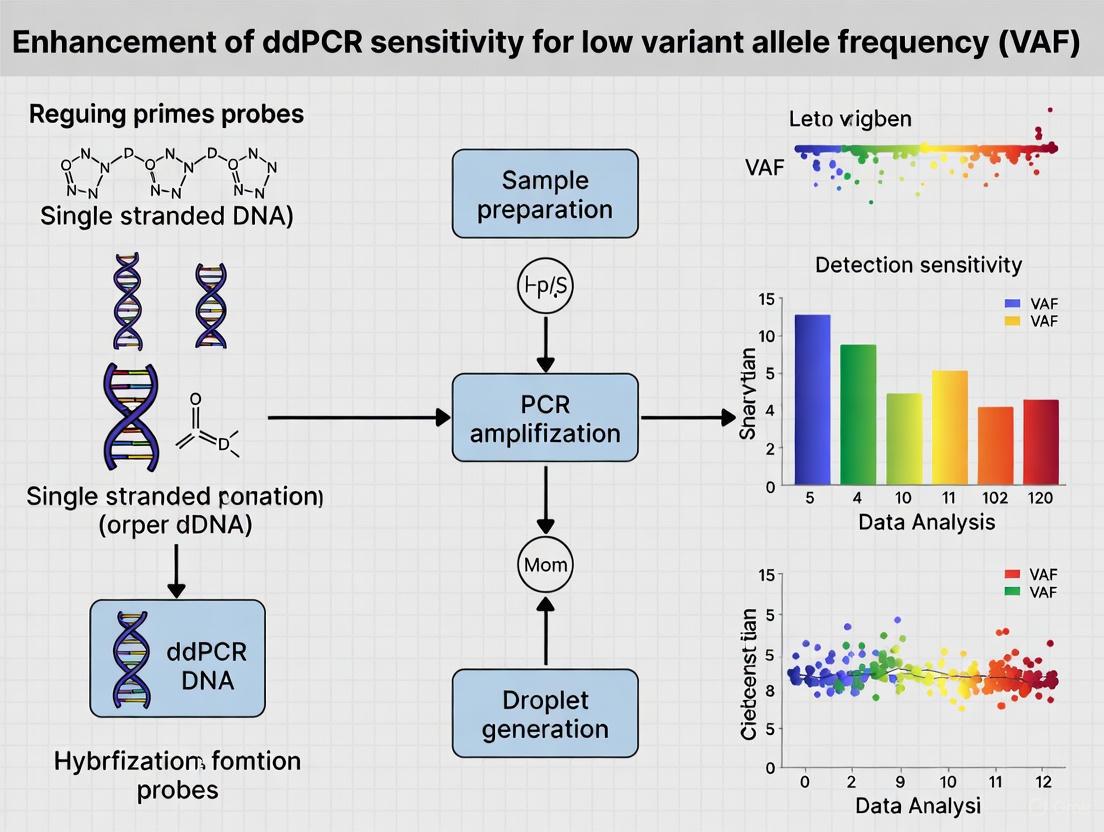
Droplet Digital PCR (ddPCR) has emerged as a powerful tool for the absolute quantification of nucleic acids, offering exceptional sensitivity for detecting low variant allele frequencies (VAF) crucial in oncology,...
Optimizing ddPCR for Ultra-Sensitive Low VAF Detection: A Guide for Biomedical Researchers
Abstract
Droplet Digital PCR (ddPCR) has emerged as a powerful tool for the absolute quantification of nucleic acids, offering exceptional sensitivity for detecting low variant allele frequencies (VAF) crucial in oncology, pathogen detection, and minimal residual disease monitoring. This article provides a comprehensive guide for researchers and drug development professionals on enhancing ddPCR sensitivity. It explores the foundational principles of ddPCR technology, details advanced methodological applications, outlines systematic troubleshooting and optimization strategies to overcome common challenges like amplification bias, and presents rigorous validation frameworks through comparative performance analysis with other molecular techniques. The synthesized insights aim to empower scientists to reliably detect rare genetic variants and low-abundance pathogens, thereby accelerating diagnostics and therapeutic development.
Understanding ddPCR: Principles and Advantages for Low VAF Quantification
The polymerase chain reaction (PCR) has undergone a remarkable evolution since its inception, transforming from a basic DNA amplification technique to sophisticated quantitative and digital platforms that enable precise molecular measurements. This evolution began with the development of real-time quantitative PCR (qPCR) in the early 1990s, which allowed researchers to monitor amplification kinetics and quantify nucleic acids during the reaction process [1]. The subsequent emergence of digital PCR (dPCR) and its droplet-based variant (ddPCR) represented a paradigm shift by enabling absolute quantification without standard curves through limiting dilution and Poisson statistical analysis [2]. This technical progression has proven particularly valuable for applications requiring detection of rare genetic events and precise quantification, such as measuring low variant allele frequencies (VAF) in cancer research, liquid biopsies, and pathogen detection [2].
The fundamental distinction between these technologies lies in their quantification approach. While qPCR relies on relative quantification based on amplification curves and cycle threshold (Ct) values compared to standards, dPCR partitions samples into thousands of individual reactions, allowing absolute quantification by counting positive and negative partitions [3]. This technical guide explores the evolution of PCR technologies, their comparative strengths, and provides practical troubleshooting guidance for researchers working with these powerful molecular tools.
Technical Comparison: qPCR versus Digital PCR
Operational Characteristics and Performance Metrics
The selection between qPCR and dPCR requires careful consideration of their operational characteristics, particularly for sensitive applications such as detecting low VAF mutations in circulating tumor DNA (ctDNA). The table below summarizes their key performance metrics based on current literature and practical implementations.
Table 1: Performance comparison between qPCR and dPCR technologies
| Parameter | qPCR | dPCR | Implications for Low VAF Research |
|---|---|---|---|
| Quantification Method | Relative (based on standard curve) | Absolute (by counting positive partitions) | dPCR eliminates standard curve variability |
| Theoretical Sensitivity | 0.1–1% VAF [3] | 0.001–0.01% VAF [2] [3] | dPCR superior for rare allele detection |
| Precision | Moderate | High [3] | dPCR provides better reproducibility for low-abundance targets |
| Dynamic Range | 7–8 logarithmic decades | 5 logarithmic decades [3] | qPCR better for samples with wide concentration ranges |
| Multiplexing Capability | High (multiple fluorescence channels) | Moderate (limited by partition number) [3] | qPCR preferred for multi-target detection |
| Throughput | High (96- or 384-well plates) | Moderate to high (increasing with newer systems) | qPCR historically higher throughput |
| Cost per Reaction | $0.2–$5 [3] | $5–$15 (higher for custom probes) [2] | Budget considerations important for large studies |
| Tolerance to Inhibitors | Moderate | High [3] | dPCR more robust for complex samples |
| Operational Complexity | Moderate | Low to moderate (after partition generation) | dPCR simpler data interpretation |
Practical Implementation in Research Settings
The practical implementation of these technologies varies significantly based on research goals. A 2025 study comparing ddPCR and next-generation sequencing (NGS) for ctDNA detection in rectal cancer demonstrated ddPCR's superior sensitivity, detecting ctDNA in 58.5% of baseline plasma samples compared to 36.6% with NGS (p = 0.00075) [2]. This enhanced detection capability comes with operational trade-offs; while ddPCR operational costs are 5–8.5-fold lower than NGS, custom probes for rare mutations may be cost-prohibitive [2].
For research requiring absolute quantification of rare targets, dPCR provides significant advantages. Its partitioning approach effectively enriches rare alleles, enabling detection at frequencies as low as 0.001% under optimal conditions [3]. This sensitivity makes dPCR particularly valuable for liquid biopsy applications where ctDNA often represents less than 0.1% of total cell-free DNA in early-stage cancers [2].
Troubleshooting Guides: Addressing Common Experimental Challenges
Low Amplification Efficiency or No Signal
Table 2: Troubleshooting low amplification efficiency
| Problem | Potential Causes | Recommended Solutions |
|---|---|---|
| No amplification | Poor template quality/quantity [4] | Assess DNA integrity by gel electrophoresis; quantify using fluorometry [4] [5] |
| Inhibitors in sample [5] | Re-purify DNA; add BSA (0.1-1 μg/μL) or use inhibitor-resistant polymerases [4] [5] | |
| Suboptimal primer design [4] | Verify primer specificity; check for secondary structures; redesign if necessary | |
| Low yield | Insufficient enzyme activity [4] | Increase polymerase amount; verify storage conditions; use fresh aliquots |
| Suboptimal Mg²⁺ concentration [4] | Titrate Mg²⁺ (typically 1.5–4 mM); adjust based on polymerase requirements | |
| Inadequate cycling conditions [4] | Increase cycle number (up to 40 for low-copy targets); optimize annealing temperature | |
| Inconsistent replicates | Pipetting inaccuracies [4] | Calibrate pipettes; use master mixes; ensure homogeneous reagent mixing |
| Well position effects [4] | Use validated plates; check thermal cycler calibration; avoid edge effects |
Specificity and Background Issues
Table 3: Addressing specificity problems
| Problem | Potential Causes | Recommended Solutions |
|---|---|---|
| Non-specific amplification | Low annealing temperature [4] | Increase temperature incrementally (1–2°C steps); use gradient cycler |
| Excess enzyme or Mg²⁺ [4] | Reduce polymerase amount; decrease Mg²⁺ concentration | |
| Primer issues [5] | Implement hot-start polymerase; optimize primer concentration (0.1–1 μM) | |
| Primer-dimer formation | Complementary primer sequences [5] | Redesign primers with minimal 3' complementarity; use design tools |
| High primer concentration [5] | Reduce primer concentration (start with 0.1–0.5 μM) | |
| Long annealing times [5] | Shorten annealing step; increase temperature | |
| Smeared bands | Excessive cycle number [5] | Reduce cycles (typically 25–35); increase input DNA if possible |
| Contaminating DNA [5] | Implement physical separation (pre- and post-PCR areas); use new primers | |
| Degraded template [4] | Assess DNA integrity; use fresh extraction methods |
Frequently Asked Questions (FAQs)
Technology Selection and Implementation
Q1: When should I choose dPCR over qPCR for my research project? A: dPCR is particularly advantageous when you require: (1) absolute quantification without standard curves, (2) detection of rare sequence variants (<1% VAF), (3) work with limited samples where high precision is needed, or (4) analysis of samples containing PCR inhibitors that affect qPCR efficiency [2] [3]. For high-throughput routine quantification where extreme sensitivity isn't critical, qPCR often remains more practical and cost-effective.
Q2: What are the key factors affecting sensitivity in low VAF detection using ddPCR? A: Key factors include: (1) input DNA quantity and quality, (2) partitioning efficiency (number of droplets), (3) probe specificity and discrimination, (4) background error rate, and (5) template fragmentation [2]. Optimizing these parameters can push detection limits to 0.001% VAF for some applications, though 0.01% is more routinely achievable.
Q3: How does sample quality impact dPCR performance for liquid biopsy applications? A: Sample quality is critical. Hemolyzed samples can release genomic DNA, diluting the ctDNA fraction [2]. Proper blood collection tubes (e.g., Streck Cell-Free DNA BCT), rapid plasma separation (<6 hours), and optimized extraction methods are essential. The degree of DNA fragmentation also affects amplification efficiency and must be considered in assay design [2].
Optimization and Troubleshooting
Q4: What strategies can improve multiplexing in dPCR applications? A: While dPCR multiplexing is more challenging than qPCR, effective approaches include: (1) using probes with non-overlapping fluorescence signatures, (2) optimizing probe concentrations to minimize spectral overlap, (3) employing ratio-based multiplexing, and (4) using unique combinations of fluorescent signals for different targets [3]. However, the finite number of partitions ultimately limits multiplexing capability compared to qPCR.
Q5: How can I reduce background signal and improve signal-to-noise ratio in dPCR? A: Strategies include: (1) optimizing probe concentration to minimize free probe background, (2) increasing annealing temperature to improve specificity, (3) using blocker oligonucleotides to prevent primer-dimer formation, (4) implementing restriction enzyme digestion to reduce complex background, and (5) applying appropriate threshold setting during data analysis [2].
Q6: What are the most common sources of contamination in sensitive PCR applications, and how can they be prevented? A: Primary contamination sources include: (1) amplicon carryover from previous reactions, (2) cross-contamination between samples, (3) contaminated reagents, and (4) environmental DNA. Prevention strategies include: physical separation of pre- and post-PCR areas, use of uracil-DNA glycosylase (UNG) treatment, dedicated equipment and supplies, aerosol-resistant tips, and rigorous cleaning protocols [5].
Essential Research Reagent Solutions
Table 4: Key reagents and their functions in advanced PCR applications
| Reagent Category | Specific Examples | Function | Optimization Tips |
|---|---|---|---|
| Polymerases | Hot-start Taq, Proofreading enzymes | DNA amplification with reduced non-specific products [4] | Match polymerase to application: proofreading for cloning, standard for quantification |
| Specialized Buffers | Inhibitor-resistant buffers, GC enhancers | Overcome sample-specific challenges [4] | Titrate Mg²⁺ separately as it critically impacts efficiency [4] |
| Probes & Primers | Hydrolysis probes, Locked Nucleic Acids (LNA) | Specific detection, especially for rare alleles [2] | LNA probes improve discrimination for single-base variants [2] |
| Sample Preparation | Cell-free DNA kits, Magnetic beads | Isolation of high-quality nucleic acids [2] | Size selection can enrich for ctDNA (160-180 bp) vs. genomic DNA [2] |
| Digital PCR Reagents | Droplet generation oil, Surfactants | Partition stability and reaction compartmentalization [1] | Quality critically impacts partition integrity and results consistency |
Experimental Workflows and Signaling Pathways
Diagram 1: Comparative workflows of qPCR and dPCR technologies
The evolution from qPCR to third-generation digital PCR represents a significant advancement in molecular detection capabilities, particularly for challenging applications such as low VAF research. As these technologies continue to develop, emerging trends include increased automation, miniaturization for point-of-care applications, reduced costs through microfluidics, and enhanced computational analysis integration [1] [3]. The ongoing refinement of both qPCR and dPCR platforms ensures that researchers will have increasingly powerful tools for precise nucleic acid quantification, enabling new discoveries in basic research and clinical applications.
For researchers working at the sensitivity limits of these technologies, systematic optimization and troubleshooting remain essential for success. By understanding the fundamental principles, comparative strengths, and practical implementation considerations outlined in this guide, scientists can effectively leverage these powerful technologies to advance their research objectives.
Frequently Asked Questions (FAQs)
Q1: What is the core principle that allows digital PCR to achieve absolute quantification? Digital PCR (dPCR) enables absolute quantification of nucleic acids without the need for a standard curve through a method called sample partitioning. The sample is divided into thousands of individual reactions, or partitions, so that each contains zero, one, or a few target molecules. After end-point amplification, the partitions are analyzed as simply positive (containing the target) or negative (not containing the target). The absolute quantity of the target in the original sample is then determined using Poisson statistics, which accounts for the random distribution of molecules and calculates the concentration based on the ratio of positive to negative partitions [6] [7].
Q2: Why is my dPCR assay showing inconsistent results or poor precision? Poor precision often stems from issues related to sample partitioning or input amount. Key factors to check are:
- Incorrect Template Concentration: The average number of target copies per partition (λ) is critical. For precise quantification, λ should ideally be between 0.5 and 3, and must not exceed 5. A value that is too high or too low reduces the statistical power of the assay [8].
- Pipetting Errors: Inaccurate pipetting during sample or reagent preparation can introduce significant bias. It is recommended to analyze samples in duplicate or triplicate to mitigate this [8].
- Sample Purity: While dPCR is more tolerant than qPCR, contaminants like salts, alcohols, proteins, or heparin can inhibit the PCR reaction, leading to reduced fluorescence and poor discrimination between positive and negative partitions [8].
Q3: My assay lacks sensitivity for detecting rare mutations. How can I improve it? Enhancing sensitivity for low Variant Allele Frequency (VAF) targets involves optimizing several parameters:
- Chemistry Selection: Use hydrolysis probes (TaqMan) for superior specificity over DNA-binding dyes, as they minimize background from nonspecific products like primer-dimers [8].
- Primer and Probe Design: Primer and probe concentrations in dPCR are often higher than in qPCR (e.g., final primer concentration of 0.5–0.9 µM and probe at 0.25 µM). This increases fluorescence amplitude, improving the separation of specific signals from background noise [8].
- Specialized Primers: For rare single nucleotide variants (SNVs), consider using SuperSelective primers. These primers are designed with a long anchor and a very short foot sequence that spans the variant, providing exceptional selectivity for the mutant allele in a vast excess of wild-type DNA, enabling reliable detection of VAFs as low as 0.1% [9].
Q4: When should I use restriction digestion prior to a dPCR assay? Restriction digestion is recommended to ensure uniform template distribution, which is crucial for accurate Poisson-based quantification. You should digest your sample in the following cases [8]:
- Highly viscous samples that could affect pipetting accuracy.
- Linked or tandem gene copies (e.g., in plasmids), to ensure each copy is counted independently.
- Supercoiled plasmids, to linearize them and improve primer/probe accessibility.
- Large DNA molecules (>30 kb), to prevent uneven partitioning and over-quantification.
Important Note: The selected restriction enzyme must not cut within your amplicon sequence.
Troubleshooting Guides
Problem: Poor Cluster Separation in Data Analysis
Symptoms: Indistinct clusters of positive and negative populations, making it difficult to set a reliable threshold.
| Possible Cause | Solution |
|---|---|
| Suboptimal fluorescence amplitude | - Increase primer and/or probe concentrations within the optimal range (e.g., 0.5–0.9 µM for primers, 0.25 µM for probes) [8].- Check the integrity of fluorescently labeled probes; avoid repeated freeze-thaw cycles and store in appropriate buffers (e.g., TE buffer, pH 7.0 for Cy5 dyes) [8]. |
| PCR inhibitors in the sample | - Re-purify the nucleic acid template using dedicated kits to remove contaminants like salts, alcohols, or heparin [8].- Ensure your workspace and labware are decontaminated to avoid foreign DNA contamination [8]. |
| Nonspecific amplification | - Switch to a sequence-specific hydrolysis probe chemistry instead of DNA-binding dyes [8].- Re-optimize primer design to avoid secondary structures and self-complementarity. |
Problem: Inaccurate Quantification
Symptoms: Measured concentration does not match expectations; over- or under-quantification.
| Possible Cause | Solution |
|---|---|
| Template concentration outside optimal range | - Dilute or concentrate your sample so the average copies per partition (λ) is between 0.5 and 3 [8]. Use the formula below to calculate your input. |
| Non-uniform distribution of template | - For high-molecular-weight DNA, linked gene copies, or supercoiled plasmids, perform restriction digestion prior to the assay [8]. |
| Improper dilution factor calculation | - Correctly account for all dilution factors in your analysis software. The total dilution factor is the product of all individual dilutions (e.g., a 1:10 stock dilution added to a reaction at 1:16 volume gives a final factor of 1:160) [10]. |
ddPCR Workflow for Low VAF Detection
The following diagram illustrates the optimized workflow for detecting rare mutations, such as those with low Variant Allele Frequency (VAF), using droplet digital PCR (ddPCR).
Problem: Low Amplification Efficiency
Symptoms: Weak or absent fluorescence signal; low number of positive partitions.
| Possible Cause | Solution |
|---|---|
| Degraded or cross-linked template | - For strongly degraded samples (e.g., FFPE tissue, cfDNA), keep amplicons as short as possible [8].- Use dedicated DNA/RNA recovery kits designed for challenging sample types [8]. |
| Suboptimal thermal cycling conditions | - Use validated cycling protocols. If adapting a qPCR assay, its conditions can often be directly applied, but verification is recommended [8] [11].- Perform an annealing temperature gradient to find the optimal condition for your primer-template system [11]. |
Quantitative Data and Experimental Parameters
Table 1: Key Optimization Parameters for dPCR Assay Development
The following table summarizes critical parameters to optimize when developing a sensitive dPCR assay, particularly for low VAF applications.
| Parameter | Optimal Range / Condition | Technical Notes & Rationale |
|---|---|---|
| Template Input (λ) | 0.5 - 3 copies/partition [8] | Critical for Poisson statistics. Values >5 lead to inaccurate quantification. |
| Primer Concentration | 0.5 - 0.9 µM (final) [8] | Higher than typical qPCR; increases fluorescence signal amplitude. |
| Probe Concentration | ~0.25 µM (final) [8] | Higher than typical qPCR; enhances signal for better cluster separation. |
| Amplicon Length | As short as possible [8] | Essential for degraded samples (FFPE, cfDNA); improves efficiency. |
| Limit of Detection (LOD) | As low as 0.01% - 0.4% VAF [11] [9] | Dependent on chemistry. SuperSelective primers enable lower LOD for SNVs. |
| Sample Purity | High (A260/A280 ~1.8-2.0) [8] | Contaminants (salts, alcohols, heparin) reduce PCR efficiency and fluorescence. |
Table 2: Example Copy Number Calculation for Genomic DNA Input
Accurate quantification requires knowing how many copies of your target are in your sample. For single-copy genes in genomic DNA, use the formula and table below as a guide.
- Formula: Mass of 1 copy (g) = Genome Size (bp) × 1.096 × 10⁻²¹ g/bp [8]
- Example (Human): 3.3 × 109 bp × 1.096 × 10−21 g/bp = 3.3 pg
| Organism | Genome Size (bp) | Gene Copies in 10 ng gDNA (single-copy gene) [8] |
|---|---|---|
| Homo sapiens (Human) | 3.3 x 10⁹ | 3,000 |
| Zebrafish | 1.7 x 10⁹ | 5,400 |
| Saccharomyces cerevisiae | 1.2 x 10⁷ | 760,500 |
| Escherichia coli | 4.6 x 10⁶ | 2,000,000 |
Sensitivity Optimization Pathway
This diagram outlines the key decision points and methods for enhancing the sensitivity of a ddPCR assay to detect low VAF targets.
The Scientist's Toolkit: Key Research Reagent Solutions
| Item | Function & Application in Sensitive dPCR |
|---|---|
| SuperSelective Primers | Specialized primers for quantifying rare single-nucleotide variants (SNVs) with high selectivity in a wild-type background, enabling detection at VAFs ≤ 0.1% [9]. |
| Hydrolysis Probes (TaqMan) | Sequence-specific probes that provide high specificity and reduce background signal from nonspecific amplification, crucial for clear cluster separation [8]. |
| DNA-Binding Dyes (e.g., EvaGreen) | Intercalating dyes that bind all double-stranded DNA. Require high PCR specificity to avoid signal from primer-dimers or nonspecific products [8]. |
| Restriction Enzymes | Used to digest large, linked, or supercoiled DNA templates to ensure uniform distribution across partitions, which is vital for accurate Poisson-based quantification [8]. |
| High-Purity Nucleic Acid Kits | Dedicated kits for specific sample types (e.g., FFPE, cfDNA) to remove PCR inhibitors and recover high-quality template, maximizing amplification efficiency [8]. |
Frequently Asked Questions (FAQs)
Q1: Our lab is new to ddPCR. What are its core advantages over qPCR and NGS for low VAF detection?
ddPCR offers distinct benefits for detecting rare alleles, as shown in the table below.
| Method | Best For | Key Advantage for Low VAF | Quantification |
|---|---|---|---|
| Droplet Digital PCR (ddPCR) | Detecting known, specific mutations [12] | High sensitivity and precision; absolute quantification without standard curves [13] [11] | Absolute [13] |
| Quantitative PCR (qPCR) | High-throughput screening of known targets | Good sensitivity, but lower than ddPCR [13] | Relative (requires standard curve) [14] |
| Next-Generation Sequencing (NGS) | Discovering novel mutations; profiling many genes simultaneously [15] | Broader scope, but can have lower agreement for VAF vs. mutant molecules than ddPCR [12] | Relative [15] |
A key strength of ddPCR is its partitioning technology, which divides a sample into thousands of nanoliter-sized droplets and performs PCR on each one. This allows for the absolute quantification of target DNA molecules without the need for a standard curve, reducing variability and improving precision for low-abundance targets [13].
Q2: We are validating a ddPCR assay for a JAK2 V617F mutation. How can we optimize it for a Limit of Quantification (LoQ) of 0.01% VAF?
Optimizing a ddPCR assay requires fine-tuning several key parameters. One study successfully achieved a 0.01% VAF LoQ for JAK2 V617F by systematically optimizing the following [11]:
- Primer/Probe Sequences and Concentrations: Using specific primers and probes and optimizing their concentrations.
- Annealing Temperature: Testing a temperature gradient to find the optimal temperature for specific amplification.
- Template Amount: Determining the ideal input DNA quantity to maximize sensitivity while avoiding inhibition.
- PCR Cycle Number: Optimizing the number of amplification cycles to enhance signal while minimizing background.
Following a rigorous optimization process and comprehensive analytical validation, the study demonstrated excellent consistency with other methods (r = 0.988) [11].
Q3: Our ddPCR data shows a lot of "rain" (intermediate fluorescence between positive and negative droplets). How can we minimize this?
Rain can hinder clear threshold setting and accurate analysis. You can minimize its impact by optimizing assay parameters using an objective, computer-based algorithm. Key factors to optimize include [16]:
- Annealing/Extension Temperature: Use your thermocycler's gradient function to test a range of temperatures.
- Oligonucleotide Concentrations: Experiment with different concentrations of primers and probes (e.g., "normal" vs. "high" concentrations). An "experience matrix" can help you rate different assay parameter combinations visually, allowing you to select the best-suited conditions for your specific target [16].
Q4: For liquid biopsy cancer research, should we report results as Variant Allele Frequency (VAF) or mutant molecules per mL of plasma?
The choice of unit depends on your research goal. A 2020 study recommends considering the following [12]:
- Use VAF when the primary interest is the relative proportion of the mutant allele within the total cell-free DNA (cfDNA) population.
- Use mutant molecules per mL plasma when the goal is to monitor tumor load or concentration over time, as this measure accounts for the total cfDNA concentration in the sample, which itself has prognostic value [12]. The same study found that ddPCR showed greater agreement between the two units of measurement compared to NGS. Discordance was primarily linked to insufficient molecular coverage in NGS and high cfDNA concentration [12].
Troubleshooting Guides
Issue: Poor Separation Between Positive and Negative Droplet Clusters
Problem: The fluorescence clusters for positive and negative droplets are too close together, making it difficult to set a reliable threshold and call mutations accurately.
Solution: Follow this systematic troubleshooting workflow.
Steps:
- Check Primer/Probe Design and Concentrations: Ensure your primers and probes are specific for the target. Optimize their concentrations; one study used 900 nM for primers and 250 nM for probes as a "high" concentration option to improve the assay signal [16].
- Optimize Annealing Temperature: Run a thermal gradient during assay validation. The optimal annealing/extension temperature is a critical parameter for maximizing the fluorescence signal distance between positive and negative droplets [16].
- Evaluate Template DNA Quality and Quantity: Assess the quality of your input DNA. Too much or degraded DNA can increase background noise. The amount of template DNA is a key parameter to fine-tune during assay optimization [11].
- Assess for PCR Inhibition: If inhibitors are present in the sample, they can cause delayed amplification and increased rain. Purifying the DNA sample or diluting it can help mitigate this issue.
Issue: Low Sensitivity in Detecting Variants Below 0.5% VAF
Problem: The assay is unable to reliably detect very low-frequency mutations, which is critical for liquid biopsy applications.
Solution:
- Confirm LOD with Orthogonal Methods: Analytically validate your assay's Limit of Detection (LOD). For example, the Northstar Select liquid biopsy assay established a 95% LOD of 0.15% VAF for SNV/Indels, which was confirmed using ddPCR, ensuring reliable detection at low levels [15] [17].
- Ensure Sufficient Molecular Coverage: In NGS-based liquid biopsy tests, insufficient molecular coverage is a key factor that hampers reliable detection at low VAFs [12]. While this is specific to NGS, the principle of ensuring sufficient input molecules for reliable detection is universal.
- Utilize Unique Molecular Identifiers (UMIs): For NGS workflows, using UMIs allows for the correction of sequencing errors and the identification of individual mutated templates, which improves the sensitivity and accuracy of variant calling [12].
Table 1: Measured Sensitivity of Detection Technologies
This table summarizes the demonstrated sensitivity of various technologies as reported in the literature, providing a benchmark for assay performance.
| Technology | Application / Target | Reported Sensitivity | Source |
|---|---|---|---|
| ddPCR | JAK2 V617F Mutation | LoQ of 0.01% VAF | [11] |
| ddPCR | Lacticaseibacillus casei detection | 100 CFU/mL | [13] |
| NGS Liquid Biopsy (Northstar Select) | SNV/Indels (84-gene panel) | 95% LOD at 0.15% VAF | [15] [17] |
| NGS Liquid Biopsy (Northstar Select) | Gene Fusions | 95% LOD at 0.30% Tumor Fraction | [15] |
| NGS Liquid Biopsy (Northstar Select) | Copy Number Variations (Amplification) | 95% LOD at 2.11 copies | [15] |
Table 2: Key Optimization Parameters for ddPCR Assays
A summary of critical parameters that require optimization during assay development to achieve maximum sensitivity and precision.
| Parameter | Optimization Goal | Example / Comment |
|---|---|---|
| Annealing Temperature | Maximize fluorescence separation between positive/negative droplets | Use a thermal cycler with a gradient function [16] |
| Primer/Probe Concentration | Maximize signal-to-noise ratio | Test "normal" vs. "high" (e.g., 900nM/250nM) concentrations [16] |
| Template DNA Amount | Balance sensitivity with potential inhibition | Fine-tune input quantity; identified as a key parameter [11] |
| PCR Cycle Number | Ensure sufficient amplification for low-abundance targets | Optimized during assay development [11] |
The Scientist's Toolkit: Essential Research Reagent Solutions
Table 3: Key Reagents and Their Functions in ddPCR and Liquid Biopsy Workflows
| Item | Function / Application |
|---|---|
| ddPCR Supermix for Probes | A ready-to-use reaction mix containing DNA polymerase, dNTPs, and buffer, optimized for probe-based ddPCR reactions [16]. |
| Hydrolysis Probes (TaqMan) | Fluorescently-labeled probes that increase specificity by only emitting a signal upon cleavage during amplification of the target sequence. Crucial for distinguishing mutant from wild-type alleles [16]. |
| Unique Molecular Identifiers (UMIs) | Short DNA barcodes added to each DNA molecule before NGS amplification. They allow bioinformatic correction of PCR errors and enable accurate counting of original DNA molecules, improving sensitivity in liquid biopsy assays [12]. |
| Integrated Fluidic Circuits (IFCs) | Microchips that partition samples into thousands of nanoliter-scale reaction chambers. They are core to the operation of systems like the Fluidigm BioMark HD and Biomark X9, enabling high-throughput digital PCR [18] [19]. |
Core Definitions and Their Importance in Low VAF Research
What are LoB, LoD, and LoQ, and why are they critical for droplet digital PCR (ddPCR) in low VAF research?
In the detection of low-level somatic mosaicism, accurately defining the limits of your ddPCR assay is non-negotiable. The Limit of Blank (LoB), Limit of Detection (LoD), and Limit of Quantification (LoQ) are a hierarchy of metrics that describe the smallest concentration of an analyte that can be reliably measured.
- Limit of Blank (LoB): The highest apparent analyte concentration expected to be found when replicates of a blank sample (containing no analyte) are tested. It represents the "noise floor" of your assay [20].
- Limit of Detection (LoD): The lowest analyte concentration that can be reliably distinguished from the LoB. It is the point at which detection is feasible, though precise quantification may not be [20].
- Limit of Quantification (LoQ): The lowest concentration at which the analyte can not only be detected but also measured with acceptable precision and bias (i.e., quantitatively). The LoQ is always greater than or equal to the LoD [20].
For low Variant Allele Frequency (VAF) research—such as detecting somatic mosaicism in neurodevelopmental disorders or cancer—a highly sensitive LoD is paramount. Studies have identified pathogenic somatic variants with VAFs as low as 0.3% in focal brain malformations [21]. ddPCR is uniquely suited for this task, with demonstrated capabilities to detect variants at a LoD of approximately 0.008% (0.00008 VAF) [21]. Properly validating these metrics ensures that your positive signals are genuine and not artifacts, which is crucial when a low VAF result has diagnostic implications [22].
Variant Allele Frequency (VAF) is the percentage of sequence reads encoding a specific DNA variant at a given genomic position. In the context of somatic mosaicism, it reflects the proportion of cells within a sample that carry the mutation [23] [21].
The biological and clinical interpretation of VAF is critical:
- Tissue Distribution: VAF can vary significantly between different tissues (e.g., blood, buccal cells, hair follicles) due to the developmental timing of the somatic mutation and clonal expansion. One study found parental VAFs in blood ranging from 0.08% to 9%, while other tissues showed different distributions [23].
- Clinical Relevance: Even extremely low VAFs can be pathogenic. For example, a somatic MTOR variant with a VAF of only 0.3% has been confirmed as the cause of drug-resistant focal epilepsy [21].
- Informed Decision-Making: In clinical diagnostics, confirming a low-level somatic mosaic variant can provide diagnostic certainty, inform genetic counseling, and influence treatment strategies, such as justifying the use of an mTOR inhibitor [21].
Table 1: Key Performance Metrics for ddPCR in Low VAF Detection
| Metric | Definition | Typical Calculation | Importance in Low VAF Research |
|---|---|---|---|
| Limit of Blank (LoB) | Highest apparent result from a blank (analyte-free) sample. | Mean~blank~ + 1.645(SD~blank~) [20] | Defines the "noise floor." Essential for distinguishing true signal from background. |
| Limit of Detection (LoD) | Lowest concentration reliably distinguished from LoB. | LoB + 1.645(SD~low concentration sample~) [20] | Determines the faintest variant signal that can be confidently "detected." ddPCR LoD can be ~0.008% [21]. |
| Limit of Quantification (LoQ) | Lowest concentration measured with acceptable precision and bias. | LoQ ≥ LoD [20] | Defines the threshold for reliable "quantification." Critical for accurately reporting VAF. |
| Variant Allele Frequency (VAF) | Percentage of sequencing reads containing a specific variant. | (Variant Reads / Total Reads) × 100 [23] | Informs on mutation burden, tissue distribution, and clinical pathogenicity, even at levels <1% [23] [21]. |
Experimental Protocols for Establishing Critical Metrics
Protocol: Determining LoB and LoD for a ddPCR Assay
This protocol is adapted from established clinical laboratory guidelines [20] and applied to the context of ddPCR for rare variant detection.
1. Sample Preparation:
- LoB Determination: Prepare a minimum of 20 replicates of a blank sample. An appropriate blank could be a no-template control (NTC) with nuclease-free water or genomic DNA from a wild-type cell line known to be negative for the target variant [20] [24].
- LoD Determination: Prepare a minimum of 20 replicates of a sample with a low concentration of the analyte. This is ideally achieved using synthetic controls, such as gBlocks (synthetically generated double-stranded DNA fragments), spiked into a wild-type genomic DNA background at a VAF near the expected LoD [23] [24].
2. Running the Assay:
- Process all replicates (blank and low-concentration samples) through your optimized ddPCR protocol using the same reagents, thermocycler conditions, and droplet reader.
3. Data Analysis and Calculation:
- Calculate LoB: Measure the apparent VAF in each of the blank replicates.
- LoB = Mean~blank~ + 1.645 * (Standard Deviation~blank~)
- This formula establishes the threshold above which only 5% of blank sample results are expected to lie (assuming a Gaussian distribution) [20].
- Calculate LoD: Measure the VAF and standard deviation (SD) from the low-concentration sample replicates.
- LoD = LoB + 1.645 * (SD~low concentration sample~)
- This ensures that 95% of measurements from a sample at the LoD will exceed the LoB [20].
4. Verification:
- Confirm the calculated LoD by testing another set of samples at the LoD concentration. No more than 5% of these results should fall below the LoB [20].
Workflow for Determining LoB and LoD
Protocol: Orthogonal Validation of Low VAF Variants Using SuperSelective ddPCR (SP-ddPCR)
Next-generation sequencing (NGS) may first identify low VAF variants, but orthogonal validation is essential. This protocol uses SuperSelective primers in ddPCR for highly specific confirmation [24].
1. Primer and Probe Design:
- Design SuperSelective primers for the target SNV. These primers consist of:
- A long 5' "anchor" sequence (~20 nt) that strongly hybridizes to the target.
- A very short 3' "foot" sequence (~5 nt) that contains the interrogated variant nucleotide.
- A middle "bridge" sequence that does not hybridize, creating a single-stranded bubble that enhances selectivity [24].
- Design standard primers for a reference gene to quantify the total number of input DNA molecules.
2. Assay Optimization and LOD Establishment:
- Test primer specificity using in silico samples with 100% and 0% VAF [24].
- Generate a standard curve for quantification by creating a serial dilution of a synthetic mutant template (e.g., gBlock) in a wild-type background to simulate VAFs from 1.0% down to 0.0% [24].
- Run the dilution series with the SuperSelective primers via ddPCR. The LOD for the specific assay is defined as the average VAF of the 0% sample plus three times its standard deviation [24]. One study reported an average LOD of 0.18% using this method [24].
3. Validation of Clinical Samples:
- Run the optimized SP-ddPCR assay on patient DNA samples.
- The total number of target copies is quantified using the standard primers, and the mutant copies are quantified using the SuperSelective primers. VAF is calculated as (mutant copies / total copies) × 100 [24].
Troubleshooting Guides and FAQs
FAQ: Resolving Common Challenges in Low VAF Detection
Q1: Our ddPCR results show a signal in the no-template control (NTC). What could be the cause, and how can we address it?
- Potential Cause 1: Contamination. Amplicon contamination from previous PCR reactions is the most likely culprit.
- Solution: Use dedicated pre- and post-PCR laboratories. Use UV irradiation and DNA degradation solutions to clean workspaces and equipment. Prepare reaction mixes in a laminar flow hood [25].
- Potential Cause 2: Probe Degradation.
- Solution: Aliquot probes to avoid repeated freeze-thaw cycles. Ensure proper storage conditions.
Q2: We are unable to achieve the published LoD for our ddPCR assay. What factors should we investigate?
- Factor 1: Suboptimal Partitioning. Poor droplet generation can reduce effective sample partitioning.
- Solution: Check the droplet generator for proper function. Ensure samples and oil are at the correct temperature. Look for any precipitates in the sample that could clog the microfluidic channels.
- Factor 2: Inefficient Primer/Probe Design.
- Factor 3: Input DNA Quality.
- Solution: Assess DNA integrity (e.g., via gel electrophoresis or Bioanalyzer). Degraded DNA or inhibitors in the sample can reduce amplification efficiency. Purify DNA if necessary.
Q3: How can we ensure that a detected low VAF variant is a true somatic mutation and not a technical artifact?
- Strategy 1: Orthogonal Validation. Always confirm NGS findings with a different molecular technology, such as ddPCR [21] [24].
- Strategy 2: Independent Sample Replication. Repeat the assay on a separately extracted DNA sample from the same source to rule out sample-specific artifacts.
- Strategy 3: Tissue Concordance. If possible, test other tissues from the same individual. A true postzygotic mosaic variant will often show a different VAF in tissues derived from different germ layers, while artifacts will not [23].
Table 2: Research Reagent Solutions for ddPCR Assay Development
| Reagent / Material | Function | Application Notes |
|---|---|---|
| gBlock Gene Fragments | Synthetic double-stranded DNA controls. | Create standard curves for LoD/LoQ determination by spiking mutant sequences into wild-type DNA [23] [24]. |
| SuperSelective Primers | Primers with a unique structure for superior allele discrimination. | Enable detection of single-nucleotide variants in an excess of wild-type DNA, improving specificity for low VAF targets [24]. |
| Locked Nucleic Acid (LNA) Probes | High-affinity RNA analogs used in hydrolysis probes. | Increase the thermal stability of probe-target binding, enhancing specificity and discrimination for variant detection [21]. |
| Droplet Digital PCR Supermix | Optimized master mix for ddPCR. | Contains polymers and stabilizers essential for consistent and efficient droplet formation [23]. |
| Qubit dsDNA BR Assay | Fluorescent DNA quantification kit. | Provides highly accurate DNA concentration measurements, which is critical for absolute copy number determination in ddPCR [23]. |
Troubleshooting High Background Signal
FAQ: Understanding ddPCR's Advantage
Why is digital PCR (ddPCR) less affected by PCR inhibitors than quantitative PCR (qPCR)?
ddPCR is less affected by PCR inhibitors primarily because of its use of end-point measurements rather than relying on amplification kinetics. In qPCR, the quantification cycle (Cq) is linked to a standard curve, and any inhibition that skews Cq values will directly impair quantification. ddPCR simply counts the number of positive partitions at the end of the run, making it less sensitive to efficiency-reducing inhibitors [26].
Furthermore, the physical partitioning of the sample into thousands of nanodroplets contributes to this elevated resistance. This partitioning reduces interactions between inhibitor molecules and the components essential for the DNA polymerization process, effectively diluting the inhibitor's effect across the reaction [26].
Complex samples can introduce various inhibitory substances. The table below summarizes common inhibitors and their sources [26]:
| Inhibitor Category | Example Sources | Key Inhibitory Molecules |
|---|---|---|
| Environmental Samples | Soil, sediment, humic substances | Humic acid, fulvic acid [26] |
| Biological Fluids | Blood, plasma, serum | Hemoglobin, immunoglobulin G (IgG), lactoferrin, heparin, EDTA [26] |
| Tissue & Food Matrices | Plant tissues, minced meat, raspberries | Polysaccharides, polyphenols, proteins [26] [4] |
| Laboratory Reagents | DNA extraction chemicals | Phenol, ethanol, proteinase K, high salt concentrations (K+, Na+) [4] |
How does the performance of ddPCR compare to Next-Generation Sequencing (NGS) in the presence of inhibitors for low VAF targets?
For the detection of low-frequency targets like circulating tumor DNA (ctDNA), ddPCR generally demonstrates higher sensitivity than targeted NGS panels. A 2025 study on rectal cancer found that a tumor-informed ddPCR assay detected ctDNA in 58.5% (24/41) of baseline plasma samples, compared to a 36.6% (15/41) detection rate for an NGS panel, a statistically significant difference (p=0.00075) [2].
This superior sensitivity is crucial for low Variant Allele Frequency (VAF) research, as ddPCR can detect somatic alterations at frequencies as low as 0.01% VAF by dividing the reaction into tens of thousands of droplets and performing absolute quantification [2].
Troubleshooting Guide: Overcoming Inhibition in ddPCR
Problem: Inconsistent or Failed Amplification in Samples from Complex Matrices
Possible Causes and Recommended Solutions:
Cause: Co-purified inhibitors from the sample matrix.
- Solution: Use inhibitor-tolerant DNA polymerase blends. These specialized enzymes are engineered for high processivity and display greater resilience to common PCR inhibitors found in soil, blood, and plant tissues [26] [4].
- Solution: Re-purify the DNA extract. Precipitate and wash the DNA with 70% ethanol to remove residual salts or inhibitors. However, be aware that this can lead to substantial DNA loss, which is a critical consideration for low-abundance targets [26] [4].
Cause: Suboptimal primer design leading to nonspecific amplification and inhibition by genomic DNA.
- Solution: Optimize primer design. Primers with high G/C content, particularly at the 3' end, can produce significantly more nonspecificity and inhibition. Design primers with a higher Tm and consider terminating the 3' end with 1-4 A or T bases to enhance specificity [27].
- Solution: Increase the annealing temperature. This can decrease nonspecific binding and inhibit off-target amplification, a common issue in the presence of high genomic DNA [27].
Cause: Insufficient DNA polymerase concentration for the level of inhibition.
- Solution: Increase the amount of DNA polymerase in the reaction mixture. This can help overcome inhibition, as a higher enzyme concentration provides more active units to compete with the inhibitor molecules [27].
Experimental Protocol: Assessing Inhibitor Tolerance
Title: Evaluating the Impact of Humic Acid Inhibition on ddPCR vs. qPCR Performance
Objective: To quantitatively compare the tolerance of ddPCR and qPCR to a common environmental inhibitor (humic acid) using a standardized plasmid target.
Materials:
- Research Reagent Solutions:
- Inhibitor-Tolerant DNA Polymerase: A high-processivity enzyme (e.g., Phusion Flash) for robust amplification in impure samples [26].
- Humic Acid Stock Solution: Prepare a concentrated stock in molecular-grade water; filter sterilize [26].
- Standardized Plasmid Target: A plasmid containing the target sequence of interest at a known copy number [27].
- Hydrolysis Probe or Intercalating Dye: Depending on the detection chemistry for qPCR and ddPCR.
Methodology:
- Reaction Setup: Prepare a master mix containing the DNA polymerase, primers, probes, and a fixed copy number of the plasmid target.
- Inhibitor Spiking: Spike the master mix with a serial dilution of humic acid stock to create a concentration gradient (e.g., 0, 10, 50, 100, 200 ng/µL).
- Instrument Run: Split each inhibited master mix for parallel analysis:
- qPCR: Run in triplicate on a real-time PCR instrument. Record the Cq values for each reaction.
- ddPCR: Generate droplets and run on a droplet digital PCR system. Analyze for the number of positive/negative droplets and calculate the calculated concentration.
- Data Analysis:
- For qPCR, plot the Cq values against the inhibitor concentration. Increased Cq or amplification failure indicates inhibition.
- For ddPCR, plot the measured target concentration (copies/µL) against the inhibitor concentration. A significant deviation from the expected concentration indicates inhibition.
- Compare the point of complete amplification failure between the two technologies.
Workflow: Inhibitor Tolerance Testing
Comparative Data: qPCR vs. ddPCR Under Inhibition
Table 1: Performance comparison of qPCR and ddPCR in the presence of humic acid, a common environmental inhibitor. Data adapted from studies showing relative performance degradation with increasing inhibitor concentration [26].
| Humic Acid Concentration (ng/µL) | qPCR Performance (Cq Shift) | ddPCR Performance (% Deviation from Expected Concentration) |
|---|---|---|
| 0 | No shift (Baseline) | < 10% deviation |
| 50 | Moderate Cq increase (Δ 2-3) | < 20% deviation |
| 100 | Significant Cq increase (Δ >5) | ~ 30% deviation |
| 200 | Complete amplification failure | ~ 50% deviation |
| >200 | Complete amplification failure | Amplification may still occur |
Table 2: Key characteristics of humic substances that contribute to PCR inhibition [26].
| Property | Humic Acid | Fulvic Acid |
|---|---|---|
| Color/Solubility | Dark brown; soluble at neutral/alkaline pH | Yellowish; soluble at all pH levels |
| Molecular Weight | Up to ~100,000 Da | ~10,000 Da |
| Oxygen Content | Lower | Higher |
| Inhibition Mechanism | Interacts with DNA polymerase and nucleic acids | Interacts with DNA polymerase and nucleic acids |
Mechanism of Action: How Inhibitors Interfere and How ddPCR Resists
Inhibition Mechanisms
PCR inhibitors can disrupt amplification through several biochemical pathways, as illustrated in the diagram below [26]:
ddPCR's Resilient Design
The fundamental architecture of ddPCR confers inherent advantages against these mechanisms. The following diagram contrasts the operational principles of qPCR and ddPCR under inhibition [26]:
Advanced ddPCR Assay Development for Sensitive Biomarker Detection
Assay Design Strategies for Optimal Primer and Probe Specificity
FAQs and Troubleshooting Guides
This section addresses common challenges in droplet digital PCR (ddPCR) assay development, providing targeted solutions to enhance primer and probe specificity, particularly for detecting low variant allele frequencies (VAFs).
FAQ 1: How can I improve the specificity of my primers and probes to reduce false positives in low VAF detection?
False positives in low VAF detection can critically impact data interpretation. To enhance specificity:
- Empirically Determine Cut-Off Values: Relying solely on cycle threshold (Ct) values from quantitative PCR (qPCR) can be misleading. Use droplet digital PCR (ddPCR) to establish a logical, primer-probe set-specific cut-off value by correlating Ct values with absolute positive droplet counts. This method has been shown to define a specific cut-off of 36 cycles, effectively differentiating true positives in clinical specimens [28].
- Optimize Annealing Temperature (AT): Conduct assays at a higher annealing temperature (e.g., 62°C) to stringently favor specific binding. Systematic evaluation of amplification efficiency across different ATs can identify primer-probe sets that maintain robust performance under stricter conditions [28].
- Validate with Orthogonal Methods: Be aware that false-positive reactions can occur in both qPCR and ddPCR with stool and other complex samples. Using ddPCR to establish accurate cut-offs and validate findings can help identify these discrepancies. Subsequent techniques like shotgun metagenomic sequencing can help investigate the causes of non-specific amplification [28].
FAQ 2: What are the key parameters to optimize when developing a laboratory-developed ddPCR assay?
The performance of a lab-developed ddPCR assay hinges on the fine-tuning of several wet-lab parameters. A systematic optimization approach for a JAK2V617F mutation assay focused on five key areas [11]:
- Primer/Probe Sequences and Concentrations: Design specific sequences and empirically determine optimal concentrations to maximize signal-to-noise ratio.
- Annealing Temperature: Test a gradient of temperatures to find the ideal balance between specificity and efficiency.
- Template Amount: Titrate the input DNA quantity to ensure the reaction is within the dynamic range of the assay and does not inhibit droplet formation.
- PCR Cycle Number: Optimize the number of amplification cycles to ensure endpoint detection without increasing background fluorescence.
Through this rigorous process, the assay achieved a limit of quantification (LoQ) of 0.01% VAF, demonstrating high sensitivity and consistency with other methods [11].
FAQ 3: How can I design a specific multiplex ddPCR assay for complex samples?
Simultaneous detection of multiple targets, such as different foodborne pathogens, requires careful design to ensure each primer-probe set functions without interference [29].
- Target Single-Copy Genes: Select target genes that are present in a single copy within the genome to ensure accurate absolute quantification. For example, an assay for Salmonella Typhi, Staphylococcus aureus, Listeria monocytogenes, and Bacillus cereus targeted the ttrA/ttrC, GltS FMN-binding domain, invasion-related endopeptidase, and essC genes, respectively [29].
- In Silico and Experimental Specificity Testing: Use software to align primer and probe sequences against databases to check for homology and potential "hairpin" structures. Follow this with empirical testing using gDNA from a panel of related non-target strains to verify no cross-reactivity occurs [29].
- Fluorophore Selection and Validation: In a two-channel instrument, distribute probes labeled with different fluorophores (eAM and HEX) carefully. The established quadruplex assay showed a strong linear correlation (r² > 0.999) and low detection limits (7-9 copies/20µL) for each target, confirming its robustness [29].
Troubleshooting Guide: Addressing Common ddPCR Assay Problems
| Problem | Potential Cause | Recommended Solution |
|---|---|---|
| High background or false-positive signals in negative controls | Non-specific primer binding or probe degradation | Increase annealing temperature; re-design primers/probes with stricter specificity criteria; aliquot and store probes properly [28] [11]. |
| Low positive droplet count or failure to detect low VAF targets | Suboptimal primer/probe concentrations, insufficient template, or inefficient amplification | Titrate primer and probe concentrations; optimize the amount of input template; check PCR cycle number [11]. |
| Inconsistent results between replicates or failed droplet generation | Inadequate sample mixing, impure template, or issues with droplet generator | Vortex and mix samples thoroughly before loading; ensure template DNA is clean and free of inhibitors; service and maintain the droplet generator according to manufacturer instructions. |
| Distinguishing between highly homologous targets | Insufficient sequence divergence in the targeted region | Target a more variable genomic region; design probes to span areas of maximum discrepancy; accept that fluorescence amplitude differences may be the distinguishing factor [30]. |
Quantitative Data for ddPCR Assay Performance
The following tables summarize key performance metrics from validated ddPCR assays, providing benchmarks for sensitivity, specificity, and dynamic range.
Table 1: Analytical Sensitivity and Specificity of ddPCR Assays
| Assay Target | Specificity (Limit of Blank) | Limit of Detection (LOD) | Key Performance Metric |
|---|---|---|---|
| SNV/Indels (Liquid Biopsy) [15] | >99.9999% | 0.15% VAF | 95% LOD confirmed by ddPCR |
| CNV Amplification [15] | >99.9% | 2.11 copies | - |
| CNV Loss [15] | >99.9% | 1.80 copies | - |
| Gene Fusions [15] | >99.9% | 0.30% Tumor Fraction | - |
| JAK2V617F Mutation [11] | - | 0.01% VAF | Limit of Quantification (LoQ) |
| S. Typhi (Food) [29] | - | 8 copies/20µL | - |
Table 2: Dynamic Range of a Quadruplex Food Pathogen ddPCR Assay [29]
| Pathogen | Target Gene | Linear Range (copies/20µL) | Correlation Coefficient (r²) |
|---|---|---|---|
| Salmonella enterica Typhi | ttrA/ttrC | 33 - 21,500 | > 0.999 |
| Staphylococcus aureus | GltS FMN-binding domain | 28 - 18,400 | > 0.999 |
| Listeria monocytogenes | Invasion-related endopeptidase | 25 - 27,000 | > 0.999 |
| Bacillus cereus | essC | 15 - 15,600 | > 0.999 |
Detailed Experimental Protocols
Protocol 1: Optimizing a TaqMan-based ddPCR Assay Using Primer-Probe Set Screening [28]
This protocol describes a method to select highly efficient primer-probe sets and establish a data-driven cut-off value.
- Primer-Probe Design: Design multiple primer-probe sets (e.g., 20 sets) targeting the gene of interest.
- Initial Screening with ddPCR: Amplify samples using different primer-probe sets at standard (e.g., 30 cycles) and high (e.g., 50 cycles) PCR cycles, and at different annealing temperatures.
- Efficiency Metrics: Evaluate amplification efficacy by measuring the absolute positive droplet (APD) counts and the mean fluorescence intensity of the droplets.
- Set Selection: Identify candidate sets that maintain high amplification efficiency at both low and high cycle numbers and perform robustly at higher annealing temperatures (e.g., 62°C).
- Determine Cut-Off Value:
- Generate a standard curve by plotting the Ct values from qPCR against the square of the APD counts from ddPCR.
- The Ct value is inversely proportional to the square of the APD. The specific cut-off Ct value (e.g., 36 cycles) can be determined from this relationship to differentiate true positives from background.
Protocol 2: Establishing a Laboratory-Developed ddPCR Assay for Somatic Mutations [11]
This protocol outlines a generalizable workflow for optimizing a ddPCR assay for a specific mutation, such as JAK2V617F.
- Parameter Optimization: Systematically fine-tune the following five parameters:
- Primer/Probe Sequences: Design to target the mutation specifically.
- Primer/Probe Concentrations: Test a range of concentrations to find the optimal balance.
- Annealing Temperature: Perform a temperature gradient experiment.
- Template Amount: Test different input amounts of DNA (e.g., 10-100 ng).
- PCR Cycle Number: Evaluate cycles between 40-50.
- Analytical Validation:
- Limit of Blank (LoB): Run no-template controls and wild-type samples to establish the background.
- Limit of Detection (LOD) & Quantification (LoQ): Use serially diluted positive control material to determine the lowest VAF that can be reliably detected and quantified. The LoQ can be defined as the lowest value with a coefficient of variation (CV) below an acceptable threshold (e.g., <80%).
- Comparative Analysis: Perform a correlation study with an established method, such as quantitative PCR (qPCR), on a set of patient samples to validate clinical performance.
Protocol 3: Specificity Testing for a Multiplex ddPCR Assay [29]
This protocol ensures that each primer-probe set in a multiplex reaction is specific to its intended target.
- In Silico Specificity Validation:
- Use sequence alignment software (e.g., DNAStar) to align the proposed primer and probe sequences against genomic databases.
- Check for potential secondary structures like "hairpins" and exclude primers/probes that form them.
- Wet-Lab Specificity Analysis:
- Extract genomic DNA from a panel of bacterial strains, including the target organisms and a wide range of non-target, closely related species.
- Perform qPCR or ddPCR reactions using each primer-probe set individually against all gDNA samples.
- Analyze the results to confirm that fluorescence signals are generated only for the intended target species and not for any non-target species.
Workflow and Relationship Diagrams
Assay Design and Validation Workflow
Troubleshooting Common ddPCR Issues
The Scientist's Toolkit: Research Reagent Solutions
Table 3: Essential Reagents and Kits for ddPCR Assay Development
| Item | Function in Assay Development | Example Context / Note |
|---|---|---|
| High-Fidelity DNA Polymerase | Ensures accurate amplification with low error rates during PCR. | Critical for all ddPCR applications to minimize amplification mistakes [31]. |
| LunaScript RT Master Mix | Provides a ready-to-use mix for consistent and efficient reverse transcription in RNA virus assays. | Used in optimized multisegment RT-PCR for influenza A virus WGS [31]. |
| Multiplex PCR Primer Pool | Allows simultaneous amplification of multiple targets (e.g., HLA loci) in a single reaction. | Concentrations of each primer set must be optimized for balanced amplification [32]. |
| Species-Specific Primer/Probe Sets | Enable highly specific detection and quantification of a target organism or gene. | Designed for cytochrome b gene to detect cryptic blind mole rat species from soil eDNA [30]. |
| Droplet Digital PCR Supermix | A specialized buffer formulation that enables stable droplet formation and efficient PCR amplification within droplets. | A core component of any ddPCR reaction workflow. |
| NGS Library Prep Kit (e.g., ExpressPlex) | Streamlines the preparation of sequencing libraries from PCR amplicons, enabling high-throughput validation. | Can be automated to prepare over 1,500 libraries in 24 hours for plasmid or amplicon sequencing [33]. |
FAQs: Troubleshooting Sensitivity for Low VAF Detection
Q1: How can I optimize annealing temperature to improve detection of rare variants in ddPCR?
A: Fine-tuning the annealing temperature is a critical first step. A suboptimal temperature can lead to poor primer binding specificity, causing false positives from non-specific amplification or false negatives from inefficient target amplification. You should perform a gradient ddPCR experiment, testing a range of temperatures (e.g., 55–65°C) in parallel. The optimal temperature is the one that maximizes the separation between positive and negative droplet clusters and yields the expected copy number for control samples. One study optimizing a SARS-CoV-2 assay found 53.5°C to be ideal for their primer-probe sets [34]. For a JAK2 V617F assay, an annealing temperature of 57°C was established through a similar optimization process [35].
Q2: My ddPCR shows high background noise or rain when detecting low-frequency mutations. What thermal cycling parameters can I adjust?
A: "Rain" (droplets with intermediate fluorescence) can obscure the clear discrimination of positive and negative clusters. To mitigate this, you can optimize the thermal cycling protocol by:
- Increasing the number of cycles: Enhancing the amplification signal for genuine low-abundance targets. Protocols often use 40-45 cycles for sensitive detection [35] [36].
- Optimizing ramp rates: Slower ramp rates between temperature steps can improve the efficiency and consistency of droplet PCR amplification.
- Validating with controls: Always include no-template controls (NTC) and wild-type genomic DNA controls to establish the baseline background signal and accurately set your detection threshold [9].
Q3: What is a systematic approach to validating the sensitivity and precision of my optimized low-VAF ddPCR assay?
A: After optimizing key parameters, a comprehensive validation of analytical performance is essential.
- Limit of Blank (LoB): Run at least 20 replicates of no-template and wild-type DNA controls to determine the background level. The LoB is typically calculated as the mean background signal + 1.645 times its standard deviation [36].
- Limit of Detection (LoD): Prepare serial dilutions of the mutant target in a wild-type background to create low VAF samples (e.g., 1%, 0.5%, 0.1%). Test multiple replicates (e.g., 20-70 per concentration) and use probit regression analysis to determine the lowest concentration detectable with 95% confidence [34] [36].
- Limit of Quantification (LoQ): This is the lowest VAF that can be quantified with acceptable precision, often defined as a coefficient of variation (CV) < 25%. It is determined by testing replicate low-VAF samples and calculating the CV for the measured copy numbers [35] [36].
Optimization Data from Experimental Protocols
The following table summarizes key optimized parameters and performance metrics from published studies relevant to low-VAF detection.
Table 1: Experimental Optimization Parameters and Performance Outcomes
| Assay Target / Context | Optimized Annealing Temperature | Key Optimized Thermal Cycling Parameters | Critical Reagent Concentrations | Achieved Sensitivity (LOD/LOQ) |
|---|---|---|---|---|
| SARS-CoV-2 Detection [34] | 53.5 °C | 45 cycles of [94°C for 30s, 53.5°C for 1min] | Primer: 500 nM each, Probe: 250 nM | LOD: ~4 copies/reaction |
| JAK2 V617F Mutation [35] | 57 °C | 40 cycles of [95°C for 15s, 57°C for 60s] | Primer: 450 nM each, Probe: 250 nM | LOQ: 0.01% VAF (CV ~76%) |
| Plant Pathogen (P. nicotianae) [36] | 58 °C | 45 cycles of [94°C for 30s, 58°C for 1min] | Primer: 500 nM each, Probe: 250 nM | LOD determined with 95% CI via probit analysis |
| Rare Somatic SNVs [9] | Assay-specific | - | Uses SuperSelective primers | Average LOD: 0.18% VAF |
Detailed Experimental Protocol for Parameter Optimization
This protocol outlines the systematic optimization of annealing temperature and thermal cycling conditions for a duplex ddPCR assay, based on methodologies used in the cited research [34] [35] [9].
1. Reagent Preparation:
- Prepare a 20 µL ddPCR reaction mix containing:
- 10 µL of 2x ddPCR Supermix for Probes.
- Primers and Probes: Start with a final concentration of 450-500 nM for each primer and 250 nM for each probe. These concentrations often serve as a robust starting point [35] [36].
- Template DNA: Use a well-characterized positive control sample (e.g., a synthetic DNA template with known mutation or a reference material) with a target VAF of 1-5%. Input 10-100 ng of genomic DNA.
- Nuclease-free water to volume.
2. Droplet Generation:
- Follow the manufacturer's instructions for your ddPCR system (e.g., QX200 Droplet Generator) to partition the reaction mixture into nanoliter-sized droplets.
3. Gradient Thermal Cycling:
- Program a thermal cycler with a gradient block for the annealing/extension step.
- Use the following cycling protocol, adapted from standard procedures [34] [35]:
- Initial Denaturation: 95°C for 10 minutes.
- Amplification Cycles (40-45 cycles):
- Denaturation: 94°C for 30 seconds.
- Annealing/Extension: Gradient from 55°C to 65°C for 1 minute.
- Final Enzyme Deactivation: 98°C for 10 minutes.
- Hold: 4°C.
4. Droplet Reading and Analysis:
- Read the droplets using a droplet reader (e.g., QX200 Droplet Reader).
- Analyze the data using the accompanying software (e.g., QuantaSoft). For each annealing temperature, assess:
- Cluster Separation: The clarity and distance between positive and negative droplet populations.
- Amplitude: The intensity of the fluorescence signal from positive droplets.
- "Rain": The number of droplets with intermediate fluorescence; less rain is better.
- Calculated Copy Number: The concentration (copies/µL) should align with expectations for the control sample.
5. Final Validation:
- Select the annealing temperature that provides the best cluster separation, highest signal amplitude, and most accurate quantification.
- Using this optimal temperature, validate the assay's sensitivity (LoD) and precision (LoQ) using serial dilutions of mutant DNA in wild-type DNA, as described in the FAQ section [9] [36].
Workflow and Troubleshooting Diagrams
Diagram 1: Optimization workflow and troubleshooting guide.
The Scientist's Toolkit: Research Reagent Solutions
Table 2: Essential Reagents for ddPCR Assay Development
| Reagent / Material | Function / Role in Optimization | Example from Literature |
|---|---|---|
| ddPCR Supermix for Probes | Provides optimized buffer, dNTPs, polymerase, and dye for probe-based digital PCR reactions. | Used universally in all cited protocols [34] [35] [36]. |
| Sequence-Specific TaqMan Probes | Fluorogenic hydrolysis probes (e.g., FAM/VIC-labeled) provide high specificity for target discrimination, crucial for low-VAF detection. | Used for SARS-CoV-2 N and S genes [34] and JAK2 V617F/WT alleles [35]. |
| SuperSelective Primers | Specialized primers that preferentially amplify mutant alleles in a vast excess of wild-type DNA, enabling detection of very rare SNVs. | Used to validate low-VAF somatic mutations identified by NGS [9]. |
| International Reference Panels | Calibrators with certified VAFs (e.g., WHO JAK2 V617F panel) used for assay calibration, determining accuracy, and establishing limits of detection. | Used to assess accuracy of the JAK2 V617F ddPCR assay [35]. |
| Nuclease-Free Water & Low-Bind Tubes | Prevents degradation of reagents and template, and minimizes adsorption of nucleic acids to tube walls, which is critical for accurate quantification of low-concentration targets. | Implied in all molecular protocols for sample and reagent preparation. |
Template Input and PCR Cycle Number Balancing for Maximized Sensitivity
Frequently Asked Questions (FAQs)
1. How do I calculate the optimal template input for my ddPCR experiment? The optimal template input is determined by the desired number of copies per partition and the technical specifications of your digital PCR system. The goal is to have an average of 0.5 to 3 target copies per partition for precise quantification [8]. You can calculate the required mass of genomic DNA (gDNA) using the formula below, which is based on the haploid genome size of your organism [8]:
- Formula: Genome Size (bp) × Average Weight of a Single Base Pair (1.096 × 10^–21 g/bp) = Mass per Haploid Genome (g)
- Example for Human gDNA: The human genome is approximately 3.3 × 10^9 bp. Therefore, the mass per haploid genome is 3.3 × 10^9 bp × 1.096 × 10^–21 g/bp = 3.6 × 10^–12 g, or 3.6 picograms (pg). This means one copy of a single-copy gene is contained in 3.6 pg of human gDNA.
The table below provides examples for various organisms [8]:
Table: Guide to Template Copy Number Calculation for Genomic DNA
| Organism | Genome Size (base pairs) | Gene Copies (per 10 ng gDNA) |
|---|---|---|
| Homo sapiens | 3.3 x 10⁹ | 3,000 |
| Zebrafish | 1.7 x 10⁹ | 5,400 |
| Saccharomyces cerevisiae | 1.2 x 10⁷ | 760,500 |
| Escherichia coli | 4.6 x 10⁶ | 2,000,000 |
2. What is the recommended number of PCR cycles for ddPCR, especially for low VAF targets? For standard ddPCR applications, 40 cycles is commonly used and has been effectively implemented in assays designed for sensitive detection of low-frequency mutations like JAK2V617F and BRAF p.V600E [37] [11] [38]. This cycle number provides a robust balance, allowing sufficient amplification of rare targets while avoiding the plateau phase where reaction efficiency drops due to reagent depletion [39] [40]. While more than 45 cycles is generally not recommended in conventional PCR due to increased nonspecific amplification [39], the partitioned nature of ddPCR reduces this risk. The optimal cycle number should be determined during assay validation.
3. My ddPCR shows low sensitivity. How can I optimize my template and cycle number? Low sensitivity often stems from suboptimal template quality, quantity, or amplification conditions. Follow this systematic approach:
- Verify Template Purity: Contaminants like salts, alcohols, or phenolic compounds can inhibit amplification. Re-purify your nucleic acid samples using dedicated kits [8].
- Optimize Template Input Amount: Test a range of template concentrations to ensure the copy number per partition falls within the ideal 0.5-3 range. Overloading partitions can lead to inaccurate quantification [8].
- Check Template Integrity: For degraded samples (e.g., FFPE tissue or cell-free DNA), use shorter amplicons (80-200 bp) to improve amplification efficiency [8] [40].
- Consider Cycle Number: If template input is limited (e.g., fewer than 10 copies), ensuring an adequate number of cycles (e.g., up to 40) is critical for capturing the target [39] [37].
4. How does ddPCR sensitivity compare to qPCR for low VAF detection? ddPCR consistently demonstrates superior sensitivity for detecting low VAF mutations. A direct comparison in detecting the BRAF p.V600E mutation showed that while qPCR could detect mutations down to a 0.5% VAF in high-concentration samples, its limit of detection (LoD) worsened to 5% VAF as target concentration decreased. In contrast, ddPCR robustly achieved a 0.1% VAF detection even in low-concentration samples, making it the more powerful tool for clinical diagnostics of rare variants [38]. Similarly, an FHV-1 assay showed a ddPCR LoD of 0.18 copies/μL, significantly more sensitive than the qPCR LoD of ~10 copies/μL [37].
Table: Comparison of qPCR and ddPCR for Low Abundance Targets
| Parameter | Quantitative PCR (qPCR) | Droplet Digital PCR (ddPCR) |
|---|---|---|
| Limit of Detection (LoD) | ~10 copies/μL (for a specific FHV-1 assay) [37] | 0.18 copies/μL (for a specific FHV-1 assay) [37] |
| Variant Allele Frequency (VAF) | 0.5% - 5%, dependent on total DNA concentration [38] | 0.1% reliably, even at low DNA concentrations [38] |
| Quantification Method | Relative (compared to a standard curve) or comparative (ΔΔCq) [41] | Absolute, without the need for a standard curve [37] [11] |
| Key Advantage for Low VAF | Widely accessible technology | Unmatched sensitivity and precision for quantifying rare mutations [11] [38] |
Troubleshooting Guides
Problem: Inconsistent or Failed Amplification in Partitions
Potential Cause 1: Poor Template Quality or Purity Inhibitors present in the sample can severely reduce PCR efficiency.
- Solution:
- Re-purify the DNA template using spin-column kits designed to remove common inhibitors like salts, alcohols, or polysaccharides [8].
- For complex templates like high-molecular-weight gDNA or supercoiled plasmids, perform restriction digestion prior to ddPCR. This reduces viscosity, linearizes DNA, and physically separates linked gene copies, leading to more even partitioning and accurate quantification. Ensure the restriction enzyme does not cut within your amplicon sequence [8].
Potential Cause 2: Suboptimal PCR Cycling Parameters The cycling conditions may not be fully optimized for your specific assay.
- Solution:
- Annealing Temperature: Use a gradient thermal cycler to determine the optimal annealing temperature for your primer set. A good starting point is 3–5°C below the primer's melting temperature (Tm) [39].
- Extension Time: Ensure the extension time is sufficient for your polymerase to synthesize the full amplicon. While Taq polymerase may require ~1 minute/kb, other enzymes (e.g., Pfu) may need 2 minutes/kb. "Slow" enzymes will require more time for comparable yields [39].
- Final Extension: Include a final extension step (e.g., 5-15 minutes) to ensure all products are fully elongated, which improves yield and is essential for applications like TA cloning [39].
Problem: Low Signal for Low VAF Targets
Potential Cause: Insufficient Number of PCR Cycles With a very low starting copy number, the amplification may not reach a detectable level within a standard number of cycles.
- Solution:
- Increase Cycle Number: For very rare targets (e.g., <10 copies), increasing the PCR cycle number to 40 cycles can be necessary to amplify the target to a detectable level within the partitions [39] [37]. The partitioned nature of ddPCR helps mitigate the risk of nonspecific amplification that can occur with high cycle numbers in traditional PCR [39] [38].
Experimental Protocol: Optimizing a ddPCR Assay for Low VAF Detection
This protocol outlines the key steps for developing and optimizing a droplet digital PCR assay, based on methodologies used to detect JAK2V617F and other low-frequency mutations [37] [11].
1. Primer and Probe Design
- Design primers and a TaqMan hydrolysis probe targeting a highly conserved region of your gene of interest. Amplicon length should ideally be between 80-200 bp [37] [40].
- Verify specificity using tools like Primer-BLAST.
- For ddPCR, use higher primer and probe concentrations than in qPCR to increase fluorescence amplitude. Optimal concentrations are often found at 500-900 nM for primers and 250 nM for the probe [8].
2. Reaction Setup and Optimization
- Prepare a 15-20 μL reaction mixture containing ddPCR supermix, optimized primer/probe concentrations, and your DNA template [37].
- Optimize Annealing Temperature: Perform a temperature gradient experiment (e.g., testing 56°C, 58°C, 60°C, 62°C, 64°C) using a positive control to identify the temperature that gives the best separation between positive and negative droplets [37].
- Generate Droplets: Follow the manufacturer's instructions for your droplet generator.
3. PCR Amplification
- Use the following thermal cycling protocol as a starting point, which has been validated for sensitive detection [37] [38]:
- Initial Denaturation/Enzyme Activation: 95°C for 10 minutes.
- Amplification (40 cycles):
- Denaturation: 96°C for 20 seconds.
- Annealing/Extension: 60°C for 60 seconds.
- Hold: 4°C or 25°C for storage.
- Ramp rates should follow the manufacturer's recommendation for the specific ddPCR system.
4. Data Analysis
- Read the plate or droplets using the digital PCR system's reader.
- Analyze the data using the accompanying software. The software will apply Poisson statistics to calculate the absolute concentration (copies/μL) and, for mutation assays, the variant allele frequency (VAF) [37] [11].
Signaling Pathways and Workflows
Diagram: ddPCR Assay Optimization Workflow
The Scientist's Toolkit: Research Reagent Solutions
Table: Essential Reagents for Sensitive ddPCR Assay Development
| Reagent / Material | Function / Role in Sensitivity | Key Consideration |
|---|---|---|
| High-Purity Nucleic Acid Kit | Extracts template DNA/RNA while removing PCR inhibitors (e.g., salts, alcohols, nucleases). | Purity is critical for achieving high PCR efficiency and clear fluorescence separation [8]. |
| TaqMan Hydrolysis Probes | Sequence-specific oligonucleotides that provide a fluorescent signal upon cleavage during amplification. | Higher specificity than DNA-binding dyes, crucial for discriminating low VAF mutations [8]. |
| Hot-Start DNA Polymerase | Reduces non-specific amplification and primer-dimer formation by requiring heat activation. | Improves assay specificity and signal-to-noise ratio, especially in early cycles [39]. |
| Digital PCR Supermix | A specialized buffer formulation containing polymerase, dNTPs, and stabilizers optimized for partitioning. | Formulated to withstand the ddPCR process and ensure consistent amplification across all droplets [37]. |
| Standard/Control Plasmid | A cloned target sequence used for generating standard curves and determining assay limits. | Essential for validating assay sensitivity, specificity, and for absolute quantification [37]. |
Technical Support Center: Troubleshooting Guides and FAQs for ddPCR Sensitivity
Frequently Asked Questions (FAQs)
1. What are the key advantages of using ddPCR over other methods for detecting low VAF JAK2V617F? Droplet Digital PCR (ddPCR) provides absolute quantification of mutant alleles without the need for a standard curve and demonstrates superior sensitivity for detecting low-level variants. It is less susceptible to PCR inhibitors due to sample partitioning and can reliably detect variant allele frequencies (VAF) as low as 0.01% to 0.05%, unlike methods like next-generation sequencing (NGS) which typically have a routine detection limit around 0.6% to 2% [42] [11] [43]. This makes it invaluable for early disease detection and monitoring minimal residual disease.
2. My ddPCR results show poor separation between positive and negative droplets. What could be wrong? Insufficient droplet separation can often be traced to suboptimal reaction conditions. First, verify that your template DNA amount is appropriate; 20 ng per reaction is a commonly used starting point [43]. Second, ensure that your primer and probe concentrations are optimized; a final concentration of 450 nM for primers and 250 nM for probes has been successfully used in JAK2V617F assays [43]. Finally, confirm that the annealing temperature is optimized for your specific assay, with 55°C being a standard temperature to test [43].
3. How do I calculate the concentration of my target DNA in the original stock solution? The calculation requires accounting for all dilution factors. You need to multiply the copies/µL result from the software by the overall dilution factor. For example, if you added 1 µL of a 1:10 diluted sample to a 16 µL reaction, the total dilution factor is (1/16) * 0.1 = 0.00625 (or 1:160). If the software reports 2,500 copies/µL, the concentration in your original stock would be 2,500 copies/µL / 0.00625 = 400,000 copies/µL [10].
4. Why is the sensitivity of ddPCR critical for studying JAK2V617F in myeloproliferative neoplasms? Highly sensitive detection is crucial because low allele frequencies of JAK2V617F can indicate early manifestations of MPN. One study found JAK2 V617F mutations with VAFs below the conventional 2% cutoff in patients with splanchnic vein thrombosis, a serious complication often associated with MPN. Detecting these low-level mutations increased the identified mutation prevalence in their cohort from 15.9% to 29.5%, significantly impacting diagnosis and understanding of disease progression [42].
Troubleshooting Common ddPCR Experimental Issues
| Problem Area | Specific Issue | Potential Causes | Recommended Solutions |
|---|---|---|---|
| Assay Design | Low amplification efficiency | Suboptimal primer/probe sequences or concentrations | Fine-tune primer and probe concentrations; validate assay with positive controls [11]. |
| Thermal Cycling | High background noise, poor resolution | Non-optimal annealing temperature | Perform a temperature gradient experiment to optimize annealing; 55°C is common [43]. |
| Template Input | Inaccurate quantification / failed reaction | Too much or too little DNA template | Use 1 µL of 20 ng/µL genomic DNA (20 ng total) as a starting point and titrate [43]. |
| Data Analysis | Software misclassification of droplets | Threshold set incorrectly, especially for low VAF | Manually adjust the fluorescence threshold in the analysis software to correctly distinguish positive and negative droplets [10]. |
| Sensitivity | Failure to detect very low VAF (<0.1%) | Method reaching its limit of detection | Verify that the Limit of Blank (LoB) and Limit of Quantification (LoQ) are established; an LoQ of 0.01% VAF is achievable with optimization [11]. |
Quantitative Data Comparison of JAK2V617F Detection Methods
| Method | Typical Lower Limit of Detection (VAF) | Key Advantages | Key Limitations |
|---|---|---|---|
| ddPCR | 0.01% - 0.05% [11] [44] | Absolute quantification without standard curve; high sensitivity and precision; resistant to inhibitors [45] [43]. | Specialized equipment required; limited multiplexing capability in standard formats. |
| Blocker Displacement Amplification (BDA) | 0.05% [44] | Cost-effective; uses standard qPCR instruments [44]. | Relatively new method; may require further validation in clinical labs. |
| Next-Generation Sequencing (NGS) | 0.6% - 2.0% [42] [44] | Ability to discover novel variants and screen multiple genes/loci simultaneously [42]. | Higher cost and complex data analysis for deep sequencing; less sensitive than ddPCR for ultralow VAF. |
| Pyrosequencing | 1 - 5% (approx.) | Good quantitative correlation with ddPCR (r=0.97) [43]. | Lower sensitivity compared to ddPCR; may not detect very early disease [43]. |
| Conventional qPCR | 1 - 2% (approx.) | Widely available; high-throughput capability [46]. | Requires a standard curve for quantification; lower sensitivity limits utility for low-VAF applications. |
Detailed Experimental Protocol: ddPCR for JAK2V617F Quantification
Objective: To precisely quantify the JAK2 V617F mutation burden in patient DNA samples with high sensitivity, suitable for detecting low variant allele frequencies.
Materials and Reagents:
- DNA Samples: Purified genomic DNA from patient peripheral blood or bone marrow (20-50 ng/µL recommended).
- ddPCR Supermix: 2X ddPCR Supermix for Probes (no dUTP).
- Primers and Probes: FAM-labeled probe for JAK2 V617F mutant allele; HEX-labeled probe for JAK2 wild-type allele. Final primer concentration of 450 nM and probe concentration of 250 nM [43].
- Nuclease-Free Water
- Droplet Generator Cartridges and Oil
- PCR Plate (96-well)
- Equipment: QX200 Droplet Generator, thermal cycler, QX200 Droplet Reader [43].
Step-by-Step Workflow:
- Reaction Mix Preparation: For each sample, prepare a 20 µL reaction mix containing:
- 10 µL of 2X ddPCR Supermix for Probes
- 1 µL of 20X primer/probe assay mix (for both mutant and wild-type)
- 1 µL of template DNA (20 ng/µL)
- 8 µL of nuclease-free water [43]
- Droplet Generation: Transfer 20 µL of the reaction mix to a DG8 cartridge. Carefully add 70 µL of droplet generation oil. Place the cartridge in the QX200 Droplet Generator. This will create ~20,000 nanodroplets per sample.
- PCR Amplification: Transfer the generated droplets to a 96-well PCR plate. Seal the plate and run on a thermal cycler using the following protocol:
- Enzyme activation: 95°C for 10 minutes
- 40 cycles of:
- Denaturation: 94°C for 30 seconds
- Annealing/Extension: 55°C for 1 minute
- Enzyme deactivation: 98°C for 10 minutes
- Hold at 4°C [43]
- Droplet Reading: Place the PCR plate in the QX200 Droplet Reader. The reader will count the number of positive (FAM and/or HEX) and negative droplets in each sample.
- Data Analysis: Use the manufacturer's software (e.g., QuantaSoft) to analyze the data. The software will calculate the mutant and wild-type concentrations (copies/µL). The Variant Allele Frequency (VAF) is calculated as: VAF = [Mutant copies / (Mutant copies + Wild-type copies)] * 100% [43].
Experimental Workflow for JAK2V617F ddPCR
Research Reagent Solutions for ddPCR Assays
| Item | Function / Role in the Experiment | Example / Specification |
|---|---|---|
| ddPCR Supermix for Probes | Provides the optimized buffer, enzymes, and dNTPs necessary for efficient PCR amplification within droplets. | Bio-Rad ddPCR Supermix for Probes (no dUTP) is commonly used [43]. |
| JAK2 V617F Primer/Probe Assay | Specifically amplifies and detects the wild-type and mutant (V617F) alleles. FAM and HEX channels are used for mutant and wild-type detection, respectively. | PrimePCR ddPCR Mutation Detection Assay (Bio-Rad) or laboratory-designed assays [43]. |
| Droplet Generation Oil | Creates a water-in-oil emulsion, partitioning the PCR reaction into thousands of individual nanodroplets. | DGTM Droplet Generation Oil for Probes [43]. |
| DNA Extraction Kit | Ishes high-quality, purified genomic DNA from patient samples (blood/bone marrow). | QIAamp DNA Blood Mini Kit (Qiagen) or similar [43]. |
| DNA Quantification Instrument | Accurately measures the concentration and purity of the extracted DNA to ensure correct template input. | NanoDrop spectrophotometer [43]. |
| Thermal Seal | Prevents evaporation and cross-contamination of samples during the high-temperature PCR process. | Foil seals compatible with the PCR plate and thermal cycler. |
Technical FAQ: Overcoming Sensitivity Challenges in Low VAF Detection
Question: What are the primary factors limiting my ability to detect BRAF V600E mutations at 0.1% VAF in liquid biopsy samples?
Answer: Achieving reliable 0.1% VAF detection requires optimization of several key parameters:
- Sample Purity: Contaminants like salts, alcohols, proteins, or EDTA can significantly inhibit PCR efficiency and fluorescence detection, reducing assay sensitivity [8].
- Sample Integrity: Circulating cell-free DNA (cfDNA) from liquid biopsies is often highly fragmented. Using short amplicons is crucial for efficient amplification of degraded samples [8].
- Partitioning Quality: The digital PCR system must generate a sufficient number of partitions to detect rare mutations. Systems creating 20,000 droplets or more provide the statistical power needed for 0.1% sensitivity [47] [48].
- Input DNA Concentration: The optimal template concentration is critical. Ideally, the average number of copies per partition should be between 0.5-3 to ensure accurate quantification while maintaining sensitivity for rare variants [8].
Question: How can I optimize my DNA extraction and preparation to maximize sensitivity for low VAF detection?
Answer: Implement these specific protocols for optimal results:
- Use Dedicated Kits: Employ nucleic acid extraction kits specifically designed for your sample type (e.g., cfDNA from plasma for liquid biopsies) to maximize yield and purity [8].
- Assess DNA Quality: For FFPE-derived DNA, use dedicated repair kits to fix formalin-induced damage such as crosslinks and abasic sites that can impede amplification [49].
- Control Input Amount: Calculate the copy number based on your expected DNA concentration. For human gDNA, 10 ng contains approximately 3,000 copies of a single-copy gene. Adjust input to stay within the optimal range of 0.5-3 copies per partition [8].
- Implement Restriction Digestion (if needed): For high-molecular-weight DNA or complex templates, use restriction enzymes that do not cut within your amplicon to ensure even distribution and prevent over-quantification [8].
Experimental Protocol: ddPCR Methodology for Ultra-Sensitive BRAF Detection
This protocol summarizes the methodology adapted from peer-reviewed studies that successfully detected BRAF V600E at very low VAFs [47] [49].
Reagent Setup and Reaction Composition
Table 1: Digital PCR Reaction Master Mix Components
| Component | Final Concentration | Function |
|---|---|---|
| ddPCR Supermix for Probes (No dUTP) | 1X | PCR reaction buffer and enzyme |
| BRAF p.V600E Mutation Assay (FAM-labeled) | 1X | Detects mutant allele |
| BRAF WT Assay (HEX-labeled) | 1X | Detects wild-type allele |
| Template DNA | 2-100 ng | Target nucleic acid |
| Nuclease-Free Water | To volume | Reaction balance |
Step-by-Step Workflow
Partitioning:
- Load the reaction mixture into a DG8 cartridge together with droplet generation oil.
- Process using the QX200 Droplet Generator to create approximately 20,000 nanoliter-sized droplets [47].
PCR Amplification:
- Transfer droplets to a 96-well PCR plate.
- Seal the plate and perform amplification with the following cycling conditions:
Droplet Reading and Analysis:
- Load the plate into the QX200 Droplet Reader.
- Measure fluorescence in each droplet individually for both FAM and HEX channels.
- Analyze data using manufacturer's software to classify droplets as mutant-positive, wild-type-positive, or negative [47].
Data Analysis and VAF Calculation
Table 2: Key Parameters for Data Analysis
| Parameter | Target Value | Significance |
|---|---|---|
| Total Partitions | >10,000 | Ensures statistical significance |
| Accepted Partitions | >95% of total | Indicates good partition quality |
| Negative Partitions | Appropriate Poisson distribution | Validates dilution factor |
| Mutant Partitions | Varies with VAF | Directly determines mutation count |
| Wild-type Partitions | Majority of partitions | Reference for total DNA |
VAF Calculation: Variant Allele Frequency = (Mutant Copies / Total Copies) × 100 Total Copies = Mutant Copies + Wild-type Copies [47]
Diagram 1: ddPCR Workflow for BRAF V600E Detection
Troubleshooting Common Experimental Issues
Table 3: Troubleshooting Guide for Low VAF Detection
| Problem | Potential Causes | Solutions |
|---|---|---|
| Poor partition separation | Improper oil:sample ratio, viscous samples | Use restriction digestion to reduce viscosity, verify droplet generator function [8] |
| High background fluorescence | Probe degradation, contaminated reagents | Prepare fresh probe aliquots, use TE buffer (pH 7.0 for Cy5 probes) for storage [8] |
| Low mutant signal despite known positive control | Inhibitors in sample, suboptimal primer concentration | Repurify DNA, increase primer concentration to 0.5-0.9µM and probes to 0.25µM [8] |
| Inconsistent replicates between runs | Pipetting errors, partition number variation | Perform technical replicates, use positive displacement pipettes, ensure consistent thermal cycling [50] |
| Failure to achieve 0.1% sensitivity | Insufficient partitions, high wild-type background | Increase number of partitions to >20,000, optimize primer/probe specificity, verify input DNA quality [47] [48] |
Research Reagent Solutions for ddPCR Applications
Table 4: Essential Materials for BRAF V600E ddPCR Detection
| Reagent/Kit | Function | Application Notes |
|---|---|---|
| QIAamp DNA FFPE Tissue Kit | DNA extraction from FFPE tissues | Optimal for archived samples; elute in 15µL buffer [49] |
| BlackPREP FFPE DNA Kit | Fast isolation of genomic DNA from FFPE | Uses patented chemical process with spin filter membrane [47] |
| NEBNext FFPE DNA Repair Mix | Repairs formalin-damaged DNA | Critical for restoring amplifiability of FFPE-derived DNA [49] |
| ddPCR Supermix for Probes | PCR reaction mixture | No dUTP version recommended for probe-based assays [47] |
| PrimePCR ddPCR Mutation Assay | BRAF V600E and WT detection | FAM-labeled for mutant, HEX-labeled for wild-type [47] |
| Qubit dsDNA BR Assay Kit | Accurate DNA quantification | Fluorometric method preferred over spectrophotometry for ddPCR [47] |
Advanced Methodological Considerations
Statistical Validation for Low VAF Detection: The limit of detection (LoD) for ddPCR assays can be determined using three different statistical methods: Poisson confidence limits, calibration regression, and Tzonev's method [47]. For clinical applications, establish LoD with 95% confidence using serial dilutions of positive control material.
Comparison to Alternative Methodologies: While ddPCR demonstrates superior sensitivity for BRAF V600E detection, other methods show varying performance:
Table 5: Method Comparison for BRAF V600E Detection
| Method | Limit of Detection | BRAF Mutations Detected | Key Advantages/Limitations |
|---|---|---|---|
| ddPCR | 0.1% VAF [48] | V600E/K/R (depends on assay design) | Absolute quantification, high sensitivity, minimal affected by inhibitors [47] [48] |
| Cobas 4800 | ~5% VAF [49] | V600E primarily | FDA-cleared, rapid, but limited sensitivity and mutation coverage [47] [49] |
| Sanger Sequencing | 15% VAF (standard), 0.2% VAF (with BDA) [49] | Comprehensive coverage of codons 596-601 | Gold standard for mutation range, but traditionally low sensitivity [49] |
| NGS | 1-5% VAF (orthogonal confirmation needed below 5%) [49] | Comprehensive mutation profiling | Broad coverage but longer turnaround, higher cost [49] |
| IHC | ~5-10% mutant cells [49] | V600E specific only | High clinical specificity for V600E, but cannot detect other mutations [49] |
Diagram 2: MAPK Signaling Pathway with BRAF V600E Mutation Impact
Core Principles of Duplex-ddPCR
Duplex digital PCR (dPCR) enables the precise, concurrent amplification and quantification of two nucleic acid targets within a single reaction. This methodology subdivides a PCR reaction into thousands of nanoscale partitions, so that each contains zero, one, or a few template molecules. Following amplification, the partitions are analyzed to provide an absolute count of target molecules based on Poisson distribution statistics, independent of a calibration curve [51].
The fundamental advantage of duplexing in the context of low variant allele frequency (VAF) research is the reduction of technical variability. By quantifying two targets from the same sample aliquot, duplex-ddPCR minimizes errors associated with pipetting inaccuracy and reaction efficiency differences that can occur between separate, uniplex reactions. This significantly improves the precision required to measure the small differences indicative of low-abundance somatic variants [51].
Duplex assays can be configured in several ways, primarily distinguished by the number of primer pairs used and whether the detection probes bind to the same or different regions of the target amplicon(s) [51].
Table 1: Core Configurations for Duplex-ddPCR Assays
| Configuration Name | Number of Primer Pairs | Probe Binding Site | Primary Application Example |
|---|---|---|---|
| Non-Competing Duplex | Two | Different regions on the two distinct amplicons [51] | Copy number variation analysis (e.g., HER2 amplification) [51] |
| Competing Duplex | One | The same region on a single amplicon [51] | Rare mutant detection (e.g., SNVs, SNPs, indels) [51] |
| Hybrid Duplex | One | Different regions on the same amplicon [51] | Co-detection of two different variants or markers on a single DNA fragment |
The following diagram illustrates the logical decision-making process for selecting and optimizing a duplex-ddPCR assay:
Troubleshooting Guides & FAQs
Assay Design and Optimization
FAQ: What are the primary strategies for multiplexing in a two-color ddPCR system?
Two main strategies enable the quantification of more than two targets in a two-color system like the QX200:
- Amplitude Multiplexing: The primer and/or probe concentrations for different assays are varied to create positive droplet clusters with distinct fluorescence amplitudes on the same axis. For example, using one FAM assay at 1x concentration and another at 0.5x concentration creates separate high- and low-amplitude clusters in the FAM channel [52].
- Probe-Mixing Multiplexing: Probes for a single target are mixed in different ratios of FAM and HEX fluorophores. This creates unique clusters in the 2D plot based on fluorescence ratio, not just amplitude. A target with a 1:1 FAM:HEX ratio, for instance, will form a cluster between the FAM-only and HEX-only clusters [52].
FAQ: How can I resolve issues with poor cluster separation in a 2D plot?
Poor cluster separation can impede accurate droplet classification. Key considerations and solutions include:
- Primer/Probe Concentration Titration: Systematically vary the concentrations of primers and probes for each target. Reducing concentrations can lower the fluorescence amplitude of a cluster, creating space for another [52].
- Thermal Cycling Optimization: Adjust annealing temperatures and times to favor specific assays. Using a thermal gradient during validation can help identify optimal conditions that maximize specificity and signal strength for all targets [52].
- Check for Assay Interference: Ensure primers and probes for different targets do not have significant cross-complementarity, which can lead to off-target amplification and background noise [51].
Data Analysis and Quantification
FAQ: Why is quantification in ddPCR based on the number of negative partitions?
The fundamental principle of dPCR quantification relies on Poisson statistics. The proportion of partitions that are negative for a target (contain zero molecules) is the most reliable data point, as it is unambiguous. A positive partition can contain one or more molecules, but a negative partition definitively contains zero. The average number of target molecules per partition (λ) is calculated as: λ = -ln(1 - p), where p is the proportion of positive partitions. This can be rearranged to use the proportion of negative partitions (w/n): λ = -ln(w/n) [51]. This approach is particularly powerful in multiplexing, where a partition can be negative for one target but positive for another.
FAQ: How do I handle "rain" or intermediate-amplitude droplets in my analysis?
"Rain" refers to droplets that do not fall neatly into the clearly positive or negative clusters, often due to inefficient amplification or non-specific products.
- Probe-Mixing Benefit: Probe-mixing multiplexing can sometimes better classify rain droplets that fall between the negative cluster and a positive cluster, which is ideal for rare mutation detection [52].
- Software Thresholding: Most analysis software (e.g., QuantaSoft Analysis Pro) allows for manual threshold adjustment. However, this should be done consistently and based on control samples to avoid bias.
- Re-optimize Assay: Persistent, significant rain indicates a suboptimal assay. Consider re-designing probes or primers, or further optimizing reagent concentrations and thermal cycling conditions [51].
The following diagram depicts the idealized cluster patterns and a common issue seen in duplex-ddPCR data analysis:
Sensitivity and Low-VAF Detection
FAQ: What is the typical limit of detection (LOD) for low-VAF variants using ddPCR, and how can it be achieved?
Droplet Digital PCR is exceptionally sensitive for detecting rare variants. Studies have established that ddPCR can have a limit of detection as low as ~0.008% VAF [21]. This is achieved through:
- Sample Partitioning: By dividing the sample into ~20,000 individual reactions, a rare mutant molecule is isolated from the abundant wild-type background, allowing its specific amplification and detection without competition [21].
- Specific Chemistry: The use of variant-specific minor groove binder (MGB) or locked nucleic acid (LNA) probes provides high specificity to distinguish single-nucleotide changes [21]. SuperSelective primers, which use a long anchor sequence and a very short foot sequence spanning the variant, offer another highly specific and potentially cost-effective approach [24].
FAQ: My duplex assay works for high-VAF samples but fails for low-VAF samples. What should I check?
- False Positives from Wild-type Background: Determine the assay's background signal by running a wild-type-only control. The Limit of Detection (LOD) is typically set as the mean VAF of the wild-type control plus three standard deviations. Ensure your expected VAF is above this threshold [24].
- Droplet Number and DNA Input: For low-VAF quantification, generating the maximum number of droplets (e.g., 20,000 for the QX200) is critical to ensure a sufficient number of mutant molecules are partitioned for reliable statistical analysis [21].
- Probe Specificity: Re-validate the specificity of your mutant probe. Even minor non-specific binding to the wild-type sequence can cause a high background signal that obscures true low-VAF signals [24].
Table 2: Key Reagents and Materials for Duplex-ddPCR Assay Development
| Reagent/Material | Function/Description | Example/Citation |
|---|---|---|
| ddPCR Supermix for Probes | Provides optimized buffer, enzymes, and dNTPs for probe-based digital PCR reactions. | Bio-Rad ddPCR Supermix for Probes (No dUTP) [52] |
| Fluorogenic Hydrolysis Probes | Sequence-specific oligonucleotides labelled with a reporter dye (FAM/HEX) and a quencher; generate fluorescent signal upon amplification. | TaqMan Assays [51] [52] |
| SuperSelective Primers | Alternative to probes; use a long anchor and a short foot sequence for highly selective amplification of rare SNVs, detectable with intercalating dye. | Custom-designed primers for low-VAF SNVs [24] |
| Droplet Generation Oil | Creates a water-in-oil emulsion to partition the PCR reaction into nanodroplets. | Droplet Generation Oil for Probes [52] |
| Restriction Enzymes | Can be added to digest high-molecular-weight genomic DNA, improving droplet generation efficiency and uniformity. | HindIII-HF [23] |
| Synthetic Control Templates | Double-stranded DNA fragments used as positive controls and for standard curve generation to validate assay sensitivity and LOD. | gBlocks Gene Fragments [23] |
Overcoming Technical Challenges: A Guide to Optimizing ddPCR Performance
Addressing Amplification Bias in GC-Rich Templates
This guide provides troubleshooting advice for researchers, particularly those working with droplet digital PCR (ddPCR) to detect low Variant Allele Frequency (VAF) targets, where amplification bias can significantly impact sensitivity and quantitative accuracy.
Why are GC-rich templates problematic in PCR and ddPCR?
GC-rich DNA sequences (typically defined as having over 60% guanine-cytosine content) are challenging to amplify due to their stable structure. The three hydrogen bonds in a G-C base pair make these regions more thermostable than A-T pairs, which have only two bonds [53]. This stability leads to two main issues:
- Incomplete Denaturation: The double-stranded DNA may not fully separate during the high-temperature denaturation step, preventing primers from binding [53] [54].
- Secondary Structure Formation: GC-rich single-stranded DNA can fold onto itself, forming stable secondary structures like hairpins. These structures can physically block the DNA polymerase, causing it to stall and resulting in incomplete or failed amplification [53] [55].
In the context of ddPCR for low VAF research, this bias can lead to the under-representation or complete dropout of the GC-rich target. This directly compromises sensitivity and can cause false negatives, making accurate quantification impossible [55] [56].
How can I optimize my PCR protocol for GC-rich templates?
A multi-pronged approach involving specialized reagents, additive agents, and cycling conditions is most effective. The following table summarizes the key optimization strategies.
Table 1: Key Optimization Strategies for GC-Rich PCR Amplification
| Component | Challenge | Optimization Strategy | Specific Examples & Notes |
|---|---|---|---|
| Polymerase Choice | Standard polymerases stall at complex secondary structures [53]. | Use polymerases specifically engineered for high GC content and high fidelity [53]. | OneTaq & Q5 High-Fidelity DNA Polymerase are supplied with a GC Enhancer [53]. AccuPrime Taq HiFi blend was also identified as effective [55]. |
| Chemical Additives | Secondary structures resist denaturation and primer annealing [53]. | Include additives that reduce secondary structure formation and increase primer stringency [53] [54]. | Betaine, DMSO, Formamide. Betaine and DMSO reduce secondary structures [53] [55] [54]. Betaine at 2M concentration can rescue extreme GC-rich fragments [55]. |
| Thermal Cycling | Fast temperature ramp rates do not allow sufficient time for denaturation of stable GC bonds [55]. | Extend denaturation times and consider thermocycler ramp speed [55]. | Extend the initial denaturation (e.g., to 3 min) and cycle denaturation (e.g., to 80 s) steps [55]. Slow-ramping thermocyclers perform better [55]. |
| Mg²⁺ Concentration | Too little Mg²⁺ reduces polymerase activity; too much promotes non-specific binding [53]. | Optimize Mg²⁺ concentration to find the "sweet spot" for your target [53]. | Test a gradient from 1.0 mM to 4.0 mM in 0.5 mM increments [53]. |
| Annealing Temperature | Non-specific amplification or no product [53]. | Optimize annealing temperature (Ta) for specificity [53]. | Use a temperature gradient. A higher Ta can help separate secondary structures and increase specificity [53]. |
What is a detailed experimental protocol for optimizing GC-rich PCR?
The following workflow outlines a systematic protocol for overcoming amplification bias. This methodology is adapted from proven approaches for challenging templates, including those used in next-generation sequencing library preparation [55] [54].
Step 1: Polymerase and Additive Screen
- Test specialized polymerases: Set up parallel reactions using polymerases known for amplifying GC-rich targets, such as Q5 High-Fidelity or OneTaq DNA Polymerase, alongside your standard polymerase [53].
- Incorporate additives: Include reactions with additives like 2M Betaine, 3-10% DMSO, or use the proprietary GC Enhancer supplied with some polymerases [53] [55] [54]. A combination of 2M betaine with extended denaturation times has been shown to rescue amplification of templates with up to 90% GC content [55].
Step 2: Mg²⁺ and Annealing Temperature (Ta) Gradient
- Prepare a Mg²⁺ gradient: Using your chosen polymerase and additive, test a range of MgCl₂ concentrations from 1.0 mM to 4.0 mM in 0.5 mM increments to find the optimal concentration for yield and specificity [53].
- Perform a Ta gradient: Design a thermal cycling protocol with an annealing temperature gradient (e.g., 5°C above and below the calculated Tm of your primers). This helps identify the temperature that maximizes specific product yield [53].
Step 3: Optimize Denaturation Time and Ramp Rate
- Extend denaturation times: If bias persists, significantly extend the denaturation steps. One optimized protocol uses an initial denaturation of 3 minutes and a cycle denaturation of 80 seconds, compared to a standard 30-second and 10-second step, respectively [55].
- Consider ramp speed: Be aware that using a thermocycler with a slow ramp speed (e.g., 2.2°C/s) can itself improve the amplification of GC-rich templates. If possible, use a slower machine or adjust your protocol for faster cyclers by extending denaturation times [55].
Step 4: Validation with ddPCR
- Once a robust endpoint PCR product is obtained, translate the optimized conditions to your ddPCR assay.
- The greatly improved amplification efficiency will ensure more accurate and sensitive quantification of your low VAF target, as ddPCR's partitioning and Poisson statistics rely on efficient end-point amplification for absolute quantification [57] [56].
The Scientist's Toolkit: Essential Reagents for GC-Rich PCR
Table 2: Key Research Reagent Solutions for GC-Rich Amplification
| Reagent / Material | Function / Rationale | Example Use Case |
|---|---|---|
| High-Fidelity GC-Rich Polymerase | Engineered to resist stalling at secondary structures; often supplied with a proprietary enhancer solution [53]. | Q5 High-Fidelity DNA Polymerase for long or difficult amplicons; OneTaq for routine GC-rich PCR [53]. |
| Betaine | A chemical additive that reduces DNA secondary structure formation by acting as a destabilizing agent, promoting even amplification across a wide %GC range [55]. | Used at a concentration of 2M to rescue fragments with extremely high GC content (>80%) [55]. |
| DMSO | Another common additive that helps denature DNA secondary structures, improving polymerase processivity [53] [54]. | Typically tested at concentrations between 3-10% (v/v) in the PCR reaction [53]. |
| Benzonase | An endonuclease that digests residual plasmids and free nucleic acids. Critical for accurate ddPCR titer quantification by removing background signal [57]. | Treatment with 100 U/mL for 1.5 hours post-infection to eliminate unincorporated lentiviral elements before genomic DNA extraction [57]. |
FAQs on GC-Rich Templates and ddPCR
Q1: How does addressing GC-rich bias specifically improve sensitivity for low VAF detection in ddPCR? ddPCR works by partitioning a sample into thousands of droplets and performing an end-point PCR in each. If the amplification of a GC-rich target is inefficient, the fluorescent signal in positive droplets may be delayed or fail to reach the detection threshold. This can cause a low VAF variant to be misclassified as a negative droplet, reducing the apparent variant frequency. By optimizing amplification efficiency, you ensure that every true positive droplet is counted, thereby maximizing the assay's sensitivity [56].
Q2: My template has both GC-rich and AT-rich regions. What should I consider? This is a common scenario. The same optimized conditions that help amplify GC-rich stretches (like betaine) can sometimes mildly suppress the amplification of AT-rich regions [55]. The key is to find a balanced protocol that works for your specific amplicon. A combination of a GC-rich polymerase, a moderate concentration of betaine, and adjusted cycling conditions often provides the best compromise, effectively amplifying the entire template [55] [54].
Q3: Are there any specific considerations for primer design for GC-rich targets? Yes. When designing primers for GC-rich targets, you might consider increasing the primer length slightly to achieve a higher melting temperature (Tm), which can improve binding specificity to the stable template. Furthermore, verifying that the primers themselves are not forming secondary structures or primer-dimers is crucial. Using a primer analysis tool is highly recommended [53].
Frequently Asked Questions (FAQs)
What is "rain" in ddPCR and why is it a problem? "Rain" refers to droplets that fall between the clearly defined positive and negative clusters on a 1D or 2D ddPCR amplitude plot. These intermediate signals represent partitions where amplification was ambiguous, either due to failed amplification, late-onset amplification, or non-specific amplification. Rain is a significant problem because it complicates the binary calling of droplets (positive vs. negative), leading to inaccurate absolute quantification, reduced reproducibility, and lower confidence in detecting rare genetic targets, which is critical for low Variant Allele Frequency (VAF) research [8] [58].
How does sample quality contribute to rain, and what can be done? The purity and integrity of the nucleic acid template are fundamental to achieving clean cluster separation. Common sample contaminants can severely disrupt the reaction:
- Inhibitors: Substances like alcohols, salts, humic acids, urea, and phenol can impair enzyme efficiency, reduce fluorescence amplitude, and impede the discrimination between positive and negative droplets [8].
- Template Structure: Complex DNA structures, including supercoiled plasmids, linked gene copies, and large DNA molecules (>30 kb), can lead to uneven partitioning and inefficient amplification, causing droplets to fall into the rain region [8].
Solution: Use high-quality nucleic acid purification kits designed for your sample type (e.g., FFPE tissue, cfDNA). For complex templates, restriction digestion is recommended to linearize plasmids, physically separate linked copies, and fragment large DNA molecules, ensuring a more uniform distribution and improved amplification efficiency. Ensure the restriction enzyme does not cut within your amplicon sequence [8].
My assay uses EvaGreen chemistry. Why is my rain more pronounced than with TaqMan assays? This is a common challenge. DNA-binding dyes like EvaGreen intercalate with all double-stranded DNA (dsDNA) in the partition. This means that any non-specific PCR products, such as primer dimers, will generate a fluorescent signal. This non-specific signal contributes to background noise and can cause droplets with low-level amplification to appear as rain. In contrast, hydrolysis probes (TaqMan) provide sequence-specific detection, as fluorescence is only generated upon successful probe cleavage, resulting in cleaner background and better cluster definition [8].
Solution: When using EvaGreen, meticulous assay design and optimization are paramount to ensure high PCR specificity and minimize the formation of primer dimers and other non-specific products [8].
Troubleshooting Guide: Systematic Steps to Reduce Rain
Step 1: Optimize Sample Quality and Input
As outlined in the FAQs, start with a foundation of pure, structurally appropriate template DNA. Furthermore, the input amount of the target molecule is critical. The average number of target copies per partition (λ) should ideally be between 0.5 and 3 to comply with Poisson distribution statistics. Overloading the reaction (typically above 5 copies/partition) increases the number of droplets containing multiple targets, which can affect amplification efficiency and contribute to rain [8].
Step 2: Refine Assay Design and Detection Chemistry
The choice of chemistry and assay design is a major factor in cluster separation.
- Primer and Probe Design: Follow best practices for qPCR/dPCR assay design, focusing on target matching, amplicon length (shorter is often better, especially for degraded samples), and the absence of secondary structures [8].
- Primer and Probe Concentration: A key difference in dPCR is that primer and probe concentrations are often higher than in qPCR. Increased concentrations enhance fluorescence amplitude, allowing for better separation of positive droplets from background noise. Evidence suggests optimal final concentrations of 0.5–0.9 µM for primers and 0.25 µM for probes [8].
- Fluorophore and Quencher Combinations: Avoid combinations where the emission spectrum of the quencher overlaps with that of the fluorescent dye, as this creates additional background signal and adversely affects cluster resolution [8].
Table 1: Key Reagent Solutions for Rain Reduction
| Research Reagent | Function & Role in Minimizing Rain |
|---|---|
| High-Purity Nucleic Acid Kits | Removes inhibitors like salts, alcohols, and proteins that reduce PCR efficiency and fluorescence amplitude. |
| Restriction Enzymes | Linearizes plasmids and fragments large DNA for even partitioning and efficient amplification, reducing uneven signals. |
| Optimized Primer/Probe Sets | Higher concentrations (e.g., 0.5-0.9 µM primers, 0.25 µM probes) increase signal intensity for better cluster separation. |
| Hydrolysis Probes (TaqMan) | Provides sequence-specific detection, minimizing background from non-specific products like primer dimers. |
Step 3: Optimize the PCR Reaction Conditions
Fine-tuning the thermal cycling conditions can significantly improve amplification uniformity across all droplets.
- Annealing Temperature Optimization: Use a thermal gradient to determine the optimal annealing/extension temperature for your specific assay. A suboptimal temperature is a primary cause of late-amplifying droplets that appear as rain.
- Cycle Number: While sufficient cycles are needed for endpoint detection, excessive cycling can increase background fluorescence. Standard protocols often use 40 cycles, but this can be adjusted based on target abundance [59].
- Ramp Rate: A slower temperature ramp rate (e.g., 2°C/s) can improve the synchronization of amplification across all droplets, ensuring more droplets reach the fluorescence threshold at the same time, which tightens clusters [59].
Step 4: Implement Advanced Data Analysis Tools
Modern data analysis software and pipelines can help distinguish rain from true positive signals. User-friendly tools like EasyFlow can process and visualize droplet data, helping researchers analyze signal profiles based on droplet size and fluorescence intensity, which aids in accurate classification [60].
Experimental Protocol: A Method for Systematic Assay Optimization
The following protocol, adapted from successful ddPCR applications in agricultural biotechnology, provides a robust framework for optimizing assay conditions to minimize rain [61].
Title: Optimization of Probe Concentration and DNA Input for ddPCR Objective: To determine the optimal probe concentration and DNA input amount that maximizes cluster separation and minimizes rain for a specific assay.
Materials:
- DNA template (e.g., genomic DNA from target organism)
- Designed primer set and probe(s)
- ddPCR Supermix (appropriate for your probe chemistry)
- Droplet Generation Oil
- ddPCR droplet generator and reader
- Thermal cycler
Methodology:
- Prepare Reaction Mixes: Set up a matrix of ddPCR reactions where you vary the probe concentration (e.g., 50 nM, 100 nM, 150 nM, 200 nM) and the DNA concentration (e.g., 1.0 ng/µL, 2.5 ng/µL, 5.0 ng/µL). Keep the primer concentration constant at an initial recommended level (e.g., 0.5 µM) [61].
- Generate Droplets: Following the manufacturer's instructions, generate water-in-oil droplets from each reaction mix.
- Amplify: Perform PCR amplification using a standardized thermal cycling protocol. A recommended starting point is: 95°C for 10 min, 40 cycles of 94°C for 30 s and an optimized annealing/extension temperature (e.g., 55–61°C) for 1 min, followed by a signal stabilization step at 98°C for 10 min. Use a ramp rate of 2°C/s [59].
- Read and Analyze: Read the plate on the droplet reader. Use the analysis software to visualize the 1D or 2D amplitude plots.
Expected Outcome: The optimal condition will be identified by the clearest separation between positive and negative clusters with the fewest number of droplets in the rain region. A study in cotton successfully used this approach to identify 150 nM probe concentration and 5.0 ng/µL DNA as the best conditions for accurate transgene copy number detection [61].
Workflow and Decision Pathways
The following diagram illustrates the logical workflow for diagnosing and addressing the causes of rain in ddPCR experiments.
Rain Troubleshooting Workflow
The Impact of Restriction Enzyme Selection on Gene Copy Number Quantification Precision
In the pursuit of increasing ddPCR sensitivity for low variant allele frequency (VAF) research, the selection of appropriate restriction enzymes is a critical, yet often overlooked, parameter in experimental design. Restriction enzymes are used in digital PCR (dPCR) and droplet digital PCR (ddPCR) to fragment genomic DNA, ensuring that the target sequence is contained within a single partition or droplet for amplification. The choice of enzyme directly influences DNA fragmentation efficiency and accessibility to the target sequence, which in turn governs the precision, accuracy, and detection limits of your gene copy number quantification [62] [63]. This guide provides targeted troubleshooting and protocols to help you optimize this key step in your workflow.
Frequently Asked Questions (FAQs)
FAQ 1: How does restriction enzyme selection fundamentally impact my ddPCR results? The restriction enzyme determines the size and distribution of DNA fragments in your sample. An inefficient enzyme or one that cuts infrequently can result in large DNA fragments that may not fully separate the target gene from homologous sequences or complex genomic regions. This can lead to:
- Reduced Precision: Higher coefficients of variation (CV) between replicate samples [62].
- Underestimation of Copy Number: If the target is not fully liberated from the genomic context, it may not be efficiently amplified [62] [64].
- Inconsistent Partitioning: Large fragments can lead to non-Poisson distribution of targets in droplets or wells, violating a key assumption of dPCR quantification.
FAQ 2: My ddPCR results show high variability between replicates. Could the restriction enzyme be the cause? Yes, this is a common symptom. Research has demonstrated that simply switching from one restriction enzyme to another can significantly improve precision. For example, in a study quantifying gene copies in the ciliate Paramecium tetraurelia, the use of HaeIII instead of EcoRI dramatically reduced the Coefficient of Variation (CV) for the QX200 ddPCR system, bringing it below 5% for all tested cell numbers [62]. If you observe high CV values, troubleshooting should include testing alternative restriction enzymes.
FAQ 3: What is the difference between 4-cutter and 6-cutter enzymes, and why does it matter? This refers to the length of the enzyme's recognition site, which dictates how often it cuts the genome and the average size of the resulting fragments.
- 4-cutter enzymes (e.g., DpnII, MboI, HaeIII): Recognize 4-base pair sequences. They cut more frequently, producing smaller fragments (median ~265 bp). This higher resolution is beneficial for pinpointing specific regions and can improve access to tightly packed or tandemly repeated genes [62] [65].
- 6-cutter enzymes (e.g., HindIII, EcoRI): Recognize 6-base pair sequences. They cut less frequently, producing larger fragments. This can be advantageous for detecting longer-range interactions but may miss shorter, promoter-proximal contacts and can lead to partial digestion issues [65].
FAQ 4: Are there reference materials to validate my enzyme selection and ddPCR assay performance? Yes, traditional methods use certified cell lines or plasmid DNA, but these can be time-consuming to develop and qualify. A modern and effective alternative is the use of synthetic hybrid amplicons. These are custom DNA fragments containing the viral or target amplicon (e.g., WPRE) linked directly to a reference gene amplicon (e.g., RPP30) by a restriction site (e.g., HindIII) [64] [66]. This design ensures a 1:1 ratio of target to reference genes, providing an ideal control to validate the accuracy and recovery of your duplex ddPCR assay [64].
Troubleshooting Guides
Issue: Poor Precision (High Coefficient of Variation)
Problem: Your replicate ddPCR reactions show unacceptably high variation in calculated copy number.
Solutions:
- Evaluate Restriction Enzyme Choice:
- Action: Compare the precision of your current enzyme with a 4-cutter alternative (e.g., compare EcoRI to HaeIII).
- Expected Outcome: A study found that switching to HaeIII significantly improved precision for the QX200 system, reducing CVs from a high of 62.1% to below 5% [62]. The table below summarizes quantitative findings from a platform comparison study.
Table 1: Impact of Restriction Enzyme on Quantification Precision [62]
| dPCR Platform | Restriction Enzyme | Sample Type | Observed Coefficient of Variation (CV) |
|---|---|---|---|
| QX200 (Bio-Rad) | EcoRI | 50 P. tetraurelia cells | Up to 62.1% |
| QX200 (Bio-Rad) | HaeIII | 50 P. tetraurelia cells | < 5% |
| QIAcuity One (QIAGEN) | EcoRI | 50 P. tetraurelia cells | Up to 27.7% |
| QIAcuity One (QIAGEN) | HaeIII | 50 P. tetraurelia cells | Up to 14.6% |
- Verify Digestion Efficiency:
- Action: Run your digested DNA on a gel. A successful digest should appear as a smooth smear, with the absence of a high-molecular-weight band.
- Rationale: Incomplete digestion leaves DNA fragments too large for optimal partitioning, causing inconsistent copy number estimates [65].
Issue: Suspected Underestimation of Copy Number
Problem: Your ddPCR results are consistently lower than expected based on other methods or known quantities.
Solutions:
- Select an Enzyme for High GC or Repetitive Regions:
- Action: If your target is in a GC-rich region or a tandemly repeated gene, use a 4-cutter enzyme like HaeIII.
- Rationale: Frequent-cutting enzymes are more effective at liberating target sequences from complex genomic architectures, making them more accessible for primer binding and amplification [62].
- Use a Linked Reference Standard for Validation:
- Action: Employ a synthetic hybrid amplicon (e.g., WPRE-RPP30) as a positive control [64] [66].
- Protocol: See the Experimental Protocol section below for a detailed method.
- Expected Outcome: This control should yield a 1:1 ratio and a % recovery close to 100%. A significant deviation indicates a problem with the digestion, partitioning, or assay conditions.
Issue: Low Signal or Failed Assay
Problem: You have a low count of positive droplets, or the assay fails to cluster properly.
Solutions:
- Check for Enzyme Inhibition:
- Action: Ensure your DNA sample is clean and free of contaminants like salts or organics that can inhibit restriction enzyme activity.
- Confirm Enzyme's Methylation Sensitivity:
- Action: Verify that your chosen enzyme is not sensitive to cytosine or adenine methylation at its recognition site, which would block cleavage. Consult the manufacturer's datasheet.
- Rationale: The epigenetic state of your DNA sample can directly impact digestion efficiency [67].
Experimental Protocols
Protocol 1: Validating Restriction Enzyme Performance Using a Hybrid Amplicon
This protocol, adapted from M. et al. (2025), provides a robust method to qualify your ddPCR assay and evaluate the effectiveness of your restriction enzyme [64] [66].
1. Principle: A synthetic double-stranded DNA fragment is created where the target amplicon (e.g., WPRE) and the reference amplicon (e.g., RPP30) are physically linked by a restriction site (e.g., HindIII). This ensures an exact 1:1 stoichiometry, serving as an ideal control to measure assay accuracy and precision.
2. Reagents:
- Synthesized WPRE-RPP30 hybrid amplicon (e.g., from IDT)
- Restriction enzyme (e.g., HindIII)
- ddPCR Supermix for Probes (No dUTP)
- Primers and probes for WPRE and RPP30
- Nuclease-free water
3. Procedure:
- Serial Dilution: Prepare a dilution series of the hybrid amplicon to test a range of input copy numbers (e.g., from 16 to 160,000 copies per reaction).
- ddPCR Reaction Setup:
- Prepare a 20 µL reaction mix containing:
- 1x ddPCR Supermix
- Primers and probes at optimized concentrations
- Hybrid amplicon template
- Note: No restriction digest is needed as the amplicon is already linear.
- Prepare a 20 µL reaction mix containing:
- Droplet Generation & PCR: Generate droplets using a droplet generator (e.g., QX200 AutoDG). Perform PCR amplification with a standard thermal cycling protocol.
- Data Analysis: Read the plate on a droplet reader and analyze with the manufacturer's software (e.g., QX Manager).
4. Data Interpretation:
- Accuracy: Calculate the % recovery for both WPRE and RPP30. Ideal recovery is close to 100%.
- Formula: % Recovery = (Measured Copies / Input Copies) × 100
- Precision: Calculate the Coefficient of Variation (CV) across replicates. A CV of <10% is generally considered excellent for ddPCR.
- Linkage: The copy numbers for WPRE and RPP30 should be statistically identical, confirming the 1:1 linkage.
Protocol 2: Comparative Testing of Restriction Enzymes
This protocol provides a systematic approach to select the optimal restriction enzyme for your specific assay.
1. Reagents:
- Test genomic DNA sample
- 2-3 candidate restriction enzymes (e.g., a 6-cutter like EcoRI and a 4-cutter like HaeIII)
- Appropriate restriction enzyme buffers
- ddPCR mastermix, primers, and probes
2. Procedure:
- Digest DNA: Set up separate digestion reactions for each candidate enzyme using the same DNA sample. Include a no-enzyme control to assess background.
- Inactivate Enzymes: Heat-inactivate the enzymes according to manufacturer guidelines (if compatible).
- Run ddPCR: Use equal amounts of each digested DNA to set up ddPCR reactions. Run all samples and replicates on the same plate to minimize run-to-run variation.
- Analyze Results: Compare the measured copy number and CV values across the different enzymes.
Table 2: Key Research Reagent Solutions
| Item | Function & Rationale | Example Products / Notes |
|---|---|---|
| 4-cutter Restriction Enzymes | Frequent cutting for higher resolution; improves access to complex regions, enhancing precision. | HaeIII, DpnII, MboI [62] [65]. |
| Digital PCR Systems | Platforms that perform absolute quantification by partitioning samples into thousands of reactions. | QX200 Droplet Digital PCR (Bio-Rad), QIAcuity One nanoplate dPCR (QIAGEN) [62]. |
| Synthetic Hybrid Amplicons | Quantitative reference standard to validate assay accuracy, precision, and recovery. | Custom-designed dsDNA fragments (e.g., WPRE-RPP30 from IDT) [64] [66]. |
| SuperSelective Primers | Specialized primers for ultra-sensitive detection of single-nucleotide variants (SNVs) at very low VAF. | Primers with a long 5'-anchor and short 3'-foot for high specificity [9]. |
| International Reference Standards | Certified genomic DNA with defined mutation VAF for assay calibration and sensitivity determination. | WHO International Reference Panel (e.g., for JAK2 V617F) [35]. |
Optimizing Primer and Probe Concentrations to Define Clear Positive/Negative Partitions
Why is clear cluster separation crucial in ddPCR?
In droplet digital PCR (ddPCR), precise quantification depends on accurately distinguishing partitions (droplets or wells) that contain the target DNA sequence (positive) from those that do not (negative). Clear separation between these populations is foundational for determining the absolute copy number of a target in a sample. Suboptimal separation, often manifested as partitions with intermediate fluorescence (an artifact known as "rain"), can hinder correct threshold setting and compromise the accuracy, sensitivity, and reliability of your results, especially when quantifying low variant allele frequencies (VAF) [16] [68].
This guide provides targeted troubleshooting and FAQs to help you optimize your assays for superior cluster separation.
Frequently Asked Questions (FAQs)
1. What are the most common causes of poor separation between positive and negative clusters? Several factors can contribute to indistinct clusters or excessive rain:
- Suboptimal Primer/Probe Concentrations: Concentrations that are too low can lead to weak fluorescence signals, while excessively high concentrations may increase background noise [68].
- Suboptimal Annealing Temperature: A temperature that is too low can reduce assay specificity, leading to non-specific amplification and rain [68].
- Poor Template Quality: Template degradation, PCR inhibitors (e.g., salts, alcohols, EDTA, proteins), or damaged DNA can cause incomplete amplification, resulting in intermediate fluorescence [8] [4].
- Probe Issues: Using old probes that have undergone degradation or multiple freeze-thaw cycles can result in a high background fluorescence and a low specific signal [68].
- Complex Template Structure: For long or complex templates like high-molecular-weight genomic DNA or supercoiled plasmids, the target may be inaccessible to primers and probes, leading to uneven amplification [8].
2. How can I optimize my assay if I am adapting a qPCR method to ddPCR? When moving from qPCR to ddPCR, a direct transfer of protocols does not always yield optimal results. Key parameters often require re-optimization [16]:
- Increase Oligonucleotide Concentrations: Evidence suggests that ddPCR often performs better with higher primer and probe concentrations than typical qPCR assays. One study optimized for GMO detection used 900 nM for primers and 250 nM for probes [16]. Another source recommends final primer concentrations between 0.5 µM and 0.9 µM and probe concentrations of 0.25 µM per reaction [8].
- Optimize Annealing Temperature Systematically: Use a thermal cycler with a gradient function to test a range of annealing temperatures. The goal is to find the highest temperature that provides strong, specific amplification and clear cluster separation while minimizing rain [16] [68].
3. What specific steps can I take to reduce "rain" in my ddPCR data? Rain—partitions with fluorescence intensity between the clear negative and positive populations—complicates analysis. To minimize it:
- Optimize Annealing Temperature: As above, this is a critical step [68].
- Check DNA Template: Ensure your DNA is free of inhibitors and is of high quality. For complex templates like plasmids or high-molecular-weight DNA, perform restriction digestion to fragment the DNA, which improves target accessibility and can significantly reduce rain [8] [68].
- Increase Cycle Number: Ensuring all positive partitions have reached the amplification plateau can sharpen the fluorescence signal [68].
- Use Additives: For GC-rich targets or sequences with secondary structures, additives like DMSO or betaine can help improve amplification efficiency [68] [4].
4. How do I calculate the correct amount of DNA input for my ddPCR reaction? The ideal DNA input is calculated based on copy number rather than mass alone, and depends on your application. For single-copy genes in a complex genome, use the following formula and reference table [8] [69]:
Number of copies = (Mass of DNA in ng) / (Mass of a single haploid genome in ng)
The table below provides examples for several organisms:
Table: Guide to DNA Copy Number Calculation for ddPCR Input
| Organism | Haploid Genome Size (bp) | Mass of 1 Haploid Genome (ng) | Gene Copies in 10 ng of gDNA* |
|---|---|---|---|
| Homo sapiens | 3.3 x 10⁹ | 0.0036 | ~2,800 |
| Zebrafish | 1.7 x 10⁹ | 0.0019 | ~5,300 |
| E. coli | 4.6 x 10⁶ | 0.000005 | ~2,000,000 |
| Standard Plasmid | 3.5 x 10³ | 3.8 x 10⁻⁹ | ~2,600,000,000 |
Table adapted from source [8].
For most ddPCR applications, you should aim for an average of 0.5 to 3 target copies per partition to ensure Poisson statistics are effective and to avoid saturation [8].
Experimental Protocol: A Step-by-Step Optimization Guide
The following workflow provides a systematic approach to optimizing primer and probe concentrations for clear cluster separation. This process is highly applicable to increasing sensitivity for low VAF detection in research.
Diagram: Workflow for systematic optimization of ddPCR assays.
Step 1: Establish a Baseline Begin with the manufacturer's recommended concentrations for your digital PCR system or the concentrations from an existing qPCR assay. A typical starting point for a hydrolysis probe assay could be 500 nM for each primer and 100-250 nM for the probe [8] [69]. Run the assay and analyze the initial data.
Step 2: Titrate Primer and Probe Concentrations If cluster separation is poor, systematically test different concentrations. Prepare reaction mixes with varying primer and probe concentrations.
- Primers: Test a range from 500 nM to 900 nM [16] [8].
- Probes: Test a range from 100 nM to 250 nM [16] [8]. A study on respiratory viruses using response surface methodology found that Mg²⁺ and primer concentrations were among the most significant factors affecting PCR efficiency, highlighting the importance of this optimization [70].
Table: Example of Primer/Probe Concentration Testing Matrix
| Test Reaction | Forward Primer (nM) | Reverse Primer (nM) | Probe (nM) |
|---|---|---|---|
| 1 (Baseline) | 500 | 500 | 100 |
| 2 | 700 | 700 | 150 |
| 3 | 700 | 700 | 250 |
| 4 | 900 | 900 | 250 |
Concentration ranges based on recommendations from [16] [8].
Step 3: Optimize Thermal Cycling Conditions Using the best concentration combination from Step 2, perform an annealing temperature gradient. Test a range around the calculated primer Tm (e.g., from 55°C to 65°C). Select the highest temperature that yields the strongest fluorescence amplitude and cleanest cluster separation with minimal rain [68].
Step 4: Evaluate and Iterate After each optimization round, run the ddPCR assay and evaluate the 1D or 2D plot. The goal is a clear, wide gap between the negative and positive clusters. If issues persist, consider template quality and the use of additives as previously discussed.
The Scientist's Toolkit: Essential Reagents and Materials
Table: Key Reagents for ddPCR Assay Optimization
| Item | Function & Importance in Optimization |
|---|---|
| Digital PCR Mastermix | A specialized buffer containing DNA polymerase, dNTPs, and Mg²⁺. Essential for consistent partitioning and robust amplification. |
| Primers (Lyophilized) | Sequence-specific oligonucleotides. Should be resuspended in TE buffer (pH 8.0) to a stock concentration, aliquoted, and stored at -20°C to avoid degradation [8]. |
| Hydrolysis Probes | Sequence-specific oligonucleotides with a 5' fluorophore and a 3' quencher. Double-quenched probes are recommended for a lower background signal [68]. Store aliquoted at -20°C and avoid repeated freeze-thaw cycles. |
| Nuclease-Free Water | Used to reconstitute primers/probes and adjust reaction volume. Prevents nucleic acid degradation by environmental nucleases. |
| TE Buffer (pH 8.0) | The preferred solution for resuspending and storing oligonucleotides. It provides a stable pH, enhancing primer and probe longevity compared to water [8]. |
| Positive Control Template | A synthetic oligo or a plasmid with the target sequence. Used for initial assay development and optimization without the variability of sample-derived DNA [68]. |
| Restriction Enzymes | Used to digest high-molecular-weight DNA or linearize plasmids. This improves target accessibility, reduces viscosity, and can minimize rain, leading to more accurate quantification [8]. |
Frequently Asked Questions
What is the Limit of Blank (LoB) and why is it critical for my ddPCR experiments? The Limit of Blank (LoB) is the highest measurement result that is likely to be observed (with a stated probability) for a blank sample that does not contain the target analyte [71]. In the context of ddPCR, it is the maximum concentration of false-positive signals considered acceptable in your negative controls. Accurately determining the LoB is fundamental because it sets the false-positive cutoff, directly impacting the sensitivity and reliability of your assay, especially when quantifying low-frequency variants [72]. A well-characterized LoB ensures that low-level true positive signals are not drowned out by technical noise.
I am detecting a high number of false-positive droplets. What could be the cause? A high number of false positives in blank samples can suggest a few potential issues. The first step is to check for laboratory or reagent contamination [72]. If contamination is ruled out, the remaining false positives should be considered the biological or molecular noise of the assay itself. In ddPCR, these can include polymerase-induced false-positive events (PIFs), which are technical artifacts that become more prominent with higher amounts of input DNA [73]. If the number of false-positive droplets is unacceptably high for your desired sensitivity, you should consider re-optimizing your assay to lower the LoB [72].
How does the LoB relate to the Limit of Detection (LoD)? The LoB and LoD are distinct but related analytical performance indicators. The LoB is determined from blank samples and defines the threshold above which a signal is unlikely to be due to background noise. The LoD is the lowest concentration of an analyte that can be reliably detected in a sample that truly contains the target. It is calculated using the LoB and the variability observed in low-level positive samples [72]. Essentially, the LoD is the minimum concentration that can be statistically distinguished from the LoB, confirming the presence of the target.
Is there a way to automatically correct for false positives in my data analysis? Yes, advanced data interpretation algorithms have been developed for this purpose. One example is the "adaptive limit of blank and PIFs: an automated correction algorithm" (ALPACA). This algorithm combines corrections for assay-specific error rates and technical artifacts like polymerase-induced false positives. Research has shown that applying ALPACA can significantly reduce false-positive results in patient samples compared to standard methods, thereby improving the specificity of your ddPCR assay [73].
LoB and LoD at a Glance
The table below summarizes the key definitions and calculation outcomes for LoB and LoD in digital PCR, based on established guidelines [72].
| Term | Definition | Typical Probability | Calculation Outcome |
|---|---|---|---|
| Limit of Blank (LoB) | The highest apparent concentration expected in a blank sample. | 95% (α=5% false positive rate) | The false-positive cutoff. A result > LoB is considered "detected" [72]. |
| Limit of Detection (LoD) | The lowest concentration that can be distinguished from the LoB and quantified. | 95% (β=5% false negative rate) | The minimum concentration for reliable detection. A result ≥ LoD is "detected and quantifiable" [72]. |
Detailed Experimental Protocol for Determining LoB and LoD
The following protocol for determining the LoB and LoD is an adapted version of the Clinical and Laboratory Standards Institute (CLSI) EP17-A2 standard, specifically for Crystal Digital PCR [72]. This method ensures robust and statistically sound characterization of your assay's sensitivity.
Part 1: Determine the Limit of Blank (LoB)
The LoB is calculated using a non-parametric method, which does not assume your data follows a normal distribution.
Experimental Setup:
- Prepare a minimum of N=30 blank samples. For higher confidence (e.g., 99%), use more samples (e.g., N=51) [72].
- A blank sample should be representative of your test samples but must not contain the target sequence. For example, if testing circulating tumor DNA (ctDNA) from plasma, your blank should be ctDNA extracted from a confirmed wild-type plasma sample [72]. A no-template control (NTC) with water can also be used.
- Run all blank samples on your digital PCR system following your optimized assay protocol.
Data Analysis and Calculation:
- Export the concentration results (in copies/µL) for your target from all blank samples and order them from lowest to highest (Rank 1 to Rank N).
- The rank position X corresponding to your desired confidence level is calculated as: X = 0.5 + (N × PLoB) where PLoB = 1 – α. For a 95% confidence level, α = 0.05, so PLoB = 0.95.
- To find the LoB, identify the concentrations at the ranks flanking X:
- C1 = concentration at the rank immediately below X (X1).
- C2 = concentration at the rank immediately above X (X2).
- Calculate the LoB as follows: LoB = C1 + Y × (C2 – C1) where Y is the digit after the decimal point of X (e.g., if X = 30.4, then Y = 0.4). If X is a whole number (Y=0), then LoB = C1.
This workflow outlines the key steps and decision points for establishing a reliable LoB:
Part 2: Determine the Limit of Detection (LoD)
The LoD is calculated using a parametric approach, which requires that the concentration measurements of your low-level samples are normally distributed.
Experimental Setup:
- Prepare a minimum of five different low-level (LL) samples. These should be representative positive samples with target concentrations between one and five times the LoB you just calculated [72]. You can use a sample with spiked-in target.
- For each of the five LL samples, perform at least six replicate dPCR runs.
Data Analysis and Calculation:
- For each group of six replicates, calculate the mean concentration and the standard deviation (SDi).
- Check that the variability (SD) between the different LL samples is not significantly different using a statistical test like Cochran's test. If there is a significant difference, the concentration range of your LL samples may be too large, and the study should be repeated with more appropriate samples.
- Calculate the pooled standard deviation (SDL) across all LL samples:
SDL = √[ Σ ( (ni - 1) × SDi² ) / ( Σ ni - J ) ]
where
n_iis the number of replicates for the i-th LL sample, andJis the number of LL samples (J=5). If all groups have the same number of replicates (n=6), you can use a simpler formula for the pooled SD. - Calculate the coefficient Cp:
Cp = 1.645 / (1 - (1/(4 × (L - J))))
where
Lis the total number of replicates (J × n), and1.645is the 95th percentile of the normal distribution. - Finally, calculate the LoD: LoD = LoB + (Cp × SDL)
The entire experimental journey from setup to final results is summarized below:
The Scientist's Toolkit: Essential Research Reagents and Materials
The table below lists key materials and reagents used in the ddPCR experiments cited, which are essential for setting up and validating your own LoB/LoD study.
| Item | Function / Explanation | Example from Literature |
|---|---|---|
| Wild-type Genomic DNA | Used to create a biologically relevant matrix for blank and low-level samples, ensuring the background mimics real experimental conditions [72]. | DNA from healthy donors used as a negative control in a JAK2 V617F ddPCR assay [35]. |
| International Reference Panel | Provides standardized materials with known mutation frequencies to validate the accuracy and linearity of the ddPCR quantification [35]. | The WHO international reference panel for JAK2 V617F (NIBSC code: 16/120) was used to assess accuracy [35]. |
| TaqMan MGB Probes | Hydrolysis probes that increase specificity by using a Minor Groove Binder (MGB) moiety, crucial for discriminating single-nucleotide variants [35]. | Used in a duplex ddPCR assay for JAK2 V617F, with separate probes for wild-type and mutant alleles [35]. |
| SuperSelective Primers | Specialized primers designed to amplify mutant alleles with high specificity in a vast excess of wild-type background, ideal for very low-VAF detection [9]. | Used in a ddPCR approach (SP-ddPCR) to validate rare SNVs identified by next-generation sequencing [9]. |
| No-Template Control (NTC) | A reaction containing all reagents except the nucleic acid template, used to identify contamination in the master mix or reagents [72]. | Water was used as an NTC in the LoB assessment protocol [35]. |
By following these detailed protocols and utilizing the appropriate materials, you can accurately characterize the Limit of Blank for your ddPCR assay, thereby reducing false positives and significantly enhancing the sensitivity and reliability of your low VAF research.
Benchmarking ddPCR: Validation Frameworks and Comparative Analysis with qPCR and NGS
For researchers in oncology and drug development, detecting low variant allele frequencies (VAF) is critical for advancing precision medicine. Establishing robust validation protocols for droplet digital PCR (ddPCR) and Next-Generation Sequencing (NGS) library preparation ensures the precision, accuracy, and reproducibility required to confidently identify these rare genetic events. This technical support center provides targeted guidance to address key experimental challenges in this sensitive workflow.
Troubleshooting Guides
FAQ: Addressing Common Low VAF Detection Challenges
1. How can I improve the limit of detection (LOD) for my ddPCR assays targeting variants below 0.5% VAF?
The key to enhancing LOD lies in optimizing sample purity and input amount. Contaminants like salts, alcohols, or EDTA can significantly inhibit PCR efficiency, reducing fluorescence amplitude and impairing discrimination between positive and negative partitions [8]. For optimal sensitivity:
- Ensure high nucleic acid purity: Use dedicated kits for specific sample types (e.g., FFPE DNA, cfDNA) to remove impurities like proteins, phenol/chloroform, and humic acids that quench fluorescence [8].
- Optimize template input: The average number of copies per partition should ideally be between 0.5 and 3 to ensure accurate Poisson distribution statistics. Excessive copies per partition (above 5) reduces quantification accuracy [8].
- Fragment large DNA molecules: Use restriction digestion for high-molecular-weight templates or linked gene copies to ensure uniform distribution and prevent over-quantification [8].
2. My NGS library prep shows high variability between runs. How can I improve reproducibility?
Automation is the most effective strategy to eliminate manual handling variability. Automated liquid handling systems ensure precise reagent dispensing, reduce cross-contamination risks through disposable tips, and standardize protocols across runs [74]. Implementing real-time quality control tools, such as omnomicsQ, allows you to flag samples that deviate from pre-defined quality thresholds before proceeding to costly sequencing [74].
3. What steps can I take to validate a low VAF finding and rule out artifacts?
Orthogonal validation using ddPCR is the gold standard for confirming NGS findings. A robust protocol involves:
- Careful assay selection: Prioritize targets with clinical relevance (e.g., in COSMIC genes) [75].
- Appropriate sample input: Use sufficient input (e.g., 55 ng) for sensitive detection in reference samples [75].
- Rigorous data analysis: Manually check and adjust cluster thresholds in the analysis software, and ensure droplet occupancy patterns are consistent with binomial distribution expectations [75].
4. How do I determine if my assay is sensitive enough for clinical research?
Adhere to fit-for-purpose validation principles, which define the required level of analytical performance based on the intended use [22]. Key performance characteristics to evaluate include:
- Analytical Sensitivity (LOD): The minimum detectable concentration of the analyte [22].
- Analytical Specificity: The assay's ability to distinguish the target from non-target sequences [22].
- Analytical Precision: The closeness of agreement between repeated measurements [22].
Quantitative Performance Data for Assay Validation
Table 1: Analytical Performance Metrics from a Validated High-Sensitivity CGP Liquid Biopsy Assay (Northstar Select). This data serves as a benchmark for low VAF detection assays [15].
| Variant Type | Specificity (Limit of Blank) | 95% Limit of Detection (LOD) |
|---|---|---|
| SNV/Indel | >99.9999% | 0.15% VAF |
| CNV (Amplification) | >99.9% | 2.11 copies |
| CNV (Loss) | >99.9% | 1.80 copies |
| Gene Fusion | >99.9% | 0.30% Tumor Fraction |
| MSI-H | >99.9% | 0.07% Tumor Fraction |
Table 2: Interlaboratory Comparison of PCR Methods for Reproducibility. Correlation analysis demonstrates the robustness of the method across different testing sites [76].
| Method | Application Context | Interlaboratory Correlation (ρ value) | Analytical Sensitivity (LOD) |
|---|---|---|---|
| RT-ddPCR | SARS-CoV-2 in Wastewater | 0.86 | 0.066 copies/μL |
| RT-qPCR | SARS-CoV-2 in Wastewater | Not Specified | 12.0 copies/μL |
Experimental Protocols
Detailed Protocol: Orthogonal Validation of NGS Variants Using ddPCR
This protocol provides a methodology for confirming low-frequency variants identified by NGS, using ddPCR as an orthogonal method [75].
1. Target and Assay Selection:
- Select candidate variants from NGS data, prioritizing those with clinical relevance (e.g., in COSMIC genes) [75].
- Use online design tools to create ddPCR assays. Avoid variants with nearby sequence polymorphisms that could interfere with primer or probe binding [75].
- Categorize targets based on variant type (e.g., SNVs, indels, CNVs) and VAF to ensure a comprehensive validation set [75].
2. Sample Preparation:
- Use 11-55 ng of genomic DNA per reaction. Higher input amounts (e.g., 55 ng) can enhance detection sensitivity for very low VAF targets [75].
- Include negative template controls (NTCs) in each run to monitor for contamination [75].
- For complex templates (e.g., high-molecular-weight DNA, plasmids), perform restriction digestion to ensure even partitioning. Ensure the restriction enzyme does not cut within the amplicon sequence [8].
3. ddPCR Run and Data Acquisition:
- Partition the sample into thousands of nanoliter-sized droplets using a system like the QX200 AutoDG [75].
- Perform PCR amplification with optimized conditions. Primer concentrations between 0.5–0.9 µM and probe concentrations of 0.25 µM per reaction often yield optimal fluorescence intensity [8].
- Read the plate and analyze the data using the instrument's software.
4. Data Analysis and Failure Criteria:
- Manually check and adjust cluster thresholds for each assay to ensure accurate calling of positive and negative droplets [75].
- Evaluate droplet occupancy patterns (negative, allele1, allele2, both). Patterns inconsistent with binomial distribution assumptions may indicate a failed assay [75].
- A validated result shows a clear separation between positive and negative droplet populations.
Workflow Visualization
Low VAF Validation Workflow
Assay Validation Framework
The Scientist's Toolkit
Table 3: Essential Research Reagent Solutions for Low VAF ddPCR/NGS Workflows
| Reagent / Material | Function | Key Considerations |
|---|---|---|
| Nucleic Acid Purification Kits | Isolate high-purity DNA/RNA from complex samples (e.g., cfDNA, FFPE). | Dedicated kits for specific sample types remove PCR inhibitors (salts, proteins, organics) that quench fluorescence and reduce efficiency [8]. |
| Lyophilized Primers & Probes | Ensure assay stability and reduce freeze-thaw degradation. | Reconstitute in low-salt TE buffer (not water) for stability. Store aliquots at -20°C; labeled probes are stable for 6-9 months [8]. |
| Restriction Enzymes | Fragment complex DNA templates for uniform partitioning. | Essential for high-molecular-weight DNA, linked gene copies, and plasmids. Must not cut within the amplicon sequence [8]. |
| Automated Liquid Handlers | Precisely dispense reagents for NGS library prep and PCR setup. | Eliminate pipetting variability, reduce cross-contamination, and ensure reproducibility across runs and operators [74]. |
| Digital PCR Supermixes | Provide optimized enzymes and buffers for partition-based amplification. | Formulations are often specific to the dPCR platform. Higher primer/probe concentrations vs. qPCR can increase signal amplitude [8]. |
| Positive Control References | Validate assay performance and monitor run-to-run reproducibility. | Samples with known, low VAF variants are critical for establishing the Limit of Detection (LOD) and confirming assay sensitivity [15] [75]. |
In the evolving landscape of molecular diagnostics and environmental DNA monitoring, the precision and sensitivity of detection methods are paramount. This technical support center focuses on the critical comparison between Droplet Digital PCR (ddPCR) and quantitative PCR (qPCR), emphasizing ddPCR's demonstrated superior sensitivity in analyzing complex samples. For researchers focusing on low Variant Allele Frequency (VAF) detection in cancer research, pathogen surveillance, or biodiversity assessment, understanding the distinct advantages of ddPCR can significantly enhance data reliability. The following guides and FAQs are designed to address specific experimental challenges, framed within our broader thesis on increasing ddPCR sensitivity for low VAF research.
Quantitative Comparison: ddPCR vs. qPCR
The table below summarizes key performance metrics from recent studies, providing a clear, data-driven comparison to guide your method selection.
Table 1: Performance Comparison of qPCR and ddPCR Across Various Applications
| Application Area | Key Finding | Performance Metric | qPCR Performance | ddPCR Performance | Citation |
|---|---|---|---|---|---|
| Environmental DNA (eDNA) | Detection & Quantification Precision | Sensitivity at low DNA concentrations (<1 copy/µL) | Lower sensitivity and precision | Higher sensitivity and quantification precision | [77] |
| Infectious Bronchitis Virus (IBV) | Assay Sensitivity & Precision | Sensitivity and precision of viral genome quantification | Wider quantification range, but lower precision | Higher sensitivity and superior precision | [78] |
| JAK2 V617F Mutation (MPN) | Limit of Quantification (LoQ) | Lowest quantifiable Variant Allele Frequency (VAF) | Not specified in result | 0.01% VAF | [35] |
| BRAF p.V600E Mutation | Limit of Detection (LoD) | Lowest detectable Variant Allele Frequency (VAF) | 0.5% - 5% VAF (dependent on concentration) | 0.1% VAF with high reproducibility | [38] |
| SARS-CoV-2 in Wastewater | Sensitivity in complex matrices | Limit of Detection (LOD) and Limit of Quantification (LOQ) | Comparable LOD/LOQ to ddPCR | Comparable LOD/LOQ to qPCR; no significant gain in this context | [79] |
| Gene Expression Analysis | Precision for low-abundance targets | Ability to resolve subtle fold changes | Did not resolve significant fold change for BCL2 | Resolved a 2.07-fold change for low-abundance BCL2 | [80] |
Troubleshooting Guides & FAQs
Frequently Asked Questions
Q1: Why is ddPCR often more sensitive than qPCR for detecting low-copy targets in complex backgrounds?
A1: The difference stems from the fundamental quantification principles. qPCR relies on a standard curve and the cycle threshold (Ct), which can be imprecise and susceptible to inhibitors at low target concentrations where amplification efficiency may drop [77]. In contrast, ddPCR partitions a sample into thousands of nanodroplets, performing an end-point PCR in each. This partitioning effectively concentrates the target, reduces the impact of inhibitors, and allows for absolute quantification without a standard curve using Poisson statistics. This makes it particularly powerful for detecting rare mutations or low-abundance pathogens [81] [38].
Q2: My ddPCR results show poor separation between positive and negative droplet clusters. What could be the cause?
A2: Poor cluster separation can result from several factors related to assay optimization and sample quality:
- Suboptimal Probe Chemistry: Avoid combinations where the quencher's emission spectrum overlaps with the fluorescent dye's emission, as this creates background noise [8].
- Insufficient Fluorescence Amplitude: Try increasing the primer and probe concentrations. Evidence suggests optimal results with a final primer set concentration between 0.5–0.9 µM and probes at 0.25 µM per reaction to boost fluorescence intensity [8].
- Sample Purity: Contaminants like salts, alcohols, or acidic polysaccharides can impair enzyme activity and fluorescence detection, leading to low signal amplitude and poor cluster definition [8].
- Suboptimal Thermal Cycling: The annealing/extension temperature may need adjustment. For instance, one study found that decreasing the temperature from 64°C to 58°C significantly improved signal intensity and cluster separation for a
PICALM::MLLT10fusion assay [82].
Q3: When should I consider using restriction enzyme digestion prior to my ddPCR assay?
A3: Restriction digestion is recommended in specific scenarios to ensure accurate quantification by promoting random template partitioning [8]:
- High-Molecular-Weight DNA: When using large DNA molecules (>30 kb) that could partition unevenly.
- Linked Gene Copies: If your target consists of tandemly repeated or linked gene copies, which would be counted as a single positive event unless physically separated.
- Supercoiled Plasmids: To linearize plasmid DNA, improving primer/probe accessibility and quantification accuracy.
- Highly Viscous Samples: To reduce viscosity, allowing for more accurate pipetting and partitioning.
Critical Note: The selected restriction enzyme must not cut within the amplicon sequence itself [8].
Q4: In a clinical context, what gives ddPCR an edge over NGS for MRD monitoring?
A4: While Next-Generation Sequencing (NGS) is powerful for broad mutation screening, ddPCR excels in Minimal Residual Disease (MRD) monitoring due to its superior sensitivity, lower cost, faster turnaround time, and simpler data analysis for tracking a known, specific mutation. It provides absolute quantification with a sensitivity that can reliably detect mutations at a 0.01% VAF or lower, which is crucial for guiding treatment decisions in leukemia [35] [82].
Experimental Protocols for Enhanced Sensitivity
Protocol 1: Optimizing a ddPCR Assay for Low VAF Detection
This protocol is adapted from studies on detecting rare mutations in hematological malignancies [35] [82].
1. Assay Design and Reagent Preparation:
- Primers/Probes: Design following standard qPCR rules (amplicon length, Tm, specificity). A typical final concentration is 450 nM for primers and 250 nM for hydrolysis probes [35].
- Storage: Reconstitute and store lyophilized primers and probes in nuclease-free TE buffer (pH 8.0, or pH 7.0 for Cy5/Cy5.5 dyes) to prevent degradation. Avoid repeated freeze-thaw cycles [8].
2. Reaction Setup:
- Prepare a 20 µL reaction mix containing: 2x ddPCR Supermix, primers/probes at optimized concentrations, and template DNA.
- The input DNA amount should be optimized to ensure the average number of copies per partition is between 0.5 to 3 for optimal Poisson statistics [8].
3. Droplet Generation and Thermal Cycling:
- Generate droplets using an automated droplet generator (e.g., Bio-Rad QX200).
- A common thermal cycling strategy involves a two-step protocol [82]:
- Enzyme Activation: 95°C for 10 minutes.
- Amplification: 40 cycles of:
- Denaturation: 94°C for 15 seconds.
- Annealing/Extension: 60°C for 60 seconds (Temperature may require gradient optimization).
- Enzyme Deactivation: 98°C for 10 minutes.
- Hold: 12°C indefinitely.
4. Droplet Reading and Data Analysis:
- Read the plate on a droplet reader.
- Analyze using the manufacturer's software (e.g., Bio-Rad's QX Manager), which applies Poisson statistics to calculate the absolute concentration (copies/µL) and, for mutation assays, the VAF.
The following diagram illustrates the core workflow and the partitioning principle that gives ddPCR its superior sensitivity for low-abundance targets.
Protocol 2: Direct Comparison Study for Sensitivity Assessment
This protocol outlines how to conduct a head-to-head sensitivity comparison as performed in eDNA and wastewater surveillance studies [77] [79].
1. Sample Preparation:
- Use identical DNA/RNA extracts from a set of samples with a known range of low target concentrations (e.g., serial dilutions of a standard).
- Include environmental or clinical samples expected to have low target abundance.
- Process all samples in parallel using the same reagents and operators.
2. Parallel qPCR and ddPCR Analysis:
- qPCR: Run samples in duplicate or triplicate. Use a standard curve derived from serially diluted standards of known concentration. Record the Ct values and the calculated concentrations.
- ddPCR: Run the same samples in duplicate or triplicate. No standard curve is needed. The software will provide the concentration in copies/µL.
3. Data Comparison:
- Compare the calculated concentrations from both methods for the standard dilutions to assess accuracy.
- Compare the reported concentrations and the frequency of detection (number of positive replicates) for the low-concentration environmental/clinical samples to determine the practical sensitivity and precision of each method.
The Scientist's Toolkit: Essential Research Reagent Solutions
The following table lists key reagents and materials critical for successfully setting up and troubleshooting sensitive ddPCR assays.
Table 2: Essential Reagents and Materials for ddPCR Experiments
| Item | Function/Description | Considerations for Low VAF/Complex Samples |
|---|---|---|
| ddPCR Supermix | Provides core PCR components and reagents optimized for droplet stability. | Choose kits designed for probe-based detection. "Advanced" mixes may offer enhanced resistance to inhibitors. |
| Hydrolysis Probes (TaqMan) | Sequence-specific fluorescent detection. | Critical for multiplexing and SNP detection. Avoid reporter/quencher combinations with spectral overlap [8]. |
| Nucleic Acid Purification Kits | Isolate high-purity DNA/RNA from sample matrices (e.g., blood, tissue, water). | High purity is vital. Kits designed for specific sample types (e.g., cfDNA, FFPE, water) can significantly improve yield and purity, reducing PCR interference [8]. |
| Primer/Probe Sets | Target-specific oligonucleotides for amplification and detection. | Store in TE buffer, not water, for stability. Optimal final concentrations are often higher than in qPCR (e.g., 0.5-0.9 µM primers, 0.25 µM probe) [8]. |
| Restriction Enzymes | Digest DNA to ensure random partitioning of target molecules. | Essential for high-molecular-weight DNA, linked gene copies, or supercoiled plasmids. Must not cut within the amplicon [8]. |
| Digital PCR System | Instrument platform for droplet generation, thermal cycling, and droplet reading. | Follow manufacturer-specific protocols for the QIAcuity, QX200, or other systems. Integrated systems minimize contamination risk [81]. |
Technical Comparison: ddPCR vs. CRISPR-Cas13a
The following table summarizes the key performance characteristics of ddPCR and CRISPR-Cas13a for detecting low-frequency point mutations, a critical requirement in liquid biopsy and minimal residual disease research [83] [84] [85].
| Parameter | ddPCR | CRISPR-Cas13a (Standard) | Enhanced CRISPR (HiCASE) |
|---|---|---|---|
| Detection Sensitivity (VAF) | 0.1% [83] [84] | 1-10% [83] [84] | 0.01% [85] |
| Limit of Detection (LoD) | Similar target LoD to qPCR, but with superior reproducibility at low VAF [83] | 10 pM of ssRNA target [83] [84] | Not specified |
| Base-Pair Specificity | High [83] | Lower specificity; fails at low VAF due to off-target signal [83] [84] | High; improved by restriction enzyme digestion [85] |
| Quantification Capability | Absolute quantification of DNA copies/μL [86] [84] | Qualitative/Low quantitative resolution [83] | Semi-quantitative (linear fluorescent signal) [85] |
| Best Suited For | Clinical diagnosis, monitoring therapy response, absolute quantification [83] [86] | Rapid, potentially portable diagnostics where ultimate sensitivity is not critical [87] [88] | Ultra-sensitive detection of known mutations in clinical plasma samples [85] |
Frequently Asked Questions (FAQs)
Q1: My ddPCR results show high variation between replicates for low VAF samples. How can I improve precision?
- A: Precision in ddPCR can be influenced by several factors. Ensure you are using sufficient input DNA; for a mutation at 0.1% VAF, you need enough DNA templates to statistically capture the rare mutant molecules. The choice of restriction enzyme can also significantly impact precision, especially with complex genomes. One study found that using HaeIII instead of EcoRI dramatically reduced the coefficient of variation (CV), bringing it below 5% for the QX200 ddPCR system [62]. Furthermore, verify that your droplet generator is producing a stable, monodisperse emulsion to ensure uniform partitioning [86].
Q2: The CRISPR-Cas13a assay is producing a high fluorescent background with wild-type samples. How do I reduce this false-positive signal?
- A: Non-specific fluorescent signal with wild-type templates is a documented challenge with the standard CRISPR-Cas13a system [83] [84] [85]. To mitigate this:
- Optimize crRNA Design: Screen multiple crRNAs to identify one with optimal specificity for your mutant allele. A mismatch between the crRNA and the target sequence can reduce collateral activity [85].
- Incorporate Restriction Enzymes (HiCASE method): Introduce a restriction enzyme digestion step before the Cas13a reaction. The enzyme is chosen to specifically digest the wild-type DNA fragments, thereby enriching the mutant templates and drastically reducing background [85].
- Tune Reaction Conditions: Adjust the concentration of MgCl₂, as elevated levels can enhance cleavage efficiency at the cost of specificity [85].
Q3: For my research on low VAF mutations, when should I choose ddPCR over CRISPR-based methods?
- A: Based on current evidence, ddPCR remains the most powerful and suitable tool for detecting point mutations at VAFs of 0.1% and below for clinical diagnostic purposes [83] [84]. Its key advantages are superior reproducibility and absolute quantification without the need for a standard curve. While CRISPR-Cas13a can detect low amounts of target, its base-pair specificity often fails at low VAF. Enhanced CRISPR methods like HiCASE are promising but are more complex, multi-step processes. If your priority is the highest possible sensitivity and robust quantification for a known mutation, ddPCR is the recommended choice. CRISPR-based methods may be more suitable for rapid, multiplexed field testing where extreme sensitivity is less critical [87] [88].
Essential Research Reagent Solutions
The table below lists key reagents and their critical functions in setting up these sensitive detection assays.
| Reagent / Material | Function | Considerations for Use |
|---|---|---|
| crRNA (CRISPR RNA) | Guides Cas13a enzyme to the specific target DNA/RNA sequence. | Must be carefully designed and screened for both sensitivity and specificity to minimize off-target cleavage [84] [85]. |
| Restriction Enzyme (e.g., MscI, SsiI) | In enhanced CRISPR assays, selectively digests wild-type DNA fragments to enrich mutant alleles and reduce background [85]. | The target sequence must contain a natural or engineered restriction site. Enzyme choice is target-dependent. |
| Blocker Oligonucleotides (for QBDA NGS) | Suppresses amplification of wild-type molecules during PCR, enabling enrichment and quantitation of rare variants down to 0.001% VAF [89]. | Design is critical; it must competitively inhibit primer binding to the wild-type sequence but not mutant templates. |
| Unique Molecular Identifiers (UMIs) | Short random nucleotide sequences added to each template molecule pre-amplification. Allows bioinformatic error correction by generating consensus sequences, distinguishing true mutations from PCR/sequencing errors [89]. | Essential for ultra-sensitive NGS methods (e.g., QBDA, DuplexSeq) aiming for VAFs <0.1% [90] [89]. |
Experimental Workflow Diagram
The following diagram illustrates the core procedural steps and critical differences between the ddPCR and CRISPR-Cas13a methodologies for point mutation detection.
Droplet Digital PCR (ddPCR) is emerging as a powerful molecular tool for the rapid and accurate diagnosis of bloodstream infections (BSIs). This technology addresses critical limitations of conventional blood culture, the current gold standard, which is hampered by a long turnaround time (several days) and reduced sensitivity in patients who have already received antimicrobial therapy [91]. ddPCR operates by partitioning a PCR reaction into thousands of nanoliter-sized droplets, each functioning as an individual PCR reactor. This allows for absolute quantification of target DNA molecules without the need for a standard curve and enables detection of low-abundance pathogens with high precision [92]. The clinical need for such a tool is pressing, as BSIs remain a significant public health concern with high morbidity and mortality, particularly when causing sepsis. Delayed initiation of effective antimicrobial therapy leads to worsened clinical outcomes and increased healthcare costs, while fast and accurate pathogen identification facilitates more precise therapy [91]. This technical support document provides comprehensive guidance on validating ddPCR results against established diagnostic methods and interpreting findings within a clinical context.
Key Research Reagent Solutions
The following table details essential reagents and materials commonly used in ddPCR assays for BSI pathogen detection, as referenced in clinical validation studies:
Table 1: Essential Research Reagents for ddPCR-based Bloodstream Infection Detection
| Reagent/Material | Function/Description | Example from Literature |
|---|---|---|
| ddPCR Platform | Instrumentation for droplet generation, PCR amplification, and droplet reading. | QX-200 Droplet Reader (Bio-Rad) [93]; CS7 chip scanner (Pilot Gene Technologies) [92]. |
| Mutation Assay | Pre-designed assays for specific point mutations. | PrimePCR ddPCR Mutation Assay for KIT wild-type and D816V [93]. |
| Nucleic Acid Extraction Kit | Isolation of high-quality DNA from clinical samples (e.g., plasma, blood). | Easy-CF2 Nucleic Acid Extraction/Purification Kit [92]; MagMAX Total Nucleic Acid Isolation Kit [45]. |
| SuperSelective Primers | Specialized primers for discriminating single-nucleotide variants (SNVs) at very low frequencies. | Custom primers with a long 5'-anchor and short 3'-foot sequence for rare SNV detection [9]. |
| Positive Control | Synthetic DNA fragment used to validate assay performance. | Synthesized DNA fragment inserted into pUC57 plasmid at 10⁴ copies/mL [92]. |
| Negative Control | Confirms absence of contamination in the assay. | DNase-free water [92]. |
Diagnostic Performance: ddPCR vs. Blood Culture
Multiple clinical studies have directly compared the diagnostic performance of ddPCR against standard blood culture. The following table synthesizes key performance metrics from recent research:
Table 2: Diagnostic Performance of ddPCR Compared to Blood Culture
| Study Cohort | Sensitivity | Specificity | Key Findings | Citation |
|---|---|---|---|---|
| 142 blood samples from 110 suspected BSI patients | 85.71% (Overall)100% (Without empirical treatment)71.43% (With empirical treatment) | Not specified | Detection rate: 30.28% for ddPCR vs. 11.27% for blood culture. 74.19% of ddPCR-positive/culture-negative cases were clinically relevant. | [91] |
| 173 patients with suspected BSIs | 81.3% (vs. BC)88.8% (vs. clinical diagnosis) | 63.2% (vs. BC)86.0% (vs. clinical diagnosis) | Pathogen DNA loads ranged from 30.0 to 3.2×10⁵ copies/mL; 72.7% were below 1,000 copies/mL. | [92] |
| Pilot study with spiked blood samples | Almost perfect correlation (r ≥ 0.997) with culture | Genus/Species specific | Time to result: 3.5-4 hours. Limit of detection: 1-0.1 pg/μL of bacterial DNA. | [94] |
| 100 bovine lymph node samples (bTB) | 90.76% (from culture)94.80% (direct from tissue) | 100% | ddPCR proved less sensitive to inhibitors and disclosed 9 samples negative by the reference standard as positive. | [45] |
Experimental Protocol for Clinical Validation
To replicate the methodologies used in the studies above, follow this core protocol for validating ddPCR against blood culture:
Sample Collection: Collect whole blood samples (using EDTA anticoagulant) from patients with suspected BSIs simultaneously with blood culture draws [92]. The study by Zhu et al. used no more than 2 mL of blood for ddPCR [91].
Sample Processing: Centrifuge blood samples at 1,200 × g for 5 minutes to separate plasma [92].
DNA Extraction: Extract nucleic acid from 2 mL of plasma using a commercial kit, such as the Easy-CF2 Nucleic Acid Extraction/Purification Kit, eluting in a final volume of 50 μL [92] [45].
ddPCR Reaction Setup:
- Prepare the reaction mixture containing 15 μL of the extracted DNA.
- Use a droplet generator (e.g., DG32) to partition the mixture into tens of thousands of water-in-oil emulsion droplets [92].
- The multiplex ddPCR assay should target a panel of common BSI pathogens (e.g., 12 bacteria, 3 fungi) and key antimicrobial resistance genes, as described by Wu et al. [92].
PCR Amplification: Perform PCR amplification on the droplets using a standardized thermal cycling protocol [92].
Droplet Reading and Analysis: Read the droplets using a droplet reader (e.g., QX-200) and analyze using manufacturer's software (e.g., Gene PMS software v1.1.8.20221121) to obtain absolute counts of target DNA copies per mL of plasma [93] [92].
The entire testing process, from sample preparation to results, can be completed in less than 2.5 to 4.5 hours [92] [94].
Correlating ddPCR with Inflammatory Markers
Quantitative results from ddPCR can be correlated with standard clinical inflammatory markers to assess disease severity and monitor progression. A prospective cohort study found that the detection rate of ddPCR was significantly higher in patients with elevated levels of white blood cell (WBC) counts (>10 · 10⁹/L), C-reactive protein (CRP >70 mg/L), or procalcitonin (PCT >0.9 ng/L) [91]. Furthermore, the pathogen loads quantified by ddPCR showed a positive correlation with the levels of WBC, CRP, and especially PCT, suggesting that the ddPCR result can precisely and rapidly reflect clinical disease progression [91].
Diagram: Correlation between ddPCR, inflammatory markers, and disease severity. Pathogen load from ddPCR correlates with WBC, CRP, and PCT levels, which collectively indicate clinical disease severity.
Frequently Asked Questions (FAQs) & Troubleshooting
Q1: How should I interpret a positive ddPCR result when the blood culture is negative? This is a common scenario. In the study by Zhu et al., 74.19% (23/31) of ddPCR-positive, culture-negative cases were consistent with the final clinical diagnosis, identifying 10 different bacteria and fungi [91]. These findings can represent:
- True infections in patients who have received empirical antibiotic therapy, which inhibits culture growth [91].
- Fastidious or slow-growing organisms difficult to culture.
- Low-level bacteremia below the detection limit of culture.
- Non-viable organisms after the initiation of effective treatment, where DNA remnants are still detectable. Always correlate the result with clinical symptoms and other laboratory findings.
Q2: What are the key advantages of ddPCR over qPCR or NGS for low VAF detection?
- vs. qPCR: ddPCR provides absolute quantification without a standard curve, is more tolerant to PCR inhibitors due to sample partitioning, and offers superior sensitivity and precision for detecting targets at low concentrations [91] [45]. For mutation detection, dPCR showed a limit of detection of 0.01% VAF, outperforming less sensitive methods [93].
- vs. NGS: While NGS has a wider breadth of detection, ddPCR is often more sensitive for detecting low amounts of specific DNA fragments and is faster, cheaper, and less complex to analyze for predefined targets [91] [38].
Q3: My ddPCR assay shows high variation in target copy numbers. What could be the cause?
- Inconsistent DNA Extraction: Ensure the extraction protocol is rigorously followed, and use internal controls to monitor extraction efficiency.
- Inhibition: Although ddPCR is more tolerant to inhibitors than qPCR, severe inhibition can still cause variability. Check the droplet generation step; a low number of accepted droplets may indicate inhibition or issues with the reaction mix [45].
- Primer/Probe Design: Verify the specificity and efficiency of your primers and probes. For single-nucleotide variant detection, consider using specialized primers like SuperSelective primers, which are designed to amplify mutant alleles in a large background of wild-type DNA with high specificity [9].
Q4: Can ddPCR results be used to guide antibiotic therapy? Yes. The short turnaround time (4-5 hours) and high sensitivity of ddPCR have a crucial guiding value for the clinical use of antibiotics [91]. By rapidly identifying the causative pathogen and its load, clinicians can:
- Initiate early, targeted antimicrobial therapy.
- De-escalate from broad-spectrum antibiotics, helping to combat antimicrobial resistance.
- Dynamically monitor pathogen loads to assess treatment response and adjust therapy timely [91].
Advanced Application: Detecting Low-Frequency Mutations
Beyond infectious diseases, ddPCR is a gold standard for detecting rare somatic mutations in oncology, such as the KIT D816V mutation in systemic mastocytosis or BRAF p.V600E in liquid biopsies [93] [38]. The following workflow outlines the specialized protocol for validating and quantifying rare Single Nucleotide Variants (SNVs) using SuperSelective primers in ddPCR (SP-ddPCR), a method highly relevant for low VAF research.
Diagram: SP-ddPCR workflow for rare SNV quantification, from discovery to validation.
Experimental Protocol for SP-ddPCR
Variant Discovery: Identify candidate low-frequency SNVs through Next-Generation Sequencing (NGS) of patient samples (e.g., whole-exome sequencing at ~85x mean coverage) [9].
Primer Design: Design SuperSelective primers for each target SNV. These primers consist of:
- A long 5' "anchor" sequence (~20 nt) for strong hybridization.
- A very short 3' "foot" sequence containing the interrogated nucleotide.
- A middle "bridge" sequence that does not hybridize, creating a single-stranded bubble that enhances selectivity for the mutant allele [9].
Assay Validation & LOD Determination:
- Test primer specificity using in silico samples with 100% and 0% VAF.
- Generate sample mixtures using plasmids carrying the SNV and wild-type sequences to simulate a range of VAFs (e.g., 1.00%, 0.50%, 0.25%, 0.13%, 0.00%).
- Perform ddPCR (n ≥ 3 per mixture) and calculate the Limit of Detection (LOD). The LOD is typically defined as the average VAF of the 0% mixture plus three times its standard deviation. One study reported an average LOD of 0.18% across seven different SNV assays [9].
Quantification in Clinical Samples: Apply the validated SP-ddPCR assay to clinical DNA samples. The variant allele frequency (VAF) is calculated as (number of mutated KIT D816V copies / total number of KIT copies) × 100 [93]. This method has been shown to confirm the presence of SNVs in normal colonic mucosa with allelic frequencies ≤ 5% [9].
Technical Troubleshooting Guides
FAQ: How can I troubleshoot low library yield in NGS preparation for antimicrobial resistance gene detection?
Low library yield is a common issue that can undermine the sensitivity of sequencing projects aimed at identifying antimicrobial resistance markers. The following table summarizes the primary causes and corrective actions.
| Cause of Low Yield | Mechanism of Yield Loss | Corrective Action |
|---|---|---|
| Poor Input Quality/Contaminants | Enzyme inhibition from residual salts, phenol, or EDTA. | Re-purify input sample; ensure wash buffers are fresh; target high purity (260/230 > 1.8) [95]. |
| Inaccurate Quantification | Under-estimating input concentration leads to suboptimal enzyme stoichiometry. | Use fluorometric methods (Qubit) over UV absorbance; calibrate pipettes; use master mixes [95]. |
| Fragmentation Inefficiency | Over- or under-fragmentation reduces adapter ligation efficiency. | Optimize fragmentation time/energy; verify fragment size distribution pre-sequencing [95]. |
| Suboptimal Adapter Ligation | Poor ligase performance or incorrect adapter-to-insert ratio. | Titrate adapter:insert molar ratios; ensure fresh ligase and buffer; maintain optimal temperature [95]. |
| Overly Aggressive Purification | Desired DNA fragments are accidentally excluded during clean-up. | Re-optimize bead-to-sample ratios; avoid over-drying beads during clean-up steps [95]. |
False positive variants can mimic true somatic mutations or rare resistance variants, requiring costly confirmatory experiments. Error can stem from multiple stages of the workflow [96].
- Sample Preparation: Errors can arise from DNA/RNA degradation (e.g., from formalin fixation) or contamination from exogenous DNA or cross-sample carryover [96].
- Library Preparation: This is a major source of artifacts. PCR amplification errors, chimeric reads, and poor barcode design can all introduce errors. Enzymatic fragmentation can introduce significantly more artifactual single nucleotide variants (SNVs) and indels than sonication fragmentation [97].
- Sequencing and Imaging: Each sequencing platform has unique error profiles, such as misreading homopolymer stretches or sequence-specific substitution errors [96].
Mitigation Strategies: A primary strategy is the use of replicates. While increasing sequencing read depth helps, it cannot correct for widespread batch effects or many experimental errors [96].
- Technical Replicates: Repeating the analysis of the exact same sample can help identify and filter stochastic errors [96].
- Bioinformatic Filtering: specialized algorithms, such as ArtifactsFinder, can identify and remove artifacts by recognizing chimeric reads containing inverted repeat or palindromic sequences [97].
Key Experimental Protocols
Detailed Methodology: Optimizing a Laboratory-Developed ddPCR Assay
The following protocol for optimizing a ddPCR assay, as demonstrated for JAK2V617F mutation detection, can be adapted for detecting low-frequency antimicrobial resistance genes. The key to success is the systematic optimization of critical parameters [11].
Workflow Overview:
Step-by-Step Protocol:
- Primer and Probe Design: Design primer pairs and fluorescent probe(s) specific to your target of interest (e.g., a specific resistance gene variant). The probe is typically dual-labeled with a 5' fluorophore and a 3' quencher [11].
- Concentration Optimization: Systematically test a range of primer and probe concentrations (e.g., 50-900 nM for primers, 50-250 nM for probes) to identify the combination that provides the clearest signal separation and highest amplitude.
- Annealing Temperature Optimization: Perform a thermal gradient experiment (e.g., from 55°C to 65°C) to determine the optimal annealing/extension temperature for your assay, which maximizes fluorescence amplitude and endpoint separation between positive and negative droplets.
- Template Amount Titration: Test different input DNA amounts (e.g., 1-100 ng per reaction) to find the quantity that yields optimal droplet generation and clear clustering without background noise.
- PCR Cycle Optimization: Evaluate different numbers of PCR cycles to ensure efficient amplification without generating excessive background fluorescence. The final optimized assay must undergo comprehensive validation to determine its Limit of Detection (LoD) and Limit of Quantification (LoQ). A well-optimized assay can achieve a LoQ of 0.01% Variant Allele Frequency (VAF) [11].
The Scientist's Toolkit: Research Reagent Solutions
The following table details essential materials and their functions in setting up sensitive detection assays for low VAF targets.
| Item | Function/Benefit |
|---|---|
| Streck Cell Free DNA BCT Tubes | Specialized blood collection tubes that stabilize nucleated blood cells and prevent background genomic DNA release, preserving the integrity of cell-free DNA for plasma-based ctDNA analysis [2]. |
| Ion AmpliSeq Cancer Hotspot Panel v2 | A targeted NGS panel that provides wide coverage of hotspot mutations in 50 oncogenes and tumor suppressor genes with high theoretical coverage (99%), useful for initial tumor mutation profiling to inform ddPCR assay design [2]. |
| Dual-Labeled Fluorescent Probes | TaqMan-style probes are hydrolyzed during PCR, generating a fluorescent signal specifically in droplets containing the target sequence. This is the core detection mechanism for a tumor-informed ddPCR assay [2]. |
| Barcoded Adapters | Short, unique oligonucleotide sequences ligated to DNA fragments during NGS library prep. They enable sample multiplexing, allowing multiple libraries to be pooled and sequenced simultaneously, reducing costs [98]. |
| Magnetic Beads for Size Selection | Used for purification and size selection of DNA fragments during library preparation. Critical for removing adapter dimers and other small fragments that can interfere with sequencing efficiency [95]. |
Conclusion
The strategic optimization of ddPCR establishes it as an indispensable technology for detecting low VAF targets, consistently demonstrating superior sensitivity and reliability over qPCR and emerging methods like CRISPR-Cas13a in challenging applications. Success hinges on a methodical approach encompassing foundational understanding, meticulous assay development, systematic troubleshooting of parameters like primer concentration and amplification bias, and rigorous validation. For biomedical research and clinical diagnostics, these advances enable unprecedented detection of rare mutations for liquid biopsy applications, low-abundance pathogens in complex patient samples, and minimal residual disease. Future directions will focus on expanding multiplexing capabilities, streamlining workflows for clinical adoption, and developing standardized guidelines to fully realize ddPCR's potential in personalized medicine and advanced diagnostic paradigms.
References
- 1. PCR past, present and future - PMC - PubMed Central [https://pmc.ncbi.nlm.nih.gov/articles/PMC7439763/]
- 2. Performance Comparison of Droplet Digital PCR and Next ... [https://pmc.ncbi.nlm.nih.gov/articles/PMC12062871/]
- 3. Quantitative or digital PCR? A comparative analysis for ... [https://www.sciencedirect.com/science/article/abs/pii/S0165993624001584]
- 4. PCR Troubleshooting Guide | Thermo Fisher Scientific - US [https://www.thermofisher.com/us/en/home/life-science/cloning/cloning-learning-center/invitrogen-school-of-molecular-biology/pcr-education/pcr-reagents-enzymes/pcr-troubleshooting.html]
- 5. PCR Troubleshooting: Common Problems and Solutions [https://www.mybiosource.com/learn/pcr-troubleshooting-common-problems-and-solutions/]
- 6. dPCR for Beginners [https://www.qiagen.com/us/applications/digital-pcr/beginners]
- 7. Digital Assays Part I: Partitioning Statistics and Digital PCR [https://www.sciencedirect.com/science/article/pii/S2472630322013334]
- 8. dPCR assay development | Digital PCR troubleshooting [https://www.qiagen.com/us/applications/digital-pcr/beginners/dpcr-guide/setup-and-troubleshooting]
- 9. Quantification of rare somatic single nucleotide variants by ... [https://www.nature.com/articles/s41598-023-39874-0]
- 10. Digital PCR Support—Troubleshooting [https://www.thermofisher.com/us/en/home/technical-resources/technical-reference-library/real-time-digital-PCR-applications-support-center/digital-pcr-support/digital-pcr-support-troubleshooting.html]
- 11. Laboratory-developed Droplet Digital PCR Assay for ... [https://www.sciencedirect.com/science/article/pii/S2699940425000190]
- 12. Comparison of variant allele frequency and number ... [https://pmc.ncbi.nlm.nih.gov/articles/PMC7782075/]
- 13. Droplet digital PCR method for the absolute quantitative ... [https://www.sciencedirect.com/science/article/pii/S0740002023000527]
- 14. Understanding Ct Values in Real-Time PCR [https://www.thermofisher.com/blog/behindthebench/understanding-ct-values/]
- 15. Validation of a liquid biopsy assay with increased sensitivity ... [https://pmc.ncbi.nlm.nih.gov/articles/PMC12447423/]
- 16. Optimization of digital droplet polymerase chain reaction for ... [https://pmc.ncbi.nlm.nih.gov/articles/PMC4827695/]
- 17. Validation of a liquid biopsy assay with increased ... [https://www.sciencedirect.com/science/article/pii/S2950195425000384]
- 18. Microfluidics-based digital quantitative PCR for single-cell ... [https://pmc.ncbi.nlm.nih.gov/articles/PMC6248614/]
- 19. Biomark X9 [https://standardbio.com/products-services/biomark-x9/]
- 20. Limit of Blank, Limit of Detection and Limit of Quantitation [https://pmc.ncbi.nlm.nih.gov/articles/PMC2556583/]
- 21. Utility of droplet digital polymerase chain reaction for studying somatic... [https://pmc.ncbi.nlm.nih.gov/articles/PMC10360090/]
- 22. Consensus guidelines for the validation of qRT-PCR ... [https://pmc.ncbi.nlm.nih.gov/articles/PMC8792405/]
- 23. Detection of low -level parental somatic mosaicism for clinically relevant... [https://humgenomics.biomedcentral.com/articles/10.1186/s40246-021-00369-6]
- 24. Quantification of rare somatic single nucleotide variants by droplet... [https://www.nature.com/articles/s41598-023-39874-0?error=cookies_not_supported]
- 25. Quantitative PCR validation for research scientists: Part 1 of 2 [https://virologyresearchservices.com/2023/01/13/quantitative-pcr-validation-part-1-of-2/]
- 26. PCR inhibition in qPCR, dPCR and MPS—mechanisms and ... [https://pmc.ncbi.nlm.nih.gov/articles/PMC7072044/]
- 27. Inhibition of the PCR by genomic DNA - PMC [https://pmc.ncbi.nlm.nih.gov/articles/PMC10120932/]
- 28. Optimization of TaqMan-based quantitative PCR diagnosis ... [https://pubmed.ncbi.nlm.nih.gov/40472050/]
- 29. A ddPCR method for simultaneous detection and ... [https://www.nature.com/articles/s41598-025-17272-y]
- 30. Soil eDNA-based droplet digital PCR assay as a new ... [https://www.sciencedirect.com/science/article/pii/S2351989425003816]
- 31. Optimized high-throughput whole-genome sequencing ... [https://pmc.ncbi.nlm.nih.gov/articles/PMC12465963/]
- 32. Optimized multiplex PCR-NGS for comprehensive HLA ... [https://www.frontiersin.org/journals/immunology/articles/10.3389/fimmu.2025.1551173/full]
- 33. Optimizing Next Generation Sequencing with Automation ... [https://seqwell.com/optimizing-next-generation-sequencing-with-automation-and-one-step-workflows/]
- 34. Droplet digital RT-PCR method for SARS-CoV-2 variants ... [https://pmc.ncbi.nlm.nih.gov/articles/PMC12267190/]
- 35. Laboratory-developed Droplet Digital PCR Assay for ... [https://pmc.ncbi.nlm.nih.gov/articles/PMC10994690/]
- 36. Development and validation of a droplet digital PCR assay ... [https://www.frontiersin.org/journals/plant-science/articles/10.3389/fpls.2025.1573949/full]
- 37. Development and Validation of a Droplet Digital PCR ... [https://pmc.ncbi.nlm.nih.gov/articles/PMC12656784/]
- 38. ddPCR Overcomes the CRISPR-Cas13a-Based Technique ... [https://www.mdpi.com/1422-0067/25/20/10902]
- 39. PCR Cycling Parameters—Six Key Considerations for ... [https://www.thermofisher.com/id/en/home/life-science/cloning/cloning-learning-center/invitrogen-school-of-molecular-biology/pcr-education/pcr-reagents-enzymes/pcr-cycling-considerations.html]
- 40. Understanding Fluorescent Quantitative PCR (qPCR) Curves [https://www.cd-genomics.com/resource-understanding-fluorescent-quantitative-pcr-curves.html]
- 41. Introduction to Quantitative PCR (qPCR) Gene Expression ... [https://www.thermofisher.com/us/en/home/life-science/pcr/real-time-pcr/real-time-pcr-learning-center/gene-expression-analysis-real-time-pcr-information/introduction-gene-expression.html]
- 42. Ultradeep targeted sequencing reveals low allele ... [https://pmc.ncbi.nlm.nih.gov/articles/PMC7737343/]
- 43. Clinical Implications of Quantitative JAK2 V617F Analysis ... [https://pmc.ncbi.nlm.nih.gov/articles/PMC5736674/]
- 44. Highly Sensitive Blocker Displacement Amplification for ... [https://pubmed.ncbi.nlm.nih.gov/36759689/]
- 45. Droplet digital PCR as alternative to microbiological culture ... [https://pmc.ncbi.nlm.nih.gov/articles/PMC10925636/]
- 46. A sensitive high-throughput method to detect activating ... [https://pmc.ncbi.nlm.nih.gov/articles/PMC1895916/]
- 47. Droplet digital PCR for detection of BRAF V600E mutation ... [https://pmc.ncbi.nlm.nih.gov/articles/PMC6291720/]
- 48. Principles of digital PCR and its applications in current ... [https://pmc.ncbi.nlm.nih.gov/articles/PMC6943456/]
- 49. High sensitivity sanger sequencing detection of BRAF ... [https://www.nature.com/articles/s41598-021-88391-5]
- 50. Digital PCR Support—Troubleshooting [https://www.thermofisher.com/br/en/home/technical-resources/technical-reference-library/real-time-digital-PCR-applications-support-center/digital-pcr-support/digital-pcr-support-troubleshooting.html]
- 51. Fundamentals of multiplexing with digital PCR - PMC [https://pmc.ncbi.nlm.nih.gov/articles/PMC5154634/]
- 52. Expanded Droplet Digital PCR Multiplexing Capability [https://www.bioradiations.com/expanded-droplet-digital-pcr-multiplexing-capability-using-two-different-strategies/]
- 53. Four tips for PCR amplification of GC-rich sequences [https://www.neb.com/en-us/nebinspired-blog/four-tips-for-pcr-amplification-of-gc-rich-sequences?srsltid=AfmBOoqryuX0ZSlbi0LtJ2XqbXwD2psciqpQFJHOCc0FV2D3V_jT2Q7E]
- 54. Optimizing PCR amplification of GC-rich nicotinic ... [https://www.sciencedirect.com/science/article/pii/S2405580825001396]
- 55. Analyzing and minimizing PCR amplification bias in Illumina ... [https://pmc.ncbi.nlm.nih.gov/articles/PMC3188800/]
- 56. Droplet Digital PCR Highly Sensitive for Detecting KIT ... [https://www.rarediseaseadvisor.com/news/droplet-digital-pcr-highly-sensitive-for-detecting-kit-d816v-variations-in-sm/]
- 57. Development and validation of a droplet digital PCR ... [https://pmc.ncbi.nlm.nih.gov/articles/PMC11532291/]
- 58. Accurate Bulk Quantitation of Droplet Digital Polymerase ... [https://pmc.ncbi.nlm.nih.gov/articles/PMC8829825/]
- 59. One Assay, Nine Targets: Advancing Viral Surveillance ... [https://pmc.ncbi.nlm.nih.gov/articles/PMC12529474/]
- 60. User-friendly analysis of droplet array images [https://www.sciencedirect.com/science/article/abs/pii/S0003267023006189]
- 61. An efficient and accurate droplet digital PCR method for ... [https://www.sciencedirect.com/science/article/abs/pii/S092666902301049X]
- 62. Comparing the precision of two digital PCR applications for ... [https://www.nature.com/articles/s41598-025-13143-8]
- 63. Digital droplet PCR (ddPCR) for the precise quantification of ... [https://pmc.ncbi.nlm.nih.gov/articles/PMC4085507/]
- 64. A method to validate viral copy-number assay involving a ... [https://pmc.ncbi.nlm.nih.gov/articles/PMC12229726/]
- 65. Restriction enzyme selection dictates detection range ... [https://pmc.ncbi.nlm.nih.gov/articles/PMC9013487/]
- 66. A method to validate viral copy-number assay involving a ... [https://www.sciencedirect.com/science/article/pii/S2329050125000786]
- 67. Restriction Endonucleases in Genome Mapping and Analysis [https://www.thermofisher.com/us/en/home/life-science/cloning/cloning-learning-center/invitrogen-school-of-molecular-biology/molecular-cloning/restriction-enzymes/restriction-enzymes-genome-mapping.html]
- 68. Digital PCR Assay Optimization - Gene Pi [https://www.gene-pi.com/item/digital-pcr-assay-optimization-2/]
- 69. Rare Mutation Detection Digital PCR Tutorial [https://www.stillatechnologies.com/digital-pcr/primer-design/rare-mutation-detection/]
- 70. Optimization of multiplex quantitative polymerase chain ... [https://pmc.ncbi.nlm.nih.gov/articles/PMC6059488/]
- 71. Method Validation Essentials, Limit of Blank ... [https://www.biopharminternational.com/view/method-validation-essentials-limit-blank-limit-detection-and-limit-quantitation]
- 72. How to characterize the Limit of Blank and ... [https://www.stillatechnologies.com/digital-pcr/naica-system-analysis/how-to-characterize-the-limit-of-blank-and-the-limit-of-detection-in-crystal-digital-pcr/]
- 73. Algorithm May Help Reduce Droplet Digital False Positives ... [https://myadlm.org/cln/articles/2021/june/algorithm-may-help-reduce-droplet-digital-false-positives-in-some-lung-cancer-patients]
- 74. How NGS Automation Improves Library Preparation ... [https://www.euformatics.com/blog-post/how-ngs-automation-improves-library-preparation-efficiency-and-accuracy]
- 75. ddPCR methods (orthogonal validation) [https://bio-protocol.org/exchange/minidetail?id=9395028&type=30]
- 76. Assessing sensitivity and reproducibility of RT-ddPCR and RT ... [https://pmc.ncbi.nlm.nih.gov/articles/PMC8267102/]
- 77. Quantifying the Detection Sensitivity and Precision of ... [https://pmc.ncbi.nlm.nih.gov/articles/PMC11634988/]
- 78. Comparison of quantitative PCR and digital PCR assays ... [https://www.sciencedirect.com/science/article/pii/S0166093423001842]
- 79. Evaluating the sensitivity of droplet digital PCR for the ... [https://pmc.ncbi.nlm.nih.gov/articles/PMC10903512/]
- 80. qPCR vs. ddPCR: Which Is Best for You? [https://www.bioradiations.com/qpcr-vs-ddpcr-assays-select-the-best-gene-expression-analysis-method-for-your-application1125/]
- 81. Droplet-based digital PCR (ddPCR) and its applications [https://www.sciencedirect.com/science/article/abs/pii/S0165993622003806]
- 82. Application of droplet digital PCR in minimal residual ... [https://www.nature.com/articles/s41598-024-57016-y]
- 83. ddPCR Overcomes the CRISPR-Cas13a-Based Technique ... [https://pubmed.ncbi.nlm.nih.gov/39456686/]
- 84. ddPCR Overcomes the CRISPR-Cas13a-Based Technique ... [https://pmc.ncbi.nlm.nih.gov/articles/PMC11507125/]
- 85. CRISPR/Cas13a-based supersensitive circulating tumor ... [https://www.nature.com/articles/s42003-024-06368-2]
- 86. Digital PCR: from early developments to its future application ... [https://pubs.rsc.org/en/content/articlehtml/2025/lc/d5lc00055f]
- 87. Challenges and perspectives of CRISPR-based ... [https://www.sciencedirect.com/science/article/pii/S0165993624000761]
- 88. A Critical Review of the CRISPR-Cas Technology ... [https://pmc.ncbi.nlm.nih.gov/articles/PMC12267969/]
- 89. Calibration-free NGS quantitation of mutations below 0.01 ... [https://www.nature.com/articles/s41467-021-26308-6]
- 90. Next-Generation Sequencing Methodologies To Detect ... [https://pmc.ncbi.nlm.nih.gov/articles/PMC10843083/]
- 91. Clinical Diagnostic Performance of Droplet Digital PCR for ... [https://pmc.ncbi.nlm.nih.gov/articles/PMC9927361/]
- 92. Clinical evaluation of a multiplex droplet digital PCR for ... [https://www.frontiersin.org/journals/cellular-and-infection-microbiology/articles/10.3389/fcimb.2024.1489792/full]
- 93. Digital PCR: A Sensitive and Precise Method for KIT ... [https://pmc.ncbi.nlm.nih.gov/articles/PMC7115889/]
- 94. Quantification of bacterial DNA in blood using droplet ... [https://www.sciencedirect.com/science/article/pii/S0732889323001840]
- 95. How to Troubleshoot Sequencing Preparation Errors (NGS ... [https://www.cd-genomics.com/resource-sequencing-preparation-troubleshooting.html]
- 96. The Role of Replicates for Error Mitigation in Next- ... [https://pmc.ncbi.nlm.nih.gov/articles/PMC4103745/]
- 97. Characterization and mitigation of artifacts derived from NGS ... [https://bmcgenomics.biomedcentral.com/articles/10.1186/s12864-024-10157-w]
- 98. A clinician's guide to bioinformatics for next-generation ... [https://pmc.ncbi.nlm.nih.gov/articles/PMC9870988/]