Trajectory Inference with Monocle in Cancer Progression: A Comprehensive Guide from Single-Cell Data to Clinical Insights
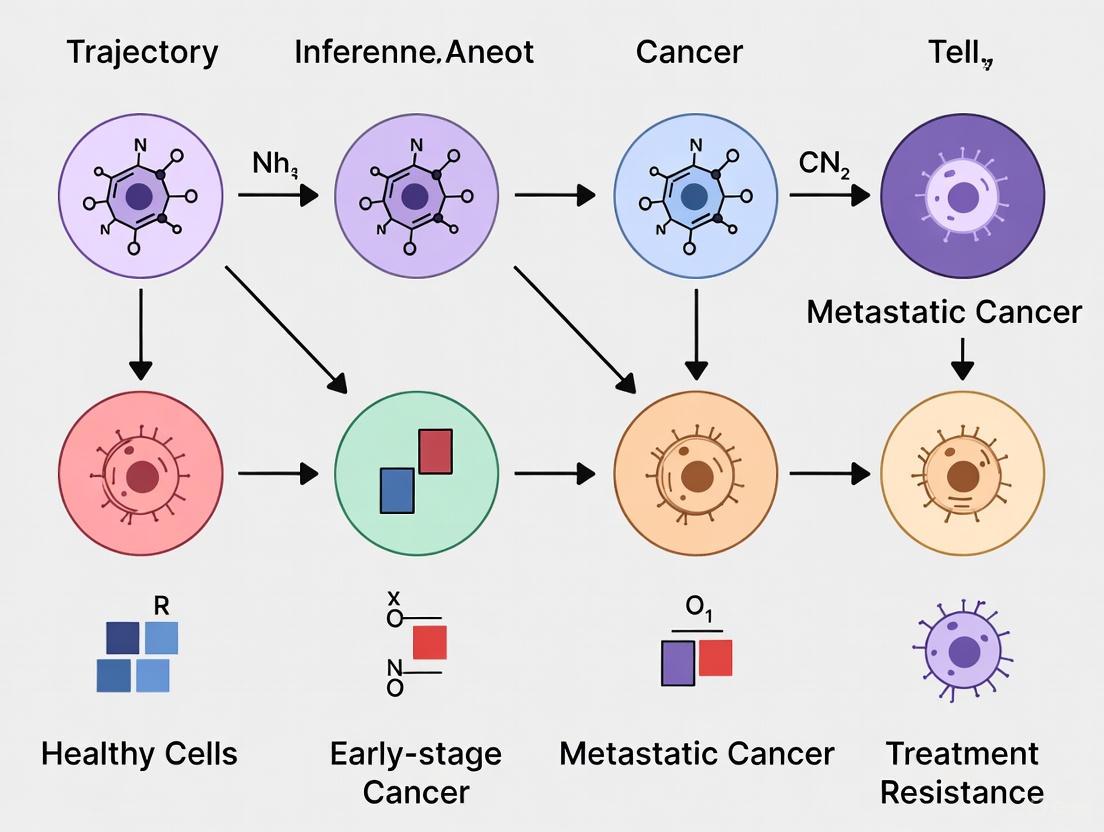
This article provides a comprehensive guide for researchers and drug development professionals on applying trajectory inference, specifically with Monocle, to unravel cancer progression dynamics from single-cell RNA sequencing data.
Trajectory Inference with Monocle in Cancer Progression: A Comprehensive Guide from Single-Cell Data to Clinical Insights
Abstract
This article provides a comprehensive guide for researchers and drug development professionals on applying trajectory inference, specifically with Monocle, to unravel cancer progression dynamics from single-cell RNA sequencing data. We cover the foundational concepts of pseudotime and cellular trajectories, detail the step-by-step Monocle workflow for analyzing processes like metastasis and therapy resistance, address critical troubleshooting and optimization strategies for robust analysis, and explore methods for validation and comparison with other tools. By integrating methodological depth with practical application in cancer biology, this resource aims to empower the discovery of novel biomarkers and therapeutic targets through advanced computational biology.
Decoding Cancer Evolution: Foundational Principles of Trajectory Inference
Trajectory inference (TI) is a computational methodology applied to single-cell RNA-sequencing (scRNA-seq) data to reconstruct dynamic biological processes, such as cell differentiation, development, and disease progression. Since temporal data cannot be collected straightforwardly in many biological systems, TI orders individual cells based on their progress along a differentiation or progression pathway according to their transcriptomic similarity [1]. This ordered progression is quantified as pseudotime, a unitless measure that represents the relative position of each cell along the inferred developmental continuum [2]. In cancer research, this approach provides a powerful tool to investigate tumor evolution, cellular heterogeneity, and the molecular mechanisms driving disease progression [3] [4] [5].
The application of trajectory inference has revealed novel insights into cancer biology. For instance, in glioblastoma (GBM), pseudotime analysis reconstructed a branched trajectory where the root exhibited a glioma stem cell-like phenotype while the trajectory endpoint showed high invasive activity, defining a 'stem-to-invasion path' [3]. Similarly, in colorectal cancer, TI has identified critical genes and transcription factors associated with cancer progression and has enabled the construction of prognostic signatures predicting patient survival [5].
Key Computational Methods and Tools
Numerous computational methods have been developed for trajectory inference, each employing distinct algorithmic approaches. These can be broadly categorized into several classes.
Table 1: Major Categories of Trajectory Inference Methods
| Method Category | Representative Tools | Key Algorithmic Approach | Applications in Cancer |
|---|---|---|---|
| Graph-based | DPT, PAGA, URD | k-nearest neighbor graphs, diffusion maps, simulated diffusion | Identifying invasive trajectories in GBM [3] |
| Minimum Spanning Tree (MST)-based | Monocle, TSCAN, Slingshot | Cluster-based MST, principal curves, orthogonal projections | Colorectal cancer progression analysis [6] [5] |
| Ensemble and Robust Methods | scTEP, Lamian | Multiple clustering results, bootstrap resampling | Multi-sample analysis of cancer severity [7] [6] |
| RNA Velocity-assisted | VeTra, Cytopath | Spliced/unspliced mRNA ratios, directed graphs, transition probabilities | - |
| Biophysical Model-based | Chronocell | Cell state transitions, process time inference, biophysical parameters | - |
More recently, advanced methods have addressed specific analytical challenges. The Lamian framework provides a comprehensive solution for differential multi-sample pseudotime analysis, enabling identification of changes in trajectory topology, cell density, and gene expression across multiple experimental conditions while accounting for sample-to-sample variation [7]. The condiments workflow specializes in comparing trajectories across multiple conditions, testing for differential progression, fate selection, and topology [8]. Meanwhile, scTEP utilizes ensemble pseudotime inference from multiple clustering results to enhance robustness against technical artifacts [6].
Experimental Protocols for Cancer Trajectory Analysis
Sample Processing and Data Generation
The initial phase involves meticulous sample processing to generate high-quality single-cell data representative of the cancer progression continuum:
- Tissue Collection and Dissociation: Obtain fresh tumor samples spanning various disease stages (e.g., normal, precancerous, early-stage, advanced-stage, metastatic, recurrent). Mechanically and enzymatically dissociate tissues into single-cell suspensions while preserving cell viability [4].
- Single-Cell RNA Sequencing: Process cells using droplet-based scRNA-seq platforms (e.g., 10X Genomics). Profile each cell to generate a gene expression matrix where rows represent genes and columns represent cells [3] [4].
- Quality Control and Filtering: Remove low-quality cells based on metrics including minimum number of aligned reads (>200,000), number of detected genes (>3,000), and percentage of mitochondrial reads. Exclude cells with high doublet likelihood [3].
- Tumor Cell Identification: Distinguish malignant epithelial cells from non-malignant stromal and immune cells using copy number variation (CNV) inference tools like CopyKAT. Compare inferred CNV profiles to normal control cells to identify aneuploid tumor cells [4].
Data Preprocessing and Normalization
Proper normalization is critical for accurate trajectory inference:
- Gene Filtering: Remove genes not expressed in at least 95% of cells for each sample to reduce noise [3].
- Count Transformation: Use the Census algorithm to transform transcripts per million (TPM) values into relative counts that follow a negative binomial distribution [3].
- Normalization: Apply scran normalization with cell-specific scaling factors to address high dropout rates characteristic of scRNA-seq data [3].
- Batch Effect Correction: Remove unwanted technical variation using RUVSeq with housekeeping genes or integration tools like Harmony, especially when analyzing multiple samples or patients [3] [4].
Trajectory Inference and Pseudotime Calculation
The core analytical phase involves reconstructing developmental trajectories:
- Dimensionality Reduction: Project high-dimensional gene expression data into a lower-dimensional space using PCA, diffusion maps, or autoencoders to reduce computational complexity and noise [1] [6].
- Cell Clustering: Group cells into biologically relevant clusters using graph-based clustering (e.g., Louvain algorithm) or density-based approaches. These clusters serve as nodes for trajectory construction [3] [7].
- Trajectory Construction: Apply trajectory inference algorithms to reconstruct the progression path. For tree-like structures, use MST-based methods (Monocle2, TSCAN); for complex trajectories, use graph-based methods (Monocle3, PAGA) [7] [6].
- Root Selection and Pseudotime Calculation: Designate the starting point of the trajectory (root) either manually based on known progenitor cells (e.g., stem-like cells) or automatically using marker genes highly expressed at the beginning of the process. Calculate pseudotime as the geodesic distance of each cell from the root along the inferred trajectory [6].
Diagram 1: scRNA-seq trajectory analysis workflow.
Differential Trajectory Analysis Across Conditions
For studies comparing multiple conditions (e.g., healthy vs. disease, different treatments):
- Data Integration: Harmonize cells from multiple samples into a common low-dimensional space using integration methods (Seurat, Harmony, scVI) to remove batch effects while preserving biological variation [7].
- Topology Assessment: Use condiments or Lamian to test whether trajectory topology differs significantly between conditions (differential topology) [7] [8].
- Differential Progression and Fate Selection: Assess whether cells from different conditions progress at different rates along shared trajectories (differential progression) or show preference for different lineage branches (differential fate selection) [8].
- Covariate-Associated Analysis: Fit regression models to evaluate how sample covariates (e.g., disease severity, treatment response) associate with changes in branch cell proportion, gene expression, or cell density along pseudotime [7].
The Scientist's Toolkit: Essential Research Reagents and Computational Tools
Table 2: Essential Reagents and Computational Tools for Trajectory Analysis
| Category | Item/Resource | Function/Application |
|---|---|---|
| Wet-Lab Reagents | Fresh tumor tissues | Source of single cells representing disease continuum |
| Dissociation enzymes | Tissue dissociation into single-cell suspensions | |
| Viability dyes | Assessment of cell viability pre-sequencing | |
| scRNA-seq kits | Generation of barcoded single-cell libraries | |
| Computational Tools | Monocle2/3 | MST-based trajectory inference with DDRTree |
| TSCAN | Cluster-based MST trajectory construction | |
| Slingshot | MST with simultaneous principal curves | |
| PAGA | Graph-based abstraction of trajectory topology | |
| condiments | Differential trajectory analysis across conditions | |
| Lamian | Multi-sample pseudotime analysis framework | |
| scTEP | Ensemble pseudotime for robust inference | |
| Data Resources | TCGA datasets | Validation of prognostic signatures |
| GTEx normal atlas | Reference for CNV inference in tumor cells | |
| Housekeeping genes | Batch effect correction with RUVSeq |
Cancer-Specific Applications and Analytical Workflows
Case Study: Deciphering the Stem-to-Invasion Path in Glioblastoma
Application of trajectory inference to glioblastoma revealed a branched trajectory with a GBM stem cell (GSC)-like phenotype at the root and highly invasive cells at the endpoint. The analytical protocol for such studies includes:
- Trajectory Rooting: Designate cells with stemness markers (e.g., CD133, SOX2) as the trajectory root [3].
- Branch Identification: Detect bifurcation points where distinct cellular lineages emerge from a common progenitor population [1] [3].
- Expression Dynamics Analysis: Identify genes showing incremental expression of invasion-associated signatures (e.g., extracellular matrix remodeling proteins) and diminishing expression of stem cell markers along the pseudotime continuum [3].
- Regulator Identification: Apply hidden Markov models (HMM) to discover transcription factors and long noncoding RNAs that regulate the transition toward invasive phenotypes [3].
Case Study: Colorectal Cancer Progression and Prognostic Modeling
In colorectal cancer, trajectory inference has enabled identification of progression-associated genes and construction of prognostic signatures:
- Pseudotime-Associated Gene Detection: Identify genes with dynamic expression patterns along the tumor progression trajectory using statistical models that test for association between gene expression and pseudotime [5].
- Regulatory Network Inference: Predict transcription factors (e.g., FOXM1, DNMT1, MYBL2) regulating pseudotime-associated genes through binding motif analysis [5].
- Cell-Cell Communication Analysis: Infer ligand-receptor interactions (e.g., TGFB1 and IL1B as effective ligands) that shape the tumor microenvironment during progression [5].
- Prognostic Model Construction: Build LASSO Cox regression models using pseudotime-associated genes to predict patient survival, with validation in independent cohorts like TCGA [5].
Diagram 2: GBM stem-to-invasion trajectory.
Advanced Analytical Considerations
Accounting for Cross-Sample Variability
Robust trajectory analysis requires proper handling of biological and technical variability:
- Variance Component Estimation: Lamian estimates cross-sample variance separately from cell-level variance, enabling distinction between consistent biological effects and sample-specific artifacts [7].
- Bootstrap Resampling: Quantify trajectory uncertainty through repeated bootstrap samplings of cells, calculating branch detection rates as the probability that a branch is recovered across resampling iterations [7].
- Mixed Effects Modeling: Incorporate both fixed effects (biological conditions of interest) and random effects (sample-specific variability) when testing for differential expression along pseudotime [7].
Multi-Condition Experimental Design
Studies comparing trajectories across conditions require specialized approaches:
- Imbalance Scoring: Visually assess condition-specific distribution differences along trajectories using local neighborhood comparisons in reduced-dimensional space [8].
- Topology Testing: Statistically evaluate whether conditions share a common trajectory structure or require separate trajectory inference [8].
- Differential Progression Testing: Identify lineages where cells from different conditions progress at significantly different rates [8].
- Differential Fate Selection Analysis: Detect lineages that are preferentially selected by cells from specific conditions after branch points [8].
The field continues to evolve with emerging methods like Chronocell introducing "process time" as a biophysically interpretable alternative to descriptive pseudotime, parameterizing trajectories with kinetic rates that have direct biological meaning [9]. This represents a paradigm shift toward more mechanistic modeling of cellular dynamics from single-cell snapshots.
The Critical Role of Cellular Trajectories in Modeling Cancer Progression and Metastasis
Cancer progression and metastasis are dynamic processes driven by complex cellular evolution and profound ecosystem remodeling within the tumor microenvironment (TME). Trajectory inference (TI) computational methods have emerged as powerful tools for reconstructing these continuous biological processes from static single-cell RNA sequencing (scRNA-seq) snapshots by ordering cells along a pseudotime axis based on transcriptional similarity [10]. This approach allows researchers to model the progression of transformative cellular programs such as the epithelial-mesenchymal transition (EMT), a key driver of metastasis enabling cancer cell dissemination from primary tumors [11] [12]. Within the framework of cancer biology, TI methods like Monocle 3 provide critical insights into the molecular programs steering tumor development, immune evasion, and therapeutic resistance, offering a systematic approach to deciphering cancer's complex evolutionary trajectories.
Key Computational Frameworks for Trajectory Inference
Several computational frameworks enable trajectory inference from single-cell data, each with distinct algorithmic approaches and applications in cancer research. The table below summarizes the most widely used TI tools and their characteristics:
Table 1: Key Trajectory Inference Tools and Their Applications in Cancer Research
| Tool | Primary Algorithm | Core Strength | Reported Cancer Application |
|---|---|---|---|
| Monocle 3 [13] [10] | Reversed Graph Embedding (DDRTree, SimplePPT), UMAP | Learning complex, disjoint trajectories; multiple roots; large datasets (>1M cells) | Head and neck squamous cell carcinoma (HNSCC) progression [4] |
| Slingshot [10] | Minimum Spanning Tree (MST) + Principal Curves | Robustness to noise; modularity with different clustering methods | Metastatic breast cancer lineage dynamics [12] |
| PAGA [10] | Partition-based Graph Abstraction | Connecting discrete clustering with continuous transitions; handles disconnected data | Mapping tumor-immune interactions in microenvironment |
| Palantir [10] | Diffusion Maps + Gaussian Kernel | Modeling continuous cell fate probabilities | Differentiation modeling in cancer cell states |
These tools have been instrumental in revealing fundamental cancer biology. For instance, Monocle 3's ability to partition cells into "supergroups" and learn disjoint trajectories is particularly valuable for analyzing tumor ecosystems containing multiple distinct cell lineages and differentiation pathways [13]. A recent HNSCC study utilizing Monocle 3 identified a specific tumorigenic epithelial subcluster regulated by TFDP1 and delineated the dynamic reprogramming of malignant cells throughout tumor initiation, progression, and metastasis [4].
Experimental Protocols for Trajectory Analysis in Cancer
Single-Cell RNA Sequencing Wet-Lab Protocol
This protocol outlines the steps for generating scRNA-seq data from tumor samples suitable for subsequent trajectory inference analysis.
Sample Preparation and Cell Dissociation
- Materials: Fresh tumor tissue (primary or metastatic), normal adjacent tissue, enzymatic dissociation kit (e.g., tumor dissociation enzyme), HBSS, fetal bovine serum (FBS), DNase I, cell strainer (40µm), viability dye (e.g., propidium iodide or DAPI).
- Procedure:
- Tissue Processing: Mince fresh tissue into 1-2 mm³ fragments in cold HBSS.
- Enzymatic Digestion: Incubate tissue fragments with appropriate dissociation enzyme mix for 30-45 minutes at 37°C with gentle agitation.
- Cell Suspension: Neutralize enzymes with FBS-containing buffer, filter through 40µm cell strainer, and centrifuge.
- Viability Assessment: Count cells and assess viability (>80% recommended) using viability dye.
- Cell Sorting (Optional): Use fluorescence-activated cell sorting (FACS) to enrich for specific populations (e.g., epithelial cells).
Single-Cell Library Preparation and Sequencing
- Materials: 10x Genomics Chromium Controller, Single Cell 3' Reagent Kits, thermal cycler, bioanalyzer, sequencing platform (e.g., Illumina NovaSeq).
- Procedure:
- Cell Partitioning: Load cell suspension onto 10x Genomics Chromium Chip to partition single cells with barcoded beads.
- cDNA Synthesis: Perform reverse transcription within droplets to create barcoded cDNA.
- Library Construction: Amplify cDNA, fragment, and add sample indexes and sequencing adapters.
- Quality Control: Assess library quality using bioanalyzer.
- Sequencing: Sequence libraries to a minimum depth of 50,000 reads per cell.
Computational Analysis Protocol with Monocle 3
This protocol details the computational workflow for inferring trajectories from scRNA-seq data using Monocle 3, framed within a cancer progression context [13] [10].
Data Preprocessing and Normalization
- Data Input: Load raw count matrix and cell metadata into a
CellDataSetobject. - Quality Control: Filter cells with high mitochondrial gene percentage (>20%) or low/high unique gene counts (indicates debris/doublets).
- Normalization: Estimate size factors and normalize counts using
estimateSizeFactors()andestimateDispersions(). - Preprocessing: Project data onto top principal components using
preprocessCDS()(default: 50 PCs).
- Data Input: Load raw count matrix and cell metadata into a
Dimensionality Reduction and Cell Partitioning
- Non-linear Reduction: Further reduce dimensionality using UMAP with
reduceDimension(method = "UMAP"). - Cell Clustering: Cluster cells using Louvain/Leiden algorithm within
clusterCells(). - Partition Detection: Automatically partition cells into "supergroups" or disjoint trajectories using
partitionCells(). This step is crucial in cancer data to separate unrelated lineages (e.g., tumor vs. stromal trajectories) [13].
- Non-linear Reduction: Further reduce dimensionality using UMAP with
Trajectory Inference and Pseudotime Assignment
- Graph Learning: Learn a principal graph for each partition using
learnGraph()with the SimplePPT or DDRTree method. - Root Selection: Visually inspect the trajectory and select root nodes (e.g., putative stem/progenitor cells) based on known markers.
- Order Cells: Calculate pseudotime values by projecting each cell onto the graph and computing its distance from the root with
orderCells().
- Graph Learning: Learn a principal graph for each partition using
Downstream Analysis
- Differential Expression: Identify genes that vary across pseudotime or between branches using
differentialGeneTest(). - Branch Analysis: Analyze genes associated with specific lineage decisions using
BEAM()to understand branching mechanisms in cancer progression.
- Differential Expression: Identify genes that vary across pseudotime or between branches using
Table 2: Key Research Reagent Solutions for scRNA-seq Trajectory Analysis
| Reagent / Tool | Function | Application in Cancer Trajectory Studies |
|---|---|---|
| 10x Genomics Chromium | High-throughput single-cell partitioning | Capturing cellular heterogeneity in primary tumors and metastases [4] [12] |
| Enzymatic Dissociation Kits | Tissue digestion into single-cell suspensions | Releasing diverse cell types from solid tumor biopsies for ecosystem analysis |
| Viability Dyes (PI/DAPI) | Distinguishing live/dead cells | Ensuring high-quality RNA from viable tumor and stromal cells |
| Cell Surface Marker Antibodies | FACS enrichment/depletion | Isulating specific populations (e.g., EpCAM+ epithelial cells, CD45+ immune cells) |
| Monocle 3 R Package | Trajectory inference and pseudotime analysis | Reconstructing cancer progression paths from scRNA-seq data [13] [10] |
| CellPhoneDB | Cell-cell communication inference | Mapping interactions between malignant cells and TME components along trajectories |
Signaling Pathways in Cancer Progression Revealed by Trajectory Analysis
Trajectory inference studies have elucidated key signaling pathways that are dynamically regulated during cancer progression and metastasis. In HNSCC, analysis of malignant cells along progression trajectories revealed activation of Wnt signaling pathways during early tumorigenesis, while advanced stages showed upregulation of protumor cytokines like TNFRSF12A and PLAU [4]. The TGF-β signaling pathway plays a critical role in promoting and sustaining the EMT phenotype in circulating tumor cells (CTCs), enhancing their metastatic potential [11]. Furthermore, interactions between POSTN+ fibroblasts and SPP1+ macrophages with malignant cells were shown to gradually increase along tumor progression, shaping a desmoplastic TME that reprograms cancer cells [4].
Figure 1: Signaling Pathway Dynamics in Cancer Progression
Applications in Metastatic Research
Trajectory inference provides critical insights into the metastatic cascade, from initial dissemination to colonization of distant organs. In metastatic breast cancer, SCT has revealed how tumor heterogeneity and clonal evolution drive disease progression and therapy resistance [12]. Analysis of CTCs has identified distinct biological states including EMT, dormancy, and stemness, which enable these cells to survive circulatory stresses and evade immune surveillance [11]. Single-cell trajectory analysis of HNSCC lymph node metastases demonstrated that exhausted CD8+ T cells with high CXCL13 expression strongly interact with tumor cells to promote more aggressive phenotypes with extranodal expansion capabilities [4].
Figure 2: Metastatic Cascade and Key Cellular States
Emerging Frontiers and Integrated Technologies
The field of trajectory inference is rapidly evolving with several emerging technologies enhancing its capabilities. Artificial intelligence (AI) approaches can now infer cell differentiation status and progression trajectories directly from routine H&E-stained whole-slide images, providing a cost-effective method for large-scale analysis of tumor progression dynamics [14]. The integration of single-cell chromatin accessibility data (scATAC-seq) with machine learning, as demonstrated by the SCOOP (Single-cell Cell Of Origin Predictor) tool, enables prediction of a cancer's cell of origin at cellular resolution by leveraging the relationship between epigenomic features and somatic mutation patterns [15]. Additionally, spatial transcriptomics technologies are being integrated with trajectory inference to preserve geographical context while analyzing temporal processes, providing unprecedented insights into the spatial organization of cellular trajectories within tumors [12].
Trajectory inference (TI) has revolutionized single-cell RNA-sequencing (scRNA-seq) research by enabling the study of dynamic changes in gene expression along continuous biological processes [16]. In cancer research, this approach allows scientists to reconstruct tumor progression trajectories, revealing how cancer cells transition from one state to another, make fate decisions, and acquire aggressive phenotypes [3]. The core assumption of TI is that transcriptomic similarity between cells reflects their progression along a continuous biological process, such as differentiation or malignant transformation [10]. By computationally ordering cells along "pseudotime" based on their gene expression patterns, researchers can infer the sequence of molecular events driving cancer progression without requiring synchronized longitudinal samples [17]. This approach has proven particularly valuable for studying complex cancer ecosystems, including glioblastoma stem cell invasion [3], head and neck squamous cell carcinoma progression [4], and lung adenocarcinoma evolution [14].
Core Concepts and Definitions
Pseudotime: The Foundation of Trajectory Analysis
Pseudotime is an abstract unit of progress that represents the distance between a cell and the start of a trajectory, measured along the shortest path of transcriptional change [18]. Unlike chronological time, pseudotime quantifies a cell's progression through a biological process based solely on its transcriptomic state. In Monocle, pseudotime is calculated after learning a trajectory graph, with the total length defined in terms of the total amount of transcriptional change a cell undergoes from starting to end state [18]. This concept is fundamental because cells in processes like tumor development progress asynchronously—even when captured simultaneously, they distribute widely along the progression continuum [17]. Pseudotime analysis alleviates problems caused by this asynchrony, enabling researchers to reconstruct the sequence of regulatory changes that occur during cellular transitions.
Branching Points: Decision Nodes in Cellular Trajectories
Branching points represent critical junctures where cells make fate decisions, leading to divergent transcriptional programs and cellular outcomes [18]. In cancer contexts, these branches may correspond to decisions between different differentiation states, metabolic programs, or metastatic potentials [3]. Monocle reconstructs "branched" trajectories when multiple outcomes exist for a biological process, with branches corresponding to cellular "decisions" [18]. Identifying these branching points is crucial for understanding how tumor cell heterogeneity arises and which regulatory mechanisms drive cells toward more aggressive phenotypes.
Cellular Fate Decisions: Outcomes of Trajectory Analysis
Cellular fate decisions represent the endpoint determinations that cells make at branching points, committing to distinct transcriptional and functional states [17]. In cancer, these decisions may determine whether cells remain in a stem-like state, differentiate, acquire invasive properties, or develop therapy resistance [3]. By analyzing branches in single-cell trajectories, researchers can identify genes that are affected by these decisions and potentially involved in making them [18]. For example, in glioblastoma, reconstructed trajectories have revealed a "stem-to-invasion path" where cells gradually transform from GSC-like phenotypes to invasive states [3].
Computational Methods for Trajectory Inference
Multiple computational methods have been developed for trajectory inference, each with distinct approaches and strengths:
Table 1: Key Trajectory Inference Methods
| Method | Algorithm Type | Key Features | Cancer Applications |
|---|---|---|---|
| Monocle | Reversed graph embedding, MST | Multiple versions (1, 2, 3); handles complex branching; scalable to large datasets | Myogenesis differentiation [17], Glioblastoma invasion [3] |
| Slingshot | Principal curves on cluster-based MST | Robust to noise; modular with different clustering methods; identifies multiple lineages | General single-cell trajectory analysis [16] |
| PAGA | Graph abstraction | Combines clustering and continuous approaches; handles disconnected clusters | Not specifically cited in cancer in reviewed papers |
| tradeSeq | Generalized additive models | Differential expression along trajectories; within-lineage and between-lineage tests | General single-cell trajectory analysis [16] |
| Lamian | Cluster-based MST with multi-sample support | Accounts for sample-to-sample variation; tests topology, expression, and density changes | COVID-19 immune response [7] |
Method Selection Considerations
Choosing an appropriate TI method depends on several factors, including trajectory complexity, dataset size, and specific research questions. Monocle uses reversed graph embedding to reconstruct trajectories and is particularly effective for studying complex processes with multiple branches, such as cancer progression paths with divergent cellular states [18]. Slingshot offers robustness against technical noise and greater modularity, as it can work with clustering results from various methods [10]. PAGA (Partition-based Graph Abstraction) combines discrete clustering and continuous trajectory approaches, making it suitable for datasets containing multiple unconnected cell types or processes [10]. For differential expression analysis along trajectories, tradeSeq provides a flexible framework that can identify both within-lineage and between-lineage expression patterns using generalized additive models [16]. When analyzing data from multiple patients or conditions, Lamian offers unique advantages by accounting for cross-sample variability, thereby reducing false discoveries that may not generalize to new samples [7].
Protocols for Trajectory Analysis in Cancer Research
Sample Preparation and Single-Cell Sequencing
Proper sample preparation is critical for successful trajectory analysis in cancer studies:
Tumor Dissociation: Fresh tumor tissues should be gently dissociated using enzymatic methods that preserve RNA integrity while generating single-cell suspensions. Include viability staining to assess cell quality.
Cell Sorting or Enrichment: For rare cell populations (e.g., cancer stem cells), include fluorescence-activated cell sorting (FACS) using known surface markers specific to the cancer type.
scRNA-seq Library Preparation: Use droplet-based (e.g., 10X Genomics) or plate-based (e.g., Smart-seq2) protocols depending on required sequencing depth and cell numbers. For cancer tissues with high heterogeneity, target 5,000-10,000 cells per sample.
Quality Control: Remove low-quality cells with fewer than 500 detected genes or high mitochondrial content (>20%), which may indicate dying cells [3].
Batch Effect Management: When processing multiple samples, use normalization methods such as Harmony [4] or Seurat integration to remove technical variations while preserving biological signals.
Monocle 3 Protocol for Cancer Trajectory Analysis
This protocol provides a step-by-step workflow for analyzing cancer progression trajectories using Monocle 3:
Critical Steps for Cancer Data:
Root Selection: For cancer progression studies, root cells should represent the earliest or least advanced state. This can be determined using known early markers (e.g., stem cell markers) or by identifying clusters with cells from early time points or precursor lesions [18].
Partition Handling: Cancer datasets often contain multiple distinct trajectories. Use
partitions()to identify and analyze separate trajectories for different cell lineages within the tumor ecosystem.Branch Analysis: Subset cells by branch using
choose_graph_segments()to focus on specific fate decisions, such as the transition from proliferative to invasive states [3].
Differential Expression Analysis Along Trajectories
Once trajectories are constructed, identify genes associated with cancer progression:
Validation and Interpretation
Pseudotime Validation: Validate pseudotime ordering using known marker genes with established expression patterns during cancer progression.
Branch Significance: Assess the robustness of branching points through bootstrap resampling or methods like Lamian that quantify branch uncertainty [7].
Functional Enrichment: Perform gene ontology and pathway analysis on genes associated with specific trajectory segments or branches to identify biological processes driving cancer progression.
Spatial Validation: When available, integrate with spatial transcriptomics or immunohistochemistry to validate that pseudotime ordering corresponds to spatial organization within tumors [14].
Cancer Case Studies
Glioblastoma Stem Cell Invasion Trajectory
A seminal study applied trajectory analysis to glioblastoma (GBM), revealing a "stem-to-invasion path" where GBM stem cells (GSCs) progressively transform into invasive cells [3]. Researchers analyzed scRNA-seq data from 350 tumor cells from four primary GBM patients, using Monocle to reconstruct a branched trajectory. The analysis revealed that cells at the trajectory root exhibited GSC-like phenotypes (expressing stemness markers), while terminal branches showed elevated expression of invasion-associated genes. Along this trajectory, cells gradually diminished expression of GBM stem cell markers while incrementally acquiring invasive signatures, identifying crucial transcription factors and long noncoding RNAs controlling this transition.
Head and Neck Squamous Cell Carcinoma Progression
A comprehensive scRNA-seq study of head and neck squamous cell carcinoma (HNSCC) reconstructed the transcriptional development trajectory of malignant epithelial cells across normal, precancerous, early-stage, advanced-stage, and recurrent tumors [4]. The trajectory analysis identified a specific malignant cell cluster regulated by TFDP1 that determined invasive phenotypes. Furthermore, the study revealed how fibroblast and macrophage subpopulations increasingly infiltrated during progression, shaping a desmoplastic microenvironment that reprograms malignant cells. The trajectory analysis also delineated distinct features of malignant cells in primary versus recurrent tumors, providing insights for targeted therapy selection.
Lung Adenocarcinoma Progression from Histopathological Images
An innovative approach used deep learning to predict cell differentiation status directly from H&E-stained whole-slide images (WSIs) of lung adenocarcinoma, then performed pseudotime analysis based on morphological features [14]. This method reconstructed tumor progression trajectories without scRNA-seq, identifying patterns of progression from well-differentiated to poorly-differentiated states. The image-derived pseudotime analysis successfully stratified patients by survival outcomes and revealed that fast-progressing tumors exhibited up-regulated cell cycle pathways, while slow-progressing tumors retained characteristics of normal lung epithelium.
The Scientist's Toolkit: Essential Reagents and Computational Tools
Table 2: Essential Research Reagent Solutions for Trajectory Analysis in Cancer
| Category | Specific Tools/Reagents | Function in Trajectory Analysis |
|---|---|---|
| Single-Cell Platforms | 10X Genomics Chromium, Fluidigm C1 | Generate single-cell transcriptomic data for trajectory inference |
| Cell Sorting Markers | CD44, CD133, EGFR, EpCAM | Isolate specific cancer subpopulations for focused trajectory analysis |
| Library Prep Kits | 10X Single Cell 3' Reagent Kits, SMART-Seq HT | Prepare sequencing libraries with appropriate depth for trajectory reconstruction |
| Computational Tools | Monocle 3, Slingshot, tradeSeq, Lamian | Perform trajectory inference and differential expression analysis |
| Data Integration | Harmony, Seurat, scVI | Remove batch effects and integrate multiple samples for robust trajectories |
| Validation Methods | RNAscope, Immunofluorescence, Spatial Transcriptomics | Validate pseudotime predictions using spatial context and protein expression |
Visualization of Trajectory Concepts
Core Concepts of Pseudotime and Branching
Monocle 3 Workflow for Cancer Trajectories
Advanced Applications in Cancer Drug Development
Trajectory analysis offers unique insights for oncology drug development by identifying critical transitions and vulnerable points in cancer progression. By mapping trajectories of therapy resistance, researchers can identify early molecular events preceding resistance and develop interventions to block these transitions. Similarly, analyzing differentiation trajectories can reveal mechanisms to redirect cancer cells toward less aggressive states. The branching points represent particularly promising therapeutic targets, as disrupting these decision nodes could prevent cells from adopting aggressive or treatment-resistant phenotypes. As single-cell technologies become more accessible, trajectory inference will increasingly guide targeted therapy development and personalized treatment strategies based on a patient's specific tumor progression path.
Monocle 3 represents a significant evolution in trajectory inference software, specifically re-engineered to analyze large, complex single-cell datasets, including those central to cancer research. In the context of precision oncology, understanding the dynamic processes of tumor progression, metastasis, and therapeutic resistance is paramount. Single-cell RNA sequencing (scRNA-seq) has emerged as a transformative approach, enabling high-resolution analysis of individual cells to reveal tumor composition, lineage dynamics, and transcriptional plasticity [12]. However, analyzing such data requires sophisticated computational tools that can handle cellular heterogeneity and reconstruct developmental trajectories. Monocle 3 addresses these challenges by introducing highly scalable algorithms capable of processing millions of cells, partitioning cells into disjoint trajectories, and learning complex trajectories with loops or points of convergence [13]. This capability is particularly valuable for cancer biology, where tumor heterogeneity and clonal evolution play crucial roles in disease progression and treatment outcomes.
The ability to resolve cellular trajectories provides critical insights into cancer mechanisms, including epithelial-mesenchymal transition (EMT), immune evasion, and the emergence of drug-resistant subpopulations [12]. Traditional bulk transcriptomics approaches average gene expression across cell populations, obscuring rare but functionally significant cell types such as cancer stem cells and drug-tolerant persister cells. Monocle 3's single-cell trajectory inference helps overcome this limitation by ordering cells along pseudotemporal trajectories, revealing the sequence of transcriptional changes that occur during dynamic biological processes such as cancer metastasis or the development of therapeutic resistance [18]. This approach is reshaping our understanding of metastatic breast cancer and other malignancies by mapping tumor evolution and characterizing cellular states that drive disease progression.
Key Technical Advancements in Monocle 3
Scalability and Performance Enhancements
Monocle 3 introduces substantial architectural improvements that dramatically increase its processing capabilities compared to previous versions, making it suitable for contemporary large-scale cancer atlas projects. A cornerstone of this enhanced scalability is the integration with the BPCells package, which enables storing the feature-cell counts matrix on-disk rather than in-memory [19]. This innovation allows Monocle 3 to analyze datasets that were previously too large to fit into computer memory, significantly expanding its applicability to massive single-cell cancer atlas projects. The updates to the DDRTree algorithm have massively improved throughput, enabling it to process millions of cells in minutes rather than hours or days [13]. These performance optimizations are critical for cancer researchers working with large patient cohorts or complex tumor ecosystems comprising hundreds of thousands of cells.
The package now supports two matrix storage modes: the traditional in-memory sparse matrix for smaller datasets and the new on-disk BPCells matrix for large datasets. When using BPCells, Monocle 3 maintains two copies of the counts matrix—one optimized for column access and another for row access—ensuring efficient data retrieval regardless of the operation being performed [19]. The combine_cds() function can merge multiple CellDataSet objects with different matrix types into a unified BPCells on-disk matrix, facilitating the integration of data from multiple experiments or patients. These technical advancements collectively establish Monocle 3 as a scalable solution capable of handling the data volumes generated in modern cancer genomics research.
Analytical and Algorithmic Innovations
Monocle 3 incorporates several methodological innovations that enhance its ability to resolve complex biological trajectories in cancer datasets. A fundamental advancement is the implementation of automatic partitioning using ideas from "approximate graph abstraction" (AGA) [13]. This capability allows Monocle 3 to detect that some cells are part of different biological processes and automatically build multiple trajectories in parallel from a single dataset. In cancer research, this is particularly valuable for analyzing tumor ecosystems where multiple cell lineages—such as cancer cells, immune cells, and stromal cells—coexist and undergo distinct transcriptional programs. Unlike Monocle 2, which assumed all cells belonged to a single trajectory, Monocle 3 can identify disjoint trajectories without requiring researchers to manually subset cell populations.
The software now offers three distinct algorithms for trajectory inference: DDRTree (an updated version of the algorithm from Monocle 2), SimplePPT (which learns tree-like trajectories without further dimensionality reduction), and L1Graph (an advanced optimization method that can learn trajectories with loops) [13]. This flexibility enables cancer researchers to select the most appropriate method for their specific biological question—for instance, L1Graph for modeling cyclic processes such as cancer cell cycle progression or immune cell activation. Additionally, Monocle 3 has replaced t-SNE with Uniform Manifold Approximation and Projection (UMAP) as the default nonlinear dimensionality reduction technique [13]. UMAP better preserves the global structure of data, which is crucial for accurately capturing the full spectrum of cellular states in heterogeneous cancer samples.
Table 1: Key Technical Advancements in Monocle 3
| Feature | Advancement | Benefit for Cancer Research |
|---|---|---|
| Scalability | Integration with BPCells for on-disk matrix storage | Enables analysis of massive cancer atlas datasets exceeding memory limitations |
| Processing Speed | Optimized DDRTree algorithm | Processes millions of cells in minutes instead of hours |
| Trajectory Topology | Support for multiple roots, loops, and convergence points | Models complex cancer processes like metastasis and drug resistance evolution |
| Partitioning | Automatic detection of disjoint trajectories using approximate graph abstraction | Identifies parallel biological processes in tumor microenvironments |
| Dimensionality Reduction | UMAP integration with better global structure preservation | More accurate representation of cellular heterogeneity in tumors |
Comparative Analysis with Predecessors
Monocle 3 represents a substantial architectural and methodological departure from Monocle 2, with significant implications for cancer research applications. The most notable improvement is in scalability and performance. While Monocle 2 could struggle with datasets exceeding tens of thousands of cells, Monocle 3's re-engineered algorithms can efficiently process millions of cells, making it suitable for large-scale cancer studies such as tumor atlases or clinical trials with multiple patients [13]. This performance gain is achieved through both algorithmic optimizations and the implementation of delayed operations using the DelayedArray package, which processes data in blocks to avoid exhausting computer memory.
The approach to trajectory inference has been fundamentally enhanced in Monocle 3. Unlike its predecessor, which assumed all cells in a dataset formed a single connected trajectory, Monocle 3 automatically partitions cells into "supergroups" corresponding to disjoint trajectories [13] [18]. This is particularly valuable in cancer research, where a tumor sample may contain multiple distinct lineages evolving in parallel—such as cancer cells, infiltrating immune cells, and stromal components—each with their own transcriptional trajectories. Monocle 3's ability to automatically identify and model these separate processes simultaneously represents a significant analytical advantage over previous versions.
Additionally, Monocle 3 introduces a more structured workflow and enhanced visualization capabilities. The software now provides a clear, step-by-step process for trajectory analysis: normalization and preprocessing, dimensionality reduction, clustering and partitioning, graph learning, and pseudotime assignment [13] [18]. The package also offers 3D visualization interfaces and interactive trajectory plotting, enabling researchers to explore complex cancer datasets from multiple perspectives and identify subtle branching points that might represent critical fate decisions in tumor progression.
Table 2: Monocle 2 vs. Monocle 3 Feature Comparison
| Feature | Monocle 2 | Monocle 3 |
|---|---|---|
| Maximum Dataset Size | Tens of thousands of cells | Millions of cells |
| Trajectory Topologies | Primarily tree-like structures | Trees, loops, and complex graphs |
| Multiple Trajectories | Manual subsetting required | Automatic partitioning |
| Default Dimension Reduction | t-SNE | UMAP |
| Memory Management | In-memory only | On-disk via BPCells |
| Learning Algorithms | DDRTree | DDRTree, SimplePPT, L1Graph |
Monocle 3 Protocol for Cancer Trajectory Analysis
Data Preprocessing and Normalization
The initial phase of any Monocle 3 analysis involves careful data preprocessing to ensure high-quality trajectory inference. For cancer datasets, begin by creating a CellDataSet object using the new_cell_data_set() function, which can accept various input formats including sparse matrices or on-disk BPCells matrices for large datasets [19]. The standard preprocessing workflow then applies essential normalization steps to account for technical variation in RNA recovery and sequencing depth. The estimate_size_factors() function calculates normalization factors for each cell, while preprocess_cds() performs principal component analysis (PCA) on the normalized expression values to project the data into a lower-dimensional space [13] [18]. For large cancer datasets, these operations utilize the DelayedArray package to process data in blocks, preventing memory exhaustion.
An important consideration for cancer data is the potential impact of batch effects, which can arise from processing samples across multiple sequencing runs or from different patients. Monocle 3 provides multiple batch correction strategies through the align_cds() function. Researchers can use the alignment_group argument to align groups of cells (e.g., different patients or experimental batches) and the residual_model_formula_str parameter to subtract continuous effects such as the percentage of mitochondrial reads or background RNA contamination [18]. Proper batch correction is essential in cancer studies to ensure that technical artifacts do not confound the biological signals of interest, particularly when analyzing cellular trajectories across multiple patients or tumor sites.
Dimension Reduction and Cell Partitioning
Following preprocessing, Monocle 3 applies further nonlinear dimensionality reduction to facilitate trajectory inference. The reduce_dimension() function with method="UMAP" is recommended over t-SNE, as UMAP better preserves the global structure of the data—a critical consideration when working with heterogeneous cancer samples containing multiple cell lineages [13] [18]. The resulting UMAP embedding serves as the foundation for subsequent trajectory analysis. Monocle 3 then automatically partitions cells into supergroups using the cluster_cells() function, which implements community detection algorithms to identify groups of cells that form disconnected components in the graphical representation of the data [18]. Each partition will ultimately form a separate trajectory.
In cancer research, partitioning is particularly valuable for distinguishing between different biological processes occurring simultaneously within a tumor ecosystem. For example, in a metastatic breast cancer sample, partitioning might automatically separate epithelial cancer cells from immune infiltrates and stromal components, allowing each lineage to be modeled independently [12]. The resolution of partitioning can be controlled through parameters that adjust how aggressively the algorithm identifies separate communities. Researchers should validate that partitions align with biological expectations by examining marker gene expression across partitions and comparing with known cell type annotations.
Trajectory Learning and Pseudotime Assignment
The core trajectory inference process begins with the learn_graph() function, which applies one of Monocle 3's graph learning algorithms (DDRTree, SimplePPT, or L1Graph) to reconstruct the underlying developmental structure of the data [13] [18]. For tree-like processes such as cellular differentiation hierarchies in cancer, DDRTree or SimplePPT are appropriate choices. For processes with potential cyclic components—such as immune cell activation or cancer cell cycle progression—L1Graph may be more suitable as it can learn trajectories with loops. The learned graph represents the potential transitions between cellular states, with nodes corresponding to key transcriptional states and edges representing possible developmental paths.
Once the graph is learned, cells are ordered in pseudotime using the order_cells() function. Pseudotime is a quantitative measure of a cell's progress through a biological process, defined as the distance along the shortest path from a designated starting point (root) to the cell [18]. In cancer studies, selecting appropriate root nodes is critical for meaningful interpretation. Root selection can be guided by prior biological knowledge—for instance, positioning less differentiated cancer stem cells or early developmental states as the starting point. Monocle 3 provides both interactive functions for manually selecting root nodes and programmatic approaches that automatically identify roots based on the distribution of cells from early time points or specific marker expression [18]. The resulting pseudotime values enable researchers to analyze gene expression dynamics along cancer progression trajectories and identify molecular programs associated with disease advancement.
Monocle 3 Cancer Analysis Workflow
Application in Cancer Research: Protocol for Metastatic Progression Analysis
Experimental Design and Data Integration
Applying Monocle 3 to investigate metastatic progression requires careful experimental design and data integration. A representative approach can be drawn from recent studies of head and neck squamous cell carcinoma (HNSCC) and metastatic breast cancer that utilized single-cell transcriptomics to map tumor evolution [12] [4] [20]. Researchers should collect samples spanning the disease spectrum—including normal tissue, precancerous lesions, primary tumors of different stages, metastatic lesions (such as lymph nodes), and recurrent tumors when available. For the HNSCC study profiled by scRNA-seq, this included 26 fresh specimens from 13 patients encompassing normal tissue, precancerous lesions, early-stage tumors, advanced tumors, metastatic lymph nodes, and recurrent tumors [4]. This comprehensive sampling strategy enables reconstruction of complete progression trajectories from initiation to metastasis.
Following data acquisition, quality control is essential. Filter out cells with fewer than 500 expressed genes or with high mitochondrial content (typically >35% mitochondrial UMI rate), as these may represent low-quality or dying cells [20]. For cancer studies specifically, consider using computational tools such as CopyKAT or InferCNV to distinguish malignant epithelial cells from normal stromal and immune cells based on copy number variation (CNV) patterns [4] [20]. Integration of multiple samples or patients can be achieved using harmony batch correction within the Monocle 3 workflow to remove technical artifacts while preserving biological variation [20]. This careful preprocessing ensures that the resulting trajectories reflect genuine biological processes rather than technical confounders.
Trajectory Inference and Metastatic Subpopulation Identification
The core analysis involves applying Monocle 3's trajectory inference capabilities to reconstruct metastatic progression paths. After standard preprocessing and UMAP reduction, use the cluster_cells() function to identify distinct cellular communities within the tumor ecosystem. In the HNSCC study, epithelial cells clustered into five distinct subpopulations with varying abundance across disease stages [4]. The learn_graph() function with default parameters typically produces robust trajectories, but researchers may need to experiment with different algorithms (DDRTree, SimplePPT, L1Graph) depending on the expected topology—for metastatic progression, branched trajectories are common, representing divergent evolutionary paths.
Critical to cancer studies is identifying transitional states and metastatic subpopulations. In the HNSCC analysis, researchers identified a specific malignant cell cluster (Cluster 1) that determined the invasive phenotype and correlated with unfavorable overall survival in validation cohorts [4]. Similarly, in breast cancer research, Monocle 3 has been employed to characterize cancer stem-like cells and epithelial-mesenchymal transition (EMT) states that drive metastasis and therapeutic resistance [12]. Once trajectories are learned, use the order_cells() function to set appropriate root nodes—often the least advanced pathological state (e.g., normal tissue or precancerous lesions) or clusters with stem-like properties. The resulting pseudotime values then enable quantitative analysis of gene expression changes along progression trajectories, revealing molecular programs associated with metastatic competence.
Validation and Functional Characterization
Trajectory inference results require validation through both computational and experimental approaches. Computationally, correlate Monocle 3-derived pseudotime with established differentiation scoring methods such as CytoTRACE, which predicts cellular differentiation states based on transcriptional diversity [20]. Additionally, perform differential expression analysis along pseudotime to identify genes and pathways dynamically regulated during progression. In the HNSCC study, this approach revealed upregulation of specific cytokines (CXCL14, IL-18, TYMP) across precancerous to advanced stages, while protumor factors (TNFRSF12A, PLAU, SDC1) emerged predominantly in advanced and metastatic lesions [4].
Experimental validation is essential to confirm biological insights. For candidate genes identified through trajectory analysis, perform functional studies using in vitro and in vivo models. For example, when LGALS1 was identified as a key regulator in HNSCC metastasis through integrated scRNA-seq and spatial transcriptomics analysis, researchers validated its role by knocking down LGALS1 in HNSCC cells, which significantly inhibited proliferation, migration, and lymph node metastasis ability [20]. Spatial validation using spatial transcriptomics or multiplex immunofluorescence can confirm the distribution of identified subpopulations within tumor architecture. These orthogonal validation approaches transform computational predictions into biologically meaningful insights with potential clinical relevance.
Table 3: Research Reagent Solutions for Monocle 3 Cancer Trajectory Analysis
| Reagent/Resource | Function in Analysis | Example Implementation |
|---|---|---|
| 10x Genomics Chromium | High-throughput single-cell RNA sequencing | Platform of choice for scalable profiling of tumor samples and circulating tumor cells [12] |
| CopyKAT Algorithm | Discrimination of malignant vs. normal epithelial cells | Identifies aneuploid tumor cells based on copy number variation inference from scRNA-seq data [4] |
| Harmony Package | Batch effect correction | Integrates single-cell data from multiple patients or experimental batches while preserving biological variation [20] |
| CellChat | Cell-cell communication analysis | Infers intercellular signaling networks within tumor microenvironment that support metastasis [20] |
| BPCells Package | On-disk matrix storage for large datasets | Enables analysis of massive cancer atlas datasets exceeding memory limitations [19] |
Monocle 3 represents a significant advancement in trajectory inference methodology, offering the scalability, flexibility, and analytical sophistication required to unravel the complex cellular dynamics of cancer progression. Its ability to handle datasets comprising millions of cells, automatically partition disjoint trajectories, and learn complex topological structures positions it as an essential tool for cancer researchers exploring tumor heterogeneity, metastasis, and therapeutic resistance. As single-cell technologies continue to evolve, generating increasingly large and complex datasets from cancer clinical trials and atlas projects, Monocle 3's architectural innovations—particularly its integration with BPCells for on-disk data management—ensure it remains capable of addressing the analytical challenges of modern cancer genomics.
The application of Monocle 3 to cancer biology has already yielded important insights, from characterizing metastatic subpopulations in head and neck cancer to mapping evolution of therapeutic resistance in breast cancer [12] [4] [20]. As trajectory inference methodologies continue to mature, integration with multi-omics platforms and spatial transcriptomics will further enhance their ability to contextualize cellular dynamics within tissue architecture and regulatory networks. For cancer researchers, Monocle 3 provides a powerful analytical framework for reconstructing tumor evolutionary trajectories, with profound implications for understanding disease mechanisms, identifying predictive biomarkers, and developing novel therapeutic strategies that intercept progression before metastatic dissemination occurs.
Cancer progression is a dynamic process characterized by complex cellular trajectories from initiation to invasion and the development of therapeutic resistance. Single-cell RNA sequencing (scRNA-seq) has emerged as a transformative technology that enables the dissection of this complexity at unprecedented resolution, moving beyond the limitations of bulk sequencing approaches that average transcriptomic signals across diverse cell populations [21]. The application of trajectory inference algorithms, such as Monocle, allows researchers to reconstruct these progression pathways and model the transcriptional dynamics that underlie critical transitions in cancer biology [12].
This protocol outlines integrated methodologies for mapping cellular trajectories across key stages of cancer progression, with particular emphasis on integrating scRNA-seq data with trajectory inference to elucidate the molecular programs driving tumor initiation, invasive progression, and the emergence of drug-tolerant persister (DTP) cells. The approaches described herein provide a framework for investigating cancer ecosystems with single-cell resolution, enabling the identification of rare transitional states and plastic cell populations that conventional methods might overlook [4] [22].
Key Findings and Quantitative Data
Recent single-cell transcriptomic studies have revealed crucial insights into the cellular and molecular events that orchestrate cancer progression. The following tables summarize key quantitative findings across different cancer types and progression stages.
Table 1: Cellular Dynamics During HNSCC Progression Trajectory
| Progression Stage | Key Cell Type/State | Marker Genes/Pathways | Functional Role |
|---|---|---|---|
| Precancerous (Pre-Ca) | Aneuploid Epithelial Cells | Oncogenesis processes (Cell growth, Wnt signaling) [4] | Transitional status from normal to precancerous |
| Early Cancer (E) | Tumorigenic Epithelial Subcluster | Regulated by TFDP1 [4] | Determines invasive phenotype |
| Advanced Cancer (A) | Malignant Cells | TNFRSF12A, PLAU, SDC1 [4] | Promotion of tumor progression |
| Lymph Node Metastasis (LN) | Exhausted CD8+ T cells | High CXCL13 expression [4] | Interaction with tumor cells for extranodal expansion |
| Recurrent Cancer (R) | Malignant Epithelial Cells | Distinct features from primary tumors [4] | Tumor recurrence and therapy resistance |
Table 2: Tumor Microenvironment Remodeling in Cancer Progression
| TME Component | Progression-Associated Subtype | Key Interaction Molecules | Impact on Malignant Cells |
|---|---|---|---|
| Fibroblasts | POSTN+ Fibroblasts | Interaction with malignant cells [4] | Shapes desmoplastic microenvironment, reprograms malignant cells |
| Macrophages | SPP1+ Macrophages | Interaction with malignant cells [4] | Reprograms malignant cells to promote progression |
| Immune Cells | T cells, B cells, Myeloid cells | Dynamic composition changes [4] | Immunosuppression and immune evasion |
Table 3: Drug-Tolerant Persister (DTP) Cell States Across Cancers
| Cancer Type | Therapy | DTP State/Features | Molecular Regulators |
|---|---|---|---|
| Breast Cancer | Lapatinib (HER2+) | Mesenchymal-like and luminal-like states coexist [22] | Stochastic transcriptional variation |
| Triple-Negative Breast Cancer | Capecitabine | Pre-DTP state with bivalent chromatin [22] | NR2F1, SOX9, chromatin-mediated priming |
| EGFR-mutant NSCLC | Osimertinib | Upregulation of CD70 [22] | Promoter demethylation |
| Colorectal Cancer | FOLFOX | Oncofetal-like reprogramming, diapause-like state [22] | MEX3A, YAP1, Retinoid X receptor dysfunction |
| Melanoma | BRAF inhibitors | Multiple phenotypic states coexist [22] | Stochastic transcriptional heterogeneity |
Experimental Protocols
Comprehensive Workflow for Single-Cell Trajectory Analysis
Protocol 1: Sample Processing for Multi-Stage Cancer Progression Analysis
Objective: To generate high-quality single-cell suspensions from normal, precancerous, early-stage cancer, advanced cancer, and metastatic tissue samples for trajectory analysis of cancer progression.
Materials:
- Fresh tissue samples (normal, precancerous, early-stage, advanced, metastatic)
- Collagenase IV (2 mg/mL in PBS)
- DNase I (0.1 mg/mL)
- HBSS with calcium and magnesium
- Fetal Bovine Serum (FBS)
- RBC Lysis Buffer
- Flow cytometry staining buffer (PBS + 2% FBS)
- 40 μm cell strainers
- Centrifuge tubes (15 mL and 50 mL)
- Hemocytometer or automated cell counter
- Water bath or incubator (37°C)
Procedure:
- Tissue Collection and Transport: Collect fresh tissue samples in cold HBSS supplemented with 2% FBS. Process samples within 1 hour of collection.
- Tissue Dissociation:
- Mince tissues into 1-2 mm³ pieces using sterile scalpels.
- Transfer tissue pieces to 15 mL conical tubes containing 5 mL of collagenase IV solution.
- Incubate at 37°C for 30-45 minutes with gentle agitation.
- Add DNase I (final concentration 0.1 mg/mL) to prevent cell clumping.
- Single-Cell Suspension Preparation:
- Neutralize digestion with 10 mL of cold HBSS + 5% FBS.
- Filter cell suspension through 40 μm cell strainers.
- Centrifuge at 400 × g for 5 minutes at 4°C.
- Resuspend pellet in 5 mL RBC lysis buffer, incubate for 3 minutes at room temperature.
- Wash cells with 10 mL HBSS + 2% FBS.
- Cell Viability and Counting:
- Resuspend cell pellet in 1 mL flow cytometry staining buffer.
- Count cells using hemocytometer or automated cell counter.
- Assess viability using Trypan Blue exclusion (target viability >85%).
- Cell Sorting (Optional):
- For specific cell population isolation, perform FACS sorting using appropriate antibodies.
- For unbiased analysis, proceed directly to scRNA-seq library preparation.
Quality Control:
- Cell viability should exceed 85%
- Cell concentration should be optimized for platform-specific requirements (e.g., 700-1,200 cells/μL for 10x Genomics)
- Assess single-cell suspension by microscopy to confirm absence of cell aggregates
Protocol 2: Single-Cell RNA Sequencing Library Preparation
Objective: To generate high-quality scRNA-seq libraries capturing transcriptomic diversity across progression stages.
Materials:
- 10x Genomics Chromium Controller and Single Cell 3' Reagent Kits
- Validated single-cell suspension (700-1,200 cells/μL)
- RT-PCR machine
- Agilent Bioanalyzer or TapeStation
- SPRIselect beads
- Qubit fluorometer and dsDNA HS assay kit
Procedure:
- Cell Capture and Barcoding:
- Prepare single-cell suspension according to 10x Genomics protocol.
- Load Chromium Chip B with cells, partitioning oil, and master mix.
- Run on Chromium Controller to generate single-cell Gel Bead-In-Emulsions (GEMs).
- Reverse Transcription and cDNA Amplification:
- Perform reverse transcription in PCR thermocycler: 53°C for 45 min, 85°C for 5 min, hold at 4°C.
- Break emulsions and recover barcoded cDNA.
- Amplify cDNA with: 98°C for 3 min; 12 cycles of 98°C for 15s, 67°C for 20s, 72°C for 1 min; 72°C for 1 min.
- Library Construction:
- Fragment amplified cDNA and size select for 200-500 bp fragments.
- Add sample index sequences during PCR amplification: 98°C for 45s; 14 cycles of 98°C for 20s, 54°C for 30s, 72°C for 20s; 72°C for 1 min.
- Library QC and Sequencing:
- Assess library quality using Bioanalyzer High Sensitivity DNA kit (expected peak ~400 bp).
- Quantify libraries using Qubit dsDNA HS assay.
- Pool libraries and sequence on Illumina platform (recommended: Novaseq 6000, 20,000 read pairs/cell).
Protocol 3: Trajectory Inference Analysis Using Monocle
Objective: To reconstruct cancer progression trajectories from scRNA-seq data and identify regulatory programs driving transitions.
Materials:
- Processed scRNA-seq count matrix (CellRanger output)
- High-performance computing environment
- R (v4.1+) with Monocle3, Seurat, and tidyverse packages
- UCSC reference genome (hg38)
Procedure:
- Data Preprocessing:
- Dimensionality Reduction and Clustering:
- Trajectory Inference:
- Differential Expression Analysis:
Interpretation:
- Pseudotime values represent progression along inferred trajectory
- Branch points indicate fate decisions or alternative progression paths
- Genes correlated with pseudotime represent progression drivers
Signaling Pathways and Molecular Interactions
Tumor-Stroma Crosstalk in Cancer Progression
Drug Tolerance Transition Pathways
The Scientist's Toolkit: Research Reagent Solutions
Table 4: Essential Reagents for Cancer Trajectory Mapping
| Reagent/Category | Specific Examples | Function/Application |
|---|---|---|
| Tissue Dissociation | Collagenase IV, DNase I, HBSS with Ca²⁺/Mg²⁺ | Generation of high-viability single-cell suspensions from tumor tissues |
| Cell Viability Assessment | Trypan Blue, Propidium Iodide, DAPI | Determination of cell viability pre-sequencing |
| scRNA-seq Platform | 10x Genomics Chromium, Smart-seq2 | High-throughput single-cell transcriptome profiling |
| Cell Sorting | FACS antibodies (CD45, EPCAM, etc.) | Isolation of specific cell populations from complex mixtures |
| Bioinformatics Tools | Monocle3, Seurat, Scanpy, CellRanger | Data processing, normalization, and trajectory inference |
| Trajectory Inference | Slingshot, PAGA, RNA Velocity | Reconstruction of cellular progression paths |
| Cell-Cell Communication | CellPhoneDB, NicheNet, ICELLNET | Inference of ligand-receptor interactions |
| DTP Enrichment | Chemotherapeutic agents, Targeted inhibitors | In vitro generation of drug-tolerant persister cells |
A Practical Monocle 3 Workflow for Cancer Trajectory Analysis
Within the broader scope of trajectory inference analysis for cancer progression, the initial steps of data pre-processing, normalization, and batch correction are critical for generating biologically accurate results. In cancer research, single-cell RNA sequencing (scRNA-seq) enables the investigation of tumor heterogeneity, identification of rare cell populations, and reconstruction of progression trajectories from progenitor cells to advanced malignant states. The Monocle software suite, specifically Monocle 3, provides a comprehensive framework for this type of analysis [23] [10]. This protocol details the essential first steps in the Monocle workflow, focusing on preparing single-cell data for robust trajectory inference that can reveal the dynamic processes underlying cancer development and metastasis.
Data Pre-processing: Loading Data into the celldataset
The foundational class for analysis in Monocle 3 is the cell_data_set (CDS), which is derived from Bioconductor's SingleCellExperiment class, ensuring interoperability with other Bioconductor tools [23].
Input Data Requirements
The cell_data_set object requires three input files, whose relationships must be strictly maintained:
- expression_matrix: A numeric matrix of expression values, where rows are genes and columns are cells.
- cell_metadata: A data frame where rows are cells and columns are cell attributes (e.g., cell type, condition, capture date).
- gene_metadata: A data frame where rows are features (e.g., genes), and columns are gene attributes. One column must be named
"gene_short_name"to denote the gene symbol for plotting [23].
The table below summarizes the required dimensions and relationships between these inputs.
Table 1: Required Input Files and Their Specifications for Creating a cell_data_set Object
| Input File | Format | Required Dimensions & Relationships |
|---|---|---|
| expression_matrix | Numeric matrix | - Number of columns must match number of rows in cell_metadata. - Number of rows must match number of rows in gene_metadata. |
| cell_metadata | Data frame | - Row names must match column names of the expression_matrix. |
| gene_metadata | Data frame | - Row names must match row names of the expression_matrix. - Must contain a "gene_short_name" column. |
Creating a celldataset from 10X Genomics Data
For data generated by the 10X Genomics platform, Monocle 3 provides a convenient loading function. The file structure should be organized such that the load_cellranger_data function can find the necessary files in the outs folder [23].
The umi_cutoff argument defaults to 100, excluding cells with fewer than 100 reads. To include all cells, set umi_cutoff = 0 [23].
Handling Large Datasets with Sparse Matrices
Single-cell data from protocols like 10X Genomics are inherently sparse. Using dense matrices can exhaust memory; thus, it is recommended to use sparse matrices from the Matrix package [23].
Normalization
Normalization adjusts raw counts for variable sampling effects and cell-to-cell technical differences, which is crucial for accurate downstream comparisons. The following methods are commonly used in the field.
Common Normalization Techniques
Table 2: Common Normalization Techniques for Single-Cell Data
| Method | Principle | Use Case | Considerations |
|---|---|---|---|
| Shifted Logarithm [24] | Applies the transformation log(y/s + y₀), where s is a size factor (e.g., median count) and y₀ is a pseudo-count. |
Stabilizing variance for dimensionality reduction and differential expression. | A fast method that outperforms others for uncovering latent data structure. |
| scran [24] [3] | Uses a deconvolution approach to estimate pool-based size factors via linear regression, improving accuracy across cells with varying count depths. | Robust normalization, particularly beneficial prior to batch correction. | Requires preliminary clustering, which adds a step to the workflow. |
| Analytic Pearson Residuals [24] | Uses regularized negative binomial regression to model technical noise. Outputs normalized residuals that can be positive or negative. | Selecting biologically variable genes and identifying rare cell types. | Does not require heuristic steps like pseudo-count addition. |
Implementing Normalization in Monocle
While Monocle has built-in normalization routines, understanding alternative methods is valuable. The code below demonstrates how to implement the scran method, which has been used in cancer studies to normalize glioblastoma data [3].
Preliminary clustering for scran (in R):
Batch Effect Correction
Batch effects are systematic technical variations between datasets that can confound biological signals. Correcting them is essential when integrating data from multiple patients, sequencing runs, or platforms—a common scenario in cancer studies.
A recent benchmark study evaluated eight common batch correction methods and found that many introduce artifacts during correction [25]. The table below summarizes key methods and their properties.
Table 3: Comparison of Common Batch Correction Methods
| Method | Input Data | Correction Object | Key Principle | Artifact Potential |
|---|---|---|---|---|
| Harmony [25] [26] | Normalized matrix | Embedding | Soft k-means with linear correction within embedded clusters. | Low - Consistently performs well without significant artifacts. |
| ComBat/ComBat-seq [25] | Raw/Normalized matrix | Count Matrix | Empirical Bayes linear correction (ComBat) or negative binomial regression (ComBat-seq). | Detectable - Can introduce measurable artifacts. |
| BBKNN [25] | k-NN graph | k-NN graph | Corrects the k-NN graph directly based on batch information. | Detectable - Can introduce measurable artifacts. |
| MNN [25] | Normalized matrix | Count Matrix | Mutual Nearest Neighbors-based linear correction. | High - Often alters data considerably. |
| SCVI [25] [26] | Raw count matrix | Embedding/Imputed Matrix | Variational autoencoder to model batch effects in a latent space. | High - Often alters data considerably. |
| Seurat CCA [25] [27] | Normalized matrix | Embedding | Aligns canonical correlation vectors to correct the embedding. | Detectable - Can introduce measurable artifacts. |
Based on this benchmark, Harmony is recommended as it effectively removes batch effects while minimizing the introduction of artifacts and preserving biological variation [25].
Correcting Batch Effects with Harmony
The following workflow integrates Harmony into a Monocle analysis. This is particularly useful when combining single-cell data from multiple GBM patients or different cancer stages [4] [3].
Integrated Workflow for Cancer Progression Studies
The pre-processing, normalization, and batch correction steps form a critical pipeline that prepares data for trajectory inference. The diagram below visualizes this integrated workflow.
Table 4: Essential Computational Tools and Resources for scRNA-seq Analysis in Cancer
| Tool/Resource | Function | Relevance to Cancer Trajectory Analysis |
|---|---|---|
| Monocle 3 [23] [10] | Trajectory Inference & Analysis | Primary tool for ordering cells along pseudotime trajectories to model cancer progression paths. |
| Harmony [25] [26] | Batch Correction | Integrates datasets from multiple patients or conditions, crucial for studying inter-tumor heterogeneity. |
| scran [24] [3] | Normalization | Provides robust size factors for accurate normalization of tumor cell transcriptomes. |
| Seurat [26] [27] | General ScRNA-seq Analysis | A versatile alternative or complementary tool for data integration, clustering, and visualization. |
| Cell Ranger [26] | Raw Data Pre-processing | The standard pipeline for generating count matrices from 10X Genomics raw sequencing data. |
| SingleCellExperiment [23] | Data Object & Ecosystem | A foundational Bioconductor class that ensures interoperability between various analysis tools. |
Uniform Manifold Approximation and Projection (UMAP) has emerged as a foundational technique in single-cell genomics for dimensionality reduction prior to trajectory inference, particularly in cancer progression studies. Unlike linear methods such as PCA, UMAP effectively preserves both local and global data structure, enabling researchers to visualize and infer complex developmental trajectories, including the branched differentiation patterns commonly observed in tumor evolution [13]. When applied to single-cell RNA sequencing (scRNA-seq) or single-cell ATAC-seq data, UMAP creates a low-dimensional representation where cells with similar expression or chromatin accessibility profiles are positioned nearby, forming continuous progressions that correspond to biological processes such as cancer stem cell differentiation, epithelial-to-mesenchymal transition, or drug resistance acquisition [18] [28].
The integration of UMAP within trajectory inference tools like Monocle 3 has revolutionized our ability to model cancer progression dynamics. In this context, UMAP serves as the computational scaffold upon which principal graphs are learned, pseudotime values are calculated, and branching decisions are identified [13]. This approach allows cancer researchers to move beyond static snapshots of tumor heterogeneity toward dynamic models of cellular evolution, enabling the identification of key transition states and regulatory pathways that drive disease progression [14]. The application of UMAP within this workflow has proven particularly valuable for characterizing the complex cellular hierarchies within tumors and understanding how cancer cells transition between states in response to therapeutic pressures.
Core UMAP Concepts for Trajectory Inference
Theoretical Foundation and Advantages
UMAP operates on the principle that the high-dimensional data describing individual cells lies along a continuous low-dimensional manifold, which corresponds to the biological reality of continuous differentiation processes in cancer development. The algorithm works by first constructing a fuzzy topological representation of the high-dimensional data that captures neighborhood relationships, then optimizing a low-dimensional layout that preserves this topological structure as faithfully as possible [13]. This approach yields several distinct advantages for trajectory inference in cancer research: significantly improved preservation of global data structure compared to t-SNE, computational efficiency that scales to large single-cell datasets (millions of cells), and robust handling of the continuous transitions that characterize tumor evolution [13].
The mathematical foundation of UMAP makes it particularly well-suited for uncovering the manifold structure of cellular states in cancer progression. Unlike methods that assume linear relationships, UMAP can capture the nonlinear trajectories that cells follow as they differentiate or undergo malignant transformation. This capability is crucial for accurately modeling processes such as cancer stem cell differentiation, where cells may follow multiple branching paths toward different lineages, or tumor cell plasticity, where cells may transition between different states in response to microenvironmental cues [18] [14].
Critical Parameters for Trajectory Analysis
The behavior and output of UMAP are governed by several key parameters that must be carefully considered in the context of trajectory inference. These parameters significantly impact the resulting embedding and consequently affect downstream trajectory analysis:
Table: Essential UMAP Parameters for Trajectory Inference
| Parameter | Default Value | Biological Interpretation | Impact on Trajectory |
|---|---|---|---|
n_neighbors |
15 | Balances local vs. global structure | Higher values preserve more global continuity |
min_dist |
0.1 | Controls clustering density | Lower values reveal finer substructure |
n_components |
2 | Output dimensions | 2-3 dimensions for visualization |
metric |
'euclidean' | Distance calculation | Should match biological similarity |
random_state |
None | Reproducibility seed | Ensures consistent results |
The n_neighbors parameter fundamentally controls the scale at which the algorithm operates, with smaller values preserving finer local structure and larger values capturing broader global relationships. For trajectory inference, intermediate values (15-50) often work well, balancing the need to resolve continuous differentiation pathways while maintaining connections between related lineages [29]. The min_dist parameter determines how tightly cells are packed in the embedding, which affects the visual clarity of trajectories; values between 0.05 and 0.2 typically provide good separation while maintaining trajectory continuity [13].
Experimental Protocol and Implementation
Data Preprocessing Requirements
Prior to UMAP dimensionality reduction, single-cell data must undergo rigorous preprocessing to ensure meaningful trajectory inference. For scRNA-seq data, this includes standard normalization procedures such as SCTransform or log-normalization, followed by selection of highly variable genes that drive biological heterogeneity. For single-cell ATAC-seq data, term frequency-inverse document frequency (TF-IDF) normalization is typically applied to account for varying sequencing depths across cells [28]. The following code block illustrates the critical preprocessing steps:
The quality of the input data profoundly impacts UMAP's ability to reveal biologically meaningful trajectories. Batch effects must be addressed using methods such as Harmony, ComBat, or the alignment functions within Monocle 3, which can integrate data from multiple samples or experimental conditions while preserving biological variation [18]. Additionally, cell cycle effects, mitochondrial content, and other technical confounders should be regressed out when they don't represent the biological process of interest, particularly in cancer studies where these factors may obscure true progression signals.
UMAP Implementation for Trajectory Inference
The implementation of UMAP within trajectory analysis workflows varies slightly depending on the specific toolchain, but follows a consistent conceptual framework. In Monocle 3, UMAP is integrated directly into the trajectory inference pipeline, while other approaches may use standalone UMAP implementations before importing the embeddings into trajectory tools:
For large datasets common in cancer studies (e.g., >50,000 cells), UMAP's computational efficiency becomes particularly valuable. The algorithm seamlessly handles the scale of modern single-cell experiments while maintaining the structural relationships necessary for accurate trajectory inference [13]. When working with extremely large datasets (≥100,000 cells), the umap.plot package can automatically switch to datashader for rendering, preventing overplotting artifacts that might obscure trajectory interpretation [29].
Workflow Integration with Trajectory Inference
Following UMAP projection, the resulting embedding serves as the foundation for trajectory inference using graph-based methods. In Monocle 3, the UMAP coordinates are used to learn a principal graph that represents the underlying differentiation trajectory:
Similar approaches are implemented in other trajectory inference tools. For instance, PAGA (Partition-based Graph Abstraction) in Scanpy uses UMAP as a visualization foundation while building trajectories based on cluster connectivity [30]. The key insight is that UMAP provides the low-dimensional space in which continuous processes can be modeled as graphs, with edges representing potential differentiation paths and nodes representing cellular states.
Visualization and Interpretation
Visualizing UMAP Embeddings for Trajectory Analysis
Effective visualization of UMAP embeddings is crucial for interpreting trajectory results and communicating findings. The umap.plot package in Python and various R functions provide flexible options for coloring cells by relevant biological annotations:
In cancer studies, UMAP plots are typically colored by cell type annotations, sample origin, expression of key marker genes, or computed pseudotime values. These visualizations help researchers identify continuous differentiation trajectories, branching points where cell fate decisions occur, and potential transition states that might represent therapeutic targets [14]. For publication-quality figures, careful attention to color contrast is essential, with color choices that remain distinguishable to readers with color vision deficiencies and sufficient contrast against background elements [31] [32].
Interpreting UMAP Results in Cancer Biology
The interpretation of UMAP embeddings in the context of cancer progression requires integrating computational results with biological domain knowledge. Continuous arrangements of cells along UMAP dimensions often represent differentiation trajectories or progression pathways, with branching points indicating lineage decisions or alternative progression routes. In cancer, these patterns may correspond to processes such as:
- Stem cell hierarchy maintenance: Where cancer stem cells differentiate into more committed progenitors
- Therapeutic resistance acquisition: Showing transitions from drug-sensitive to resistant states
- Metastatic progression: Revealing epithelial-to-mesenchymal transition and subsequent adaptations
- Tumor microenvironment interactions: Demonstrating communication between cancer cells and stromal components
The application of UMAP-based trajectory inference to histopathology images represents an emerging frontier in cancer research. Recent approaches have used deep learning to predict cell differentiation status directly from H&E-stained whole-slide images, then applied UMAP to these image-derived features to reconstruct spatial tumor evolution trajectories [14]. This innovative methodology enables large-scale analysis of tumor progression dynamics using routinely collected pathology slides, dramatically increasing the potential scope of trajectory inference studies in cancer research.
Research Reagent Solutions
Table: Essential Research Reagents and Computational Tools for UMAP Trajectory Analysis
| Reagent/Tool | Function | Application Context |
|---|---|---|
| Monocle 3 | Comprehensive trajectory analysis | R package for end-to-end trajectory inference |
| umap-learn | Python UMAP implementation | Flexible UMAP dimensionality reduction |
| Scanpy | Single-cell analysis in Python | PAGA trajectory inference with UMAP visualization |
| SeuratWrappers | Format conversion | Interface between Seurat and Monocle 3 |
| Signac | ATAC-seq analysis | Chromatin trajectory inference integration |
| Phikon | Histopathology foundation model | Image-based trajectory inference [14] |
Workflow Diagram
Parameter Optimization Diagram
Advanced Applications in Cancer Research
Multi-Omic Trajectory Integration
UMAP-based trajectory inference has expanded beyond transcriptomic data to enable integrated multi-omic analysis of cancer progression. By applying UMAP to combined datasets incorporating gene expression, chromatin accessibility, and protein abundance, researchers can construct comprehensive models of tumor evolution that capture regulation at multiple molecular levels. In single-cell ATAC-seq data, for example, UMAP can reveal trajectories of chromatin state changes that underlie cellular differentiation in cancer [28]. The integration of these multimodal trajectories provides unprecedented insight into the regulatory mechanisms driving cancer progression and has identified novel dependencies that could be targeted therapeutically.
The implementation of multi-omic trajectory analysis follows similar principles to transcriptomic approaches, with appropriate preprocessing for each data modality. For ATAC-seq data, TF-IDF normalization followed by latent semantic indexing (LSI) replaces gene expression normalization and PCA, but the subsequent UMAP application and trajectory inference proceed analogously [28]. This consistent analytical framework across data types enables direct comparison of trajectories derived from different molecular layers, facilitating identification of concordant and discordant progression patterns that reveal fundamental insights into cancer biology.
Image-Based Trajectory Inference
A groundbreaking application of UMAP in cancer research involves trajectory inference directly from histopathological images. Deep learning models can now predict cell differentiation status from H&E-stained whole-slide images, and image-derived features can be processed with UMAP to reconstruct spatial tumor evolution trajectories [14]. This approach enables large-scale analysis of tumor progression dynamics using routinely collected pathology slides, dramatically expanding the potential scope of trajectory inference studies.
The methodology involves training a deep learning model, such as the Phikon histopathology foundation model, on annotated tumor regions representing different differentiation states [14]. Features extracted from this model then serve as input to UMAP, analogous to gene expression values in scRNA-seq analysis. The resulting embeddings reveal progression trajectories that correlate with clinical outcomes and can identify spatial patterns of tumor evolution within tissue architecture. This image-based approach to trajectory inference represents a powerful complement to single-cell genomic methods, particularly for large cohort studies where molecular profiling may be impractical.
Within the broader thesis on trajectory inference analysis for cancer progression, this step represents a pivotal computational phase where single-cell transcriptomic data transitions from a collection of discrete cellular observations into a continuous model of disease dynamics. In cancer research, this allows researchers to move beyond static cellular snapshots to reconstruct the unobserved temporal sequence of transcriptional changes that drive tumor evolution, therapeutic resistance, and metastatic spread [3]. The dual processes of cell partitioning and principal graph learning work in concert to decompose complex tumor ecosystems into biologically meaningful progression trajectories, enabling the identification of critical transition states and branch points that may represent novel therapeutic targets [4].
Cell partitioning addresses the fundamental heterogeneity inherent in cancer ecosystems by recognizing that not all cells follow identical progression paths. Through computational separation of distinct cell communities, researchers can isolate trajectories specific to different cellular lineages or tumor subclones, thereby modeling parallel evolutionary pathways within the same tumor mass [13]. Subsequently, learning the principal graph imposes a continuous manifold structure onto these partitions, creating a framework for quantifying each cell's position along cancer progression axes through pseudotime values [18]. This integrated approach has revealed transformative insights across multiple cancer types, including the stem-to-invasion trajectory in glioblastoma [3], epithelial reprogramming throughout initiation, progression, lymph node metastasis and recurrence of head and neck squamous cell carcinoma [4], and colorectal cancer progression features [5].
Theoretical Foundation
Mathematical Principles of Graph Learning
The principal graph learning in Monocle 3 implements reversed graph embedding, a machine learning technique that simultaneously learns a principal graph that fits the data while projecting cells onto that graph [13]. This method defines the graph as a set of points (nodes) connected by edges, which together form a smooth curve through the high-dimensional expression space. Formally, the algorithm optimizes two objective functions: one that measures the fidelity of the graph to the data (how well the graph represents the cellular relationships), and another that regularizes the graph's complexity (preventing overfitting to noise) [33].
The mathematical representation incorporates a principal graph ( G ) with nodes ( Y = {y1, y2, ..., ym} ) and edges ( E ), and the single-cell data ( X = {x1, x2, ..., xn} ). The optimization problem can be expressed as:
[ \min{G, \phi} \sum{i=1}^{n} \|xi - \phi(xi)\|^2 + \lambda R(G) ]
Where ( \phi(x_i) ) projects cell ( i ) onto the graph ( G ), and ( R(G) ) is a regularization term that penalizes graph complexity, with ( \lambda ) controlling the trade-off between data fidelity and graph simplicity [33].
For trajectory inference in cancer, this mathematical framework enables the reconstruction of complex progression patterns including multifurcations and cycles, which are essential for modeling the non-linear dynamics of tumor evolution and cellular plasticity observed in cancer stem cell populations and epithelial-mesenchymal transitions [3] [4].
Partitioning Theory in Cancer Ecosystems
Cell partitioning in Monocle 3 employs approximate graph abstraction (AGA), which uses community detection algorithms to identify disjoint sets of cells (partitions) that represent distinct trajectories or separate biological processes [13]. The partitioning is based on the concept of "transcriptional neighborhoods" - regions of the expression space where cells share similar transcriptional programs and developmental fates.
The algorithm constructs a k-nearest neighbor graph from the cells' reduced dimension coordinates, then applies Louvain community detection to identify densely connected subgraphs. Each partition must meet specific density and connectivity thresholds, ensuring that cells within a partition can be connected by a smooth trajectory while cells in different partitions represent fundamentally different progression paths [13].
In cancer applications, this approach successfully separates tumor cells from stromal components, identifies distinct cellular lineages within heterogeneous tumors, and isolates rare subpopulations such as cancer stem cells or pre-metastatic clusters that may drive disease progression [3] [4]. The ability to automatically detect these partitions prevents the erroneous connection of biologically distinct trajectories, a critical consideration when studying complex tumor ecosystems containing multiple cell types with divergent behaviors.
Experimental Protocols
Computational Methodology for Cell Partitioning
The partitioning protocol begins with a preprocessed and dimensionally-reduced celldataset object, typically following the standard Monocle 3 workflow of normalization, PCA, and UMAP projection [34]. The partitioning is implemented through the cluster_cells() function with the following detailed protocol:
Function Call and Basic Parameters:
Parameter Optimization:
resolution: Controls granularity of partitions. Lower values (1e-5) produce broader partitions suitable for initial discovery, while higher values (0.01-0.1) detect finer sub-structures [34].k: Number of nearest neighbors (default 20) affects partition connectivity. Increase k (50-100) for larger datasets (>10,000 cells) to ensure robust community detection.louvain_iter: Number of iterations for Louvain algorithm (default 1). Increasing to 3-5 improves stability for heterogeneous cancer datasets.
Partition Validation:
- Assess partition quality by examining the distribution of cells per partition. Partitions with <10 cells may represent outliers or technical artifacts.
- Validate biologically using known marker genes with
plot_cells(cds, color_cells_by="partition", genes=c("MARKER1", "MARKER2")). - Compare partitions with prior biological knowledge, such as cell type annotations or sample origins [3].
Batch Effect Mitigation: For multi-sample cancer studies, apply alignment before partitioning:
This ensures partitions reflect biological rather than technical variation [18].
Table 1: Key Parameters for Cell Partitioning in Monocle 3
| Parameter | Default Value | Recommended Range for Cancer Studies | Biological Interpretation |
|---|---|---|---|
resolution |
1e-5 | 1e-5 to 0.01 | Lower values capture major lineages; higher values detect subclones |
k (nearest neighbors) |
20 | 20-50 | Balances local and global structure; increase for dense datasets |
louvain_iter |
1 | 1-5 | Improves partition stability in heterogeneous samples |
random_seed |
NULL | Any integer | Ensures reproducibility across analyses |
Principal Graph Learning Protocol
The principal graph learning step constructs a trajectory graph within each partition identified in the previous step. Monocle 3 provides multiple algorithms for this purpose, with the following implementation details:
Graph Learning Execution:
Algorithm Selection and Parameters:
- SimplePPT (default): Ideal for tree-like structures with clear progression paths. Suitable for differentiation trajectories and linear cancer progression models [13].
- DDRTree: Enhanced version of Monocle 2's algorithm. Better for complex topologies with multiple branches. Recommended for modeling cancer stem cell lineages with bidirectional plasticity [35].
- L1-graph: Capable of learning cyclic trajectories. Appropriate for modeling oscillatory biological processes or cancer-immune feedback loops [13].
Parameter Optimization for Cancer Data:
minimal_branch_len: Controls minimum distance between branch points. Increase (15-20) for noisier cancer datasets to prevent over-branching.prune_graph: Remove small dead-end branches (TRUE) to simplify complex trajectories and focus on major progression paths.nn_control: Use approximate nearest neighbors (method="annoy") for large cancer datasets (>50,000 cells) to improve computational efficiency.
Graph Quality Assessment:
- Visual inspection with
plot_cells(cds, color_cells_by="cluster", label_groups_by_cluster=FALSE, label_leaves=TRUE, label_branch_points=TRUE). - Check that graph structure aligns with known biological hierarchies and cellular transitions.
- Verify that rare cell states (e.g., cancer stem cells) are properly positioned within the trajectory [3].
- Visual inspection with
Table 2: Graph Learning Algorithms in Monocle 3 for Cancer Applications
| Algorithm | Topology | Computational Complexity | Ideal Cancer Applications |
|---|---|---|---|
| SimplePPT | Tree-like | O(n log n) | Lineage tracing, stem cell hierarchies, drug resistance evolution |
| DDRTree | Complex branches | O(n²) | Tumor heterogeneity modeling, branching evolution paths |
| L1-graph | Cycles, complex | O(n²) | Immune-cancer interactions, tumor microenvironment cycles |
Visualization Framework
Workflow Diagram
Figure 1: Computational workflow for cell partitioning and principal graph learning, highlighting iterative validation steps essential for robust trajectory inference in cancer datasets.
Decision Framework for Parameter Selection
Figure 2: Decision framework for parameter selection in cell partitioning and graph learning, emphasizing the connection between biological questions and computational choices.
Research Reagent Solutions
Table 3: Essential Computational Tools for Trajectory Analysis in Cancer Research
| Tool/Resource | Function | Application in Cancer Studies | Implementation in Monocle 3 |
|---|---|---|---|
| Single-cell RNA-seq Data | Transcriptomic profiling | Baseline data for trajectory construction | Input as celldataset object with count matrix |
| CopyKAT | CNV inference from scRNA-seq | Distinguishes malignant from non-malignant cells | Pre-processing step before trajectory analysis [4] |
| Harmony/ComBat | Batch effect correction | Integrates multi-sample cancer datasets | Applied via align_cds() function [18] |
| UMAP | Dimensionality reduction | Visualizes high-dimensional cancer cell relationships | Default reduction method in reduce_dimension() [13] |
| Cicero | Co-accessibility analysis | Links regulatory elements to gene expression in cancer | Extension for single-cell ATAC-seq integration [36] |
| TradeSeq | Differential expression along trajectories | Identifies genes associated with cancer progression | Complementary package for branched expression analysis |
Cancer-Specific Applications
Case Study: Glioblastoma Stem-to-Invasion Trajectory
Application of cell partitioning and principal graph learning to glioblastoma single-cell data has revealed the stem-to-invasion path, a branched trajectory wherein glioblastoma stem cells (GSCs) progressively transition to invasive phenotypes [3]. Through partitioning, researchers first isolated malignant epithelial cells from the tumor microenvironment, then learned a principal graph that reconstructed the transcriptional progression from stem-like states to invasive states.
Key findings from this analysis include:
- Identification of a root state with high expression of GSC markers (CD133, SOX2)
- Branch endpoints showing elevated expression of invasion-associated signatures (MMP2, TGFBI)
- Pseudotime ordering that revealed gradual loss of stem cell markers with concurrent acquisition of invasive characteristics
- Discovery of crucial transcription factors (TFs) and long noncoding RNAs (lncRNAs) regulating the transition
This trajectory analysis provided novel insights into GBM progression mechanisms and identified potential therapeutic targets for preventing the acquisition of invasive potential in primary tumor cells [3].
Case Study: Head and Neck Squamous Cell Carcinoma Progression
In HNSCC, partitioning and trajectory analysis across normal tissue, precancerous lesions, early-stage cancer, advanced cancer, and recurrent tumors has delineated the dynamic reprogramming of malignant epithelial cells throughout tumor initiation, progression, lymph node metastasis, and recurrence [4]. The analytical approach included:
- Multi-stage partitioning that separated epithelial cells by disease stage while maintaining continuum relationships
- Integrated trajectory construction that connected stages into a coherent progression path
- Branch point analysis that identified key divergence points between progression outcomes
The study revealed a specific malignant cell cluster (Cluster 1) that determined invasive phenotype and correlated with unfavorable overall survival in TCGA-HNSCC cohorts [4]. Furthermore, trajectory analysis demonstrated gradual increases in POSTN+ fibroblasts and SPP1+ macrophage infiltration along progression paths, with corresponding enhancement of their interactions with malignant cells that collectively shape a desmoplastic microenvironment conducive to tumor advancement.
Troubleshooting and Quality Control
Common Challenges in Cancer Data Analysis
Table 4: Troubleshooting Guide for Partitioning and Graph Learning in Cancer Studies
| Problem | Potential Causes | Solutions | Validation Approaches |
|---|---|---|---|
| Over-partitioning (too many small partitions) | Resolution too high, technical batch effects | Reduce resolution parameter, apply batch correction | Check if partitions correspond to biological replicates vs. true subsets |
| Under-partitioning (biologically distinct cells grouped together) | Resolution too low, insufficient preprocessing | Increase resolution, improve feature selection | Validate with known cell type markers across putative partitions |
| Disconnected trajectory | Large gaps in transcriptional space, missing intermediate states | Adjust k-nearest neighbors, check data quality | Examine if "gaps" contain rare populations requiring deeper sequencing |
| Biologically implausible branches | Technical artifacts, algorithm limitations | Adjust minimalbranchlen, try different graph algorithms | Validate branch points with orthogonal methods (e.g., RNA velocity) |
| Failure to converge | Large dataset size, parameter incompatibility | Increase iterations, simplify model complexity | Test on data subset first, then scale to full dataset |
Quality Control Metrics
Robust trajectory analysis in cancer research requires rigorous quality control throughout the partitioning and graph learning process:
Partition Quality Assessment:
- Silhouette width > 0.25 indicates well-separated partitions
- Average within-partition distance should be significantly lower than between-partition distance
- Partitions should be reproducible across random seeds and subsampled datasets
Graph Quality Metrics:
- Connectivity: Graph should connect biologically related cell states without creating impossible transitions
- Branch validity: Branch points should correspond to known fate decisions or represent biologically plausible transitions
- Pseudotime consistency: Cells from earlier disease stages should generally have lower pseudotime values than later stages
Biological Validation:
Advanced Applications in Cancer Research
Integration with Multi-omics Data
The partitioning and graph learning framework in Monocle 3 can be extended to incorporate multi-omics data for enhanced trajectory reconstruction in cancer studies. The Cicero extension enables integration of single-cell chromatin accessibility data with transcriptomic trajectories, allowing researchers to connect regulatory landscape changes with transcriptional progression during cancer evolution [36].
Implementation workflow:
- Construct gene expression trajectory using standard Monocle 3 workflow
- Process parallel scATAC-seq data using Cicero to define co-accessible peaks
- Integrate datasets to link regulatory element dynamics with transcriptional changes along cancer progression paths
- Identify master regulator transcription factors whose accessibility changes drive transcriptional reprogramming
This integrated approach has proven particularly powerful for identifying epigenetic drivers of cancer progression and mapping the regulatory architecture of cell fate decisions in tumor ecosystems.
Drug Target Discovery Applications
Trajectory analysis through cell partitioning and principal graph learning provides a powerful framework for identifying novel therapeutic targets in cancer research. By analyzing gene expression dynamics along progression paths, researchers can:
- Identify critical transition points where small molecular interventions might divert cells from aggressive trajectories
- Discover lineage-specific vulnerabilities by finding genes essential for particular progression paths but dispensable for others
- Predict resistance mechanisms by mapping alternative trajectories that bypass targeted therapies
In colorectal cancer, this approach has identified twelve transcription factors (including FOXM1, DNMT1, and MYBL2) as key regulators of tumor epithelial cell progression, while a twenty-gene prognostic signature derived from pseudotime analysis can predict 3-year survival with AUC >0.7 [5]. Similarly, in glioblastoma, trajectory analysis revealed crucial factors controlling the acquisition of invasive potential, providing valuable implications for GBM therapy [3].
In single-cell RNA-sequencing studies of cancer progression, individual cells are captured at static time points but exist at different stages of dynamic biological processes such as tumor evolution, therapeutic resistance development, and metastatic transformation. Pseudotime analysis computationally orders these cells along a reconstructed trajectory that reflects their progression through such continuous processes [18] [10]. This ordering is particularly valuable in cancer research for understanding transcriptional reprogramming events that drive disease advancement.
The core concept of pseudotime is an abstract unit of progress that represents the distance a cell has traveled from a starting state along a learned trajectory [18]. In Monocle, this measurement is calculated after learning the principal graph that describes the underlying cellular transitions. Proper establishment of the trajectory root - the biological starting point - is critical for generating accurate pseudotime values that reliably reflect cancer progression dynamics [18] [13].
Theoretical Framework and Computational Basis
Mathematical Foundation of Pseudotime
Monocle 3 measures pseudotime as the distance between a cell and the start of the trajectory, measured along the shortest path through the learned graph [18]. The trajectory's total length is defined in terms of the total amount of transcriptional change that a cell undergoes as it moves from the starting state to the end state. This graph-based approach effectively models complex cancer progression trajectories including linear differentiation paths, branched lineages representing cellular decision points, and even loops that may represent cycling populations or reversible phenotypic transitions [13].
The algorithm projects each cell onto the trajectory graph and calculates its geodesic distance to the user-specified root position. Cells that cannot be connected to the root through the graph structure are assigned NA values for pseudotime, indicating they exist outside the trajectory of interest [18]. This frequently occurs when cells belong to different partitions representing distinct biological processes within heterogeneous tumor ecosystems.
Biological Significance in Cancer Research
In cancer studies, proper pseudotime ordering enables researchers to:
- Reconstruct the sequence of molecular events during tumor evolution
- Identify genes regulated progressively during malignant transformation
- Understand cellular plasticity and phenotype switching in response to therapies
- Discover potential early warning biomarkers of disease progression
For example, in neuroendocrine prostate cancer (NEPC) studies, pseudotime analysis has revealed key trajectory-dependent genes involved in the transition from adenocarcinoma to NEPC states, with expression of markers like ASCL1 and WDFY4 elevating with progression to NEPC cell fate [37].
Experimental Protocol: Ordering Cells and Setting Roots
Prerequisite Steps
Before ordering cells in pseudotime, ensure these preprocessing steps are complete:
- Successful Creation of CellDataSet Object: The single-cell expression data must be properly loaded into Monocle's CellDataSet class with appropriate normalization and pre-processing [35].
- Dimensionality Reduction: Data should be projected into lower-dimensional space using UMAP (recommended) or t-SNE [18] [13].
- Cell Clustering and Partitioning: Cells must be clustered using
cluster_cells(), which also identifies partitions (disjoint trajectories) [18]. - Trajectory Graph Learning: The principal graph must be learned using
learn_graph()function [18].
Visualizing the Trajectory Graph for Root Selection
Before setting the root, visualize the learned trajectory to identify potential starting points:
This visualization reveals the graph structure with black lines showing trajectory paths and circles denoting special points within the graph [18]. In cancer studies, the root should typically correspond to:
- The earliest known time point in time-series experiments
- The least differentiated cell state (e.g., cancer stem cells)
- The pre-malignant or treatment-naïve state based on biological knowledge
Manual Root Selection Protocol
The most straightforward method for setting the trajectory root involves manual selection based on biological knowledge:
- Visual Inspection: Examine the UMAP plot with cell annotations to identify regions containing cells that biologically represent the starting state [18].
- Interactive Root Selection: Use the
order_cells()function without specifying theroot_pr_nodeparameter to launch an interactive plotting window:
- Node Identification: In the interactive window, click on the node or cell cluster that represents the beginning of the biological process. Monocle will highlight the selected node.
- Pseudotime Calculation: After selection, Monocle automatically calculates pseudotime values for all cells relative to the chosen root.
Programmatic Root Selection
For reproducible analyses or when working with large datasets, programmatic root selection is preferred:
This approach automatically selects the node most heavily occupied by cells from early time points, ensuring consistency across analyses [18].
Verification of Pseudotime Ordering
After assigning pseudotime, verify the ordering biologically:
Cells with NA pseudotime values appear gray in the plot and typically belong to different partitions representing distinct trajectories [18].
Key Parameters and Functions
Table 1: Essential Monocle Functions for Pseudotime Ordering
| Function | Key Parameters | Purpose | Output |
|---|---|---|---|
order_cells() |
root_pr_nodes, root_cells |
Assigns pseudotime values relative to root | CellDataSet with pseudotime values in pseudotime(cds) |
plot_cells() |
color_cells_by = "pseudotime" |
Visualizes pseudotime on trajectory | ggplot object showing pseudotime distribution |
cluster_cells() |
resolution (optional) |
Partitions cells into disjoint trajectories | Identifies separate trajectories for root assignment |
learn_graph() |
use_partition (optional) |
Learns principal graph for trajectory | Graph structure for pseudotime calculation |
Table 2: Critical Parameters for Root Selection in Cancer Studies
| Parameter | Considerations for Cancer Research | Recommended Approach |
|---|---|---|
| Root location | Should represent cancer initiation cell | Use earliest time point or least malignant state |
| Partitions | Multiple trajectories may represent parallel evolution | Set root separately for each partition if needed |
| Batch effects | Can confound root selection | Correct using align_cds() before trajectory building |
| Cell quality | Low-quality cells can distort topology | Filter rigorously before analysis |
Research Reagent Solutions
Table 3: Essential Computational Tools for Pseudotime Analysis
| Tool/Resource | Function | Application in Cancer Studies |
|---|---|---|
| Monocle 3 R package | Trajectory inference | Reconstructing cancer evolution paths |
| Seurat Wrappers | Object conversion | Integrating with existing Seurat workflows |
| SingleCellExperiment | Data container | Alternative object class for single-cell data |
| InferCNV | Copy number variation analysis | Identifying malignant cells in tumor ecosystems |
Workflow Integration and Quality Control
Integration with Broader Analysis Workflow
Pseudotime ordering represents a critical step in the comprehensive Monocle trajectory analysis workflow:
- Data Preprocessing → Dimensionality Reduction → Clustering → Graph Learning → Pseudotime Ordering → Differential Expression
After establishing pseudotime, researchers typically identify genes that vary along the trajectory using differential expression testing, which can reveal molecular drivers of cancer progression [35].
Troubleshooting Common Issues
- All pseudotime values are NA: This occurs when no root is set or selected root is in different partition from cells. Ensure root is selected from appropriate partition [18].
- Pseudotime values don't match biological expectations: Root may be set incorrectly. Verify using known markers or time points.
- Discontinuous pseudotime values: May indicate poor graph learning or multiple disconnected trajectories. Check partitioning and consider adjusting clustering parameters.
Validation Strategies
Biological validation of pseudotime ordering is essential for credible cancer studies:
- Correlate pseudotime with known temporal markers or clinical time points
- Verify that established progression markers show expected expression patterns
- Use cross-validation with complementary methods like RNA velocity
- Validate findings in independent cohorts or using functional experiments
Pseudotime Ordering Workflow: Integration of root selection within the broader Monocle trajectory analysis pipeline.
Application in Cancer Research
The pseudotime ordering methodology has been successfully applied across multiple cancer types to reconstruct disease progression trajectories. In bladder cancer studies post-BCG therapy, Monocle pseudotime analysis revealed distinct cellular trajectories associated with disease progression, identifying TGF-β signaling as a key pathway gradually enriched from pre-treatment to post-progression samples [38]. Similarly, in neuroendocrine prostate cancer, pseudotime analysis illuminated the transcriptional transition from adenocarcinoma states to NEPC states, uncovering novel biomarkers like ASCL1 and WDFY4 that increase with progression to NEPC cell fate [37].
These applications demonstrate how proper root selection and pseudotime ordering can reveal molecular dynamics driving cancer evolution, providing insights into potential therapeutic targets and biomarkers for early detection of disease progression.
Colorectal cancer (CRC) remains a leading cause of cancer-related mortality worldwide, primarily due to metastatic progression. Understanding the cellular and molecular pathways that drive metastasis is crucial for developing targeted therapies. Recent advances in single-cell RNA sequencing (scRNA-seq) and trajectory inference analysis have enabled researchers to decipher the complex plasticity and transitional states of tumor cells during metastasis. This application note details how trajectory inference analysis, specifically using Monocle, can reconstruct metastatic pathways in colorectal cancer, providing a framework for identifying critical regulatory nodes and potential therapeutic targets.
Background: Metastatic Complexity in Colorectal Cancer
The liver is the primary target organ for hematogenous metastasis of CRC, with liver metastasis being the leading cause of death in CRC patients [39]. Metastatic tumors exhibit significant phenotypic plasticity, often losing intestinal cell identities and reprogramming into various non-canonical states [40]. Single-cell transcriptomic analyses have revealed that metastatic progression involves ordered cell-state transitions rather than simple mutational accumulation [40].
Metabolic reprogramming plays a crucial role in tumor metastasis, with recent studies demonstrating heightened tricarboxylic acid cycle activity and oxidative phosphorylation in colorectal cancer liver metastases [39]. Additionally, tumor budding - the presence of individual cells or small cell clusters at the invasive front - is positively associated with colorectal cancer metastasis and represents a key morphological manifestation of epithelial plasticity [41].
Key Cellular States and Transition Pathways in CRC Metastasis
Progressive Plasticity Model
Recent research on patient-matched normal colon, primary tumor, and metastatic tissue has revealed a progressive plasticity model during CRC metastasis [40]. This model involves three distinct, ordered cell-state transitions:
- Transition from differentiated intestinal states in normal colon to an LGR5+ intestinal stem cell (ISC)-like state enriched in primary tumors
- Developmental reprogramming to a fetal progenitor state associated with epithelial injury
- Non-canonical differentiation into divergent squamous and neuroendocrine-like states
Metabolic Reprogramming in Liver Metastasis
Metabolomic profiling has revealed heightened tricarboxylic acid cycle activity in liver metastases. scRNA-seq analysis shows increased oxidative phosphorylation in metastatic cells, including a highly malignant cell subtype characterized by augmented OXPHOS. This metabolic shift is associated with TGFβ pathway activation, and inhibition of TGFβ signaling reduces OXPHOS activity, thereby attenuating the progression of colorectal cancer liver metastasis [39].
Tumor Budding and Invasive Front Dynamics
At the invasive front of CRC, a unique subcluster of tumor epithelial cells associated with tumor budding has been identified. This subcluster exhibits high mesothelin expression and is wrapped by POSTN+ fibroblasts, which show enhanced expression of genes in epithelial-mesenchymal transition and angiogenesis signaling pathways. These POSTN+ fibroblasts interact with MSLN+ budding-potential cells through the ligand-receptor pair POSTN-ITGB5 to promote tumor metastasis [41].
Table 1: Key Cellular States in Colorectal Cancer Metastasis
| State Category | Specific State | Key Marker Genes | Association with Metastasis |
|---|---|---|---|
| Canonical Intestinal | Intestinal Stem Cell-like | LGR5, ASCL2, EPHB2 | Enriched in primary tumors |
| Differentiated Absorptive | FABP2, KRT20 | Decreased in metastasis | |
| Differentiated Secretory | TFF3, TFF1 | Decreased in metastasis | |
| Injury/Regeneration | Metastasis-initiating | L1CAM, EMP1, TACSTD2 | Tumor regenerative properties |
| Epithelial-Mesenchymal Transition | CDH2, VIM | Associated with invasion | |
| Endodermal Development | WNT5B, BMP4 | Developmental reprogramming | |
| Non-canonical Differentiated | Squamous-like | KRT5, ELF5 | Enriched in metastases |
| Neuroendocrine-like | NEUROD1, CHGB | Enriched in metastases | |
| Osteoblast-like | MSX1, DLX5 | Present in some metastases |
Experimental Workflow for Trajectory Inference Analysis
Sample Processing and Single-Cell RNA Sequencing
Protocol: Single-Cell Suspension Preparation from CRC Tissues
- Tissue Collection: Collect fresh CRC tissues (normal colon, primary tumor, and metastasis) during surgical resection and immediately place in cold preservation medium.
- Tissue Dissociation:
- Transfer tissues to a culture dish and wash three times with PBS containing antibiotics.
- Remove connective tissues, blood, and other impurities.
- Mince tissues into small fragments (approximately 1-2 mm³) using sterile scalpels.
- Centrifuge at 1,000 rpm for 5 minutes at 4°C and discard supernatant.
- Resuspend pellet in complete medium containing 1% Type IV collagenase and 0.05% hyaluronidase.
- Place in a 37°C shaking incubator at 150 rpm for enzymatic digestion.
- Monitor digestion every 30 minutes under a microscope until tissue fragments become translucent and fluffy.
- Cell Strainer Filtration: Filter the solution through a 70 μm cell strainer to remove undigested tissue fragments.
- Cell Collection: Centrifuge filtrate at 1,000 rpm for 5 minutes at 4°C, discard supernatant, and resuspend cell pellet in complete medium containing antibiotics.
- Quality Control: Assess cell viability using trypan blue exclusion, aiming for >80% viability. Count cells using a hemocytometer or automated cell counter.
- Single-Cell RNA Sequencing: Prepare libraries according to 10X Genomics protocol and sequence on an Illumina platform to achieve a minimum of 50,000 reads per cell.
Data Preprocessing and Quality Control
Protocol: scRNA-seq Data Processing Using Seurat
- Data Input: Convert raw scRNA-seq data into Seurat objects using the R package "Seurat".
- Quality Control:
- Retain genes expressed in at least 5 cells
- Remove cells expressing fewer than 100 genes
- Exclude cells with more than 5% mitochondrial gene content
- Normalization: Normalize data using the
NormalizeDatafunction with a scale factor of 10,000. - Feature Selection: Identify the top 2,000 highly variable genes using the
FindVariableFeaturesfunction. - Dimensionality Reduction: Perform principal component analysis (PCA) using the top 2,000 variable genes.
- Batch Correction: Integrate data across different samples using Harmony algorithm with the
RunHarmonyfunction to remove batch effects. - Clustering: Apply graph-based clustering using the
FindClustersfunction with a resolution parameter of 0.5.
Trajectory Inference Analysis Using Monocle
Protocol: Pseudotime Analysis with Monocle 2
- Data Preparation: Convert the Seurat object to a CellDataSet object compatible with Monocle using the
importCDSfunction. - Dimensionality Reduction: Perform independent component analysis (ICA) or DDRTree reduction on highly variable genes.
- Cell Ordering: Order cells along pseudotime using the
orderCellsfunction, specifying the root state based on known progenitor markers (e.g., normal colon epithelial cells or LGR5+ intestinal stem cells). - Differential Expression Analysis: Identify genes that change along the pseudotime trajectory using the
differentialGeneTestfunction. - Branch Analysis: Analyze genes associated with branching points in the trajectory using the
BEAMfunction to identify fate-determining genes. - Visualization: Plot the trajectory with cells colored by tissue type, cluster identity, or pseudotime using the
plot_cell_trajectoryfunction.
Diagram 1: Experimental workflow for trajectory inference analysis
Key Signaling Pathways in CRC Metastasis
TGFβ-OXPHOS Axis in Liver Metastasis
Recent research has identified a crucial signaling axis between TGFβ and oxidative phosphorylation in colorectal cancer liver metastasis. scRNA-seq analysis shows increased OXPHOS in metastatic cells, with a highly malignant cell subtype characterized by augmented OXPHOS. Further analysis identified significant upregulation of OXPHOS associated with TGFβ pathway activation. Both in vivo and in vitro experiments demonstrate that inhibition of TGFβ signaling reduces OXPHOS activity, thereby attenuating the progression of colorectal cancer liver metastasis [39].
Diagram 2: TGFβ-OXPHOS signaling axis in liver metastasis
POSTN-ITGB5 Interaction in Tumor Budding
At the invasive front of colorectal cancer, POSTN+ cancer-associated fibroblasts interact with MSLN+ tumor budding cells through the ligand-receptor pair POSTN-ITGB5 to promote tumor metastasis. POSTN+ fibroblasts in the CRC microenvironment show enhanced expression of genes in epithelial-mesenchymal transition and angiogenesis signaling pathways, which wrap around MSLN+ tumor budding cells in the invasive front of CRC [41].
PROX1-Mediated Lineage Restriction
The transcriptional repressor PROX1 is coordinately induced with the fetal progenitor state across multiple patients and functions to repress non-intestinal lineage genes. Loss of PROX1-dependent lineage restriction during tumour progression licenses differentiation into non-canonical lineages. This represents a key mechanism in the two-stage model of metastatic plasticity, whereby metastasis promotes highly plastic cell states that can be induced to differentiate along diverse trajectories by cues from the tumour microenvironment [40].
Research Reagent Solutions
Table 2: Essential Research Reagents for CRC Metastasis Studies
| Reagent/Category | Specific Examples | Function/Application | Experimental Context |
|---|---|---|---|
| Cell Lines | HCT116, SW620 | In vitro functional assays | Migration, invasion, OCR measurements [39] |
| Animal Models | BALB/c nude mice | In vivo metastasis studies | Intrasplenic injection liver metastasis model [39] |
| Inhibitors | TGFβ inhibitor (LY2157299) | Pathway inhibition | Reduces OXPHOS activity, attenuates metastasis [39] |
| OXPHOS inhibitor (IACS-010759) | Metabolic inhibition | Suppresses OXPHOS, inhibits metastasis [39] | |
| Antibodies | Anti-MSLN | Identification of budding cells | Marks tumor budding potential cells [41] |
| Anti-POSTN | Fibroblast characterization | Identifies POSTN+ CAFs [41] | |
| Anti-TROP2 (TACSTD2) | Injury-repair marker staining | Labels metastasis-initiating cells [40] | |
| Sequencing Kits | 10X Genomics scRNA-seq | Single-cell transcriptomics | Cellular heterogeneity analysis [42] [40] |
| Analysis Software | Monocle 2 | Trajectory inference | Pseudotime analysis [42] |
| Seurat | scRNA-seq analysis | Data processing and clustering [42] [43] | |
| CellChat | Cell-cell communication | Ligand-receptor interaction analysis [42] |
Data Interpretation and Analysis Framework
Identifying Critical State Transitions
When analyzing trajectory inference results from CRC metastasis data, several critical transition points warrant particular attention:
Normal to Primary Tumor Transition: Characterized by upregulation of LGR5+ intestinal stem-like programs and co-expression of absorptive and secretory intestinal cell type programs in the same cells, indicating dysregulation of physiological intestinal hierarchies [40].
Primary Tumor to Metastasis Transition: Marked by decreased ISC programs and increased expression of non-canonical modules including squamous-like, neuroendocrine-like, and injury-repair programs [40].
Metabolic Transition Points: Shifts toward oxidative phosphorylation and TCA cycle activity, particularly in liver metastases [39].
Validation Strategies
Protocol: Spatial Validation of Trajectory Inference Findings
Multiplex Immunofluorescence:
- Design antibody panels targeting key identified markers (e.g., CDX2, CK20, OLFM4, TROP2)
- Perform multiplex staining on formalin-fixed, paraffin-embedded tissue sections
- Use automated image analysis platforms to quantify marker expression and spatial relationships
Spatial Transcriptomics Integration:
- Process spatial transcriptomics data using Seurat v4.3.0
- Normalize raw spatial expression matrices using SCTransform
- Use Robust Cell Type Decomposition algorithm to deconvolute cell type composition in spatial data
- Validate spatial localization of identified cell states [42]
Trajectory inference analysis using Monocle provides a powerful framework for reconstructing metastatic pathways in colorectal cancer. By applying this approach to single-cell RNA sequencing data from patient-matched normal, primary tumor, and metastatic tissues, researchers can identify critical cellular state transitions, key regulatory nodes, and potential therapeutic targets. The progressive plasticity model of CRC metastasis, with its ordered transitions through intestinal stem-like states, fetal progenitor states, and non-canonical differentiation, offers new opportunities for therapeutic intervention. The integration of trajectory inference with metabolic studies, spatial transcriptomics, and functional validation creates a comprehensive approach to understanding and ultimately targeting the metastatic cascade in colorectal cancer.
Head and Neck Squamous Cell Carcinoma (HNSCC) represents the sixth most common cancer worldwide, characterized by high heterogeneity and unsatisfactory treatment outcomes [4]. This malignancy progresses through a stepwise cascade from normal tissue to precancerous lesions, early cancer, advanced cancer, lymph node metastasis, and recurrence. A critical biological process underlying this progression is epithelial-mesenchymal plasticity (EMP), a dynamic continuum between epithelial and mesenchymal states that enhances cancer cell invasiveness, metastatic potential, and therapy resistance [44] [45]. While traditional bulk sequencing approaches have identified general EMP associations, they lack resolution to characterize the rare transitional cell states that drive disease progression.
Single-cell RNA sequencing (scRNA-seq) coupled with trajectory inference analysis has emerged as a transformative methodology for reconstructing tumor progression dynamics at cellular resolution. This case study examines how computational tools like Monocle can reconstruct the transcriptional trajectories of malignant cells during HNSCC progression, revealing previously uncharacterized pre-metastatic subpopulations and their regulatory networks. By profiling the continuum of epithelial plasticity states, researchers can identify critical transition points and therapeutic vulnerabilities throughout HNSCC development.
Experimental Design and Workflow
Sample Collection and Processing Strategy
Comprehensive trajectory analysis requires scRNA-seq profiling across multiple disease stages. The optimal experimental design incorporates:
- Multi-stage sampling: Normal tissue, precancerous lesions, early-stage cancer, advanced cancer, recurrent tumors, and metastatic lymph nodes (both intracapsular and extracapsular) [4]
- Patient matching: Where feasible, collecting paired samples from the same patients across different progression stages
- Rapid processing: Immediate tissue dissociation and cell suspension preparation to preserve transcriptomic integrity
- Quality control: Filtering to retain cells with >500 detected genes, UMI counts between 500-10,000, and mitochondrial gene content <20% [46]
Single-Cell RNA Sequencing Workflow
The following diagram illustrates the core experimental and computational workflow for trajectory inference in HNSCC:
Table 1: Key Single-Cell Sequencing and Analysis Parameters from Representative Studies
| Experimental Parameter | Specification | Purpose |
|---|---|---|
| Platform | 10X Genomics Chromium | Single-cell partitioning & barcoding |
| Chemistry | Single Cell 3' Gene Expression (v3.1) | 3' transcript capture & library construction |
| Sequencing | Illumina NovaSeq 6000 | High-throughput sequencing |
| Target Cells | 5,000-10,000 cells per sample | Adequate cellular representation |
| Read Depth | 50,000-100,000 reads/cell | Sufficient transcript detection |
| Reference Genome | GRCh38 (with HPV concatenation for HPV+ HNSCC) | Accurate read alignment |
Key Analytical Findings in HNSCC Progression
Trajectory Inference Reveals Pre-metastatic Transitions
Application of trajectory inference algorithms to HNSSC scRNA-seq data has identified critical transition states during tumor progression:
- Identification of pre-metastatic cells: Malignant cells within primary tumors that share transcriptional signatures with nodal metastatic cells and demonstrate enhanced migratory capacity [46]
- Ordered progression trajectories: Pseudo-temporal ordering reveals stepwise transitions from primary to nodal disease with increasing de-differentiation (measured by CytoTRACE) and partial EMT characteristics [46]
- Actionable pathway dependencies: Pre-metastatic transitions are driven by targetable pathways including AXL and Aurora kinase (AURK) signaling, with inhibition experiments demonstrating reduced tumor invasion in patient-derived cultures [46]
Epithelial Meta-Programs and Plasticity States
Consensus non-negative matrix factorization (cNMF) analysis of multi-site HNSSC single-cell transcriptomes has resolved conserved meta-programs defining cellular ecosystems:
Table 2: Key Epithelial Meta-Programs in HNSCC Identified Through cNMF Analysis
| Meta-Program | Key Regulators | Functional Associations | Clinical Correlation |
|---|---|---|---|
| Epi_Diff | SPDEF | Epithelial differentiation, cell maturation | Favorable prognosis, enhanced cell-cell adhesion |
| Epi_pEMT | TEAD4, VIM, TGFB1 | Extracellular matrix remodeling, invasion, partial EMT | Metastasis propensity, therapeutic resistance |
| Cell Cycle | MKI67, TOP2A, PCNA | Proliferation, DNA replication | Tumor grade, proliferation index |
| Interferon Response | STAT1, IRF7, ISG15 | Antiviral response, immune signaling | Immune activation status |
| Epithelial Senescence | CDKN1A, CDKN2A | Cell cycle arrest, senescence-associated secretion | Context-dependent pro/anti-tumor effects |
The Epi_pEMT program represents a critical intermediate state in epithelial plasticity, characterized by simultaneous expression of epithelial (e.g., EPCAM) and mesenchymal (e.g., VIM) markers, enabling adaptive responses to microenvironmental cues [47]. This hybrid state demonstrates greater metastatic competence than fully epithelial or fully mesenchymal states due to retained plasticity.
Tumor Microenvironment Interactions Along Progression Trajectories
The tumor microenvironment undergoes coordinated reprogramming throughout HNSCC progression, with distinct cell-cell communication networks emerging at different disease stages:
- Fibroblast evolution: POSTN+ cancer-associated fibroblasts and SPP1+ tumor-associated macrophages show progressively increased infiltration from early to advanced stages, shaping a desmoplastic microenvironment through COL1A1-CD44 and SPP1-CD44 interactions [4] [47]
- Immve cell dynamics: Exhausted CD8+ T cells with high CXCL13 expression show strengthened interactions with tumor cells during lymph node metastasis, particularly in extranodal expansion contexts [4]
- Spatial organization: Epi_pEMT cells coordinate with specific fibroblast (mCAF1) and macrophage (TAM(SPP1)) subpopulations, suggesting formation of a pro-invasive niche [47]
Detailed Protocol: Trajectory Inference for HNSCC
Computational Analysis Pipeline
Step-by-Step Methodology
Step 1: Data Preprocessing and Quality Control
- Align FASTQ files to reference genome using Cell Ranger (10X Genomics)
- Create Seurat objects with minimum thresholds: 200 genes/cell, >3 cells/gene
- Remove poor-quality cells using mitochondrial percentage thresholds (median + 3*MAD)
- Normalize data using SCTransform and integrate multiple samples with Harmony to remove batch effects [47]
Step 2: Malignant Cell Identification
- Subset epithelial cells using canonical markers (EPCAM, KRT7, KRT17)
- Perform copy number variation analysis using InferCNV with non-epithelial cells as reference
- Identify malignant cells based on CNV scores and correlation patterns [46] [47]
Step 3: Trajectory Inference with Monocle
- Create CellDataSet object from malignant cell expression matrix
- Order cells along pseudotime using DDRTree reduction algorithm
- Define trajectory starting point based on:
- Identify branching points and alternative progression paths
Step 4: Transition State Analysis
- Apply GeneSwitches algorithm to identify critical genes associated with trajectory transitions [46]
- Perform pseudotime-dependent gene expression analysis (tradeSeq)
- Calculate module scores for epithelial (CDH1, EPCAM) and mesenchymal (VIM, FN1) markers
- Identify intermediate pEMT states using hybrid expression profiles
Step 5: Microenvironment Interaction Mapping
- Use CellChat or CellPhoneDB to analyze ligand-receptor interactions between trajectory states and stromal/immune cells
- Identify differentially expressed ligands/receptors along pseudotime
- Validate spatial relationships using spatial transcriptomics or multiplex immunofluorescence
Signaling Pathways in HNSCC Plasticity and Progression
The molecular regulation of epithelial plasticity in HNSCC involves coordinated action of multiple signaling pathways that drive phenotypic transitions:
These signaling cascades converge on core EMT transcription factors (SNAIL, SLUG, ZEB1/2, TWIST) that coordinately repress epithelial genes while activating mesenchymal programs [44]. In HNSCC, this process often manifests as partial EMT (pEMT), maintaining cellular plasticity that enhances metastatic competence without complete commitment to mesenchymal state.
Table 3: Key Research Reagent Solutions for HNSCC Trajectory Analysis
| Category | Specific Reagents/Tools | Application Purpose | Key Findings Enabled |
|---|---|---|---|
| Single-Cell Platforms | 10X Genomics Chromium Controller, Illumina sequencing reagents | Single-cell partitioning, barcoding, and library preparation | Comprehensive cellular heterogeneity mapping across HNSCC stages |
| Bioinformatics Tools | Seurat, Monocle2/3, Cell Ranger, InferCNV, Harmony | Data integration, trajectory inference, malignant cell identification | Reconstruction of pseudotemporal progression trajectories |
| Cell Type Markers | EPCAM (epithelial), PTPRC (immune), COL1A1 (fibroblasts), CDH5 (endothelial) | Major lineage annotation and population identification | Ecosystem-level analysis of TME reprogramming during progression |
| EMT/Phenotype Markers | CDH1 (E-cadherin), VIM (vimentin), KRTs (keratins), ZEB1, SNAI1 | Epithelial plasticity state characterization | Identification of pEMT hybrid states and transitional populations |
| Pathway Inhibitors | SB431542 (TGF-β inhibitor), AXL inhibitors, Aurora kinase inhibitors | Functional validation of trajectory-predicted dependencies | Confirmation of AXL/AURKB roles in pre-metastatic transition [46] |
| Spatial Validation Tools | Multiplex immunofluorescence, spatial transcriptomics platforms | Validation of predicted cell-cell interactions and niches | Confirmation of Epi_pEMT-CAF spatial co-localization [47] |
Discussion and Future Perspectives
Trajectory inference analysis has fundamentally advanced our understanding of HNSCC progression by moving beyond static snapshots to dynamic models of tumor evolution. The identification of pre-metastatic cell states and their transcriptional drivers provides novel opportunities for therapeutic intervention before overt metastasis occurs. Furthermore, the recognition of epithelial plasticity as a spectrum rather than a binary state has profound implications for targeting EMP therapeutically.
Future applications of these methodologies should focus on:
- Integration of multi-omic dimensions: Combining scRNA-seq with epigenomic and proteomic profiling to elucidate regulatory mechanisms driving trajectory transitions
- Therapeutic targeting of plasticity: Developing strategies to either lock cells in differentiated states or force complete EMT commitment to reduce adaptive plasticity
- Clinical translation: Validating trajectory-based biomarkers for early detection of high-risk transitions and treatment response prediction
- Spatio-temporal mapping: Combining trajectory inference with spatial transcriptomics to resolve both temporal and architectural organization of progression
The application of trajectory inference to HNSCC represents a paradigm shift in cancer biology, transforming how we conceptualize and investigate tumor progression while providing a powerful framework for identifying novel therapeutic vulnerabilities throughout the disease continuum.
In cancer research, understanding the dynamic process of tumor progression is essential for identifying key driver genes and developing targeted therapies. Trajectory inference (TI) computational methods order single cells along a pseudotemporal trajectory based on transcriptional similarity, modeling dynamic processes such as cancer initiation, progression, and metastasis from static single-cell RNA-sequencing (scRNA-seq) snapshots [33] [48]. A critical downstream application is identifying genes that change as a function of this pseudotime, revealing molecular mechanisms underlying cancer evolution and cellular heterogeneity. This analysis moves beyond discrete clustering to characterize continuous gene expression dynamics, uncovering regulators of cell fate decisions, tumorigenesis, and therapeutic resistance [16]. This protocol details computational methods and best practices for robust identification of pseudotime-dependent genes within the context of cancer biology, providing a framework for biomarker and target discovery.
Key Computational Methods and Statistical Frameworks
Several computational frameworks have been developed to test for gene expression changes along pseudotime. The choice of method depends on trajectory topology, sample size, and the specific biological question. The table below summarizes the primary software tools and their applications.
Table 1: Key Computational Frameworks for Pseudotime Differential Expression Analysis
| Method | Underlying Model | Key Features | Trajectory Topology | Reference |
|---|---|---|---|---|
| tradeSeq | Negative Binomial Generalized Additive Model (NB-GAM) | Tests for multiple patterns of differential expression (within-lineage, between-lineages); accounts for zero inflation. | Complex, multi-branching | [16] |
| Lamian | Functional mixed effects model | Designed for multi-sample experiments; tests for changes in gene expression, cell density, and topology; accounts for cross-sample variability. | Multi-branching | [7] |
| Monocle (BEAM) | Not specified | Tests for branch-dependent gene expression. | Bifurcating | [16] |
| GPfates | Gaussian Process Mixture Model | Tests for association of gene expression with a bifurcation point. | Bifurcating (single) | [16] |
ThetradeSeqFramework for Complex Trajectories
The tradeSeq framework employs a negative binomial generalized additive model (NB-GAM) to model gene expression as a nonlinear function of pseudotime for each lineage in a trajectory [16]. For a gene g and cell i, the model is:
where s_gl is a smoothing spline for gene g along lineage l, T_li is the pseudotime of cell i in lineage l, Z_li is the cell assignment weight to lineage l, U_i are cell-level covariates, and N_i is a cell-specific offset for sequencing depth [16]. tradeSeq provides several statistical tests to identify different gene expression patterns: association with pseudotime within a lineage, differences in expression patterns between lineages, and genes that change expression before or after a branching point.
TheLamianFramework for Multi-Sample Experiments
The Lamian framework extends pseudotime analysis to datasets with multiple samples or replicates across different conditions (e.g., healthy vs. disease, treated vs. control) [7]. It uses a functional mixed effects model to test two types of differential expression:
- TDE (Pseudotime Differential Expression): Tests whether a gene's expression profile
f(t)is constant along pseudotime (H0: f(t) = c). - XDE (Covariate Differential Expression): Tests whether the gene's pseudotime-expression curve
f(t)is associated with a sample-level covariate (e.g., disease severity) [7]. By explicitly modeling cross-sample variability,Lamianreduces false discoveries that are not generalizable and provides a statistically rigorous framework for case-control studies in cancer genomics.
Integrated Experimental and Computational Protocol
This section provides a detailed workflow for performing differential expression analysis along pseudotime in cancer studies.
The following diagram illustrates the complete analytical pipeline, from data input to biological interpretation.
Step-by-Step Protocol
Step 1: Data Preprocessing and Trajectory Inference
- Input Data: Begin with a quality-controlled, normalized scRNA-seq count matrix. For multi-sample studies, integrate and harmonize data from different patients or conditions using tools like
Seurat,Harmony, orscVIto remove batch effects while preserving biological variation [7]. - Trajectory Inference: Reconstruct cellular trajectories using TI algorithms such as
Monocle,Slingshot, orTSCAN. This step orders individual cells along a pseudotemporal trajectory based on transcriptional similarity, modeling the cancer progression continuum from precursor to malignant states [33] [48]. - Output: For each cell, obtain its pseudotime value and assignment to one or multiple trajectory lineages.
Step 2: Method Selection and Model Fitting
- Single-Sample vs. Multi-Sample: Select the appropriate statistical framework based on experimental design. For a single biological sample, use
tradeSeq. For multiple samples across conditions (e.g., tumor grades, treatment responses), useLamianto account for cross-sample variability [7] [16]. - Model Fitting: Fit the chosen statistical model (e.g., NB-GAM in
tradeSeq) to model gene expression as a smooth function of pseudotime for each lineage. The model incorporates cell-level weights, adjusts for covariates, and includes offsets for sequencing depth.
Step 3: Statistical Testing and Interpretation
- Define Hypothesis Tests: Based on biological questions, perform specific statistical tests:
- Within-lineage test: Identify genes whose expression changes significantly along a specific lineage (e.g., from primary to metastatic state).
- Between-lineage test: Detect genes with divergent expression patterns between two branching lineages (e.g., different cancer subtypes).
- Early vs. late differentiation test: Find genes associated with specific branching events.
- Multiple Testing Correction: Apply stringent false discovery rate (FDR) control (e.g., Benjamini-Hochberg) to account for multiple hypothesis testing across thousands of genes.
- Visualization and Validation: Visualize expression patterns of significant genes along pseudotime. Validate findings using orthogonal methods such as RNA in situ hybridization, immunohistochemistry on patient samples, or functional assays in cancer models.
The Scientist's Toolkit: Essential Research Reagents and Solutions
Table 2: Key Research Reagent Solutions for Pseudotime Analysis
| Reagent / Software Solution | Function | Application Context |
|---|---|---|
| scRNA-seq Library | Provides single-cell transcriptome data for trajectory inference. | Profiling heterogeneous tumor ecosystems. |
| Trajectory Inference Software (e.g., Monocle, Slingshot) | Reconstructs pseudotemporal ordering of cells. | Modeling cancer progression dynamics. |
| Differential Expression Tools (e.g., tradeSeq, Lamian) | Identifies genes associated with pseudotime. | Discovering dynamic cancer biomarkers. |
| Spatial Transcriptomics | Validates pseudotime predictions in tissue context. | Confirming tumor region-specific gene expression. |
| Chromatin Accessibility Data (scATAC-seq) | Integrates epigenetic regulation with transcriptional dynamics. | Identifying regulatory drivers of cancer progression. |
Application in Cancer Research: A Case Study in Lung Adenocarcinoma
The power of pseudotime analysis is demonstrated by its application in dissecting lung adenocarcinoma (LUAD) progression. An AI-based approach used H&E-stained whole-slide images to infer cell differentiation status and pseudotime trajectories, successfully stratifying patients into slow- and fast-progressing groups [14]. Integrated transcriptomic analyses revealed that fast-progressing tumors exhibited up-regulated cell cycle pathways, while slow-progressing tumors retained characteristics of normal lung epithelium [14]. This cost-effective method enables large-scale analysis of tumor progression dynamics using routine pathology slides, highlighting how pseudotime-based metrics can provide prognostic insights and reveal underlying molecular mechanisms of cancer aggressiveness.
In head and neck squamous cell carcinoma (HNSCC), single-cell trajectory analysis deciphering progression from normal tissue to precancerous lesions, primary tumors, and metastases identified a specific malignant cell cluster regulated by TFDP1 that determined invasive phenotype [4]. The infiltration of POSTN+ fibroblasts and SPP1+ macrophages was found to gradually increase with tumor progression, shaping a desmoplastic microenvironment that reprograms malignant cells and promotes tumor evolution [4]. These findings illustrate how trajectory-based analysis can uncover critical cellular interactions and regulatory networks driving cancer advancement.
Downstream analysis of genes that change as a function of pseudotime provides a powerful approach for unraveling the dynamic molecular events driving cancer progression. By applying robust statistical frameworks like tradeSeq and Lamian to single-cell transcriptomic data, researchers can move beyond static snapshots to reconstruct continuous tumor evolutionary trajectories, identify key genetic regulators at critical decision points, and uncover novel therapeutic targets. This methodology, when integrated with multi-omic data and clinical outcomes, offers unprecedented insights into tumor heterogeneity, treatment resistance mechanisms, and patient stratification strategies, ultimately advancing personalized cancer medicine.
Optimizing Robustness: Troubleshooting Common Pitfalls in Cancer Trajectories
Single-cell RNA sequencing (scRNA-seq) has revolutionized our ability to study biological systems at unprecedented resolution, enabling the investigation of cellular heterogeneity in development, homeostasis, and disease. However, scRNA-seq data are notably affected by substantial technical noise and variability that can obscure biological signals and compromise downstream analyses [49]. This technical noise manifests primarily as high dropout rates, where genes expressed in some cells fail to be detected in other cells of the same type, resulting in sparse data matrices with excessive zero counts [50] [51]. In the context of cancer progression research using trajectory inference tools like Monocle, these technical artifacts can distort the reconstruction of cellular dynamics, leading to inaccurate models of tumor evolution and metastasis.
The prevalence of zeros in scRNA-seq data arises from both biological and technical sources. True biological zeros occur when a gene is not expressed in a particular cell, while technical zeros (dropouts) result from inefficient mRNA capture, reverse transcription, or amplification during library preparation [51]. The distinction between these two types of zeros is crucial for accurate biological interpretation, yet challenging to discern. Dropout rates can be exceptionally high in scRNA-seq data, with some datasets exhibiting zero rates of up to 90%, particularly affecting lowly expressed genes [50]. This technical variability poses significant challenges for trajectory inference in cancer studies, where accurately reconstructing continuous processes like epithelial-mesenchymal transition or drug resistance evolution depends on reliable measurements of transcriptional states across cell populations.
Understanding the Impact of Technical Noise
Effects on Clustering and Trajectory Inference
Technical noise in scRNA-seq data directly impacts the ability to identify biologically meaningful patterns. In standard analytical pipelines, clustering methodologies typically operate on the assumption that similar cells are close to each other in transcriptional space. However, high dropout rates can disrupt this fundamental assumption, making it difficult to reliably detect dense local neighborhoods of cells [50]. This breakdown has cascading effects on downstream analyses:
- Reduced Cluster Stability: While cluster homogeneity (cells of the same type grouping together) may be maintained under increasing dropout rates, the stability of clusters (cell pairs consistently appearing in the same cluster) significantly decreases [50]. This instability particularly affects the identification of sub-populations within cell types, which is essential for understanding cancer heterogeneity.
- Compromised Nearest-Neighbor Relationships: Many trajectory inference methods, including Monocle, rely on accurate construction of cell-to-cell relationships through nearest-neighbor graphs. Dropout events can cause a cell's nearest neighbors to be determined by technical noise rather than biological similarity, leading to erroneous trajectory reconstruction [50] [49].
- Obscured Transitional States: In cancer progression studies, rare transitional cell states that bridge discrete tumor subpopulations may be missed due to dropout events, creating artificial gaps in continuous biological processes.
Implications for Cancer Progression Studies
In the specific context of cancer research using Monocle for trajectory inference, technical noise presents particular challenges:
- Misrepresentation of Tumor Evolution: The transcriptional development trajectory of malignant cells may be inaccurately reconstructed, potentially missing critical bifurcation points that represent fate decisions in tumor progression [4].
- Biased Characterization of Metastatic Pathways: During lymph node metastasis, technical noise can obscure the identification of exhausted T cells with high CXCL13 expression that strongly interact with tumor cells to promote more aggressive phenotypes [4].
- Inaccurate Identification of Therapeutic Targets: Tumor cell subpopulations with differential therapeutic sensitivities may be misclassified, affecting the discovery of biomarkers for treatment response [52].
Computational Methods for Noise Reduction
Several computational strategies have been developed to address technical noise in scRNA-seq data, each with distinct theoretical foundations and practical considerations. These methods generally fall into three categories: statistical imputation approaches, deep learning-based methods, and hybrid frameworks.
Table 1: Comparison of scRNA-seq Noise Reduction Methods
| Method | Underlying Approach | Strengths | Limitations | Best Suited For |
|---|---|---|---|---|
| RECODE [53] | High-dimensional statistics-based technical noise reduction | Comprehensive noise reduction without requiring spike-ins; applicable to diverse single-cell modalities | May oversmooth biological variation in highly heterogeneous populations | Cross-dataset comparisons; rare cell type detection |
| ZILLNB [49] | Zero-Inflated Latent factors Learning-based Negative Binomial (ZINB) regression with deep generative modeling | Superior performance in cell type classification (ARI 0.05-0.2 improvements); robust differential expression analysis | Computationally intensive; requires technical expertise for implementation | Datasets with complex noise structures; clinical sample analysis |
| Statistical Generative Model [51] | Generative model using external RNA spike-ins to quantify technical noise | Accurate distinction of technical from biological variability; validated against smFISH data | Requires spike-in controls; less effective for datasets without spike-ins | Experimental designs with spike-in controls; allele-specific expression studies |
| DrImpute [50] | Imputation using expression values of nearby cells (clusters) | Utilizes inherent data structure; integrates well with clustering pipelines | Depends on accurate initial clustering; may reinforce existing artifacts | Datasets with clear cluster structure; preliminary data exploration |
Performance Metrics and Validation
When evaluating the performance of noise reduction methods, several metrics provide quantitative assessment of their effectiveness:
- Cell Type Identification: ZILLNB demonstrates improvements in Adjusted Rand Index (ARI) and Adjusted Mutual Information (AMI) ranging from 0.05 to 0.2 over other methods including VIPER, scImpute, DCA, DeepImpute, SAVER, scMultiGAN and ALRA [49].
- Differential Expression Analysis: When validated against matched bulk RNA-seq data, ZILLNB shows improvements of 0.05 to 0.3 for area under the Receiver Operating Characteristic curve (AUC-ROC) and the Precision-Recall curve (AUC-PR) compared to standard and other imputation methods [49].
- Biological Variance Estimation: For lowly expressed genes (<20th percentile), approximately 11.9% of variance in expression across cells can be attributed to biological variability on average, as opposed to 55.4% for highly expressed genes (>80th percentile) [51].
Diagram Title: Noise Reduction Workflow
Experimental Protocols for Noise Mitigation
Protocol 1: Implementing RECODE for Technical Noise Reduction
Purpose: To comprehensively reduce technical noise in scRNA-seq data without requiring external spike-in controls, enabling more accurate downstream trajectory inference analysis.
Materials:
- scRNA-seq count matrix (genes × cells)
- Computational environment with R/Python and RECODE installation
- High-performance computing resources for large datasets
Procedure:
- Data Preprocessing: Begin with quality-controlled scRNA-seq data that has undergone basic filtering to remove low-quality cells and genes.
- RECODE Implementation:
- Install RECODE platform following developer guidelines from https://github.com/recode-sc
- Load count matrix into RECODE-compatible format
- Run primary noise reduction algorithm with default parameters initially
- Adjust dimensionality parameters based on dataset size and complexity
- Output Generation:
- Extract denoised expression matrix
- Generate diagnostic plots to assess noise reduction efficacy
- Compare variance structure before and after processing
- Validation:
- Assess preservation of biological heterogeneity through clustering consistency
- Evaluate enhancement of trajectory inference robustness
- Confirm retention of known cell type markers
Troubleshooting Tips:
- If biological signal appears oversmoothed, reduce the strength of noise correction parameters
- For large datasets (>50,000 cells), utilize batch processing capabilities
- Ensure compatibility with downstream tools by verifying matrix format specifications
Protocol 2: ZILLNB for Integrated Denoising and Imputation
Purpose: To address both technical noise and dropout events through a hybrid statistical-deep learning framework, particularly suited for cancer progression studies with complex heterogeneity.
Materials:
- Processed scRNA-seq count data
- Python environment with TensorFlow/PyTorch dependencies
- GPU acceleration recommended for large datasets
Procedure:
- Data Preparation:
- Normalize raw counts by library size
- Log-transform expression values
- Partition data into training and validation sets if tuning parameters
- Model Configuration:
- Initialize ZILLNB with default architecture combining InfoVAE and GAN components
- Set zero-inflated negative binomial parameters appropriate for data sparsity level
- Configure latent space dimensions based on expected cellular complexity
- Training Phase:
- Iteratively optimize latent factors and regression coefficients via Expectation-Maximization algorithm
- Monitor reconstruction loss and prior alignment metrics for convergence
- Apply early stopping if validation performance plateaus
- Application:
- Generate denoised expression values for all cell-gene pairs
- Extract latent representations for downstream trajectory analysis
- Identify technically-driven zeros versus biological zeros
Validation Metrics:
- Calculate ARI and AMI for cell type identification
- Compare differential expression results with bulk RNA-seq validation data where available
- Assess trajectory stability through bootstrap resampling
Protocol 3: Spike-In Based Noise Decomposition
Purpose: To quantitatively distinguish technical from biological variability using external RNA spike-in controls, providing ground truth measurements for noise characterization.
Materials:
- scRNA-seq data with ERCC or other spike-in controls
- Known concentrations of spike-in RNAs
- Computational resources for statistical modeling
Procedure:
- Spike-In Processing:
- Extract spike-in counts from alignment files
- Normalize based on expected concentrations
- Calculate capture efficiency and technical noise parameters
- Generative Model Application:
- Implement statistical model that decomposes total variance into biological and technical components [51]
- Use spike-in molecules to model expected technical noise across expression dynamic range
- Estimate cell-specific capture efficiency and amplification bias
- Biological Variance Estimation:
- Subtract technical variance components from total observed variance
- Generate calibrated expression values with reduced technical artifacts
- Identify genes with significant biological variability for downstream analysis
Technical Notes:
- This approach requires careful experimental design with spike-ins added during library preparation
- Method assumes similar technical noise profiles for spike-ins and endogenous genes
- Particularly valuable for distinguishing genuine stochastic allele-specific expression from technical artifacts [51]
Integration with Trajectory Inference in Cancer Research
Enhanced Monocle Analysis Through Noise-Reduced Data
Applying noise reduction methods prior to trajectory inference with Monocle significantly improves the robustness of cancer progression models. The denoised expression matrices enable more accurate construction of pseudotime trajectories that reflect biological processes rather than technical artifacts.
In colorectal cancer research, pseudotime trajectory analysis of scRNA-seq data has identified 377 important genes in cancer progression and 12 transcription factors (including FOXM1, DNMT1, and MYBL2) as key regulators in tumor epithelial cells' progression [5]. These findings emerged more clearly from noise-reduced data, enabling construction of prognostic signatures that predict 3-year survival with AUC >0.7.
Table 2: Research Reagent Solutions for scRNA-seq Noise Mitigation
| Reagent/Resource | Function | Application Context | Considerations |
|---|---|---|---|
| ERCC Spike-In Mix | External RNA controls for technical noise quantification | Calibrating sample-specific noise parameters; method validation | Requires careful concentration optimization; may not fully capture endogenous gene behavior |
| 10x Genomics Chromium | High-throughput scRNA-seq platform | Generating datasets compatible with multiple noise reduction methods | Dropout rates vary by cell type and expression level |
| CellRanger | Processing pipeline for 10x Genomics data | Initial data processing before noise reduction | Default parameters may require adjustment for specific cancer types |
| Harmony [52] | Batch effect correction algorithm | Integrating multiple scRNA-seq datasets while preserving biological variance | Should be applied after noise reduction for optimal results |
| Monocle2/3 | Trajectory inference software | Reconstructing cancer progression lineages from denoised data | More stable trajectories obtained from noise-reduced inputs |
Signaling Pathway Analysis in Denoised Data
Noise reduction enables more reliable reconstruction of signaling pathways active during cancer progression. In head and neck squamous cell carcinoma, analysis of denoised data revealed how infiltration of POSTN+ fibroblasts and SPP1+ macrophages gradually increases with tumor progression, and how their interactions with malignant cells shape the desmoplastic microenvironment to promote tumor progression [4].
Diagram Title: Tumor Microenvironment Crosstalk
Applications in Metastatic Breast Cancer Research
In metastatic breast cancer, single-cell transcriptomics has revealed how tumor heterogeneity drives therapeutic resistance through the emergence of drug-tolerant subpopulations [12]. Noise reduction methods are particularly valuable in this context because:
- They enable identification of rare cancer stem-like cells and transitional states during epithelial-mesenchymal transition
- They improve detection of transcriptional reprogramming associated with resistance mechanisms
- They facilitate analysis of cell-cell communication networks that support metastatic niche formation
The application of ZILLNB to metastatic breast cancer data has demonstrated distinct advantages in identifying fibroblast subpopulations undergoing fibroblast-to-myofibroblast transition, with validated marker gene expression and pathway enrichment analyses [49]. These findings provide insights into stromal contributions to therapy resistance that were previously obscured by technical noise.
Addressing technical noise and dropout effects in scRNA-seq data is not merely a preprocessing step but a fundamental requirement for biologically accurate trajectory inference in cancer progression studies. The methods outlined here—RECODE, ZILLNB, and spike-in based approaches—provide robust solutions tailored to different experimental designs and research questions. As single-cell technologies continue to evolve, integrating noise reduction with emerging multi-omics approaches and spatial transcriptomics will further enhance our ability to reconstruct accurate models of tumor evolution and therapeutic resistance.
The strategic application of these protocols within cancer research workflows will lead to more reliable identification of key transcriptional regulators, cellular trajectories in metastasis, and predictive biomarkers for treatment response. By systematically addressing the challenges of technical variability, researchers can extract fuller biological insights from precious clinical samples, accelerating the development of targeted therapeutic interventions for cancer patients.
Resolving Suboptimal Graph Structures and Incorrect Branching Points
Trajectory inference (TI) methods, such as Monocle, have become indispensable in cancer research for reconstructing cellular progression trajectories from single-cell RNA sequencing (scRNA-seq) data. These methods computationally order cells along a pseudotemporal continuum to map dynamic processes like tumor evolution, metastasis, and therapeutic resistance [54] [55]. However, a prevalent challenge in their application is the generation of suboptimal graph structures and incorrect branching points, which can lead to biologically misleading interpretations of cancer progression pathways. These inaccuracies often stem from intratumoral heterogeneity, technical artifacts in scRNA-seq data, and inadequate parameter configuration [4] [12]. This Application Note provides a structured framework to diagnose, troubleshoot, and resolve these issues, ensuring that inferred trajectories robustly reflect the underlying biology of cancer.
Diagnosis of Common Trajectory Inference Artifacts
Accurate diagnosis is the first step in resolving trajectory artifacts. The following table summarizes common issues, their potential impact on analysis, and methods for their detection.
Table 1: Common Artifacts in Trajectory Inference and Their Diagnosis
| Artifact Type | Description | Biological Impact | Diagnostic Methods |
|---|---|---|---|
| Incorrect Branching | Spurious bifurcations that do not correspond to genuine cell-fate decisions [56]. | Misidentification of cancer cell states (e.g.,混淆 drug-resistant vs. sensitive lineages). | Gene set enrichment analysis; Validation with known lineage markers [12]. |
| Disconnected Graph Structure | Failure to connect related cell states due to high dropout rates or over-clustering [54]. | Incomplete view of tumor evolution trajectories and metastatic pathways. | Check k-nearest neighbor (k-NN) graph connectivity; Assess clustering resolution. |
| Pseudotime Reversal | Cells from later stages are placed earlier in pseudotime, violating the presumed progression [55]. | Faulty models of cancer progression and drug resistance acquisition. | Correlate pseudotime with known temporal markers or oncogenic signatures. |
| Overly Complex Trajectories | Graphs with excessive branching points that lack parsimony and biological plausibility. | Over-interpretation of noise as meaningful biological heterogeneity. | Simplify trajectories by adjusting dimensionality reduction parameters. |
Experimental Protocols for Trajectory Validation and Refinement
Protocol: Resolving Incorrect Branching Points Using Covariate Integration
Background: A primary source of incorrect branching is unaccounted for heterogeneity, where batch effects, genetic subtypes, or sample covariates confound the inference. The PhenoPath algorithm provides a statistical framework to explicitly model how covariates modulate pseudotime trajectories, thereby decomposing gene expression variability into static (covariate-driven) and dynamic (progression-driven) components [55].
Detailed Workflow:
- Data Preparation: Format your single-cell expression matrix (cells x genes) and a corresponding covariate matrix. Covariates can be binary (e.g., tumor vs. normal, pre- vs. post-treatment) or continuous.
- PhenoPath Analysis:
- Installation: Install the
PhenoPathpackage from Bioconductor in R. - Model Fitting: Execute the core function to fit the model. The key parameters are the expression matrix and the covariate vector.
- Interaction Analysis: Extract and analyze the interaction terms (
Bin the PhenoPath model). Genes with significant non-zeroBvalues are those whose expression dynamics along pseudotime are dependent on the covariate.
- Installation: Install the
- Interpretation: Genes with significant covariate-pseudotime interactions indicate where distinct trajectories should exist for different covariate groups. This can validate a suspected branch or reveal that a spurious branch is better explained by a batch effect.
Protocol: Benchmarking Trajectory Topologies
Background: When the "true" trajectory is unknown, benchmarking against known biological facts or using simulation studies is critical to select the most accurate inference method and parameters.
Detailed Workflow:
- Method Comparison: Apply multiple TI algorithms (e.g., Monocle 2/3, Slingshot, DPT) to the same dataset [55].
- Topological Evaluation: Compare the resulting graph structures (linear, bifurcating, multifurcating) for consensus.
- Biological Plausibility Check:
- Marker Gene Expression: Project the expression of well-established marker genes onto the trajectory. A biologically valid trajectory should show a smooth progression of marker expression (e.g., epithelial-to-mesenchymal transition markers in metastasis [12]).
- Functional Enrichment: Perform Gene Ontology (GO) or pathway enrichment analysis on genes that are differentially expressed along the trajectory branches. Each branch should be enriched for biologically distinct processes [4].
- Parameter Sensitivity Analysis: Systematically vary key parameters in your chosen TI method (e.g., the number of clusters in Monocle 2's DDRTree, the k-NN graph density) and assess the stability of the resulting branching points.
Protocol: Leveraging Copy Number Variation to Anchor Malignant Cell Trajectories
Background: In cancer scRNA-seq, the epithelium often contains a mix of normal and malignant cells. Inferring a trajectory from a heterogeneous population can lead to suboptimal graphs that conflate distinct lineages.
Detailed Workflow:
- Identify Malignant Cells: Use the CopyKAT algorithm to infer large-scale copy number variations (CNVs) from scRNA-seq data [4]. Cells with aneuploid genomes are classified as malignant, while those with diploid genomes are considered non-malignant.
- Subset the Data: Filter the dataset to include only the malignant cells identified by CopyKAT.
- Re-run Trajectory Inference: Perform TI analysis on the purified malignant cell population. This removes the confounding influence of normal epithelial and stromal cells, leading to a cleaner and more accurate trajectory of tumor cell evolution [4].
Visualization of Analysis Workflows and Decision Processes
The following diagrams, generated with Graphviz, illustrate the core logical and experimental workflows described in this note.
Diagnostic and Refinement Workflow
Diagram 1: A systematic workflow for diagnosing and resolving common trajectory inference artifacts.
Cell-State Transition Signaling
Diagram 2: Key signaling pathways and transitions in cancer progression identified via trajectory inference.
The Scientist's Toolkit: Research Reagent Solutions
Table 2: Essential Reagents and Computational Tools for Trajectory Inference
| Reagent / Tool | Function | Application Note |
|---|---|---|
| 10x Genomics Chromium | High-throughput scRNA-seq platform [4] [12]. | Ideal for capturing cellular diversity in tumor ecosystems; 3'-end tagging may introduce bias. |
| CopyKAT | Computational tool to infer CNVs from scRNA-seq data [4]. | Critical for distinguishing malignant from non-malignant epithelial cells before TI. |
| PhenoPath | Bayesian statistical tool for modeling covariate-pseudotime interactions [55]. | Resolves confounding in branching points by integrating sample metadata. |
| Monocle 2/3 | Toolkit for ordering single cells along trajectories [55]. | DDRTree in Monocle 2 is widely used; Monocle 3 uses a graph-based approach. |
| CellPhoneDB | Tool to infer intercellular communication [12]. | Validates trajectories by analyzing changing ligand-receptor interactions along pseudotime. |
| Slingshot | TI tool integrating cluster-based and minimum-spanning-tree approaches. | Useful as a comparative method for benchmarking against Monocle's results. |
Strategies for Accurate Root State Selection in the Absence of Clear Time-Series Data
Root state selection is a critical, yet challenging, step in single-cell trajectory inference analysis of cancer progression. An inaccurate root can misrepresent the entire trajectory, leading to flawed biological interpretations regarding tumor evolution, metastasis, and therapeutic resistance. This challenge is compounded when analyzing clinical samples, which typically lack clear temporal ordering. These application notes provide a structured framework and validated experimental protocols for accurately inferring root states in cancer single-cell RNA-sequencing (scRNA-seq) studies using Monocle 3, enabling reliable reconstruction of tumor progression trajectories.
In trajectory inference, pseudotime quantifies a cell's relative progression along a biological process, with the root state defining the starting point of this progression [10] [57]. For cancer studies, accurately setting this root is fundamental to correctly modeling disease evolution—placing the root in advanced malignant cells rather than progenitor states would completely reverse the inferred progression timeline. While algorithms like Monocle 3 can learn trajectory graph structures, they require manual or programmatic specification of root nodes to initialize pseudotime calculation [58] [18].
This protocol addresses the central challenge of root state selection without temporal data, synthesizing strategies from multiple cancer domains including head and neck squamous cell carcinoma (HNSCC), colorectal cancer, and lung adenocarcinoma.
Theoretical Foundation: Cancer Progression Context
The Root State Selection Problem
The fundamental assumption underlying root state selection is that transcriptional similarity often reflects progression proximity. However, cancer ecosystems exhibit exceptional heterogeneity, with coexisting cell states representing different progression phases rather than discrete lineages [4]. Single-cell transcriptomics of HNSCC progression—from normal tissue to precancerous lesions, early-stage cancer, advanced cancer, and recurrence—reveals that malignant cells undergo continuous transcriptional reprogramming alongside dynamic microenvironmental interactions [4].
Table 1: Key Transcriptional Hallmarks of Early Tumor States
| Feature Category | Early Progression Markers | Advanced Progression Markers |
|---|---|---|
| Malignant Cell State | Aneuploidy, cell cycle genes, Wnt signaling [4] | TNFRSF12A, PLAU, SDC1 [4] |
| EMT Status | Epithelial genes (CDH1) [59] | Intermediate EMT (SFN, ITGB4, SNCG) [59] |
| Microenvironment | Minimal fibroblast/immune reshaping [4] | POSTN+ fibroblasts, SPP1+ macrophages, T-cell exhaustion [4] |
| Metastasis Potential | Limited dissemination signature [4] | EGFR, SAA1, SAA2 (ENE+ LN) [4] |
Multiple computational approaches exist for trajectory inference, each with different root specification requirements:
- Monocle 3: Uses UMAP reduction and graph learning, requires manual or attribute-based root selection [58] [18]
- Slingshot: Employs cluster-based minimum spanning trees (MST) and principal curves [10] [57]
- PAGA: Combines clustering and continuous approaches, robust to disconnected populations [10]
- TSCAN: MST-based approach that can incorporate "outgroups" to avoid spurious connections [57]
Core Validation Strategies for Root State Assignment
Multi-Modal Root Confidence Assessment
When clear time-series data is unavailable, root state assignment requires integration of multiple orthogonal validation strategies:
Table 2: Root Confidence Assessment Framework
| Validation Method | Protocol | Interpretation for Root Assignment |
|---|---|---|
| Known Marker Expression | Identify cells expressing established early cancer markers (e.g., epithelial genes CDH1, EPCAM) versus late markers (e.g., partial EMT genes SFN, ITGB4) [4] [59] | Root confidence increases when putative root cells show high expression of early markers and minimal late markers |
| Copy Number Variation (CNV) Burden | Infer CNV profiles from scRNA-seq using CopyKAT; compare aneuploidy levels across clusters [4] | Clusters with lower CNV burden may represent earlier states, though some aneuploidy may appear in "transitional" normal cells |
| Cell Cycle Scoring | Calculate cell cycle phase scores using canonical S and G2/M markers [57] | Elevated cycling may indicate either early transformation or aggressive late states; interpret with other markers |
| Ancestral Population Reconstruction | Apply mitochondrial mutation lineage tracing or DNA barcoding where available | Provides orthogonal validation of inferred hierarchy |
| Spatial Transcriptomic Correlation | Compare putative root state with histological regions from H&E images or spatial transcriptomics [14] | Early states often correlate with well-differentiated histological regions |
Negative Selection Criteria
Equally important to identifying true root states is excluding incorrect ones. The following states should not be selected as roots without compelling multi-omics evidence:
- Highly proliferative clusters without early differentiation markers
- Cells expressing exhaustion markers (e.g., T-cell CXCL13) or senescence signatures
- Clusters dominated by microenvironment cells (e.g., POSTN+ fibroblasts, SPP1+ macrophages)
- Necrotic regions or low-quality cells with high mitochondrial content
Experimental Protocols
Monocle 3 Root Selection Workflow
This protocol details root state specification in Monocle 3 for cancer scRNA-seq data:
Workflow for Root Selection in Cancer Trajectories
Pre-processing and Trajectory Inference
Data Preparation: Begin with normalized counts following standard scRNA-seq processing. Filter to the top 5,000 highly variable genes (2,000 genes for datasets with <5,000 cells; 300 genes for datasets with <1,000 cells) [58].
Dimensionality Reduction: Project data using UMAP (default settings), specifying 2-3 dimensions for visualization. Scale normalized expression values to Z-scores if not previously normalized [58].
Graph Learning: Execute
learn_graph()function to reconstruct the trajectory structure. Visually inspect the graph to ensure biological plausibility.
Manual Root Selection Protocol
Visual Inspection: Plot the trajectory using
plot_cells()and identify potential root nodes (white circles) and branch points (black circles) [58].Multi-parameter Annotation: Create cell annotations integrating:
- Cluster identities
- Epithelial (EPCAM, CDH1) versus mesenchymal (VIM, ZEB1) scores
- CNV burden from CopyKAT
- Cell cycle phase
- Known early cancer markers
Interactive Selection: Manually select root nodes by left-clicking trajectory nodes occupied by cells with:
- High epithelial scores
- Low CNV burden
- Minimal expression of late progression markers (PLAU, SDC1)
- Absence of metastasis-associated genes (EGFR, SAA1)
Programmatic Root Selection Protocol
When metadata suggests potential starting populations, implement automated root selection:
Attribute Specification: In the Trajectory Analysis setup, select "Programmatically calculate default root nodes" [58].
Root Attribute Definition:
- Attribute for root nodes: Select cell-level attribute representing putative early states (e.g., "differentiation_status")
- Attribute value for root nodes: Specify value corresponding to earliest state (e.g., "welldifferentiated" or "lowCNV")
Algorithmic Selection: Monocle 3 will group cells by trajectory node, calculate the fraction of early-state cells at each node, and select the node with highest early-state prevalence as root [58].
Cross-Platform Validation Protocol
To validate Monocle 3 trajectories against other methods:
TSCAN Implementation:
- Compute MST on cluster centroids in PC space
- Designate root node based on early marker expression
- Compare pseudotime ordering with Monocle 3
Slingshot Implementation:
- Fit principal curves to the data
- Set starting cluster using the same root criteria
- Assess correlation of pseudotime values
PAGA Implementation:
- Construct graph abstraction with statistical testing of connectivity
- Identify putative root communities using marker evidence
- Compare graph structure with Monocle 3 trajectory
The Scientist's Toolkit: Research Reagent Solutions
Table 3: Essential Resources for Root State Identification
| Resource Category | Specific Tools | Application in Root Selection |
|---|---|---|
| Computational Tools | Monocle 3 [18], CopyKAT [4], UCell [59] | Trajectory inference, CNV estimation, gene signature scoring |
| Gene Signatures | Hallmark EMT genes [59], Epithelial score (EPCAM, CDH1) [4], Cell cycle markers [57] | Quantifying progression states using validated gene sets |
| Validation Assays | Spatial transcriptomics [14], Immunofluorescence, Lineage tracing | Orthogonal confirmation of inferred progression orders |
| Data Resources | TCGA bulk RNA-seq [4], Single-cell atlases (e.g., HNSCC [4], CRC [5]) | Reference data for marker prioritization and validation |
Troubleshooting and Quality Assessment
Common Pitfalls and Solutions
Inconsistent Trajectory Direction: If pseudotime contradicts established biology, re-evaluate root selection using the multi-modal validation framework.
Disconnected Trajectories: Use PAGA or TSCAN with outgroups to identify truly disconnected populations that should not be forced into a single trajectory [10] [57].
Ambiguous Root States: When no clear root emerges, consider multiple trajectory hypotheses and validate using external datasets or functional assays.
Trajectory Quality Metrics
Quality Assessment for Root Selection
Application to Cancer Biology Questions
Accurate root state selection enables investigation of fundamental cancer progression mechanisms:
- Therapeutic Resistance: Reconstruct evolution of drug-tolerant states by rooting trajectories in treatment-naïve cells
- Metastasis Pathways: Model dissemination routes by rooting in primary tumor populations and tracing to circulating or metastatic cells
- Cellular Plasticity: Quantify EMT/MET dynamics using intermediate state markers (SFN, NRG1) to validate trajectory directionality [59]
- Microenvironment Co-evolution: Analyze how stromal and immune populations reshape alongside malignant progression
Root state selection remains partially subjective but can be systematically constrained through multi-modal evidence integration. The protocols outlined herein provide a structured approach to root specification that maximizes biological plausibility when true temporal data is unavailable. As trajectory inference methods evolve toward incorporating spatial information and multi-omics data, root state identification will become increasingly objective and accurate, further enhancing our understanding of cancer progression dynamics.
Within the framework of cancer biology, understanding the dynamic process of tumor progression is paramount for developing effective therapeutic strategies. Trajectory inference (TI) has emerged as a pivotal computational method that reconstructs these dynamic progressions by ordering individual cells along continuous trajectories based on transcriptional similarity, a metric known as pseudotime [33]. This approach allows researchers to model complex biological processes such as cellular differentiation, tumor evolution, and metastasis from static, single-cell RNA sequencing (scRNA-seq) snapshots, without requiring longitudinal time-series experiments [33]. The application of TI within cancer research, particularly using tools like Monocle, has enabled the dissection of tumor heterogeneity and the identification of critical transitional states during disease progression.
However, the intricate nature of cancer necessitates methods that can handle complex trajectory topologies. Real-world tumor ecosystems often exhibit loops (e.g., in cancer stem cell regeneration), disconnected trajectories (e.g., in parallel clonal expansions), and multiple partitions (e.g., in spatially separated metastatic niches) [33] [60]. Traditional TI methods, which were initially designed for linear or simple branching structures, often struggle to accurately capture these complexities. This application note provides detailed protocols and analytical frameworks for leveraging advanced TI methods to model complex topologies in cancer progression research, enabling a more nuanced understanding of the disease.
Key Concepts and Computational Foundations
Trajectory inference operates on several core principles and assumptions to reconstruct cellular progression from high-dimensional single-cell omics data. A fundamental premise is that the dataset captures a continuous biological process where gene expression changes gradually across states, with cells representing independent, asynchronous samples drawn from this trajectory at different progression points [33]. The methods assume the existence of an underlying low-dimensional manifold structure, which dimensionality reduction techniques can reveal to facilitate trajectory embedding [33].
From a mathematical perspective, pseudotime serves as a foundational scalar metric, assigning each cell a continuous value that quantifies its progression along an inferred developmental path [33]. This is often derived from the projection of a cell's expression profile onto a parameterized trajectory curve. Advanced representations employ graph-based models where cells or clusters form nodes in a similarity graph, and edges are weighted by metrics such as k-nearest neighbor distances [33]. The minimum spanning tree (MST) of this graph often approximates the global topology, providing a tree-like backbone for pseudotime assignment. Methods like PAGA (Partition-based Graph Abstraction) reconcile clustering with trajectory inference via topology-preserving graph abstractions, enabling coarse-grained connectivity maps for complex manifolds [33].
For branching topologies, models extend linear trajectories to tree structures, incorporating bifurcation points where cell fates diverge; these are often parameterized as Gaussian processes per branch [33]. The statistical models assume that expression profiles vary smoothly along the inferred pseudotime, implying that nearby cells in pseudotime exhibit similar transcriptomic states [33]. Violations of these assumptions, such as insufficient sampling density across trajectory states or the presence of technical noise overwhelming biological signal, can introduce artifacts and distort trajectory reconstruction.
Protocol for Analyzing Complex Topologies in Cancer Progression
Experimental Design and Data Preprocessing
Sample Collection and Single-Cell Preparation: The foundation of a robust trajectory analysis is high-quality single-cell data. Profiling a comprehensive set of samples spanning the biological process is critical. For instance, in a study on head and neck squamous cell carcinoma (HNSCC), researchers performed scRNA-seq on normal tissue, precancerous tissue, early-stage and advanced-stage cancer tissue, lymph node metastases, and recurrent tumors [4]. This design captures the full spectrum of disease progression.
- Key Consideration: Ensure patient and sample metadata (e.g., diagnosis, stage, location) are meticulously recorded for downstream annotation.
scRNA-seq Data Processing and Quality Control: Process raw sequencing data using established pipelines.
- Alignment and Quantification: Use tools like
CellRanger(10x Genomics) orSTARto align reads to a reference genome and generate a feature-barcode matrix. - Quality Control and Filtering: In
R/Seurat, filter out low-quality cells based on thresholds for unique gene counts, total counts, and mitochondrial gene percentage. For example, apply a threshold of a minimum of 400 genes per cell and mitochondrial content below 20% [60]. - Batch Correction: Integrate multiple samples or datasets using tools like
Harmony[4] orSeurat's integration to remove technical batch effects. - Normalization and Clustering: Normalize data, identify highly variable genes, perform dimensionality reduction (PCA), and cluster cells using graph-based methods (e.g., Louvain/Leiden algorithm) [60].
- Alignment and Quantification: Use tools like
Cell Type Annotation and Malignant Cell Identification:
- Annotate cell types (e.g., T cells, fibroblasts, epithelial cells) using reference datasets and marker genes [4] [60].
- Critically, identify malignant epithelial cells using copy number variation (CNV) inference tools like
CopyKATorInferCNV[4]. This step is essential for focusing the trajectory analysis on the tumor cell lineage.
Trajectory Inference and Topology Handling
This protocol outlines the use of Monocle 3 for trajectory inference, which is capable of handling complex topologies.
Workflow for Trajectory Inference in Monocle 3:
- Data Conversion: Convert the annotated
Seuratobject into aMonocle 3celldataset object. - Preprocessing and Dimensionality Reduction: Perform normalization, and use
UMAPfor non-linear dimensionality reduction. - Cell Clustering: Cluster cells within the reduced space.
- Trajectory Graph Learning: Use
learn_graph()function to construct the trajectory, specifying theuse_partition = TRUEparameter to allow for multiple, disconnected trajectories (partitions). This is crucial for modeling scenarios like independent primary and metastatic lesions or distinct clonal expansions [33]. - Ordering Cells in Pseudotime: Use
order_cells()to define the trajectory's root node. This can be based on prior biological knowledge (e.g., a normal cell cluster) or an algorithmically estimated start point.
- Data Conversion: Convert the annotated
Addressing Specific Topologies:
- Loops: While some methods struggle with cycles,
Monocle 3's graph-based approach can, in some cases, capture cyclic structures like those in the cell cycle or regenerative feedback loops. Visually inspect the graph for loop-like connections. - Disconnected Trajectories and Multiple Partitions: The
use_partitionargument inlearn_graph()is key. It prevents the forced connection of all cells into a single tree, instead identifying separate trajectories (partitions) within the data. This is analogous to the approach inSlingshot, which infers multiple, independent lineages over clusters [33]. - Complex Branching (Multifurcations):
Monocle 3naturally handles trajectories with more than two branches (multifurcations), which are common in cancer as cells diverge into multiple sub-lineages.
- Loops: While some methods struggle with cycles,
The following workflow diagram illustrates the key steps in this protocol for processing single-cell data and inferring complex trajectories.
Downstream Differential Expression Analysis
Once a trajectory is inferred, identify genes that vary along paths or between lineages using a trajectory-based differential expression (DE) tool.
- Application of
tradeSeq:- Input: The
tradeSeqpackage requires the original count matrix, the inferred pseudotime values, and cell assignments to lineages [16]. - Model Fitting: Fit a negative binomial generalized additive model (NB-GAM), which models gene expression as a nonlinear function of pseudotime for each lineage [16].
- Hypothesis Testing:
tradeSeqprovides several statistical tests to answer specific biological questions (see Table 1).
- Input: The
Table 1: Differential Expression Tests in tradeSeq for Complex Topologies
| Test Name | Biological Question | Application in Cancer Progression |
|---|---|---|
| Association Test | Is the gene's expression pattern associated with progression along a specific lineage? | Identify genes gradually up/down-regulated during metastasis. |
| Contrast Test | Does the gene's expression pattern differ between two specified lineages? | Compare transcriptional programs of two distinct metastatic routes (e.g., bone vs. liver). |
| Pattern Test | Are there global differences in expression profiles across all lineages in the trajectory? | Discover genes that mark major fate decisions or partitions in the tumor ecosystem. |
| Early vs. Late Detection | Does the gene differentiate between early and late pseudotime within a lineage? | Find genes associated with the initiation vs. stabilization of a drug-tolerant state. |
Validation and Interpretation
- Spatial Validation: Validate inferred trajectories and gene expression patterns using spatial transcriptomics. Techniques like
RCTD (Robust Cell Type Decomposition)can deconvolute cell types in spatial data, confirming the spatial distribution of cell states predicted by the trajectory [60]. - Functional Validation: The role of key genes identified in DE analysis, such as transcription factors driving a transition, should be validated experimentally. For example, in colorectal cancer, the functional role of a gene like
SCAND1was confirmed via overexpression and knockout experiments in cell lines, assessing impacts on proliferation, apoptosis, and metastasis [60].
The Scientist's Toolkit: Research Reagent Solutions
Table 2: Essential Reagents and Computational Tools for Trajectory Analysis
| Item / Reagent | Function / Application | Example / Source |
|---|---|---|
| 10x Genomics Chromium | High-throughput single-cell RNA sequencing platform. | Used in HNSCC and breast cancer studies for profiling thousands of cells [4] [12]. |
| CopyKAT (Copy Number Karyotyping of Aneuploid Tumors) | Computational tool to infer genomic copy number profiles from scRNA-seq data to distinguish malignant from non-malignant cells. | Used to identify 7,054 malignant epithelial cells in HNSCC study [4]. |
| Monocle 3 / Slingshot | Software packages for trajectory inference supporting complex topologies (graphs, multiple lineages). | Slingshot infers multiple lineages by constructing minimum spanning trees over clusters [33]. |
| tradeSeq | R package for trajectory-based differential expression analysis along lineages. | Identifies genes associated with progression or differentially expressed between lineages [16]. |
| CellChat / NicheNet | Tools to infer cell-cell communication networks based on ligand-receptor interactions. | Reveals how interactions (e.g., between POSTN+ fibroblasts and malignant cells) shape the microenvironment [4] [60]. |
| Harmony | Algorithm for integrating multiple single-cell datasets to remove batch effects. | Integrated 26 HNSCC samples from different progression stages for a unified analysis [4]. |
Case Study: Topological Analysis in Head and Neck SCC
A study on HNSCC provides a prime example of analyzing complex progression trajectories. Researchers built a single-cell atlas from samples across normal, precancerous, early/advanced cancer, metastatic lymph node, and recurrent tumor stages [4].
- Topology Revealed: The analysis revealed a complex trajectory of malignant cells from normal to advanced stages, with branching into lymph node metastasis and recurrence paths.
- Key Findings:
- A specific tumorigenic epithelial subcluster regulated by
TFDP1was identified along the trajectory [4]. - The infiltration of
POSTN+fibroblasts andSPP1+macrophages was shown to gradually increase along the tumor progression trajectory, shaping a pro-tumor microenvironment [4]. - In lymph node metastasis, exhausted
CD8+T cells with highCXCL13expression were found to interact with tumor cells, promoting aggressive phenotypes [4].
- A specific tumorigenic epithelial subcluster regulated by
This case demonstrates how resolving complex topologies can map the entire ecosystem's evolution, uncovering critical cellular players and interactions throughout tumor initiation, progression, and metastasis. The following diagram summarizes the key cellular interactions discovered in this study that shape tumor progression.
Trajectory inference represents a powerful computational approach for reconstructing continuous biological processes, such as cellular differentiation or cancer progression, from single-cell omics data. In cancer research, this method enables scientists to order individual cells along a pseudotemporal path that reflects their transition from one functional state to another, such as from a pre-malignant state to invasive carcinoma. This ordering simulates the progression of a cell away from a reference cell state, which can have multiple branching paths, thereby revealing the sequence of molecular changes driving tumor evolution [10]. Unlike traditional bulk sequencing that provides population averages, single-cell RNA sequencing (scRNA-seq) captures the transcriptional heterogeneity within tumors, making it possible to identify rare transitional states that are often critical drivers of disease progression and therapy resistance.
The Monocle package, developed by Cole Trapnell's lab, has pioneered the use of RNA-Seq for single-cell trajectory analysis. Rather than purifying cells into discrete states experimentally, Monocle uses computational algorithms to learn the sequence of gene expression changes each cell must undergo as part of a dynamic biological process [18]. The latest iteration, Monocle 3, has been re-engineered to analyze large, complex single-cell datasets with algorithms that can handle millions of cells, making it particularly suitable for comprehensive cancer atlas studies [13]. When applied to cancer biology, this approach can reveal how tumor cells evolve from less aggressive to more malignant states, how they diversify into subclones with different functional properties, and how they develop resistance to therapeutic interventions.
Core Principles of Monocle for Cancer Analysis
Conceptual Foundation of Pseudotime
In the context of cancer progression, cells do not progress in perfect synchrony. In single-cell expression studies of processes such as tumor evolution, captured cells might be widely distributed in terms of their progression along malignancy pathways. That is, in a population of cells captured at the same time, some cells might be far along in transformation, while others might not yet have begun the process. This asynchrony creates major problems when trying to understand the sequence of regulatory changes that occur as cells transition from one state to the next [18].
Monocle addresses this challenge by introducing the concept of "pseudotime," which is an abstract unit of progress that represents how far a cell has advanced through a biological process. Pseudotime is calculated as the distance between a cell and the start of the trajectory, measured along the shortest path [18]. The trajectory's total length is defined in terms of the total amount of transcriptional change that a cell undergoes as it moves from the starting state to the end state. In cancer studies, the starting state typically represents the least advanced tumor cells (often similar to cancer stem cells or early progenitors), while endpoints may represent various differentiated or aggressive states.
Monocle 3 Architecture for Complex Trajectories
Monocle 3 introduces several architectural improvements that are particularly relevant for cancer progression studies. Unlike earlier versions that assumed all cells belonged to a single trajectory, Monocle 3 can automatically partition cells into "supergroups" or disjoint trajectories using a method derived from "approximate graph abstraction" [13]. This capability is crucial in cancer research because tumors often contain multiple cell lineages evolving in parallel, including malignant cells, immune populations, and stromal components – each with distinct transcriptional programs and trajectories.
The algorithm employs a reversed graph embedding approach to organize cells into trajectories. Monocle 3 provides three different methods for this purpose: DDRTree (an updated version of the method used in Monocle 2), SimplePPT (which learns tree-like trajectories without further dimensionality reduction), and L1Graph (an advanced optimization method that can learn trajectories containing loops) [13]. This flexibility allows researchers to model complex tumor behaviors, including convergent evolution where different initial states progress toward similar endpoints, or cyclical processes such as epithelial-mesenchymal plasticity.
Critical Parameters for Clustering and Graph Learning
Pre-processing and Normalization Parameters
The initial pre-processing steps establish the foundation for all subsequent trajectory analysis. Proper normalization is essential to account for technical variation in RNA recovery and sequencing depth, which can otherwise obscure biological signals [13]. In Monocle 3, the preprocess_cds() function projects the data onto top principal components, typically using 50 dimensions by default, though this parameter should be optimized based on dataset complexity [13]. For large cancer datasets with substantial technical heterogeneity, additional parameters for batch correction become critical.
The align_cds() function can be used to correct for batch effects using the alignment_group argument, which aligns groups of cells (i.e., batches) [18]. Additionally, the residual_model_formula_str parameter allows subtraction of continuous effects, such as the fraction of mitochondrial reads or background RNA contamination, which is particularly important in cancer samples where cell viability can vary substantially [18]. Proper handling of these technical confounders is essential for revealing true biological trajectories rather than technical artifacts.
Table 1: Key Pre-processing Parameters in Monocle 3
| Parameter | Function | Default Value | Recommended Setting for Cancer Data | Biological Impact |
|---|---|---|---|---|
num_dim |
Number of principal components | 50 | 50-100 based on complexity | Captures transcriptional heterogeneity |
alignment_group |
Batch effect correction | NULL | Sample or batch identifier | Reduces technical variance |
residual_model_formula_str |
Controls for continuous covariates | NULL | Mitochondrial percentage, background RNA | Removes confounding technical effects |
norm_method |
Normalization method | "log" | "log" or "size_only" | Accounts for sequencing depth variation |
Dimensionality Reduction Parameters
Dimensionality reduction is a critical step that eliminates noise and makes downstream computations more tractable. Monocle 3 supports both t-SNE and UMAP for non-linear dimensionality reduction, but strongly recommends UMAP for trajectory analysis because it often better preserves the global structure of the data [18] [13]. This global preservation is essential for understanding the overall architecture of cancer progression pathways.
The reduce_dimension() function in Monocle 3 implements UMAP with parameters such as max_components (typically set to 2 for visualization or 3 for more complex trajectories), min_dist (which controls how tightly points are packed), and n_neighbors (which balances local versus global structure) [13]. For cancer datasets with high complexity, increasing n_neighbors can help capture broader progression patterns, while decreasing min_dist can reveal finer substructure within tumor subpopulations. The choice between UMAP and t-SNE represents a fundamental tradeoff: UMAP is faster and often better preserves global structure, while t-SNE is more established but may break continuous trajectories into disjoint fragments [13].
Table 2: Dimensionality Reduction Parameters in Monocle 3
| Parameter | Function | Default Value | Effect on Trajectory | Cancer-Specific Considerations |
|---|---|---|---|---|
max_components |
Output dimensions | 2 | 2-3 for visualization | Higher dimensions for complex evolution |
reduction_method |
Algorithm choice | "UMAP" | "UMAP" recommended | Preserves cancer progression continuum |
n_neighbors |
Local vs. global balance | 15 | 15-50 for large datasets | Larger values capture broader patterns |
min_dist |
Point packing density | 0.1 | 0.01-0.5 | Smaller values reveal fine structure |
metric |
Distance calculation | "cosine" | "cosine" or "euclidean" | Depends on data distribution |
Clustering and Partitioning Parameters
Monocle 3 introduces a crucial partitioning step that recognizes that not all cells in a dataset descend from a common transcriptional "ancestor." In cancer samples, this is particularly relevant because the tumor microenvironment contains multiple distinct cell types with different lineages – malignant cells, immune populations, stromal cells – each potentially following separate trajectories [18]. The cluster_cells() function employs the Louvain algorithm for community detection, with key parameters including resolution which controls the granularity of clustering [10].
The partition_cells() function then divides cells into "supergroups" or partitions based on ideas from approximate graph abstraction [13]. Cells from different partitions cannot be part of the same trajectory, making this parameter critical for ensuring biologically meaningful trajectories. In cancer data, appropriate partitioning prevents the erroneous connection of distinct lineages, such as linking the differentiation trajectory of tumor-infiltrating lymphocytes with the malignant evolution of cancer cells. The k parameter (number of nearest neighbors) in partitioning influences how communities are identified, with higher values resulting in broader partitions.
Graph Learning and Trajectory Parameters
The core trajectory inference in Monocle 3 occurs through the learn_graph() function, which fits a principal graph to the data using one of three algorithms: DDRTree, SimplePPT, or L1Graph [13]. The choice of algorithm depends on the expected topology of cancer progression – tree-like structures for divergent evolution (DDRTree, SimplePPT) or cyclic structures for processes like epithelial-mesenchymal plasticity (L1Graph).
A critical parameter in graph learning is use_partition, which determines whether trajectories are learned separately for each partition identified in the previous step [28]. For cancer data, this should typically be set to TRUE to respect the biological reality of distinct lineages. Additional parameters such as close_loop control whether the algorithm can form cyclic trajectories, which may be relevant for modeling reversible phenotypic transitions in cancer. The euclidean_distance_ratio and geodesic_distance_ratio parameters balance between local and global structure when learning the graph topology.
Table 3: Graph Learning and Pseudotime Parameters in Monocle 3
| Parameter | Function | Default Value | Impact on Cancer Trajectory |
|---|---|---|---|
use_partition |
Learn separate trajectories per partition | TRUE | Preserves distinct cancer lineages |
learn_graph_algorithm |
Graph learning method | "SimplePPT" | "DDRTree", "SimplePPT", or "L1Graph" |
close_loop |
Allow cyclic trajectories | FALSE | Set TRUE for reversible phenotypes |
root_cells |
Pseudotime origin | NULL | Early cancer cells or stem-like cells |
root_pr_nodes |
Programmatic root selection | NULL | Automatic start point identification |
Pseudotime Calculation Parameters
Ordering cells in pseudotime requires identifying the starting point of the biological process using the order_cells() function. In cancer studies, this typically involves specifying the "root" of the trajectory, which should represent the earliest stage of the process being studied – such as cancer stem cells, pre-malignant cells, or treatment-naïve cells [18] [28]. The root can be specified manually through root_cells based on biological knowledge or marker expression, or programmatically using root_pr_nodes by identifying nodes occupied by cells from early time points or with stem-like signatures [18].
Monocle 3 supports multiple root nodes, enabling the analysis of trajectories with convergent origins. For cancer progression, this flexibility allows modeling how different molecular subtypes might converge toward similar aggressive states. The resulting pseudotime values represent the transcriptional distance each cell has traveled from the root state, providing a continuous metric of progression that can be correlated with driver mutations, pathological features, or clinical outcomes.
Experimental Protocol for Cancer Trajectory Analysis
Complete Workflow for Cancer Progression Studies
Step-by-Step Implementation Protocol
Step 1: Data Pre-processing and Quality Control
Begin by loading your single-cell RNA-seq data into a CellDataSet object, the core data structure of Monocle. Perform quality control to remove low-quality cells based on metrics like total UMI counts, percentage of mitochondrial genes, and detectable features. Normalize the data using estimate_size_factors() to account for differences in sequencing depth. For cancer datasets, pay particular attention to potential technical confounders such as batch effects, cell cycle phase, and apoptosis signatures that might obscure true biological trajectories. Use the align_cds() function with the alignment_group parameter to correct for batch effects when multiple samples or sequencing runs are involved [18].
Step 2: Feature Selection and Dimensionality Reduction
Identify highly variable genes that drive heterogeneity in your cancer dataset using the preprocess_cds() function with default 50 dimensions or a higher value for complex cancers with multiple subtypes. Project the data onto principal components to capture the major axes of transcriptional variation. Then apply non-linear dimensionality reduction using UMAP with reduce_dimension(method="UMAP"). For large cancer datasets (>10,000 cells), increase the n_neighbors parameter to 30-50 to better capture global progression patterns, while adjusting min_dist to 0.01-0.1 to reveal fine-scale substructure within tumor subpopulations [13].
Step 3: Cell Clustering and Partitioning
Cluster cells using cluster_cells() which implements the Louvain community detection algorithm. Adjust the resolution parameter to control cluster granularity – lower values (0.2-0.8) for broad cancer subtypes, higher values (1.0-2.0) for fine subpopulations. Critically, use partition_cells() to identify disjoint supergroups within your data. In cancer analyses, these partitions typically correspond to distinct lineages (malignant vs. non-malignant) or major molecular subtypes that should be analyzed as separate trajectories [13].
Step 4: Trajectory Graph Learning
Learn the principal graph using learn_graph(). For most cancer progression analyses, use the default SimplePPT algorithm for tree-like trajectories or select L1Graph if you suspect cyclic processes (e.g., phenotype switching). Set use_partition=TRUE to ensure trajectories are learned separately for each biologically distinct lineage. If analyzing malignant cells only, consider setting close_loop=TRUE to capture potential reversible transitions between cell states [13] [28].
Step 5: Pseudotime Ordering and Root Selection
Order cells in pseudotime using order_cells(). Select root cells that represent the starting point of the biological process – for cancer progression, this is typically cells with stem-like properties, the least advanced pathological state, or treatment-naïve populations. Root selection can be done interactively or programmatically by identifying nodes enriched for early time points or stem cell markers. For complex cancers with multiple origins, specify multiple root nodes to model convergent evolution [18] [28].
Step 6: Differential Expression and Branch Analysis
Identify genes that vary along pseudotime using graph_test() with the "morans_i" method, which detects genes with spatial autocorrelation along the trajectory. For branching points that represent fate decisions or subtype diversification, use branch_test() to find genes that are differentially expressed between branches. In cancer contexts, these genes often represent molecular drivers of subtype specification or therapeutic resistance [18].
Table 4: Essential Computational Tools for Cancer Trajectory Analysis
| Tool/Resource | Function | Application in Cancer Research |
|---|---|---|
| Monocle 3 R Package | Core trajectory analysis platform | Reconstruction of cancer evolution paths from scRNA-seq data |
| SeuratWrappers | Conversion between Seurat and CellDataSet objects | Integrating Monocle into broader scRNA-seq analysis pipelines |
| Bioconductor 3.14+ | Genomic analysis ecosystem | Dependency for Monocle and related single-cell tools |
| EnsDb.Hsapiens.v75 | Gene annotation database | Accurate gene symbol and pathway annotation for human cancer data |
| SingleCellExperiment | Container for single-cell data | Alternative object structure for large-scale cancer atlas data |
| DelayedArray | Memory-efficient matrix operations | Handling large cancer datasets with millions of cells |
Validation and Interpretation in Cancer Biology
Biological Validation Strategies
Validating computational trajectories against established biological knowledge is essential for meaningful interpretation in cancer research. Several strategies can strengthen confidence in trajectory results. First, correlate pseudotime ordering with known temporal markers – for example, in studies of tumor evolution, early pseudotime cells should express markers of stemness or less aggressive states, while late pseudotime cells should express markers of advanced disease [10]. Second, utilize orthogonal datasets such as bulk time-course experiments, spatial transcriptomics, or lineage tracing to confirm ordering predictions.
Another powerful approach involves leveraging driver mutation data – if variant allele frequencies are available from parallel single-cell DNA sequencing or inferred from RNA data, these can validate whether cells with accumulating mutations progress further in pseudotime. Additionally, cross-validation with established cancer progression models from histopathology or clinical staging provides important biological context. For example, in breast cancer progression, trajectories should recapitulate the known sequence from atypical ductal hyperplasia (ADH) to ductal carcinoma in situ (DCIS) to invasive ductal carcinoma (IDC) [61].
Interpretation Caveats and Limitations
While trajectory inference provides powerful insights into cancer progression, several limitations warrant careful consideration. The fundamental assumption of trajectory analysis is that transcriptional similarity reflects temporal progression, which may not always hold in cancer contexts where heterogeneity can stem from genetic divergence rather than progression. Additionally, sparse sampling of transitional states can lead to incorrect trajectory connections, particularly in aggressive cancers with rapid evolution.
The choice of root position substantially influences pseudotime values and subsequent interpretation, making it crucial to base this decision on strong biological evidence rather than computational convenience. Monocle's partitioning approach, while useful for separating distinct lineages, may sometimes incorrectly split continuous biological processes, potentially obscuring important interactions between tumor and microenvironment components. Finally, trajectory analysis reveals correlation rather than causation – experimental validation remains essential for establishing true driver relationships in cancer progression.
Advanced Applications in Cancer Research
Integrating Multi-omic Data for Enhanced Resolution
Modern cancer trajectory analysis increasingly leverages multi-omic single-cell technologies to obtain a more comprehensive view of progression mechanisms. Monocle 3 can be integrated with single-cell ATAC-seq data to connect transcriptional trajectories with epigenetic changes, revealing how chromatin accessibility dynamics drive cancer evolution [28]. The conversion between Seurat objects (commonly used for ATAC-seq analysis) and CellDataSet objects enables this integration through the SeuratWrappers package.
For example, in a study of hematopoietic differentiation, Satpathy and Granja et al. used Monocle 3 to reconstruct trajectories from single-cell ATAC-seq data, revealing lineage commitment paths in normal and malignant hematopoiesis [28]. Similar approaches can be applied to solid tumors to understand how epigenetic reprogramming facilitates phenotypic plasticity and therapy resistance. The key parameters for ATAC-seq trajectory analysis parallel those for RNA-seq, though preprocessing steps must accommodate the distinct characteristics of chromatin accessibility data.
Drug Response and Resistance Modeling
Trajectory analysis offers powerful approaches for modeling therapeutic response and resistance development in cancer. By analyzing single-cell data from treated tumors, researchers can reconstruct how cells transition from drug-sensitive to resistant states, identify potential resistance pathways, and pinpoint critical decision points where interventions might divert cells from resistance trajectories. The branch analysis capabilities in Monocle 3 are particularly valuable for identifying genes that drive resistance branching decisions.
In practice, this application involves collecting single-cell data at multiple time points during treatment, constructing trajectories that connect different response states, and identifying genes whose expression correlates with progression toward resistance. These genes represent potential targets for combination therapies that could prevent or delay resistance development. The graph_test() function in Monocle 3 can identify such genes through spatial autocorrelation analysis along the resistance trajectory.
Parameter tuning in Monocle 3 represents both a technical challenge and a biological opportunity in cancer trajectory analysis. The choices made in pre-processing, dimensionality reduction, clustering, graph learning, and root selection fundamentally shape the resulting biological interpretation of cancer progression pathways. By carefully optimizing these parameters based on both computational principles and cancer biology knowledge, researchers can extract meaningful insights into tumor evolution, subtype diversification, and therapy resistance mechanisms.
The protocols and parameters outlined in this application note provide a foundation for implementing Monocle 3 in cancer progression studies, but should be adapted based on specific biological contexts and technological considerations. As single-cell technologies continue to evolve, enabling even larger-scale and multi-omic profiling of tumors, the integration of trajectory inference with genetic, epigenetic, and spatial data will further enhance our ability to reconstruct and ultimately intervene in cancer evolution pathways.
Trajectory inference (TI) is a powerful computational approach that orders single-cell omics data along a hypothetical path, reconstructing continuous biological processes such as cell differentiation, cancer progression, and therapeutic response from static snapshots of cellular states [10]. This ordering, known as pseudotime, simulates a cell's progression away from a defined reference state, potentially along multiple branching paths, thereby enabling the study of dynamic transitions within complex tissues and tumors [10]. In cancer research, applying TI to single-cell RNA sequencing (scRNA-seq) data has proven invaluable for uncovering tumor heterogeneity, mapping the evolution of malignant clones, and understanding the dynamic reprogramming of the tumor microenvironment (TME) during progression and metastasis [4] [62] [63].
A central challenge, however, lies in robustly distinguishing genuine biological signal from the analytical artefacts that frequently arise from the technical noise, sparsity, and complexity of single-cell data. The core assumption of TI is that the similarity between the omic profiles of individual cells reflects their proximity along a underlying biological trajectory [10]. When this assumption is violated due to technical artefacts or inappropriate analytical choices, the resulting inferred trajectories can be misleading. This Application Note provides a structured framework and detailed protocols for the rigorous application and validation of TI, specifically using Monocle, within the context of cancer progression research, with a focus on ensuring biological interpretability and reproducibility.
Core Concepts and Computational Tools for Trajectory Inference
Foundational Principles of Trajectory Inference
Trajectory inference methods operate on the principle that cells undergoing a continuous biological transition will exist in a continuum of molecular states. By measuring the similarities and distances between these states in a high-dimensional space (e.g., gene expression space), computational methods can arrange cells along a path that recapitulates the temporal dynamics of the process. The resulting pseudotime metric is a unitless, relative ordering that indicates a cell's progression along the inferred path from a user-defined starting point [10]. It is critical to remember that pseudotime is not a direct measure of real time but rather of state transition.
These methods must account for several complex biological scenarios, including branching points (bifurcations representing cell fate decisions), cycles (e.g., cell cycle), and converging trajectories from different origins [10]. The ability to correctly identify these topologies is a key test of a TI method's robustness.
Several TI tools are widely used, each with distinct algorithmic strengths. The selection of an appropriate method is a critical first step in analysis.
Table 1: Key Trajectory Inference Methods and Their Applications in Cancer Research
| Method | Primary Algorithm | Key Strengths | Common Cancer Research Applications |
|---|---|---|---|
| Monocle 3 [10] | Reversed Graph Embedding (UMAP + Louvain clustering) | Handles large datasets (>1M cells); complex topologies (loops, multiple origins); full analysis toolkit. | Mapping intratumor heterogeneity and malignant cell evolution [62]. |
| Slingshot [10] | Cluster-based Minimum Spanning Tree (MST) + Principal Curves | Highly robust to noise; stable to sub-sampling; modular with any clustering method. | Lineage tracing in development and cell differentiation studies. |
| PAGA [10] | Partition-based Graph Abstraction | Bridges discrete clustering & continuous transitions; handles disconnected data well. | Resolving complex cancer ecosystems and TME cell-state relationships [4]. |
| Palantir [10] | Diffusion Maps + Adaptive Gaussian Kernel | Treats trajectories as a continuum; models variable cell density along paths. | Analysis of cancer stem cell differentiation and fate commitment. |
For studies focused on the complex heterogeneity and potential for branching evolution within tumors, Monocle 3 is often the tool of choice due to its scalability and flexibility in modeling diverse trajectory topologies [10]. Its integration within a comprehensive R/Bioconductor framework also streamlines the analytical workflow from preprocessing to differential expression testing.
Experimental Design and Preprocessing for Robust TI
Prerequisite Single-Cell Experimental Design
The reliability of any TI result is fundamentally constrained by the quality of the underlying experimental data. Key considerations include:
- Cell Number and Coverage: TI assumes sufficient cells are sampled to densely cover all transition states. Gaps in the continuum can lead to ambiguous or incorrect trajectories [10]. For cancer progression, this means profiling a sufficient number of cells across different pathological stages (e.g., normal, precancerous, early-stage, advanced, metastatic) to capture the full spectrum of disease [4].
- Sample Multiplexing: To control for batch effects, which can be misinterpreted as biological trajectories, techniques like cell hashing or genetic barcoding should be employed to pool samples from different conditions or time points prior to library preparation.
- Validation Plan: Allocate a subset of samples for orthogonal validation (e.g., via fluorescence-activated cell sorting (FACS) or spatial transcriptomics) to confirm key findings from the TI analysis.
Critical Data Preprocessing Steps
Preprocessing decisions directly influence the biological signals captured for trajectory inference. The following protocol outlines a standard workflow for scRNA-seq data prior to analysis with Monocle.
Table 2: Essential Research Reagents and Computational Tools for scRNA-seq TI
| Item Name | Function / Purpose | Example / Note |
|---|---|---|
| 10X Genomics Chromium | Single-cell RNA sequencing platform | Widely used for generating high-quality scRNA-seq data. |
| Seurat R Package | Single-cell data preprocessing, normalization, and integration | Often used for initial QC and clustering before TI with Slingshot [10]. |
| Monocle 3 R Package | End-to-end analysis of scRNA-seq data, including TI | Preferred for complex trajectories and large datasets [10]. |
| CopyKAT R Package | Inference of copy number alterations (CNA) from scRNA-seq | Used to distinguish malignant from non-malignant epithelial cells [4] [62]. |
| CellChat R Package | Analysis of cell-cell communication networks | Identifies changes in ligand-receptor interactions across pseudotime [63]. |
Protocol 1: Data Preprocessing and Quality Control for TI
Quality Control (QC) and Filtering: Use Seurat or Monocle's built-in functions to filter out low-quality cells.
- Exclude cells with an abnormally high number of detected genes (potential doublets) or a high percentage of mitochondrial reads (indicating apoptotic or stressed cells). A common threshold is to remove cells with >20% mitochondrial gene content [63].
- Retain cells with a robust number of detected genes (e.g., >500-3,000 genes, depending on the protocol) [62] [63].
Normalization and Feature Selection: Normalize the count data to account for sequencing depth (e.g., using Monocle's
normalize_data()function). Subsequently, select highly variable genes (HVGs) which drive the most biological heterogeneity. Typically, 2,000-3,000 HVGs are used for downstream dimensionality reduction [62] [10].Batch Effect Correction: If multiple samples or batches are integrated, use tools like Harmony (integrated in Monocle 3) or Seurat's CCA to remove technical variation while preserving biological signal [63] [10].
Cell Type Annotation: Classify cells into known biological types (e.g., T cells, fibroblasts, malignant cells) using canonical marker genes and reference databases. This step is crucial for subsetting the data—for instance, to isolate malignant cells for a progression trajectory—and for interpreting the final trajectory [4] [63]. The identification of malignant cells can be reinforced by inferring large-scale chromosomal aneuploidies using CopyKAT [62].
A Detailed Protocol for Trajectory Inference with Monocle
This protocol guides users through a typical TI workflow in Monocle 3 for analyzing cancer progression, incorporating checks to mitigate artefacts.
Protocol 2: Trajectory Inference and Validation using Monocle 3
Data Import and Preprocessing: Load the preprocessed and annotated single-cell dataset (from Protocol 1) into Monocle. Preprocess the data using
preprocess_cds()with dimensionality reduction method (e.g., PCA) and the number of significant principal components.Dimensionality Reduction and Clustering: Project the data into a non-linear space (e.g., UMAP or t-SNE) using
reduce_dimension(). Perform clustering usingcluster_cells(). Critical Check: Overlay the cluster labels onto the dimensionality reduction plot. Ensure that clusters correspond to biologically meaningful groups identified during annotation.Learn Trajectory Graph: Construct the trajectory graph using
learn_graph(). This step infers the principal graph that captures the major transitions in the data. Critical Check: Visually inspect the graph overlaid on the dimensionality reduction. Does the graph connect biologically related cell types/states? Does it avoid connecting clearly disparate populations (e.g., immune cells and epithelial cells)? If not, re-evaluate the data preprocessing and clustering.Order Cells in Pseudotime: Select a reasonable root node (the starting state of the trajectory) using
order_cells(). The root should be chosen based on biological knowledge, such as a population of progenitor-like cancer stem cells or cells from the earliest pathological stage available. Critical Check: The resulting pseudotime values should show a smooth gradient across the trajectory. Abrupt jumps or disjointed patterns may indicate an incorrect root or an artefact.Branch and Fate Analysis: Use
graph_test()to identify genes that are differentially expressed across the trajectory or between branches. This helps in understanding the molecular drivers of progression and fate decisions.
Distinguishing Biological Signal from Analytical Artefacts
Table 3: Troubleshooting Common Artefacts in Trajectory Inference
| Artefact Type | Potential Causes | Mitigation and Validation Strategies |
|---|---|---|
| Batch-Driven Trajectories | Strong technical variation between sample batches is the dominant signal. | Use batch correction algorithms; ensure samples are multiplexed; validate trajectory in a single-batch subset. |
| Cell Cycle-Driven Patterns | Proliferating and quiescent cells are connected as a "trajectory" of cell cycle phases. | Regress out cell cycle scores during preprocessing; color cells by cycle phase in plots to check for alignment with pseudotime. |
| Ambiguous or Spurious Branches | Insufficient cells in a transition state; over-fitting of the trajectory graph. | Use Slingshot for its robustness to subsampling [10]; check branch stability via bootstrapping or down-sampling. |
| Incorrect Root Selection | Pseudotime ordering does not reflect true biological initiation point. | Root the trajectory using a population defined by known early markers (e.g., stemness genes) or from the earliest disease stage sample [4]. |
| Conflation of Discrete Types | The graph connects transcriptionally similar but lineage-distinct cell types. | Use PAGA to understand discrete connectivity first [10]; validate with lineage tracing data if available. |
Robustness and Biological Validation Protocols
Protocol 3: Validation and Interpretation of Trajectory Results
Methodological Cross-Checking: Perform TI on the same dataset using a second, algorithmically distinct method (e.g., run both Monocle 3 and Slingshot). The core progression and major branch points should be consistent across methods. Discrepancies require careful biological investigation [10].
Integration with Bulk RNA-seq Data: Validate the expression trends of key genes identified along pseudotime (e.g., via
graph_test) in independent bulk RNA-seq cohorts with clinical outcome data. For example, a gene signature derived from advanced pseudotime cells should be enriched in high-grade tumors and associate with poor prognosis [4].Spatial Validation: Correlate pseudotime predictions with spatial context using spatial transcriptomics or multiplexed immunohistochemistry. Cells with high pseudotime values should localize to invasive fronts or metastatic sites, as demonstrated in HNSCC where specific cytokines were spatially restricted [4].
Functional Validation: Perform perturbation experiments on key driver genes identified in the trajectory analysis. For instance, if the trajectory predicts that gene PRAME activation drives recurrence, in vitro and in vivo models should confirm that its inhibition suppresses metastatic phenotypes like epithelial-mesenchymal transition (EMT) [64].
Analysis of Coupled Phenomena: Explore how other molecular layers change along the inferred pseudotime. For example, project DNA methylation data from matched samples to see if epigenetic reprogramming (e.g., hypomethylation of specific genes) coincides with transcriptomic progression, as seen in recurrent NSCLC [64].
Trajectory inference provides a powerful lens through which to view the dynamic process of cancer progression. However, the inferred paths are computational hypotheses that must be subjected to rigorous scrutiny. By adhering to robust experimental design, meticulous preprocessing, and—most critically—a multi-faceted validation strategy that integrates methodological checks, independent molecular data, spatial context, and functional assays, researchers can confidently distinguish true biological signal from analytical artefact. This disciplined approach ensures that insights gained from Monocle and similar tools genuinely illuminate the mechanisms of cancer evolution, thereby reliably informing the development of novel therapeutic strategies.
Ensuring Biological Relevance: Validation and Comparative Framework for TI Methods
Validating Trajectories with Known Marker Genes and Biological Priors
Trajectory inference (TI) methods computationally reconstruct dynamic cellular processes, such as cancer progression, by ordering single cells along pseudotime trajectories from static single-cell RNA sequencing (scRNA-seq) data [33]. While unsupervised TI algorithms like Monocle have revolutionized our ability to hypothesize developmental pathways, they face significant limitations, including high sensitivity to technical noise, data sparsity, and heavy dependence on hyperparameter choices [65]. These limitations can result in mathematically coherent yet biologically implausible reconstructions, particularly problematic in cancer research where accurate delineation of progression pathways directly impacts therapeutic insights.
The integration of biological prior knowledge addresses these limitations by constraining trajectory inference to biologically meaningful patterns. Semi-supervised approaches leverage established marker genes and known lineage topologies to anchor computational reconstructions to experimental biology, significantly enhancing the robustness and interpretability of inferred trajectories [65]. This validation paradigm is particularly crucial in cancer studies, where understanding the transition from stem-like states to invasive phenotypes (the "stem-to-invasion path") can reveal novel therapeutic targets [3]. This protocol details methodologies for rigorous biological validation of computationally inferred trajectories, with specific application to cancer progression studies utilizing Monocle.
Theoretical Foundation: From Unsupervised to Semi-Supervised Trajectory Inference
The Pitfalls of Unsupervised Trajectory Inference
Unsupervised TI methods primarily rely on transcriptomic similarity to infer cellular progression through low-dimensional manifolds or graphs [65]. Early algorithms such as Monocle [18] and Wanderlust [33] established the field by using graph-based embeddings and diffusion maps, while subsequent tools like Slingshot and PAGA extended these approaches through principal curves and abstracted graphs [65]. However, these methods operate without biological constraints, rendering them susceptible to several critical issues:
- Technical Vulnerability: High sensitivity to batch effects, dropout events, and sampling biases can distort the inferred manifold [65].
- Instability: Inferred trajectories may vary substantially across experimental replicates or with different parameter settings [65].
- Biological Implausibility: Mathematical optimizations may produce trajectories inconsistent with established biology [65].
These limitations become particularly problematic when studying complex cancer ecosystems, such as head and neck squamous cell carcinoma (HNSCC), which exhibit high heterogeneity and dynamic microenvironmental interactions [4].
The Semi-Supervised Paradigm
Semi-supervised Bayesian frameworks, such as BayesTraj, address these limitations by incorporating biologically informed priors into a hierarchical generative model [65]. This approach simultaneously infers pseudotime, lineage proportions, and marker-gene dynamic parameters while providing per-cell branch-assignment probabilities [65]. The model formalizes the expression of marker genes along trajectories using parametric functions, capturing switch-like activation through logistic functions and transient expression through Gaussian pulses [65].
Table 1: Comparison of Trajectory Inference Approaches
| Feature | Unsupervised Methods | Semi-Supervised Methods |
|---|---|---|
| Biological Constraints | None | Incorporates known lineage topology & marker genes |
| Robustness to Noise | Low | High (regularized by priors) |
| Output Stability | Variable across parameters | Consistent through biological anchoring |
| Interpretability | Mathematical ordering | Biologically grounded progression |
| Key Example | Monocle, Slingshot | BayesTraj, Ouija |
Methodological Framework: A Bayesian Approach to Validation
The BayesTraj Model Architecture
The BayesTraj framework implements a hierarchical Bayesian mixture model that formally integrates prior biological knowledge [65]. The model treats cellular differentiation as a probabilistic mixture of latent lineages, capturing marker-gene dynamics through explicitly parameterized functions.
The core generative process begins with a uniform prior on pseudotime ( ti \sim \text{Uniform}(0,1) ) and a symmetric Dirichlet prior on lineage proportions ( \pi1, \pi2, \ldots, \piK \sim \text{Dirichlet}(1/K, \ldots, 1/K) ) [65]. Each cell is then assigned to a lineage ( zi \sim \text{Categorical}(\pi1, \pi2, \ldots, \piK) ), conditioning on which the observed expression profile ( y_i ) follows a multivariate normal distribution with time-dependent mean and variance [65].
For marker genes, the mean expression ( \mu{ij}(ti, \Theta_{jk}) ) follows a switch-like logistic function:
[ \mu{ij}(ti, \Theta{jk}) = \frac{2\deltaj}{1 + \exp(-\tauj((ti - t_j^{(0)})))} ]
where ( \deltaj ) controls the maximal amplitude, ( \tauj ) represents the activation steepness, and ( t_j^{(0)} ) denotes the activation time [65]. For non-marker genes, a transient Gaussian pulse function is employed:
[ \mu{ij}(ti, \Theta{jk}) = 2\etaj \exp(-\zetaj(ti - t_j^{(0)})^2) ]
where ( \zetaj ) controls the pulse width, ( tj^{(0)} ) specifies the midpoint, and ( \eta_j ) represents the peak magnitude [65].
Posterior Inference and Differentiation Potential
BayesTraj conducts posterior inference using Hamiltonian Monte Carlo (HMC), yielding estimates of pseudotime, lineage proportions, and gene activation parameters [65]. This approach provides a principled quantification of uncertainty through the full posterior distribution.
A particularly powerful application is the quantification of cellular differentiation potential using Shannon entropy computed from the posterior distribution of lineage assignments [65]. Cells with high entropy across multiple lineages represent plastic or uncommitted states, while cells with low entropy reflect lineage commitment. Additionally, Bayesian model comparison enables rigorous detection of lineage-specific gene expression patterns [65].
Figure 1: Bayesian Validation Workflow. The diagram illustrates the integration of biological priors with expression data in a unified probabilistic framework, yielding multiple validated outputs with uncertainty quantification.
Experimental Protocol: Implementation for Cancer Progression Studies
The validation protocol begins with appropriate data collection and preprocessing. Both simulated and real scRNA-seq datasets can be utilized, with real data often obtained from public repositories such as GEO and ENA [65]. For cancer progression studies, samples should span multiple disease stages. For example, in HNSCC research, this includes normal tissue, precancerous lesions, early-stage cancer, advanced-stage cancer, recurrent tumors, and metastatic lymph nodes [4].
Quality control and normalization follow standard scRNA-seq processing pipelines. For Monocle-based analyses, this includes normalization with cell-specific scaling factors using scran to account for high dropout rates [3]. The Census algorithm can transform TPM values into relative counts for negative binomial modeling [3]. Batch effects and unwanted variation should be removed using tools like Harmony [4] or RUVSeq [3].
Critical step: Identification of malignant cells using copy number variation (CNV) analysis tools such as CopyKAT distinguishes tumor cells from non-malignant cells in the tumor microenvironment [4]. This is particularly important as stromal and immune cells can dominate scRNA-seq datasets and confound trajectory reconstruction if not properly identified.
Marker Gene Selection and Prior Specification
The selection of appropriate marker genes is fundamental to the validation process. Researchers should curate lineage-specific markers from literature, databases, or preliminary analyses. The BayesTraj authors recommend at least four marker genes per lineage for robust inference [65]. These markers should exhibit distinct dynamic patterns along putative lineages.
Table 2: Research Reagent Solutions for Trajectory Validation
| Reagent/Resource | Function | Implementation Example |
|---|---|---|
| scRNA-seq Dataset | Primary input data | Normal, precancerous, early, advanced cancer samples [4] |
| Lineage Marker Genes | Biological priors for validation | Curated from literature for each cancer subtype |
| Copy Number Tools | Malignant cell identification | CopyKAT for CNV inference [4] |
| Trajectory Inference Software | Core analysis | Monocle 3, BayesTraj, Slingshot |
| Differential Expression Tools | Validation of inferred trajectories | tradeSeq for lineage-associated genes [16] |
For cancer studies, markers should capture key biological processes such as:
- Stemness markers (e.g., SOX2, OCT4) for progenitor states
- Proliferation markers (e.g., MKI67, PCNA) for cycling cells
- Invasion markers (e.g., SNAI1, VIM) for metastatic transitions
- Differentiation markers tissue-specific terminal states
In glioblastoma research, for example, the "stem-to-invasion path" shows incremental expression of invasion-associated signatures and diminishing expression of stem cell markers along the trajectory [3].
Trajectory Inference with Monocle 3
For Monocle-based analyses, the standard trajectory inference workflow proceeds as follows [18]:
- Preprocessing: Normalize and align cells using
align_cds()with appropriate batch correction parameters. - Dimensionality Reduction: Reduce dimensions using UMAP (recommended over t-SNE for trajectory analysis).
- Clustering: Cluster cells using
cluster_cells()to identify discrete states. - Graph Learning: Learn the trajectory graph using
learn_graph(). - Pseudotime Ordering: Order cells in pseudotime using
order_cells(), specifying the root state based on biological knowledge (e.g., stem-like cells in cancer progression).
Critical validation step: The root of the trajectory should be specified based on biological knowledge, such as early time points in time-series experiments or stem-like cells in cancer progression [18]. This can be done manually or programmatically by identifying nodes most heavily occupied by early cells [18].
Integration and Validation with BayesTraj
After initial trajectory inference with Monocle, implement BayesTraj validation through the following protocol:
- Input Preparation: Extract the normalized expression matrix for selected marker genes and the putative lineage topology from Monocle.
- Prior Specification: Set priors for gene dynamic parameters based on biological knowledge. When such knowledge is limited, use empirical Bayes approaches to infer priors from the data.
- Model Fitting: Conduct posterior inference using Hamiltonian Monte Carlo sampling, monitoring convergence with standard diagnostics.
- Validation Metrics:
- Assess concordance between prior lineage topology and posterior estimates
- Evaluate fit of marker gene dynamics to prescribed parametric forms
- Compute posterior probabilities for branch assignments
- Biological Interpretation:
- Calculate differentiation potential using Shannon entropy
- Identify lineage-specific genes via Bayesian model comparison
- Compare expression dynamics of key genes across lineages
Figure 2: Experimental Protocol Workflow. The step-by-step process from data preprocessing through validated trajectory interpretation, highlighting stages requiring biological prior specification.
Case Study: Applying the Framework to Cancer Progression
Head and Neck Squamous Cell Carcinoma (HNSCC) Progression
In a comprehensive study of HNSCC progression, researchers constructed a single-cell atlas spanning normal tissue, precancerous lesions, early-stage cancer, advanced-stage cancer, recurrent tumors, and metastatic lymph nodes [4]. After identifying malignant epithelial cells using CNV analysis, they performed trajectory inference to reconstruct the transcriptional development trajectory.
The analysis revealed gradual reprogramming of the tumor microenvironment along the progression trajectory, with increasing infiltration of POSTN+ fibroblasts and SPP1+ macrophages as the tumor advanced [4]. These cellular interactions shaped a desmoplastic microenvironment that promoted tumor progression. The validated trajectory provided insights into the dynamic nature of ecosystem remodeling throughout HNSCC initiation, progression, and metastasis.
Glioblastoma Stem-to-Invasion Path
In glioblastoma (GBM), researchers reconstructed a branched trajectory through pseudotemporal ordering of single tumor cells, identifying a "stem-to-invasion path" where the root displayed stem-like phenotypes while the endpoint showed high invasive activity [3]. Along this path, cells demonstrated incremental expression of invasion-associated signatures and diminishing expression of stem cell markers.
This validated trajectory revealed crucial factors controlling the acquisition of invasive potential, including transcription factors and long noncoding RNAs [3]. The analysis provided novel insights into GBM progression and supported the cancer stem cell model, with implications for therapeutic targeting of the stem-to-invasion transition.
Downstream Analysis: Extracting Biological Insights
Differential Expression Analysis with tradeSeq
Once trajectories are validated, tradeSeq provides a powerful framework for identifying genes associated with lineage differentiation [16]. The method fits generalized additive models (GAMs) to model gene expression as nonlinear functions of pseudotime along each lineage:
[ \begin{cases} Y{gi} \sim \text{NB}(\mu{gi}, \phig) \ \log(\mu{gi}) = \eta{gi} \ \eta{gi} = \sum{l=1}^{L} s{gl}(T{li})Z{li} + Ui\alphag + \log(N_i) \end{cases} ]
where ( s{gl} ) are lineage-specific smoothing splines, ( Z{li} ) indicates lineage assignment, ( Ui ) represents cell-level covariates, and ( Ni ) are cell-specific offsets [16].
tradeSeq enables several biologically meaningful tests:
- Association with pseudotime: Identifies genes whose expression changes along a lineage
- Differentiation between lineages: Detects genes with different expression patterns across lineages
- Early/late differentiation: Pinpoints where expression patterns diverge between lineages
Visualization and Interpretation
Effective visualization of validated trajectories is essential for biological interpretation. Key elements include:
- Trajectory graph overlaid on dimensionality reduction (e.g., UMAP)
- Pseudotime heatmaps showing expression dynamics of key genes
- Branch highlighting with posterior probability estimates
- Differentiation potential visualization across the trajectory
Color schemes should ensure sufficient contrast for accessibility, with a minimum contrast ratio of 4.5:1 for normal text and 3:1 for large text [66]. The contrast-color() CSS function can automatically generate contrasting colors when developing interactive visualizations [67].
Validating computationally inferred trajectories with known marker genes and biological priors transforms trajectory inference from a purely mathematical exercise to a biologically grounded analysis. The integration of Bayesian frameworks like BayesTraj with established tools like Monocle creates a powerful pipeline for reconstructing cancer progression pathways with quantified uncertainty.
This approach has demonstrated utility across multiple cancer types, from identifying the stem-to-invasion path in glioblastoma to characterizing ecosystem remodeling in HNSCC progression. As single-cell technologies continue to evolve, incorporating multi-omics data and spatial information will further enhance our ability to reconstruct and validate the dynamic trajectories driving cancer progression, ultimately informing therapeutic strategies that target critical transitions in tumor evolution.
Trajectory inference (TI) has emerged as a pivotal computational approach for analyzing single-cell RNA sequencing (scRNA-seq) data, enabling researchers to reconstruct cellular progression pathways and model dynamic processes such as cancer evolution, metastasis, and therapeutic resistance. By ordering individual cells along pseudotemporal trajectories based on transcriptional similarities, TI methods can reconstruct the sequence of molecular events driving disease progression without the need for longitudinal sampling [10]. This approach has proven particularly valuable in cancer research, where it helps decipher the complex transition from normal epithelial cells to precancerous lesions, advanced carcinomas, and ultimately metastatic disease [4] [60].
The selection of an appropriate TI method is crucial for accurately modeling cancer progression dynamics. This application note provides a structured benchmarking analysis of four prominent TI tools—Monocle, Slingshot, PAGA, and Totem—evaluating their performance characteristics, algorithmic approaches, and applicability to cancer datasets. We frame this comparison within the context of a broader thesis on trajectory inference analysis in cancer progression, with particular emphasis on Monocle-based research paradigms. Our evaluation incorporates both quantitative performance metrics and qualitative usability assessments to guide researchers, scientists, and drug development professionals in selecting optimal methodologies for their specific research questions.
Trajectory Inference Methodologies: Core Algorithms and Principles
Theoretical Foundations of Evaluated Methods
Monocle employs a comprehensive approach to TI through multiple algorithm iterations. Monocle 1 utilized independent component analysis (ICA) for dimensionality reduction combined with a minimum spanning tree (MST) to connect cells, ordering them via a PQ tree along the longest path [68]. Monocle 2 introduced reversed graph embedding (RGE) to improve scalability and branching detection, while Monocle 3 further enhanced capability for large datasets (millions of cells) using UMAP for dimensionality reduction, Louvain clustering, and a principal graph algorithm for trajectory construction [10]. Pseudotime is calculated as the geodesic distance from a user-specified root node within the learned trajectory graph [6].
Slingshot implements a two-stage TI methodology that combines cluster-based stability with continuous curve-fitting. During the first stage, the algorithm constructs an MST on identified cell clusters to determine global lineage structure, including branches and endpoints. The second stage employs simultaneous principal curves to fit smooth branching trajectories to these lineages, assigning pseudotime values based on orthogonal projection of cells onto these curves [68]. This approach provides robustness to noise while accommodating multiple branching lineages without requiring pre-specification of trajectory complexity.
PAGA (Partition-based Graph Abstraction) uniquely bridges discrete clustering and continuous trajectory approaches by constructing a graph of connectivity between cell groups or clusters. This method utilizes a statistical model to determine significant connections between partitions, effectively preserving global topology while accommodating disconnected cell populations and sparse sampling inherent in scRNA-seq data [10]. The resulting abstracted graph represents population-level relationships that can inform trajectory models while naturally handling complex topologies including cycles and multiple disconnected trajectories.
Totem employs a clustering-based approach for inferring tree-shaped trajectories, with particular emphasis on visualization and iterative refinement. The method utilizes cell connectivity patterns to identify milestone transitions and branching points within a multidimensional embedding [69]. A key feature is its interactive capability, allowing users to validate trajectories against known gene markers and adjust clustering parameters to ensure biological plausibility, making it particularly suitable for exploratory analysis of complex cancer progression paths.
Computational Workflows for Trajectory Inference
The following diagram illustrates the core algorithmic workflows for the four evaluated TI methods:
Quantitative Benchmarking Analysis
Performance Metrics Across Trajectory Types
We evaluated the four TI methods using standardized benchmarking frameworks, including the gold standard data collections assembled by Saelens et al. (2019) and subsequent evaluations. The assessment incorporated multiple metrics including HIM distance, F1 branches, correlation with known trajectories, and scalability to large datasets.
Table 1: Performance Comparison Across Trajectory Types
| Method | Linear Trajectories | Bifurcating Trajectories | Multi-Branching Trajectories | Scalability | Running Time |
|---|---|---|---|---|---|
| Monocle | Moderate (0.71) | High (0.82) | High (0.79) | High (Millions of cells) | Medium-Fast |
| Slingshot | High (0.89) | High (0.85) | Moderate (0.73) | Medium (Tens of thousands) | Fast |
| PAGA | Moderate (0.69) | High (0.80) | High (0.81) | High (Hundreds of thousands) | Medium |
| Totem | High (0.85) | Moderate (0.75) | Moderate (0.70) | Medium (Tens of thousands) | Medium |
Performance scores represent normalized values (0-1) aggregated from benchmark studies, with higher values indicating better performance [6] [68] [10]. Scalability categories reflect typical practical application limits based on memory and computation time requirements.
Cancer-Specific Application Performance
In applications to cancer progression analysis, each method demonstrates distinct strengths. Monocle has been successfully applied to model colorectal cancer progression, identifying key transcription factors and constructing prognostic signatures based on pseudotime-related genes [5]. Slingshot has proven effective in characterizing stepwise progression in head and neck squamous cell carcinoma (HNSCC), mapping transitions from normal tissue to precancerous lesions, early cancer, advanced cancer, and metastatic stages [4]. PAGA has shown particular utility in analyzing complex tumor ecosystems with multiple disconnected components, such as in metastatic breast cancer with its diverse cellular subpopulations [12]. Totem's iterative visualization approach has facilitated the identification of subtle branching points in colorectal cancer epithelial cell plasticity during metastasis [60] [69].
Table 2: Method-Specific Advantages for Cancer Research Applications
| Method | Optimal Cancer Applications | Identified Limitations | Required User Input |
|---|---|---|---|
| Monocle | Lineage tracing in heterogeneous tumors; Drug resistance evolution; Metastatic progression | Sensitive to clustering quality; Requires root state specification | Root state; Dimensionality reduction method |
| Slingshot | Multi-step progression modeling; Early to advanced stage transitions; Differentiation trajectories | Limited to tree-shaped trajectories; Cluster-dependent | Starting cluster; Clustering result |
| PAGA | Complex tumor ecosystems; Disconnected cell states; Tumor microenvironment interactions | Abstracted graph may oversimplify continuous transitions | Clustering resolution; Connectivity threshold |
| Totem | Exploratory analysis; Hypothesis generation; Validation of known progression markers | Less suitable for very large datasets; Requires manual validation | Marker genes for validation; Multiple clustering results |
Experimental Protocols for Trajectory Inference in Cancer Progression
Standardized Workflow for Monocle-based Cancer Progression Analysis
Protocol 1: Monocle 3 Implementation for Colorectal Cancer Progression Modeling
This protocol details the application of Monocle 3 to scRNA-seq data from colorectal cancer samples to reconstruct progression trajectories from normal epithelium to metastatic stages.
Research Reagent Solutions:
- Single-cell RNA-seq Data: Processed count matrix from colorectal cancer atlas (GSE132465, GSE178318, GSE200997) containing normal, primary tumor, and liver metastasis samples [60].
- Software Environment: R 4.1.0 with Monocle 3 package installed via Bioconductor.
- Computational Resources: Minimum 16GB RAM for datasets under 50,000 cells; 64+ GB RAM for larger datasets.
- Reference Annotations: Known marker genes for colorectal epithelial subtypes (EPCAM, CDH1), stem-like cells (LGR5, ASCL2), and metastatic signatures (S100A4, VIM).
Procedure:
- Data Preprocessing: Load the filtered count matrix into Monocle 3 CDS object. Perform quality control to remove low-quality cells (<400 genes/cell) and high mitochondrial content (>20%).
- Normalization and Feature Selection: Normalize data using Monocle's built-in functions. Select highly variable genes using the
choose_cellsfunction. - Dimensionality Reduction: Apply UMAP reduction using
reduce_dimensionfunction with default parameters. Use PCA as initial reduction method for large datasets. - Cell Clustering: Perform graph-based clustering using Louvain algorithm with resolution parameter 0.001 for broad cell type identification.
- Trajectory Construction: Learn principal graph using
learn_graphfunction. Specify normal epithelial cluster as root state usingorder_cellsfunction. - Pseudotime Calculation: Extract pseudotime values for each cell relative to the normal epithelial root state.
- Differential Expression Analysis: Identify genes correlated with progression using
graph_testfunction. Filter results by q-value < 0.01 and spatial autocorrelation test.
Validation:
- Validate trajectory structure using known marker genes: Normal epithelium (FABP1, KRT20), advanced carcinoma (CEACAM5, MUC1), metastasis (SPARC, MMP7).
- Compare with histopathological staging and clinical outcomes where available.
- Perform pathway enrichment analysis on pseudotime-dependent genes using GO and KEGG databases.
Comparative Analysis Protocol Across Multiple TI Tools
Protocol 2: Cross-Platform Evaluation on HNSCC Progression Dataset
This protocol enables direct comparison of all four TI methods using head and neck squamous cell carcinoma data spanning normal tissue, precancerous lesions, early cancer, advanced cancer, and metastatic lymph nodes [4].
Research Reagent Solutions:
- Dataset Access: HNSCC scRNA-seq data from Gene Expression Omnibus (Accession number provided in [4]).
- Software Packages: R 4.1.0 with slingshot, monocle, Totem, and SeuratWrappers for PAGA interface.
- Reference Annotations: HNSCC marker genes including epithelial (KRT5, KRT14), EMT (VIM, ZEB1), and proliferation (MKI67) markers.
- Validation Data: Bulk RNA-seq with clinical outcomes from TCGA-HNSCC cohort.
Procedure:
- Data Integration: Harmonize datasets across different pathological stages using Harmony algorithm to remove batch effects.
- Cell Type Annotation: Identify major cell populations (epithelial, immune, stromal) using canonical markers.
- Epithelial Subsetting: Extract epithelial cells for trajectory analysis using EPCAM and KRT gene expression.
- Parallel Trajectory Inference:
- Monocle 3: Follow Protocol 1 with root set at normal epithelial cluster.
- Slingshot: Apply
slingshotfunction on clustered data using normal epithelial cluster as start cluster. - PAGA: Run through Scanpy Python pipeline with epithelial cells, using normal samples as reference.
- Totem: Implement clustering-based trajectory inference with iterative refinement.
- Result Comparison: Align pseudotime orderings across methods using correlation analysis. Identify consensus progression paths.
Validation Metrics:
- Topological Accuracy: Compare inferred trajectories to known HNSCC progression biology.
- Lineage Conservation: Evaluate consistency in identifying key transitions (normal→dysplasia→carcinoma).
- Clinical Relevance: Correlate pseudotime extremes with survival data from TCGA.
- Marker Expression: Verify expected expression patterns of known progression markers along pseudotime.
Method Selection Guidelines for Cancer Research Applications
Decision Framework for Trajectory Inference Method Selection
The following diagram provides a structured approach for selecting the most appropriate TI method based on research objectives and dataset characteristics:
Integration with Complementary Analysis Approaches
For comprehensive cancer progression analysis, trajectory inference should be integrated with complementary computational approaches:
Multi-omics Integration: Combine scRNA-seq trajectory analysis with single-cell ATAC-seq data to link transcriptional progression with chromatin accessibility changes. Monocle 3 supports integrated analysis of multi-modal single-cell data.
Spatial Validation: Utilize spatial transcriptomics data to validate inferred trajectories against physical tissue organization. Spatial mapping of pseudotime-ordered genes confirms histological relevance of computational predictions [60].
RNA Velocity Enhancement: Augment trajectory inference with RNA velocity analysis to derive directional information and distinguish between differentiating and transitioning states. Methods like scVelo can complement pseudotime analysis.
Therapeutic Target Identification: Apply trajectory-based differential expression analysis to identify novel therapeutic targets specific to progression stages. For example, identification of SCAND1 as a regulator of epithelial plasticity in colorectal cancer metastasis [60].
This benchmarking analysis demonstrates that method selection for trajectory inference in cancer progression research should be guided by specific research questions, dataset characteristics, and analytical requirements. Monocle provides robust performance for complex branching trajectories in large-scale datasets, Slingshot offers stability and efficiency for continuous progression modeling, PAGA effectively handles disconnected populations and complex topologies, while Totem enables interactive exploration and validation. Integration of multiple approaches, validation with orthogonal methodologies, and interpretation within established cancer biology frameworks remain essential for deriving biologically meaningful insights from pseudotemporal ordering of tumor cells.
The continued advancement of trajectory inference methodologies will further enhance our ability to decipher cancer evolution patterns, identify critical transition states, and ultimately discover novel therapeutic interventions targeting disease progression pathways.
The condiments Framework for Multi-Condition Trajectory Analysis (e.g., Treatment vs. Control)
In single-cell RNA sequencing (scRNA-seq) studies of dynamic biological systems such as cellular differentiation or cancer progression, trajectory inference (TI) has become a fundamental computational approach for reconstructing cellular processes. A key challenge arises when these processes are studied under multiple biological conditions, such as treatment versus control, wild-type versus knock-out, or healthy versus diseased states [8]. The condiments framework addresses this need directly, providing a statistical workflow for the inference and interpretation of cell trajectories across multiple conditions, thereby enabling the detection of nuanced, condition-specific changes in dynamic biological processes [8].
The analysis of multi-condition scRNA-seq datasets presents unique challenges. Traditional cluster-based differential abundance tests ignore the continuous nature of cellular state transitions, making them suboptimal for trajectory-based data [8]. In oncology research, understanding how a therapeutic intervention alters the differentiation trajectory of cancer cells, or how a mutation affects the path to malignancy, is crucial for developing targeted therapies. For instance, in multiple myeloma, the complex interplay between tumor cells and the bone marrow microenvironment, including neuroimmune interactions, contributes to disease heterogeneity and resistance [70]. The condiments workflow leverages the underlying trajectory structure to increase both the interpretability of results and the statistical power to detect meaningful changes between conditions [8].
Core Concepts and Workflow of the condiments Framework
The condiments workflow is built upon a well-defined statistical model. For a cell i, its position along a developmental path is defined by a condition-specific trajectory ( \mathcal{T}{c(i)} ), a vector of pseudotimes ( \mathbf{T}i ) (representing progression along each lineage), and a vector of lineage weights ( \mathbf{W}_i ) (representing the likelihood of belonging to each lineage) [8]. The framework is structured into three sequential steps of hypothesis testing, each designed to answer a specific biological question.
The Three-Step Workflow
- Differential Topology Test (
topologyTest): This initial step assesses whether the fundamental developmental process—the structure of the trajectory itself—is different between conditions. The null hypothesis is that a single, common trajectory adequately describes the data from all conditions. Condiments provides both a quantitative test (topologyTest) and a visual diagnostic tool (imbalance_score) to inform the decision of whether to fit a single shared trajectory or separate trajectories for each condition [8] [71]. Fitting a common trajectory is generally preferred for stability and simplifies downstream comparative analysis [8]. - Differential Progression and Fate Selection Test: If the topology is not significantly different, the analysis proceeds to test for global differences in how cells navigate the shared trajectory.
- Differential Progression: Tests whether cells from one condition progress faster or slower along a shared lineage compared to another condition [8] [71].
- Differential Fate Selection: In branched trajectories, this test identifies whether cells from different conditions show a bias towards selecting one lineage over another at branch points [8].
- Differential Expression Test: The final step detects more subtle, gene-level differences. It tests whether the pattern of gene expression along a lineage differs between conditions, going beyond what cluster-based differential expression methods can achieve [8].
Table 1: Core Hypothesis Tests in the condiments Workflow
| Step | Test Name | Biological Question | Interpretation of a Significant Result |
|---|---|---|---|
| 1 | Differential Topology | Is the trajectory structure the same across conditions? | The underlying developmental process is fundamentally altered (e.g., a lineage is missing or novel in one condition). |
| 2 | Differential Progression | Do cells from different conditions progress at different rates? | Cells in one condition are accelerated or delayed along a developmental path. |
| 2 | Differential Fate Selection | Do cells from different conditions favor different lineage outcomes? | A cell fate decision is biased by the experimental condition. |
| 3 | Differential Expression | Does gene expression along a trajectory differ between conditions? | A gene's dynamic behavior during the process is condition-dependent. |
Workflow Diagram
The following diagram illustrates the logical sequence and decision points within the condiments analytical workflow.
Detailed Experimental Protocol for condiments Analysis
This section provides a step-by-step protocol for applying the condiments framework to a multi-condition scRNA-seq dataset, such as a cancer treatment study.
Data Preprocessing and Integration
Objective: To merge datasets from different conditions (e.g., treatment vs. control) into a unified representation, removing technical batch effects while preserving biological differences.
Procedure:
- Data Import: Load the raw count matrices for all conditions into R using the
SingleCellExperimentclass [71]. - Normalization and Integration with Seurat:
- Split the
SingleCellExperimentobject by condition. - Convert to Seurat objects and perform SCTransform normalization on each dataset individually.
- Identify integration features (
SelectIntegrationFeatures). - Prepare objects for integration (
PrepSCTIntegration). - Find integration anchors (
FindIntegrationAnchors). - Integrate the datasets (
IntegrateData). - Perform dimensionality reduction (PCA, UMAP) on the integrated data [71].
- Split the
- Convert Back to SingleCellExperiment: Convert the integrated Seurat object back to a
SingleCellExperimentobject for trajectory analysis [71].
Code Example: Data Integration
Trajectory Inference and Step 1: Differential Topology
Objective: To infer a trajectory on the integrated data and statistically determine if a common trajectory is appropriate.
Procedure:
- Infer a Common Trajectory: Use a TI method like
slingshoton the integrated data to obtain a initial trajectory with pseudotime values and lineage weights [71] [72]. - Visual Diagnostics with Imbalance Score:
- Calculate the imbalance score, which measures if the local distribution of condition labels is unbalanced compared to the global distribution.
- Visualize the scores on the UMAP plot. Regions with high scaled scores indicate local imbalance and potential topological differences [71].
- Formal Hypothesis Testing with
topologyTest:- Perform the formal
topologyTestto evaluate the null hypothesis that the trajectories share a common topology. - A non-significant p-value (e.g., > 0.05) supports the use of a common trajectory for subsequent steps.
- Perform the formal
Code Example: Topology Assessment
Table 2: Interpretation of Topology Test Results
topologyTest Result |
Imbalance Score Visualization | Recommended Action |
|---|---|---|
| Significant P-value (e.g., p < 0.05) | Large, contiguous regions of high imbalance aligning with trajectory paths. | Infer separate trajectories for each condition. Direct comparison is complex. |
| Non-significant P-value (e.g., p > 0.05) | Only small, scattered regions of imbalance. | Proceed with the common trajectory for Steps 2 and 3. |
Steps 2 and 3: Differential Progression, Fate Selection, and Expression
Objective: To test for global and gene-level differences between conditions along the shared trajectory.
Procedure:
- Test for Differential Progression and Fate Selection: Using the
condimentsfunctions, test whether cells from different conditions are distributed differently along pseudotime (progression) or across lineages (fate selection) [8]. - Test for Differential Expression: Use a method like
tradeSeqto fit gene expression patterns as smooth functions of pseudotime and test for condition-specific patterns. This identifies genes whose expression dynamics are altered by the treatment or condition along the developmental path [8] [71].
Code Example: Progression and Expression
The Scientist's Toolkit: Essential Reagents and Computational Tools
Table 3: Key Research Reagent Solutions for condiments Analysis
| Item / Software Package | Function in Analysis | Specific Application in Protocol |
|---|---|---|
| SingleCellExperiment (R/Bioconductor) | Core data structure for storing and manipulating single-cell genomics data. | Holds the integrated expression matrix, reduced dimensions, and trajectory results. |
| Slingshot (R/Bioconductor) | Trajectory Inference (TI) method. | Infers the initial trajectory, pseudotime, and lineage weights from reduced dimensions. |
| condiments (R/Bioconductor) | Multi-condition trajectory analysis framework. | Performs the core tests: differential topology, progression, and fate selection. |
| tradeSeq (R/Bioconductor) | Differential expression analysis along trajectories. | Identifies genes with condition-specific expression patterns over pseudotime. |
| Seurat (R/CRAN) | Single-cell analysis toolkit, particularly for integration. | Normalizes data and removes batch effects between conditions prior to TI. |
| UMAP | Non-linear dimensionality reduction technique. | Provides a 2D/3D representation of data for visualization and as input for some TI methods. |
| SCTransform | Normalization and variance stabilization method for UMI data. | Preprocessing step within the Seurat integration workflow to handle technical noise. |
Application in Cancer Progression Research
The condiments framework is highly applicable to cancer research, where understanding the impact of perturbations on cellular trajectories is paramount. For example, it can be used to analyze how a drug treatment alters the transcriptional trajectory of cancer cells compared to a control, potentially revealing mechanisms that drive resistance or induce cell death [73]. In the context of multiple myeloma, single-cell RNA sequencing has revealed distinct subpopulations of myeloma cells with varying differentiation states and proliferative capacities [70]. A condiments analysis could be used to compare the trajectory of these cells from a high-risk smoldering myeloma (SMMh) condition to an active multiple myeloma (MM) condition, identifying not just differences in cell state abundance (differential progression) but also potential shifts in the trajectory topology itself that mark the transition to active disease.
Furthermore, the framework's ability to detect differential fate selection is crucial for studying phenomena like the epithelial-to-mesenchymal transition (EMT) in cancer, where a treatment might bias cells towards one phenotypic outcome over another [71]. By moving beyond static cluster comparisons, condiments enables a dynamic, process-oriented view of cancer progression and therapeutic intervention, aligning with the broader thesis that cancer progression can be understood and modeled as a series of traversable cellular trajectories.
Integrating Trajectory Results with Spatial Transcriptomics and Multi-Omics Data
The study of cancer progression has been revolutionized by single-cell RNA sequencing (scRNA-seq), which enables the inference of cellular trajectories and transitions using tools like Monocle. However, a significant limitation of these approaches has been the lack of spatial context. The emergence of spatial transcriptomics (ST) and multi-omics technologies now allows researchers to map these trajectories within the intact tissue architecture, providing unprecedented insights into the spatial mechanisms of tumor evolution, cellular crosstalk, and therapeutic resistance. This integration is particularly powerful for studying cancer, where the tumor microenvironment (TME) exhibits profound spatial heterogeneity that influences disease progression and treatment response [74]. This protocol details the methodology for integrating trajectory inference from Monocle with spatial multi-omics data, framed within a broader thesis on understanding cancer progression dynamics.
Background & Significance
Spatially resolved multi-omics is revolutionizing cancer therapy by decoding the cellular and molecular heterogeneity of the TME through spatial coordinates [74]. This approach moves beyond single-cell analysis by preserving the critical spatial context in which cellular trajectories and interactions occur. In cancer research, this integration has revealed critical insights; for example, HPV-positive and HPV-negative cervical cancers demonstrate distinct spatial organizations of immune and epithelial cells, leading to different cell-cell communication patterns and clinical outcomes [75]. Similarly, studies in early gastric cancer have identified precise spatial niches where tumor-initiating cells interact with specific immune and stromal populations to drive carcinogenesis [76].
The computational framework for this integration has advanced significantly with methods like STORIES (SpatioTemporal Omics eneRgIES), which uses optimal transport theory to learn cell fate landscapes from spatial transcriptomics data across multiple time points [77]. This approach formalizes the Waddington epigenetic landscape concept, where undifferentiated cells have high potential and move toward low-potential transcriptomic states corresponding to mature cell types, creating a causal model of cellular dynamics capable of predicting future gene expression patterns within their spatial context.
Integrated Analysis Workflow
Experimental Design and Sample Preparation
The integrated workflow begins with careful experimental design and sample preparation. For cancer progression studies, collect fresh tumor samples prior to any treatment (chemotherapy, radiotherapy, or immunotherapy) to preserve native transcriptional states. In the referenced cervical cancer study, samples were washed with phosphate-buffered saline (PBS), minced into pieces smaller than 1 mm³ using a scalpel on ice, and cryopreserved in specialized preservation fluid (e.g., SINOTECH Tissue Sample Cryopreservation Kit), initially frozen at -80°C overnight before transfer to liquid nitrogen for long-term storage [75].
For spatial transcriptomics using the 10x Genomics Visium platform, formalin-fixed paraffin-embedded (FFPE) tissues undergo sequential processing including deparaffinization, staining, and application of whole-transcriptome probe panels. After hybridization, probes are ligated, and the ligation products are liberated from the tissue through RNase treatment and permeabilization. Spatially barcoded oligonucleotides capture the ligated probe products, followed by extension reactions and library generation through PCR-based amplification and purification steps [75].
Table 1: Essential Research Reagents and Solutions
| Reagent/Solution | Function/Purpose | Example Product/Kit |
|---|---|---|
| Single-Cell Multiplexing Kit | Labels individual cells with unique barcodes before pooling for scRNA-seq | BD Human Single-Cell Multiplexing Kit (Cat. No. 633781) [75] |
| Tissue Cryopreservation Kit | Preserves tissue integrity and RNA quality for subsequent single-cell or spatial analysis | SINOTECH Tissue Sample Cryopreservation Kit (JZ-SC-58202) [75] |
| Visium Spatial Gene Expression Kit | Enables whole-transcriptome analysis of tissue sections on spatially barcoded slides | 10x Genomics Visium Spatial Gene Expression for FFPE [75] |
| HPV Genotyping Kit | Determines HPV infection status, a critical clinical variable in cancers like cervical cancer | HPV Genotyping Diagnosis Kit [75] |
Single-Cell RNA Sequencing and Trajectory Inference
For single-cell sequencing, create single-cell suspensions and assess viability (aim for 70-80%) using fluorescent dyes like Calcein AM and Draq7. Use systems like the BD Rhapsody Express with a microwell cartridge to capture single-cell transcriptomes, followed by reverse transcription, cDNA synthesis, and library preparation for sequencing on platforms such as Illumina HiSeq2500 [75].
Load the resulting gene expression matrices into Monocle, creating a CellDataSet object. It is crucial to specify the correct distribution for your data using the expressionFamily parameter: use negbinomial.size() for UMI count data and tobit() for FPKM/TPM values [35]. Perform standard Monocle workflow steps including dimensionality reduction (UMAP is strongly recommended over t-SNE for trajectory analysis), clustering with cluster_cells(), and learning the trajectory graph with learn_graph() [18].
Order cells in pseudotime using order_cells(), which requires specifying the trajectory's root. This can be done manually by identifying regions occupied by cells from early time points or programmatically by selecting nodes most heavily occupied by early cells [18]. Pseudotime represents the distance each cell has progressed along the learned trajectory, effectively ordering cells by their transcriptional progression regardless of actual capture time.
Diagram 1: Integrated analysis workflow for combining Monocle trajectories with spatial transcriptomics.
Spatial Transcriptomics Data Processing
Process spatial transcriptomics data using the Seurat package (version 4.3.0 or higher). Filter spots based on a minimum detected gene count (e.g., 200 genes), and remove genes with fewer than 10 read counts or expressed in fewer than 3 spots. Perform inter-spot normalization using appropriate functions like LogVMR. For enhanced spatial resolution, use the BayesSpace package (version 1.6.0) spatialEnhance function to cluster spots beyond the original spatial resolution [75].
Integrate the pseudotime ordering from Monocle with the spatial coordinates using computational tools like Cottrazm, which integrates single-cell and ST data with histological images to delineate spatial regions of the TME and facilitates the dissection of cellular composition and cell-cell interactions along spatial axes [74]. The SpatialTME online portal (http://www.spatialtme.yelab.site/) provides resources for visual analysis of these integrated datasets [74].
Advanced Spatial Trajectory Inference with STORIES
For more sophisticated spatiotemporal trajectory analysis, implement the STORIES method, which uses fused Gromov-Wasserstein optimal transport to learn spatially informed differentiation potentials from spatial transcriptomics data across multiple time points [77]. STORIES trains a neural network Jθ that assigns a differentiation potential to each cell based on its gene expression profile, formalizing the Waddington epigenetic landscape concept. This approach provides two biologically meaningful outputs: (1) the potential Jθ(x), which naturally orders cells along a differentiation process, and (2) the vector -∇xJθ(x), which gives the direction of gene expression evolution [77].
The key innovation of STORIES is its use of spatial coordinates without direct comparison between time points, making it invariant to spatial isometries (rotations, translations) that naturally occur between samples. This allows learning a general dynamic model less prone to overfitting, capable of predicting the evolution of cells at future time points [77].
Key Analytical Applications in Cancer
Characterizing Spatial Tumor Microenvironment Heterogeneity
Integrated trajectory-spatial analysis can delineate the spatial TME complexity along the malignant-boundary-nonmalignant axis. Studies have revealed that tumor cells at the boundary or core regions exhibit distinct phenotypic states and microenvironmental features [74]. For example, a unique tumor-specific keratinocyte (TSK) population localized to a fibrovascular niche at the tumor boundary serves as crucial hubs for intercellular communication and promotes tumor progression [74].
In cervical cancer, integrated analysis has demonstrated that HPV-positive samples show elevated proportions of CD4+ T cells and cDC2s, whereas HPV-negative samples exhibit increased CD8+ T cell infiltration [75]. Furthermore, epithelial cells in HPV-positive cervical cancer act as primary regulators of cDC2s via the ANXA1-FPR1/3 pathway, with cDC2s subsequently modulating CD4+ T cells and interferon-related CD8+ T cell subtypes. In contrast, HPV-negative cervical cancer features epithelial cells predominantly influencing monocytes and macrophages, which then interact with CD8+ T cells [75].
Table 2: Key Signaling Pathways Identified Through Integrated Analysis
| Cancer Type | Signaling Pathway/Interaction | Spatial Context | Functional Significance |
|---|---|---|---|
| Cervical Cancer | ANXA1-FPR1/3 [75] | HPV-positive tumors; between epithelial cells and cDC2s | Primary regulatory pathway for immune cell crosstalk |
| Cervical Cancer | MDK-LRP1 [75] | Across HPV statuses; for recruiting immunosuppressive cells | Potential key mechanism for fostering immunosuppressive TME |
| Early Gastric Cancer | NAMPT→ITGA5/ITGB1 [76] | PMCP precancerous niche; between PMC2 cells and fibroblasts | Promotes cellular proliferation and early cancer development |
| Early Gastric Cancer | AREG→EGFR/ERBB2 [76] | PMCP precancerous niche; between PMC2 cells and macrophages | Fosters cancer initiation and immune suppression |
| Hepatocellular Carcinoma | SPP1+ macrophages-CAFs [74] | Tumor immune barrier (TIB) structure | Limits CD8+ T cell infiltration; blocking sensitizes to immunotherapy |
Identifying Cell-Cell Communication Networks
The integration of trajectory inference with spatial data enables the mapping of ligand-receptor interactions across pseudotime and space. In early gastric cancer, this approach identified a critical tipping point (PMCP) characterized by an immune-suppressive microenvironment where inflammatory pit mucous cells with stemness (PMC2) interact with fibroblasts via NAMPT→ITGA5/ITGB1 signaling and with macrophages via AREG→EGFR/ERBB2 signaling, fostering cancer initiation [76]. Similar analyses in glioblastoma have identified segregated niches hallmarked by immunological and metabolic stress factors, with hypoxia significantly affecting glioma architecture and inducing chromosomal rearrangements [74].
Diagram 2: Key cell-cell communication pathways identified through integrated spatial trajectory analysis in different cancers.
Predicting Therapeutic Response and Targeting Spatial Niches
Spatial multi-omics data enables more accurate prediction of treatment responses by revealing how spatial organization influences therapeutic efficacy. In triple-negative breast cancer, proliferative CD8+TCF1+ T cells and MHCII+ cancer cells were identified as dominant predictors of response to immune checkpoint blockade, alongside cancer-immune interactions involving B cells and GZMB+ T cells [74]. Response was best predicted by combining tissue features assessed before treatment.
Therapeutic targeting of spatially-defined niches has shown promise in preclinical models. In hepatocellular carcinoma, integrated analysis revealed a tumor immune barrier (TIB) structure formed through interactions between SPP1+ macrophages and cancer-associated fibroblasts that limits CD8+ T cell infiltration. Blocking SPP1 or specifically deleting Spp1 in macrophages in murine models disrupted the TIB structure, thereby sensitizing HCC to immunotherapy [74]. Similarly, in early gastric cancer, targeting NAMPT and AREG disrupted key cell interactions, inhibited JAK-STAT, MAPK, and NFκB pathways, reduced PD-L1 expression, delayed disease progression, reversed the immunosuppressive microenvironment, and prevented malignant transformation in mouse models [76].
Computational Methods and Implementation
Data Integration Approaches
Multiple computational methods exist for integrating trajectory inference with spatial transcriptomics. The STORIES method uses fused Gromov-Wasserstein optimal transport as a machine learning loss to learn a continuous model of differentiation that incorporates spatial information without using spatial coordinates as direct input [77]. This approach involves representing the empirical distribution of cells at time t as μt = Σiaiδ(xi,ri), characterized by gene expression profiles xi, spatial coordinates ri, and weights ai. Similarly, predictions ρt(θ) = Σjbjδ(yj,sj) represent STORIES outputs at time t. The Fused Gromov-Wasserstein distance enables comparison of these distributions while remaining invariant to spatial isometries.
For Monocle users, a practical approach involves first performing trajectory analysis on single-cell data, then mapping the results to spatial coordinates using integration tools. The importCDS() function in Monocle can convert Seurat objects and SCESets from scater into CellDataSet objects compatible with Monocle, facilitating this integration [35].
Visualization Strategies
Effective visualization of integrated trajectory-spatial data requires specialized approaches. For spatial visualization of trajectory results, Graphviz can be used with specific color codes to highlight different cellular states or trajectory paths. Use hexadecimal color codes (e.g., color='#40e0d0') rather than RGB tuples or named colors for precise color specification [78]. Ensure sufficient contrast between text and background colors by explicitly setting fontcolor when specifying fillcolor for nodes.
When plotting trajectories colored by gene expression or pseudotime values in Monocle, use continuous color scales rather than discrete scales for continuous variables. The error "Continuous value supplied to discrete scale" typically occurs when using scale_color_manual() with continuous data; instead, use appropriate continuous color scales like scale_color_gradient() or scale_color_viridis_c() [79].
The integration of trajectory inference results from Monocle with spatial transcriptomics and multi-omics data represents a powerful framework for understanding cancer progression in its native spatial context. This approach enables researchers to move beyond characterizing cellular states to understanding the spatial dynamics of state transitions, cell-cell communication networks, and the formation of specialized niches that drive tumor evolution and therapeutic resistance. The protocols and applications outlined here provide a roadmap for implementing this integrated analysis, with particular relevance for cancer researchers seeking to understand the spatial mechanisms of disease progression and identify novel therapeutic targets. As spatial technologies continue to advance and computational methods become more sophisticated, this integration will likely become a standard approach in cancer research, enabling increasingly precise mapping of the spatiotemporal dynamics of tumor evolution.
Leveraging Cell Connectivity and Topology Tests for Trajectory Assessment
Trajectory inference (TI) has revolutionized single-cell RNA sequencing (scRNA-seq) research by enabling the study of dynamic biological processes such as cancer progression, cell differentiation, and cellular activation. These methods order individual cells along a pseudotemporal trajectory based on their gene expression profiles, providing a powerful framework for reconstructing cellular evolution from static snapshots. Within oncology, TI offers unprecedented insights into tumor heterogeneity, drug resistance mechanisms, and metastatic progression. The computational framework Monocle has been instrumental in this domain, introducing pseudotemporal ordering to map complex biological processes including cancer evolution. However, accurately reconstructing trajectories requires robust assessment of cell connectivity and topology—the spatial relationships and transitional paths between cellular states. This application note details experimental protocols and analytical frameworks for leveraging connectivity and topology tests to enhance trajectory assessment reliability in cancer research, providing researchers with standardized methodologies for validating inferred trajectories.
Theoretical Foundation of Trajectory Inference
Core Concepts and Terminology
Trajectory inference operates on the principle that scRNA-seq data captures individual cells at different points along continuous biological processes. The asynchronous progression of these processes across a cell population enables reconstruction of developmental or evolutionary pathways.
Pseudotime represents an abstract measure of progression along a trajectory, where cells are ordered based on transcriptional similarity rather than actual chronological time. While pseudotime generally increases with biological progression, its relationship to real time is often non-linear [35] [16].
Lineages represent distinct branches or paths within a trajectory, typically corresponding to alternative cellular fates or differentiation pathways. A trajectory constitutes the collection of all lineages for the biological process under study [16].
Cell connectivity refers to the transitional relationships between cells, defining how cellular states are interconnected within the trajectory graph structure. Robust connectivity assessment ensures that trajectories accurately reflect biological continuity rather than technical artifacts.
Topology tests evaluate the overall architecture of the inferred trajectory, determining whether the trajectory follows a linear, bifurcating, multifurcating, or cyclic pattern. Different topological frameworks are appropriate for different biological contexts.
Trajectory Patterns in Cancer Progression
Cancer progression trajectories often exhibit characteristic topological patterns with significant biological implications:
- Linear trajectories typically represent progressive dedifferentiation or acquisition of malignant features without branching, commonly observed in homogeneous tumor evolution.
- Bifurcating trajectories indicate divergence into distinct cellular subtypes or fate decisions, such as the emergence of drug-resistant subclones or alternative differentiation states.
- Multifurcating trajectories represent complex branching patterns with multiple simultaneous outcomes, frequently observed in highly heterogeneous tumors with parallel evolution.
- Cyclic trajectories correspond to recurring biological processes such as cell cycle progression within tumor populations.
Table 1: Common Trajectory Topologies in Cancer Research
| Topology | Biological Interpretation | Common Cancer Contexts |
|---|---|---|
| Linear | Unidirectional progression | Carcinogenesis, metastatic progression |
| Bifurcating | Fate decisions, subtype divergence | Therapeutic resistance, cellular plasticity |
| Multifurcating | Complex heterogeneity | Tumor evolution, clonal diversification |
| Cyclic | Recurrent processes | Cell cycle, metabolic cycling |
Computational Framework and Tool Comparison
Multiple computational frameworks have been developed for TI, each employing distinct algorithms for dimensionality reduction, graph construction, and trajectory inference. The method selection significantly impacts connectivity assessment and topological accuracy.
Monocle introduced the concept of ordering cells in pseudotime using reversed graph embedding, which learns an explicit principal graph from single-cell genomics data [35]. Subsequent versions have enhanced this approach with more sophisticated machine learning techniques.
tradeSeq provides a flexible generalized additive model framework based on the negative binomial distribution that enables powerful within-lineage and between-lineage differential expression analysis downstream of trajectory inference [16]. Unlike discrete clustering approaches, tradeSeq exploits the continuous resolution provided by pseudotemporal ordering.
CancerTrace represents a specialized framework for cancer evolution that integrates Transfer Entropy and sparse conditional structure within a variational Bayesian model to recover dynamic, patient-specific regulatory mechanisms from scRNA-seq data [80]. This approach specifically addresses temporal heterogeneity in cancer progression.
Quantitative Method Comparison
Table 2: Comparative Analysis of Trajectory Inference Tools
| Method | Core Algorithm | Topology Support | Cancer-Specific Features | Differential Expression |
|---|---|---|---|---|
| Monocle 2 | Reversed Graph Embedding | Complex branching | Pseudotime ordering of malignant cells | Association with pseudotime, branching tests |
| tradeSeq | Generalized Additive Models | Multiple lineages | Within-lineage and between-lineage expression patterns | Multiple testing frameworks for distinct patterns |
| CancerTrace | Variational Bayesian with Transfer Entropy | Multi-stage progression | Driver gene identification, directed influence networks | Driver-modulator relationships |
| GPfates | Gaussian Process Mixtures | Single bifurcation | Limited to simple branching patterns | Bifurcation significance testing |
The choice of TI method depends on experimental goals: Monocle provides comprehensive trajectory reconstruction capabilities; tradeSeq offers sophisticated differential expression analysis for complex trajectories; while CancerTrace specializes in identifying cancer-specific driver genes and regulatory networks [80] [35] [16].
Experimental Protocols for Trajectory Assessment
Protocol 1: Cell Connectivity Validation Using Monocle
Purpose: To reconstruct cellular trajectories from scRNA-seq data and validate cell connectivity patterns relevant to cancer progression.
Materials:
- scRNA-seq count matrix (raw counts or UMI data)
- R statistical environment (version 4.0 or higher)
- Monocle package (version 2.4.0 or higher)
- SingleCellExperiment object containing expression data and metadata
Procedure:
Data Preparation and CellDataSet Creation
- Load expression data, ensuring rows represent genes and columns represent cells
- Create phenotype data (phenoData) with cell attributes (e.g., sample origin, treatment status)
- Prepare feature data (featureData) with gene attributes including "geneshortname"
- Instantiate CellDataSet object using
newCellDataSet()with appropriate distribution:- Use
negbinomial.size()for UMI or count data - Use
tobit()for FPKM/TPM values [35]
- Use
Dimensionality Reduction and Cell Ordering
- Reduce dimensionality using
reduceDimension()with DDRTree method - Order cells along trajectory using
orderCells()function - Define trajectory starting point based on prior knowledge (e.g., normal cell population)
- Reduce dimensionality using
Connectivity Assessment
- Extract minimum spanning tree coordinates using
minSpanningTree() - Calculate connectivity metrics between adjacent cellular states
- Validate connectivity using known marker genes across trajectory points
- Extract minimum spanning tree coordinates using
Visualization and Interpretation
- Plot trajectory using
plot_cell_trajectory()with color-coding by pseudotime or cell type - Overlay expression patterns of key cancer genes to validate biological relevance
- Identify critical transition points indicating rapid phenotypic changes
- Plot trajectory using
Troubleshooting Notes:
- Ensure appropriate distribution specification for expression data to avoid modeling errors
- If trajectory structure contradicts biological knowledge, adjust starting point or consider alternative dimensionality reduction methods
- For large datasets (>10,000 cells), use Monocle 2 for improved computational efficiency
Protocol 2: Topology Testing with tradeSeq
Purpose: To perform rigorous statistical testing of differential expression patterns within and between trajectory lineages using tradeSeq.
Materials:
- Processed scRNA-seq data with pre-computed pseudotime values
- Cell assignments to lineages (from Monocle, slingshot, or other TI methods)
- R packages: tradeSeq, slingshot, SummarizedExperiment
Procedure:
Data Preparation
- Import pseudotime values and cell lineage assignments from TI method
- Create SingleCellExperiment object containing count data and trajectory information
- Filter low-quality cells and genes with minimal expression
Model Fitting
- Fit negative binomial generalized additive model (NB-GAM) using
fitGAM():- Specify pseudotime values for each lineage
- Include relevant covariates (e.g., batch, patient ID)
- Set appropriate number of knots (typically 5-8) for smoothing splines
- Fit negative binomial generalized additive model (NB-GAM) using
Topology-Associated Differential Expression Testing
- Perform association testing between gene expression and pseudotime using
associationTest() - Conduct between-lineage differential expression analysis using
diffEndTest()andpatternTest() - Identify early diversification genes with
startVsEndTest() - Detect genes with different expression patterns between lineages using
earlyDETest()
- Perform association testing between gene expression and pseudotime using
Result Interpretation
- Apply multiple testing correction (Benjamini-Hochberg FDR control)
- Integrate results with biological knowledge to identify key transition genes
- Validate findings using external datasets or functional enrichment analysis
Analytical Considerations:
- tradeSeq's flexibility allows compatibility with multiple TI methods, including slingshot and Monocle 2 [16]
- Different tests address distinct biological questions—select tests based on experimental hypotheses
- PatternTest is particularly powerful for identifying genes with different expression patterns between lineages, potentially revealing branching decisions in cancer evolution
Protocol 3: Cancer-Specific Trajectory Analysis with CancerTrace
Purpose: To identify driver genes and regulatory networks during cancer progression using CancerTrace's specialized framework.
Materials:
- Longitudinal scRNA-seq data from cancer patients at multiple time points
- Python environment (3.7 or higher) with CancerTrace package
- Required Python packages: numpy, scipy, pandas, scanpy
Procedure:
Data Preprocessing
- Load scRNA-seq data from multiple time points (normal tissue → primary tumor → metastasis)
- Isolate malignant cell compartment using marker genes and clustering
- Normalize expression values and remove technical artifacts
Time-Aware Trajectory Reconstruction
- Reconstruct stage-resolved expression dynamics using variational Bayesian model
- Apply Transfer Entropy to infer directed influence between genes
- Map regulator → driver relationships across temporal trajectory
Driver Gene Identification
- Extract ranked list of patient-specific driver genes
- Reconstruct driver-centered influence networks
- Perform in-silico perturbation analyses to validate predicted relationships
Validation and Interpretation
- Compare identified drivers with known cancer genes (e.g., COSMIC database)
- Assess conservation of drivers across multiple patients
- Correlate driver expression with clinical outcomes where available
Application Notes:
- CancerTrace specifically addresses temporal heterogeneity in cancer progression [80]
- The method recovers both canonical oncogenes/tumor suppressors and novel candidates
- Applied to lung adenocarcinoma, CancerTrace identified epithelial drivers influencing NK cell activity, consistent with their stage-wise decline [80]
Essential Research Reagent Solutions
Table 3: Key Computational Tools for Trajectory Assessment
| Tool/Resource | Function | Application Context |
|---|---|---|
| Monocle | Pseudotemporal ordering, trajectory inference | General cancer progression, cell differentiation |
| tradeSeq | Trajectory-based differential expression | Identifying lineage-associated genes in complex trajectories |
| CancerTrace | Driver gene identification, regulatory network inference | Cancer evolution with temporal heterogeneity |
| Seurat | Single-cell preprocessing, clustering, integration | Data quality control, cell type annotation |
| Slingshot | Trajectory inference | Flexible lineage assignment for tradeSeq analysis |
| SingleCellExperiment | Data container for single-cell genomics | Standardized data structure for analysis pipelines |
Workflow Visualization
Title: Comprehensive Trajectory Analysis Workflow
Cancer-Specific Trajectory Analysis
Title: Cancer Progression Trajectory Topology
Discussion and Future Perspectives
The integration of cell connectivity assessment and topology testing has significantly enhanced the reliability of trajectory inference in cancer research. Methods like Monocle provide robust frameworks for initial trajectory reconstruction, while specialized tools like tradeSeq and CancerTrace enable sophisticated analysis of dynamic expression patterns and regulatory networks. The protocols outlined here offer standardized approaches for applying these methods to cancer progression studies.
Future developments in trajectory analysis will likely focus on multi-omics integration, combining scRNA-seq with spatial transcriptomics, chromatin accessibility, and protein expression data. Additionally, machine learning approaches are increasingly being applied to predict trajectory patterns directly from histopathological images, potentially enabling large-scale cancer progression analysis using routinely collected pathology slides [14]. As single-cell technologies continue to evolve, trajectory inference methods will play an increasingly vital role in unraveling the complex dynamics of cancer evolution and therapeutic resistance.
For research continuing in this field, we recommend establishing validation frameworks that combine computational trajectory predictions with functional experiments, such as lineage tracing or perturbation assays, to ground computational inferences in biological mechanism. Furthermore, developing standards for trajectory assessment metrics will enhance reproducibility and comparability across studies, ultimately accelerating discoveries in cancer biology and therapeutic development.
Connecting Computational Findings to Clinical Outcomes and Biomarker Discovery
The transition from computational findings to clinically actionable insights represents a central challenge in modern oncology. Trajectory inference (TI) methods, which order single cells along a pseudotemporal continuum to reconstruct cellular dynamics, are powerful tools for deconvoluting cancer progression [10]. These methods move beyond static snapshots, allowing researchers to model the dynamic processes of tumor evolution, metastasis, and therapeutic resistance. When applied to single-cell RNA sequencing (scRNA-seq) data, TI can reconstruct the progression trajectories of malignant cells, characterize tumor microenvironment (TME) reprogramming, and identify critical transition points in disease pathogenesis [4] [12]. Framed within a broader thesis on trajectory inference analysis in cancer, this application note provides detailed protocols and analytical frameworks for connecting computational trajectory analyses, particularly those performed with Monocle and related tools, to clinical outcome assessment and biomarker discovery. We demonstrate how these methods can illuminate the molecular underpinnings of disease progression and identify potential diagnostic, prognostic, and predictive biomarkers.
Trajectory Inference in Cancer Biology
Core Concepts and Methodological Landscape
Trajectory inference operates on the principle that transcriptional similarity between cells can approximate developmental or progressive relationships. The resulting pseudotime value represents a cell's relative position along an inferred biological process [10]. Several TI methods have been developed, with Monocle (in its various versions), Slingshot, and PAGA among the most widely cited [10]. These methods differ in their underlying algorithms and assumptions. Monocle employs reversed graph embedding to reconstruct complex trajectories with multiple branches, while Slingshot combines cluster-based minimum spanning trees with principal curves for robust lineage detection [10]. PAGA utilizes a graph-based approach that reconciles discrete clustering with continuous trajectory modeling, effectively handling disconnected cellular states [10].
In cancer research, TI has been successfully applied to model diverse processes including epithelial-mesenchymal transition (EMT), cancer stem cell differentiation, metastatic evolution, and the emergence of therapy-resistant subpopulations [81] [12]. For instance, in head and neck squamous cell carcinoma (HNSCC), TI has revealed transcriptional trajectories from normal tissue through precancerous lesions to advanced cancer, identifying a tumorigenic epithelial subcluster regulated by TFDP1 and dynamic reprogramming of the TME throughout progression [4].
Analytical Framework for Clinical Translation
The pathway from trajectory inference to clinical application involves multiple validation steps to ensure biological and clinical relevance, as outlined in Figure 1.
Figure 1. Workflow for clinical translation of trajectory inference findings. The pathway begins with computational analysis of single-cell data and progresses through multiple validation stages to establish clinical utility.
Quantitative Data Integration and Analysis
Key Differential Expression Methods for Trajectory Analysis
Downstream of trajectory inference, specialized differential expression (DE) methods are required to identify genes associated with lineages or differentially expressed between lineages. Table 1 compares several DE methods applicable to trajectory-based analyses.
Table 1: Differential Expression Methods for Single-Cell Trajectory Analysis
| Method | Underlying Approach | Trajectory Compatibility | Key Features | Clinical Application Strengths |
|---|---|---|---|---|
| tradeSeq | Generalized additive models (GAMs) based on negative binomial distribution | All major TI methods (Slingshot, Monocle, PAGA) | Tests within-lineage and between-lineage expression patterns; handles zero inflation | High interpretability; identifies expression pattern changes associated with progression [16] |
| HEART | Statistical combination test assessing multiple distribution parameters | Group-based comparisons along trajectories | Detects DE genes with various sources of differences beyond mean expression; high computational efficiency | Robustness to heterogeneous single-cell data; suitable for large-scale datasets [82] |
| Monocle BEAM | Binary tree analysis of branches | Monocle trajectories only | Tests for branch-dependent expression | Identifies genes associated with lineage fate decisions [16] |
| Wilcoxon Rank-Sum | Non-parametric test of distribution locations | Discrete groups along pseudotime | Standard method in Seurat; simple implementation | Limited sensitivity to complex expression patterns [82] |
Trajectory-Associated Gene Signatures with Clinical Correlations
The application of DE analysis along trajectories has revealed numerous gene signatures with prognostic significance across cancer types. Table 2 presents key findings from recent studies connecting trajectory-derived gene expression patterns to clinical outcomes.
Table 2: Clinically Relevant Gene Signatures Identified Through Trajectory Analysis
| Cancer Type | Trajectory-Associated Genes | Analysis Method | Clinical Correlation | Prognostic Value |
|---|---|---|---|---|
| Head and Neck SCC | TFDP1, CXCL14, TNFRSF12A, PLAU, SDC1, EGFR, SAA1/2 | Pseudotime ordering with DE analysis | Expression changes throughout normal→premalignant→advanced stages; association with extranodal extension | Epithelial subcluster signature associated with unfavorable overall survival (TCGA validation) [4] |
| Colorectal Cancer | CTTN, S100A4, S100A6, UBA52, FAU, VIM | HEART differential expression | Associated with metastatic progression | Potential blood-based biomarkers for metastasis [82] |
| Bladder Cancer | WDHD1 | Pseudotime analysis of EMT trajectory | Correlation with EMT, immune evasion, and therapy response | Independent predictor of worse survival; associated with drug sensitivity [81] |
| Glioblastoma | TUBB2A, SSBP1, RPA3 | Lactylation-related trajectory analysis | Association with tumor recurrence and metabolic reprogramming | Prognostic for patient survival; potential therapeutic targets [83] |
| Nasopharyngeal Carcinoma | CDC6, EZH2, PHF14, PRC1, RAD54B, UHRF1 | Machine learning integration with trajectory features | Chromatin remodeling associations in epithelial subpopulations | Diagnostic (AUC>0.8) and prognostic value [84] |
Experimental Protocols
Comprehensive Protocol: Trajectory Inference and Biomarker Discovery
This protocol outlines the complete workflow from single-cell data processing through trajectory inference to biomarker validation, with emphasis on connecting computational findings to clinical outcomes.
Sample Preparation and Single-Cell Sequencing
- Sample Collection: Obtain fresh tumor tissues spanning disease progression stages (normal, precancerous, early-stage, advanced, metastatic, recurrent) when possible [4]. For HNSCC, the recommended sample set includes adjacent normal tissue, precancerous lesions, early-stage tumors, advanced tumors, metastatic lymph nodes (both intracapsular and extracapsular), and recurrent tumors [4].
- Single-Cell Suspension Preparation: Process tissues within 1 hour of resection. Use gentle mechanical dissociation followed by enzymatic digestion (e.g., collagenase IV/DNase I mixture) tailored to tissue type. Filter through 40μm strainers and assess viability (>80% required).
- scRNA-seq Library Preparation: Use droplet-based (10X Genomics Chromium) or plate-based (Smart-seq2) platforms depending on throughput and sensitivity requirements. For large, heterogeneous tumor ecosystems, 10X Genomics is recommended [4] [12]. Process according to manufacturer protocols with minimum target of 5,000 cells per sample.
- Sequencing: Sequence libraries to appropriate depth (typically 50,000 reads/cell for 10X Genomics). Include spike-in controls if quantifying absolute expression.
Computational Analysis and Trajectory Inference
Data Preprocessing:
- Process raw data using Cell Ranger (10X) or appropriate alignment tools.
- Perform quality control with Seurat (v4+): Filter cells with 200-7,000 detected genes and <20% mitochondrial reads [83].
- Normalize data using SCTransform or log-normalization.
- Remove batch effects using Harmony or similar integration methods [4].
Trajectory Inference with Monocle 3:
- Import processed data into Monocle 3 following the package documentation.
- Perform dimensionality reduction using UMAP [10].
- Cluster cells using Louvain/Leiden algorithm.
- Select root nodes based on biological knowledge (e.g., normal epithelial cells or cancer stem cells).
- Learn trajectory graph using
learn_graph()function. - Order cells in pseudotime with
order_cells().
Differential Expression Analysis:
- Apply tradeSeq to identify genes associated with progression trajectories [16].
- Test for differential expression patterns using association test, pattern test, and start vs. end point test as implemented in tradeSeq.
- Adjust p-values for multiple testing using Benjamini-Hochberg procedure (FDR < 0.05).
- Validate findings in bulk RNA-seq datasets (e.g., TCGA) to confirm prognostic significance [4] [81].
Clinical Correlation and Validation
Spatial Validation:
- Validate trajectory-derived biomarkers using spatial transcriptomics (10X Visium) [83].
- Perform multiplex immunofluorescence (CODEX or similar) to confirm protein-level expression in tissue context.
- Correlate spatial expression patterns with clinical pathology features.
Functional Validation:
- Select top candidate genes from DE analysis for experimental validation.
- Perform knockdown/overexpression in relevant cell lines (e.g., PHF14 in nasopharyngeal carcinoma models) [84].
- Assess functional phenotypes: proliferation (CCK-8 assay), migration (transwell assay), invasion (Matrigel-coated transwells).
- Evaluate drug sensitivity changes in candidate gene-modified cells.
Clinical Outcome Correlation:
- Analyze association between candidate gene expression and patient survival using Kaplan-Meier analysis and Cox proportional hazards models.
- Construct predictive models using machine learning algorithms (lasso-logistic regression, Boruta algorithm) [84].
- Validate prognostic models in independent patient cohorts.
Specialized Protocol: Weighted Trajectory Analysis for Clinical Outcomes
Weighted Trajectory Analysis (WTA) extends Kaplan-Meier methodology to ordinal clinical outcomes, enabling visualization and statistical comparison of trajectory patterns between treatment groups.
Data Structure and Preprocessing
- Outcome Variables: Define ordinal outcome variables with finite ranges (e.g., ECOG performance status 0-5, CTCAE toxicity scores 0-4) [85].
- Data Format: Structure data with rows for each patient assessment and columns for patient ID, timepoint, ordinal score, and treatment group.
- Censoring: Apply similar censoring rules as Kaplan-Meier for patients lost to follow-up.
Analysis Procedure
Trajectory Calculation:
- At each timepoint, calculate the proportion of patients at each ordinal score.
- Compute weighted scores by assigning numerical values to ordinal categories.
- Generate trajectory plots showing temporal evolution of ordinal outcomes.
Statistical Comparison:
- Apply weighted logrank test (modified from standard logrank test) to compare trajectories between groups [85].
- For small sample sizes, use computational simulation approach to determine p-values.
- Calculate confidence intervals using bootstrapping methods.
Interpretation:
- Identify timepoints with significant divergence between treatment trajectories.
- Assess both deterioration and improvement patterns in outcomes.
- Correlate trajectory patterns with traditional survival endpoints.
Figure 2. Weighted Trajectory Analysis workflow for ordinal clinical outcomes. This method enables statistical comparison of treatment effects on multidimensional clinical outcomes.
The Scientist's Toolkit
Essential Research Reagent Solutions
Table 3: Key Reagents and Computational Tools for Trajectory Analysis
| Category | Item/Reagent | Specification/Function | Application Notes |
|---|---|---|---|
| Wet Lab Reagents | Collagenase IV/DNase I | Tissue dissociation enzyme mixture | Concentration and incubation time must be optimized for each tumor type to preserve viability |
| Chromium Single Cell 3' Reagent Kits (10X Genomics) | Droplet-based scRNA-seq library preparation | Suitable for capturing 500-10,000 cells per sample; ideal for heterogeneous tumor ecosystems [4] [12] | |
| Smart-seq2 Reagents | Full-length scRNA-seq protocol | Higher sensitivity for detecting lowly expressed genes; lower throughput | |
| MACS Cell Separation Kits | Immune cell enrichment | Useful for enriching rare cell populations before sequencing | |
| Computational Tools | Monocle 3 | Trajectory inference toolkit | Handles complex trajectories with multiple branches; integrates with single-cell analysis workflow [10] |
| tradeSeq | Differential expression along trajectories | Identifies genes with various expression patterns along pseudotime [16] | |
| HEART | High-efficiency differential expression | Robust to heterogeneous single-cell data; fast computation for large datasets [82] | |
| Seurat | Single-cell data analysis | Standard platform for preprocessing, clustering, and visualization; compatible with trajectory methods | |
| Validation Resources | TCGA Datasets | Bulk RNA-seq validation | Essential for validating prognostic significance of trajectory-derived signatures [4] [81] |
| 10X Visium Spatial Gene Expression | Spatial transcriptomics validation | Confirms spatial distribution of trajectory-identified cell states [83] | |
| CellPhoneDB | Cell-cell communication analysis | Infers interactions between cell types identified in trajectories |
The integration of trajectory inference with clinical outcome analysis represents a paradigm shift in cancer research, enabling the transition from descriptive molecular classifications to dynamic models of disease progression. The protocols and analytical frameworks presented here provide a systematic approach for leveraging computational trajectory analysis to identify clinically relevant biomarkers and therapeutic targets. As single-cell technologies continue to evolve and integrate with spatial omics and functional validation, trajectory-based approaches will play an increasingly central role in precision oncology, ultimately enabling earlier intervention strategies and more effective targeting of the dynamic processes that drive cancer progression and therapeutic resistance.
Conclusion
Trajectory inference with Monocle provides a powerful, scalable framework for modeling the continuous nature of cancer progression, offering unprecedented insights into metastatic pathways, cellular plasticity, and the emergence of therapy-resistant clones. By mastering the foundational concepts, methodological workflow, optimization strategies, and validation frameworks outlined in this guide, researchers can robustly reconstruct these dynamic processes from single-cell data. Future directions will focus on tighter integration with spatial multi-omics technologies, the development of standardized benchmarks for clinical translation, and the application of these tools to dissect intra-tumor heterogeneity in response to therapy, ultimately paving the way for novel diagnostic and therapeutic strategies in precision oncology.
References
- 1. DTFLOW: Inference and Visualization of Single - cell ... Pseudotime [https://pmc.ncbi.nlm.nih.gov/articles/PMC8602766/]
- 2. A Guide to Trajectory Inference and RNA Velocity [https://pubmed.ncbi.nlm.nih.gov/36495456/]
- 3. Single‐cell RNA‐seq reveals the invasive trajectory and ... [https://pmc.ncbi.nlm.nih.gov/articles/PMC6887585/]
- 4. Single cell deciphering of progression trajectories of the ... [https://www.nature.com/articles/s41467-024-46912-6]
- 5. Deciphering colorectal cancer progression features and ... [https://www.sciencedirect.com/science/article/pii/S2405580823000729]
- 6. A robust and accurate single - cell data trajectory method... inference [https://bmcbioinformatics.biomedcentral.com/articles/10.1186/s12859-023-05179-2]
- 7. A statistical framework for differential pseudotime analysis ... [https://www.nature.com/articles/s41467-023-42841-y]
- 8. Trajectory inference across multiple conditions with ... [https://www.nature.com/articles/s41467-024-44823-0]
- 9. from Trajectory - inference genomics data with a process... single cell [https://journals.plos.org/ploscompbiol/article?id=10.1371/journal.pcbi.1012752]
- 10. Trajectory Inference for Single Cell Omics - PMC [https://pmc.ncbi.nlm.nih.gov/articles/PMC11844634/]
- 11. Clinical applications of circulating tumor cells in metastasis ... [https://jhoonline.biomedcentral.com/articles/10.1186/s13045-025-01733-y]
- 12. Single-cell transcriptomics in metastatic breast cancer [https://www.frontiersin.org/journals/genetics/articles/10.3389/fgene.2025.1669741/full]
- 13. Monocle 3 alpha - trapnell lab [http://cole-trapnell-lab.github.io/monocle-release/monocle3/]
- 14. Image-based inference of tumor cell trajectories enables large ... [https://pmc.ncbi.nlm.nih.gov/articles/PMC12273761/]
- 15. Learning the cellular origins across cancers using single ... [https://www.nature.com/articles/s41467-025-63957-3]
- 16. Trajectory-based differential expression analysis for single- ... [https://www.nature.com/articles/s41467-020-14766-3]
- 17. Pseudo-temporal ordering of individual cells reveals dynamics ... [https://pmc.ncbi.nlm.nih.gov/articles/PMC4122333/]
- 18. Constructing single-cell trajectories - Monocle 3 [http://cole-trapnell-lab.github.io/monocle3/docs/trajectories/]
- 19. cole-trapnell-lab/monocle3 [https://github.com/cole-trapnell-lab/monocle3]
- 20. Integrated analysis of single cell and spatial transcriptomics ... [https://pmc.ncbi.nlm.nih.gov/articles/PMC12380577/]
- 21. Single‐cell RNA sequencing in cancer research - PMC [https://pmc.ncbi.nlm.nih.gov/articles/PMC7919320/]
- 22. Drug-tolerant persister cells in cancer: bridging the gaps ... [https://www.nature.com/articles/s41467-025-66376-6]
- 23. Getting started with Monocle 3 - trapnell lab [http://cole-trapnell-lab.github.io/monocle3/docs/getting_started/]
- 24. 7. Normalization [https://www.sc-best-practices.org/preprocessing_visualization/normalization.html]
- 25. Batch correction methods used in single-cell RNA sequencing ... [https://pmc.ncbi.nlm.nih.gov/articles/PMC12315870/]
- 26. Top 10 Bioinformatics Tools for scRNA-seq in 2025 [https://neovarsity.org/blogs/top-bioinformatics-tools-for-scrna-seq]
- 27. 13 Correcting Batch Effects | ANALYSIS OF SINGLE CELL ... [https://broadinstitute.github.io/2019_scWorkshop/correcting-batch-effects.html]
- 28. Building trajectories with Monocle 3 • Signac [https://stuartlab.org/signac/articles/monocle]
- 29. Plotting UMAP results — umap 0.5.8 documentation [https://umap-learn.readthedocs.io/en/latest/plotting.html]
- 30. Trajectory inference using PAGA [https://nbisweden.github.io/workshop-scRNAseq/labs/scanpy/scanpy_07_trajectory.html]
- 31. Text has enhanced contrast | ACT Rule | WAI [https://www.w3.org/WAI/standards-guidelines/act/rules/09o5cg/]
- 32. Accessible text requirements - Windows apps [https://learn.microsoft.com/en-us/windows/apps/design/accessibility/accessible-text-requirements]
- 33. Trajectory inference [https://grokipedia.com/page/Trajectory_inference]
- 34. Inferring single cell trajectories with Monocle3 (R) [https://training.galaxyproject.org/training-material/topics/single-cell/tutorials/scrna-case_monocle3-rstudio/tutorial.html]
- 35. Perform differential expression analysis - Monocle [http://cole-trapnell-lab.github.io/monocle-release/docs/]
- 36. Cicero for Monocle 3 - trapnell lab [https://cole-trapnell-lab.github.io/cicero-release/docs_m3/]
- 37. Frontiers | New insights into markers for distinguishing neuroendocrine... [https://www.frontiersin.org/journals/immunology/articles/10.3389/fimmu.2025.1551815/full]
- 38. TGF-β signaling and tumor microenvironment dynamics in bladder... [https://bmccancer.biomedcentral.com/articles/10.1186/s12885-025-15079-8]
- 39. The integration of single-cell and metabolomics reveals the ... [https://pmc.ncbi.nlm.nih.gov/articles/PMC12512483/]
- 40. Progressive plasticity during colorectal cancer metastasis [https://www.nature.com/articles/s41586-024-08150-0]
- 41. Comprehensive single-cell transcriptome landscape of ... [https://www.nature.com/articles/s41698-025-01187-y]
- 42. Dynamic remodelling of epithelial plasticity in colorectal ... [https://translational-medicine.biomedcentral.com/articles/10.1186/s12967-025-07380-8]
- 43. The single-cell atlas of colorectal cancer reveals cellular ... [https://pmc.ncbi.nlm.nih.gov/articles/PMC12514102/]
- 44. Epithelial–Mesenchymal Transition in Cancer: Insights Into ... [https://pmc.ncbi.nlm.nih.gov/articles/PMC12394892/]
- 45. Scale‐Up of Human Amniotic Epithelial Cells Through ... [https://pmc.ncbi.nlm.nih.gov/articles/PMC11923953/]
- 46. Single cell analysis in head and neck cancer reveals ... [https://www.nature.com/articles/s41467-023-37379-y]
- 47. Single‐Cell Profiling Reveals Conserved Differentiation ... [https://pmc.ncbi.nlm.nih.gov/articles/PMC12049153/]
- 48. Single-cell trajectories reconstruction, exploration and ... [https://www.nature.com/articles/s41467-019-09670-4]
- 49. Denoising single-cell RNA-seq data with a deep learning ... [https://bmcbioinformatics.biomedcentral.com/articles/10.1186/s12859-025-06296-w]
- 50. The impact of dropouts in scRNAseq dense neighborhood ... [https://pmc.ncbi.nlm.nih.gov/articles/PMC11992407/]
- 51. Characterizing noise structure in single-cell RNA-seq ... [https://www.nature.com/articles/ncomms9687]
- 52. Spatial transcriptomics and scRNA-seq: decoding tumor ... [https://pmc.ncbi.nlm.nih.gov/articles/PMC12351954/]
- 53. Comprehensive noise reduction in single-cell data with the ... [https://pubmed.ncbi.nlm.nih.gov/40967209/]
- 54. Single‐cell RNA sequencing in cancer research [https://jeccr.biomedcentral.com/articles/10.1186/s13046-021-01874-1]
- 55. Uncovering pseudotemporal trajectories with covariates ... [https://pmc.ncbi.nlm.nih.gov/articles/PMC6015076/]
- 56. A combination approach of pseudotime analysis and ... [https://www.nature.com/articles/s41598-021-97887-z]
- 57. Chapter 10 Trajectory Analysis | Advanced Single-Cell ... [https://bioconductor.org/books/3.14/OSCA.advanced/trajectory-analysis.html]
- 58. Monocle 3 [https://help.connected.illumina.com/icm/analyses/analysis-functionality/task-menu/trajectory-analysis/trajectory-analysis-monocle-3]
- 59. Modeling the dynamics of EMT reveals genes associated ... [https://www.nature.com/articles/s41540-025-00512-2]
- 60. Dynamic remodelling of epithelial plasticity in colorectal ... [https://pmc.ncbi.nlm.nih.gov/articles/PMC12642194/]
- 61. (PDF) Analysis of breast cancer using principal... progression [https://www.academia.edu/3811445/Analysis_of_breast_cancer_progression_using_principal_component_analysis_and_clustering]
- 62. Integrated machine learning and single-cell analysis reveal ... [https://www.frontiersin.org/journals/immunology/articles/10.3389/fimmu.2025.1577781/full]
- 63. Single-cell pseudotime and intercellular ... [https://link.springer.com/article/10.1007/s12672-025-01918-4]
- 64. Multi-omics analyses reveal biological and clinical insights ... [https://www.nature.com/articles/s41467-024-55068-2]
- 65. A semi-supervised Bayesian approach for marker gene ... [https://pmc.ncbi.nlm.nih.gov/articles/PMC12410927/]
- 66. Color Contrast | Web Accessibility Checklist [https://dequeuniversity.com/checklists/web/color-contrast]
- 67. contrast-color() - CSS - MDN Web Docs [https://developer.mozilla.org/en-US/docs/Web/CSS/Reference/Values/color_value/contrast-color]
- 68. Slingshot: cell lineage and pseudotime inference for single ... [https://bmcgenomics.biomedcentral.com/articles/10.1186/s12864-018-4772-0]
- 69. 2.1.7 Trajectory visualization and interpretation [https://bio-protocol.org/exchange/minidetail?id=15982282&type=30]
- 70. Frontiers | Decoding multiple myeloma: single-cell insights into tumor... [https://www.frontiersin.org/journals/immunology/articles/10.3389/fimmu.2025.1584350/full]
- 71. Trajectory inference across conditions: differential expression ... [https://kstreet13.github.io/bioc2020trajectories/articles/workshopTrajectories.html]
- 72. 11 Trajectory inference | Analysis of single cell RNA-seq data [https://biocellgen-public.svi.edu.au/mig_2019_scrnaseq-workshop/trajectory-inference.html]
- 73. Cellograph: a semi-supervised approach to analyzing multi ... [https://pmc.ncbi.nlm.nih.gov/articles/PMC10788980/]
- 74. The spatial multi-omics revolution in cancer therapy [https://pmc.ncbi.nlm.nih.gov/articles/PMC11525011/]
- 75. Integrated multi-omics analysis of single-cell and spatial ... [https://pmc.ncbi.nlm.nih.gov/articles/PMC12481161/]
- 76. Spatiotemporal multi-omics analysis uncovers NAD ... [https://www.nature.com/articles/s41392-025-02390-w]
- 77. STORIES: learning cell fate landscapes from spatial ... [https://www.nature.com/articles/s41592-025-02855-4]
- 78. Set custom node color using Python Graphviz package [https://stackoverflow.com/questions/69667665/set-custom-node-color-using-python-graphviz-package]
- 79. How to customize the color in 'plot_cell_trajectory' function [https://github.com/cole-trapnell-lab/monocle-release/issues/424]
- 80. Multi-Stage Single-Cell Analysis of Networked Cancer ... [https://www.sciencedirect.com/science/article/pii/S2001037025004830]
- 81. An immune biomarker associated with EMT serves as a ... [https://www.aging-us.com/article/205927/text]
- 82. A high-efficiency differential expression method for cancer ... [https://pmc.ncbi.nlm.nih.gov/articles/PMC9746874/]
- 83. Integrated analysis of single-cell RNA-seq and spatial ... [https://www.frontiersin.org/journals/immunology/articles/10.3389/fimmu.2025.1601533/full]
- 84. Integrated machine learning and single-cell analysis ... [https://link.springer.com/article/10.1007/s10238-025-01953-z]
- 85. Weighted Trajectory Analysis and Application to Clinical ... [https://www.mdpi.com/2673-7426/3/4/52]