Tumor Microenvironment Heterogeneity: Decoding Its Role in Cancer Emergence, Progression, and Therapeutic Resistance
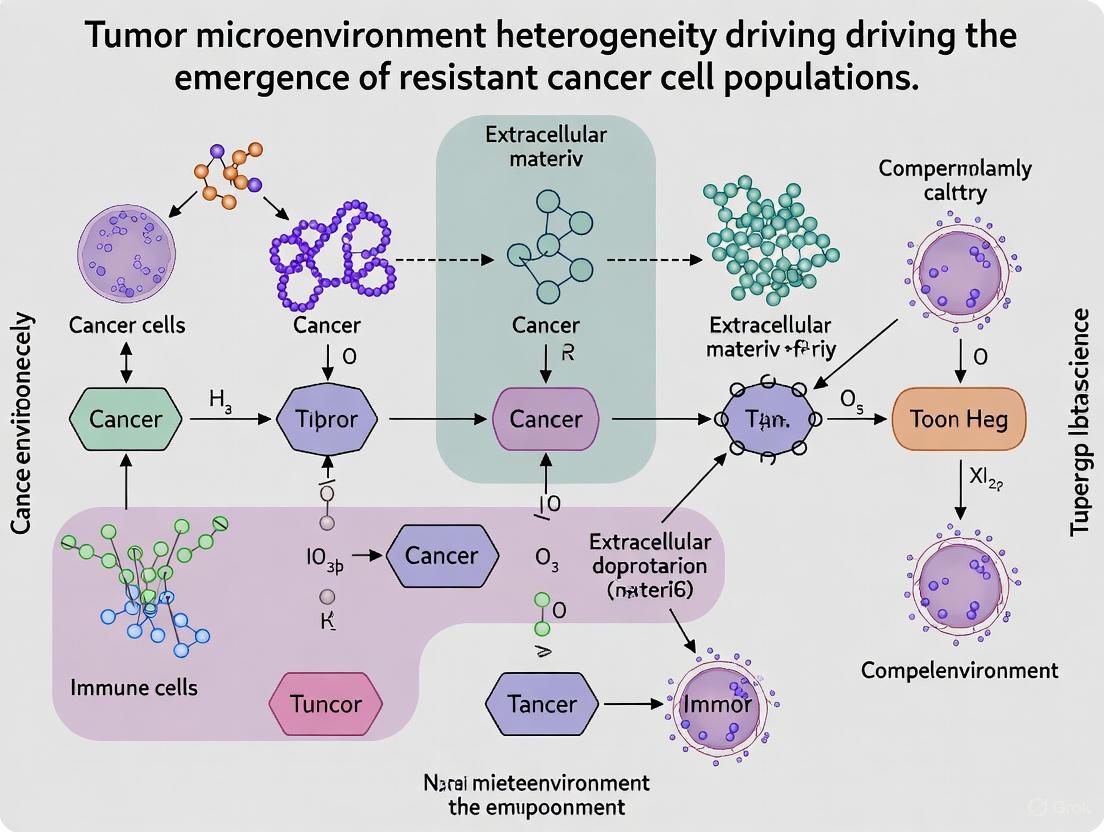
This article provides a comprehensive analysis of how heterogeneity within the tumor microenvironment (TME) drives cancer emergence and progression.
Tumor Microenvironment Heterogeneity: Decoding Its Role in Cancer Emergence, Progression, and Therapeutic Resistance
Abstract
This article provides a comprehensive analysis of how heterogeneity within the tumor microenvironment (TME) drives cancer emergence and progression. Tailored for researchers and drug development professionals, it explores the foundational sources of TME heterogeneity—including genetic, epigenetic, and immune cell diversity—and its functional consequences. The piece details cutting-edge methodological approaches like single-cell and spatial multi-omics for dissecting this complexity, addresses central challenges such as therapeutic resistance, and evaluates advanced preclinical models for validation. By synthesizing insights across these four intents, the article aims to bridge fundamental research with the development of novel, effective therapeutic strategies that target the dynamic ecosystem of the TME.
Deconstructing the Ecosystem: The Origins and Components of a Heterogeneous TME
Tumor heterogeneity represents a fundamental challenge in clinical oncology, driving diverse therapeutic responses and clinical outcomes among patients with histologically similar cancers. This complexity manifests at multiple levels, creating a multi-layered biological puzzle that complicates diagnosis, treatment, and prognostication. Intertumoral heterogeneity refers to the molecular and phenotypic differences observed between tumors from different patients or between different tumor nodules within the same patient. In contrast, intratumoral heterogeneity (ITH) describes the genetic, transcriptomic, and phenotypic diversity of cancer cells within a single tumor mass [1]. This diversity arises through continuous clonal evolution under selective pressures, resulting in subclones with distinct molecular alterations that contribute significantly to treatment resistance and disease recurrence [2] [1].
The clinical significance of tumor heterogeneity is profound, with over 90% of cancer-related deaths associated with metastasis, a process intimately linked with heterogeneous cell populations [1]. The tumor microenvironment (TME) serves as a critical orchestrator of this heterogeneity, crafting a unique realm that enables malignant cells to withstand therapeutic onslaught through complex cellular interactions, metabolic dynamics, and evolving spatial architectures [3]. This review examines the defining characteristics of intertumoral and intratumoral heterogeneity, their underlying mechanisms, advanced methodological approaches for their quantification, and their direct implications for therapeutic resistance and clinical management strategies.
Molecular Dimensions and Defining Characteristics
Genetic and Non-Genic Drivers of Heterogeneity
The formation of tumor heterogeneity is primarily driven by genomic instability, epigenetic modifications, plastic gene expression, and variations within the TME [2]. Genetic heterogeneity emerges through accumulated mutations during tumor growth, leading to subclonal populations with distinct genotypes. This includes both spatial heterogeneity (differences between primary tumors and metastases or within different regions of the same tumor) and temporal heterogeneity (dynamic changes in molecular characteristics over time and in response to therapies) [2].
Epigenetic modifications represent another crucial layer, with temporal shifts in DNA methylation patterns and chromatin remodeling contributing to phenotypic diversity without altering the underlying DNA sequence [2]. Additionally, cellular plasticity enables cancer cells to transition between states, with cancer stem-like cells (CSCs) playing a particularly important role in generating heterogeneity through their capacity for unlimited self-renewal and differentiation [4].
Table 1: Key Mechanisms Driving Tumor Heterogeneity
| Mechanism | Key Components | Functional Impact |
|---|---|---|
| Genomic Instability | Elevated mutation rates, Mismatch repair defects, Extrachromosomal DNA (eccDNA) | Increased genetic diversity, Accelerated evolution, Therapy resistance |
| Epigenetic Modifications | DNA methylation patterns, Chromatin remodeling, Histone modifications | Reversible phenotypic changes, Adaptive responses, Cellular plasticity |
| Tumor Microenvironment | Growth factors, Cytokines, Metabolic gradients, Hypoxia, ECM composition | Selective pressures, Niche specialization, Immune evasion |
| Cellular Plasticity | Cancer stem cells, EMT transition, Phenotype switching | Tumor initiation, Metastatic capability, Therapeutic resilience |
Spatial Organization and Clinical Impact
The spatial architecture of heterogeneity significantly influences clinical outcomes across cancer types. In colorectal cancer (CRC), research has revealed unexpectedly high intratumoral morphological heterogeneity, with most tumors exhibiting two or three different dominant morphotypes [5]. AI-based image analysis of 644 H&E sections from 161 primary CRCs identified distinct morphological patterns with specific clinical associations:
Table 2: Morphological Heterogeneity in Colorectal Cancer and Clinical Associations
| Morphotype | Prevalence Patterns | Clinical Associations |
|---|---|---|
| Complex Tubular (CT) | Most common morphotype | Left side, lower grade, better survival in stage I-III patients |
| Desmoplastic (DE) | Rarely dominant, rarely combined with other morphotypes | Higher T-stage, N-stage, distant metastases, AJCC stage, shorter overall survival and relapse-free survival |
| Mucinous (MU) | Mostly combined with solid/trabecular and papillary morphotypes | Higher grade, right side, microsatellite instability (MSI) |
| Papillary (PP) | Variable combinatorial patterns | Earlier T- and N-stage, absence of metastases, improved overall and relapse-free survival |
Critically, the study concluded that it is not heterogeneity per se, but rather the proportions of specific morphologies that associate with clinical outcomes [5]. This finding underscores the importance of quantitative spatial analysis in prognostic assessment.
In hepatocellular carcinoma (HCC), molecular heterogeneity manifests through varying surface marker expression (EpCAM, CD133, CD90, CD13) on cancer stem-like cells (LCSCs), which dynamically switch phenotypes over time, contributing to therapeutic resistance and tumor recurrence [4]. The "bad apple" effect demonstrates how the most aggressive tumor subpopulation can ultimately determine clinical trajectory, highlighting why targeting dominant clones alone may yield limited success [6].
Methodological Approaches for Dissecting Heterogeneity
Advanced Genomic and Transcriptomic Technologies
Single-cell RNA sequencing (scRNA-seq) has revolutionized heterogeneity research by enabling unprecedented resolution at the cellular level. A comprehensive thyroid cancer study analyzing 405,077 single cells from 50 tumors and 14 normal tissues identified four major cellular lineages (thyrocytes, endothelial cells, mesenchymal cells, and immune cells) and numerous distinct subtypes within each category [7]. The experimental workflow for such analyses typically involves:
Spatial transcriptomics complements scRNA-seq by preserving geographical context within tissues. This technique maps gene expression patterns to specific tissue locations, revealing how cellular interactions and local environmental influences shape heterogeneity [8]. When integrated with scRNA-seq data, researchers can reconstruct high-resolution spatial maps of cellular distribution and interaction networks within the TME.
Multiregional sequencing approaches address spatial heterogeneity by sampling multiple regions from individual tumors. In HCC, analysis of 172 multiregional samples from 37 patients demonstrated that transcriptomic heterogeneity captures crucial evolutionary information predictive of clinical outcomes [6]. Genes exhibiting both high intra- and inter-tumoral expression variation were significantly enriched for prognostic information, enabling development of an evolutionary signature (HCCEvoSig) that predicted disease progression and mortality independent of established clinicopathological indices.
Computational and Imaging Approaches
Artificial intelligence has emerged as a powerful tool for quantifying morphological heterogeneity. In the CRC study previously referenced, researchers trained a deep learning image analysis AI model (DenseNet V2) using the HALO platform to automatically detect six distinct morphotypes across 644 digital section files [5]. The model was trained on regions with perfect inter-pathologist agreement, achieving an intersection-over-union coefficient greater than 0.9 for all categories before application to the full dataset.
Computational digital pathology leverages spatial metrics to characterize tumor immunoarchitecture, including:
- Mixing score: Quantifies the intermingling of different cell types
- Average neighbor frequency: Measures the composition of immediate cellular neighborhoods
- Shannon's entropy: Calculates diversity based on proportions of constituting parts
- G-cross function: Analyzes spatial point patterns to identify clustering or dispersion [9]
These metrics enable classification of TME immunoarchitecture into "cold," "mixed," and "compartmentalized" patterns, which have demonstrated associations with treatment efficacy [9].
Hybrid modeling frameworks such as spatial quantitative systems pharmacology (spQSP) integrate whole-patient compartmental models with spatial agent-based models (ABMs) to simulate intratumoral heterogeneity dynamics and therapeutic responses [9]. These computational approaches facilitate quantitative validation of heterogeneity metrics and enable in silico testing of combination therapies.
The Scientist's Toolkit: Essential Research Reagents and Platforms
Table 3: Key Research Reagents and Platforms for Heterogeneity Research
| Category | Specific Examples | Function/Application |
|---|---|---|
| Single-Cell Platforms | 10X Genomics Chromium, Drop-seq, inDrops | Single-cell barcoding, library preparation, high-throughput analysis |
| Spatial Transcriptomics | 10X Visium, Slide-seq, MERFISH | Spatial mapping of gene expression, tissue context preservation |
| Cell Type Markers | CD45 (immune cells), EPCAM (epithelial), PDGFRB (mesenchymal), EMCN (endothelial) [7] | Cell lineage identification, population characterization |
| Computational Tools | HALO AI, CellChat, NicheNet, AUCell, UMAP | Image analysis, cell-cell communication inference, pathway enrichment, dimensionality reduction |
| CSC Surface Markers | EpCAM, CD13, CD24, CD44, CD47, CD90, CD133, ICAM1, LGR5 [4] | Cancer stem cell identification, functional characterization |
| Spatial Metrics | Mixing score, Shannon's entropy, G-cross function [9] | Quantitative heterogeneity assessment, immunoarchitecture classification |
Therapeutic Implications and Clinical Translation
Resistance Mechanisms and Treatment Strategies
Intratumoral heterogeneity is a primary driver of therapeutic resistance through multiple mechanisms. The presence of genetically distinct subclones means that a single therapeutic agent may effectively target only specific cellular populations, leaving resistant clones to proliferate and drive disease progression [2]. This is particularly evident in targeted therapies, where pre-existing minor subclones with resistance mutations can be selectively enriched under treatment pressure.
The TME further complicates therapeutic response by creating physical and functional barriers to drug delivery and efficacy. Collagen heterogeneity within the ECM influences immune cell infiltration, with excessive collagen deposition hindering immune cell penetration and contributing to the formation of "cold" tumors characterized by minimal T-cell infiltration [10]. Therapeutic strategies targeting collagen metabolism have shown promise in converting these immunologically cold tumors into "hot" tumors, potentially enhancing response to immunotherapy [10].
Emerging Therapeutic Approaches
Combination therapies represent the most promising approach to address heterogeneity-driven resistance. By simultaneously targeting multiple pathways or cellular populations, combination regimens can potentially overcome the limitations of single-agent approaches. For example, in breast cancer, molecular stratification based on hormone receptor and HER2 status has enabled development of targeted combinations that address intertumoral heterogeneity [1].
Immunotherapy combinations seek to modulate the TME to enhance anti-tumor immunity. Research has identified specific cellular interactions within the TME that contribute to immunosuppression, such as inhibitory communications between APOE+ macrophages and CD8+ PDCD1+ T cells in anaplastic thyroid cancer [7]. Targeting these specific interactions represents a promising strategy for overcoming resistance.
Evolution-informed therapy leverages understanding of clonal dynamics to design treatment sequences that anticipate and preempt resistance mechanisms. In HCC, the HCCEvoSig signature derived from multiregional transcriptional heterogeneity has demonstrated predictive utility for responses to both immunotherapy and trans-arterial chemoembolization, highlighting the potential for evolutionary signatures to guide treatment selection [6].
Tumor heterogeneity represents a multi-layered challenge that permeates every aspect of cancer biology, from molecular pathogenesis to clinical management. The distinction between intertumoral and intratumoral heterogeneity provides a conceptual framework for understanding the diverse manifestations of cancer complexity, but these dimensions are intimately interconnected through shared underlying mechanisms and clinical consequences.
Advances in single-cell technologies, spatial mapping, and computational analysis are rapidly transforming our ability to dissect and quantify heterogeneity at unprecedented resolution. These approaches have revealed that heterogeneity is not merely background biological noise, but rather contains critical information about tumor evolution, therapeutic vulnerability, and clinical trajectory. The successful translation of these insights into clinical practice will require continued development of integrative analytical frameworks that can reconcile molecular measurements across spatial and temporal scales, and therapeutic strategies that acknowledge and address the dynamic, multi-clonal nature of malignant disease.
Genetic instability and clonal evolution represent fundamental biological processes that fuel the development and progression of cancer. Genetic instability refers to increased propensity for genomic alterations during cell division, while clonal evolution describes the process by which tumor cells with competitive advantages are selected and expand [11]. Together, these mechanisms generate the remarkable diversity—both genetic and phenotypic—that characterizes advanced malignancies and presents significant challenges for therapeutic intervention. This diversity manifests not only within individual tumors (intratumor heterogeneity) but also between tumors of the same histological type in different patients (intertumor heterogeneity) [12]. Within the complex milieu of the tumor microenvironment (TME), this cellular diversity undergoes continuous reprogramming through dynamic ecosystem pressures, ultimately shaping disease trajectory and therapeutic response [12].
The interplay between genetic instability and the TME creates a vicious cycle: genomic alterations drive cellular diversity, which reshapes the microenvironment, which in turn exerts selective pressures that further influence clonal evolution [12]. This review explores the mechanistic basis of genetic instability, the patterns of clonal evolution, and how these processes interface with the TME to drive tumor progression and therapy resistance, providing a comprehensive framework for understanding cancer diversity.
Mechanisms of Genetic Instability
Forms of Genomic Instability
Genetic instability in cancer manifests primarily through two distinct mechanisms: chromosomal instability (CIN) and microsatellite instability (MSI). CIN, the more frequent form, involves ongoing chromosomal alterations including translocations, deletions, and amplifications that lead to abnormal chromosome numbers and structures [11]. In contrast, MSI typically arises from deficiencies in the DNA mismatch repair (MMR) system and results in elevated mutation rates, particularly in short, repetitive DNA sequences known as microsatellites [11]. Both forms are triggered by the accumulation of replication-stress-associated double-strand breaks (DSBs), with the specific repair pathway employed determining which type of instability develops [11].
Table 1: Characteristics of Genomic Instability Types
| Feature | Chromosomal Instability (CIN) | Microsatellite Instability (MSI) |
|---|---|---|
| Primary Cause | Erroneous repair by non-homologous end joining (NHEJ) | Deficient mismatch repair system |
| Main Characteristics | Chromosomal translocations, deletions, aneuploidy | Elevated mutation rates in microsatellite regions |
| Trigger | Accumulation of replication-stress-associated DSBs | Accumulation of replication-stress-associated DSBs |
| Repair Mechanism | Faulty NHEJ | Microhomology-mediated end joining (MMEJ) |
| Common in | Most cancer types | Colorectal, endometrial, gastric cancers |
Replication Stress as a Driver of Mutagenesis
Under normal replication conditions, high-fidelity DNA polymerases δ and ε faithfully replicate DNA with support from proofreading and MMR systems, resulting in low mutation rates [11]. However, when cells experience replication stress, this carefully regulated process is disrupted. Replication-stress-associated DSBs accumulate and are often repaired by low-fidelity translesion synthesis (TLS) polymerases (η, κ, θ) that lack proofreading activity [11]. This switch from high-fidelity to error-prone repair mechanisms creates a mutagenic background where cancer-driver mutations frequently arise, including base substitutions, small insertions/deletions, and large gene deletions [11].
The risk of genomic destabilization increases with cellular senescence, partly due to reduced levels of histone H2AX, which mediates repair-factor recruitment and is essential for maintaining genome stability [11]. Cells in this H2AX-diminished state become vulnerable to exogenous growth acceleration, causing them to accumulate DSBs in association with replication stress and subsequently develop genomic instability [11].
Clonal Evolution Models and Patterns
Models of Tumor Evolution
Tumor evolution follows several putative models through which cellular populations diversify and adapt. The linear evolution model involves sequential accumulation of mutations in a dominant clone. In contrast, branching evolution allows multiple subclones to evolve in parallel, generating significant intratumor heterogeneity [12]. Neutral evolution occurs when multiple subclones evolve without strong selective pressure, while punctuated evolution features bursts of genomic changes followed by periods of stability [12]. Importantly, these models are not mutually exclusive; multiple evolutionary patterns can coexist within a single tumor, and the dominant model may shift during disease progression or in response to therapeutic pressures [12].
Analysis of 2,500 tumors across cancer types revealed that 91% had at least one driver mutation, with an average of 4.6 drivers per individual tumor, indicating pervasive diversity across cancers [12]. The relationships between subclones can be sibling (branching) or parent-child, with sibling subclones approximately three times more common than parent-child subclones [12].
Quantifying Heterogeneity: A Case Study in Colorectal Cancer
Advanced methodologies, including AI-based image analysis, have enabled precise quantification of morphological heterogeneity and its clinical implications. A comprehensive study of 161 stage I-IV primary colorectal cancers (CRCs) analyzed 644 H&E sections to evaluate six distinct morphotypes: complex tubular (CT), solid/trabecular (TB), mucinous (MU), papillary (PP), desmoplastic (DE), and serrated (SE) [5].
Table 2: Morphological Heterogeneity in Colorectal Cancer and Clinical Associations
| Morphotype | Frequency | Combinatorial Preferences | Clinical Associations |
|---|---|---|---|
| Complex Tubular (CT) | Most common dominant morphotype | No specific preferences | Left side, lower grade, better survival in stage I-III |
| Desmoplastic (DE) | Rarely dominant | Rarely combined with other dominant morphotypes | Higher T-stage, N-stage, distant metastases, shorter OS and RFS |
| Mucinous (MU) | Variable | Mostly combined with TB and PP | Higher grade, right side, microsatellite instability (MSI) |
| Papillary (PP) | Variable | Combines with MU | Earlier T- and N-stage, absence of metastases, improved OS |
| Solid/Trabecular (TB) | Variable | Combines with MU | Higher proportions in MSI tumors |
| Serrated (SE) | Not specified | Not specified | Not specified |
Most tumors exhibited two or three different dominant morphotypes, with the majority showing medium or high heterogeneity [5]. The study demonstrated that it is not heterogeneity per se, but the specific proportions of morphologies that associate with clinical outcomes [5]. For instance, a higher proportion of the desmoplastic (DE) morphotype correlated with more advanced disease and poorer survival, while papillary (PP) morphotype associated with earlier stage and improved outcomes [5].
The Tumor Microenvironment as an Evolutionary Ecosystem
Spatial Heterogeneity and Cellular Cross-talk
The tumor microenvironment represents a complex ecosystem wherein cancer cells interact with diverse stromal components, including immune cells, fibroblasts, endothelial cells, and extracellular matrix [12]. Technological advances, particularly single-cell RNA sequencing (scRNA-seq), have enabled unprecedented resolution in mapping this complexity. A pan-cancer scRNA-seq atlas analyzing 230 treatment-naïve samples across 9 cancer types identified 70 shared cell subtypes and revealed their patterns of co-occurrence [13]. This analysis discovered two significant TME hubs of strongly co-occurring subtypes: one resembling tertiary lymphoid structures (TLS), and another consisting of immune-reactive PD1+/PD-L1+ immune-regulatory T cells and B cells, dendritic cells, and inflammatory macrophages [13]. Subtypes within each hub demonstrated spatial co-localization, and their abundance correlated with both early and long-term responses to checkpoint immunotherapy [13].
In advanced non-small cell lung cancer (NSCLC), scRNA-seq profiling has revealed that tumor heterogeneity dynamically reprograms the TME [12]. Lung adenocarcinoma (LUAD) and lung squamous carcinoma (LUSC) cells follow distinct developmental trajectories: LUAD transitions from alveolar type 2 (AT2) and club cells, while LUSC transitions from basal cells [12]. Additionally, intratumor heterogeneity shows specific correlations with immune populations—positively with neutrophils and macrophage subsets, and negatively with plasma cells [12]. These patterns demonstrate how genetic heterogeneity in tumor cells exerts profound influences on the composition and functional orientation of the surrounding microenvironment.
Immunotyping for Classification and Therapeutic Stratification
The heterogeneity of TME composition has led to efforts to classify tumors based on their immune contexture. The TMEclassifier represents one such approach, leveraging machine learning to categorize cancers into three distinct subtypes: Immune Exclusive (IE), marked by high stromal abundance and aggressive phenotypes; Immune Suppressive (IS), featuring myeloid-derived suppressor cell infiltration; and Immune Activated (IA), often linked to EBV/MSI status and exhibiting robust T-cell presence with improved immunotherapy response [14]. This classification system effectively stratifies patients for personalized immunotherapeutic strategies, with in vivo experiments demonstrating that targeting IL-1 can counteract immunosuppression in the IS subtype and markedly improve its responsiveness to immunotherapy [14].
Experimental Approaches and Research Methodologies
Protocol: Multi-region Sampling and Morphological Analysis
Comprehensive assessment of tumor heterogeneity requires meticulous sampling strategies. The following protocol for morphological heterogeneity analysis in colorectal cancer illustrates this approach [5]:
Sample Collection: For each tumor, select four FFPE blocks representing:
- The deepest invasion point at the serosa side
- The deepest invasion point at the insertion side of mesocolon/mesorectum
- The transition point between tumor and normal mucosa
- A central tumor block containing representative histology
Section Preparation and Staining:
- Cut 5-μm sections from each block
- Stain with hematoxylin and eosin (H&E)
- Scan slides using a digital scanner at 20x magnification (0.234 μm/pixel resolution)
Morphotype Classification:
- Define morphotypes according to established criteria (CT, TB, MU, PP, DE, SE)
- Have multiple pathologists independently score morphotype presence
- Establish regions of perfect inter-observer agreement as "ground truth"
AI-Based Image Analysis:
- Train a deep learning model (DenseNet V2) on annotated regions
- Apply the trained model to all digital sections
- Quantify surface area occupied by each morphotype
- Compute heterogeneity indices (e.g., normalized Shannon index)
Workflow for Tumor Heterogeneity Analysis
Protocol: Single-Cell RNA Sequencing for TME Analysis
Single-cell RNA sequencing has revolutionized our ability to deconstruct tumor heterogeneity and ecosystem composition [13] [12]:
Sample Processing:
- Obtain fresh or preserved tumor tissue from multiple regions
- Dissociate tissue to create single-cell suspension
- Assess cell viability and concentration
Library Preparation:
- Capture individual cells using microfluidic platforms
- Perform reverse transcription and cDNA amplification
- Prepare sequencing libraries with cell-specific barcodes
Sequencing and Data Processing:
- Sequence libraries on appropriate high-throughput platform
- Demultiplex data based on cellular barcodes
- Perform quality control, normalization, and batch correction
Bioinformatic Analysis:
- Cluster cells based on transcriptional profiles
- Identify marker genes for each cluster
- Reconstruct developmental trajectories
- Analyze cell-cell communication networks
The Scientist's Toolkit: Essential Research Reagents and Platforms
Table 3: Essential Research Reagents and Platforms for Heterogeneity Research
| Tool/Reagent | Function | Application Context |
|---|---|---|
| scRNA-seq Platforms (10X Genomics) | High-throughput single-cell transcriptomics | TME cell subtype identification [13] |
| DenseNet V2 AI Model | Deep learning for image analysis | Automated morphotype classification in CRC [5] |
| HALO Image Analysis Platform | Digital pathology and image analysis | Quantitative assessment of morphological patterns [5] |
| TMEclassifier | Machine learning-based immunotyping | Stratifying patients for immunotherapy [14] |
| Translesion Synthesis Polymerase Inhibitors | Targeting error-prone DNA repair | Experimental intervention against mutation acquisition [11] |
Therapeutic Implications and Future Directions
The dynamic interplay between genetic instability, clonal evolution, and TME remodeling represents a significant challenge for cancer therapy. Tumor heterogeneity directly influences therapeutic targets and shapes the TME to influence drug resistance across all treatment modalities, including chemotherapy, radiotherapy, targeted therapy, and immunotherapy [12]. Advanced cancers often develop resistance to multiple therapies through the selection of pre-existing resistant subclones or the acquisition of new resistance mutations [15].
Evolution-informed treatment strategies are emerging to address these challenges. Adaptive therapy aims to maintain stable tumor volumes by leveraging competition between drug-sensitive and resistant cells [15]. Extinction therapy seeks to simultaneously target multiple independent pathways to prevent escape routes [15]. Reflexive control therapies utilize frequent monitoring and treatment adaptation in response to evolving tumor characteristics [15]. Understanding the evolutionary trajectories of cancers can thus inform more effective, personalized treatment protocols that anticipate and counter resistance mechanisms.
The intricate relationship between genetic instability, clonal evolution, and TME heterogeneity creates both challenges and opportunities for cancer management. While diversity fuels progression and therapy resistance, comprehensive characterization of this diversity through advanced technologies provides the insights necessary for developing more effective, evolutionarily-informed treatment approaches that can ultimately improve outcomes for cancer patients.
Epigenetic remodeling encompasses the dynamic and reversible mechanisms that regulate gene expression without altering the underlying DNA sequence. These processes—including DNA methylation, histone modifications, chromatin remodeling, and RNA-associated silencing—create a complex regulatory layer that determines cellular identity, function, and adaptability [16]. Within the context of the tumor microenvironment (TME), epigenetic remodeling drives phenotypic diversity and fosters heterogeneity, significantly influencing cancer progression, therapeutic resistance, and immune evasion [17] [18].
The TME consists of malignant cells surrounded by diverse stromal and immune cells, all engaged in constant communication. Spatial and temporal epigenetic heterogeneity within this ecosystem arises from genetic instability, environmental pressures, and therapeutic interventions [17] [19]. This review examines how epigenetic mechanisms govern cellular phenotypes in the TME, explores advanced experimental methodologies for their study, and discusses emerging epigenetic therapies that aim to overcome treatment resistance by reprogramming the tumor-immune interface.
Molecular Mechanisms of Epigenetic Control
Epigenetic regulation operates through several interconnected mechanisms that collectively shape the chromatin landscape and control transcriptional accessibility.
DNA Methylation and Demethylation
DNA methylation involves the covalent addition of a methyl group to the 5-carbon of cytosine in CpG dinucleotides (5mC), primarily catalyzed by DNA methyltransferases (DNMTs) [16]. DNMT1 maintains methylation patterns during DNA replication, while DNMT3A and DNMT3B establish de novo methylation [16]. This modification typically leads to gene silencing when it occurs in promoter regions, contributing to the repression of tumor suppressor genes in cancer [16].
The ten-eleven translocation (TET) family of proteins (TET1-3) catalyzes the iterative oxidation of 5mC to 5-hydroxymethylcytosine (5hmC) and further to 5-formylcytosine (5fC) and 5-carboxycytosine (5caC), initiating DNA demethylation pathways [16]. The balance between DNMT and TET activity critically regulates cellular differentiation and stemness; for example, TET2 dysfunction promotes leukemogenesis by inducing hypermethylation and repression of hematopoietic differentiation genes like GATA2 and HOX family members [20].
Histone Modifications
Histones undergo numerous post-translational modifications that alter chromatin structure and DNA accessibility. Key modifications include:
- Histone Acetylation: Catalyzed by histone acetyltransferases (HATs), acetylation of lysine residues neutralizes their positive charge, reducing histone-DNA affinity and promoting an "open" chromatin state permissive for transcription [16]. Histone deacetylases (HDACs) reverse this process, leading to chromatin condensation and transcriptional repression [16].
- Histone Methylation: This modification can either activate or repress transcription depending on the specific residue modified and its methylation state. For example, H3K4me3 and H3K36me3 are associated with active transcription, while H3K9me3 and H3K27me3 correlate with gene repression [21].
The bivalent chromatin state—characterized by the simultaneous presence of activating H3K4me3 and repressive H3K27me3 marks at promoter regions—maintains pluripotency genes in a poised state in stem cells, allowing rapid activation or repression during differentiation [21].
Chromatin Remodeling Complexes
ATP-dependent chromatin remodeling complexes, including SWI/SNF, ISWI, CHD, and INO80 subfamilies, regulate nucleosome positioning, composition, and accessibility [22] [23]. These complexes use ATP hydrolysis to slide, evict, or restructure nucleosomes, thereby controlling DNA accessibility for transcription, replication, and repair [23]. In cancers such as breast cancer and uveal melanoma, these complexes are frequently dysregulated, contributing to disease progression and presenting potential therapeutic targets [22] [23].
Epigenetic Dynamics in the Tumor Microenvironment
The TME exhibits remarkable epigenetic heterogeneity that drives phenotypic plasticity and fosters pro-tumorigenic interactions.
Cancer Cell-Intrinsic Epigenetic Reprogramming
Cancer cells undergo extensive epigenetic alterations that influence their interactions with immune cells. Key enzymes shape this immunogenic landscape:
Table 1: Epigenetic Regulators of Tumor-Immune Interactions
| Epigenetic Regulator | Function | Impact on TME |
|---|---|---|
| SETDB1 | H3K9 methyltransferase | Represses IFN genes, reduces immunogenicity [18] |
| HDAC8 | Histone deacetylase | Silences CCL4 chemokine gene, limits CD8+ T cell infiltration [18] |
| MLL3/MLL4 | H3K4 mono-methyltransferases | Regulate GSDMD expression, impact CD8+ T cell activation [18] |
| TET2 | DNA demethylase | Loss leads to hypermethylation of differentiation genes, promotes stemness [20] |
| DNMT1 | DNA methyltransferase | Silences tumor suppressors, supports cancer stem cell maintenance [20] |
| EZH2 | H3K27 methyltransferase | Represses differentiation genes, maintains stem cell identity [21] |
These modifications create an immunosuppressive TME by reducing tumor immunogenicity and inhibiting immune cell infiltration and function [18].
Epigenetic Regulation of Stromal and Immune Cells
Stromal cells in the TME, including cancer-associated fibroblasts (CAFs) and immune cells, exhibit epigenetically driven phenotypic alterations:
- Cancer-Associated Fibroblasts: CAFs display global DNA hypomethylation with site-specific hypermethylation, influencing genes such as HOXB6 in gastric cancer and SMAD3 in lung cancer [24]. This epigenetic reprogramming enhances their pro-tumorigenic functions, including extracellular matrix remodeling and growth factor secretion.
- Immune Cells: Epigenetic mechanisms dictate immune cell differentiation, polarization, and function within the TME. For instance, in glioma, macrophages with CD44 and CD109 phenotypes localize predominantly to stromal regions, while soluble CD10 expression is elevated in the tumor core [17]. T cell exhaustion—a dysfunctional state in chronic antigen exposure—is also maintained through epigenetic programs that persist even after antigen clearance [18].
Metabolic-Epigenetic Crosstalk
The metabolic landscape of the TME directly influences epigenetic regulation. Tumor cells often exhibit glycolytic reprogramming, leading to lactate accumulation and extracellular acidification. This metabolic shift inhibits TET enzyme activity by disrupting α-ketoglutarate homeostasis, resulting in DNA hypermethylation [20]. Similarly, mutations in isocitrate dehydrogenase (IDH) genes promote production of the oncometabolite D-2-hydroxyglutarate, which competitively inhibits TET enzymes and DNA demethylation [20].
Experimental Approaches for Epigenetic Analysis
Mapping the Epigenome
Advanced technologies enable comprehensive profiling of epigenetic states:
- Bisulfite Sequencing: Whole-genome bisulfite sequencing (WGBS) provides single-base resolution maps of DNA methylation patterns, revealing differentially methylated regions (DMRs) critical for gene regulation [25].
- Chromatin Accessibility Assays: Assay for Transposase-Accessible Chromatin using sequencing (ATAC-Seq) identifies genomically regions with open chromatin configuration, indicating regulatory activity [18].
- Histone Modification Profiling: Chromatin immunoprecipitation followed by sequencing (ChIP-Seq) maps the genomic localization of specific histone modifications and transcription factors.
- Multi-Omics Integration: Combined analysis of epigenetic marks, transcriptomic data, and genetic information through single-cell multi-omics technologies reveals coordinated regulatory networks driving cellular phenotypes [18].
Programmable Epigenetic Editing
The CRISPRoff and CRISPRon systems enable precise epigenetic manipulation without altering DNA sequences. These technologies utilize catalytically inactive dCas9 fused to epigenetic effectors:
- CRISPRoff: dCas9 linked to DNMT3A, DNMT3L, and KRAB domains writes heritable DNA methylation marks to silence target genes [25].
- CRISPRon: dCas9 fused to TET1 catalytic domain removes DNA methylation to activate silenced genes [25].
Table 2: Experimental Applications of Epigenetic Editing
| Target Gene | Editing System | Biological Outcome | Therapeutic Relevance |
|---|---|---|---|
| CD55, CD81, CD151 | CRISPRoff | Durable silencing (>28 days) through DNA methylation [25] | Platform validation |
| FAS, PTPN2, RC3H1 | CRISPRoff | Silencing therapeutically relevant genes in T cells [25] | Enhanced CAR-T function |
| FOXP3 enhancer | CRISPRon | Targeted demethylation and FOXP3 induction [25] | Treg programming |
| Endogenous genes | CRISPRoff + CAR knock-in | Multiplexed epigenetic and genetic engineering [25] | Combination therapy development |
This epigenetic engineering platform demonstrates high specificity, with whole-genome bisulfite sequencing confirming that methylation changes are restricted to target loci without widespread epigenetic dysregulation [25].
Diagram 1: CRISPRoff and CRISPRon Epigenetic Engineering Systems. These all-RNA platforms enable durable gene silencing or activation without double-strand breaks through targeted DNA methylation or demethylation [25].
The Scientist's Toolkit: Research Reagent Solutions
Table 3: Essential Reagents for Epigenetic Research
| Category | Specific Reagents/Tools | Function/Application |
|---|---|---|
| Epigenetic Editors | CRISPRoff mRNA, CRISPRon mRNA | Targeted gene silencing/activation without DNA breaks [25] |
| Guide RNA Design | sgRNAs targeting CpG islands near TSS | Optimized for epigenetic editing efficiency [25] |
| Delivery Systems | Electroporation (Lonza 4D Nucleofector), mRNA with 1-Me-ps-UTP | Efficient delivery to primary cells like T cells [25] |
| DNMT Inhibitors | 5-aza-2'-deoxycytidine (Decitabine) | DNA hypomethylating agents for bulk epigenetic reprogramming [24] |
| HDAC Inhibitors | Valproic Acid (VPA), Vorinostat | Increase histone acetylation, enhance reprogramming efficiency [21] |
| Chromatin Remodeler Inhibitors | FHD286, FHT2344 | Inhibit BAF complex ATPase activity, target transcription factor networks [23] |
| Analytical Tools | WGBS, RNA-seq, scATAC-seq | Multi-omics assessment of epigenetic and transcriptional changes [25] [18] |
Therapeutic Targeting of Epigenetic Mechanisms
Epigenetic therapies offer promising approaches for reprogramming the TME and overcoming treatment resistance.
Epigenetic Drugs in Clinical Development
Several classes of epigenetic-targeting agents are under investigation:
- DNMT Inhibitors: Azacitidine and decitabine promote DNA hypomethylation and are approved for myelodysplastic syndromes and acute myeloid leukemia [20]. In solid tumors, they may enhance tumor immunogenicity by reversing hypermethylation of tumor suppressor genes.
- HDAC Inhibitors: Compounds such as vorinostat and romidepsin inhibit histone deacetylases, increasing histone acetylation and gene expression. HDAC inhibitors can sensitize tumor cells to conventional therapies and modulate immune cell function [16].
- EZH2 Inhibitors: Tazemetostat and other EZH2 inhibitors target the catalytic subunit of PRC2, reducing H3K27me3 levels and reactivating silenced tumor suppressor genes [21].
- BAF Complex Inhibitors: FHD286 and FHT2344 are dual inhibitors of the BAF complex ATPase subunits BRG1 and BRM, showing promise in preclinical models of uveal melanoma by disrupting oncogenic transcription factor networks [23].
Epigenetic-Immunotherapy Combinations
Combining epigenetic therapies with immune checkpoint inhibitors (ICIs) represents a strategic approach to overcome resistance mechanisms in cold tumors. Preclinical studies demonstrate that epigenetic modifiers can enhance response to ICIs by:
- Increasing tumor antigen presentation through MHC upregulation
- Inducing expression of endogenous retroviruses and viral mimicry responses
- Modulating chemokine profiles to promote T cell infiltration
- Reversing T cell exhaustion programs [18]
In GBM models, HDAC inhibition has been shown to sensitize tumors to immunotherapy by modifying the immunosuppressive TME [17]. Similarly, DNMT inhibitors can upregulate tumor-associated antigens and immune recognition pathways in solid tumors [18].
Epigenetic remodeling serves as a fundamental regulator of cellular phenotypes within the tumor microenvironment, driving heterogeneity through dynamic, reversible mechanisms that respond to genetic, environmental, and therapeutic pressures. The integration of advanced epigenetic profiling technologies with novel epigenetic editing platforms like CRISPRoff/CRISPRon provides unprecedented precision in mapping and manipulating these regulatory networks.
Future research directions should focus on understanding the spatial coordination of epigenetic states across different TME compartments, deciphering the metabolic-epigenetic cross-talk that sustains tumor heterogeneity, and developing next-generation epigenetic therapies that can be strategically combined with immunotherapy to overcome resistance. As our knowledge of epigenetic regulation deepens, so too does our potential to harness these mechanisms for more effective, personalized cancer treatments.
Cancer Stem Cells (CSCs) and Their Role in Functional Heterogeneity
Cancer Stem Cells (CSCs) represent a highly plastic and therapy-resistant subpopulation within tumors that drives tumor initiation, progression, metastasis, and relapse [26]. Once viewed as a fixed cellular hierarchy, CSCs are now recognized as a fluid functional state that tumor cells can enter or exit, driven by intrinsic genetic programs, epigenetic reprogramming, and critical microenvironmental cues [27] [28]. This dynamic plasticity fundamentally complicates CSC identification due to inconsistent marker expression while simultaneously enabling multifaceted resistance mechanisms, dormancy, and metastatic dissemination [27]. The functional heterogeneity of CSCs emerges not from a rigid hierarchical structure but from continuous bidirectional interactions with the tumor microenvironment (TME), creating a complex landscape that poses significant challenges for therapeutic targeting [29] [26].
The evolving CSC paradigm has profound implications for cancer therapeutics. While conventional treatments effectively target rapidly dividing bulk tumor cells, they often fail against the adaptive mechanisms of CSCs, leading to therapeutic resistance and disease recurrence [30]. The CSC concept remains clinically contested despite promising preclinical efforts, primarily due to insufficient understanding of state transitions and inadequate experimental models that fully recapitulate human tumor complexity [27]. This technical guide examines CSC heterogeneity and regulatory mechanisms within the framework of tumor microenvironment heterogeneity, providing researchers with current methodologies and conceptual frameworks to advance CSC-directed therapeutic strategies.
CSC Biomarkers and Heterogeneity Across Cancer Types
The identification of CSCs relies heavily on specific surface markers and functional assays, though considerable heterogeneity exists across different cancer types. This variation reflects the influence of both tissue origin and microenvironmental context on CSC phenotypes [26]. No universal CSC marker exists, requiring researchers to employ context-specific biomarker panels for accurate identification and isolation [26].
Table 1: Established Cancer Stem Cell Markers Across Different Malignancies
| Tumor Type | Key Biomarkers | Functional Characteristics | References |
|---|---|---|---|
| Breast Cancer | CD44+/CD24-/low, ALDH+ | Tumor initiation, metastasis, therapy resistance | [30] |
| Prostate Cancer | CD44+, α2β1+, ALDH+ | Self-renewal, metastatic potential | [30] |
| Glioblastoma | CD133+, Nestin, SOX2 | Tumor initiation, radiation resistance | [26] [30] |
| Colon Cancer | CD133+, CD44+, CD166+, EpCAM+, ALDH+ | Sphere formation, tumorigenicity | [30] |
| Lung Cancer | CD133+, CD44+, ALDH+, CD117+ | Chemoresistance, self-renewal | [30] |
| Pancreatic Cancer | CD133+, CD44+, CD24+, ESA+ | Tumorigenicity, metastatic potential | [30] |
| Liver Cancer | CD133+, CD44+, CD90+, EpCAM+, CD13+ | Tumor initiation, recurrence | [30] |
| Ovarian Cancer | CD133+, CD44+, ALDH+, CD117+ | Platinum resistance, sphere formation | [30] |
| Melanoma | ABCB5+, CD20+, CD271+ | Drug efflux, tumor initiation | [30] |
| Head and Neck Cancer | CD44+, ALDH+, CD66- | Invasion, metastasis | [30] |
The dynamic nature of CSC phenotypes presents significant challenges for reliable identification. Surface marker expression demonstrates considerable context-dependent variability influenced by factors including hypoxia, therapy exposure, and spatial positioning within the tumor [27] [26]. Furthermore, non-CSCs can acquire stem-like characteristics through dedifferentiation processes, blurring the distinction between CSC and non-CSC populations [28]. This plasticity necessitates functional validation of putative CSCs through sphere formation assays, in vivo limiting dilution transplantation, and treatment resistance evaluations to confirm stemness properties beyond surface marker expression [26].
Tumor Microenvironment: Driver of CSC Heterogeneity
The tumor microenvironment serves as an indispensable regulator of CSC maintenance and plasticity, contributing to functional heterogeneity through complex bidirectional signaling. Major TME components including immune cells, cancer-associated fibroblasts (CAFs), mesenchymal stem cells (MSCs), endothelial cells, and extracellular matrix (ECM) constituents establish specialized niches that support CSC persistence [29]. These cellular and structural elements engage in continuous crosstalk with CSCs, creating dynamic ecosystems that promote tumor progression, therapy resistance, and metastatic dissemination [29] [30].
Extracellular Matrix and Biomechanical Cues
The ECM provides critical biochemical and biophysical signals that influence CSC behavior. In breast cancer, dense clusters of cross-linked collagen fibrils create increased matrix stiffness that correlates with poor patient survival [29]. This biomechanical property activates specific mechanotransduction pathways; particularly, high matrix stiffness induces nuclear translocation of TWIST1 by releasing it from its cytoplasmic binding partner G3BP2 [29]. The TWIST1-G3BP2 mechanotransduction pathway responds to biomechanical signals from the TME to drive epithelial-mesenchymal transition (EMT), invasion, and metastasis [29]. Similar mechanisms operate in prostate cancer, where ECM stiffness regulates tumor cell migration and aggressiveness [29].
ECM remodeling represents another critical mechanism through which the TME influences CSC heterogeneity. Enzymes including matrix metalloproteinases (MMPs) modify ECM structure and composition, creating permissive environments for CSC maintenance. For instance, Pleiotrophin (PTN) secreted by breast cancer cells induces extensive ECM remodeling through stimulation of stromal fibroblasts, upregulating aggressive phenotype markers including PKCδ and MMP-9 [29]. Similarly, interactions between tumor cells and tumor-associated macrophages (TAMs) promote ECM remodeling that activates pro-tumorigenic signaling pathways including IL-6/JAK/Stat3, further enhancing CSC properties [29].
Diagram 1: TME-Driven CSC Regulation Pathways
Cellular Components of the CSC Niche
Immune cells within the TME play paradoxical roles in CSC regulation. Tumor-associated macrophages (TAMs) frequently support CSC maintenance through secretion of cytokines including IL-6, which activates STAT3 signaling in CSCs [29] [30]. Similarly, mesenchymal stem cells (MSCs) recruited to the tumor site enhance CSC properties through direct cell-contact-mediated signaling and paracrine factor secretion [29] [30]. Cancer-associated fibroblasts (CAFs) represent another critical niche component that promotes CSC expansion through TGF-β signaling, cytokine secretion, and ECM remodeling [29]. These cellular interactions create immunosuppressive niches that protect CSCs from immune surveillance while simultaneously promoting stemness traits.
The vascular niche provides specialized microenvironments that support CSC maintenance. Endothelial cells directly interact with CSCs through adhesion molecules and secreted factors that promote self-renewal and survival [26]. Perivascular localization of CSCs facilitates metabolic symbiosis, where CSCs benefit from nutrient-rich environments while receiving critical maintenance signals [26]. Hypoxic regions within tumors further reinforce CSC properties through hypoxia-inducible factor (HIF)-mediated signaling that promotes stemness, survival, and therapy resistance [26].
Methodological Approaches for CSC Research
Experimental Models and Isolation Techniques
Advanced experimental models are essential for investigating CSC biology within physiologically relevant contexts. Traditional two-dimensional culture systems often fail to recapitulate the complexity of CSC-microenvironment interactions, driving development of more sophisticated approaches [26].
Table 2: Key Methodologies for CSC Research
| Methodology | Key Features | Applications in CSC Research | Limitations | |
|---|---|---|---|---|
| Single-Cell Sequencing | High-resolution analysis of transcriptional heterogeneity | Identification of CSC subpopulations, plasticity trajectories, state transitions | Loss of spatial context, technical artifacts | [26] |
| 3D Organoid Models | Preservation of cell-cell interactions, tissue architecture | Studying CSC-TME interactions, drug screening, personalized medicine | Variable reproducibility, complexity of establishment | [26] |
| CRISPR-Based Functional Screens | Genome-wide loss-of-function studies | Identification of essential CSC maintenance genes, synthetic lethal interactions | Off-target effects, delivery challenges | [26] |
| Flow Cytometry with CSC Markers | Isolation of live cells based on surface markers | CSC enrichment, functional characterization, transplantation assays | Marker expression variability, population heterogeneity | [30] |
| Patient-Derived Xenografts (PDX) | Preservation of tumor heterogeneity, human TME components | In vivo CSC studies, preclinical therapeutic testing | High cost, time-intensive, ethical considerations | [26] |
Diagram 2: Experimental Workflow for CSC Characterization
The Scientist's Toolkit: Essential Research Reagents
Table 3: Essential Research Reagents for CSC Investigations
| Reagent Category | Specific Examples | Research Application | Functional Purpose | |
|---|---|---|---|---|
| CSC Surface Markers | Anti-CD44, Anti-CD133, Anti-CD24, Anti-ALDH1 | Identification and isolation of CSC populations | FACS sorting, immunohistochemical detection, magnetic bead separation | [30] |
| Cytokines & Growth Factors | EGF, bFGF, TGF-β, BMPs | CSC maintenance in culture | Promotion of self-renewal, survival signaling in serum-free conditions | [29] [26] |
| Signaling Inhibitors | Notch inhibitors (DAPT), Wnt inhibitors (IWP-2), Hedgehog inhibitors (Cyclopamine) | Functional studies of signaling pathways | Targeting essential self-renewal pathways to assess CSC dependence | [26] |
| Extracellular Matrix Components | Collagen I, Matrigel, Laminin, Fibronectin | 3D culture systems, invasion assays | Recreation of tumor microenvironment, study of biomechanical cues | [29] |
| Metabolic Probes | 2-NBDG (glucose uptake), MitoTracker, C11-BODIPY (lipid peroxidation) | Assessment of CSC metabolic states | Monitoring metabolic plasticity, fuel utilization preferences | [26] |
CSC-Mediated Therapeutic Resistance and Targeting Strategies
CSCs employ multiple overlapping mechanisms to resist conventional cancer therapies, making them critical mediators of treatment failure and disease recurrence. Understanding these resistance mechanisms is essential for developing effective CSC-directed therapeutic approaches.
Mechanisms of Therapy Resistance
The slow-cycling nature of many CSCs provides inherent resistance to chemotherapeutic agents that target rapidly dividing cells [30]. This quiescent state allows CSCs to survive initial treatment and subsequently regenerate tumors [30]. Additionally, CSCs express high levels of ATP-binding cassette (ABC) transporters including ABCB1 (MDR1) and ABCG2, which actively efflux chemotherapeutic compounds, reducing intracellular drug accumulation [30]. Enhanced DNA repair capacity further protects CSCs from genotoxic insults, while upregulated anti-apoptotic proteins including BCL-2 and IAP family members confer resistance to apoptosis induction [30].
The TME contributes significantly to CSC-mediated therapy resistance through multiple mechanisms. Hypoxic regions within tumors activate HIF-1α signaling, which promotes stemness and resistance [26]. Interactions with stromal elements including CAFs and MSCs provide survival signals that protect CSCs from therapy-induced stress [29] [30]. Metabolic symbiosis with surrounding stromal cells allows CSCs to adapt to nutrient deprivation and oxidative stress, further enhancing treatment resistance [26].
Emerging Therapeutic Approaches
Novel therapeutic strategies specifically target CSC vulnerabilities to overcome therapy resistance. These approaches include:
- Dual metabolic inhibition: Simultaneously targeting multiple metabolic pathways to address CSC metabolic plasticity [26]
- CAR-T cell therapies: Engineering immune cells to recognize CSC-specific surface markers such as EpCAM [26]
- Small molecule inhibitors: Targeting essential self-renewal pathways including Wnt, Notch, and Hedgehog [26] [31]
- Nanoparticle-based delivery systems: Enhancing specific delivery of therapeutic agents to CSCs while minimizing off-target effects [31]
- Epigenetic modulators: Targeting DNA methylation and histone modification processes that maintain CSC identity [27] [26]
- MicroRNA-based therapies: Exploiting miRNAs that regulate CSC properties for therapeutic intervention [27]
Despite promising preclinical developments, clinical translation of CSC-targeted therapies faces significant challenges including the lack of universal CSC biomarkers, tumor heterogeneity, and the potential for on-target toxicity against normal stem cells [26]. Future success will likely require combination approaches that simultaneously target CSCs and the bulk tumor population while modulating the TME to eliminate protective niches [26].
Cancer Stem Cells represent dynamic functional states rather than fixed cellular entities, with their heterogeneity driven by complex interactions with the tumor microenvironment. This plasticity enables CSCs to adapt to therapeutic pressures and drive disease recurrence, making them critical targets for next-generation cancer therapies. Future research directions should focus on defining actionable CSC vulnerabilities across different cancer types, developing improved models that better recapitulate human tumor complexity, and advancing therapeutic strategies that specifically target CSC maintenance mechanisms while minimizing effects on normal stem cells [27] [26].
The integration of single-cell technologies, spatial transcriptomics, artificial intelligence-driven multiomics analysis, and advanced 3D culture systems will continue to refine our understanding of CSC biology within the context of tumor microenvironment heterogeneity [26]. As these technologies mature, they will enable increasingly precise targeting of CSC populations and state transitions, potentially leading to more durable therapeutic responses and improved patient outcomes. The ongoing challenge for researchers and clinicians remains the translation of these sophisticated biological insights into effective clinical strategies that overcome CSC-mediated therapy resistance and prevent tumor recurrence.
The progression from a primary tumor to established metastasis is a dynamic, multi-step process, fundamentally orchestrated through continuous and reciprocal interactions between cancer cells and the evolving tumor microenvironment (TME). This spatiotemporal evolution is not merely a passenger phenomenon but a critical driver of metastatic efficiency, therapy resistance, and patient outcomes [32]. The metastatic cascade encompasses a series of orchestrated events: local invasion at the primary site, intravasation into circulation, survival during transport, extravasation into a distant organ, and subsequent colonization and macro-metastasis formation [33]. At each of these stages, the TME is actively remodeled, and in turn, imposes selective pressures that shape the fitness of cancer cell subclones. Key cellular players in this dance include cancer-associated fibroblasts (CAFs), tumor-associated macrophages (TAMs), myeloid-derived suppressor cells (MDSCs), and other immune cells, which are recruited and reprogrammed to support tumor growth and immune evasion [34] [32]. Understanding the heterogeneity and adaptive dynamics of the TME across these spatiotemporal contexts is paramount for developing novel therapeutic strategies that can effectively interrupt the metastatic process.
Fundamental Biological Processes in TME Evolution
Epithelial-Mesenchymal Transition (EMT) and Local Invasion
The initial breakaway from the primary tumor is often facilitated by the epithelial-mesenchymal transition (EMT), a pivotal process that confers migratory and invasive capabilities upon cancer cells. During EMT, cells lose epithelial markers like E-cadherin and gain mesenchymal markers such as N-cadherin and vimentin [33]. This plasticity is regulated by a core network of signaling pathways and transcription factors. The TGF-β/SMAD–SNAIL axis is a primary driver, where TGF-β signaling activates Snail. Concurrently, Notch and Wnt/β-catenin signaling promote the expression of other EMT-transcription factors like Twist and Zeb [33]. This reprogramming allows cells to detach, invade the local extracellular matrix (ECM), and initiate dissemination.
Remodeling of the Extracellular Matrix (ECM)
The ECM provides the structural scaffold of the TME, and its remodeling is a critical step in invasion and metastasis. Signaling pathways such as TGF-β, Wnt/β-catenin, and Hippo regulate the expression of ECM-modifying enzymes including matrix metalloproteinases (MMPs), heparanases, and lysyl oxidase (LOX) [33]. These enzymes degrade the existing matrix and alter its mechanical properties, creating physical tracks for cell migration, releasing growth factors, and facilitating the disruption of vascular barriers like the blood-brain barrier (BBB) during later stages of metastasis [35] [33].
Immune Evasion and Metabolic Reprogramming
A consistent hallmark of the evolving TME is its ability to suppress anti-tumor immunity. This involves the recruitment and education of immunosuppressive cells, including TAMs and MDSCs, which release cytokines and other molecules to create a tolerogenic niche [35] [34]. Furthermore, cancer cells and stromal cells within the TME undergo profound metabolic reprogramming to meet the bioenergetic and biosynthetic demands of rapid growth and survival in nutrient-poor conditions [32]. This reprogramming often involves a shift to glycolysis, even in the presence of oxygen (the Warburg effect), and creates a metabolically hostile milieu for effector immune cells, further aiding immune evasion. The emerging concept of a metabolic-epigenetic-immune axis underscores the deep interconnection between these systems in driving tumor progression [32].
Experimental Models for Investigating Spatiotemporal TME Dynamics
A profound understanding of the TME's role in metastasis requires experimental models that faithfully recapitulate the human disease process. The choice of model is critical and depends on the specific research question, whether it is focused on the complete metastatic cascade or particular stages like brain colonization.
Table 1: Comparison of Primary Animal Modeling Approaches for Metastasis Research
| Modeling Method | Applicable Research Scope | Key Advantages | Key Limitations |
|---|---|---|---|
| Stereotactic Intracranial Injection [35] | Pharmacological evaluation of anti-brain tumor drugs. | High success rate for model establishment; targets cells directly to the brain. | Cannot simulate the early steps of the metastatic cascade (e.g., intravasation, BBB crossing). |
| Tail Vein Injection [35] | Research on the mechanism, diagnosis, and treatment of metastasis. | Simple operation; high likelihood of invasion and metastasis. | Low brain specificity; prone to metastasis in other sites, which can cause premature death. |
| Carotid Artery Injection [35] | Studying the hematogenous metastasis process. | High brain specificity; higher success rate in model establishment. | High surgical difficulty. |
| Left Ventricle (Intracardiac) Injection [35] | Modeling disseminated metastasis, including to the brain. | Consistent with biological characteristics of metastasis; high success rate. | High surgical difficulty; prone to causing death in mice during model establishment. |
| Orthotopic Implantation [35] | Studying primary tumor growth and spontaneous metastasis. | High consistency with clinical cancer; ability to metastasize from the primary site. | High technical difficulty; low brain metastasis rate; can cause pneumothorax. |
Detailed Protocol: Intracardiac Injection Model for Brain Metastasis
This protocol models the hematogenous dissemination of cancer cells to the brain and other organs [35] [33].
- Objective: To establish brain metastases via the arterial circulation, simulating a key route for human metastasis.
- Materials:
- Immunodeficient Mice (e.g., Nude or SCID): Required for the engraftment of human-derived tumor cells without immune rejection [35].
- Cancer Cells: Fluorescently or luciferase-labeled human cancer cell lines (e.g., MDA-MB-231-BR for breast cancer) or patient-derived cells suspended in PBS or Matrigel.
- Anesthesia: Isoflurane or ketamine/xylazine mixture.
- Equipment: Stereotactic device with animal tooth bar, 70% ethanol and betadine for sterilization, 1 mL insulin syringe with a 28-gauge needle, heating pad, and bioimaging system (e.g., IVIS for luciferase).
- Procedure:
- Anesthetize the mouse and fix it in a supine position on a heating pad.
- Surgically expose the chest cavity to visualize the beating heart.
- Insert the needle into the left ventricle of the heart. Proper placement is confirmed by pulsatile, bright red blood entering the syringe.
- Slowly inject 100 µL of cell suspension (containing ~100,000 - 500,000 cells) over 60 seconds.
- Gently withdraw the needle and apply pressure to the injection site with a sterile cotton swab.
- Monitor mice until fully recovered from anesthesia.
- Metastatic burden can be tracked over time using in vivo bioluminescent imaging and confirmed by histology of brain and other organs post-sacrifice.
- Key Considerations: This method is technically challenging with a risk of fatal cardiac tamponade. Proper training is essential. The use of immunodeficient mice limits the study of adaptive immune interactions, though humanized mouse models can circumvent this [35].
Detailed Protocol: Analyzing Spatial TME Architecture with TME-Analyzer
The TME-Analyzer is a Python-based, interactive image analysis tool designed to quantify the spatial contexture of the TME from multiplexed immunofluorescence (MxIF) or similar images [36].
- Objective: To quantify densities and spatial distances of different immune cell populations within defined tumor compartments.
- Materials:
- Multiplexed Tissue Images: Whole-slide sections stained with a panel of antibodies (e.g., CD3, CD8, CD20, CD68, Pan-CK) and a nuclear marker.
- TME-Analyzer Software: Available as a standalone graphical user interface (GUI).
- Computing Hardware: A standard computer capable of running image analysis software.
- Procedure [36]:
- Image Loading: Load the multiplexed image file into TME-Analyzer.
- Foreground Selection & Compartment Segmentation: Use intensity histograms to select thresholds and segment the image into tumor (Pan-CK+) and stroma compartments.
- Nucleus/Cell Segmentation: Perform nucleus segmentation using the watershed algorithm or a machine learning approach on the nuclear marker channel. Use these nuclei as seeds for Voronoi cell segmentation.
- Cell Phenotyping: Use a flow cytometry-like gating interface to phenotype cells based on marker expression (e.g., CD3+CD8+ for cytotoxic T cells). Selected cells are back-projected onto the image for real-time validation.
- Data Analysis and Export: The software automatically quantifies cellular densities per compartment and calculates nearest-neighbor distances (e.g., distance from any cell to the nearest CD8+ T cell). Export single-cell data and summary metrics for statistical analysis.
- Key Considerations: TME-Analyzer allows for manual adjustment to address tissue heterogeneity and has demonstrated high concordance with commercial tools like inForm and open-source software like QuPath [36]. This spatial analysis can reveal critical predictors; for instance, in triple-negative breast cancer (TNBC), shorter distances between immune effector cells and tumor cells are associated with an "inflamed" phenotype and can predict overall survival [36].
Key Signaling Pathways and Molecular Mechanisms
The functional evolution of the TME is driven by a complex network of conserved signaling pathways that regulate EMT, ECM remodeling, and immune crosstalk.
Core Signaling Pathways in Metastasis
- TGF-β Pathway: A master regulator of EMT and immune suppression. TGF-β activation leads to SMAD complex formation, which translocates to the nucleus to promote the expression of EMT-transcription factors like Snail, Slug, and Twist. In the immune context, TGF-β inhibits T cell and NK cell function, fostering an immunosuppressive TME [33] [32].
- Wnt/β-catenin Pathway: Activation of Wnt signaling prevents the degradation of β-catenin, allowing it to accumulate and translocate to the nucleus to activate target genes (e.g., c-MYC, cyclin D1) that promote proliferation and EMT. Aberrant Wnt signaling is frequently associated with specific subtypes, such as triple-negative breast cancer (TNBC) [33].
- Receptor Tyrosine Kinases (RTKs): Overexpression of RTKs like HER2 and EGFR drives sustained oncogenic signaling through the MAPK and PI3K/AKT pathways, promoting cell survival, proliferation, and metabolism. HER2 amplification, for example, is a key driver of aggressive breast cancer with a high propensity for brain metastasis [33] [32].
Table 2: Key Research Reagent Solutions for TME and Metastasis Research
| Reagent / Tool | Function / Application | Specific Examples / Notes |
|---|---|---|
| Immunodeficient Mice [35] | Host for human-derived tumor xenografts to study human-specific metastatic processes without immune rejection. | Nude mice (lack T cells); SCID mice (lack T and B cells); NSG mice (enhanced immunodeficiency). |
| Fluorescent/Luciferase-Labeled Cell Lines [35] | Enable tracking of tumor growth and metastatic dissemination in vivo using imaging techniques. | Cell lines like MDA-MB-231-BR (brain-tropic breast cancer) transfected with GFP/luciferase. |
| Multiplex Immunofluorescence (MxIF) [36] | Simultaneous detection of multiple protein markers on a single tissue section to characterize cellular composition and spatial relationships in the TME. | Antibody panels for immune cells (CD3, CD8, CD68) and tumor cells (Pan-Cytokeratin). |
| Spatial Transcriptomics [34] | Capture the entire transcriptome of tissues while retaining spatial location information, revealing region-specific gene expression patterns in the TME. | Used to identify tumor and immune-enriched zones and their associated gene signatures [34]. |
| TME-Analyzer Software [36] | Interactive, customizable image analysis tool for quantifying cell densities, phenotypes, and spatial distances from multiplexed images. | Python-based GUI; outputs metrics critical for survival prediction, such as immune cell distances. |
| Single-Cell RNA Sequencing (scRNA-seq) [34] | Deconvolve cellular heterogeneity within the TME by providing transcriptomic data at the single-cell level. | Identifies distinct cell clusters (e.g., neoplastic epithelial, immune, stromal) and their functional states [34]. |
The spatiotemporal evolution of the tumor microenvironment is a foundational principle underlying metastatic progression. From the initiation of EMT at the primary site to the establishment of a supportive niche in a distant organ, the TME is in constant flux, shaped by and shaping the cancer cells within it. The experimental models, analytical tools, and molecular insights outlined in this review provide a roadmap for researchers to dissect these complex dynamics. Leveraging advanced technologies like single-cell omics, spatial transcriptomics, and AI-powered multi-omics integration will be crucial to fully capture the heterogeneity and adaptive nature of the TME [34] [32]. This deeper understanding is the key to unlocking next-generation therapies that can disrupt the metastatic cascade by targeting the very environment that nurtures it.
Cutting-Edge Tools: Mapping TME Heterogeneity with Single-Cell and Spatial Multi-Omics
Single-cell RNA sequencing (scRNA-seq) has emerged as a transformative technology in biomedical research, enabling the detailed characterization of gene expression at the level of individual cells. This capability is particularly crucial for understanding complex biological systems such as the tumor microenvironment (TME), where cellular heterogeneity plays a fundamental role in disease progression and treatment response. This technical guide provides a comprehensive overview of scRNA-seq methodologies, analytical frameworks, and applications, with a specific focus on how this technology is revolutionizing our understanding of tumor ecosystem heterogeneity in cancer research.
Single-cell RNA sequencing (scRNA-seq) represents a paradigm shift from traditional bulk RNA sequencing, which averages gene expression across thousands to millions of cells, thereby masking underlying cellular heterogeneity [37] [38]. While bulk RNA sequencing provides a collective snapshot of transcriptional activity—similar to hearing the collective noise of a bustling neighborhood—scRNA-seq allows researchers to distinguish individual transcriptional "voices" within that population, much like distinguishing specific conversations in individual buildings [38].
The fundamental advantage of scRNA-seq lies in its ability to resolve cellular heterogeneity, identify rare cell populations, trace developmental trajectories, and characterize complex ecosystems such as the tumor microenvironment [37]. For cancer researchers, this technology has become indispensable for unraveling the cellular complexity of tumors, which comprise not only malignant cells but also diverse immune populations, stromal cells, and vascular components that collectively influence disease progression and therapeutic response [39] [40] [41].
Technical Foundations of scRNA-seq
Core Technological Principles
The scRNA-seq workflow typically involves several critical steps that enable the transition from tissue to transcriptional data. The process begins with the dissociation of tissue into a single-cell suspension, followed by cell isolation using either fluorescence-activated cell sorting (FACS), microfluidic systems, or combinatorial barcoding approaches [37] [42]. A landmark innovation in the field was the introduction of cellular barcoding, which allows individual cells to be tagged with unique nucleotide sequences, enabling thousands of cells to be pooled and processed simultaneously while retaining information about their cellular origin [38].
The extremely low abundance of RNA in a single cell necessitates amplification before sequencing. Early scRNA-seq protocols achieved this through PCR-based amplification, but more recent approaches often employ linear amplification via in-vitro transcription (IVT), which reduces bias toward highly-expressed genes and increases detection sensitivity [38]. The development of droplet-based microfluidics has further revolutionized the field by enabling high-throughput processing of thousands of cells in parallel, dramatically scaling what was once a painstakingly low-throughput technique [43] [37] [42].
Key Methodological Considerations
When designing scRNA-seq experiments, researchers must carefully consider several technical parameters that directly impact data quality and experimental costs:
- Number of cells per sample: Depending on the biological question and technology platform, this can range from hundreds to tens of thousands of cells [38].
- Sequencing depth: Typically varies between 30,000-150,000 reads per cell, balancing cost against the probability of detecting lowly expressed genes [38].
- Number of detected genes per cell: Varies substantially by cell type, with inactivated immune cells expressing approximately 1,200 genes per cell compared to 4,000 genes in activated immune cells [38].
Table 1: Comparison of scRNA-seq Platform Technologies
| Technology | Platform | Cell Isolation | Optimal Cell Number | Coverage | Detected RNA Species |
|---|---|---|---|---|---|
| SORT-seq | 384-well plates | FACS sorting required | 384-1,500 | 3' | mRNA |
| VASA-seq | 384-well plates | FACS sorting required | 384-1,500 | Full length | mRNA & non-coding RNA |
| 10x Genomics | Microfluidics | Microfluidics | 3,000-10,000 | 3' and 5' | mRNA |
scRNA-seq Experimental Workflow
The complete scRNA-seq experimental pipeline encompasses both laboratory procedures and computational analyses, each with critical steps that influence final data quality and biological interpretations.
Sample Preparation and Library Generation
The initial wet-lab phase begins with generating a high-quality single-cell suspension from tissue samples, a step that requires careful optimization to preserve cell viability while minimizing stress-induced transcriptional changes [37] [42]. For tumor samples, this often involves enzymatic digestion and mechanical dissociation tailored to the specific tissue type [44]. The isolated cells are then processed through a platform-specific approach:
In droplet-based systems like 10x Genomics Chromium, single cells are encapsulated in oil droplets (GEMs) together with barcoded beads and reagents, enabling cell lysis, reverse transcription, and barcoding to occur within individual partitions [43]. The redesigned GEM-X technology generates twice as many GEMs at smaller volumes, reducing multiplet rates and increasing throughput capabilities up to 960,000 cells per run [43]. Alternative approaches like combinatorial in-situ barcoding use fixed and permeabilized cells in multi-well plates, with sequential barcode ligation across multiple rounds of pooling and redistribution [42].
Following single-cell processing, the barcoded cDNA is amplified, and sequencing libraries are prepared incorporating sample-specific indices. The pooled libraries are then sequenced on next-generation platforms such as Illumina, with subsequent computational processing to generate a gene-barcode count matrix that forms the foundation for all downstream analyses [43] [42].
Data Processing and Quality Control
The transformation of raw sequencing data into biologically meaningful information requires rigorous quality control and preprocessing. The initial computational steps include:
FASTQ Processing and Alignment: Raw sequencing data (FASTQ files) are processed through pipelines like Cell Ranger (10x Genomics) or alternative tools (Kallisto/bustools, STAR) that perform quality checks, align reads to a reference genome, and generate a digital gene expression matrix [45] [42]. This matrix quantifies the number of transcripts (UMI counts) for each gene in each cell.
Quality Control and Filtering: scRNA-seq data requires careful filtering to remove technical artifacts, including:
- Empty droplets and low-quality cells with limited detected genes (typically <200-500 genes) [42] [44]
- Dead or dying cells characterized by high mitochondrial read percentages (commonly >10-20%, though cell-type dependent) [42]
- Doublets (multiple cells with the same barcode) identified using tools like Scrublet or DoubletFinder [42]
- Ambient RNA contamination removed by SoupX, CellBender, or DecontX [45] [42]
Normalization and Batch Correction: To address variations in sequencing depth between cells, normalization methods (e.g., log normalization, SCTransform) are applied [45] [42]. When integrating multiple samples or experiments, batch effect correction tools such as Harmony, Seurat, or scVI are essential to remove technical variations while preserving biological signals [45] [42].
Analytical Frameworks for scRNA-seq Data
Core Analytical Approaches
Once quality control is complete, researchers employ a suite of analytical techniques to extract biological insights from scRNA-seq data:
Dimensionality Reduction and Clustering: High-dimensional gene expression data is visualized using techniques like UMAP (Uniform Manifold Approximation and Projection) or t-SNE, which project cells into 2D or 3D space based on transcriptional similarity [40] [45]. Unsupervised clustering algorithms (e.g., in Seurat or Scanpy) then group cells into putative cell types or states based on shared expression patterns [40] [45].
Differential Expression Analysis: Identifying genes that vary between conditions or cell populations is a fundamental application. Methods like NEBULA, MAST, and glmmTMB can perform differential expression testing while accounting for both cell-level and subject-level variability [46] [45]. For multi-condition experiments, tools like scViewer provide interactive platforms for exploring cell-type-specific differential expression [46].
Cell Type Annotation: Clustered cells are annotated using canonical marker genes from existing databases or through reference-based mapping to annotated datasets, facilitating cell type identification and comparison across studies [45].
Advanced Analytical Techniques for Tumor Ecosystem Characterization
For cancer research, several specialized analytical approaches are particularly valuable for deciphering tumor heterogeneity and microenvironment complexity:
Developmental Trajectory Inference: Tools like Monocle reconstruct pseudotemporal ordering of cells along differentiation trajectories, allowing researchers to model cellular transition states and identify regulators of cell fate decisions [40] [44]. In lung cancer, this approach has revealed how alveolar type 2 cells and club cells transition into adenocarcinoma cells, while basal cells serve as progenitors for squamous carcinoma [39].
Copy Number Variation (CNV) Analysis: Programs like InferCNV infer large-scale chromosomal alterations from scRNA-seq data, distinguishing malignant from non-malignant cells and revealing subclonal genetic architecture within tumors [39] [40]. In NSCLC, this approach has demonstrated higher CNV heterogeneity in squamous carcinoma (LUSC) compared to adenocarcinoma (LUAD) [39].
Cell-Cell Communication Analysis: Tools such as CellPhoneDB systematically map potential ligand-receptor interactions between different cell types within the TME, revealing signaling networks that shape ecosystem function and therapeutic responses [40] [44]. In urothelial carcinoma, this approach identified strong interactions involving inflammatory cancer-associated fibroblasts (iCAFs) and endothelial cells, with differential activation of FGF-FGFR3 and immune checkpoint pathways across subtypes [40].
Table 2: Computational Tools for scRNA-seq Analysis in Cancer Research
| Analysis Type | Tool Examples | Key Functionality | Application in Cancer Research |
|---|---|---|---|
| Quality Control | CellBender, SoupX, Scrublet | Remove ambient RNA, doublets, low-quality cells | Ensure tumor cell populations are not obscured by technical artifacts |
| Data Integration | Harmony, Seurat, scVI | Batch correction, data harmonization | Integrate multiple tumor samples across patients or conditions |
| Differential Expression | NEBULA, MAST, scViewer | Identify genes varying between conditions | Find markers distinguishing tumor subtypes or treatment responses |
| Trajectory Analysis | Monocle, SCORPIUS | Reconstruct developmental paths | Model cancer stem cell differentiation and drug resistance emergence |
| Cell-Cell Communication | CellPhoneDB, NicheNet | Infer ligand-receptor interactions | Map signaling networks in tumor microenvironment |
| CNV Analysis | InferCNV | Detect chromosomal alterations from scRNA-seq | Distinguish malignant cells and identify subclonal populations |
Applications in Tumor Microenvironment Research
Characterizing Tumor Heterogeneity
scRNA-seq has dramatically advanced our understanding of intra-tumoral heterogeneity, revealing both inter-patient and intra-patient diversity in cancer cell populations. In advanced non-small cell lung cancer (NSCLC), scRNA-seq profiling of 42 patients demonstrated that lung squamous carcinoma (LUSC) exhibits higher inter- and intra-tumor heterogeneity compared to lung adenocarcinoma (LUAD), with LUSC showing significantly higher copy-number alteration-based heterogeneity scores [39]. This heterogeneity has profound implications for therapy resistance and disease progression.
The technology has also enabled the identification of rare cell populations with critical functional roles in tumor biology. In urothelial carcinoma, researchers discovered a rare epithelial cell subtype (EP9) exhibiting both epithelial-to-mesenchymal transition (EMT) and cancer stem cell (CSC) features, characterized by SOX6 expression and association with poor prognosis [40]. Similarly, in pancreatic undifferentiated carcinoma with osteoclast-like giant cells (UCOGCP), scRNA-seq revealed that the distinctive osteoclast-like giant cells originate from stem-cell-like mesenchymal epithelial cells (SMECs) expressing LOX, SPERINE1, CD44, and TGFBI markers linked to poor prognosis [44].
Deconvoluting the Tumor Immune Microenvironment
The immune compartment of tumors represents a complex ecosystem of cell types and states that significantly influence therapeutic responses. scRNA-seq provides unprecedented resolution to characterize this diversity, as demonstrated in head and neck cancer where it has revealed extensive heterogeneity of tumor-infiltrating immune cells that may underpin treatment resistance [41].
In urothelial carcinoma, comprehensive scRNA-seq analysis of bladder, ureter, and renal pelvis tumors revealed distinct immune landscapes: CD8+ effector T cells were more enriched in upper tract tumors (UCU and UCRP), while T regulatory cells (Tregs) were predominantly enriched in bladder tumors (UCB) [40]. Additionally, specific macrophage (C1QC+) and dendritic cell (LAMP3+) subsets were more abundant in UCB, contributing to the formation of a heterogeneous immunosuppressive microenvironment [40].
Revealing Stromal Diversity and Function
The non-immune stromal compartment, including cancer-associated fibroblasts (CAFs) and endothelial cells, plays a crucial role in tumor progression and therapy response. scRNA-seq studies have revealed remarkable heterogeneity within these populations. In NSCLC, researchers identified five endothelial cell subtypes (lymphatic, venous, arterial, tip cells, and interferon-responsive ECs) and six fibroblast subpopulations, each with potentially distinct functional roles in the TME [39].
In urothelial carcinoma, inflammatory cancer-associated fibroblasts (iCAFs) were found to be more enriched in ureter tumors (UCU), while ESM1+ endothelial cells were more prominent in bladder and renal pelvis tumors, suggesting distinct stromal activation patterns across anatomical subtypes [40]. These findings highlight how scRNA-seq can uncover previously unappreciated stromal diversity with potential therapeutic implications.
Essential Research Reagents and Tools
The successful implementation of scRNA-seq experiments relies on a comprehensive ecosystem of specialized reagents, hardware, and computational resources.
Table 3: Essential Research Reagents and Tools for scRNA-seq
| Category | Specific Tools/Reagents | Function/Purpose | Examples/Notes |
|---|---|---|---|
| Cell Preparation | Tissue dissociation kits, Dead cell removal kits, Viability stains | Generate high-quality single-cell suspensions, remove apoptotic cells | MACS Tissue Dissociation Kits, AO/PI staining for viability [44] |
| Library Preparation | 10x Chromium kits, Parse Biosciences kits, Singleron GEXSCOPE kits | Barcoding, reverse transcription, cDNA amplification | 10x Chromium uses GEM-X technology [43], Combinatorial barcoding for fixed cells [42] |
| Sequencing | Illumina platforms, NovaSeq reagents | High-throughput sequencing | NovaSeq 6000 for high cell numbers [44] |
| Data Processing | Cell Ranger, Kallisto/bustools, STAR | FASTQ processing, alignment, count matrix generation | Cell Ranger for 10x data [45] [44] |
| Quality Control | CellBender, SoupX, DoubletFinder, Scrublet | Remove ambient RNA, doublets, low-quality cells | SoupX for droplet-based data [45] [42] |
| Data Analysis | Seurat, Scanpy, Monocle, CellPhoneDB | Dimensionality reduction, clustering, trajectory inference, cell-cell communication | Seurat and Scanpy are comprehensive frameworks [40] [45] |
| Visualization | scViewer, Loupe Browser, cellxgene VIP | Interactive data exploration, publication-ready figures | scViewer for differential expression and co-expression [46] |
Signaling Pathways in Tumor Microenvironments
scRNA-seq studies have revealed complex signaling networks within tumor ecosystems that drive disease progression and therapy resistance. Cell-cell communication analysis using tools like CellPhoneDB has identified several critical pathways active in various cancer types.
In urothelial carcinoma, strong interactions were observed between inflammatory cancer-associated fibroblasts (iCAFs), EP9 cells (with stem-like and EMT features), and ESM1+ endothelial cells [40]. This communication network involved differential activation of the FGF-FGFR3 signaling axis and immune checkpoint pathways across different urothelial carcinoma subtypes [40]. In pancreatic undifferentiated carcinoma with osteoclast-like giant-cells (UCOGCP), CD74-mediated signaling was identified as playing a central role in the formation of the tumor-associated macrophage-enriched microenvironment [44].
Single-cell RNA sequencing has fundamentally transformed our ability to profile cellular diversity at unprecedented resolution, providing powerful insights into the complex heterogeneity of tumor ecosystems. The technology's capacity to simultaneously characterize malignant, immune, and stromal components has revealed previously unappreciated dimensions of tumor biology, from rare cell populations with stem-like properties to intricate cell-cell communication networks that drive disease progression.
As scRNA-seq methodologies continue to evolve—with improvements in throughput, sensitivity, and multimodal integration—their applications in cancer research will expand correspondingly. The ongoing development of automated analysis pipelines like scRNASequest [45] and interactive visualization tools like scViewer [46] is making this powerful technology increasingly accessible to the broader research community. For cancer researchers and drug development professionals, scRNA-seq offers an indispensable toolkit for deciphering the cellular and molecular complexity of tumors, with profound implications for biomarker discovery, therapeutic development, and ultimately, personalized cancer medicine.
Spatial transcriptomics and proteomics technologies have revolutionized our understanding of cellular interactions within the tumor microenvironment (TME). These advanced molecular profiling techniques enable researchers to map the precise spatial organization of cells while simultaneously quantifying gene and protein expression patterns within tissue architecture. This technical guide explores cutting-edge methodologies that preserve spatial context to dissect tumor heterogeneity, cellular communication networks, and tissue dynamics. By integrating multiscale data through artificial intelligence and computational frameworks, these approaches provide unprecedented insights into the complex biological processes driving cancer progression, therapeutic resistance, and immune evasion. The application of these technologies is accelerating drug development by identifying novel biomarkers and therapeutic targets within the spatial context of tumor-stroma interactions.
The tumor microenvironment represents a complex ecosystem comprising malignant cells, immune populations, stromal components, and extracellular matrix. Tumor heterogeneity manifests not only through genetic diversity of cancer cells but also through spatial organization of constituent cells within the TME, creating specialized niches that influence disease progression and treatment response [47]. Spatial biology technologies have emerged as essential tools for characterizing this heterogeneity by providing localization-indexed molecular information that traditional bulk sequencing or single-cell approaches cannot capture due to loss of spatial context.
Spatial transcriptomics and proteomics technologies enable researchers to investigate the dynamic interplay of cellular subtypes and phenotypic characteristics within intact tissue sections. This capability is particularly valuable for understanding functional interactions between different tissue regions, identifying rare cell populations, and deciphering cell-cell communication networks that underlie therapeutic resistance mechanisms [48] [47]. The integration of these spatial modalities with histological assessment and computational analysis is advancing precision oncology by revealing how spatial organization influences tumor behavior and patient outcomes.
Core Technologies and Methodologies
Spatial Transcriptomics Platforms
Spatial transcriptomics encompasses diverse technological approaches for mapping gene expression patterns within tissue architecture while preserving spatial context:
Next-Generation Sequencing-Based Approaches: These methods utilize barcoded primers immobilized in spatial arrays to capture location-specific transcriptomic information. The original Spatial Transcriptomics (ST) technology featured 1,040 capture spots with 100μm diameter, while the commercial 10X Genomics Visium platform increased resolution to 4,992 spots at 55μm diameter [47]. The experimental workflow involves tissue fixation, staining, imaging, permeabilization, and spatial barcoding during reverse transcription, enabling high-throughput gene expression profiling mapped to histological context.
Imaging-Based Approaches: This category includes both in situ sequencing and in situ hybridization methods. RNA in situ hybridization techniques like RNAscope enable single-molecule visualization while retaining tissue morphology through unique probe design strategies that simultaneously amplify signals and inhibit background noise [47]. Advanced multiplexed error-robust fluorescence in situ hybridization (MERFISH) and sequential fluorescence in situ hybridization (seqFISH) methods further enhance multiplexing capacity for comprehensive transcriptome-wide imaging.
Spatial Proteomics Platforms
Spatial proteomics technologies provide highly multiplexed protein expression data within morphological context, with recent advances earning recognition as Nature Methods' 2024 Method of the Year [49]:
Immunohistochemistry-Based Methods: Technologies including cyclic immunofluorescence (cycIF), co-detection by indexing (CODEX/PhenoCycler), iterative bleaching extends multiplexity (IBEX), multiplexed ion beam imaging (MIBI), and imaging mass cytometry (IMC) utilize antibody-based detection to visualize dozens of protein markers simultaneously while maintaining cellular and subcellular resolution [49] [50]. These approaches enable deep phenotyping of cell types and states within tissue architecture through antibody panels targeting lineage and functional markers.
Mass Spectrometry-Based Approaches: Deep visual proteomics (DVP) combines high-content microscopy with laser capture microdissection and high-sensitivity mass spectrometry to achieve substantial proteome coverage without antibody limitations [49]. This method retains spatial context through targeted dissection of regions or single cells identified based on morphological features, enabling proteomic profiling of specific tissue microenvironments.
Table 1: Comparison of Major Spatial Omics Technologies
| Technology | Modality | Resolution | Multiplex Capacity | Key Applications |
|---|---|---|---|---|
| 10X Visium | Transcriptomics | 55μm spots | Whole transcriptome | Tumor heterogeneity, spatial gene expression |
| RNAscope | Transcriptomics | Single molecule | ~12-plex | Validation, low-plex spatial mapping |
| PhenoCycler (CODEX) | Proteomics | Single cell | 40-100+ proteins | Cellular neighborhoods, immune profiling |
| Imaging Mass Cytometry | Proteomics | Single cell | 40-50 markers | Deep phenotyping, signaling analysis |
| Deep Visual Proteomics | Proteomics | Single cell | ~10,000 proteins | Unbiased proteome discovery |
Experimental Workflows
The standard workflow for spatial omics analysis involves tissue preparation, multiplexed imaging, cell segmentation, feature extraction, and spatial analysis:
Tissue Preparation: Fresh frozen or formalin-fixed paraffin-embedded (FFPE) tissues are sectioned onto specialized slides compatible with spatial platforms. Optimal tissue preservation is critical for maintaining RNA or protein integrity while preserving morphological features.
Data Generation: For spatial transcriptomics, tissues undergo permeabilization to release RNAs that are captured by spatial barcodes followed by library construction and sequencing. For spatial proteomics, tissues are stained with antibody panels either sequentially (cycling approaches) or using DNA-barcoded antibodies (CODEX/PhenoCycler) followed by multi-round imaging.
Image Processing and Analysis: Computational pipelines perform cell segmentation using tools like StarDist or Cellpose to identify individual cells, followed by feature extraction to quantify molecular signals per cell [51]. Unsupervised clustering algorithms such as Leiden community detection then identify cell types and states based on integrated molecular profiles.
Spatial Analysis: Advanced analytical methods characterize spatial patterns including cellular neighborhoods (recurring multicellular communities), cell-cell interactions, and spatial gradients of gene or protein expression [50]. Tools like Spaco provide spatially-aware colorization to enhance visualization of complex cellular distributions [52].
Diagram 1: Spatial Omics Experimental Workflow
Computational Integration and Analysis Methods
Multimodal Data Integration
The integration of spatial data across omics layers requires sophisticated computational approaches to overcome technical limitations where multiple modalities cannot be simultaneously profiled in the same tissue section:
SIMO Framework: The Spatial Integration of Multi-Omics (SIMO) method enables probabilistic alignment of diverse single-cell modalities including transcriptomics, chromatin accessibility, and DNA methylation into spatial context [53]. This computational approach uses a sequential mapping process beginning with spatial transcriptomics integration followed by alignment of non-transcriptomic data through optimal transport algorithms, constructing comprehensive multimodal spatial maps from separately profiled datasets.
Deep Learning Approaches: MISO (Multiscale Integration of Spatial Omics) represents a deep learning framework that predicts spatial transcriptomics from routinely available H&E-stained histology slides [54]. This method significantly outperforms competing approaches in benchmarks across 348 samples from five cancer indications, enabling near single-cell resolution gene expression prediction from standard pathology specimens.
Spatial Analysis Algorithms
Advanced computational tools extract biologically meaningful patterns from complex spatial data:
Cellular Neighborhood Analysis: Identification of recurrent multicellular communities using clustering algorithms applied to cell type composition in tissue regions. These neighborhoods represent functional units within tissues, with specific combinations associated with clinical outcomes in colorectal cancer and other malignancies [50].
Cell-Cell Interaction Mapping: Statistical frameworks that identify significant pairwise interactions between cell types beyond random spatial association, revealing communication networks within the TME that may influence therapeutic responses.
Spatial Trajectory Inference: Reconstruction of molecular transition patterns across tissue regions, such as gradient expression changes from tumor core to invasive margin, providing insights into phenotypic plasticity and cellular differentiation trajectories.
Table 2: Key Computational Tools for Spatial Omics Analysis
| Tool | Function | Input Data | Output |
|---|---|---|---|
| SIMO | Multi-omics integration | ST + scRNA-seq + scATAC-seq | Spatially mapped multi-omics |
| MISO | H&E to spTx prediction | H&E images | Predicted gene expression |
| Spaco | Spatial visualization | Cell type labels + coordinates | Optimized color mapping |
| CyLinter | Data quality control | Multiplexed images | Corrected images |
| CalicoST | Tumor evolution | ST data | Clonal architecture |
Applications in Tumor Microenvironment Research
Characterizing Tumor Heterogeneity
Spatial omics technologies have revealed profound intratumor heterogeneity in multiple cancer types, identifying distinct malignant cell states with specific spatial distributions [47]. In colorectal cancer liver metastases (CRLM), spatial profiling has uncovered specialized cellular neighborhoods that correlate with disease progression and treatment response [48]. These neighborhoods represent coordinated multicellular communities that function as functional units within the TME, influencing clinical outcomes through emergent biological properties.
The tumor-immune interface represents a critical spatial compartment where immunosuppressive environments develop. Spatial proteomics of colorectal cancer samples has identified nine distinct cellular neighborhoods with unique immune and cancer cell compositions that interact in patterns correlating with prognosis [50]. Similarly, in ovarian cancer, spatial technologies have mapped the distribution of immunosuppressive myeloid populations and their association with tertiary lymphoid structures, revealing mechanisms of immune evasion and resistance to checkpoint inhibitors [55].
Understanding Therapy Resistance
Spatial profiling of pre- and post-treatment samples has illuminated microenvironmental changes associated with treatment failure:
Immunotherapy Resistance: Spatial analysis of non-responders to immune checkpoint blockade has revealed resistant niches characterized by specific macrophage populations, excluded T-cell patterns, and immunosuppressive stromal barriers that limit therapeutic efficacy [56].
Chemotherapy Adaptation: In ovarian cancer, spatial transcriptomics has identified niche-specific stress responses in malignant cells surrounded by protective cancer-associated fibroblasts, creating sanctuary sites for tumor repopulation after treatment [55].
Targeted Therapy Resistance: Spatial analysis of CRLM has uncovered stromal-mediated resistance mechanisms where extracellular matrix remodeling and fibroblast interactions create physical and signaling barriers to targeted agents [48].
Diagram 2: Tumor Microenvironment Complexity
The Scientist's Toolkit: Essential Research Reagents and Platforms
Table 3: Essential Research Reagents and Platforms for Spatial Omics
| Category | Specific Products/Platforms | Key Function | Application Context |
|---|---|---|---|
| Spatial Transcriptomics | 10X Genomics Visium | Whole transcriptome mapping | Tumor heterogeneity discovery |
| MERFISH/seqFISH | Subcellular RNA localization | Single-cell spatial dynamics | |
| Spatial Proteomics | PhenoCycler-Fusion (CODEX) | 40-100-plex protein imaging | Cellular neighborhoods |
| Imaging Mass Cytometry | Metal-tagged antibody detection | Deep immune phenotyping | |
| Akoya PhenoImager | Multiplexed immunofluorescence | Clinical biomarker validation | |
| Computational Tools | QuPath + StarDist | Cell segmentation | Feature extraction from images |
| SIMO | Multi-omics integration | Cross-modal spatial mapping | |
| Spaco | Spatial visualization | Enhanced pattern recognition | |
| Sample Preparation | DNA-barcoded antibodies | Multiplexed protein detection | CODEX/PhenoCycler workflows |
| RNAscope probes | Targeted RNA detection | Validation of spatial targets |
Future Directions and Clinical Translation
The field of spatial biology is rapidly evolving toward higher multiplexing, improved resolution, and enhanced multi-omics integration. Emerging methods aim to achieve single-cell resolution spatial transcriptomics across entire tissues, combined with subcellular protein localization, providing unprecedented views of tissue organization [49]. Computational innovations will focus on artificial intelligence approaches for predicting spatial organization from standard histology, potentially making spatial profiling more accessible for clinical applications [54].
Large-scale consortium efforts including the Human BioMolecular Atlas Program (HuBMAP) and Human Tumor Atlas Network (HTAN) are establishing standardized workflows, data processing pipelines, and visualization tools to democratize spatial technologies [49]. These resources will accelerate the transition of spatial biomarkers into clinical practice, enabling more precise patient stratification and tailored therapeutic interventions.
The application of spatial omics in drug development is expanding beyond target discovery to include pharmacodynamic biomarker assessment, patient selection strategies, and understanding resistance mechanisms [56]. As these technologies become more accessible through streamlined workflows and reduced costs, they will increasingly guide clinical trial design and therapeutic decision-making, ultimately advancing precision oncology through spatially-informed treatment strategies.
The tumor microenvironment (TME) represents a complex ecosystem comprising cancer cells, immune cells, stromal components, and extracellular elements that collectively influence tumor progression, therapeutic response, and patient outcomes [57] [58]. Integrative multi-omics approaches have emerged as powerful frameworks for deciphering this complexity by simultaneously analyzing multiple molecular layers—genomics, transcriptomics, epigenomics, proteomics, and metabolomics—generated from the same patient specimens [59]. These technologies enable a systems biology perspective that moves beyond single-dimensional analysis to capture the dynamic interactions and heterogeneous nature of the TME. The paradigm shift toward multi-omics is driven by advances in high-throughput technologies, sophisticated computational algorithms, and large-scale research collaborations that together provide unprecedented opportunities to classify cancer subtypes, identify predictive biomarkers, and understand key pathophysiological processes across different molecular layers [59].
The fundamental rationale for multi-omics integration stems from the recognition that cancer heterogeneity manifests not only between different patients but also within individual tumors and across metastatic sites [60] [58]. This heterogeneity arises from genomic instability, epigenetic modifications, and dynamic cellular crosstalk within the TME, creating substantial challenges for therapeutic interventions [57]. Single-platform analyses provide insufficient resolution to decipher this complexity or identify robust associations with cancer driver mutations [59]. Multi-omics studies address these limitations by integrating diverse datasets to identify coherent molecular and clinical features preserved across different data types, thereby enabling more accurate patient stratification and targeted therapeutic strategies [59].
Computational Frameworks for Multi-Omics Data Integration
The analysis of multi-omics data requires sophisticated computational frameworks capable of handling high-dimensional datasets and identifying biologically meaningful patterns across different molecular layers. These algorithms employ diverse mathematical approaches to integrate genomic, transcriptomic, epigenomic, proteomic, and metabolomic data from the same set of patients [59].
Core Computational Methodologies
Multi-omics integration tools are predominantly based on four computational approaches: Bayesian statistics, similarity networks, joint nonnegative matrix factorization, and sparse canonical correlation analysis [59]. Bayesian methods incorporate prior knowledge and probability distributions to model uncertainty in multi-omics data, making them particularly valuable for identifying driver genes and molecular interactions [59]. Similarity network approaches construct patient similarity networks for each omics data type and then integrate these networks to identify consensus subgroups. Nonnegative matrix factorization methods decompose high-dimensional omics data into lower-dimensional representations that capture latent factors, while canonical correlation analysis identifies relationships between different sets of variables [59].
The selection of appropriate multi-omics tools presents both computational and biological challenges, as performance varies significantly depending on the biological characteristics of the study objects [59]. Table 1 summarizes the primary computational frameworks used in multi-omics studies of the TME.
Table 1: Computational Frameworks for Multi-Omics Data Integration
| Method Category | Representative Algorithms | Key Principles | Typical Applications |
|---|---|---|---|
| Bayesian Models | Kirk et al.; Lock & Dunson; Shen et al. | Probabilistic graphical models incorporating prior knowledge | Identify driver genes, molecular interactions, patient subgroups |
| Similarity Networks | SNF; PINSPlus | Constructs patient networks for each data type and fuses them | Disease subtyping, identify preserved patterns across omics layers |
| Matrix Factorization | iCluster; JNMF | Joint latent variable models for dimensional reduction | Identify novel subgroups from multi-omics data, feature extraction |
| Correlation Analysis | Sparse CCA | Identifies relationships between different sets of variables | Biomarker discovery, pathway analysis, inter-omics relationships |
Machine Learning Applications
Machine learning approaches have significantly enhanced the analysis of multi-omics data, particularly for prognostic modeling and patient stratification. These algorithms can effectively handle high-dimensional datasets, capture non-linear relationships, and identify subtle patterns that may be overlooked by traditional statistical methods [61]. In colorectal cancer research, for example, the Multi-Omics Integrative Clustering and Machine Learning Score (MCMLS) model has demonstrated strong prognostic value by integrating transcriptomic, epigenomic, genomic, and microbiome data [61]. This model successfully identified two major CRC subtypes (CS1 and CS2) with distinct molecular characteristics, survival outcomes, and immunotherapy responses [61].
The development of robust ML-based models typically involves training multiple algorithms (e.g., 101 different models were evaluated in the CRC study) and selecting the optimal approach based on discrimination metrics such as the concordance index (C-index) [61]. These models consistently outperform single-omics prognostic signatures and clinical risk factors alone, highlighting the value of integrated multi-dimensional analysis [61].
Key Cellular Mechanisms in the TME Revealed by Multi-Omics
Multi-omics approaches have illuminated critical mechanisms by which cellular components of the TME drive tumor progression, metastatic spread, and therapeutic resistance. The TME fosters drug resistance through dynamic remodeling, creating hypoxic conditions, immunosuppressive networks, and metabolic stress that collectively impair treatment response and promote therapeutic escape [57].
Major Cellular Components and Their Roles
Cancer-associated fibroblasts (CAFs) promote therapy resistance through extracellular matrix (ECM) remodeling, generating dense fibrotic barriers that impede drug penetration [57]. In pancreatic ductal adenocarcinoma, TGFβ-high tumors drive fibrosis, resulting in elevated collagen fiber density and tissue stiffness that restricts chemotherapeutic delivery [57]. Beyond physical obstruction, CAFs serve as a major source of cytokines, chemokines, and growth factors within the TME. By recruiting regulatory T cells (Tregs) via CXCL12 and activating stromal stiffening pathways such as VAV2, CAFs reinforce immunosuppression—a mechanism linked to trastuzumab resistance in HER2+ breast cancer [57]. CAFs also secrete extracellular vesicles that enhance cancer cell aggressiveness; for instance, CAF-derived exosomal miR-423-5p promotes taxane resistance in prostate cancer by targeting GREM2 and amplifying TGF-β signaling [57].
Tumor-associated macrophages (TAMs), particularly M2-polarized subsets, exacerbate therapeutic resistance by secreting IL-10 and TGF-β, expressing PD-L1, and sequestering drugs, which collectively suppress cytotoxic T-cell activity and immunotherapy efficacy [57]. These macrophages also promote tumor vascularization through angiogenesis induction and secretion of pro-angiogenic factors such as VEGF and matrix metalloproteinases (MMPs) [57]. In glioblastoma, bevacizumab-induced VEGF depletion unexpectedly elevates macrophage migration inhibitory factor at the tumor periphery, expanding TAM infiltration [57]. Macrophage-derived extracellular vesicles mediate intercellular communication by transporting proteins, metabolites, and nucleic acids; in ovarian cancer, exosomal miR-1246 amplifies P-glycoprotein function through the Cav1/P-gP/PRPS2 axis, reducing paclitaxel uptake and accelerating chemoresistance [57].
Tumor endothelial cells form abnormal, leaky blood vessels with heterogeneous permeability but inadequate perfusion, creating hypoxic niches that enhance cancer cell survival and therapy resistance [57]. Hypoxia triggered by anti-VEGF therapy increases galectin-1 expression in tumor cells, where it binds glycosylated VEGFR2 on endothelial cells to sustain angiogenesis through VEGFA-mimetic signaling [57]. Endothelial cells also develop acquired resistance to antiangiogenic tyrosine kinase inhibitors and chemotherapeutic agents, employing mechanisms similar to tumor cells, such as P-glycoprotein upregulation [57].
Immunosuppressive cells including Tregs and myeloid-derived suppressor cells (MDSCs) accumulate in the TME through chemokine-mediated recruitment and peripheral conversion via TGF-β and IL-10 [57]. Tregs suppress cytotoxic T cells by downregulating effector molecules such as granzyme B and IFN-γ, while MDSCs inhibit T cell activity through production of ARG1, iNOS, TGF-β, and IL-10 [57]. In cisplatin-resistant bladder cancer, MDSCs are recruited via chemokine upregulation and suppress CD8+ T cell responses through enhanced ARG1 and iNOS expression, promoting resistance to both chemotherapy and immune checkpoint inhibitors [57].
Cancer stem cells (CSCs) demonstrate dynamic plasticity by alternating between proliferative and quiescent states, with dormancy facilitating long-term survival through metabolic suppression while retaining cell cycle re-entry capacity [57]. Their characteristic slow-cycling behavior confers resistance to diverse agents including cisplatin, taxol, and doxorubicin [57]. Paradoxically, radiation therapy enriches CSC populations due to their inherent radioresistance relative to differentiated tumor cells [57].
Diagram: Multi-omics reveals TME-mediated therapy resistance mechanisms. TME cellular components drive resistance through distinct mechanisms that can be decoded via multi-omics technologies.
Experimental Protocols and Methodologies
Single-Cell Multi-Omics Workflow
Single-cell technologies have revolutionized TME analysis by enabling high-resolution dissection of cellular heterogeneity and rare cell populations. The standard workflow involves multiple critical steps:
Cell Isolation Techniques: Efficient and accurate isolation of individual cells represents the foundational step in single-cell analysis. Advanced isolation strategies include: (1) Fluorescence-activated cell sorting (FACS) - cells are labeled with fluorescent dyes or antibodies and hydrodynamically focused into a single-cell stream for sorting based on multidimensional signal acquisition; (2) Magnetic-activated cell sorting (MACS) - employs magnetic beads conjugated with affinity ligands to capture surface proteins on target cells; (3) Microfluidic technologies - control fluid dynamics within microscale channels to achieve highly efficient cell separation with minimal cellular stress; (4) Laser capture microdissection (LCM) - isolates target cells manually under microscopic guidance using laser beams, preserving spatial context [60].
Single-Cell Sequencing Applications: Following cell isolation, diverse sequencing technologies interrogate distinct molecular layers: (1) Single-cell RNA sequencing (scRNA-seq) - enables unbiased characterization of gene expression programs using unique molecular identifiers (UMIs) and cell-specific barcodes to minimize technical noise; (2) Single-cell DNA sequencing (scDNA-seq) - provides broader genomic coverage for identifying copy number variations and single nucleotide variants, with multiple displacement amplification as the primary method for whole-genome amplification; (3) Single-cell assay for transposase-accessible chromatin sequencing (scATAC-seq) - leverages Tn5 transposase-mediated insertion to label accessible chromatin regions, enabling high-resolution chromatin accessibility mapping; (4) Single-cell epigenomic technologies - including bisulfite sequencing for DNA methylation profiling and scCUT&Tag for histone modification mapping [60].
Data Integration and Analysis: Single-cell multi-omics data integration employs sophisticated computational pipelines for clustering, trajectory inference, and cell-cell communication analysis. Platforms such as 10x Genomics Chromium X and BD Rhapsody HT-Xpress enable profiling of over one million cells per run with improved sensitivity and multimodal compatibility [60].
Bulk Multi-Omics Integration Protocol
For large-scale cohort studies, integrative analysis of bulk multi-omics data follows standardized protocols:
Data Acquisition and Processing: Comprehensive multi-omics datasets typically include mRNA, lncRNA, miRNA expression data, DNA methylation profiles, mutation data, and microbiome composition. Data preprocessing involves quality control, normalization, and batch effect correction using computational packages such as the sva package in R [61].
Feature Selection and Clustering: Multi-omics integrative clustering employs algorithms implemented in packages like MOVICS in R. Feature selection criteria include: (1) for mRNA, lncRNA, and miRNA expression data - selection of top features based on median absolute deviation (MAD) with filtering using Cox regression; (2) for DNA methylation data - selection of top features based on MAD with statistical filtering; (3) for mutation data - frequency-based filtering; (4) for microbiome data - selection based on standard deviation [61]. The optimal number of clusters is determined using cluster prediction analysis with multiple algorithms, and clustering quality is evaluated using silhouette analysis [61].
Immune Landscape Characterization: The immune landscape of identified subtypes is characterized through gene set variation analysis (GSVA) using immune-related pathways, estimation of stromal and immune scores using algorithms like ESTIMATE, and immune cell composition deconvolution using tools such as CIBERSORT [61].
Table 2: Essential Research Reagent Solutions for Multi-Omics TME Studies
| Reagent Category | Specific Examples | Primary Function | Application Context |
|---|---|---|---|
| Cell Isolation Reagents | Fluorescent antibodies (CD45, CD3, EPCAM); Magnetic beads | Label specific cell surface markers for sorting | FACS, MACS isolation of TME cell populations |
| Single-Cell Barcoding | 10x Genomics Chromium reagents; UMIs | Uniquely label molecules from individual cells | scRNA-seq, scATAC-seq, single-cell multi-omics |
| Library Preparation Kits | SMART-seq; Nextera XT; ATAC-seq kits | Prepare sequencing libraries from limited input | Amplification and adapter addition for NGS |
| Spatial Transcriptomics | Visium Spatial Gene Expression reagents | Capture location-specific gene expression | Spatial mapping of TME heterogeneity |
| Immuno-oncology Assays | PD-L1 IHC assays; Multiplex cytokine panels | Characterize immune context and checkpoints | Assessment of immunosuppressive TME |
Spatial Multi-Omics Integration
Spatial technologies preserve architectural context while providing multi-omics readouts, enabling mapping of cellular interactions within tissue microenvironments:
Spatial Transcriptomics: Technologies like Visium Spatial Gene Expression enable genome-wide RNA sequencing while maintaining spatial localization information. Integration with H&E staining allows correlation of molecular features with histological patterns [34].
Computational Deconvolution: Spatial data analysis employs computational methods such as inferCNV for copy number variation inference and CARD for cell-type deconvolution, enabling tumor/non-tumor classification and identification of spatially restricted cell subpopulations [34].
Pan-Cancer Spatial Atlas Integration: Recent advances include the development of pan-cancer single-cell atlases that simultaneously consider heterogeneity across multiple cell types collected from hundreds of treatment-naive samples across different cancer types. These atlases identify pan-cancer cell subtypes and investigate their patterns of co-occurrence, revealing TME hubs of strongly co-occurring subtypes such as tertiary lymphoid structures and immune-regulatory cell assemblies [13].
Clinical Translation and Therapeutic Implications
Multi-omics approaches have profound implications for clinical oncology, particularly in predicting treatment response and guiding therapeutic strategies for advanced cancers.
Predicting Immunotherapy Response
Integrative multi-omics analysis has revealed critical determinants of immunotherapy response in metastatic TMEs. Transcriptomic studies of metastatic tumors show pronounced upregulation of immune checkpoint molecules such as PD-L1 and CTLA-4, which serve to suppress T cell activation and promote immune tolerance [58]. Simultaneously, metastatic niches exhibit recruitment of immunosuppressive cells including Tregs and MDSCs, which create an immunosuppressive microenvironment through secretion of cytokines like IL-10, TGF-β, and IL-6 [58].
Single-cell RNA sequencing has enabled high-resolution dissection of the cellular ecosystems associated with immunotherapy response. Analysis of pan-cancer atlases has identified two TME hubs of strongly co-occurring subtypes: one resembling tertiary lymphoid structures (TLS), and another consisting of immune-reactive PD1+/PD-L1+ immune-regulatory T cells and B cells, dendritic cells, and inflammatory macrophages [13]. These hubs demonstrate spatial co-localization, and their abundance associates with both early and long-term response to immune checkpoint blockade [13].
Machine learning models integrating multi-omics data have demonstrated consistent ability to predict immunotherapy response across multiple independent datasets [61]. For example, the MCMLS model identified a low-score group exhibiting higher immune cell infiltration, increased metabolic pathway activity, and potentially better immunotherapy response, while the high-score group showed higher mutation burden, fibroblast infiltration, and enrichment of cell adhesion and migration pathways [61].
Overcoming Therapy Resistance
Multi-omics approaches have uncovered novel resistance mechanisms and therapeutic vulnerabilities within the TME. In breast cancer, integrated single-cell RNA sequencing and spatial transcriptomics revealed that low-grade tumors contain enriched stromal and myeloid subtypes (CXCR4+ fibroblasts, IGKC+ myeloid cells, and CLU+ endothelial cells) with distinct spatial localization and immune-modulatory functions [34]. Paradoxically, these subtypes were associated with reduced immunotherapy responsiveness despite their association with favorable clinical features [34]. High-grade tumors exhibited reprogrammed intercellular communication, with expanded MDK and Galectin signaling, revealing potential targets for combination therapies [34].
Multi-omics dissection of TME-mediated drug resistance has identified several key adaptive programs: (1) Metabolic symbiosis - where different cell populations within the TME develop complementary metabolic dependencies; (2) Immune evasion networks - coordinated interactions between tumor cells, TAMs, and Tregs that establish immunosuppressive niches; (3) ECM remodeling - CAF-driven alterations to physical tissue properties that impede drug delivery; (4) Cellular plasticity - transitions between epithelial and mesenchymal states or proliferative and quiescent states that enable therapeutic escape [57] [62].
These insights have inspired novel therapeutic strategies aimed at reprogramming the TME rather than directly targeting tumor cells, including stromal normalization approaches, metabolic modulators, and immune contexture reprogramming [57]. The integration of multi-omics data provides a scientific rationale for targeting TME-specific vulnerabilities and designing effective combination therapies tailored to the molecular features of individual patients' tumors [58] [62].
Integrative multi-omics approaches represent a paradigm shift in cancer research, providing unprecedented insights into the complexity and heterogeneity of the tumor microenvironment. By simultaneously analyzing multiple molecular layers across genomic, transcriptomic, epigenomic, proteomic, and metabolomic dimensions, these approaches enable a systems-level understanding of the dynamic interactions that drive tumor progression, metastasis, and therapy resistance. The continued refinement of single-cell technologies, spatial mapping methods, and computational integration frameworks will further enhance our ability to decipher TME complexity and develop more effective, personalized cancer therapeutics. As multi-omics technologies become increasingly accessible and standardized, they are poised to transform clinical oncology by enabling truly individualized treatment strategies based on the comprehensive molecular characterization of each patient's tumor ecosystem.
Tumor heterogeneity represents a fundamental challenge in oncology, driving variations in treatment response, emergence of drug resistance, and ultimately, patient outcomes. This heterogeneity extends beyond genetic mutations to encompass diverse cellular populations, spatial organization, and dynamic interactions within the tumor microenvironment (TME). Traditional assessment methods like single-region biopsies provide limited snapshots that fail to capture this complexity, potentially missing critical subpopulations that dictate therapeutic success [63].
Radiomics has emerged as a transformative approach that extracts high-dimensional quantitative features from standard medical images, converting routine CT, MRI, and PET scans into mineable data that reflect underlying tumor biology [64]. By quantifying phenotypic characteristics across the entire tumor landscape, radiomics provides a non-invasive method to assess intra-tumoral heterogeneity (ITH) and its relationship to the TME. This technical guide explores how imaging biomarkers decode heterogeneity, their biological validation, methodological standardization, and clinical applications within oncology drug development.
Biological Foundations: Linking Imaging Features to Tumor Microenvironment
The fundamental premise of radiomics is that quantitative imaging features correlate with critical biological processes within the TME. Multi-omics integration studies have systematically elucidated these relationships, providing biological validation for radiomic signatures.
Molecular Pathways Captured by Radiomics
Gene set enrichment analyses of radiomics risk-stratified groups have revealed significant associations with key oncogenic pathways. In non-small cell lung cancer (NSCLC), high-risk radiomic signatures demonstrate enrichment of tumor invasion and proliferation-related pathways including hypoxia, TNFA-NF-κB signaling, inflammatory response, and angiogenesis [65] [66]. Differential gene expression analyses further identified marked disparities in cell cycle regulation, DNA repair mechanisms, and platinum resistance pathways between radiomic risk groups [65].
Immune Microenvironment Correlates
Radiomic features reflect immune landscape alterations within the TME. Immune profiling of NSCLC patients stratified by radiomic risk showed significantly reduced immune scores and decreased proportions of naive B cells in high-risk patients, indicating impaired immune activity [66]. Similarly, in hepatocellular carcinoma (HCC), a composite radiomic score capturing both global tumor regions and intratumoral heterogeneity identified an immune-inflamed microenvironment characterized by enriched plasma cells and M1 macrophages with reduced M2 macrophage infiltration in low-risk patients [67].
Table 1: Biological Processes Linked to Radiomic Features
| Biological Process | Radiomic Association | Functional Significance |
|---|---|---|
| Hypoxia Signaling | Enriched in high-risk radiomic signatures [65] | Drives treatment resistance, metastatic potential |
| Immune Evasion | Reduced naive B cells, decreased immune scores [66] | Predicts immunotherapy response |
| Angiogenesis | Associated with high-risk rad-scores [65] | Correlates with metastatic potential |
| Matrix Remodeling | Linked to CAF activity patterns [68] | Impacts drug delivery efficiency |
| Metabolic Reprogramming | Reflects lactate accumulation, HIF-1α signaling [63] | Associated with chemoresistance |
Methodological Framework: Standardized Radiomic Pipelines
Robust radiomic analysis requires standardized workflows from image acquisition to feature extraction. The Image Biomarker Standardisation Initiative (IBSI) has established harmonized definitions and processing methods to improve reproducibility across platforms and institutions [64].
Image Acquisition and Preprocessing
Standardized CT acquisition parameters for thoracic imaging typically include: tube voltage 120 kV, tube current 250 mAs, slice thickness of 5 mm with 5 mm interval, and matrix size of 512×512 [65] [66]. Essential preprocessing steps include:
- Voxel resampling to isotropic resolution (typically 1×1×1 mm³) using B-spline interpolation [69]
- Intensity standardization by clipping Hounsfield Units to anatomical ranges (-700 to 400 for lung parenchyma) and linear mapping to 0-255 [69]
- Image filtration using wavelet or Laplacian of Gaussian (LoG) filters to extract features at multiple spatial scales [64]
Tumor Segmentation and Feature Extraction
Region of interest (ROI) delineation represents a critical methodological step:
- Manual segmentation by experienced radiologists using platforms like 3D Slicer provides reference standard [65]
- Semi-automated approaches balance efficiency with accuracy [69]
- Multi-slice strategies focusing on the three largest axial tumor areas can optimize computational efficiency while retaining diagnostic information [69]
Feature extraction following IBSI guidelines encompasses several classes:
- Shape features: Volume, surface area, compactness, sphericity (16 features)
- First-order statistics: Intensity-based metrics like mean, entropy, skewness, kurtosis (19 features)
- Texture features: Gray-level co-occurrence matrix (GLCM), gray-level run-length matrix (GLRLM), gray-level size zone matrix (GLSZM) features (60+ features)
- Filter-derived features: Wavelet-decomposed and LoG-filtered textures [64]
Table 2: Standardized Radiomic Feature Classes per IBSI Guidelines
| Feature Class | Number of Features | Representative Features | Biological Correlates |
|---|---|---|---|
| Shape-based | 16 | Volume, surface area, compactness, sphericity | Tumor burden, growth patterns |
| First-order | 19 | Mean, median, entropy, skewness, kurtosis | Cellular density, necrosis |
| GLCM | 24 | Contrast, correlation, homogeneity, energy | Structural homogeneity, tissue patterns |
| GLRLM | 16 | Short run emphasis, run length non-uniformity | Microarchitectural organization |
| GLSZM | 16 | Zone entropy, large zone emphasis | Necrotic patterns, tissue density |
| NGTDM | 5 | Coarseness, busyness, complexity | Surface roughness, structural patterns |
| Filter-based | Varies | Wavelet-energy, LoG-entropy | Multi-scale texture information |
Heterogeneity Quantification Methods
Intratumoral heterogeneity (ITH) quantification employs specialized computational approaches:
- Subregional clustering: Simple linear iterative clustering (SLIC) partitions tumors into superpixels with similar radiomic properties [69]
- Radiomic texture analysis: Heterogeneity indices derived from texture matrices quantify spatial disorder [67]
- Habitat mapping: Multiple clustering approaches identify distinct microenvironment niches within tumors [69]
Experimental Protocols for Radiomic Biomarker Development
Multi-Omics Integration Protocol
Integrating radiomics with genomic and transcriptomic data provides biological context for imaging biomarkers:
- Patient Cohort Selection: Recruit homogeneous patient populations (e.g., stage I-IIIA NSCLC) with available preoperative imaging and matched tissue samples [65]
- Radiomic Feature Extraction: Extract IBSI-compliant features from predefined regions of interest [64]
- Molecular Profiling: Conduct bulk RNA sequencing or targeted gene expression panels from tumor tissue
- Data Integration: Employ multivariate analysis to identify correlations between radiomic features and molecular pathways
- Biological Validation: Perform gene set enrichment analysis (GSEA) to identify pathways enriched in specific radiomic subgroups [65] [66]
Predictive Model Development Protocol
For developing radiomic models predicting treatment response or clinical outcomes:
- Feature Preprocessing: Apply Z-score normalization using training set parameters only [65]
- Feature Reduction: Implement dimensionality reduction using minimum redundancy maximum relevance (MRMR) or LASSO regression to address multicollinearity [70]
- Model Training: Employ machine learning algorithms (e.g., random forest, XGBoost) with nested cross-validation to prevent overfitting [69]
- Validation: Assess performance in independent internal and external validation cohorts using area under the receiver operating characteristic curve (AUC) and calibration metrics [65] [67]
- Clinical Integration: Develop risk stratification thresholds based on model outputs (e.g., Rad-score) and correlate with survival outcomes [65]
Table 3: Essential Resources for Radiomics Research
| Resource Category | Specific Tools/Platforms | Application in Radiomics |
|---|---|---|
| Image Analysis Software | 3D Slicer, ITK-SNAP | Tumor segmentation, visualization |
| Radiomics Extraction | PyRadiomics, LIFEx | IBSI-compliant feature extraction |
| Data Integration | IntegrAO, NMFProfiler | Multi-omics data integration |
| Preclinical Models | Patient-derived xenografts (PDX), Organoids | Biological validation of radiomic features [71] |
| Spatial Biology | Multiplex IHC/IF, Spatial transcriptomics | Tumor microenvironment characterization [71] |
| Statistical Analysis | R, Python with scikit-learn | Feature selection, model development |
Validation and Clinical Translation
Standardization Initiatives
The Image Biomarker Standardisation Initiative (IBSI) has established critical frameworks for reproducible radiomics by providing:
- Digital phantoms with benchmark values for software calibration [64]
- Mathematically precise definitions for 150+ radiomic features [64]
- Standardized preprocessing protocols for intensity discretization, filtering, and feature aggregation [64]
Clinical Validation Studies
Recent multicenter studies demonstrate the clinical validity of radiomic biomarkers:
- In NSCLC, a radiomic signature (Rad-score) demonstrated prognostic stratification capacity across training, internal validation, and external validation cohorts (hazard ratios: 2.14-3.21) [65]
- For hepatocellular carcinoma, a composite GTR-ITH score predicted treatment response to combination therapy with AUCs of 0.82-0.83 in validation cohorts [67]
- In early-stage lung adenocarcinoma, intratumoral heterogeneity quantification achieved AUCs of 0.718-0.807 for predicting lymph node metastasis [69]
Radiomics represents a paradigm shift in cancer characterization, moving beyond qualitative image interpretation to quantitative, data-rich tissue phenotyping. By non-invasively decoding tumor heterogeneity, imaging biomarkers provide unique insights into TME dynamics that drive disease progression and therapeutic resistance. The integration of radiomics with multi-omics data creates powerful frameworks for understanding the biological basis of imaging phenotypes, enabling more precise patient stratification in clinical trials and drug development. While standardization challenges remain ongoing initiatives like IBSI provide essential foundations for reproducible biomarker development. As validation studies continue to demonstrate clinical utility, radiomics is poised to become an integral component of precision oncology, offering a non-invasive window into tumor biology that can optimize therapeutic strategies and improve patient outcomes.
Tumor progression is not merely a consequence of autonomous cancer cell proliferation but a complex process driven by dynamic co-evolution between malignant cells and the surrounding tumor microenvironment (TME). This heterogeneity manifests both genetically, through accumulating mutations and clonal selection, and spatially, through diverse cellular neighborhoods and ecological niches within the tumor ecosystem [72] [73]. Advanced computational modeling and artificial intelligence (AI) now provide unprecedented capabilities to map these dynamics, revealing that the TME consists of intricate networks of cancer cells interacting with immune populations, cancer-associated fibroblasts (CAFs), vascular networks, and extracellular matrix components [74]. These interactions collectively drive disease progression, metastasis, and therapeutic resistance through multiple cooperative and competitive mechanisms.
The clinical imperative for understanding these dynamics stems from the significant challenges posed by tumor evolution. Mantle cell lymphoma exemplifies this problem, with its high risk of relapse driven by significant intratumor heterogeneity already present at diagnosis and unique evolutionary paths during disease progression for each patient [72]. Similarly, in triple-negative breast cancer (TNBC), TME heterogeneity contributes to markedly variable responses to immunotherapy, with BRCA1 mutation status reshaping immune cell composition and creating distinct therapeutic vulnerabilities [75] [76]. The spatial organization of these cellular interactions matters profoundly—recent multi-cancer analyses demonstrate that immune and stromal cells are not randomly distributed but form organized patterns around tumor microregions, with characteristic spatial distributions that differ between primary and metastatic sites [77] [73].
Computational Frameworks for Modeling Tumor Evolution
Cancer Progression Models and Fitness Landscapes
Cancer progression models (CPMs) represent a foundational computational approach for inferring the sequence and dependencies of mutation accumulation from cross-sectional genomic data. These models operate by identifying restrictions in the order of genetic events, effectively mapping probable paths of tumor evolution [78] [79]. Methods such as conjunctive Bayesian networks (CBN), oncogenetic trees (OT), and CAncer PRogression Inference (CAPRI) encode evolutionary trajectories as directed graphs, where nodes represent mutational states and edges denote probable progression pathways [79]. The predictive performance of these models depends critically on the underlying fitness landscape—while they perform well on single-peaked landscapes (with one fitness maximum), their accuracy diminishes significantly on multi-peaked landscapes (with multiple fitness maxima), which are increasingly recognized as common in cancer biology [79].
Rather than predicting complete evolutionary trajectories from initiation to metastasis, recent approaches focus on short-term conditional predictions that are more clinically relevant. This paradigm addresses the question: "Given a tumor with its current specific genotype, what genotype is likely to emerge next?" [78]. This approach demonstrates that even when long-term predictions remain challenging, forecasting immediate evolutionary steps can successfully inform adaptive therapy strategies. Performance varies substantially across cancer types and depends on specific genotype characteristics, with some mutational patterns yielding more predictable sequential evolution than others [78].
Multiscale Modeling and Digital Twins
Multiscale computational frameworks integrate phenomena across biological scales—from molecular signaling networks to cellular populations to tissue-level organization. Agent-based models (ABMs) simulate individual cells as discrete agents with defined behavioral rules, capturing emergent spatial heterogeneity and cell-cell interactions that continuous population models might miss [74]. These can be combined with continuum models that describe macroscopic tumor growth patterns and nutrient distribution, creating hybrid modeling systems that offer both granular detail and computational efficiency [80] [74].
The convergence of mechanistic modeling with AI has enabled the development of digital twins—virtual replicas of individual patients' tumors that simulate disease progression and treatment response in silico. These systems integrate real-time patient data with biological principles to enable personalized treatment planning and therapeutic optimization [80] [74]. For instance, AI-enhanced models can generate efficient approximations of computationally intensive simulations, enabling real-time predictions and rapid sensitivity analyses that would be infeasible with traditional mechanistic models alone [74].
Table 1: Computational Modeling Approaches in Oncology
| Model Type | Key Features | Applications | Limitations |
|---|---|---|---|
| Cancer Progression Models (CPMs) | Infers mutational pathways from cross-sectional data; encodes evolutionary constraints | Predicting short-term tumor evolution; identifying dependency relationships | Performance degrades on multi-peaked fitness landscapes; requires large sample sizes [78] [79] |
| Agent-Based Models (ABMs) | Simulates individual cells with behavioral rules; captures emergent spatial heterogeneity | Studying cell-cell interactions; tumor-immune dynamics; therapy resistance mechanisms | Computationally intensive; challenging to parameterize and validate [74] |
| Digital Twins | Virtual replica of patient's tumor; integrates multiscale data with mechanistic principles | Personalized treatment optimization; in silico clinical trials; adaptive therapy design | Requires extensive validation; regulatory uncertainty; data integration challenges [80] [74] |
| Hybrid AI-Mechanistic Models | Combines machine learning with biological principles; AI estimates parameters | Pattern recognition in high-dimensional data; parameter estimation; surrogate modeling | Model interpretability; need for continuous updates as new biology emerges [74] |
Experimental Protocols for Spatial TME Analysis
Integrated Multi-Omic Mapping
Comprehensive TME characterization requires integrating multiple technological platforms to capture both cellular composition and spatial organization. A representative protocol for spatial TME analysis involves:
Tissue Processing and Multi-Modal Data Generation: Collect fresh tumor tissue and divide for parallel processing. Generate Visium spatial transcriptomics data from OCT-embedded cryosections (10μm thickness), producing whole-transcriptome data from spatially barcoded spots. Process matched samples for single-nucleus RNA sequencing (snRNA-seq) using 10x Genomics platform to achieve cell-type resolution. For protein-level validation, generate co-detection by indexing (CODEX) multiplex imaging data from formalin-fixed paraffin-embedded (FFPE) sections using antibody panels targeting 40-60 protein markers [73].
Data Integration and Cell Type Annotation: Process each data modality independently using standardized pipelines. For snRNA-seq, apply quality control filters (nFeatureRNA > 500, nCountRNA > 1000, mitochondrial percentage < 20%), then integrate datasets using Harmony algorithm to correct batch effects [76]. Annotate cell types using reference-based (SingleR) and marker-based approaches. Project these annotations onto spatial data using Seurat's integration pipeline, transferring cell type labels to Visium spots based on transcriptional similarity [76].
Spatial Analysis and Microregion Definition: Identify tumor microregions as spatially contiguous cancer cell clusters separated by stromal components using morphological algorithms. Calculate microregion properties including size, depth, and boundary characteristics. Perform layered analysis by indexing spots based on their depth to tumor boundaries to characterize radial patterns of gene expression and cellular composition [73].
Diagram Title: Multi-Omic Spatial Analysis Workflow
Tracing Clonal Evolution in Primary and Relapsed Disease
To map evolutionary trajectories and identify relapse-driving populations:
Longitudinal Single-Cell Sequencing: Process matched diagnostic and relapsed samples using single-cell RNA sequencing with B cell receptor (BCR) profiling for hematologic malignancies, or whole-genome sequencing for solid tumors. For mantle cell lymphoma analysis, researchers integrated scRNA-seq with whole-genome sequencing across 20 diagnosed/untreated and/or relapsed samples from 11 patients [72].
Clonal Reconstruction and Phylogenetic Analysis: Assemble BCR sequences or somatic mutations to define clonal populations. Construct phylogenetic trees using maximum likelihood methods, with clonal relationships informed by shared mutations or BCR rearrangements. Calculate clonal diversity metrics including Shannon diversity index and clonal dominance scores.
TME Composition Analysis: Characterize immune cell composition in paired primary and relapsed samples using multiplex immunohistochemistry (mIHC) with panels including CD3, CD8, CD4, CD20, CD68, CD163, PD-1, and PD-L1. Classify TME immune phenotypes as "inflamed," "excluded," or "desert" based on T cell distribution patterns [77]. Correlate clonal evolution with TME remodeling.
Clinical Translation and Therapeutic Forecasting
Predictive Biomarkers and Therapy Response Modeling
Computational approaches can forecast therapeutic response by modeling the interplay between tumor genetics and TME composition. In triple-negative breast cancer, multi-scale analysis integrating spatial, single-cell, and bulk RNA-seq data identified ISG15 as a potential immunoregulatory biomarker and MEG3+ pre-CAF as a cancer-associated fibroblast subgroup associated with immunotherapy response [75] [76]. Machine learning pipelines trained on these features demonstrated potential in predicting immune checkpoint inhibitor response, although require further validation [76].
Evolutionary modeling approaches inform adaptive therapy strategies that aim to suppress treatment-resistant subpopulations by leveraging competitive interactions between sensitive and resistant cells. These approaches use mathematical frameworks from ecology and evolution to design treatment schedules that maintain stable tumor burdens by preventing the emergence of resistant clones [80] [74]. Clinical AI frameworks such as caiSC integrate multimodal single-cell data with clinical histories to inform patient-specific therapeutic decisions [80].
Table 2: Key Research Reagents and Computational Tools for TME Analysis
| Reagent/Tool | Type | Function/Application | Example Use Case |
|---|---|---|---|
| Visium Spatial Transcriptomics | Experimental Platform | Whole-transcriptome mapping in tissue context | Defining tumor microregions and spatial subclones across 6 cancer types [73] |
| CODEX Multiplex Imaging | Experimental Platform | High-parameter protein detection in situ | Spatial localization of 40+ protein markers in tumor-immune interfaces [73] |
| Seurat | Computational Tool | Single-cell RNA-seq analysis and integration | Cell type annotation and mapping to spatial coordinates [76] |
| CopyKAT | Computational Algorithm | Inference of copy number variations from scRNA-seq | Identification of malignant cells from single-cell data [76] |
| pySCENIC | Computational Tool | Gene regulatory network inference | Transcription factor activity analysis in TME cell subpopulations [76] |
| CompuCell3D | Modeling Platform | Multiscale tissue modeling | Simulation of tumor growth and TME interactions [80] |
In Silico Clinical Trials and Virtual Patient Cohorts
Computational models enable the generation of virtual patient cohorts that replicate the heterogeneity of real populations, supporting in silico clinical trials that complement traditional studies. These approaches enhance scalability while reducing ethical and logistical constraints [80]. For example, virtual trials can test adaptive therapy strategies across thousands of simulated patients with varying TME compositions and evolutionary dynamics, identifying optimal treatment rules before clinical implementation [74].
The integration of AI with mechanistic modeling has shown particular promise in predicting intra-tumoral spatial interactions that modulate immune infiltration and therapy efficacy. Agent-based models simulating metabolic competition, invasion dynamics, and immune cell trafficking can recapitulate emergent behaviors observed in real tumors, including the formation of immune-hot and immune-cold regions [74]. These spatial patterns significantly influence drug penetration and efficacy, making their prediction essential for treatment optimization.
Diagram Title: Digital Twin Clinical Decision Framework
Future Directions and Implementation Challenges
Despite considerable progress, several challenges remain in translating computational models to routine clinical practice. Model validation remains problematic due to scarcity of high-quality, longitudinal datasets necessary for parameter calibration and outcome benchmarking [74]. The complexity of biologically realistic models creates computational bottlenecks, while oversimplification risks missing critical emergent behaviors [74]. Additionally, the rapid pace of discovery in cancer biology necessitates continuous model refinement to incorporate new mechanistic insights.
Regulatory uncertainty represents another significant barrier, with questions regarding acceptance and standardization of computational modeling in clinical and pharmaceutical settings [74]. Clinician skepticism often stems from concerns over model interpretability and insufficient validation, while the use of patient data raises privacy and security considerations under regulations such as GDPR and HIPAA [74].
Future progress will require developing more sophisticated multi-scale models that explicitly capture spatial and temporal dynamics of tumor-immune co-evolution. The AACR Cancer Evolution Working Group has highlighted emerging concepts such as the "tumor macroenvironment"—the mutual interactions between evolving tumors and ostensibly normal host tissues that influence metastatic spread and comorbidity [81]. Next-generation models must account for these systemic interactions and their impact on patients' ability to tolerate therapies and overall quality of life [81].
The integration of advanced AI methodologies with mechanistic understanding presents the most promising path forward. Symbolic regression and physics-informed neural networks can derive functional relationships directly from data, offering new insights into tumor biology [74]. As these technologies mature and validation frameworks strengthen, computational forecasting of tumor evolution and therapy response will increasingly guide precision oncology, enabling more dynamic and patient-tailored therapeutic regimens.
Overcoming Clinical Hurdles: TME Heterogeneity in Drug Resistance and Trial Design
Therapeutic resistance remains a formidable challenge in clinical oncology, primarily driven by two interconnected phenomena: immune evasion and clonal selection. These processes are fundamentally shaped by the pervasive heterogeneity of the tumor microenvironment (TME), which creates a dynamic ecosystem where cancer cells adapt to survive therapeutic insults. Immune evasion encompasses the diverse strategies tumors employ to avoid detection and destruction by the host immune system, while clonal selection describes the evolutionary process through which treatment-resistant cellular subpopulations emerge and expand under therapeutic pressure [82] [83].
The TME serves as a critical nexus where genetic, epigenetic, and microenvironmental factors converge to drive these resistance mechanisms. Within this complex milieu, tumor cells continuously interact with immune components, stromal cells, and extracellular matrix, creating spatial and temporal heterogeneity that profoundly influences disease progression and treatment outcomes [3] [83]. Understanding the co-evolution of tumor cells and their microenvironment provides crucial insights into the fundamental principles governing therapy resistance and reveals potential vulnerabilities for therapeutic intervention.
Tumor Microenvironment Heterogeneity as a Driver of Immune Evasion
Cellular and Metabolic Architecture of the Immunosuppressive Niche
The TME is a highly organized ecosystem composed of malignant cells, immune infiltrates, stromal components, vasculature, and signaling molecules that collectively foster an immunosuppressive state. This microenvironment exhibits remarkable spatial and temporal heterogeneity, with distinct cellular compositions and functional states existing simultaneously within different regions of the same tumor [83] [84]. This variability creates specialized niches that enable immune evasion through multiple interconnected mechanisms.
Cellular mediators of immune suppression within the TME include regulatory T cells (Tregs), myeloid-derived suppressor cells (MDSCs), M2-polarized tumor-associated macrophages (TAMs), and cancer-associated fibroblasts (CAFs) [82] [84]. These populations employ diverse strategies to inhibit antitumor immunity. Tregs suppress effector T cell function through cytokine secretion (IL-10, TGF-β) and expression of immune checkpoint molecules like CTLA-4 [82]. MDSCs produce reactive oxygen species (ROS), nitric oxide (NO), and arginase, which deplete essential nutrients required for T cell function and proliferation [82]. Spatial transcriptomic analyses of head and neck squamous cell carcinoma (HNSCC) have revealed distinct "immune desert" regions characterized by near-complete absence of effector T cells and dendritic cells, alongside "immune excluded" phenotypes where immune cells are present but functionally impaired by physical barriers and immunosuppressive signals [84].
Metabolic reprogramming represents another cornerstone of immune evasion within the TME. Tumor cells typically exhibit elevated aerobic glycolysis (the Warburg effect), resulting in lactate accumulation and extracellular acidification [82]. This acidic environment (pH 6.5-6.8) directly inhibits T cell receptor signaling and proliferation by disrupting STAT5 and ERK phosphorylation pathways [82]. Lactate also induces macrophages to adopt an immunosuppressive M2 phenotype and promotes regulatory T cell expansion [82]. Beyond lactate, ammonia—produced through glutaminolysis in rapidly proliferating cells—induces a unique form of T cell death characterized by lysosomal alkalization, mitochondrial damage, and impaired autophagic flux [82]. Nutrient competition further exacerbates immune suppression, with tumor cells outcompeting T cells for essential resources like glucose, glutamine, and tryptophan.
Table 1: Key Immunosuppressive Components in the Tumor Microenvironment
| Component | Mechanism of Action | Impact on Antitumor Immunity |
|---|---|---|
| Regulatory T Cells (Tregs) | Secretion of IL-10, TGF-β; expression of CTLA-4 | Suppression of effector T cell activation and proliferation |
| Myeloid-Derived Suppressor Cells (MDSCs) | Production of ROS, NO, arginase; nutrient depletion | Inhibition of T cell function and promotion of Treg expansion |
| M2 Macrophages | ARG1-mediated L-arginine depletion; IL-10/VEGF secretion | Impaired TCR signaling; immunosuppressive angiogenesis |
| Lactate/Acidosis | pH reduction to 6.5-6.8; disruption of signaling pathways | Inhibition of T cell activation, proliferation, and cytokine production |
| Cancer-Associated Fibroblasts (CAFs) | ECM remodeling; TGF-β secretion; physical barrier formation | T cell exclusion; immune cell dysfunction |
Immune Checkpoint Dysregulation
Immune checkpoint pathways represent a critical regulatory mechanism normally responsible for maintaining self-tolerance and preventing autoimmunity. Tumors co-opt these pathways to evade immune surveillance, primarily through overexpression of inhibitory checkpoint molecules such as PD-L1, which engages PD-1 on T cells to suppress their activation and effector functions [82] [84]. The regulation of PD-L1 expression in tumor cells is influenced by multiple factors, including oncogenic signaling pathways (e.g., PI3K/AKT) and inflammatory cytokines (e.g., IFN-γ) within the TME [82].
Beyond the PD-1/PD-L1 axis, tumors employ additional checkpoint mechanisms including CTLA-4, which competes with CD28 for binding to B7-1/B7-2 on antigen-presenting cells, thereby inhibiting T cell co-stimulation [82]. The spatial organization of these checkpoints within tumors exhibits significant heterogeneity, with studies in HNSCC revealing enrichment of PD-L1 at invasive fronts, particularly on cancer stem-like cells (CSCs) [84]. This strategic localization at tumor-stroma interfaces maximizes opportunities for immune suppression during immune cell infiltration.
Emerging research has identified novel mechanisms of checkpoint-mediated evasion, including the transfer of extracellular vesicle (EV)-encapsulated PD-L1, which can systemically suppress T cell activity beyond the immediate TME [84]. Additionally, cytokines such as IL-6 and TGF-β synergistically reinforce immunosuppression by activating STAT3 to upregulate alternative checkpoint molecules like B7-H3 while simultaneously driving Treg differentiation and CD8+ T cell exhaustion [84].
Clonal Evolution Under Therapeutic Pressure
Genetic Instability and Tumor Heterogeneity
Clonal evolution in cancer is driven by genetic instability, which generates diverse subpopulations with varying capacities to withstand therapeutic insults. Tumors originate from one or more tumor-initiating cells (TICs) that found hierarchical populations of progeny cells through a process resembling Darwinian evolution [85]. This genetic heterogeneity arises from multiple sources, including differential nutrient availability due to irregular tumor vasculature, infiltration of normal cells, and the inherent genetic instability of cancer cells [85].
Whole-genome doubling (WGD) events represent critical milestones in tumor evolution that significantly influence clonal dynamics. A case study tracking EGFR-mutant lung cancer through multiple therapies demonstrated that mutations occurring before WGD are present on multiple DNA copies and are less likely to be lost during metastatic progression, whereas post-WGD mutations reside on single copies and demonstrate higher susceptibility to therapeutic selection pressure [86]. This temporal relationship between mutation timing and genetic stability has profound implications for therapy resistance, as illustrated by the observed loss of a clonal EGFR exon 19 deletion mutation following osimertinib and neoantigen vaccine therapy in a transformed liver metastasis [86].
The molecular chaperone Hsp90 plays a surprising role in tumor evolution by functioning as an evolutionary capacitor that buffers phenotypic variation. Under normal conditions, Hsp90 promotes developmental robustness, but in cancer, it enables the accumulation of genetic diversity by stabilizing the products of sporadic mutations that would otherwise be degraded [85]. This chaperone-mediated stabilization of oncoproteins creates a dependency that has been therapeutically exploited through Hsp90 inhibitors, which demonstrate multi-targeting capacity against diverse tumor cell lineages [85].
Therapy-Induced Clonal Selection Dynamics
Therapeutic interventions impose strong selective pressures that reshape tumor clonal architecture. Single-cell RNA sequencing of multiple myeloma patients has revealed three primary trajectories of transcriptional evolution following treatment: (1) clonal elimination in patients with undetectable minimal residual disease (MRD-), (2) clonal stabilization, and (3) clonal selection in MRD+ patients [87]. Resistant clones employ distinct survival strategies, with some exhibiting metabolic shifts toward fatty acid oxidation while others activate alternative signaling pathways like NF-κB [87].
Clonal tracing studies using DNA barcoding in mouse models have demonstrated that even genetically identical cancer cells can exhibit heterogeneous responses to immune checkpoint blockade (ICB) [88]. These studies reveal that primary response to ICB is associated with higher immune infiltration and leads to enrichment of pre-existing resistant clones that exhibit distinct transcriptional signatures, including elevated interferon response genes and glucocorticoid response genes [88]. The polyclonal nature of therapeutic resistance is further illustrated by an autopsy case of metastatic urothelial carcinoma, where different tumor sites within the same patient exhibited divergent responses to anti-PD-1 therapy, with distinct subclones dominating at different anatomical locations [89]. Phylogenetic analysis of this case identified 19 distinct subclones, with resistant populations forming unique immunosuppressive niches tailored to their specific microenvironments [89].
Table 2: Mechanisms of Clonal Selection Under Therapeutic Pressure
| Selection Mechanism | Process | Clinical Consequence |
|---|---|---|
| Pre-existing Resistance | Enrichment of minor subclones with intrinsic resistance mechanisms | Primary progression; lack of initial treatment response |
| Acquired Resistance | Emergence of new genetic or epigenetic alterations during therapy | Initial response followed by disease progression |
| Transcriptional Adaptation | Metabolic rewiring (e.g., toward fatty acid oxidation) and pathway activation | Persistent minimal residual disease; early relapse |
| Anatomical Selection | Different subclones dominating at distinct metastatic sites | Mixed treatment response within the same patient |
| Lineage Plasticity | Cellular dedifferentiation or transformation to alternative lineages | Histological transformation (e.g., adenocarcinoma to small cell) |
Experimental Approaches for Investigating Resistance Mechanisms
Clonal Tracing and Lineage Tracking
Clonal tracing represents a powerful methodological approach for investigating tumor evolution and therapy resistance dynamics. This technique utilizes unique DNA barcodes to label individual cancer cells and their progeny, enabling precise tracking of clonal dynamics in response to therapeutic interventions [88]. The experimental workflow involves:
Library Preparation: A complex library of DNA barcodes is cloned into lentiviral vectors, ensuring sufficient diversity to uniquely label thousands to millions of individual cells.
Cell Labeling: Target cancer cells are transduced at low multiplicity of infection (MOI = 0.01) to minimize multiple barcode integration per cell, followed by selection to generate a stably labeled population [88].
In Vivo Modeling: Barcoded cells are transplanted into immunocompetent syngeneic hosts and subjected to therapeutic interventions such as immune checkpoint blockade.
Barcode Recovery and Quantification: Following treatment, tumor DNA is isolated, barcodes are amplified via PCR, and high-throughput sequencing is performed to quantify clonal abundances [88].
Mathematical Modeling: Computational algorithms analyze barcode frequency distributions to infer clonal expansion and contraction dynamics in response to therapy.
This approach has revealed that ICB treatment significantly increases intra-group variance in tumor size and drives diverse response patterns even from the same ancestral cancer cells, underscoring the importance of both cell-intrinsic and microenvironmental factors in shaping therapeutic outcomes [88].
Single-Cell and Spatial Multi-Omics Technologies
Advanced single-cell technologies have revolutionized our ability to dissect the complexity of therapy resistance at unprecedented resolution. Single-cell RNA sequencing (scRNA-seq) enables comprehensive profiling of transcriptional states across malignant and stromal cell populations within the TME [87]. Applied to paired diagnostic and post-treatment bone marrow samples from multiple myeloma patients, scRNA-seq has identified distinct resistance pathways, including metabolic adaptation and enhanced immune evasion mechanisms in persistent clones [87].
Spatial transcriptomics complements single-cell approaches by preserving the architectural context of cellular interactions within intact tissue sections. This technology has been instrumental in identifying distinct immune phenotypes such as "immune desert" and "immune excluded" patterns in HNSCC, revealing how spatial organization influences treatment response [84]. The integration of single-cell and spatial methods provides a comprehensive view of how clonal selection and immune evasion interact within the topographic context of the TME.
Integrated experimental workflow:
- Multi-region tissue sampling from pre- and post-treatment specimens
- Single-cell dissociation and partitioning into nanoliter-scale droplets or wells
- Library preparation and sequencing of transcriptomes, immune repertoires, or epigenomes
- Spatial transcriptomic profiling of consecutive tissue sections
- Computational integration of single-cell and spatial data to reconstruct cellular ecosystems
- Validation of findings using multiplex immunohistochemistry or in situ hybridization
Visualization of Resistance Mechanisms
Diagram 1: Integrated Framework of Immune Evasion and Clonal Selection in Therapy Resistance. This diagram illustrates how tumor heterogeneity and TME heterogeneity interact to drive immune evasion and clonal selection, ultimately leading to therapy resistance.
Research Reagent Solutions for Investigating Resistance Mechanisms
Table 3: Essential Research Tools for Studying Immune Evasion and Clonal Selection
| Research Tool | Application | Key Utility |
|---|---|---|
| Clonal Tracing Barcodes | Lineage tracking and clonal dynamics | Enables quantification of clone-specific expansion/contraction during therapy |
| Single-Cell RNA-Seq Kits | Transcriptional profiling at single-cell resolution | Identifies resistant cell states and associated gene expression programs |
| Spatial Transcriptomics Platforms | Topographic mapping of gene expression | Correlates clonal localization with microenvironmental features |
| Multiplex Immunofluorescence Panels | Simultaneous detection of multiple protein markers | Characterizes immune cell composition and functional states in situ |
| Organoid Co-culture Systems | Modeling tumor-immune interactions in vitro | Enables experimental manipulation of specific microenvironmental components |
| Cytokine/Chemokine Arrays | Comprehensive soluble factor profiling | Quantifies immunosuppressive mediators in the TME |
| Metabolomic Profiling Kits | Measurement of metabolic intermediates | Characterizes nutrient availability and metabolic competition in the TME |
Therapeutic Implications and Future Directions
The intricate interplay between immune evasion and clonal selection necessitates innovative therapeutic strategies that simultaneously target multiple resistance mechanisms. Current approaches include immune checkpoint inhibitors, bispecific antibodies, oncolytic viruses, and nanotechnology-driven immunotherapies [82]. However, the variable performance of biomarkers such as PD-L1 expression and tumor mutation burden across clinical trials highlights the limitations of single-parameter prediction models [88].
Future therapeutic success will likely require personalized combination strategies informed by comprehensive profiling of both tumor-intrinsic and microenvironmental factors. Promising directions include targeting metabolic vulnerabilities such as lactate production or ammonia metabolism [82], disrupting stromal barriers that impede immune infiltration [84], and developing multi-antigen targeting approaches to overcome clonal heterogeneity [83]. Additionally, temporal therapeutic adaptation—adjusting treatment strategies based on evolving clonal dynamics—may help preempt the emergence of resistant populations.
The integration of multi-omics data, spatial profiling, and computational modeling will be essential for deciphering the complex ecological dynamics within tumors and designing effective therapeutic interventions. By simultaneously addressing the dual challenges of immune evasion and clonal selection, next-generation cancer therapies aim to transform lethal malignancies into manageable chronic conditions.
Lymph node metastasis (LNM) represents a critical step in cancer progression, yet the mechanisms enabling cancer cell survival within immunologically active sites remain incompletely understood. This review explores the emerging paradigm of Major Histocompatibility Complex Class II (MHC-II)-mediated immune evasion as a fundamental driver of metastatic success. We examine how tumor cell plasticity leads to heterogeneous MHC-II expression in the lymph node microenvironment, facilitating the expansion of regulatory T cells (Tregs) and inducing T-cell anergy rather than productive immunity. Through integration of quantitative data from recent studies and detailed experimental methodologies, we establish how this mechanism operates within the broader context of tumor microenvironment heterogeneity. The findings presented herein provide a mechanistic framework for understanding immune suppression in LNM and highlight novel therapeutic avenues for disrupting this niche to improve patient outcomes.
Tumor-draining lymph nodes (TDLNs) serve as primary sites for initial metastatic dissemination in diverse solid tumors, including breast, prostate, colorectal cancer, and melanoma [90] [91] [92]. Paradoxically, these structures, which typically function as hubs for initiating adaptive immune responses, become permissive niches for metastatic cancer cells. The presence of LNM correlates strongly with poor prognosis and guides therapeutic decision-making across cancer types [91] [92].
This paradox highlights a critical gap in our understanding of cancer immunology: how do metastatic cancer cells survive and proliferate within environments replete with immune cells capable of their destruction? Emerging evidence indicates that cancer cells employ sophisticated immune evasion strategies, particularly MHC-II-mediated mechanisms, to subvert normal immune function within LNs [91]. This review explores the molecular basis of this phenomenon, focusing on how MHC-II expression on cancer cells drives T-cell anergy and establishes an immunosuppressive metastatic niche.
Understanding these processes requires appreciation of the spatial and functional heterogeneity inherent to tumor microenvironments [93] [94]. The lymph node metastasis niche represents a specialized microenvironment where cancer cells adapt to selective pressures through phenotypic plasticity, metabolic reprogramming, and active manipulation of immune cell function. By examining MHC-II-mediated immune evasion within this context, we can identify novel therapeutic targets to disrupt metastatic progression.
Molecular Mechanisms of MHC-II-Mediated Immune Evasion in LNM
Cancer Cell Plasticity and MHC-II Expression
Metastatic cancer cells display remarkable phenotypic plasticity during lymph node colonization. Single-cell RNA sequencing studies of murine breast cancer models reveal that cancer cells in lymph nodes undergo mesenchymal-to-epithelial transition (MET), adopting a more epithelial-like state characterized by elevated expression of MHC-II components [91]. This transition is associated with upregulated expression of CD74, H2-Eb1, and H2-Aa – essential elements of the MHC-II complex required for antigen presentation [91].
Notably, MHC-II+ cancer cells in lymph nodes typically lack expression of costimulatory molecules (such as CD80, CD86, and CD40) that are necessary for effective T-cell activation [91]. This creates an immunological imbalance where antigen presentation occurs without proper costimulation, leading to T-cell anergy or tolerance rather than effective anti-tumor immunity. The table below summarizes key gene expression changes associated with this process:
Table 1: Gene Expression Patterns in MHC-II+ Cancer Cells in Lymph Node Metastasis
| Gene Category | Specific Genes | Expression Pattern | Functional Consequence |
|---|---|---|---|
| MHC-II Components | CD74, H2-Aa, H2-Eb1 | Upregulated in epithelial-like cancer cells | Enhanced antigen presentation capability |
| Costimulatory Molecules | CD80, CD86, CD40 | Absent or significantly downregulated | Inadequate T-cell activation |
| Phenotypic Markers | Epcam, Vim | Variable expression patterns | Association with MET process in LN |
| Transcription Factors | CIITA | Upregulated in MHC-II+ cells | Direct control of MHC-II expression |
MHC-II-Mediated Treg Expansion and Immunosuppression
The consequence of MHC-II expression without costimulation is the expansion of regulatory T cells (Tregs), which potently suppress anti-tumor immunity. Experimental evidence demonstrates that MHC-II+ cancer cells directly drive Treg proliferation in lymph nodes, creating an immunosuppressive microenvironment that facilitates metastatic growth [91].
Genetic manipulation studies confirm the causal role of this pathway:
- MHC-II knockout in cancer cells reduces LNM and Treg expansion
- Overexpression of CIITA (the master regulator of MHC-II expression) worsens LNM and causes excessive Treg accumulation [91]
This MHC-II–Treg axis represents a sophisticated immune evasion mechanism wherein cancer cells co-opt normal regulatory pathways to establish immune tolerance within the metastatic niche. The resulting immunosuppression not only protects established metastases but may also facilitate further dissemination to distant organs.
Quantitative Analysis of MHC-II in Lymph Node Metastasis
Recent studies provide quantitative insights into the prevalence and functional impact of MHC-II expression in lymph node metastases. The following table synthesizes key quantitative findings from experimental models:
Table 2: Quantitative Data on MHC-II-Mediated Immune Evasion in LNM
| Experimental System | MHC-II+ Cancer Cells | Tcell Response | Metastatic Outcome | Source |
|---|---|---|---|---|
| Murine breast cancer (4T1 model) | EpCAM+ cluster (∼30% of LN cancer cells) | ↑ Treg expansion; ↓ CD4+ effector T cells | Increased LNM burden | [91] |
| CIITA-overexpressing tumors | >50% increase in MHC-II+ cancer cells | Excessive Treg expansion | Worse LNM | [91] |
| MHC-II-knockout tumors | No MHC-II expression | Reduced Treg expansion | Decreased LNM | [91] |
| Human breast cancer samples | Heterogeneous expression across patients | Correlation with Treg presence | Association with poor prognosis | [91] |
The data reveal several consistent patterns:
- MHC-II+ cancer cells typically represent a subpopulation within lymph node metastases, highlighting the functional heterogeneity of metastatic cells
- The balance between MHC-II+ and MHC-II- cells may determine the overall immunosuppressive tone of the metastatic niche
- Treg expansion shows quantitative correlation with MHC-II expression levels, supporting a dose-dependent relationship
Experimental Models and Methodologies for Investigating MHC-II in LNM
Single-Cell RNA Sequencing Workflow
Comprehensive characterization of the lymph node metastasis niche requires sophisticated analytical approaches. Single-cell RNA sequencing (scRNA-seq) has emerged as a powerful tool for deconvoluting cellular heterogeneity and identifying novel subpopulations. The following methodology outlines a standard approach for investigating MHC-II-mediated immune evasion:
Protocol: Single-Cell Analysis of Lymph Node Metastasis
- Sample Preparation:
- Collect paired primary tumors and tumor-draining lymph nodes from murine models (e.g., orthotopic 4T1 breast cancer models)
- Process tissues into single-cell suspensions using enzymatic digestion (collagenase IV + DNase I)
- Viability staining and cell counting
Cell Sorting and Sequencing:
- Isolate live single cells using fluorescence-activated cell sorting (FACS)
- Prepare barcoded single-cell libraries using platforms such as 10x Genomics
- Sequence to appropriate depth (typically 50,000 reads per cell)
Computational Analysis:
- Align sequences to reference genome and perform quality control
- Cluster cells using graph-based methods (Seurat, Scanpy)
- Identify differentially expressed genes between clusters
- Perform trajectory analysis (pseudotime) to reconstruct cellular transitions
Functional Validation:
- Validate findings using flow cytometry and immunohistochemistry
- Utilize genetic approaches (CRISPR, overexpression) to manipulate candidate genes
- Assess functional consequences using in vitro and in vivo assays
Genetic Manipulation Approaches
To establish causal relationships between MHC-II expression and metastatic progression, several genetic manipulation strategies have been employed:
CIITA Overexpression:
- Amplify MHC-II expression by transducing cancer cells with CIITA-expressing lentiviruses
- Monitor effects on T cell polarization in co-culture assays
- Assess metastatic potential in syngeneic mouse models
MHC-II Knockout:
- Utilize CRISPR/Cas9 to disrupt essential MHC-II components (e.g., CIITA, CD74)
- Confirm knockout via flow cytometry and Western blot
- Evaluate changes in Treg expansion and metastatic burden
Visualization of MHC-II-Mediated Immune Evasion in Lymph Node Metastasis
The following diagram illustrates the key molecular events in MHC-II-mediated immune evasion:
Diagram 1: MHC-II-mediated immune evasion in lymph node metastasis. Cancer cells expressing MHC-II without costimulatory molecules engage T-cell receptors, leading to Treg expansion and effector T-cell anergy, ultimately facilitating metastatic establishment.
The Scientist's Toolkit: Essential Research Reagents
Investigation of MHC-II-mediated immune evasion requires specialized reagents and tools. The following table catalogs essential resources for studying this pathway:
Table 3: Essential Research Reagents for Investigating MHC-II in LNM
| Reagent Category | Specific Examples | Application | Key Considerations |
|---|---|---|---|
| Cell Lines | 4T1 (murine breast cancer), B16-F10 (melanoma), MC38 (colon carcinoma) | In vivo metastasis models | Syngeneic, immunocompetent compatible |
| Antibodies | Anti-MHC-II (I-A/I-E), anti-CD4, anti-FoxP3, anti-EpCAM, anti-vimentin | Flow cytometry, IHC, functional blockade | Clone validation for specific applications |
| Cytokines/Growth Factors | Recombinant IFN-γ, TGF-β, IL-10 | Modulation of MHC expression, Treg differentiation | Concentration-dependent effects |
| Genetic Tools | CIITA overexpression vectors, CRISPR/Cas9 for MHC-II knockout | Mechanistic studies | Efficiency validation essential |
| Animal Models | Immunocompetent syngeneic mice, humanized mouse models | In vivo metastasis and therapy studies | Genetic background influences immune responses |
Therapeutic Implications and Future Directions
The mechanistic understanding of MHC-II-mediated immune evasion in LNM opens several promising therapeutic avenues. Potential strategies include:
Disruption of MHC-II–Treg Interactions:
- Blockade of specific T-cell receptors engaged by MHC-II
- Inhibition of Treg recruitment or function
- Restoration of costimulatory signaling
Modulation of MHC-II Expression:
- Fine-tuning rather than complete ablation of MHC-II to avoid converting immune ignorance to activation
- Combination approaches with immune checkpoint inhibitors
- Temporal considerations regarding intervention timing
Spatially-Targeted Therapies:
- Exploitation of the distinct metabolic and immunological properties of the LN niche
- Delivery systems that preferentially target lymph node metastases
- Neoadjuvant approaches to reverse immunosuppression before surgical intervention
The dual role of TDLNs as both immune-activating and metastatic sites presents a clinical challenge [95]. Recent evidence suggests that preserving TDLNs during surgery while administering neoadjuvant immunotherapy may enhance anti-tumor immunity and improve outcomes [95]. This approach leverages the natural function of LNs in immune priming while counteracting the immunosuppressive mechanisms employed by metastatic cells.
MHC-II-mediated immune evasion represents a sophisticated mechanism by which metastatic cancer cells subvert normal immune function within lymph nodes. Through phenotypic plasticity leading to MHC-II expression without costimulation, cancer cells drive Treg expansion and effector T-cell anergy, establishing a permissive niche for metastatic growth. This process exemplifies how tumor microenvironment heterogeneity, particularly the spatial specialization of the lymph node niche, drives cancer progression and therapeutic resistance.
Future research should focus on delineating the upstream regulators of cancer cell MHC-II expression, the precise mechanisms of T-cell anergy induction, and the potential for therapeutic intervention in this pathway. By targeting MHC-II-mediated immune evasion, we may develop more effective strategies to disrupt metastatic progression and improve outcomes for cancer patients with lymph node involvement.
Limitations of Traditional Preclinical Models (e.g., 2D cultures, PDX)
The tumor microenvironment (TME) is now recognized as a critical determinant of cancer progression, therapeutic response, and the emergence of drug resistance. This dynamic ecosystem comprises diverse cell types—including cancer-associated fibroblasts, immune cells, and endothelial cells—embedded in an extracellular matrix with unique physicochemical properties such as hypoxia and acidosis [96]. This complex heterogeneity drives cancer evolution and presents a fundamental challenge for therapy development. Traditional preclinical models, particularly two-dimensional (2D) cell cultures and patient-derived xenograft (PDX) models, have served as foundational tools in oncology research. However, their capacity to recapitulate the intricate cellular and molecular diversity of human TMEs is limited. Within the context of a broader thesis on TME heterogeneity, this technical guide examines the specific limitations of these established models, details advanced methodologies that more faithfully mirror the TME, and provides a structured toolkit for researchers navigating this evolving landscape. Understanding these limitations is essential for developing more predictive models that can accelerate the translation of effective therapies to the clinic.
Fundamental Limitations of 2D Cell Culture Models
Two-dimensional cell culture models, while cost-effective and versatile, fail to capture the three-dimensional (3D) architecture and multicellular complexity of native tumors. Their simplicity introduces significant distortions in cell behavior and drug response compared to the in vivo setting.
Loss of Physiological Architecture and Cell-Cell Interactions
In 2D monolayers, cells are forced into an unnatural state of polarization and exhibit altered cell-matrix and cell-cell interactions. They do not represent the structure of the tissue they were collected from, lacking the 3D orientation that influences critical processes like proliferation, differentiation, and apoptosis [97]. This model imminent feature is preserved in more advanced systems like PDX models but is entirely lost in plastic-based 2D cultures [98]. Furthermore, 2D models are homogenous, making it impossible to study the paracrine signaling and direct contact-mediated interactions between different cell types within the TME, such as those between cancer cells and tumor-infiltrating lymphocytes [97].
Failure to Recapitulate the Tumor Microenvironment
The TME significantly influences cancer prognosis and therapeutic outcomes [14]. However, 2D cell lines do not recapitulate the interconnection and interactivity of the TME and cannot correctly reflect tumor complexity [97]. Key physiological aspects of the TME, such as:
- Gradient Formation: The absence of 3D structure prevents the formation of nutrient, oxygen, and drug gradients that occur in solid tumors, which are critical for driving the emergence of resistant cell populations [99].
- Extracellular Matrix (ECM) Absence: 2D cultures lack a complex ECM. In vivo, the ECM provides a physical barrier that prevents immune cell infiltration and influences immune cell activation through its density and stiffness [96].
- Acidosis and Hypoxia: Rapid tumor metabolism creates acidic (pH ~6.7-7.1) and hypoxic conditions that suppress host immunity [96]. These conditions are not present in standard 2D culture, leading to inaccurate drug efficacy assessments.
Genetic and Phenotypic Drift
Cell lines kept in laboratories for many passages accumulate various mutations, karyotype changes, and phenotype drift. Over time, they no longer genetically or physiologically resemble the original tissue they were collected from [97]. This is compounded by widespread issues of cross-contamination, misidentification, and mislabeling of cell lines used in daily research, jeopardizing the validity of the resulting data [97].
Table 1: Quantitative Limitations of 2D Cell Culture Models
| Limitation Category | Specific Shortcoming | Impact on Research |
|---|---|---|
| Architectural & Spatial | Lack of 3D tissue architecture and cell polarity | Altered cell signaling, proliferation, and differentiation pathways [97] |
| Absence of extracellular matrix (ECM) | No physical barrier or biochemical cues from ECM; altered drug penetration [96] | |
| TME Complexity | Homogeneous cell population | Cannot study heterotypic cell interactions (e.g., immune-tumor cell crosstalk) [97] |
| Absence of nutrient/pH gradients | Fails to model hypoxia, acidosis, and emergent drug resistance [96] | |
| Genetic Fidelity | Genetic and phenotypic drift during long-term culture | Reduced genetic resemblance to original tumor [97] |
| High risk of cross-contamination/misidentification | Compromised data integrity and reproducibility [97] |
Constraints of Patient-Derived Xenograft (PDX) Models
PDX models, generated by implanting patient tumor tissue into immunocompromised mice, represent a significant advancement over cell line-derived xenografts. They better preserve tumor histology, heterogeneity, and molecular signatures because the tumor cells never "see plastic," thus avoiding the clonal selection of traditional cell line establishment [98]. Despite their advantages, PDX models possess inherent constraints that limit their ability to fully model the human TME and its heterogeneity.
Loss of Human Stroma and Immune System Interactions
A major limitation of PDX models is the gradual replacement of the human stromal compartment by murine elements. While the initial implant contains human fibroblasts and other stromal cells, these are replaced over time by mouse stroma [100]. This replacement creates a fundamentally hybrid TME where human tumor cells are supported by mouse vasculature and fibroblasts, which may not interact with human tumors in a perfectly physiological manner. Furthermore, because PDX models are established in immunocompromised mice to permit human tumor engraftment, they lack a functional human immune system. This makes them unsuitable for studying immunotherapies, such as checkpoint inhibitors, which require interaction with human T-cells and other immune components to assess efficacy [100]. The immune cell compartment is a critical part of the TME, and its absence is a profound shortcoming.
Practical and Technical Hurdles
From a practical standpoint, PDX models are resource-intensive. They are more expensive and time-consuming to produce than in vitro models [101]. The engraftment process also faces significant challenges:
- Lag Time and Throughput: There is a significant lag between tumor engraftment and first passage, and a tumor take rate that varies from 20% to 85% [100]. This slow timeline and variable success rate limit their use in rapid therapy selection, such as in personalized medicine applications where time is of the essence for the patient [98].
- Ethical Considerations: The use of mouse models raises ethical concerns regarding animal welfare, which must be considered [99].
Engraftment Biases and Limited Microenvironmental Control
The PDX engraftment process itself can introduce biases. Successful engraftment may selectively favor more aggressive tumor subclones, leading to a model that does not fully represent the cellular heterogeneity of the original patient tumor. Moreover, while the PDX model preserves some TME features, researchers have limited ability to experimentally manipulate and control specific microenvironmental variables, such as precisely tuning the degree of hypoxia or the spatial arrangement of specific immune cells, to study their individual functions.
Table 2: Quantitative Limitations of Patient-Derived Xenograft (PDX) Models
| Limitation Category | Specific Shortcoming | Impact on Research |
|---|---|---|
| TME Fidelity | Replacement of human stroma with mouse stroma | Non-physiological tumor-stroma interactions; hybrid TME [100] |
| Lack of a functional human immune system | Cannot study immunotherapies or immune-mediated cytotoxicity [100] | |
| Practical & Technical | High cost and resource intensity | Lower throughput and higher operational costs than in vitro models [101] |
| Long engraftment time and variable take rate (20-85%) | Not suitable for rapid, real-time personalized therapy prediction [100] | |
| Ethical concerns regarding animal use | Animal welfare considerations and regulatory oversight [99] | |
| Experimental Bias & Control | Potential selection for aggressive subclones | May not fully capture the heterogeneity of the original tumor |
| Limited control over TME variables | Difficult to isolate the role of specific TME factors (e.g., hypoxia) |
Emerging Models to Decode TME Heterogeneity
To overcome the limitations of traditional models, several advanced preclinical platforms have been developed that more accurately mimic the complexity of the human TME. These models are proving invaluable for probing the mechanisms by which heterogeneity drives therapeutic emergence.
Patient-Derived Organoids (PDOs) and 3D Cultures
Patient-derived organoids are 3D cell clusters cultured from patient tumor samples that self-assemble to recapitulate the phenotypic and genetic features of the original tumor [101]. They offer a more accurate simulation of the in vivo physiological environment than 2D cultures by restoring 3D cell-cell and cell-ECM interactions [99]. Organoids can be established efficiently from various sample types with success rates ranging from 62% to 100% for pancreatic cancer, and a drug screen can be performed in as little as 4 weeks [100]. However, a key challenge is that most organoid cultivation protocols lack the immune cell compartment of the TME, though advanced co-culture systems are being developed to incorporate autologous immune cells for immunotherapy testing [100].
Organotypic Tissue Slice Cultures (OTSCs)
OTSCs are an ex vivo model involving the short-term cultivation of thin, intact tumor tissue slices. This model uniquely preserves the native tissue architecture, including the autologous tumor, stromal, and immune cells in their original spatial context [100]. This allows for the study of therapeutic responses within the preserved tissue context, enabling analysis via digital pathology and spatial molecular profiling. OTSCs are a quick and cost-effective method, but their utility is limited to short-term studies, typically up to 6 days, as tissue viability decreases over time [100].
Humanized Mouse Models
Humanized mice are created by engrafting human hematopoietic stem cells or immune components into immunocompromised mice, thereby reconstituting a human immune system [98]. When combined with PDX tumors (creating "humanized PDX" models), this platform allows for the investigation of human-specific immune-oncology therapies, such as checkpoint inhibitors, in a more physiologically relevant context. This model is deemed one of the most interesting new discoveries, making models "even closer to the clinic" by enabling the study of human immune cells interacting with human tumor cells [98]. The technical complexity and cost of generating these models remain significant hurdles.
Integrated Multi-Model Approaches and Computational Analysis
Given that no single model is perfect, an integrated approach that leverages the strengths of multiple systems is often most powerful. A holistic strategy might use PDX-derived cell lines for initial high-throughput screening, move to organoids to refine biomarker hypotheses in a 3D context, and finally employ PDX or humanized PDX models for in vivo validation [101]. Furthermore, the integration of single-cell RNA sequencing (scRNA-seq) and spatial transcriptomics is revolutionizing our ability to decode TME heterogeneity. These technologies can identify distinct cell subtypes and their co-occurrence patterns within the TME, revealing, for instance, hubs of immune-reactive cells that correlate with response to immunotherapy [13]. Machine learning tools are also being developed to classify cancers into distinct TME subtypes (e.g., Immune Exclusive, Suppressive, or Activated) which can guide personalized immunotherapeutic strategies [14].
The Scientist's Toolkit: Key Reagents and Experimental Workflows
Essential Research Reagents for Advanced TME Modeling
Table 3: Key Research Reagent Solutions for TME Modeling
| Reagent / Material | Function in Experimental Workflow | Application Example |
|---|---|---|
| Y-27632 (ROCK inhibitor) | Promotes cell survival and proliferation by inhibiting Rho-associated kinase; essential for conditional reprogramming of primary cells [97]. | Establishment of conditionally reprogrammed (CR) cell cultures from primary tissue [97]. |
| Irradiated Swiss 3T3-J2 Fibroblasts | Serve as feeder cells; provide crucial yet undefined signals and a physical substrate for the co-culture of primary epithelial and cancer cells [97]. | Co-culture setup for conditional cell reprogramming and organoid initiation. |
| Matrigel / Basement Membrane Extract | A solubilized basement membrane preparation from mouse sarcoma; provides a 3D scaffold that supports complex tissue morphogenesis [100]. | 3D embedding of organoids and primary tissue for ex vivo culture. |
| Stem Cell Niche Factors | A cocktail of growth factors (e.g., EGF, Noggin, R-spondin) that mimic the stem cell niche and support the self-renewal and differentiation of stem cells [100]. | Long-term maintenance and propagation of patient-derived organoids. |
| Human Cytokines (e.g., IL-2, GM-CSF) | Used to expand and maintain the viability of specific human immune cell populations (T cells, dendritic cells) in co-culture systems [100]. | Generation of autologous immune cell co-cultures for immunotherapy testing. |
Experimental Protocol: Autologous Organoid-Immune Cell Co-Culture
This protocol, adapted from Holokai et al., is designed to test immunotherapy efficacy by incorporating a patient's own immune cells with their tumor organoids [100].
- Sample Acquisition and Processing: Obtain fresh tumor tissue from surgical resection or biopsy. Mechanically and enzymatically dissociate the tissue into a single-cell suspension.
- Organoid Establishment: Embed the tumor cell fraction in Matrigel droplets and culture in a specialized medium containing stem cell niche factors. Allow organoids to form and expand over 2-3 weeks.
- Immune Cell Isolation: From the same patient's tumor tissue (or from peripheral blood), isolate the desired immune cell populations (e.g., cytotoxic T lymphocytes - CTLs, polymorphonuclear myeloid-derived suppressor cells - PMN-MDSCs) using density gradient centrifugation and/or magnetic-activated cell sorting (MACS).
- Co-Culture Setup: Harvest the mature organoids and re-embed them in a thin layer of Matrigel in a culture plate. Gently overlay the cultured medium containing the isolated autologous immune cells at a defined effector-to-target ratio.
- Therapeutic Intervention: Add the therapeutic agent(s) to the co-culture. For example, add an anti-PD-1 inhibitor (e.g., Nivolumab) to test checkpoint blockade.
- Response Assessment: After 3-7 days, assess tumor cell killing. This can be done via:
- Live-Cell Imaging: Use image analysis tools to quantify immune cell attraction, spatial relationships, and tumor organoid killing over time [98].
- Viability Assays: Measure ATP levels (CellTiter-Glo) to quantify organoid viability.
- Immunofluorescence: Stain for cleaved caspase-3 to detect apoptosis and for CD8 to visualize T-cell infiltration.
Diagram 1: Organoid-Immune Cell Co-culture Workflow. This diagram visualizes the protocol for establishing a co-culture system to test immunotherapies using a patient's own tumor and immune cells.
The limitations of traditional 2D and PDX models in capturing the full complexity of the tumor microenvironment are significant and have profound implications for predicting therapeutic efficacy. As cancer research increasingly focuses on how TME heterogeneity drives the emergence of drug resistance, the adoption of more sophisticated models—such as immune-competent organoids, humanized PDX, and organotypic slice cultures—is becoming essential. These advanced systems, especially when used in an integrated, multi-platform approach and combined with cutting-edge computational analyses, provide a more powerful and predictive framework for drug discovery and the development of personalized cancer treatment strategies.
Strategies for Enhanced Patient Stratification in Clinical Trials
Tumor heterogeneity remains a formidable obstacle in oncology drug development, driving therapy resistance and high failure rates in Phase II and III clinical trials [71]. This heterogeneity exists not only between different tumors but also within a single tumor, where variations can alter treatment targets and shape the complex ecosystem of the tumor microenvironment (TME) [71]. The bidirectional interactions between tumor cells and their microenvironment serve as key drivers of tumor evolution, enabling cancer cells to develop tolerance and resistance to both targeted therapies and immunotherapies [102]. Traditional single-gene biomarkers or histopathological approaches often fail to capture this complexity, necessitating advanced stratification strategies that acknowledge the dynamic, multi-dimensional nature of tumor biology [71]. Within this context, enhanced patient stratification emerges as a critical methodology for matching the right patients with the right therapies based on a comprehensive understanding of their unique TME composition.
Multi-Omics Integration for Comprehensive Profiling
Multi-omics approaches provide a powerful framework for deconvoluting TME heterogeneity by delivering complementary layers of biological information. Each 'omics' layer offers distinct insights into tumor biology, and their integration enables researchers to identify molecular patient subgroups with different prognoses and therapeutic responses [71].
Table 1: Multi-Omics Technologies for TME Characterization
| Omics Layer | Analytical Focus | Key Technologies | Revealed Insights |
|---|---|---|---|
| Genomics | Genetic landscape | Whole Genome/Exome Sequencing | Driver mutations, copy number variations, structural variations [71] |
| Transcriptomics | Gene expression | RNA sequencing, single-cell RNA-seq | Pathway activity, regulatory networks, immune cell states [71] [103] |
| Proteomics | Functional cellular state | Mass spectrometry, immunofluorescence | Protein networks, post-translational modifications, signaling activity [71] |
The power of multi-omics integration is exemplified in recent pan-cancer research, where a single-cell atlas encompassing 9 cancer types identified 70 shared cell subtypes within the TME. This analysis revealed two distinct hubs of strongly co-occurring cell subtypes: one resembling tertiary lymphoid structures (TLS) and another consisting of immune-reactive PD1+/PD-L1+ regulatory T cells, B cells, dendritic cells, and inflammatory macrophages. Critically, the abundance of these spatially co-localized hubs associated with both early and long-term response to immune checkpoint blockade therapy [103].
Experimental Protocol: Integrated Single-Cell and Spatial Analysis
Objective: To characterize TME heterogeneity and identify predictive cellular communities for patient stratification.
Methodology:
- Sample Collection: Collect 230 treatment-naive tissue samples across multiple cancer types (e.g., breast, colorectal, NSCLC, melanoma), including primary tumors, metastatic sites, and tumor-invaded lymph nodes [103].
- Single-Cell Suspension: Immediate tissue digestion using a standardized protocol to minimize dissociation bias [103].
- Single-Cell RNA Sequencing: Process majority of samples using 5'-scRNA-seq (10x Genomics) with a target of 1,358 genes detected per cell [103].
- Cell Type Identification: Analyze each cancer type separately to identify major cell lineages (cancer/epithelial cells, endothelial cells, fibroblasts, immune cell subsets) [103].
- Subclustering and Batch Correction: Apply Harmony algorithm to correct for batch effects between 5' and 3' scRNA-seq, then subcluster each cell type using Local Inverse Simpson's Index (LISI) to confirm batch effect removal [103].
- Spatial Validation: Validate co-occurrence patterns using spatial transcriptomics or multiplex immunohistochemistry on tissue sections from representative samples [103].
Spatial Biology: Mapping the Tumor Ecosystem
Spatial biology technologies preserve the architectural context of tissues, revealing how cells interact and how immune cells infiltrate tumors. This spatial context is crucial for understanding functional organization within the TME that bulk or single-cell analyses alone cannot capture [71].
Table 2: Spatial Biology Techniques for TME Mapping
| Technique | Analytical Capability | Application in Patient Stratification |
|---|---|---|
| Spatial Transcriptomics | Maps RNA expression within tissue sections | Reveals functional organization of cellular ecosystems; identifies tertiary lymphoid structures [71] [103] |
| Spatial Proteomics | Evaluates protein localization and modifications in situ | Characterizes immune checkpoint distribution and signaling networks [71] |
| Multiplex IHC/IF | Detects multiple protein biomarkers in a single section | Studies cellular localization and interaction; identifies immune-reactive niches [71] |
| Mass Spectrometry Imaging | Provides high-resolution biomolecular insights | Maps metabolic states and drug distributions within TME niches [71] |
Research in head and neck cancer demonstrates the critical importance of spatial context, where the heterogeneity of the tumor immune microenvironment (TIME) has been identified as an essential factor in treatment inefficacy [41]. Single-cell and spatial sequencing technologies have enabled researchers to dissect this complexity, revealing distinct immune cell distribution patterns that correlate with clinical outcomes [41].
Figure 1: Spatial Phenotyping Workflow for Biomarker Discovery
AI and Computational Pathology for Biomarker Discovery
Advanced artificial intelligence is transforming patient stratification by extracting subtle morphological patterns from histopathology images that are invisible to the human eye. Modern deep learning architectures, particularly transformer-based models, can process gigapixel whole-slide images with sophisticated attention mechanisms that identify clinically relevant tissue regions across long spatial ranges [104].
Key AI Methodologies in Pathology
- Multiple Instance Learning (MIL): Effectively handles the challenge of slide-level outcome labels by treating each slide as a "bag" containing thousands of image patches. The algorithm learns to identify which tissue patterns are most predictive of patient outcomes without needing detailed manual annotations [104].
- Self-Supervised Learning: Leverages large repositories of unlabeled histopathology images to learn fundamental tissue patterns through pretext tasks, dramatically reducing annotation requirements while creating robust feature representations [104].
- Foundation Models: Large-scale models like Paige's Virchow2 demonstrate strong pan-cancer detection performance across multiple institutions, outperforming both specialized AI models and human pathologists on external datasets [104].
The economic impact of AI-enhanced stratification is substantial, reducing diagnostic and genotyping costs by 10-13% and cutting time to treatment initiation from approximately 12 days to less than one day. This addresses the pharmaceutical industry's critical challenge of low oncology drug development success rates, where less than 10% of oncology drugs progress from Phase I to approval [104].
Functional Preclinical Models for Translational Stratification
Robust translational hypotheses require preclinical models that faithfully recapitulate human TME heterogeneity. Advanced model systems now provide a critical bridge between molecular discovery and clinical validation for stratification biomarkers.
Table 3: Preclinical Models for Stratification Biomarker Development
| Model System | Key Features | Applications in Stratification |
|---|---|---|
| Patient-Derived Xenografts (PDX) | Preserves patient-specific genomic profile; enables therapy testing | Characterizes tumor-specific mutations and gene expression signatures; identifies resistance mechanisms [71] |
| Patient-Derived Organoids (PDOs) | 3D architecture; maintains cellular heterogeneity | Models tumor growth, metastasis, and therapeutic response; optimizes immune-based therapies [71] |
| Organ-on-a-Chip | Microfluidic platform; models TME interactions in real-time | Studies dynamic cell-cell interactions and drug penetration; models immune cell trafficking [71] |
Functional precision oncology (FPO) approaches using these models are increasingly moving beyond static molecular measurements to identify actionable therapeutic strategies. Aligning omics data from patient-derived models with clinical samples establishes a robust translational bridge for evidence-based decision-making in early-phase trials [71].
The Scientist's Toolkit: Essential Reagents and Technologies
Table 4: Key Research Reagent Solutions for TME Stratification Studies
| Reagent/Technology | Function | Application Context |
|---|---|---|
| 10x Genomics Chromium | Single-cell partitioning and barcoding | High-throughput single-cell RNA sequencing of dissociated tumor tissues [103] |
| Cell Hashing Antibodies | Sample multiplexing | Pooling multiple samples in one scRNA-seq run to reduce batch effects and costs [103] |
| Multiplex IHC Panels | Simultaneous detection of 6+ protein markers | Spatial phenotyping of immune and stromal cells in FFPE sections [71] |
| Viability Dyes | Exclusion of dead cells | Improving single-cell RNA-seq data quality by removing compromised cells [103] |
| CRISPR Libraries | High-throughput genetic perturbation | Functional screening of gene dependencies in patient-derived organoids [102] |
| CITE-seq Antibodies | Surface protein quantification with scRNA-seq | Combined transcriptome and proteome analysis at single-cell level [103] |
Implementation Framework and Regulatory Compliance
Successful implementation of enhanced stratification strategies requires standardized pipelines and robust bioinformatics frameworks. Emerging tools like IntegrAO, which integrates incomplete multi-omics datasets and classifies new patient samples using graph neural networks, demonstrate the potential for robust stratification even with partial data [71]. Similarly, NMFProfiler identifies biologically relevant signatures across omics layers, improving biomarker discovery and patient subgroup classification [71].
Data generated for clinical decision-making must meet CAP and CLIA-accredited standards to ensure integrity, reproducibility, and regulatory compliance. The updated SPIRIT 2025 statement provides critical guidance for protocol development, emphasizing open science principles and standardized reporting that are essential for complex stratification-driven trials [105].
Figure 2: Translational Pathway for Stratification Biomarkers
The future of patient stratification in clinical trials is fundamentally intertwined with our ability to decipher tumor microenvironment heterogeneity. By integrating multi-omics profiling, spatial biology, functional preclinical models, and advanced computational approaches, researchers can move beyond simplistic classification schemes to develop stratification strategies that reflect the complex biological reality of cancer. These integrated approaches enable selection of patients most likely to benefit from specific therapeutic interventions, ultimately improving trial success rates and accelerating the delivery of effective treatments to cancer patients.
Cancer has historically been viewed through the lens of the cancer cell itself, focusing on the stepwise accumulation of driver gene mutations. However, tumor initiation and progression are now recognized to result from complex interactions at genetic, cellular, tissue, organ, and systemic levels [106]. The tumor microenvironment (TME) is a dynamic ecosystem composed of immunological, neoplastic, stromal, and extracellular matrix cells that actively support tumor growth and metastasis [107]. The significant heterogeneity of the TME across and within cancer types is a primary driver of therapeutic resistance and variable treatment outcomes, necessitating a shift from broad-spectrum therapies to integrated strategies that target both local and systemic cancer ecosystems [108] [106]. This whitepaper explores emerging approaches that target the multifaceted components of the TME, providing a technical guide for researchers and drug development professionals aiming to overcome the challenges posed by tumor heterogeneity.
Decoding Tumor Microenvironment Heterogeneity
Conserved Patterns in TME Composition
Despite significant heterogeneity, conserved patterns of TME composition have been identified across cancers. Machine learning analyses of transcriptomic data have classified tumors into three distinct immunophenotypes:
Immune-Activated (IA) Subtype: Characterized by robust T-cell presence, elevated expression of multiple immune checkpoint genes (CD274, PDCD1LG2, TIGIT, LAG3, CTLA4, HAVCR2), and genes associated with effector CD8+ T cell function (CD8A, GZMA, GZMB, CXCL9, CXCL10, IFNG, PRF1, TBX21) [109]. This subtype is often linked to microsatellite instability (MSI) and Epstein-Barr virus (EBV) positivity, exhibits higher tumor mutation burden (TMB), and demonstrates improved response to immune checkpoint blockade (ICB) therapies [109].
Immune-Suppressive (IS) Subtype: Features infiltration of myeloid-derived suppressor cells (MDSCs) that intensify immunosuppression [109]. This subtype demonstrates reprogrammed intercellular communication, with expanded MDK and Galectin signaling, creating a barrier to effective immunotherapy [34].
Immune-Exclusive (IE) Subtype: Marked by high stromal cell abundance and associated with aggressive cancer phenotypes [109]. This subtype is predominantly enriched in the epithelial-mesenchymal transition (EMT) subtype and shows minimal immune cell infiltration, creating a physical barrier to immune-mediated attack [109].
Single-Cell and Spatial Resolution of TME Diversity
Advanced technologies have revealed further complexity within these broad classifications. Single-cell RNA sequencing (scRNA-seq) in breast cancer has identified 15 major cell clusters, including neoplastic epithelial, immune, stromal, and endothelial populations, with distinct functional specializations [34]. Low-grade tumors show enriched subtypes such as CXCR4+ fibroblasts, IGKC+ myeloid cells, and CLU+ endothelial cells with distinct spatial localization and immune-modulatory functions [34].
Spatial transcriptomics has been crucial for understanding the regional distribution of these cellular components. Analyses show tumor and non-tumor cells forming distinct transcriptional subtypes with unique copy number variation (CNV) and marker gene signatures [34]. High-grade tumors display greater tumor cell density, while intermediate-grade tumors show higher immune cell content, illustrating how TME composition shifts with disease progression [34].
Figure 1: Heterogeneity of the Tumor Microenvironment. The TME can be classified into three conserved immunophenotypes and comprises diverse cellular and non-cellular elements [109] [107].
Emerging Therapeutic Strategies Targeting the TME
Overcoming Physical and Metabolic Barriers
The TME presents numerous physical and metabolic barriers to effective treatment, which have become promising therapeutic targets:
Targeting Acidosis: The acidic TME (pH 6.7-7.1) suppresses immune cell function by impairing lymphocyte proliferation, migration, and cytokine production [96]. Strategies to counteract this include MCT1 inhibitors like AZD3965 (currently in clinical trials, NCT01791595), which block lactate export from tumor cells, reducing acidosis [107]. Combination approaches using metformin with MCT1/MCT4 inhibition have shown synthetic lethality for cancer cells in culture [107].
Addressing Hypoxia: Hypoxia induces HIF signaling that activates pro-tumorigenic immune cells and inhibits anti-tumor immune functions [107]. HIF inhibitors are being investigated to decrease immunosuppression and cancer progression. Hypoxia also contributes to immune evasion by promoting endothelial-to-mesenchymal transition (EMT) and fostering expression of immune checkpoints [107].
Normalizing Tumor Vasculature: The abnormal, disorganized vasculature of tumors hinders treatment delivery and T-cell infiltration [96]. VEGF-targeting therapies aim to normalize this vasculature, improving drug penetration and immune cell access while reducing the elevated fluid pressure that creates physical barriers to treatment [96].
Reprogramming Cellular Components
Targeting Cancer-Associated Fibroblasts (CAFs): CAFs protect cancer cells from immune surveillance and therapeutic agents by secreting tumor-promoting cytokines, chemokines, and growth factors [107]. Novel approaches include CAF-specific nanoparticles to improve drug delivery in stroma-rich cancers like pancreatic ductal adenocarcinoma (PDAC) [108]. CAF subpopulations with distinct functional programs offer opportunities for selective targeting [34].
Modulating Myeloid Cells: Tumor-associated macrophages (TAMs) are strongly associated with poor prognosis, supporting immune suppression, angiogenesis, and metastasis [34]. Re-educating TAMs from a pro-tumor M2 phenotype to an anti-tumor M1 state represents a promising strategy. Similarly, targeting myeloid-derived suppressor cells (MDSCs) in the IS subtype can counteract immunosuppression [109].
Reshaping the Extracellular Matrix (ECM): The ECM creates a physical barrier that prevents immune cell infiltration and activation [96]. ECM-targeting approaches include enzymes that degrade dense matrix components and inhibitors of matrix-remodeling enzymes like matrix metalloproteinases (MMPs) and lysyl oxidases, potentially improving drug penetration and immune cell access [96].
Systemic Approaches: Targeting the Tumor Macroenvironment
Emerging research highlights the importance of the tumor macroenvironment (TMaE) - the host's multisystemic state along with external exposures that systemically regulate cancer initiation and progression [106]. The TMaE integrates metabolic, immune, neuroendocrine, microbial, and inflammatory signals that remodel local ecosystems [106]. Key systemic factors include:
- Aging and Circadian Rhythms: These systemic factors influence hormone levels, immune competence, and cellular metabolism, all of which can shape tumor behavior [106].
- Chronic Inflammation and Cachexia: Systemic inflammatory responses and cancer-associated wasting syndromes create favorable conditions for tumor progression and therapy resistance [106].
- Psychosocial Stress: Stress-induced neuroendocrine pathways can directly modulate immune function and tumor growth through catecholamine and glucocorticoid signaling [106].
- Gut Microbiome: The intestinal microbiota composition systemically influences immune function and can modulate responses to cancer therapies, particularly immunotherapy [106].
Table 1: Emerging TME-Targeted Therapeutic Approaches
| Therapeutic Target | Specific Approach | Mechanism of Action | Development Stage |
|---|---|---|---|
| Tumor Acidosis | MCT1 inhibitors (AZD3965) | Block lactate export, reduce extracellular acidosis | Clinical trials (NCT01791595) |
| Cancer-Associated Fibroblasts | CAF-specific nanoparticles | Enhance drug delivery to stroma-rich tumors | Preclinical [108] |
| Myeloid Suppression | IL-1β targeting | Counteract MDSC-mediated immunosuppression | In vivo validation [109] |
| Immune Checkpoints | PD-1/PD-L1 blockade | Reactivate anti-tumor T-cell responses | Approved therapies [109] |
| Tumor Vasculature | VEGF inhibitors | Normalize abnormal blood vessels, improve drug delivery | Approved therapies [96] |
| ECM Remodeling | Matrix-degrading enzymes | Break down physical barriers to immune infiltration | Preclinical [96] |
Experimental and Methodological Framework
TME Classification and Profiling Technologies
Comprehensive TME analysis requires integration of multiple advanced technologies:
Single-Cell RNA Sequencing: Enables resolution of cellular heterogeneity within the TME by capturing transcriptomic profiles of individual cells. Experimental workflow includes tissue dissociation, single-cell capture, library preparation, sequencing, and unsupervised clustering analysis to identify transcriptionally distinct cell populations [34]. This approach has identified 15 major cell clusters in breast cancer, including neoplastic epithelial, immune, stromal, and endothelial populations [34].
Spatial Transcriptomics: Preserves spatial context of cellular distribution within tumors. Methodology involves tissue sectioning onto specialized arrays, mRNA capture with spatial barcodes, sequencing, and computational reconstruction of spatial localization [34]. This technology has revealed tumor-enriched and immune-enriched zones with distinct spatial compartmentalization of stromal populations across histological subtypes [34].
Bulk RNA-Seq Deconvolution: Computational approaches to infer cellular composition from bulk transcriptomic data using reference scRNA-seq datasets. The CIBERSORT and MCP-counter algorithms estimate infiltration of specific immune and stromal cell populations, enabling TME classification without single-cell resolution [109].
Figure 2: Experimental Workflow for TME Analysis. Integrated approaches combine single-cell, spatial, and bulk transcriptomic technologies to classify TME subtypes and validate findings [109] [34].
Machine Learning Approaches for TME Classification
The TMEclassifier represents a machine learning framework that utilizes transcriptomic data to classify cancers into the three TME subtypes (IE, IS, IA) [109]. Key methodological aspects include:
- Feature Selection: Pairwise differential expression gene analysis identified 134 feature genes for subtype classification (IE: 40, IS: 19, IA: 75) [109].
- Model Training: Integration of six machine learning algorithms (SVM, RF, NNET, XGBoost, DecTree, and KNN) into an ensemble model, achieving high concordance in training (accuracy: 94%, Kappa: 90%) and validation cohorts (accuracy: 82%, Kappa: 74%) [109].
- Validation: Application across multiple cancer cohorts, including 1992 gastric cancers, with validation in prospective cohorts and correlation with clinical outcomes [109].
In Vivo Validation Models
In vivo models are essential for validating TME-targeting strategies:
- Mouse Models: Used to demonstrate differential responses to immunotherapy across TME subtypes and to test combination approaches, such as IL-1β targeting to counteract IS subtype immunosuppression [109].
- Humanized Mouse Models: Incorporate human immune cells to better recapitulate human-specific immune interactions within the TME for evaluating immunotherapies [106].
Table 2: Key Research Reagent Solutions for TME Analysis
| Reagent Category | Specific Examples | Function/Application | Technical Notes |
|---|---|---|---|
| Cell Isolation | Collagenase/Hyaluronidase mixtures | Tissue dissociation for single-cell analysis | Concentration optimization critical for viability [34] |
| Single-Cell Platforms | 10X Genomics Chromium | Partitioning cells for scRNA-seq | Enables high-throughput cell capture [34] |
| Spatial Transcriptomics | Visium Spatial Gene Expression | mRNA capture with spatial barcoding | Preserves architectural context [34] |
| Cell Type Markers | EPCAM (epithelial), PECAM1 (endothelial), CD3D (T cells) | Cell population identification | Validate with multiple markers [34] |
| Computational Tools | CIBERSORT, MCP-counter | Bulk transcriptome deconvolution | Requires appropriate reference signatures [109] |
| Machine Learning | TMEclassifier R package | TME subtype classification | https://github.com/LiaoWJLab/TMEclassifier [109] |
Targeting the tumor ecosystem represents a paradigm shift in oncology, moving beyond cancer-cell-centric approaches to address the complex multicellular environment that supports tumor progression and therapeutic resistance. The heterogeneity of the TME, while presenting challenges, also offers multiple therapeutic vulnerabilities that can be exploited through personalized combination strategies.
Future progress will depend on several key developments:
- Advanced Multi-omics Integration: Combining transcriptomic, proteomic, metabolomic, and epigenomic data will provide a more comprehensive understanding of TME dynamics and cellular crosstalk [106].
- Longitudinal Monitoring: Tracking TME evolution during treatment through liquid biopsies and repeat sampling will be essential for understanding and overcoming therapeutic resistance [96].
- Human-Relevant Model Systems: Refinement of organoid, microfluidic, and humanized mouse models that better recapitulate the human TME will improve preclinical prediction of therapeutic efficacy [106].
- AI-Driven Analytics: Artificial intelligence and machine learning will play increasingly important roles in analyzing complex TME data, identifying predictive patterns, and guiding treatment personalization [108] [96].
As these technologies and approaches mature, targeting the cancer ecosystem will likely become increasingly central to oncology drug development and clinical practice, ultimately improving outcomes for patients across diverse cancer types.
From Bench to Bedside: Validating Findings with Advanced Models and Clinical Translation
Patient-Derived Organoids (PDOs) represent a transformative advancement in preclinical cancer models, offering unprecedented fidelity in preserving tumor architecture, cellular heterogeneity, and molecular characteristics of original patient tumors. These three-dimensional ex vivo cultures bridge the critical gap between traditional two-dimensional cell lines and in vivo models, enabling more accurate drug screening and personalized therapeutic prediction. This technical review examines the methodologies for establishing and characterizing PDOs, their capacity to maintain tumor heterogeneity, and their growing role in precision oncology within the framework of tumor microenvironment research.
Patient-Derived Organoids (PDOs) are three-dimensional (3D) cell cultures obtained from patient tissues that preserve the complex cellular composition and architecture of the original tissue [110]. Unlike traditional two-dimensional (2D) cell cultures that often experience genetic drift over time and fail to simulate real human tumors accurately, PDOs maintain histological and molecular characteristics with remarkable fidelity [111]. The emergence of PDO technology has progressively revolutionized 3D culture in oncology by providing models that recapitulate the polyclonal nature of tumors and their microenvironmental interactions.
The significance of PDOs lies in their ability to address a fundamental challenge in oncology research: tumor heterogeneity. Malignant tumors contain diverse cellular subpopulations with distinct molecular profiles that drive differential growth rates, metastatic potential, and drug sensitivity [112]. This heterogeneity manifests spatially within tumors and temporally as cancers evolve under therapeutic pressure. PDOs capture this complexity by enabling the culture of multiple cellular subtypes present in the original tissue, providing a more physiologically relevant platform for studying disease biology and therapeutic responses [113] [111].
Methodological Framework for PDO Establishment
Source Materials and Initial Processing
PDOs can be generated from various patient-derived sources, including:
- Surgical tumor specimens
- Core needle biopsies
- Fine-needle aspirates
- Biological fluids (ascites, blood) [111]
The biopsy type selection is determined by cancer type and clinical circumstances, with core needle biopsies generally preferred for breast cancer and fine-needle biopsies for liver cancer [110]. Typically, only approximately 25% of the biopsy sample is allocated for PDO generation, with the remainder used for DNA/RNA sequencing and histological studies that serve as controls for PDO validation [110].
The establishment process begins with mechanical and/or enzymatic dissociation of tumor tissue to create a suspension of isolated cells or small aggregates. This cellular material is then embedded in an extracellular matrix (ECM) dome and cultured in specific enriched media optimized for the tumor type [111].
Culture Systems and Microenvironment Engineering
Table 1: Extracellular Matrix Options for PDO Culture
| ECM Type | Composition | Advantages | Limitations |
|---|---|---|---|
| Matrigel/BME | Natural hydrogel from murine chondrosarcoma; primarily laminin and collagen IV | Supports robust organoid growth; widely used with established protocols | Significant interbatch variability; animal origin may hinder clinical translation |
| Decellularized Tissues | ECM from decellularized human or animal tissues | Offers biochemical properties of original tissue | Complex preparation process; variable composition |
| Collagen-Based Hydrogels | Pure collagen or mixed with laminin, fibronectin, or hyaluronic acid | More defined composition; natural origin | May require optimization for different cancer types |
| Synthetic Hydrogels (PEG, PLGA) | Polyethylene glycol or poly(lactic-co-glycolic acid) | Finely regulated composition; highly reproducible | May lack natural bioactive motifs without functionalization |
The ECM provides essential 3D microenvironment cues for PDO growth and self-organization. Beyond the submerged ECM culture method, alternative systems include:
Air-Liquid Interface (ALI) Culture: This technique involves finely slicing tissue, coating it with collagen, depositing it on a filter, and adding growth factor-poor media. The ALI system maintains microenvironment components, including fibroblasts and immune cells, for up to one month [111] [114].
ECM-free Cultures: Certain PDOs, particularly glioblastoma organoids, can be established by culturing tumor pieces in ultralow attachment plates containing defined serum-free media on orbital shakers to facilitate organoid formation [111].
Culture Media Formulation
PDO culture media require precise supplementation with growth factors and signaling pathway inhibitors tailored to the tissue of origin. Two signaling pathways are particularly essential:
- EGFR pathway activation promotes cancer cell proliferation, typically requiring EGF supplementation
- Wnt pathway stimulation necessitates agonists (R-Spondin and Wnt3a) for LGR and Frizzled receptors [111]
However, tumors with specific mutations may alter growth factor requirements. For example, colorectal cancers with Wnt pathway activation mutations can be cultured without Wnt and R-Spondin supplementation, while tumors with EGF receptor signaling mutations may not require EGF [111].
Table 2: Essential Culture Media Components for Different Cancer Types
| Component | Function | Cancer Types Where Critical | Notes |
|---|---|---|---|
| EGF | Activates EGFR pathway promoting proliferation | Most epithelial cancers | Omitted for tumors with constitutive EGFR activation |
| R-Spondin | Wnt pathway agonist | Gastrointestinal cancers | Essential for normal tissue; may be omitted in Wnt-mutant cancers |
| Wnt3a | Wnt pathway ligand | Gastrointestinal cancers | Required for LGR5+ stem cell maintenance |
| Noggin | BMP inhibitor | Multiple epithelial cancers | Promires epithelial growth over differentiation |
| FGF10 | Fibroblast growth factor | Prostate, lung cancers | Supports specific epithelial subtypes |
| N-Acetylcysteine | Antioxidant | Gastrointestinal cancers | Reduces oxidative stress in culture |
Preserving Tumor Architecture and Heterogeneity
Genetic and Molecular Fidelity
PDOs demonstrate remarkable capacity to retain essential elements of the transcriptomic profile and capture the heterogeneity observed in patient tumors [110]. Comprehensive genomic analyses reveal strong concordance between PDOs and their parental tumors:
- Copy Number Variations (CNVs): PDOs maintain consistent patterns of genomic amplifications and losses mirroring the original tissue [110]
- Somatic Mutations: Driver mutations show notable consistency between tissue specimens and PDOs, with studies demonstrating 85% sensitivity and 95% specificity in mutation preservation [110]
- Clonal Evolution: PDOs maintain clonal representation and can evolve in culture, reflecting tumor dynamics [111]
Single-cell RNA sequencing of matched patient tumors and PDOs across various cancer types (lung, kidney, ovarian, colorectal) reveals comparable abundance of distinct cell types, including tumor cells, cancer-associated fibroblasts, and immune cells [110].
Tumor Microenvironment Recapitulation
The tumor microenvironment (TME) comprises complex interactions between tumor cells, stromal components, immune cells, and extracellular matrix. While early PDO models primarily contained epithelial elements, advanced co-culture systems now incorporate critical TME components:
Multicellular PDOs: These incorporate tumor stromal cells such as fibroblasts, lymphocytes, and myeloid cells. For instance, Ding et al. developed multicellular lung tumor PDOs that preserve the patient's tumor microenvironment [110].
Mechanical Microenvironment: Tumors exhibit distinct biomechanical properties including elevated stiffness and solid stress that influence drug penetration and therapeutic efficacy [115]. PDOs can replicate these mechanical properties when cultured in appropriate ECM environments.
Immunocompetent Models: Co-culture of PDOs with peripheral blood mononuclear cells (PBMCs) or specific immune cell populations enables study of tumor-immune interactions and immunotherapy response prediction [116].
Technical Protocols for Key Experiments
Drug Sensitivity Screening
Comprehensive drug screening represents one of the most significant applications of PDO technology. The standard protocol involves:
PDO Preparation:
- Harvest and dissociate PDOs to single cells or small fragments
- Seed in 384-well plates embedded in appropriate ECM at standardized density
- Culture for 3-7 days to allow structure formation
Compound Treatment:
- Prepare drug dilutions in concentration gradients (typically 8-point, 1:3 dilutions)
- Apply compounds and incubate for 5-7 days based on doubling time
- Include controls (DMSO vehicle, reference chemotherapeutics)
Viability Assessment:
- Measure cell viability using CellTiter-Glo 3D or similar 3D-optimized assays
- Quantify ATP levels as surrogate for viable cell number
- Perform high-content imaging for morphological analysis
- Calculate IC50 values and generate dose-response curves
Studies demonstrate that PDO drug responses correlate with patient clinical outcomes, supporting their predictive value [113] [111]. Successful screening requires adequate PDO expansion, with current microfluidic technologies enabling production of sufficient quantities for comprehensive testing within the clinically relevant 10-14 day window for treatment decisions [110].
Genetic Manipulation and Functional Studies
CRISPR-Cas9 gene editing in PDOs enables functional genomic studies:
Electroporation-Based Protocol:
- Dissociate PDOs to single cells
- Resuspend in electroporation buffer with CRISPR ribonucleoproteins
- Electroporate using optimized parameters (1100V, 20ms, 2 pulses)
- Recover in cytokine-enriched media for 48 hours
- Re-embed in ECM and expand for functional assays
Genetic manipulation allows investigation of tumor dependencies, drug resistance mechanisms, and validation of therapeutic targets in a physiologically relevant context [117].
The Scientist's Toolkit: Essential Research Reagents
Table 3: Essential Research Reagents for PDO Research
| Reagent Category | Specific Examples | Function | Considerations |
|---|---|---|---|
| Extracellular Matrices | Matrigel, BME, Cultrex, Synthetic PEG hydrogels | Provide 3D scaffolding and biochemical cues | Batch variability in natural matrices; synthetic offers reproducibility |
| Dissociation Reagents | Collagenase, Dispase, Trypsin-EDTA, Accutase | Tissue dissociation into single cells/small fragments | Enzyme selection critical for viability and recovery |
| Growth Factors | EGF, R-Spondin, Noggin, FGF10, Wnt3a | Support stem cell maintenance and proliferation | Requirements vary by cancer type; mutant tumors may not need specific factors |
| Basal Media | Advanced DMEM/F12, IntestiCult, MammoCult | Nutrient foundation | Must be supplemented with specific factors for each cancer type |
| Viability Assays | CellTiter-Glo 3D, CTB, MTS, CCK-8 | Quantify response to therapeutic agents | 3D-optimized assays essential for accurate assessment |
| Cryopreservation Media | STEM-CELLBANKER, Bambanker, custom formulations | Long-term storage of PDO biobanks | Maintain viability and differentiation capacity post-thaw |
Advanced Applications and Integration with Emerging Technologies
Microfabrication and Scaling Technologies
Recent innovations address traditional limitations in PDO generation:
Microfluidic Droplet Systems: Enable large-scale PDO production supporting comprehensive testing within clinically relevant timeframes (10-14 days) [110]
Organ-on-a-Chip Platforms: Integrate PDOs with microfluidic perfusion to mimic vascularization and enhance physiological relevance
High-Content Imaging Systems: Automated platforms for 3D morphological analysis and phenotypic screening
Biobanking and Clinical Translation
Cryopreserved PDO biobanks enable large-scale drug discovery efforts and retrospective studies. Recent advances demonstrate that tumor specimens stored using specialized cryopreservation techniques maintain viability and can successfully generate organoids after long-term freezing with success rates exceeding 95% [114]. These biobanked PDOs retain structural features, tumor marker expression, and drug responses similar to those derived from fresh tissues [114].
The clinical implementation of PDOs is accelerating, with regulatory agencies increasingly recognizing their value. The FDA has begun accepting data from organoid models for drug development, and China's NMPA has incorporated organoid data into the compliance evidence chain for rare disease drug development [117].
Patient-Derived Organoids have established themselves as indispensable tools in oncology research by faithfully preserving tumor architecture and heterogeneity. Their capacity to maintain genetic and phenotypic characteristics of original tumors, combined with advances in culture techniques that incorporate tumor microenvironment elements, positions PDO technology at the forefront of precision medicine. As standardization improves and integration with emerging technologies accelerates, PDOs are poised to transform drug discovery and clinical treatment decision-making, ultimately bridging the gap between laboratory research and patient care.
A significant bottleneck in oncology is the frustratingly low translation of results from preclinical models to clinical success. More than 95% of anticancer drugs that show effectiveness in preclinical studies ultimately fail in clinical trials, underscoring a critical gap in our experimental models [118]. This disparity highlights an urgent need for preclinical systems that more accurately mirror the complex reality of human cancer, particularly the tumor immune microenvironment (TIME), which decisively shapes tumor evolution, metastasis, and therapy resistance [118].
Humanized mouse models have emerged as a transformative solution to this challenge. By definition, these are immunodeficient mice that have been xenografted with human cells or genetically modified to express human genes, enabling them to better recapitulate key features of human biology and disease [118]. In the context of immuno-oncology, next-generation humanized mouse models support the co-engraftment of patient-derived tumors and a functional human immune system, creating a powerful platform for advancing precision cancer medicine and optimizing immuno-oncology clinical trial design [118] [119]. This technical guide explores how these models are unraveling the profound influence of tumor microenvironment heterogeneity on therapeutic outcomes.
The Evolution of Humanized Mouse Platforms
The development of humanized mice has progressed through several generations, each offering improved engraftment and functionality.
Foundation: Immunodeficient Mouse Strains
The journey began with nude mice (lacking T cells) discovered in 1966, followed by SCID mice (lacking T and B cells) in 1983 [118]. A significant advancement came with the introduction of mice on the NOD background (e.g., NOD-SCID), which presented an impaired function of natural killer (NK) cells and a polymorphism in the SIRPA gene that conferred high affinity to human CD47. This "do not eat me" signal protected human immune cells from phagocytosis by mouse myeloid cells, significantly improving engraftment [118].
The subsequent generation, including NSG, NOG, and NRG mice, featured a knockout of the IL2 receptor common gamma chain (IL2rg), leading to more profound immunodeficiency and superior engraftment of human tissues [118]. The polymorphism in SIRPA present in NOD-background strains remains a critical factor for successful hematopoietic engraftment, as SIRPANOD demonstrates enhanced binding to the human CD47 ligand [118].
Next-Generation Humanized Models
Next-generation models have been further engineered to address remaining limitations through two primary strategies:
- Enhanced Immunodeficiency: Further reducing residual mouse immunity by targeting myeloid cell development (e.g., NRG-F, BRGS-F, MISTRG) [118].
- Human Transgene Expression: Expressing human cytokines or HLA molecules to support more diverse and functional human immune cell development [118].
Table 1: Key Genetic Modifications in Next-Generation Humanized Mouse Models
| Model Category | Example Strains | Key Genetic Features | Primary Application |
|---|---|---|---|
| Myeloid-Optimized | MISTRG, NOG-GCSF | Defects in mouse myeloid development; human cytokine expression | Improved antigen presentation; myeloid cell therapies |
| Cytokine-Expressing | NSG-SGM3, NOG-EXL | Human GM-CSF, IL-3, etc. | Enhanced myeloid and NK cell development |
| HLA-Expressing | NSG-A2, BRGS-A2/DR2 | Human HLA class I and/or II molecules | Antigen-specific T cell responses; vaccine studies |
Modeling the Human Tumor Immune Microenvironment
The true power of humanized mouse models lies in their ability to recapitulate the complex ecosystem of human tumors, which are characterized by significant heterogeneity at multiple levels.
Tumor heterogeneity exists both between different tumors (inter-tumor) and within individual tumors (intratumor) [12] [93]. This diversity arises from:
- Genetic and epigenetic alterations in cancer cells that define transcriptomic and phenotypic profiles [12].
- Spatial and temporal evolution during tumor development, leading to constant reprogramming of the TIME [12].
- Diverse selective pressures within the TME, such as hypoxia, acidity, and limited nutrients [12] [93].
This heterogeneity fundamentally drives drug resistance, as different cellular subpopulations within a tumor can exhibit varying sensitivities to therapeutic agents [12] [120].
Key Cellular Players in the Tumor Microenvironment
The TME comprises both cancerous and non-cancerous cells engaged in extensive crosstalk:
- Cancer-Associated Fibroblasts (CAFs): These abundant stromal cells demonstrate remarkable functional heterogeneity, with different subpopulations either promoting or suppressing tumor growth [93]. CAFs originate from multiple sources, including resident fibroblasts, endothelial-mesenchymal transition, bone marrow-derived mesenchymal cells, and even cancer stem cells [93].
- Immune Cells: The immune compartment includes diverse cell types such as tumor-associated macrophages (TAMs—M1 and M2 phenotypes), myeloid-derived suppressor cells (MDSCs), natural killer (NK) cells, and T and B lymphocytes [63]. Exhausted CD8+ T cells expressing checkpoint receptors like PD-1 and CTLA-4 are particularly relevant for immunotherapy [63].
- Endothelial Cells and Other Stromal Components: These contribute to the abnormal tumor vasculature and create spatial heterogeneity in oxygen and nutrient availability [93].
Figure 1: Cellular Architecture of the Tumor Microenvironment. The TME comprises heterogeneous cancer cells interacting with diverse immune and stromal components through complex signaling networks.
Establishing Humanized Mouse Models: Technical Approaches
Human Immune System Reconstitution Strategies
Three primary methods exist for engrafting the human immune system in immunodeficient mice:
Table 2: Human Immune System (HIS) Mouse Model Generation Approaches
| Model Type | Human Tissue Source | Reconstitution Time | Key Advantages | Major Limitations |
|---|---|---|---|---|
| Hu-HSC | CD34+ hematopoietic stem cells from cord blood, bone marrow, or fetal liver | 2-4 months | Multi-lineage immune reconstitution; minimal GVHD; suitable for long-term studies | Limited T cell function due to absence of human thymic education |
| Hu-PBMC | Peripheral blood mononuclear cells | 1-2 weeks | Rapid reconstitution; predominance of mature T cells; suitable for short-term studies | Primarily T cell reconstitution; rapid onset of GvHD limits study window |
| Hu-BLT | Fetal liver, thymus, and bone marrow-derived CD34+ HSCs (same donor) | 2-4 months | Superior T cell development via human thymic education; multi-lineage reconstitution | Technically challenging; ethical concerns with fetal tissue; chronic GvHD possible |
Tumor Xenograft Establishment
Human tumors can be established in HIS mice using two main approaches:
- Cell Line-Derived Xenografts (CDXs): Utilize immortalized cancer cell lines cultured in vitro. While convenient and well-characterized, CDXs often fail to recapitulate the original tumor heterogeneity [118].
- Patient-Derived Xenografts (PDXs): Generated by transplanting fresh patient tumor fragments or suspensions directly into immunodeficient mice. PDXs better preserve the histological features, molecular characteristics, and intratumor heterogeneity of the original tumor, though establishment can take several months to over a year [118].
Figure 2: Experimental Workflow for Humanized Mouse Studies. The typical workflow involves sequential human immune system reconstitution followed by tumor implantation, culminating in therapeutic intervention and comprehensive endpoint analysis.
Applications in Preclinical Immuno-Oncology Research
Evaluating Immunotherapies
HIS mice have become invaluable for testing diverse immunotherapeutic modalities:
- Immune Checkpoint Blockade: Anti-PD-1, anti-PD-L1, and anti-CTLA-4 antibodies have been successfully evaluated in HIS models across various cancer types, including breast, colorectal, pancreatic, lung, and hematological malignancies [121]. Responding tumors in HIS mice typically show increased infiltration of T cells with an inflammatory signature, mirroring observations in human clinical trials [121].
- CAR-T Cell Therapy: HIS models provide a critical platform for evaluating chimeric antigen receptor (CAR) T cells against both hematological and solid tumors [122]. For example, HIS models have been used to assess CAR-T cells targeting CD117 for acute myeloid leukemia and HER2 for pancreatic adenocarcinoma [122].
- Combination Therapies: The HIS platform enables testing of rational combination strategies, such as oncolytic adenoviruses (CAdTrio) combined with HER2-CAR-T cells for pancreatic cancer, demonstrating unprecedented lasting antitumor effects not observable in standard immunodeficient models [122].
Personalized Cancer Medicine
A particularly promising application is the development of personalized HIS mouse avatars. By co-engrafting a patient's tumor cells alongside their own immune cells (using HSCs or PBMCs), researchers can create a customized model that reflects the individual's unique tumor immune microenvironment [123]. These models can potentially guide clinical decision-making by predicting individual responses to various immunotherapies before administration to patients [123].
The Scientist's Toolkit: Essential Research Reagents
Table 3: Key Research Reagent Solutions for Humanized Mouse Studies
| Reagent Category | Specific Examples | Function/Application | Technical Notes |
|---|---|---|---|
| Immunodeficient Mice | NSG, NOG, NRG, BRGS | Base strains for humanization; lack adaptive immunity | NOD-SIRPA polymorphism enhances human cell engraftment |
| Cytokine-Expressing Mice | NSG-SGM3, NOG-EXL | Express human cytokines to support myeloid/lymphoid development | Improve specific immune cell populations |
| HLA-Expressing Mice | NSG-A2, BRGS-A2/DR2 | Express human HLA molecules for antigen-specific responses | Critical for T cell receptor repertoire studies |
| Human Immune Cells | CD34+ HSCs, PBMCs | Source for human immune system reconstitution | HSCs allow multi-lineage reconstitution |
| Human Tumor Models | PDX, CDX | Source of human tumor tissue for implantation | PDX models better preserve tumor heterogeneity |
| Flow Cytometry Antibodies | Anti-human CD45, CD3, CD4, CD8, CD19 | Monitoring human immune cell engraftment | Essential for quality control of humanization |
| Immunotherapy Agents | Anti-PD-1, Anti-CTLA-4, CAR-T cells | Therapeutic interventions for efficacy testing | Include relevant isotype controls |
Current Challenges and Future Perspectives
Despite significant advances, humanized mouse models still present several limitations that require consideration in experimental design and data interpretation:
- Incomplete Human Immunity: Certain aspects of human immunity remain suboptimal, including poor class switching of B cells, limited development of human neutrophils, and inadequate lymphoid organ organization [118] [123].
- Graft-versus-Host Disease (GvHD): Particularly problematic in Hu-PBMC models, where human T cells rapidly mount xenogeneic responses against mouse tissues, limiting the experimental window [122] [123].
- Mouse-Human Cross-Reactivity: Some cytokines and signaling molecules may not function across species barriers, potentially compromising specific immune responses [118].
- Ethical and Practical Considerations: The use of human fetal tissues for Hu-BLT models raises ethical concerns, while the high cost and technical expertise required can limit accessibility [122].
Future directions focus on addressing these limitations through further genetic engineering, such as introducing additional human cytokine genes and improving human stromal component development. The integration of induced pluripotent stem cell (iPSC) technology represents a particularly promising frontier, enabling the generation of patient-specific HSCs for personalized HIS models without the need for repeated tissue sampling [123].
Humanized mouse models have revolutionized preclinical immuno-oncology research by providing an in vivo platform that recapitulates critical aspects of the human immune system and tumor microenvironment heterogeneity. While technical challenges remain, these models offer unprecedented opportunities to study human-specific immune responses to cancer, evaluate novel immunotherapeutic strategies, and advance the goals of precision oncology. As these platforms continue to evolve, they will play an increasingly vital role in bridging the translational gap between preclinical discovery and clinical application, ultimately accelerating the development of more effective cancer immunotherapies.
Functional Precision Oncology (FPO) represents a paradigm shift in cancer treatment, moving beyond purely genomic stratification to incorporate direct observation of tumor cell behavior. By combining ex vivo drug sensitivity testing with genomic profiling, FPO aims to identify more effective, personalized treatment options for patients with recurrent or refractory cancer [124]. This approach is particularly powerful for addressing the significant limitations of traditional precision medicine, which often fails to predict therapeutic response accurately when non-genetic mechanisms drive resistance [125].
The core premise of FPO aligns with the broader thesis that tumor microenvironment heterogeneity is a critical driver of therapeutic emergence and resistance. As cancer cells evolve within complex ecosystems comprising diverse cellular and non-cellular components, their functional responses to treatment are shaped by dynamic interactions that genomic snapshots alone cannot capture [106] [76]. FPO methodologies directly address this complexity by preserving and testing viable tumor samples within their native architectural context, thereby providing a more holistic platform for therapeutic prediction.
Core Principles and Workflows of Functional Testing
Key Methodological Approaches
Functional precision medicine integrates several complementary approaches to capture tumor behavior:
Ex Vivo Drug Sensitivity Testing: Isolated viable tumor cells from blood, bone marrow, or tissue samples are exposed to a panel of clinically relevant drugs within hours of collection. Using AI-driven high-throughput microscopy, researchers can evaluate both on-target and off-target drug effects in under 72 hours, making the process clinically applicable for time-sensitive decisions in aggressive malignancies [125].
Resistance Profiling: By exposing patient samples to different drugs and analyzing outcomes alongside transcriptomic and proteomic profiles, FPO can uncover emerging resistance pathways that might not be apparent through genomic analysis alone. These often involve adaptive cellular responses such as variations in iron or energy metabolism, epigenetic changes, or stress responses [125].
Multi-Omics Integration: Functional readouts are correlated with genomic, transcriptomic, and proteomic data to identify biomarkers that predict drug response. This integration helps bridge the gap between observed phenotypic behavior and underlying molecular mechanisms [126].
Technical Workflow Specifications
Table 1: Key Stages in Functional Precision Medicine Workflow
| Workflow Stage | Technical Specifications | Timeframe | Key Outputs |
|---|---|---|---|
| Sample Acquisition & Processing | Fresh tumor tissue, blood, or bone marrow; mechanical/enzymatic dissociation; viability >70% | 2-4 hours | Single-cell suspension, preserved tissue for spatial analysis |
| Ex Vivo Culture & Drug Exposure | 3D organoids/co-cultures; 96-384 well plates; clinical drug concentrations; 5-7 day exposure | 1-2 days | Dose-response curves, viability metrics |
| High-Content Screening | Automated imaging, multiplexed immunofluorescence, AI-based image analysis | 1-2 days | Apoptosis quantification, cell cycle status, morphological profiling |
| Multi-Omics Analysis | scRNA-seq, bulk RNA-seq, spatial transcriptomics, proteomics | 3-5 days | Cell subtype identification, pathway activation, resistance signatures |
| Data Integration & Clinical Reporting | AI/ML models integrating functional, genomic & clinical data | 1-2 days | Therapeutic sensitivity ranking, resistance predictions |
Figure 1: Functional Precision Oncology Workflow - This diagram outlines the key stages from sample collection to clinical reporting, highlighting critical timepoints and outputs.
The Tumor Microenvironment: Functional Implications for Therapeutic Response
Microenvironmental Heterogeneity as a Therapeutic Barrier
The tumor microenvironment (TME) comprises cellular and non-cellular elements that form a dynamic ecosystem supporting tumor initiation, progression, and metastasis [106]. This local environment regulates immune evasion, angiogenesis, metabolism, and therapy resistance through diverse pathways. Recent advances in single-cell and spatial technologies have mapped its cellular states and interactions, establishing the TME as both a therapeutic target and a window into systemic influences [106].
In triple-negative breast cancer (TNBC), multi-scale analysis integrating spatial, single-cell, and bulk RNA-seq data has revealed how BRCA1 status reshapes the TME. Compared to BRCA1 mutant patients, BRCA1 wild-type patients demonstrate increased T-cell exhaustion and dendritic cell tolerance, creating an immunosuppressive landscape that limits therapeutic efficacy [76]. Similar microenvironmental reprogramming occurs in colorectal cancer liver metastases, where chromosomal instability (CIN) and immune cell polarization within the TME regulate immune suppression and extracellular matrix remodeling, becoming key driving factors for metastatic progression and treatment resistance [127].
Signaling Networks in Tumor-Stroma Interactions
Figure 2: TME Signaling Network - This diagram illustrates key cellular interactions and signaling molecules within the tumor microenvironment that influence therapeutic response.
Advanced Technologies Enabling Functional Precision Oncology
Single-Cell and Spatial Multiomics Platforms
Advanced technologies have revolutionized cancer research since the completion of the human genome project, empowering precision oncology through unprecedented resolution of tumor biology [126]. These include:
Single-Cell Multiomics: Allows simultaneous analysis of genomics, transcriptomics, epitranscriptomics, epigenomics, proteomics, and metabolomics in individual cells, making them valuable for studying complex cellular processes. Recent advancements have been driven by high-throughput platforms and innovative analytical methods including microfluidics, droplet-based sequencing, and combinatorial indexing [126].
Spatial Transcriptomics: Preserves architectural context while capturing molecular profiles, enabling researchers to map cellular interactions within the native tissue landscape. This approach is particularly powerful for understanding how spatial relationships influence therapeutic response [76].
Single Nuclei RNA-Seq (snRNA-seq): Addresses limitations of single-cell RNA-seq by profiling gene expression from isolated nuclei, making it suitable for archived or hard-to-dissociate tissues. This method reduces bias in cell type isolation and better reveals the cellular basis of disease [126].
The Scientist's Toolkit: Essential Research Reagents and Platforms
Table 2: Key Research Reagent Solutions for Functional Precision Oncology
| Reagent/Platform | Function | Application in FPO |
|---|---|---|
| Patient-Derived Organoids | 3D culture systems maintaining tumor architecture | Ex vivo drug screening, biomarker validation |
| scRNA-seq Kits | Single-cell RNA sequencing reagents | Cellular heterogeneity mapping, subpopulation analysis |
| Spatial Transcriptomics Slides | Positional RNA capture on tissue sections | Spatial mapping of TME interactions, zone-specific expression |
| High-Content Screening Reagents | Multiplexed fluorescent dyes, viability indicators | Multiparameter drug response assessment |
| AI-Based Image Analysis Software | Automated quantification of complex phenotypes | Morphological profiling, response classification |
Clinical Translation and Therapeutic Decision-Making
Functional Profiling in Clinical Trials
Functional precision medicine plays a critical role in improving clinical trial design and patient stratification. A major issue in oncology clinical trials is data dilution caused by enrolling patients unlikely to benefit from the therapy. There is a clear translational gap between drug target discovery and testing on cells and animal models, and their application in clinical trials, where the drug often proves ineffective for a significant subset of patients [125].
FPO addresses this challenge by enabling pre-screening of patients using various biomarkers to identify those most likely to respond to either standard-of-care drugs or newly developed therapies. This approach enhances the statistical power of trials, reduces costs, and improves patient outcomes. The VenEx trial in acute myeloid leukemia exemplifies this trend, using flow cytometry-based functional testing to predict real-world treatment outcomes of venetoclax and differentiate responders from non-responders [125]. In this trial, ex vivo venetoclax sensitivity emerged as the most robust predictor for favorable treatment response, demonstrating that functional profiling can, and should, play a larger role in patient stratification [125].
Quantitative Assessment of Functional Responses
Table 3: Quantitative Metrics for Evaluating Functional Treatment Responses
| Response Metric | Measurement Technique | Predictive Value | Clinical Correlation |
|---|---|---|---|
| IC50 Values | Dose-response curves | Drug potency | Treatment efficacy |
| Apoptosis Induction Caspase activation assays | Early response indicator | Tumor shrinkage | |
| Metabolic Activity | ATP quantification, Seahorse assays | Cellular viability | Disease progression |
| Immune Cell Activation | Cytokine secretion, surface markers | Immunotherapy response | Durable remission |
| Stemness Markers | Flow cytometry, sphere formation | Recurrence risk | Progression-free survival |
Future Perspectives and Implementation Challenges
Emerging Trends and Technologies
The field of functional precision oncology continues to evolve rapidly, with several emerging trends shaping its future trajectory:
AI and Machine Learning Integration: When working with complex datasets from high-throughput microscopy or multiomics analyses, AI helps identify patterns and correlations that are extremely difficult to detect manually. It enables integration of diverse data types, ranging from imaging to genomics to clinical variables, in a coherent and actionable manner [125].
Next-Generation Functional Assays: Advancements like co-cultures and organoid systems are bridging the gap between simple 2D cultures and in vivo models. Both clinical and academic studies have demonstrated the significant potential of ex vivo drug response models to inform patient stratification in preclinical development [125].
Pan-Cancer Stratification: There is growing movement toward reclassifying cancers based on shared molecular properties across traditional anatomical boundaries, facilitated by functional response patterns that transcend tissue of origin [126].
Implementation Barriers and Ethical Considerations
Despite its promise, widespread implementation of FPO faces several challenges:
Technical Hurdles: Working with ex vivo patient samples raises ethical considerations that must be carefully addressed. Ethical rigor requires working only with samples from patients who have provided informed consent, while maintaining complete transparency regarding how samples are processed and how data is managed [125].
Interpretative Complexity: Functional data generates complex, multi-dimensional datasets that require sophisticated bioinformatic tools and specialized expertise for accurate interpretation, creating resource demands that may limit accessibility at smaller institutions.
Regulatory Frameworks: As the FDA moves towards reduced animal testing, ex vivo models are gaining traction. However, standardized validation frameworks for functional assays are still evolving, requiring careful attention to regulatory requirements [125].
Successful implementation will depend on interdisciplinary collaboration between academia, industry, and medical institutions. Clinicians provide context and ensure the clinical relevance of work in a patient-centric way, while researchers provide functional data that could ultimately guide care. To make this translation work, integrated data systems, aligned diagnostic workflows, and mutual understanding are essential [125].
Intrahepatic cholangiocarcinoma (ICC) is a highly aggressive malignancy characterized by therapeutic resistance and poor prognosis. This case study examines aspartate β-hydroxylase (ASPH) as a promising molecular target within the heterogeneous tumor microenvironment (TME) of ICC. We explore how ASPH drives ICC progression through multiple oncogenic pathways and detail the therapeutic potential of ASPH inhibition using small molecule inhibitors (SMIs). The content is framed within the broader context of how TME heterogeneity fuels emergent treatment resistance mechanisms, highlighting integrated experimental approaches including single-cell transcriptomics, spatial transcriptomics, and preclinical validation models that collectively provide a roadmap for clinical translation of ASPH-targeted therapies in ICC.
Intrahepatic cholangiocarcinoma (ICC) represents a devastating hepatobiliary malignancy with increasing global incidence and limited treatment options. Patients typically present with advanced disease, where current systemic therapies provide minimal survival benefit due to inherent therapeutic resistance. The tumor microenvironment of ICC exhibits significant heterogeneity, which drives progression and complicates treatment approaches [128].
Aspartate β-hydroxylase (ASPH) is an oncofetal enzyme minimally expressed in normal adult tissues but significantly upregulated in 70-90% of human solid tumors, including ICC [129]. ASPH belongs to the α-ketoglutarate-dependent dioxygenase family and catalyzes the hydroxylation of aspartyl and asparaginyl residues within epidermal growth factor-like (EGF-like) domains of various substrate proteins [129]. This post-translational modification activates numerous oncogenic signaling pathways that drive malignant transformation and progression. ASPH's restricted expression pattern in tumors versus normal tissues, combined with its crucial role in promoting invasiveness, positions it as an ideal therapeutic target for ICC [129] [130].
Table 1: ASPH Expression and Clinical Significance in Cancers
| Cancer Type | ASPH Expression Level | Clinical Correlation | Reference |
|---|---|---|---|
| Intrahepatic Cholangiocarcinoma | Significantly upregulated | Promotes invasion, metastasis, and poor prognosis | [128] [130] |
| Hepatocellular Carcinoma | Highly upregulated | Mediates sorafenib resistance, worse outcomes | [131] |
| Chondrosarcoma | Highly expressed | Associated with metastasis and death | [132] |
| Head and Neck Squamous Cell Carcinoma | Significantly upregulated | Promotes invasiveness, potential therapeutic target | [133] |
Molecular Mechanisms of ASPH in ICC Progression
ASPH-Mediated Oncogenic Signaling
ASPH exerts its pro-tumorigenic effects through activation of multiple signaling cascades critical for ICC progression. Primarily, ASPH activates the Notch signaling pathway by hydroxylating Notch receptors, leading to cleavage and nuclear translocation of the Notch intracellular domain (NICD) fragment, which promotes cell proliferation and tumor growth [129]. Additionally, ASPH interacts with and activates SRC kinase to stimulate angiogenesis and facilitate metastatic spread [129]. The enzyme also regulates downstream effectors including matrix metalloproteinases (MMPs), which degrade extracellular matrix components to enable invasion and metastasis [130].
ASPH further contributes to ICC pathogenesis through modulation of calcium-binding EGF-like domains in various proteins, enhancing cell motility and invasiveness. ASPH expression is upregulated by growth factors and hypoxia via Wnt/β-catenin and insulin/IGF1/IRS1 signaling pathways, creating a positive feedback loop that sustains ASPH overexpression and continuous activation of oncogenic signaling in ICC [129].
ASPH in Tumor Microenvironment and Immune Evasion
Recent single-cell and spatial transcriptomic analyses of ICC TME have revealed sophisticated immune evasion mechanisms mediated by ASPH. Tumor cells in N1 lymph nodes demonstrate high expression of tumor-specific MHC-II molecules but concurrently silence co-stimulatory factors CD80/CD86. This imbalance induces an anergic state in CD4+ T cells, effectively facilitating immune escape [128]. This mechanism represents how ASPH-positive tumors manipulate the immune component of the TME to support progression.
Beyond its cell-autonomous functions, ASPH also regulates the immunosuppressive landscape of the TME. Studies demonstrate that ASPH inhibition reduces regulatory T cells (Tregs) within tumors while enhancing activation of CD8+ T cells, NK cells, macrophages, and dendritic cells [134]. This immunomodulatory effect positions ASPH as a regulator of both tumor-intrinsic signaling and the broader immune microenvironment.
Therapeutic Targeting of ASPH in ICC
Small Molecule Inhibitors of ASPH
Small molecule inhibitors (SMIs) represent the most advanced approach for targeting ASPH in ICC. These compounds are designed to bind the catalytic site of ASPH, inhibiting its hydroxylase activity and downstream oncogenic signaling. MO-I-1151 and MO-I-1182 are lead SMIs with demonstrated efficacy in preclinical ICC models [130] [133]. These inhibitors significantly reduce ICC cell migration and invasion in vitro and suppress tumor growth and metastasis in vivo [130]. Another identified SMI, cepharanthine (CEP), has shown potent anti-tumor effects in ICC models by effectively suppressing ASPH-mediated invasion and progression [128].
The development of high-throughput mass spectrometric assays has accelerated the discovery of novel ASPH inhibitors. These robust screening platforms have identified potent compounds such as pyridine-2,4-dicarboxylic acid (2,4-PDCA) and N-oxalylglycine (NOG), which effectively inhibit ASPH enzymatic activity [135]. Crystal structures of ASPH in complex with 2,4-PDCA have validated the binding mode of these inhibitors, providing structural insights for rational drug design [135].
Immunotherapeutic Approaches
Beyond SMIs, immunotherapeutic strategies targeting ASPH have shown promise. ASPH functions as a tumor-associated antigen capable of inducing both CD8+ and CD4+ T-cell responses in mice [129]. The PAN-301-1 vaccine against ASPH has completed a phase 1 clinical trial in patients with prostate cancer, demonstrating the feasibility of this approach [129]. Additionally, dendritic cells loaded with ASPH antigen have generated antitumor immunity in rat models of ICC, significantly reducing tumor burden [130].
ASPH inhibition also enhances adaptive anti-tumor immunity when combined with DNA vaccination. This combination therapy significantly enhances CD8+ T cell responses while reducing regulatory T cells within the tumor microenvironment, resulting in improved tumor control [134]. The ability of ASPH-targeted approaches to engage multiple immune effector mechanisms highlights their potential within immunooncology paradigms for ICC treatment.
Table 2: ASPH-Targeted Therapeutic Approaches in Preclinical Models
| Therapeutic Approach | Specific Agent | Model System | Key Findings | Reference |
|---|---|---|---|---|
| Small Molecule Inhibitor | MO-I-1182 | Rat ICC model | Suppressed intrahepatic metastasis, reduced MMP expression | [130] |
| Small Molecule Inhibitor | Cepharanthine (CEP) | ICC organoids, mouse models | Suppressed tumor progression, targeted invasion subtypes | [128] |
| Small Molecule Inhibitor | MO-I-1151 | Head and neck cancer models (relevant to ICC) | Reduced migration and invasion in monolayer and spheroid cultures | [133] |
| Immunotherapy | ASPH-loaded dendritic cells | Rat ICC model | Generated antitumor immunity, reduced tumor burden | [130] |
| Combination Therapy | ASPH inhibition + DNA vaccine | TC-1/A9 tumor model | Enhanced CD8+ T cell response, reduced Tregs, improved tumor control | [134] |
Experimental Models and Methodologies
In Vitro and In Vivo Models for Evaluating ASPH Inhibition
Robust experimental models are essential for evaluating ASPH-targeted therapies. In vitro approaches utilize human ICC cell lines to assess the impact of ASPH inhibition on proliferation, migration, and invasion. Knockdown of ASPH using shRNA substantially inhibits cell migration and invasion in ICC cell lines, while treatment with SMIs produces similar effects [130]. Three-dimensional culture systems, including organoid models, have emerged as valuable tools for studying ASPH function in more physiologically relevant contexts [128].
For in vivo validation, syngeneic rodent models of ICC provide critical preclinical data. Orthotopic implantation of ICC cells into livers of immunocompetent rats or mice recapitulates the native TME and enables evaluation of both primary tumor growth and metastatic dissemination. In such models, systemic administration of ASPH inhibitors like MO-I-1182 significantly reduces tumor growth, MMP activity in tumors, and metastatic burden [130]. Patient-derived xenograft (PDX) models maintain the original tumor heterogeneity and offer enhanced predictive value for clinical translation [132].
Advanced Analytical Techniques
Single-cell RNA sequencing (scRNA-seq) has revolutionized our understanding of ICC heterogeneity and ASPH function within distinct cellular compartments. This technology enables characterization of ASPH expression across different malignant clones and stromal cell populations within the TME [128]. When integrated with spatial transcriptomics, which preserves architectural context, researchers can map ASPH expression to specific tissue regions and identify spatially-restricted signaling networks [128].
Additional analytical methods include flow cytometry for comprehensive immune profiling, enzyme-linked immunospot (ELISPOT) assays to quantify antigen-specific T cell responses, and multiplex immunofluorescence to visualize protein expression within intact tissue sections [128] [134]. These techniques provide multidimensional data on how ASPH inhibition remodels the TME and enhances anti-tumor immunity.
The Scientist's Toolkit: Essential Research Reagents
Table 3: Key Research Reagents for Studying ASPH in ICC
| Reagent/Category | Specific Examples | Function/Application | Reference |
|---|---|---|---|
| ASPH Inhibitors | MO-I-1151, MO-I-1182, Cepharanthine | Inhibit ASPH enzymatic activity; reduce invasion and metastasis | [128] [130] [133] |
| ASPH Antibodies | FB-50 monoclonal antibody | Detect ASPH expression in IHC, Western blot, immunofluorescence | [132] |
| Cell Lines | Human ICC cell lines, TC-1/A9 | In vitro modeling of ASPH function and inhibitor screening | [134] [130] |
| Animal Models | Syngeneic rat ICC models, PDX models | Preclinical validation of ASPH-targeted therapies | [130] [132] |
| Assay Kits | CellTiter-Glo, Transwell invasion assays | Measure cell viability, migration, and invasion capabilities | [134] [132] |
| Molecular Tools | shRNA against ASPH, CRISPR-Cas9 | Genetic manipulation of ASPH expression | [131] [130] |
ASPH in Tumor Microenvironment Heterogeneity and Therapeutic Resistance
The tumor microenvironment of ICC exhibits profound heterogeneity that drives emergent resistance mechanisms. Single-cell transcriptomic analyses have identified distinct molecular subtypes of ICC cells, with ASPH specifically marking the invasive subtype [128]. This spatial and functional heterogeneity enables tumor adaptation under therapeutic pressure and contributes to treatment failure.
ASPH plays a central role in mediating chemoresistance through multiple mechanisms. In hepatocellular carcinoma models, high ASPH expression predicts worse outcomes in sorafenib-treated patients and promotes resistance by upregulating the SQSTM1/P62 and SLC7A11-GPX4 axis, thereby enhancing autophagy while blocking ferroptosis [131]. Similarly, in cholangiocarcinoma, ASPH modulates DNA damage responses (DDRs) by affecting ATM and ATR kinase activity, leading to resistance to genotoxic chemotherapies [136]. Targeting ASPH in combination with chemotherapy enhances DDRs and improves therapeutic efficacy in preclinical CCA models [136].
The interplay between ASPH and metabolic pathways further contributes to therapeutic resistance. Elevated levels of 2-oxoglutarate (2-OG), a key metabolic intermediate, antagonize DNA damage responses in CCA chemotherapy through ASPH-dependent mechanisms [136]. Patients with progressive disease following chemotherapy show significantly higher serum 2-OG levels than responders, highlighting the clinical relevance of this metabolic adaptation [136].
Future Directions and Clinical Translation
The compelling preclinical data supporting ASPH inhibition in ICC warrants accelerated clinical translation. Future studies should focus on optimizing combination therapies that simultaneously target ASPH and complementary pathways. Based on emerging evidence, promising combinations include ASPH inhibitors with DNA-damaging chemotherapies, immunomodulatory agents, or targeted therapies against complementary signaling nodes [134] [136].
Advancements in patient stratification will be crucial for clinical success. Development of non-invasive biomarkers for ASPH-active tumors, such as circulating tumor DNA or metabolic imaging approaches, could identify patients most likely to benefit from ASPH-targeted therapies [136]. Additionally, comprehensive profiling of ASPH expression and function within individual tumors may guide personalized treatment approaches.
Further investigation is needed to fully elucidate the structural biology of ASPH and develop next-generation inhibitors with enhanced potency and selectivity. The crystal structure of ASPH in complex with 2,4-PDCA provides a foundation for structure-based drug design [135]. Continued exploration of ASPH's role in tumor-stroma interactions and immune modulation will uncover new therapeutic opportunities that leverage the interconnected nature of signaling networks within the TME.
ASPH represents a promising therapeutic target in intrahepatic cholangiocarcinoma, with multifaceted roles in promoting invasion, metastasis, chemoresistance, and immune evasion within the heterogeneous tumor microenvironment. Integrated therapeutic approaches combining ASPH inhibition with conventional chemotherapy or immunotherapy have demonstrated enhanced efficacy in preclinical models. The ongoing development of small molecule inhibitors and immunotherapeutic strategies targeting ASPH, coupled with advanced biomarker-driven patient selection, holds significant potential for improving outcomes in this devastating malignancy. As research continues to unravel the complexities of ASPH biology within the context of TME heterogeneity, new opportunities will emerge for innovative treatment paradigms that address the challenges of therapeutic resistance in ICC.
The tumor microenvironment (TME) is increasingly recognized as a decisive factor in cancer development, therapeutic response, and emergence of resistant disease phenotypes. Comprising not only tumor cells but also immune cells, cancer-associated fibroblasts (CAFs), endothelial cells, extracellular matrix (ECM), and various soluble factors, the TME represents a dynamic and heterogeneous ecosystem [137] [138]. This complexity drives tumor initiation, progression, and metastasis through intricate reciprocal interactions between cancer cell genotype/phenotype and the physicochemical environment [139]. Understanding this complexity requires sophisticated models that can recapitulate the biological, physiological, and immunologic functionality of human tumors while allowing for controlled experimental manipulation [140].
The critical challenge in TME research lies in selecting appropriate model systems that balance physiological relevance with experimental tractability. Different model systems offer distinct advantages and limitations in capturing specific aspects of TME heterogeneity, from cellular diversity and spatial organization to biochemical gradients and mechanical stresses [141] [139]. This comparative analysis provides a structured framework for researchers to evaluate model systems based on their specific research objectives within the broader context of how TME heterogeneity drives emergence in cancer biology.
Classification of TME Model Systems
The term "model" encompasses diverse experimental approaches in TME research, which can be systematically categorized into four primary classes based on their fundamental characteristics and applications [141]. Each category serves distinct research purposes and offers unique capabilities for probing different aspects of TME biology.
Model Organisms (In Vivo Models)
Model organisms represent the most physiologically complete systems for studying TME dynamics, maintaining native cellular interactions, systemic physiology, and intact immune responses [141] [140]. These include genetically engineered mice, chemically induced models, cell-derived xenografts (CDX), patient-derived xenografts (PDX), and humanized mouse models incorporating human immune systems [140]. Their key advantage lies in capturing the full intricacy of tumor-immune responses and microenvironmental interactions within a living organism [141]. However, species-specific differences, particularly in immune system function, and limited scalability for high-throughput applications represent significant constraints [141] [140].
In Vitro Models
In vitro models provide reductionist systems that isolate specific TME components under controlled conditions, ranging from simple 2D monocultures to sophisticated 3D architectures [141] [139]. These include traditional 2D cultures, 3D spheroids, organoids, air-liquid interface (ALI) cultures, and various co-culture systems that incorporate stromal and immune cells [140] [138]. These models offer superior experimental control, higher throughput capacity, and direct accessibility for intervention and observation compared to in vivo systems [141]. The evolution from 2D to 3D systems has significantly enhanced their ability to mimic tissue-like organization, cell-cell interactions, and gradient formation that more closely resemble in vivo conditions [139].
Mathematical Models
Mathematical models employ quantitative frameworks and equations to describe TME dynamics, including tumor growth kinetics, nutrient diffusion gradients, and immune cell-tumor interactions [141]. These approaches enable hypothesis testing, prediction of system behavior under different conditions, and integration of multi-scale data from molecular to tissue levels. While powerful for theoretical exploration and identifying emergent properties, mathematical models require validation against experimental data and may oversimplify biological complexity [141].
Computational Models
Computational models leverage advanced algorithms and in silico simulations to analyze complex TME datasets, predict therapeutic responses, and identify patterns across multiple dimensions of TME heterogeneity [141] [13]. These include pan-cancer analyses of single-cell RNA sequencing data, spatial transcriptomics, and digital reconstructions of TME architecture [13]. The growing application of computational approaches has enabled identification of conserved cellular programs across cancer types and revealed novel TME hubs associated with immunotherapy response [13].
Comparative Analysis of Major Model Systems
In Vivo Models
Table 1: Comparative Analysis of Major In Vivo Model Systems
| Model Type | Key Features | Strengths | Limitations | Primary Research Applications |
|---|---|---|---|---|
| Genetically Engineered Models (GEM) | Endogenous tumor development in immunocompetent hosts; defined genetic drivers | Intact native TME and immune system; recapitulates tumor evolution; spontaneous metastasis | Limited genetic complexity; species-specific biology; long latency periods | Studying tumor initiation and early TME formation; immuno-oncology in syngeneic context |
| Chemically Induced Models | Carcinogen exposure leading to tumor formation; inflammatory microenvironment | Model tumor promotion and progression; inflammatory TME components | Heterogeneous tumor development; variable latency; multispectral carcinogenesis | Investigating inflammation-driven tumorigenesis; carcinogen research |
| Cell-Derived Xenografts (CDX) | Established cell lines implanted in immunodeficient mice | High reproducibility; scalable; well-characterized | Limited TME complexity; human-mouse species mismatch; lack of functional immune system | High-throughput drug screening; mechanistic studies of specific pathways |
| Patient-Derived Xenografts (PDX) | Fresh patient tumor fragments implanted in immunodeficient mice | Preserves tumor heterogeneity and stromal architecture; clinical relevance | Variable engraftment rates; limited human immune component; costly and time-consuming | Co-clinical trials; biomarker identification; personalized medicine approaches |
| Humanized Mouse Models | Immunodeficient mice engrafted with human immune system and tumors | Functional human immune context; human-specific immunotherapy testing | Technical complexity; graft-versus-host disease; limited time window for studies | Human-specific immuno-oncology; combination therapy assessment; tumor-immune dynamics |
In vivo models, particularly mouse models, remain predominant in TME research due to their ability to maintain physiological cellular interactions and systemic responses [141]. The emergence of humanized mouse models has been particularly transformative for immuno-oncology, enabling the study of human-specific immune responses against tumors in vivo [140] [138]. However, these models face challenges including species mismatch between tumor and host microenvironments, limited throughput, and high operational costs [141]. The translation of findings from animal models to human diseases remains controversial, necessitating complementary approaches for validation [141].
In Vitro Models
Table 2: Comparative Analysis of Major In Vitro Model Systems
| Model Type | Key Features | Strengths | Limitations | Primary Research Applications |
|---|---|---|---|---|
| 2D Monoculture | Tumor cells cultured on plastic surfaces; simple and standardized | High throughput; cost-effective; easy genetic manipulation and imaging | Non-physiological architecture; lacks TME complexity; altered cell signaling | Initial drug screening; basic mechanism studies; high-content imaging |
| 3D Spheroids | Self-assembled tumor cell aggregates in suspension or embedded matrices | 3D architecture; gradient formation (oxygen, nutrients); more physiological drug response | Limited TME components; variable size control; manual processing often required | Drug penetration studies; radiation biology; metabolic gradient analysis |
| Organoids | Stem cell-derived 3D structures with self-organization capacity | Preserves tumor heterogeneity; patient-specific; long-term expansion potential | Variable stromal and immune components; technical complexity; cost-intensive | Personalized medicine; tumor heterogeneity studies; developmental biology |
| Organoid/Immune Cell Co-culture | Tumor organoids combined with exogenous immune cells | Modeling tumor-immune interactions; patient-specific immunotherapy testing | Requires protocol optimization; immune cell functionality maintenance | Adoptive cell therapy; immune checkpoint inhibitor studies; antigen presentation |
| Microfluidic Systems | Micro-engineered channels and chambers enabling controlled fluid flow and gradients | Precise control of biochemical and mechanical cues; real-time imaging; low reagent consumption | Technical expertise required; limited cell number; scalability challenges | Metastasis studies (invasion, intravasation); vascular-tumor interactions; gradient studies |
| 3D Bioprinting | Layer-by-layer deposition of cells and biomaterials with spatial control | Customizable TME architecture; precise cell positioning; reproducible scaffold design | Resolution limitations; cell viability challenges; biomaterial constraints | Spatial organization studies; engineered TME constructs; vascular network modeling |
Advanced 3D in vitro models have emerged as powerful tools for TME research, bridging the gap between simple 2D cultures and complex in vivo systems [138]. These models can be broadly categorized into scaffold-dependent systems (using Matrigel, hydrogels, or decellularized ECM) and scaffold-free approaches (hanging drop, magnetic levitation, or rotary cultures) [138]. The progression from simple spheroids to patient-derived organoids has significantly enhanced the ability to maintain tumor heterogeneity and patient-specific characteristics in vitro [140] [138]. Microfluidic platforms and 3D-bioprinting technologies further enable precise control over spatial organization, biochemical gradients, and mechanical cues within the TME [139].
Experimental Protocols for Key TME Models
Protocol: Patient-Derived Organoid and Immune Cell Co-culture
The co-culture of tumor organoids with immune cells represents a cutting-edge approach for studying tumor-immune interactions in a patient-specific context [138]. This protocol enables evaluation of immune cell cytotoxicity, screening of immunotherapeutic agents, and modeling of adaptive immune resistance mechanisms.
Materials and Reagents:
- Patient-derived tumor organoids in Matrigel
- Autologous peripheral blood mononuclear cells (PBMCs) or specific immune cell populations
- Advanced organoid culture medium
- T-cell medium (e.g., RPMI-1640 with IL-2)
- Reduced-growth factor Matrigel
- Dissociation reagent (e.g., TrypLE, Accutase)
- IFNγ for MHC-I upregulation
- Anti-CD28 and anti-PD-1 antibodies for T cell activation
- 96-well U-bottom plates for suspension co-culture
Methodology:
- Organoid Preparation: Harvest mature organoids from Matrigel using gentle mechanical disruption and cold recovery. Dissociate organoids into single-cell suspensions using enzymatic digestion at 37°C for 5-15 minutes.
- Immune Cell Activation: Isolate PBMCs via density gradient centrifugation. Activate T cells using anti-CD28 (1μg/mL) and anti-PD-1 (10μg/mL) antibodies in T-cell medium containing IL-2 (100IU/mL).
- Antigen Presentation Enhancement: Treat tumor cell suspensions with IFNγ (50-100ng/mL) for 48 hours to increase MHC-I expression and enhance antigen presentation capacity.
- Co-culture Establishment: Mix tumor cells and immune cells at optimized ratios (typically 1:1 to 1:10 tumor:immune cells) in U-bottom plates to maximize cell-cell contact. Centrifuge briefly at 300g to promote contact.
- Culture Maintenance: Maintain co-cultures in T-cell medium with IL-2 for 7-14 days, with medium changes every 2-3 days.
- Functional Assessment: Monitor immune cell activation (CD69, CD25 expression), tumor cell killing (apoptosis assays), and cytokine production (IFNγ, TNFα ELISA) at defined timepoints.
Technical Considerations: For enhanced immune cell infiltration, Matrigel can be diluted to 50% concentration before organoid embedding. Include controls for non-specific immune activation and assess baseline PD-L1 expression in organoids, as IFNγ treatment may upregulate this immune checkpoint [138].
Protocol: Microfluidic Model for Tumor Cell Invasion
Microfluidic platforms enable precise control over biochemical and biomechanical cues within the TME, particularly for studying tumor cell invasion mechanisms [139]. This protocol establishes chemokine gradients and interstitial flow conditions to model invasive behavior.
Materials and Reagents:
- Polydimethylsiloxane (PDMS) microfluidic devices with three-channel design
- Type I collagen solution (2-4mg/mL)
- Tumor cells (e.g., breast cancer cell lines MDA-MB-231)
- Chemokine solution (e.g., CXCL12 at 100ng/mL)
- Serum-free medium and complete medium
- Fluorescent dyes for cell tracking (e.g., Calcein-AM)
- Live-cell imaging compatible microscope
Methodology:
- Device Preparation: Sterilize PDMS devices using UV irradiation or 70% ethanol. Treat with plasma cleaner if surface modification is required.
- Matrix Loading: Prepare collagen solution on ice and inject into the central channel of the device. Polymerize at 37°C for 30-60 minutes.
- Cell Seeding: Trypsinize and resuspend tumor cells in serum-free medium at 2-5×10^6 cells/mL. Seed cells into the collagen matrix through access ports.
- Gradient Establishment: Fill side channels with serum-free medium (sink) and chemokine-containing medium (source). Maintain hydrostatic pressure difference or use pumps to establish stable gradients.
- Interstitial Flow Application: Apply controlled pressure differences (0.1-2.0Pa) across the device to generate interstitial flow mimicking physiological conditions.
- Real-time Imaging: Acquire time-lapse images every 15-30 minutes for 12-48 hours using a live-cell imaging system maintained at 37°C and 5% CO2.
- Migration Analysis: Track individual cell trajectories using automated tracking software. Quantify migration speed, directionality, and persistence.
Technical Considerations: Collagen concentration and stiffness should be optimized for specific cancer types. Include appropriate controls without gradients or flow to establish baseline migration. For invasion studies, incorporate stromal cells (e.g., cancer-associated fibroblasts) in the matrix to model paracrine signaling effects [139].
Research Reagent Solutions for TME Modeling
Table 3: Essential Research Reagents for TME Model Systems
| Reagent Category | Specific Examples | Function in TME Models | Application Notes |
|---|---|---|---|
| Extracellular Matrices | Matrigel, Collagen I, Fibrin, Hyaluronic Acid, Synthetic PEG-based hydrogels | Provide 3D structural support; mediate biomechanical signaling; influence cell differentiation | Matrigel lot variability requires batch testing; collagen concentration controls stiffness; synthetic hydrogels offer defined composition |
| Cytokines and Growth Factors | EGF, FGF, TGF-β, IFN-γ, CXCL12, VEGF | Modulate immune cell function; influence tumor-stroma crosstalk; establish chemotactic gradients | Concentration gradients critical for function; combination cocktails often required; species-specific activity considerations |
| Immune Cell Activation Reagents | Anti-CD3/CD28 beads, IL-2, PMA/Ionomycin, LPS, Immune checkpoint inhibitors (anti-PD-1, anti-CTLA-4) | Activate and expand immune cells; model T cell exhaustion; test immunotherapeutic agents | Activation strength influences functional outcomes; exhaustion models require prolonged exposure |
| Cell Line Tags and Reporters | Luciferase, GFP/RFP, H2B-GFP, Calcium indicators, Activity biosensors | Enable cell tracking; monitor proliferation and viability; visualize signaling activity | Fluorescent proteins require spectral compatibility; luciferase offers superior quantification; biosensors enable real-time signaling monitoring |
| Metabolic Modulators | 2-DG, Metformin, Oligomycin, DMOG, Mitochondrial inhibitors | Perturb metabolic pathways; model nutrient competition; study hypoxia responses | Dose-response characterization essential; off-target effects common; combination with nutrient restriction enhances effects |
| Small Molecule Inhibitors | Trametinib (MEK inhibitor), SB431542 (TGF-β inhibitor), LY294002 (PI3K inhibitor), MMP inhibitors | Pathway-specific perturbation; dissect signaling networks; identify therapeutic targets | Specificity varies widely; compensatory signaling common; combination approaches often required |
| Viability and Function Assays | Alamar Blue, MTT, ATP luminescence, LDH release, Caspase activity, Cytokine ELISA | Quantify cell viability; assess cytotoxicity; measure functional responses | 3D models require protocol adaptation; penetration issues in thick specimens; multiplexed approaches recommended |
Decision Framework for Model Selection
Selecting the optimal TME model system requires careful consideration of research objectives, available resources, and technical constraints. The following decision framework provides guidance for matching model systems to specific research questions in TME heterogeneity and emergence.
Model Selection Decision Framework
The selection of appropriate TME models should be guided by specific research questions, with consideration of the complementary strengths of different systems [140]. For studies of human-specific immune responses, humanized mouse models or organoid-immune cell co-cultures provide the most relevant platforms, despite their technical complexity [138]. When patient-specific tumor heterogeneity is the primary focus, patient-derived organoids or PDX models offer superior preservation of original tumor characteristics compared to established cell lines [140]. For high-throughput screening applications, 2D cultures and 3D spheroids balance physiological relevance with scalability, while microfluidic systems enable medium-throughput analysis with enhanced microenvironmental control [139]. Mechanistic studies may employ reductionist approaches using 3D co-culture systems or more integrated in vivo models depending on the specific biological questions and need for system complexity [141].
Emerging Trends and Future Perspectives
The field of TME modeling is rapidly evolving, with several emerging trends shaping future research directions. Bibliometric analyses reveal a significant increase in TME-focused research, with particular growth in immune-related keywords such as "immunotherapy," "immune microenvironment," and "PD-L1" since 2020 [48]. This reflects the growing recognition of immune components as critical determinants of therapeutic response and emergence of resistant disease states.
Single-cell RNA sequencing technologies are enabling unprecedented resolution of TME heterogeneity, with pan-cancer analyses identifying 70 shared cell subtypes across diverse cancer types [13]. These approaches have revealed conserved TME hubs, including tertiary lymphoid structures (TLS) and PD1+/PD-L1+ immune regulatory hubs, that correlate with immunotherapy response and represent emerging therapeutic targets [13]. The integration of spatial information with single-cell data is particularly valuable for understanding the organizational principles that govern TME function and emergent behaviors.
Advanced engineering approaches including 3D-bioprinting, organ-on-chip systems, and multiplexed imaging are enabling more precise reconstruction of TME architecture and dynamics [137] [139]. These technologies allow controlled manipulation of specific TME parameters—including matrix stiffness, oxygen tension, nutrient availability, and fluid shear stress—to dissect their individual and combined contributions to tumor progression [139]. Future model development will likely focus on multi-scale integration, combining the analytical power of reductionist systems with the physiological completeness of in vivo models through computational approaches [141] [13].
The successful application of TME models requires careful attention to quality assurance and validation metrics. System suitability testing using defined standards and quality control samples ensures analytical reliability and reproducibility across experiments [142]. Establishing validity criteria for biological assays—including signal control, parallelism, linearity, and repeatability—provides essential benchmarks for model performance and experimental outcomes [143]. As model complexity increases, standardized validation frameworks will become increasingly important for comparing results across platforms and laboratories.
The comparative analysis of TME model systems reveals a diverse ecosystem of complementary approaches, each with distinct strengths and limitations for probing different aspects of tumor microenvironment heterogeneity. The selection of appropriate models must be guided by specific research questions within the framework of how TME heterogeneity drives emergent behaviors in cancer biology. While no single model system fully captures the complexity of human tumors, strategic integration of multiple approaches—from reductionist in vitro systems to physiologically complete in vivo models—provides powerful insights into TME dynamics. Future advances will depend on continued refinement of existing models, development of novel platforms with enhanced physiological relevance, and computational integration across scales to bridge the gap between model systems and human cancer biology.
Conclusion
The heterogeneity of the tumor microenvironment is not a passive background but an active, dynamic driver of cancer emergence, progression, and therapy failure. A conclusive understanding requires integrating insights from its foundational origins, the advanced technologies that map it, the clinical challenges it poses, and the robust models used to validate interventions. Future research must pivot towards ecosystem-level targeting, leveraging integrated multi-omics data and sophisticated preclinical models to design combination therapies that co-target cancer cells and their supportive niches. Overcoming the hurdle of TME heterogeneity is paramount for realizing the full potential of personalized medicine and improving long-term patient outcomes in oncology.
References
- 1. Heterogeneity in Cancer [https://www.mdpi.com/2072-6694/17/3/441]
- 2. Intratumoral heterogeneity and drug resistance in cancer - PMC [https://pmc.ncbi.nlm.nih.gov/articles/PMC11917089/]
- 3. Tumor Microenvironment Heterogeneity, Potential ... [https://www.sciencedirect.com/org/science/article/abs/pii/S156800962400034X]
- 4. Heterogeneity of hepatocellular carcinoma [https://www.nature.com/articles/s41417-024-00764-w]
- 5. A quantitative tumor‐wide analysis of morphological ... [https://pmc.ncbi.nlm.nih.gov/articles/PMC12163513/]
- 6. Spatial heterogeneity reveals an evolutionary signature ... [https://www.frontiersin.org/journals/bioinformatics/articles/10.3389/fbinf.2025.1669236/full]
- 7. Comprehensive single-cell RNA analysis reveals ... [https://www.nature.com/articles/s41698-025-00924-7]
- 8. Decoding the Tumor Microenvironment: Insights and New ... [https://pmc.ncbi.nlm.nih.gov/articles/PMC12468534/]
- 9. Quantifying Intratumoral Heterogeneity and ... [https://pmc.ncbi.nlm.nih.gov/articles/PMC10216176/]
- 10. Collagen heterogeneity: a barrier and bridge driving tumor ... [https://pubmed.ncbi.nlm.nih.gov/40921908/]
- 11. Genomic-Destabilization-Associated Mutagenesis and Clonal ... [https://pmc.ncbi.nlm.nih.gov/articles/PMC6895985/]
- 12. Tumor heterogeneity reshapes the ... [https://pmc.ncbi.nlm.nih.gov/articles/PMC9066118/]
- 13. Decoding tumor heterogeneity: A spatially informed pan ... [https://www.sciencedirect.com/science/article/pii/S2666379125004896]
- 14. Immunotyping the Tumor Microenvironment Reveals ... [https://pubmed.ncbi.nlm.nih.gov/40433880/]
- 15. Clonal evolution and therapy resistance in the era of ... [https://www.sciencedirect.com/science/article/pii/S1044579X25001257]
- 16. Epigenetic regulation in the tumor microenvironment [https://www.nature.com/articles/s41392-023-01480-x]
- 17. and individualized treatment of Heterogeneity in... microenvironment [https://www.spandidos-publications.com/10.3892/or.2023.8654]
- 18. JCI - Epigenetic regulation of tumor immunity [https://www.jci.org/articles/view/178540]
- 19. of the Heterogeneity immune tumor and its... microenvironment [https://ehoonline.biomedcentral.com/articles/10.1186/s40164-022-00277-y]
- 20. Epigenetic regulation of cancer stemness [https://www.nature.com/articles/s41392-025-02340-6]
- 21. Epigenetic regulation of reprogramming and pluripotency [https://pmc.ncbi.nlm.nih.gov/articles/PMC11911487/]
- 22. architects influencing breast cancer progression [https://pubmed.ncbi.nlm.nih.gov/41278204/]
- 23. Targeting chromatin remodeling complexes to treat uveal ... [https://elifesciences.org/articles/109262]
- 24. Epigenetic control of the tumor microenvironment - PMC [https://pmc.ncbi.nlm.nih.gov/articles/PMC5289035/]
- 25. Integrated epigenetic and genetic programming of primary ... [https://www.nature.com/articles/s41587-025-02856-w]
- 26. Cancer stem cells: landscape, challenges and emerging ... [https://www.nature.com/articles/s41392-025-02360-2]
- 27. Cancer stem cells in focus: Deciphering the dynamic ... [https://pubmed.ncbi.nlm.nih.gov/40912376/]
- 28. Cancer stem cells in focus: Deciphering the dynamic ... [https://www.sciencedirect.com/science/article/pii/S0304419X25001829]
- 29. Tumor microenvironment heterogeneity: challenges and ... [https://pmc.ncbi.nlm.nih.gov/articles/PMC5802345/]
- 30. Cancer Stem Cells and Targeting Strategies - PMC [https://pmc.ncbi.nlm.nih.gov/articles/PMC6721823/]
- 31. Global Cancer Stem Cells Market, Size, Future, Growth [https://www.marketsandata.com/industry-reports/cancer-stem-cells-market]
- 32. Emerging hallmarks and the rise of complexities and ... [https://pmc.ncbi.nlm.nih.gov/articles/PMC12648106/]
- 33. Decoding the mechanisms underlying breast cancer brain metastasis ... [https://biomarkerres.biomedcentral.com/articles/10.1186/s40364-025-00854-3]
- 34. Machine learning analysis reveals tumor heterogeneity ... [https://www.nature.com/articles/s41746-025-01967-7]
- 35. Refining Lung Cancer Brain Metastasis Models for Spatiotemporal ... [https://pmc.ncbi.nlm.nih.gov/articles/PMC12071743/]
- 36. TME-analyzer: a new interactive and dynamic image ... [https://www.nature.com/articles/s44303-024-00022-6]
- 37. A practical guide to single-cell RNA-sequencing for ... [https://genomemedicine.biomedcentral.com/articles/10.1186/s13073-017-0467-4]
- 38. Single-cell RNA Sequencing Guide [https://www.scdiscoveries.com/single-cell-rna-sequencing-guide/]
- 39. Single-cell profiling of tumor heterogeneity and the ... [https://www.nature.com/articles/s41467-021-22801-0]
- 40. Single‐Cell RNA Sequencing Reveals the Tumor ... [https://pmc.ncbi.nlm.nih.gov/articles/PMC11875766/]
- 41. Heterogeneity of the tumor immune cell microenvironment ... [https://www.sciencedirect.com/science/article/pii/S1040842825000654]
- 42. Getting Started with scRNA-seq: Post-Sequencing Data ... [https://www.parsebiosciences.com/blog/getting-started-with-scrna-seq-post-sequencing-data-analysis/]
- 43. Single cell RNA-seq: An introductory overview and tools for ... [https://www.10xgenomics.com/blog/single-cell-rna-seq-an-introductory-overview-and-tools-for-getting-started]
- 44. Single-cell RNA-seq reveals the genesis and heterogeneity of ... [https://molecular-cancer.biomedcentral.com/articles/10.1186/s12943-022-01596-8]
- 45. scRNASequest: an ecosystem of scRNA-seq analysis ... [https://bmcgenomics.biomedcentral.com/articles/10.1186/s12864-023-09332-2]
- 46. scViewer: An Interactive Single-Cell Gene Expression ... [https://pmc.ncbi.nlm.nih.gov/articles/PMC10253102/]
- 47. Spatial Transcriptomics for Tumor Heterogeneity Analysis - PMC [https://pmc.ncbi.nlm.nih.gov/articles/PMC9309247/]
- 48. Advances and emerging trends in the tumor microenvironment ... [https://pmc.ncbi.nlm.nih.gov/articles/PMC12334386/]
- 49. Method of the Year 2024: spatial proteomics [https://www.nature.com/articles/s41592-024-02565-3]
- 50. Single-Cell Proteomics [https://www.akoyabio.com/spatial-discovery-applications/]
- 51. Graphical and Interactive Spatial Proteomics Image ... [https://pmc.ncbi.nlm.nih.gov/articles/PMC12154974/]
- 52. Spaco: A comprehensive tool for coloring spatial data at ... [https://www.sciencedirect.com/science/article/pii/S2666389923003240]
- 53. Spatial integration of multi-omics single-cell data with SIMO [https://www.nature.com/articles/s41467-025-56523-4]
- 54. A deep learning-based multiscale integration of spatial ... [https://www.nature.com/articles/s41467-025-66691-y]
- 55. a bibliometrics and visualization study from 2005 to 2024 [https://www.frontiersin.org/journals/immunology/articles/10.3389/fimmu.2025.1605695/full]
- 56. Accelerating Drug Development Using Spatial Multi-omics [https://pubmed.ncbi.nlm.nih.gov/38571424/]
- 57. Multi-omics dissection of tumor microenvironment-mediated ... [https://pmc.ncbi.nlm.nih.gov/articles/PMC12277294/]
- 58. Multi-omics analysis of the tumor microenvironment after ... [https://www.frontiersin.org/journals/immunology/articles/10.3389/fimmu.2025.1648987/full]
- 59. Integrative Multi-Omics Approaches in Cancer Research: From Biological Networks to Clinical Subtypes - PMC [https://pmc.ncbi.nlm.nih.gov/articles/PMC8334347/]
- 60. Single-cell multi-omics in cancer immunotherapy: from tumor heterogeneity to personalized precision treatment | Molecular Cancer [https://link.springer.com/article/10.1186/s12943-025-02426-3]
- 61. Integrative analysis of multi-omics data and gut microbiota composition reveals prognostic subtypes and predicts immunotherapy response in colorectal cancer using machine learning | Scientific Reports [https://www.nature.com/articles/s41598-025-08915-1]
- 62. Multi-omics advances in understanding cancer drug ... [https://www.sciencedirect.com/science/article/pii/S2949723X25000510]
- 63. Role of tumor microenvironment in cancer promotion ... [https://jenci.springeropen.com/articles/10.1186/s43046-025-00317-8]
- 64. Radiomics and the Image Biomarker Standardisation Initiative ... [https://pmc.ncbi.nlm.nih.gov/articles/PMC12640658/]
- 65. Radiomics reveals the biological basis for non-small cell ... [https://pmc.ncbi.nlm.nih.gov/articles/PMC12640975/]
- 66. Radiomics Reveals the Biological Basis for non-small cell ... [https://www.frontiersin.org/journals/immunology/articles/10.3389/fimmu.2025.1708692/full]
- 67. Decoding tumor heterogeneity with imaging biomarkers ... [https://pubmed.ncbi.nlm.nih.gov/41213031/]
- 68. The tumor microenvironment as the missing piece in cancer ... [https://pmc.ncbi.nlm.nih.gov/articles/PMC12288999/]
- 69. CT-based intratumoral heterogeneity quantification fusing ... [https://www.nature.com/articles/s41598-025-26331-3]
- 70. Benchmarking feature projection methods in radiomics [https://www.nature.com/articles/s41598-025-16070-w]
- 71. The Future of Clinical Trials: Incorporating 'Omics for ... [https://blog.crownbio.com/the-future-of-clinical-trials-incorporating-omics-for-enhanced-stratification]
- 72. Tumor evolution and immune microenvironment dynamics ... [https://pubmed.ncbi.nlm.nih.gov/40876452/]
- 73. Tumour evolution and microenvironment interactions in 2D ... [https://www.nature.com/articles/s41586-024-08087-4]
- 74. Challenges and opportunities for the next generation of ... [https://journals.plos.org/plosbiology/article?id=10.1371/journal.pbio.3003269]
- 75. Resolving tumor microenvironment heterogeneity to ... [https://pubmed.ncbi.nlm.nih.gov/40904511/]
- 76. Resolving tumor microenvironment heterogeneity to ... [https://www.frontiersin.org/journals/oncology/articles/10.3389/fonc.2025.1538574/full]
- 77. Tumour microenvironment heterogeneity in primary and ... [https://pubmed.ncbi.nlm.nih.gov/40945303/]
- 78. Conditional prediction of consecutive tumor using cancer... evolution [https://journals.plos.org/ploscompbiol/article?id=10.1371/journal.pcbi.1009055]
- 79. Every which way? On predicting tumor using cancer... evolution [https://pmc.ncbi.nlm.nih.gov/articles/PMC6693785/]
- 80. Computational modeling and simulation in oncology - PMC [https://pmc.ncbi.nlm.nih.gov/articles/PMC12411925/]
- 81. Evolving Our Understanding of Cancer's Evolution | Blog [https://www.aacr.org/blog/2025/11/14/evolving-our-understanding-of-cancers-evolution-progression-and-persistence/]
- 82. Immune evasion in cancer: mechanisms and cutting-edge ... [https://www.nature.com/articles/s41392-025-02280-1]
- 83. Heterogeneity of the tumor immune microenvironment and ... [https://pmc.ncbi.nlm.nih.gov/articles/PMC9034473/]
- 84. Unraveling the immune evasion mechanisms in the tumor ... [https://www.frontiersin.org/journals/immunology/articles/10.3389/fimmu.2025.1597202/full]
- 85. Tumor Heterogeneity, Clonal Evolution, and Therapy Resistance [https://pmc.ncbi.nlm.nih.gov/articles/PMC4083486/]
- 86. Clonal driver neoantigen loss under EGFR TKI and ... [https://www.nature.com/articles/s41586-025-08586-y]
- 87. Identification of Therapy-Induced Clonal Evolution and ... [https://pubmed.ncbi.nlm.nih.gov/38900040/]
- 88. Clonal tracing reveals diverse patterns of response to ... [https://pmc.ncbi.nlm.nih.gov/articles/PMC7559192/]
- 89. Clonal diversity shapes the tumour microenvironment ... [https://www.nature.com/articles/s41467-025-63309-1]
- 90. of Mechanisms : An extracellular vesicle... lymph node metastasis [https://pubmed.ncbi.nlm.nih.gov/39116620/]
- 91. Cancer cell plasticity and MHC-II–mediated immune ... [https://pmc.ncbi.nlm.nih.gov/articles/PMC10286805/]
- 92. in cancer progression: molecular... Lymph node metastasis [https://www.nature.com/articles/s41392-023-01576-4?error=cookies_not_supported&code=508facad-35bd-4f5e-9253-d8c66985ebd4]
- 93. Tumor microenvironment heterogeneity an important ... [https://www.nature.com/articles/s41698-022-00272-w]
- 94. Spatial Heterogeneity in the Tumor Microenvironment - PMC [https://pmc.ncbi.nlm.nih.gov/articles/PMC4968167/]
- 95. Tumor-draining lymph nodes – friend or foe during immune ... [https://www.sciencedirect.com/science/article/pii/S2405803325001049]
- 96. The tumor immune microenvironment: implications for ... [https://www.frontiersin.org/journals/immunology/articles/10.3389/fimmu.2025.1621812/full]
- 97. Conditionally Reprogrammed Cells as Preclinical Model for ... [https://pmc.ncbi.nlm.nih.gov/articles/PMC12427407/]
- 98. From Tumor to Treatment: How PDX Models are Powering ... [https://www.criver.com/eureka/tumor-treatment-how-pdx-models-are-powering-cancer-breakthroughs]
- 99. 3D tumor cultures for drug resistance and screening ... [https://molecular-cancer.biomedcentral.com/articles/10.1186/s12943-025-02281-2]
- 100. Preclinical Patient-Derived Culture Models for ... [https://www.mdpi.com/2072-6694/15/11/3027?]
- 101. Transforming Cancer Therapy: Insights from 2025 H1 FDA ... [https://blog.crownbio.com/transforming-cancer-therapy-insights-from-2025-h1-fda-approvals-and-preclinical-drug-discovery]
- 102. Tumor Heterogeneity, Plasticity and Therapy (3rd edition) [https://www.vibconferences.be/events/tumor-heterogeneity-plasticity-and-therapy-3rd-edition]
- 103. Decoding tumor heterogeneity: A spatially informed pan ... [https://pmc.ncbi.nlm.nih.gov/articles/PMC12629804/]
- 104. Advanced AI Unlocks Precision Patient Stratification ... [https://pixelscientia.com/articles/advanced-ai-unlocks-precision-patient-stratification-for-drug-development/]
- 105. SPIRIT 2025 statement: Updated guideline for protocols of ... [https://pmc.ncbi.nlm.nih.gov/articles/PMC12037212/]
- 106. Tumor Microenvironment and Macroenvironment: A New ... [https://www.sciencedirect.com/science/article/abs/pii/S0304383525006482]
- 107. Beyond Cancer Cells: How the Tumor Microenvironment ... [https://www.mdpi.com/2073-4409/13/19/1666]
- 108. Decoding the tumor microenvironment: insights into ... [https://pmc.ncbi.nlm.nih.gov/articles/PMC12346663/]
- 109. Immunotyping the Tumor Microenvironment Reveals ... [https://pmc.ncbi.nlm.nih.gov/articles/PMC12224993/]
- 110. Patient-derived organoids as therapy screening platforms ... [https://pmc.ncbi.nlm.nih.gov/articles/PMC11324859/]
- 111. Patient-derived tumor organoids: a new avenue for ... [https://www.nature.com/articles/s12276-024-01272-5]
- 112. Advances on Recognizing and Managing Tumor ... [https://pmc.ncbi.nlm.nih.gov/articles/PMC6136997/]
- 113. State of the Art and Clinical Implications of Ovarian Cancer ... [https://pubmed.ncbi.nlm.nih.gov/37046719/]
- 114. Establishing a cryopreserved biobank of living tumor ... [https://www.sciencedirect.com/science/article/pii/S2452199X24003955]
- 115. Multidimensional characteristics of the tumor microenviron- ... [https://pmc.ncbi.nlm.nih.gov/articles/PMC12382323/]
- 116. Patient-Derived Tumour Organoids (PDOs) may help ... [https://pubmed.ncbi.nlm.nih.gov/41165525/]
- 117. 三优生物类器官产学研联盟启航 - ByDrug [https://bydrug.pharmcube.com/news/detail/4f5677a36a65b5e889d55de05fd7bea8]
- 118. Modeling the Tumor Microenvironment and Cancer ... [https://pmc.ncbi.nlm.nih.gov/articles/PMC10251926/]
- 119. Humanized Mouse Models for Immuno-Oncology Research [https://www.sciencedirect.com/science/article/pii/S2666364324001516]
- 120. The role of tumor microenvironment in drug resistance [https://www.frontiersin.org/journals/oncology/articles/10.3389/fonc.2023.1170264/full]
- 121. Testing Cancer Immunotherapy in a Human Immune ... [https://www.frontiersin.org/journals/immunology/articles/10.3389/fimmu.2021.607282/full]
- 122. Progress, implications, and challenges in using humanized ... [https://pmc.ncbi.nlm.nih.gov/articles/PMC10961865/]
- 123. Advances in Human Immune System Mouse Models for ... [https://www.frontiersin.org/journals/immunology/articles/10.3389/fimmu.2021.643544/full]
- 124. Functional precision medicine: the future of cancer care [https://www.sciencedirect.com/science/article/pii/S147149142400282X]
- 125. THE POWER OF FUNCTIONAL PRECISION MEDICINE IN ... [https://www.oncologycompass.com/digest/issue14/]
- 126. Precision Oncology: Current Landscape, Emerging Trends ... [https://pmc.ncbi.nlm.nih.gov/articles/PMC12651332/]
- 127. Molecular landscape of colorectal cancer liver metastasis [https://pubmed.ncbi.nlm.nih.gov/40946880/]
- 128. A study based on single-cell and spatial transcriptomic ... [https://pubmed.ncbi.nlm.nih.gov/40489753/?utm_source=Chrome&utm_medium=rss&utm_campaign=None&utm_content=1nASi37tjavVgwsXmk5YUf_GRBPtoGVcaaaxKnz2ejNfc5MMoY&fc=None&ff=20250610170414&v=2.18.0.post9+e462414]
- 129. Aspartate β-hydroxylase as a target for cancer therapy [https://jeccr.biomedcentral.com/articles/10.1186/s13046-020-01669-w]
- 130. Targeting Aspartate Beta-Hydroxylase with the Small ... [https://link.springer.com/article/10.1007/s10620-020-06330-2]
- 131. Original Articles ASPH dysregulates cell death and induces ... [https://www.sciencedirect.com/science/article/abs/pii/S0304383524007912]
- 132. ASPH Is a Metastatic Factor and Therapeutic Target in ... [https://www.mdpi.com/2072-6694/17/6/951]
- 133. Aspartate β-Hydroxylase Is Upregulated in Head and Neck ... [https://www.mdpi.com/1422-0067/25/9/4998]
- 134. Inhibition of Aspartate β-Hydroxylase Enhances Anti-Tumor ... [https://pmc.ncbi.nlm.nih.gov/articles/PMC12254584/]
- 135. Aspartate/asparagine-β-hydroxylase: a high-throughput ... [https://www.nature.com/articles/s41598-020-65123-9]
- 136. Elevated 2-oxoglutarate antagonizes DNA damage ... [https://www.sciencedirect.com/science/article/abs/pii/S0304383523004445]
- 137. Mimicking and analyzing the tumor microenvironment [https://www.sciencedirect.com/science/article/pii/S2667237524002443]
- 138. Newly developed 3D in vitro models to study tumor–immune ... [https://jeccr.biomedcentral.com/articles/10.1186/s13046-023-02653-w]
- 139. Modeling Tumor Microenvironments In Vitro - PMC [https://pmc.ncbi.nlm.nih.gov/articles/PMC4023667/]
- 140. In vitro and in vivo experimental models for cancer ... [https://www.sciencedirect.com/science/article/pii/S2590262824000364]
- 141. Modelling the Tumour Microenvironment, but What Exactly ... [https://pmc.ncbi.nlm.nih.gov/articles/PMC10416922/]
- 142. Guidelines and considerations for the use of system ... [https://pmc.ncbi.nlm.nih.gov/articles/PMC5960010/]
- 143. Establishing Systems Suitability and Validity Criteria for ... [https://www.pharmtech.com/view/establishing-systems-suitability-and-validity-criteria-for-analytical-methods-and-bioassays]