Volatile Organic Compounds (VOCs) in Breath Analysis: A Non-Invasive Frontier for Cancer Detection and Monitoring
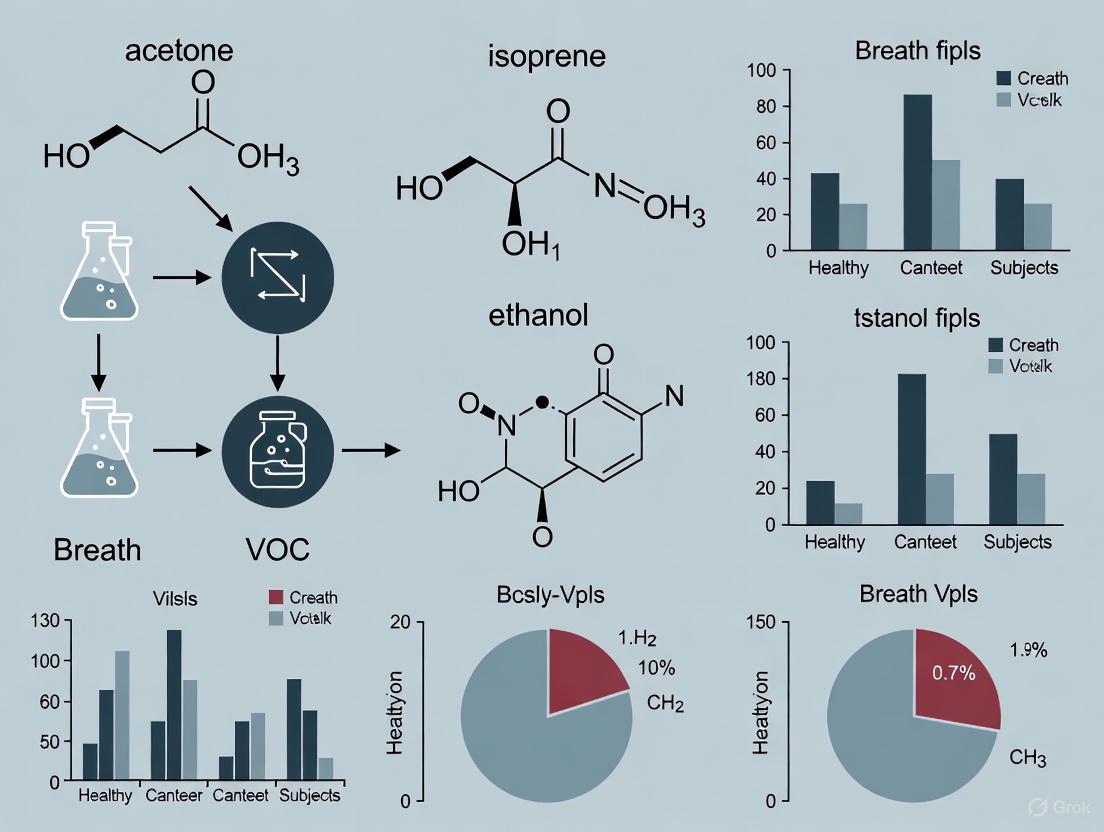
This article comprehensively reviews the application of volatile organic compound (VOC) analysis in exhaled breath for cancer detection, a rapidly advancing non-invasive diagnostic frontier.
Volatile Organic Compounds (VOCs) in Breath Analysis: A Non-Invasive Frontier for Cancer Detection and Monitoring
Abstract
This article comprehensively reviews the application of volatile organic compound (VOC) analysis in exhaled breath for cancer detection, a rapidly advancing non-invasive diagnostic frontier. It explores the biochemical foundations of cancer-specific VOC biomarkers, detailing their origins from altered metabolic pathways such as lipid peroxidation, the Warburg effect, and oxidative stress. The review critically compares established and emerging analytical methodologies, including mass spectrometry-based techniques and sensor-based electronic nose systems, highlighting their respective strengths in compound identification versus clinical deployability. It addresses significant challenges in protocol standardization, compound identification, and background contamination, while synthesizing recent validation data demonstrating high diagnostic accuracy (AUC up to 0.94) across multiple cancer types. Designed for researchers, scientists, and drug development professionals, this analysis provides a strategic framework for advancing VOC-based diagnostics from research to clinical implementation.
The Biological Basis of Cancer-Derived Volatile Organic Compounds
Core Concepts and Biological Significance
Endogenous volatile organic compounds (VOCs) are carbon-based chemicals characterized by high vapor pressure and low boiling points, produced as natural byproducts of human metabolic activity [1]. These compounds serve as dynamic indicators of physiological processes, reflecting the body's real-time metabolic status [2]. Unlike exogenous VOCs that originate from external sources like diet, drugs, or environmental exposure, endogenous VOCs are generated internally through metabolic pathways and are eliminated via respiration, perspiration, and other bodily excretions [3]. The examination of these compounds provides a noninvasive window into systemic metabolism, offering researchers a valuable approach for assessing health and disease states by comparing VOC profiles [1].
The significance of endogenous VOCs as metabolic footprints lies in their direct relationship to cellular processes. These compounds are generated through various biochemical pathways including lipid peroxidation, amino acid metabolism, carbohydrate metabolism, and microbial-host co-metabolism [2] [4]. The molecular weight of endogenous VOCs varies significantly, ranging from less than 50 g/mol to several hundred g/mol, with lower molecular weight compounds generally exhibiting higher volatility [3]. As metabolites traverse biological membranes and exchange into air spaces in the lungs, they create a breath fingerprint that mirrors ongoing metabolic activity throughout the body [3]. This process is remarkably efficient, with the entire circulating blood volume able to be analyzed through continuous preconcentration of exhaled breath over approximately one minute [3].
Endogenous VOCs in Cancer Biology
In oncological research, endogenous VOCs have emerged as particularly valuable biomarkers due to the profound metabolic differences between neoplastic and normal cells [1]. Cancer pathogenesis alters fundamental metabolic processes, resulting in distinct VOC profiles that can be detected in exhaled breath and other bodily fluids [1] [4]. These metabolic alterations include increased oxidative stress, changes in mitochondrial function, upregulated glycolysis, and modified amino acid metabolism, all of which generate characteristic volatile compounds that serve as metabolic footprints of malignancy [2].
The clinical utility of endogenous VOCs in cancer research spans multiple applications including screening, diagnosis, treatment efficacy prediction, and recurrence monitoring [1]. Malignant cells exhibit metabolic reprogramming that generates unique VOC signatures distinguishable from normal metabolic patterns. For instance, increased levels of specific alkanes like 4-methyldecane, decane, and 4-methylundecane have been identified in the breath of patients with high-grade lymphoma, representing by-products of lipid peroxidation resulting from oxidative stress conditions in the tumor microenvironment [4]. Conversely, certain VOCs such as methanethiol show significantly lower abundance in acute leukemia patients compared to healthy controls, suggesting altered sulfur metabolism or microbial interactions in malignancy [4].
Table 1: Cancer-Associated Endogenous VOCs and Their Metabolic Origins
| VOC Compound | Cancer Type | Abundance Pattern | Proposed Metabolic Origin |
|---|---|---|---|
| 4-Methyldecane | High-grade lymphoma | Increased | Lipid peroxidation from oxidative stress |
| Decane | High-grade lymphoma | Increased | Lipid peroxidation from oxidative stress |
| 2,3,5-Trimethylhexane | High-grade lymphoma | Increased | Lipid peroxidation from oxidative stress |
| Methanethiol | Acute leukemia | Decreased | Methionine metabolism by bacterial enzymes |
| Allyl methylsulfide | Acute leukemia | Decreased | Gut microbiome metabolism of dietary compounds |
| 2,3-Dehydro-1,8-cineole | Various cancers | Variable | Plant-derived compound metabolism |
The molecular mechanisms underlying cancer-specific VOC signatures often involve reactive oxygen species (ROS)-mediated lipid peroxidation and subsequent degradation of long-chain polyunsaturated fatty acids [4]. This is particularly relevant in hematological malignancies like lymphoma, where lipid peroxidation and ferroptosis have been implicated in tumorigenesis, progression, and drug resistance [4]. The detection of these volatile metabolic footprints provides researchers with noninvasive insights into fundamental cancer processes occurring at the cellular level.
Analytical Methodologies and Detection Platforms
The detection and analysis of endogenous VOCs require sophisticated analytical techniques capable of measuring trace concentrations, typically in the parts per billion by volume (ppbv or μg/L) range [2]. The field employs two primary methodological approaches: sensor-based arrays and separation-based instrumentation.
Gas sensor array-based electronic noses (E-noses) represent one prominent technological approach. These systems utilize arrays of different sensor types including quartz crystal microbalance sensors (QCMS), photoionization detector sensors (PIDS), surface acoustic wave sensors (SAWS), solid-state electrochemical sensors (SSES), and metal oxide sensors (MOS) [2]. When exposed to volatile samples, these sensors respond to the presence of specific compounds—for instance, MOS sensors change conductivity when exposed to target gases [2]. The sensor responses are registered and converted to spectra or numerical data for processing. One study utilizing an E-nose with five distinct sensors achieved 78.7% accuracy, 72.5% sensitivity, and 82.4% specificity in classifying lung cancer patients [2].
Separation-based analytical techniques provide higher specificity and compound identification. Gas chromatography-mass spectrometry (GC-MS) serves as the gold standard, combining the separation power of gas chromatography with the identification capabilities of mass spectrometry [2] [4]. In this method, VOCs are first separated in the GC section based on their partitioning between a mobile gas phase and a stationary liquid phase, then ionized and detected in the MS section based on their mass-to-charge ratios [2]. Advanced implementations like the GC-Orbitrap-MS system used in recent hematological malignancy research enable high-resolution accurate mass measurements, facilitating precise compound identification [4].
Table 2: Analytical Techniques for Endogenous VOC Detection
| Technique | Principles | Sensitivity | Applications in VOC Research |
|---|---|---|---|
| Gas Sensor Arrays (E-nose) | Multiple sensors with different selectivities respond to VOC presence | Moderate | Rapid screening; disease classification |
| Gas Chromatography-Mass Spectrometry (GC-MS) | Separation by volatility/polarity followed by mass spectrometry identification | High (ppbv range) | Compound identification and quantification; biomarker discovery |
| Ion Mobility Spectrometry (IMS) | Separation based on ion mobility in electric field | Moderate to High | Real-time monitoring; field applications |
| Thermal Desorption | Pre-concentration of VOCs before analysis | High (ppt-ppb range) | Trace VOC analysis; breath sample processing |
Additional methodologies include ion mobility spectrometry (IMS) and various combinations of these techniques [2]. Sample collection methods have also been standardized, with technologies like the Breath Biopsy platform utilizing controlled sampling devices such as the ReCIVA Breath Sampler, which monitors breathing in real-time using pressure sensors to collect specific phases of the respiratory cycle while excluding anatomic dead space air [4]. This precision in sampling ensures reproducible collection of alveolar breath containing systemic VOCs.
Experimental Protocols and Workflows
Breath Sample Collection Protocol
Standardized breath collection represents a critical first step in endogenous VOC analysis. The following protocol details the methodology used in recent hematological malignancy research [4]:
Participant Preparation: Subjects should refrain from eating, drinking (except water), and smoking for at least 2 hours prior to sample collection. Document recent medication use, dietary intake, and potential environmental exposures.
Sample Collection Device Setup: Utilize the ReCIVA Breath Sampler (Owlstone Medical Ltd.) or comparable system. Prepare Breath Biopsy Cartridges containing four Tenax TA + Carbograph 5TD sorbent tubes for VOC capture.
Breath Sampling: Participants wear a breathing mask connected to the sampling system. The device monitors breathing in real-time using pressure sensors, triggering sampling pumps to collect breath at specific stages of the respiratory cycle. Focus collection on exhaled breath from the lungs while excluding air from the mouth and upper airway (anatomic dead space). Collect samples over 8-12 minutes to obtain sufficient analyte volume.
Sample Processing: Dry purge collected samples in a thermal desorption instrument (e.g., TD-100, Markes International) to remove excess water. Store samples at appropriate conditions until batch analysis to minimize variability.
Quality Assessment: Curate samples to confirm acceptable quality before data analysis. Exclude samples with pressure inconsistencies representing potential sampler leakage or other collection artifacts.
VOC Analysis Protocol
The following GC-MS analysis protocol is adapted from recent research on hematological malignancies [4]:
Sample Introduction: Thermally desorb samples from sorbent tubes into the GC-MS system. Use split/splitless injection with optimized temperatures to transfer VOCs without degradation.
Chromatographic Separation: Employ a mid-polarity stationary phase GC column (e.g., 30-60m length, 0.25-0.32mm internal diameter). Implement a temperature gradient program optimized for VOC separation, typically starting at 40°C and ramping to 240-280°C at 5-10°C/min.
Mass Spectrometric Detection: Use electron impact ionization (70eV) with mass detection across an appropriate range (e.g., m/z 35-350). Operate the mass spectrometer in full scan mode for untargeted analysis or selected ion monitoring for targeted compounds.
Data Processing: Convert raw chromatograms to molecular features using software such as Compound Discoverer. Align features across samples and perform peak integration for quantification.
Compound Identification: Compare mass spectra to reference libraries (NIST, HRAM libraries). Apply matching thresholds (typically >80% similarity) and retention index calculations for confident identifications.
Metabolic Pathways of Endogenous VOC Generation
Endogenous VOCs originate from multiple biochemical pathways that are frequently altered in pathological states such as cancer. Understanding these metabolic sources is essential for interpreting VOC signatures as meaningful metabolic footprints.
Lipid peroxidation represents a major source of endogenous VOCs, particularly alkanes and aldehydes. This process involves ROS-mediated oxidation of polyunsaturated fatty acids in cell membranes, resulting in carbon-centered radicals that undergo molecular rearrangement to form volatile hydrocarbons [4]. The detection of specific alkanes like 2,3,5-trimethylhexane and methylated alkanes in lymphoma patients reflects increased oxidative stress in the tumor microenvironment [4]. The metabolic pathway involves hydrogen abstraction from fatty acids, beta-scission of alkoxyl radicals, and eventual excretion of volatile fragments via respiration.
Amino acid metabolism generates various sulfur-containing and nitrogen-containing VOCs. Methanethiol, identified at decreased levels in acute leukemia, originates from methionine degradation via methionine γ-lyase activity from host or microbial enzymes [4]. Similarly, branched-chain amino acid metabolism produces ketones and aldehydes that may serve as metabolic indicators. The observed decrease in dietary-derived VOCs like allyl methylsulfide in leukemia patients may reflect altered gastrointestinal metabolism or absorption rather than direct tumor metabolism [4].
Carbohydrate metabolism and gut microbiome-host co-metabolism contribute additional VOC diversity. Microbial fermentation of carbohydrates in the gastrointestinal tract produces short-chain fatty acids and various volatile metabolites that can be detected in breath [3]. The integration of these multiple metabolic sources creates complex VOC profiles that provide researchers with systems-level insights into physiological and pathological processes.
Research Reagent Solutions and Essential Materials
Table 3: Essential Research Materials for Endogenous VOC Studies
| Item | Function/Application | Example Products/Suppliers |
|---|---|---|
| Breath Samplers | Controlled collection of exhaled breath with phase discrimination | ReCIVA Breath Sampler (Owlstone Medical Ltd.) |
| Sorbent Tubes | Capture and retention of VOCs during sample collection | Tenax TA + Carbograph 5TD tubes (Markes International) |
| Thermal Desorption Units | Pre-concentration and introduction of VOCs to analytical systems | TD-100 Thermal Desorber (Markes International) |
| GC-MS Systems | Separation, detection, and identification of VOC compounds | QExactive GC Hybrid Quadrupole-Orbitrap MS (Thermo Scientific) |
| Standard Reference Materials | Instrument calibration and compound identification | NIST Mass Spectral Library, Internal HRAM libraries |
| Data Processing Software | Peak alignment, compound identification, and statistical analysis | Compound Discoverer (Thermo Scientific) |
| Quality Control Materials | Method validation and inter-laboratory comparison | Custom VOC mixtures, Internal standards |
The Breath Biopsy VOC Atlas represents a particularly valuable research resource, serving as a catalog of identified and quantified volatile organic compounds found in exhaled breath to support biomarker discovery and validation [3]. For targeted metabolic pathway analysis, EVOC (Exogenous VOC) Probes enable assessment of specific enzymatic activities by monitoring the metabolism of administered exogenous compounds, providing insights into pathway functionality relevant to disease states and treatment responses [3].
Volatile organic compounds (VOCs) represent a promising frontier in non-invasive cancer detection, with their production being intrinsically linked to fundamental alterations in cellular metabolism. This technical guide examines the mechanistic relationship between two hallmark cancer phenotypes—the Warburg effect (aerobic glycolysis) and oxidative stress—and the generation of characteristic VOC profiles. We explore how reactive oxygen species (ROS), generated as metabolic byproducts, drive lipid peroxidation cascades that yield volatile metabolites detectable in breath and other biospecimens. This review synthesizes current experimental evidence, details methodological approaches for investigating cancer VOCs, and discusses the translation of these findings into clinical diagnostic tools for researchers and drug development professionals working in cancer breath analysis.
Cancer cells undergo profound metabolic reprogramming to support rapid proliferation, survival, and growth in challenging microenvironments. Two interconnected features of this reprogramming are the Warburg effect (aerobic glycolysis) and increased oxidative stress, both of which directly contribute to the production of volatile organic compounds (VOCs) [5] [6]. VOCs are low molecular weight compounds (typically <300 Da) that can evaporate at room temperature and include various chemical classes such as aldehydes, ketones, alcohols, hydrocarbons, and organic acids [7]. These compounds originate from catalytic peroxidation processes initiated by reactive oxygen species (ROS), which oxidize cellular components including lipids, proteins, and nucleic acids [5]. The resulting volatile metabolites can diffuse into the bloodstream and be excreted via breath, sweat, urine, and other bodily fluids, providing a window into underlying pathological processes [7] [6].
The application of VOC analysis in oncology represents a paradigm shift in cancer diagnostics, offering potential for non-invasive early detection, monitoring of treatment response, and disease recurrence surveillance [7]. However, the successful translation of these biomarkers from basic research to clinical implementation requires a deep understanding of the metabolic pathways that generate them and the development of robust analytical frameworks to distinguish cancer-specific signatures from confounding variables [8]. This review provides an in-depth examination of the molecular mechanisms linking altered cancer metabolism to VOC production, with particular focus on the interplay between glycolytic flux, mitochondrial dysfunction, ROS signaling, and peroxidation pathways.
Biochemical Foundations of VOC Production
Reactive Oxygen Species and Lipid Peroxidation
The production of cancer-specific VOCs is fundamentally driven by reactive oxygen species (ROS)-mediated peroxidation of cellular components [5] [6]. ROS encompass both radical and non-radical oxygen-containing molecules with high chemical reactivity, including superoxide radicals (O₂•⁻), hydrogen peroxide (H₂O₂), hydroxyl radicals (•OH), as well as reactive nitrogen and sulfur species [5]. In cancer cells, ROS are generated through multiple mechanisms:
- Mitochondrial electron transport chain: Incomplete reduction of oxygen during oxidative phosphorylation [5] [9]
- NADPH oxidases (NOX): Membrane-bound enzymes that catalyze ROS production [5]
- Metabolic enzyme activity: Including xanthine oxidase, cytochrome P450, and electron transfer flavoprotein during fatty acid β-oxidation [5] [9]
Table 1: Major Reactive Oxygen Species and Their Sources in Cancer Cells
| ROS Type | Chemical Formula | Primary Cellular Sources | Role in VOC Production |
|---|---|---|---|
| Superoxide anion | O₂•⁻ | Mitochondrial ETC, NOX enzymes | Initiates peroxidation cascades |
| Hydrogen peroxide | H₂O₂ | Superoxide dismutation, various oxidases | Lipid peroxidation, protein oxidation |
| Hydroxyl radical | •OH | Fenton reaction | Most reactive ROS, directly attacks PUFAs |
| Peroxynitrite | ONOO⁻ | Reaction of O₂•⁻ with NO | Nitrative stress, oxidation of biomolecules |
Lipid peroxidation, particularly of polyunsaturated fatty acids (PUFAs) in cellular membranes, represents a major pathway for VOC generation [5]. This process occurs through a radical chain reaction mechanism comprising three stages:
- Initiation: ROS abstract hydrogen atoms from PUFAs, forming lipid radicals
- Propagation: Lipid radicals react with oxygen, forming peroxyl radicals that attack adjacent PUFAs
- Termination: Radical species combine to form non-radical products [5]
The peroxidation of PUFAs generates unstable lipid hydroperoxides that decompose into various volatile carbonyl compounds, including aldehydes (e.g., alkanals, alkenals), ketones, and hydrocarbons [5]. These reactive aldehydes can be further metabolized by enzymatic systems such as alcohol dehydrogenases (ADH) to form corresponding alcohols, contributing to the diversity of VOCs observed in cancer [10].
The Warburg effect describes the propensity of cancer cells to preferentially utilize glycolysis for energy production, even under oxygen-sufficient conditions, resulting in increased lactate production [11]. This metabolic reprogramming creates a favorable environment for VOC generation through multiple mechanisms:
- Glycolytic flux and mitochondrial retrograde signaling: Enhanced glucose consumption alters mitochondrial metabolism and increases electron leakage from the electron transport chain, boosting ROS production [9]
- Lactate-mediated signaling: Lactate, the end product of glycolysis, can influence gene expression patterns that promote VOC production and create an acidic microenvironment that favors lipid peroxidation [10]
- Precursor availability: Increased glycolytic intermediates feed into branching pathways that generate volatile metabolites
Experimental evidence demonstrates that directly manipulating glycolysis affects VOC profiles. A 2024 study showed that inhibiting glycolysis with 2-deoxy-D-glucose (2-DG) or 3-bromopyruvate (3-BrPA) in lung cancer cells significantly altered VOC emissions, with acetoin emerging as a common differential VOC across multiple cancer cell lines under glycolytic control [11]. This finding underscores the tight coupling between glycolytic activity and VOC production.
Hypoxia and Lactate Signaling in VOC Regulation
Tumor hypoxia, a common feature of rapidly growing malignancies, further modulates VOC patterns by influencing cellular metabolism. Research using A549 lung cancer cells has demonstrated that hypoxic conditions (O₂ concentration <1.5%) combined with lactate supplementation significantly enhanced the production of specific VOCs such as trans-2-hexenol [10]. This hypoxia-lactate axis appears to operate through:
- Transcriptional reprogramming: RNA sequencing data revealed that hypoxia and lactate co-treatment altered the expression of genes involved in VOC metabolic pathways [10]
- Enzymatic regulation: Alcohol dehydrogenase (ADH) activity converts lipid-derived aldehydes (e.g., trans-2-hexenal) to their corresponding alcoholic VOCs (e.g., trans-2-hexenol) [10]
- Redox balance modulation: Lactate shuttling influences NAD+/NADH ratios, thereby affecting ADH-mediated VOC conversion
The intersection of hypoxia, lactate signaling, and VOC production represents a potentially exploitable metabolic vulnerability for cancer detection and targeting.
Figure 1: Metabolic Pathway Linking Warburg Effect to VOC Production. This diagram illustrates how enhanced glycolytic flux (Warburg effect) and hypoxia converge to increase ROS production, leading to lipid peroxidation and subsequent VOC generation through enzymatic conversion. Abbreviations: ADH (alcohol dehydrogenase), HIF-1α (hypoxia-inducible factor 1-alpha), LDH (lactate dehydrogenase), PUFA (polyunsaturated fatty acids), ROS (reactive oxygen species), TCA (tricarboxylic acid cycle), ETC (electron transport chain).
Experimental Models and Methodological Approaches
In Vitro Cell Culture Systems
Well-characterized cell line models provide controlled systems for investigating cancer-specific VOCs and their metabolic underpinnings. Key considerations for in vitro VOC analysis include:
Table 2: Representative Cell Lines for Cancer VOC Research
| Cell Line | Origin | Key Characteristics | VOC Findings |
|---|---|---|---|
| A549 | Human lung adenocarcinoma | KRAS mutation, high glycolytic activity | Increased trans-2-hexenol under hypoxia/lactate; acetoin production under glycolytic control [11] [10] |
| PC-9 | Human lung adenocarcinoma | EGFR mutation | Common VOC profile with other lung cancer lines under glycolysis inhibition [11] |
| NCI-H460 | Human large cell lung carcinoma | p53 mutation, high metastatic potential | Shared acetoin signature with other lung cancer cells during glycolysis modulation [11] |
| BEAS-2B | Normal human bronchial epithelium | Non-tumorigenic, basal phenotype | Reference for baseline VOC patterns [11] |
Standardized culture conditions are essential for reproducible VOC profiling. Cells should be maintained in appropriate media (e.g., RPMI-1640 or DMEM with 10% FBS), harvested during logarithmic growth phase, and transferred to glass vessels to minimize background VOC contamination from plasticware [11]. Parafilm sealing of culture flasks prevents cross-contamination of VOCs between different cell lines incubated in shared spaces [11].
Metabolic Perturbation Strategies
Deliberate manipulation of metabolic pathways enables researchers to establish causal relationships between specific metabolic fluxes and VOC output:
- Glycolysis inhibition: 2-Deoxy-D-glucose (2-DG, 10-40 mM) competitively inhibits hexokinase; 3-Bromopyruvic acid (3-BrPA, 50-200 μM) targets glyceraldehyde-3-phosphate dehydrogenase [11]
- Glutaminolysis blockade: Compounds like CB-839 inhibit glutaminase, limiting substrate availability for the TCA cycle [11]
- Hypoxia induction: Using gas-barrier bags with oxygen absorbers to achieve <1.5% O₂ tension [10]
- Lactate modulation: Supplementation with 10-20 mM L-lactate to mimic tumor microenvironment conditions [10]
Cell viability must be monitored throughout interventions using standardized assays (e.g., CCK-8, MTT) to ensure that VOC changes reflect metabolic modulation rather than cytotoxicity [11].
VOC Capture and Analytical Techniques
Advanced analytical methods are required to detect and quantify the complex mixture of VOCs produced by cancer cells:
Solid Phase Microextraction Gas Chromatography-Mass Spectrometry (SPME-GC-MS) SPME-GC-MS represents the gold standard for VOC analysis due to its sensitivity, reproducibility, and compatibility with complex biological samples [8] [11]. A typical analytical workflow includes:
- VOC Pre-concentration: Headspace sampling using SPME fibers (65 μm PDMS/DVB recommended) at 37°C for 20 minutes [11]
- Thermal Desorption: SPME fiber introduction into GC injection port at 200°C for 5 minutes
- Chromatographic Separation: HP-5MS column (30 m × 0.25 mm × 0.25 μm) with temperature programming (50°C for 5 min, ramp to 150°C at 5°C/min, then to 330°C at 40°C/min) [11] [10]
- Mass Spectrometric Detection: Electron impact ionization (70 eV) with scan range m/z 35-350
- Compound Identification: Spectral matching against reference libraries (NIST, AMDIS) with match factors >80% [8] [11]
Alternative Analytical Platforms
- Proton Transfer Reaction Mass Spectrometry (PTR-MS): Enables real-time VOC monitoring without pre-concentration [7]
- Selected Ion Flow Tube Mass Spectrometry (SIFT-MS): Suitable for targeted quantification of specific VOCs [7]
- Electronic Noses (E-nose): Array-based sensors generating distinctive "breathprints" for pattern recognition [7] [12]
Figure 2: Experimental Workflow for Cancer VOC Analysis. This diagram outlines the key steps in capturing and analyzing VOCs from cancer cell cultures, from metabolic perturbation to data interpretation. Abbreviations: HS-SPME (headspace solid-phase microextraction), GC (gas chromatography), MS (mass spectrometry), 2-DG (2-deoxy-D-glucose), 3-BrPA (3-bromopyruvic acid).
Key Experimental Findings and Biomarker Validation
Cancer-Associated VOCs and Their Metabolic Origins
Research across multiple model systems has identified consistent VOC patterns associated with altered cancer metabolism:
Table 3: Experimentally Validated VOCs Linked to Cancer Metabolism
| VOC | Chemical Class | Metabolic Origin | Experimental Evidence |
|---|---|---|---|
| Acetoin | Ketone | Glycolytic overflow, pyruvate metabolism | 2.60-3.29-fold increase in lung cancer cells under glycolysis inhibition; common across A549, PC-9, and NCI-H460 lines [11] |
| trans-2-Hexenol | Alcohol | ROS-mediated lipid peroxidation of ω-6 PUFAs, ADH conversion | Enhanced production under hypoxia with lactate supplementation in A549 cells; confirmed ADH enzymatic activity [10] |
| Ethyl propionate | Ester | Glycolysis-TCA cycle interaction | Common differential VOC in lung cancer cells versus normal bronchial epithelium [11] |
| 3-Decen-5-one | Unsaturated ketone | Lipid peroxidation product | Consistently elevated across multiple lung cancer cell types [11] |
| Dimethyl sulfide | Sulfur compound | Methionine oxidation, SELENBP1 mutation | Associated with impaired methanethiol clearance in cancer cells [5] [6] |
Diagnostic Performance and Machine Learning Approaches
The translation of VOC biomarkers into clinically useful tools requires robust analytical frameworks that account for inter-individual variability and confounding factors. A 2025 study employing GC-MS analysis of exhaled breath from lung cancer patients, tuberculosis patients, and asymptomatic controls demonstrated the power of integrating VOC profiling with machine learning [8]. After statistical elimination of confounders (smoking status, gender, diet), ten VOCs were identified as potential biomarkers with the following diagnostic performance:
- Lung cancer vs. controls: Partial least squares-discriminant analysis (PLS-DA) achieved 82% sensitivity, 90% precision, 80% accuracy, and 86% F1-score [8]
- Lung cancer vs. tuberculosis: The same model maintained 88% precision, recall, accuracy, and F1-score, demonstrating specificity against confounding pulmonary disease [8]
This analytical framework highlights the importance of controlling for exogenous influences (smoking, environmental exposures) and intrinsic patient factors (gender, comorbidities) when developing VOC-based diagnostic signatures [8].
The Scientist's Toolkit: Essential Research Reagents and Platforms
Table 4: Key Research Reagents and Platforms for Cancer VOC Investigation
| Category/Reagent | Specifications | Research Application | Key Considerations |
|---|---|---|---|
| Glycolysis Inhibitors | |||
| 2-Deoxy-D-glucose (2-DG) | 154-17-6, ≥98% purity | Competitive hexokinase inhibition | Dose range: 5-40 mM; monitor cytotoxicity via CCK-8 assay [11] |
| 3-Bromopyruvic acid (3-BrPA) | 1113-59-3, ≥98% purity | GAPDH alkylation | Effective at 50-200 μM; prepare fresh solutions due to instability [11] |
| Metabolic Modulators | |||
| L-Lactic acid | L0165, high purity | Lactate signaling studies | Use 10-20 mM in culture medium; pH adjustment required [10] |
| SPME Fibers | 65 μm PDMS/DVB | VOC pre-concentration | Optimal for broad VOC capture; precondition at 200°C before use [11] |
| GC-MS Columns | HP-5MS (30 m × 0.25 mm × 0.25 μm) | VOC separation | Standard non-polar phase; compatible with most volatile metabolites [11] [10] |
| Cell Culture Ware | T-25 glass culture flasks | VOC-free cell culture | Essential to minimize background from plasticizers [11] |
| Analytical Software | AMDIS, NIST library, OpenChrom | VOC identification and deconvolution | Match factor >80% for confident identification [8] [11] |
Future Directions and Technical Challenges
Despite significant advances, several challenges remain in fully elucidating the relationship between cancer metabolism and VOC production:
- Enzymatic regulation of VOC pathways: The specific enzymes responsible for the synthesis and metabolism of most cancer VOCs remain poorly characterized [5] [6] [10]
- Metabolic cross-talk in tumor ecosystems: The contribution of stromal cells, immune cells, and tumor microbes to overall VOC signatures requires further investigation [5]
- Standardization of analytical protocols: Inter-laboratory variability in sampling, pre-concentration, and detection methodologies hampers comparative analyses [8] [7]
- Dynamic monitoring of VOC fluxes: Current methods provide snapshot views rather than real-time metabolic flux data [10]
Emerging technologies show promise for addressing these challenges. Electrochemical biosensors coupled with machine learning algorithms, such as the platform developed by UT Dallas researchers, demonstrate potential for rapid, point-of-care VOC analysis with 90% accuracy in preliminary studies [12]. Similarly, automated VOC enrichment systems like VEM-1 (VOC Enrichment Machine) enable higher throughput and more reproducible sampling from cell cultures [10].
The integration of VOC analysis with other omics technologies (transcriptomics, proteomics, metabolomics) will provide a more comprehensive understanding of how altered cancer metabolism translates into detectable volatile signatures. This systems biology approach, combined with advanced computational models, will accelerate the translation of cancer VOC research into clinically impactful diagnostic and monitoring tools.
The production of volatile organic compounds in cancer cells emerges as a direct consequence of fundamental metabolic reprogramming, particularly the Warburg effect and associated oxidative stress. Through ROS-mediated peroxidation of cellular components, especially polyunsaturated fatty acids, cancer cells generate characteristic VOC profiles that reflect their altered metabolic state. Experimental evidence demonstrates that targeted manipulation of glycolysis and associated pathways directly influences VOC output, providing causal evidence for these relationships. While technical challenges remain, ongoing advances in analytical technologies, computational modeling, and our understanding of cancer metabolism continue to enhance the potential of VOC analysis as a non-invasive approach for cancer detection, classification, and therapeutic monitoring. For researchers and drug development professionals, the intersection of cancer metabolism and VOC biogenesis represents a promising frontier for both basic discovery and translational innovation.
Volatile organic compounds (VOCs) are organic chemicals characterized by high vapor pressure and low boiling points at room temperature, which facilitates their evaporation into the surrounding air [13]. In the context of cancer research, the analysis of endogenous VOCs has emerged as a promising non-invasive approach for early cancer detection and monitoring [14] [1]. These compounds serve as indicators of human metabolic activity, reflecting fundamental differences between the metabolic pathways operating in tumor cells compared to normal cells [1]. The biochemical origins of specific VOC classes are intimately connected to cancer-specific metabolic alterations, including changes in oxidative stress, lipid peroxidation, energy metabolism, and enzyme activities [5]. This technical guide provides an in-depth examination of four key VOC classes—alkanes, aldehydes, ketones, and aromatic compounds—their proposed biochemical origins, and the experimental methodologies employed in their analysis, framed within the advancing field of cancer breath research.
Volatile Organic Compounds in Cancer Biology
The Role of Reactive Oxygen Species in VOC Generation
In cancer cells, a hallmark of metabolic dysfunction is the elevated production of reactive oxygen species (ROS) [5]. ROS encompass a category of molecules including radical and non-radical oxygen derivatives, including superoxide radicals, hydrogen peroxide, and hydroxyl anions [5]. These species drive the catalytic peroxidation of cellular structures, primarily targeting polyunsaturated fatty acids (PUFAs) in lipid membranes [5]. This peroxidation process generates unstable lipid peroxides that subsequently decompose into a variety of smaller, volatile metabolites, including alkanes, aldehydes, and ketones [5]. The process can be conceptualized through a simplified pathway (see Diagram 1).
Diagram 1: Simplified ROS-mediated VOC generation pathway in cancer cells.
The concentration of ROS significantly influences cellular outcomes. Lower ROS concentrations tend to promote cancer proliferation and invasion by activating pathways such as PI3K/Akt, while higher ROS levels lead to oxidative stress, apoptosis, and ultimately, the generation of volatile organic compounds that can be detected in exhaled breath [5].
Diagnostic Potential of VOCs
The diagnostic application of VOCs, particularly in breath analysis, offers significant advantages including non-invasiveness, cost-effectiveness, and potential for real-time monitoring [14]. A recent meta-analysis of VOC-based cancer diagnostics reported a high aggregate diagnostic accuracy, with a mean area under the curve (AUC) of 0.94, sensitivity of 89%, and specificity of 87% [14]. These performance metrics highlight the substantial potential of VOC profiling as a screening and diagnostic tool in oncology.
Key VOC Classes & Proposed Biochemical Origins
The following section details the specific VOC classes, their chemical properties, and their proposed origins in the context of cancer metabolism. Quantitative data on these compounds is summarized in Table 1.
Table 1: Key VOC Classes in Cancer Breath Analysis: Proposed Origins and Diagnostic Significance
| VOC Class | Representative Compounds | Proposed Biochemical Origin | Associated Cancer Types | Key References |
|---|---|---|---|---|
| Alkanes & Alkenes (e.g., Ethane, Pentane, Dodecane) | Ethane, Pentane, Dodecane, Decane | Lipid peroxidation of polyunsaturated fatty acids (PUFAs) by ROS. | Lung Cancer [8] | [5] [8] |
| Aldehydes | Decanal, Hexanal, Octanal | Secondary products of lipid peroxidation; aldehydes are reactive and can be toxic. | Lung Cancer [8] | [5] [8] |
| Ketones | Acetone, 2-Butanone | Derived from fatty acid β-oxidation and ketogenesis; altered in cancer metabolism. | Lung Cancer (general VOC profiles) [14] | [5] |
| Aromatic Compounds | Benzene derivatives, Phenol, o-Cymene | Potential origins include protein oxidation, environmental exposure, or gut microbiome alterations. | Lung Cancer (e.g., o-Cymene) [8] | [5] [8] |
Alkanes and Alkenes
Alkanes are saturated hydrocarbons (containing only single bonds), while alkenes are unsaturated hydrocarbons featuring one or more carbon-carbon double bonds [15]. These compounds are highly non-polar and generally exhibit low boiling points [16] [17]. In cancer biology, alkanes such as ethane and pentane are well-established products of the lipid peroxidation cascade [5] [18]. The hydroxyl radical (•OH) attacks PUFAs, leading to a chain reaction that terminates with the cleavage of alkane and alkene fragments [5]. Their detection in breath is considered a direct marker of oxidative stress.
Aldehydes
Aldehydes contain a carbonyl group (C=O) bonded to at least one hydrogen atom [16] [17]. They are more reactive than alkanes and are produced as secondary, stable end-products of lipid peroxidation [5]. Notable examples include decanal and hexanal. Due to their reactivity and potential cytotoxicity, cells often convert them into less reactive forms, such as alcohols or carboxylic acids, before excretion [5]. Their presence in breath provides insight into the extent and specific pathways of lipid peroxidation occurring within the body.
Ketones
Ketones feature a carbonyl group (C=O) bonded to two carbon atoms [16] [17]. A prominent example is acetone. In metabolic pathways, ketones are primarily produced through fatty acid β-oxidation and ketogenesis [5]. Cancer-induced metabolic reprogramming, such as shifts in energy substrate utilization, can alter the production rates of ketone bodies, making them potential indicators of systemic metabolic dysregulation associated with malignancy.
Aromatic Compounds
Aromatic compounds are characterized by the presence of a benzene ring or related structures [15]. Their origins in breath are complex and may involve multiple pathways. Proposed mechanisms include the oxidation of amino acids (e.g., phenylalanine) [5], exposures from environmental sources (e.g., tobacco smoke) [8], or metabolic activities of the gut microbiome. In studies, compounds like o-cymene have been identified as potential biomarkers for lung cancer [8].
Experimental Protocols & Methodologies
Standard Workflow for VOC Analysis
The analytical process for VOC-based cancer detection follows a multi-stage workflow, from sample collection to data interpretation, with stringent controls to ensure reliability (see Diagram 2).
Diagram 2: Generalized experimental workflow for VOC analysis in breath.
Detailed Methodologies for Key Experiments
Breath Sample Collection and Pre-concentration
- Protocol: Exhaled breath samples are typically collected in a controlled manner. Participants exhale into inert bags (e.g., Tedlar) or through a system that directly traps VOCs onto sorbent tubes [8].
- Critical Considerations: Standardization of collection protocols is paramount. Factors such as environmental contaminants, dietary intake, and smoking history must be recorded and statistically controlled for, as they can significantly confound results [8]. For instance, compounds like phenyl acetate and decanal have been shown to be influenced by smoking behavior [8].
Gas Chromatography-Mass Spectrometry (GC-MS) Analysis
- Instrumentation: GC-MS is considered the gold standard for VOC analysis due to its high sensitivity and ability to provide both separation (via the GC column) and definitive identification (via the mass spectrometer) of individual compounds [8].
- Typical GC-MS Conditions:
- Column: A non-polar or mid-polar capillary column (e.g., DB-5MS, 30m x 0.25mm i.d., 0.25µm film thickness).
- Temperature Program: Ramp from 40°C (hold 2 min) to 250°C at a rate of 5-10°C per minute.
- Ionization Mode: Electron Impact (EI) at 70 eV.
- Mass Range: m/z 35-350.
- Identification and Quantification: Compounds are identified by comparing their mass spectra to reference libraries (e.g., NIST) with a match factor typically >80% [8]. Quantification employs external calibration curves. For example, a study established excellent linearity for o-cymene and hexadecane (R² = 0.998 and 0.997), with limits of detection (LOD) at 4.89 ppm and 0.08 ppm, respectively [8].
Data Analysis and Machine Learning
- Pre-processing: Raw GC-MS data undergoes peak picking, alignment, and normalization to correct for variations in sample concentration [8].
- Statistical Modeling: After initial statistical tests (e.g., Mann-Whitney U test) to identify significant VOCs, machine learning models are employed for classification. Partial Least Squares-Discriminant Analysis (PLS-DA) has demonstrated high performance, with one study reporting a recall of 82%, precision of 90%, and accuracy of 80% in distinguishing lung cancer patients from controls [8]. This model also showed 88% precision and recall in distinguishing lung cancer from tuberculosis, underscoring its robustness [8].
The Scientist's Toolkit: Essential Research Reagents & Materials
Successful execution of VOC analysis requires specialized materials and reagents. Key components are listed in Table 2.
Table 2: Essential Research Reagents and Materials for VOC Analysis
| Item | Function/Application | Example Use Case |
|---|---|---|
| Gas Chromatograph-Mass Spectrometer (GC-MS) | High-precision separation, identification, and quantification of individual VOCs in a complex mixture. | Primary instrument for untargeted VOC profiling and biomarker discovery [14] [8]. |
| Sorbent Tubes (e.g., Tenax TA, Carbograph) | Trapping and pre-concentration of VOCs from breath samples prior to thermal desorption into the GC-MS. | Sample pre-concentration to enhance detection sensitivity for low-abundance VOCs [8]. |
| NIST Mass Spectral Library | Reference database of mass spectra used to tentatively identify unknown compounds by spectral matching. | Essential for compound identification; a match factor >80% is commonly used as a threshold [8]. |
| External Calibration Standards | Pure chemical compounds used to create calibration curves for absolute quantification of target VOCs. | Used to establish linearity, LOD, and LOQ for compounds like o-cymene and hexadecane [8]. |
| Internal Standards (e.g., deuterated VOCs) | Compounds added to the sample to correct for variability during sample preparation and instrument analysis. | Although sometimes omitted in diagnostic studies to preserve sample integrity, they are critical for robust quantification in method development [8]. |
| Machine Learning Software (e.g., R, Python with scikit-learn) | Platform for performing statistical analysis and building classification models (PLS-DA, Random Forest). | Used to develop diagnostic models based on VOC patterns and evaluate their performance [8]. |
The investigation of key VOC classes—alkanes, aldehydes, ketones, and aromatic compounds—provides a critical window into the altered biochemical landscape of cancer cells. Their origins are predominantly linked to ROS-induced lipid peroxidation and shifts in core energy metabolism. While the diagnostic potential of breath VOC analysis is immense, as evidenced by high AUC values in meta-analyses, the field must overcome challenges related to standardization of protocols and confounding factors like smoking and diet. Future research must focus on large-scale validation studies and a deeper exploration of the fundamental enzymatic and regulatory pathways governing VOC production. Such efforts will be crucial for translating this promising, non-invasive technology from research settings into routine clinical practice, ultimately improving early cancer detection and patient outcomes.
Volatile organic compounds (VOCs) present in exhaled breath offer a promising frontier for the non-invasive detection and diagnosis of lung cancer. This comprehensive review synthesizes evidence from cellular, clinical, and analytical studies to elucidate the specific VOC profiles associated with lung carcinogenesis. We examine the biological origins of these volatile biomarkers, stemming from altered metabolic pathways and oxidative stress responses in malignant cells. The review further provides a critical evaluation of current detection methodologies, detailing standardized protocols for gas chromatography-mass spectrometry (GC-MS) and emerging electronic nose (e-nose) technologies. Supported by recent meta-analyses indicating high diagnostic accuracy (AUC up to 0.93), the evidence underscores the translational potential of VOC-based breath analysis as a rapid, cost-effective tool for lung cancer screening. Standardization of collection and analytical procedures remains essential for future clinical implementation.
Lung cancer persists as a leading cause of cancer-related mortality globally, with poor survival rates largely attributable to late-stage diagnosis [8] [19]. The five-year survival rate for stage I lung cancer can exceed 90%, but plummets to less than 5% for those diagnosed at a late stage [8] [20]. While low-dose CT (LDCT) scans are the current standard for screening, they are characterized by high false-positive rates, cost, and radiation exposure [20] [21]. There is a consequent urgent need for non-invasive, rapid, and cost-effective diagnostic tools suitable for widespread screening [19] [22].
Analysis of volatile organic compounds (VOCs) in exhaled breath has emerged as a promising solution to this diagnostic challenge [1] [22]. VOCs are carbon-based chemicals with high vapor pressure at ambient temperature. Endogenous VOCs are metabolic byproducts eliminated via respiration, serving as indicators of the body's metabolic state [1]. The fundamental premise of breath analysis for cancer detection is that tumorigenesis alters cellular metabolism—through processes such as the Warburg effect, oxidative stress, and gene mutations—leading to the production and release of a distinct VOC profile that can be detected in exhaled breath [19] [20] [23].
This review consolidates evidence on lung cancer-specific VOC profiles from in vitro studies, tissue analyses, and breath testing. We detail the experimental protocols for VOC profiling, summarize key biomarker candidates in structured tables, diagram the metabolic pathways and workflows, and evaluate the analytical techniques shaping this frontier of cancer diagnostics.
Metabolic Origins of Lung Cancer VOCs
The distinct VOC signatures in lung cancer patients are a direct reflection of underlying pathological metabolic processes. Cancer cells exhibit a metabolic shift, even under aerobic conditions, favoring glycolysis over oxidative phosphorylation for energy production—a phenomenon known as the Warburg effect [20]. This shift, along with increased oxidative stress and lipid peroxidation, generates characteristic volatile metabolites.
Pathways of VOC Generation
Oxidative Stress and Lipid Peroxidation: The cancer microenvironment is often characterized by hypoxia and inflammation, leading to increased levels of reactive oxygen species (ROS). These ROS, such as hydrogen peroxide (H₂O₂), attack polyunsaturated fatty acids in cell membranes, initiating a chain reaction of lipid peroxidation [24] [23]. This process generates a range of volatile alkanes and aldehydes, including pentane, hexane, and decanal, which are subsequently released into the bloodstream and exhaled [21] [23].
Aberrant Metabolic Pathways: Oncogenic transformations alter the activity of key metabolic enzymes. The overactivation of cytochrome P450 enzymes can elevate levels of certain alcohols, while changes in the mevalonic pathway—involved in cholesterol synthesis—affect isoprene production [23]. Furthermore, the heightened glycolytic flux in cancer cells can lead to increased production of ketones (e.g., acetone) and other oxygenated VOCs [20] [23].
The diagram below illustrates the primary biochemical pathways that generate key volatile organic compounds associated with lung cancer metabolism.
Experimental Protocols for VOC Profiling
Robust VOC profiling relies on standardized, meticulous protocols across different biological models. The following sections detail the key methodologies employed in in vitro and clinical breath studies.
1In VitroCell Culture VOC Analysis
In vitro studies are crucial for linking VOCs directly to cancer cell metabolism, free from systemic confounders. The protocol below, based on comprehensive cell line studies, outlines this process [24].
Protocol: VOC Headspace Analysis of Lung Cell Lines
Cell Culture:
- Cell Lines: Common models include A549 (non-small cell lung cancer, NSCLC), H446 (small cell lung cancer, SCLC), and BEAS-2B (normal human bronchial epithelium) as a control.
- Culture Conditions: Cells are cultured in appropriate media (e.g., DMEM for A549, RPMI 1640 for H446) supplemented with 10% Fetal Bovine Serum (FBS) and 1% penicillin-streptomycin in T25 or T75 culture flasks. They are maintained at 37°C in a humidified incubator with 5% CO₂.
- Oxidative Stress Model: To investigate the role of oxidative stress, normal BEAS-2B cells can be treated with a specific concentration of hydrogen peroxide (H₂O₂, e.g., 100 µM) for a set duration [24].
Headspace Sampling:
- Upon reaching ~80% confluence, the culture medium is replaced, and flasks are sealed with gas-tight septa.
- The headspace (the air above the cell culture) is incubated for a defined period (e.g., 4-6 hours) to allow VOCs to accumulate.
- A solid-phase microextraction (SPME) fiber is injected through the septum and exposed to the headspace to adsorb volatile compounds. Alternatively, headspace gas can be drawn using a gas-tight syringe.
GC-MS Analysis:
- The SPME fiber is injected into the heated inlet of a Gas Chromatograph-Mass Spectrometer (GC-MS) for thermal desorption.
- GC Separation: VOCs are separated on a chromatographic column (e.g., DB-5ms) with a programmed temperature ramp (e.g., 40°C for 2 min, then 10°C/min to 250°C).
- MS Detection: Eluted compounds are ionized (typically by electron impact, EI) and detected by a mass spectrometer. Compounds are identified by comparing their mass spectra to reference libraries (e.g., NIST) with a match factor typically >80% [8].
Data Analysis:
- Peak areas of VOCs are integrated. Statistical tests (e.g., Mann-Whitney U test for non-normally distributed data) are used to identify VOCs that are significantly different between cancer and normal cell lines.
Clinical Breath Sampling and Analysis
Breath analysis protocols must control for exogenous VOCs to ensure the analysis of endogenous, biologically relevant compounds.
Protocol: Exhaled Breath Collection and Processing with GC-MS [8]
Patient Preparation:
- Participants should not have smoked or consumed alcohol within 24 hours prior to sampling to avoid confounding VOC profiles [20].
- Breath sampling is typically performed in a controlled environment to minimize background VOC contamination.
Breath Sampling:
- Subjects exhale through a mouthpiece connected to a system that captures the alveolar (Phase III) portion of breath, often using a Tedlar gas sampling bag or specialized sorbent tubes.
- The collected sample is then concentrated, often using thermal desorption tubes or SPME.
GC-MS Analysis:
- The concentrated VOCs are introduced into the GC-MS system. The process is similar to the in vitro analysis but requires high sensitivity due to low VOC concentrations (parts-per-billion to parts-per-trillion range).
- Calibration with external standards (e.g., o-cymene, hexadecane) is performed to confirm instrument linearity and sensitivity. Excellent linearity (R² > 0.997) and low relative standard deviations (RSD < 5%) are required for precision [8].
Data Processing and Statistical Analysis:
- Software like AMDIS and Openchrom is used for peak picking, deconvolution, and NIST library matching.
- After identifying VOCs, machine learning models (e.g., Partial Least Squares-Discriminant Analysis - PLS-DA) are applied to build diagnostic classifiers. Significant VOCs are those that remain after statistically eliminating compounds influenced by confounders like smoking history, gender, or diet [8].
Lung Cancer-Associated VOC Biomarkers
Consistent VOC signatures have been identified across in vitro and clinical breath studies. The following tables summarize the key biomarker candidates.
Table 1: Key VOC Biomomers Identified in Lung Cancer Studies
| VOC Class | Specific Compound | Evidence Source (Study Type) | Association with Lung Cancer | Notes / Potential Origin |
|---|---|---|---|---|
| Aldehydes | Decanal | Clinical Breath [21], Cell Culture [24] | Elevated | Associated with lipid peroxidation; also influenced by smoking [8]. |
| Acetaldehyde | Cell Culture [24] | Elevated | Identified in A549 and H446 cell lines; linked to oxidative stress. | |
| Alkanes | n-Dodecane | Clinical Breath [8], Cell Culture [24] | Elevated | Potential biomarker; levels can be influenced by gender [8]. |
| Pentane, Hexane | Clinical Breath [21], Meta-Analysis [21] | Elevated | Common products of lipid peroxidation. | |
| Aromatic Compounds | Benzene | Clinical Breath [20] [21], Meta-Analysis [21] | Elevated | Frequently reported; exogenous sources must be ruled out. |
| Isopropylbenzene, 1,2,4-Trimethylbenzene | Cell Culture [24] | Elevated | Identified as exclusive biomarkers for A549 and H446 lines, respectively. | |
| Ketones | Acetone | Clinical Breath [21], Meta-Analysis [21] | Elevated | Linked to altered glycolysis and ketone body metabolism. |
| Alcohols | Ethanol | Clinical Breath [21], Meta-Analysis [21] | Elevated | Potential biomarker; requires careful control for exogenous exposure. |
| Other | Isoprene | Clinical Breath [21], Meta-Analysis [21] | Altered | Product of the mevalonic acid pathway in cholesterol synthesis. |
Table 2: Diagnostic Performance of VOC Detection Technologies for Lung Cancer
| Technology | Principle | Typical Performance Metrics | Advantages | Limitations |
|---|---|---|---|---|
| GC-MS [8] [22] | Separation and precise identification of individual VOCs. | Accuracy: ~80-90% [8]; Sensitivity/Specificity: ~87%/81% (across cancers) [21] | Gold standard; high sensitivity and specificity; identifies specific biomarkers. | Expensive, lab-bound, requires skilled operators, slower. |
| Electronic Nose (E-Nose) [20] [25] | Array of cross-reactive sensors generating a breath "fingerprint". | Accuracy: 92-96% [20] [25]; AUC: 0.80-0.93 [25] [23] | Rapid (~5 min), portable, cost-effective (~$215 [26]), easy to use. | Does not identify specific VOCs; patterns can be disease-specific. |
| Sensor Arrays [23] | Semi-selective sensors (MOS, chemiresistive) with pattern recognition. | AUC: 0.91-0.93 (comparable to MS) [23] | Low-cost, suitable for widespread screening. | Performance can vary with sensor type and algorithm. |
Analytical Technologies and Workflows
The journey from a breath sample to a diagnostic result involves a structured workflow, with a choice between two main technological approaches: identification-based (MS) and pattern-based (sensors).
The Scientist's Toolkit: Essential Research Reagent Solutions
Table 3: Key Reagents and Materials for VOC Research
| Item | Function / Application | Example Specifications / Notes |
|---|---|---|
| Cell Lines | In vitro model for studying cancer-specific VOC metabolism. | A549 (NSCLC), H446 (SCLC), BEAS-2B (normal lung). |
| SPME Fiber | Extracts and pre-concentrates VOCs from headspace or breath samples. | Various coatings (e.g., Carboxen/PDMS) for different VOC classes. |
| GC-MS System | Gold standard for separation, identification, and quantification of VOCs. | Requires high-sensitivity MS detector for trace-level breath VOCs. |
| Gas Sampling Bags | Collection and temporary storage of exhaled breath samples. | Tedlar bags are commonly used; must be inert and clean. |
| Electronic Nose | Portable device for rapid breath pattern analysis. | Contains array of metal oxide semiconductor (MOS) sensors [20] [26]. |
| NIST Library | Reference mass spectral library for VOC identification. | Match factor >80% typically required for confident ID [8]. |
| External Standards | Calibration of GC-MS response for quantitative analysis. | e.g., o-cymene, hexadecane; used to confirm linearity (R² > 0.997) [8]. |
The convergence of evidence from in vitro, tissue, and breath studies robustly confirms the existence of distinct VOC profiles associated with lung cancer. Meta-analyses of diagnostic accuracy are compelling, with one recent study reporting a pooled sensitivity of 87% and specificity of 81% (AUC 0.93) across various cancers, with no significant difference in performance between MS and sensor-based methods [21] [23]. This validates the potential of both precise biomarker discovery and rapid, pattern-based diagnostics.
For this potential to be fully realized, future work must focus on standardizing pre-analytical and analytical protocols across research centers to ensure reproducibility. Large-scale, prospective, multi-center trials—such as the one validating an e-nose across two clinical sites in the Netherlands [25]—are the critical next step. Furthermore, integrating VOC profiling with other omics data and exploring its utility in monitoring treatment response and recurrence will solidify the role of this non-invasive tool in the future of oncology, moving from a screening concept to an integral component of clinical management.
Volatile organic compound (VOC) analysis represents a paradigm shift in cancer diagnostics, offering a non-invasive approach to detect metabolic alterations across multiple cancer types. This comprehensive technical review synthesizes current evidence on VOC signatures in lung, breast, gastroesophageal, and colorectal cancers, highlighting their pan-cancer diagnostic potential. Meta-analyses demonstrate remarkable consistency in diagnostic performance, with pooled area under the curve (AUC) values of 0.94 across cancer types, sensitivity of 89% (95% CI 87%-90%), and specificity of 87% (95% CI 84%-88%) [23]. Technological approaches spanning mass spectrometry to sensor-based pattern recognition show comparable efficacy (AUC: 0.91 vs. 0.93, p = 0.286), supporting the feasibility of simplified detection systems for clinical deployment [23]. This whitepaper examines the biochemical foundations, methodological frameworks, and translational potential of VOC-based cancer detection, providing researchers and drug development professionals with a technical foundation for advancing this emerging field.
Volatile organic compounds are carbon-based chemicals characterized by high vapor pressure and low boiling points under standard conditions, originating from both exogenous (environmental) and endogenous (metabolic) sources [1]. In the context of oncology, endogenous VOCs reflect fundamental alterations in cellular metabolism that accompany malignant transformation. Cancer-associated pathological mechanisms—including hypoxia, cellular hyperproliferation, heightened inflammatory responses, and increased reactive oxygen species activity—trigger significant alterations in VOC spectra and concentrations both locally and systemically [23].
The biochemical pathways governing VOC production in cancer cells encompass several key mechanisms. Oxidative stress within the cancer microenvironment generates alkanes and alkane derivatives through lipid peroxidation [23]. The mevalonic pathway of cholesterol synthesis produces unsaturated hydrocarbons like isoprene, while cytochrome P450 enzyme overactivation elevates alcohol levels [23]. Additionally, the Warburg effect (aerobic glycolysis) in cancer cells generates ketones and alcohols as byproducts, and altered methionine metabolism in the transamination pathway yields sulfur-containing compounds [23]. These compounds permeate cancer cell membranes, enter the bloodstream, and undergo gas exchange in the lungs, ultimately appearing in exhaled breath at concentrations typically ranging from parts per trillion (pptv) to parts per billion (ppbv) [23].
Table 1: Major VOC Classes and Their Proposed Biochemical Origins in Cancer
| VOC Class | Biochemical Pathway | Representative Compounds |
|---|---|---|
| Alkanes | Oxidative stress-induced lipid peroxidation | Ethane, pentane, octane |
| Alcohols | Cytochrome P450 overactivation; alcohol dehydrogenase activity | Ethanol, methanol, propanol |
| Aldehydes | Lipid peroxidation; alcohol dehydrogenase/aldehyde dehydrogenase activity | Hexanal, heptanal, nonanal |
| Ketones | Aerobic glycolysis (Warburg effect) | Acetone, 2-butanone, 2-pentanone |
| Sulfur compounds | Altered methionine metabolism | Dimethyl sulfide, carbon disulfide |
| Aromatic compounds | Cellular metabolism | Benzene, toluene, styrene |
Pan-Cancer Diagnostic Performance of VOC Analysis
Comprehensive meta-analyses of VOC-based cancer detection reveal robust diagnostic performance across multiple cancer types. A synthesis of 180 studies demonstrates consistently high accuracy, with no significant difference observed between mass spectrometry and sensor-based methodologies [23]. This suggests that both targeted chemical identification and pattern recognition approaches effectively capture the metabolic signatures of malignancy.
Table 2: Summary Diagnostic Performance of VOC Analysis Across Major Cancers
| Cancer Type | Number of Studies | Pooled Sensitivity (95% CI) | Pooled Specificity (95% CI) | AUC (95% CI) |
|---|---|---|---|---|
| Lung Cancer | 100 | 0.89 (0.87-0.91) | 0.87 (0.85-0.89) | 0.94 (0.92-0.96) |
| Breast Cancer | 24 | 0.88 (0.85-0.91) | 0.86 (0.82-0.89) | 0.93 (0.90-0.95) |
| Gastroesophageal Cancer | 22 | 0.87 (0.84-0.90) | 0.85 (0.81-0.88) | 0.92 (0.89-0.94) |
| Colorectal Cancer | 11 | 0.86 (0.82-0.89) | 0.84 (0.80-0.87) | 0.91 (0.88-0.93) |
| Overall Performance | 180 | 0.89 (0.87-0.90) | 0.87 (0.84-0.88) | 0.94 (0.91-0.96) |
Data adapted from meta-analysis of 5,578 cancer patients and 9,402 healthy controls for mass spectrometry detection, and 2,551 patients and 3,668 controls for sensor detection [23].
The remarkable consistency in diagnostic performance across anatomically distinct cancers suggests common underlying metabolic alterations in malignancy that are reflected in VOC profiles. Subgroup analyses further indicate no statistical difference in AUCs between heterogeneous and homogeneous sensor groups, supporting the potential for simplified, cost-effective detection systems [23]. This pan-cancer diagnostic capability positions VOC analysis as a potentially transformative technology for cancer screening and early detection.
Cancer-Specific VOC Signatures and Biomarkers
Lung Cancer VOC Profiles
Lung cancer exhibits a distinct VOC signature characterized by compounds including toluene, benzene, acetone, and alkane derivatives [20]. These compounds arise from altered protein expression, gene mutations, and the Warburg effect in lung cancer cells [20]. A recent pilot study utilizing a metal oxide semiconductor sensor array demonstrated 96.26% accuracy in distinguishing lung cancer patients from healthy controls, with 92.88% sensitivity and 97.75% specificity [20]. The system achieved classification in approximately 5 minutes, highlighting the potential for rapid clinical deployment [20].
Key discriminatory VOCs in lung cancer include a combination of oxygenated and hydrocarbon compounds. Studies analyzing urine samples from lung cancer patients have identified 2-pentanone, 2-hexenal, 2-hexen-1-ol, hept-4-en-2-ol, 2-heptanone, 3-octen-2-one, 4-methylpentanol, and 4-methyl-octane as significantly altered compared to healthy controls [27]. These compounds reflect the complex metabolic reprogramming characteristic of pulmonary malignancies.
Breast Cancer VOC Profiles
Breast cancer VOC signatures include alterations in furan-3-methanol, (E, E)-octadeca-2,4-dienal, 2-ethylhexan-1-ol, and 2-undecen-1-al [27]. These compounds potentially originate from lipid peroxidation and oxidative stress processes in breast tissue. Additionally, 8-oxo-7,8-dihydro-2'-deoxyguanosine has been identified as a marker of oxidative DNA damage in breast cancer [27].
The distinct VOC profile of breast cancer enables discrimination from benign breast conditions and healthy tissue. Twenty-four studies specifically investigating breast cancer have demonstrated consistent VOC patterns, contributing to the high diagnostic accuracy reflected in the meta-analysis data [23]. This consistency across multiple independent studies strengthens the validity of VOC analysis for breast cancer detection.
Gastroesophageal Cancer VOC Profiles
Gastroesophageal cancers produce VOC signatures that distinguish them from both healthy controls and patients with benign gastrointestinal conditions. While specific compound profiles for gastroesophageal cancers weren't detailed in the available literature, their inclusion in 22 studies in the meta-analysis confirms their distinct VOC fingerprints contribute meaningfully to the overall diagnostic accuracy of VOC testing [23].
The proximity of gastroesophageal tumors to the respiratory system potentially enhances the detectability of their VOC signatures in exhaled breath, as these compounds require less diffusion distance to reach the exhaled air compared to more distal malignancies.
Colorectal Cancer VOC Profiles
Colorectal cancer (CRC) demonstrates characteristic alterations in VOC patterns detectable in both breath and urine samples. As CRC remains a major contributor to cancer deaths globally, with over 1.9 million new cases annually, non-invasive detection methods offer significant clinical potential [28]. CRC tumors are particularly prolific in releasing volatile compounds into circulation, making them strong candidates for VOC-based detection [28].
Research indicates that VOC analysis may address critical limitations in current CRC screening methodologies by improving screening accuracy, assessing minimal residual disease, identifying high-risk patients, and evaluating treatment effectiveness [28]. The integration of VOC profiling with other liquid biopsy approaches, such as circulating tumor DNA analysis, represents a promising multimodal approach to colorectal cancer detection and monitoring.
Analytical Methodologies and Technical Approaches
Mass Spectrometry-Based Platforms
Mass spectrometry techniques represent the current gold standard for VOC identification and quantification, providing high-precision analysis of individual compounds.
Gas Chromatography-Mass Spectrometry (GC-MS): This workhorse technique separates complex VOC mixtures through chromatographic separation followed by mass spectral identification. GC-MS enables definitive compound identification and quantification, making it invaluable for biomarker discovery and validation [23] [29].
Thermal Desorption GC-MS (TD-GC-MS): This advanced approach preconcentrates VOCs onto adsorption tubes, enhancing sensitivity for trace-level compounds. Studies comparing TD-GC-MS across different sample types (exhaled breath, lesional air, lesional brushings) found it superior to other techniques in detecting more VOCs and providing stronger separation between oral cancer patients and controls [29].
Additional MS Platforms: Selected ion flow tube mass spectrometry (SIFT-MS), GC-ion mobility MS (GC-IMS), GC/time-of-flight MS (GC/TOF-MS), and proton transfer reaction MS (PTR-MS) offer specialized capabilities for real-time analysis, high sensitivity, and compound separation [30] [31].
Sensor-Based Pattern Recognition
Electronic nose (e-nose) systems utilize semi-selective sensor arrays to detect disease-specific VOC patterns without necessarily identifying individual compounds:
Metal Oxide Semiconductor (MOS) Sensors: These sensors change electrical resistance when exposed to VOCs, providing a composite response pattern that serves as a "breathprint" for different diseases [20]. Recent advances incorporate multiple MOS sensors targeting specific VOCs known to be associated with particular cancers.
Chemiresistive Sensors: Specialized sensors can be fabricated for specific compound classes, such as alkanes. For example, sensors created by depositing tetracosane and carbon powder across electrodes demonstrate selective responsiveness to alkane VOCs important in lung cancer detection [20].
Electrochemical Biosensors: Emerging technologies combine biosensors with artificial intelligence to detect specific VOC biomarkers. One recently developed system identifies eight VOC biomarkers for thoracic cancers with 90% accuracy in confirmed cancer cases [12].
Diagram 1: VOC Analysis Workflow from Sample Collection to Diagnostic Output
Experimental Protocols and Methodologies
Breath Sample Collection and Preparation
Standardized protocols for breath sample collection are critical for reproducible VOC analysis:
Participant Preparation: Participants should fast for at least 6 hours before sampling and abstain from tobacco, vaping, alcohol, and recreational drugs for 24 hours prior to collection [29]. They should avoid using toothpaste, mouthwash, and personal care products on the day of sampling to reduce contamination.
Sample Collection Devices:
- Tedlar Gas Sampling Bags: Breath samples can be collected in 1L Tedlar bags, which are chemically inert and prevent VOC adsorption [20].
- BioVOC-2 Device: This specialized device captures exhaled breath directly onto thermal desorption tubes for subsequent GC-MS analysis [29].
- Syringe-Based Collection: For immediate analysis with GC-IMS, 5mL syringes can be used to collect environmental air, lesional air, and exhaled breath [29].
Sample Processing: For TD-GC-MS analysis, samples are typically dry purged with nitrogen (50 mL/min) and spiked with internal standards before storage at 4°C for no longer than 15 days to maintain VOC stability [29].
Sensor-Based Detection Protocol
A validated protocol for e-nose-based lung cancer detection involves these key steps:
Baseline Calibration: Pump ambient air into the gas chamber at 0.5 L/minute for 30 seconds to establish baseline sensor readings [20].
Sample Exposure: Introduce the breath sample into the airtight gas chamber for 30 seconds, recording sensor responses at approximately 1 Hz frequency [20].
Chamber Clearing: Open the chamber lid, activate internal fans to expel air, then reseal and flush with nitrogen gas to remove residual VOCs through inelastic collisions [20]. This cleaning cycle takes approximately 1 minute.
Data Acquisition: Record resistance changes from all sensors during exposure, generating time-series data for subsequent analysis [20].
Data Preprocessing: Apply baseline correction by subtracting mean resistance values during stabilization, followed by standardization to rescale features to zero mean and unit variance [20].
Data Analysis and Machine Learning Approaches
Advanced computational methods are essential for extracting diagnostic information from complex VOC data:
Data Augmentation: For small sample sizes, generate synthetic samples by perturbing existing data with isotropic Gaussian noise (σₐ = 0.6 in standardized units) to improve model generalization while preserving class structure [20].
Dimensionality Reduction: Apply principal component analysis (PCA) or linear discriminant analysis (LDA) to reduce the feature space from multiple sensors and timepoints [20].
Classification Algorithms: Implement multilayer perceptron neural networks with 5-fold cross-validation, achieving accuracy up to 96.26% for lung cancer detection [20].
Validation Methods: Utilize rigorous cross-validation approaches and hold-out test sets containing only real (non-augmented) samples to ensure unbiased performance estimation [20].
Biochemical Pathways of Cancer-Associated VOCs
The VOC signatures observed across different cancers originate from fundamental alterations in cellular metabolism and biochemical pathway dysregulation.
Diagram 2: Biochemical Pathways Generating Cancer-Associated VOCs
These metabolic alterations collectively produce distinct VOC profiles that serve as sensitive indicators of malignant processes. The consistent appearance of similar VOC classes across different cancer types suggests common underlying metabolic reprogramming in malignancy, explaining the pan-cancer diagnostic potential of VOC analysis.
Research Reagent Solutions and Essential Materials
Table 3: Essential Research Materials for VOC Cancer Detection Studies
| Category | Specific Products/Technologies | Research Application |
|---|---|---|
| Sample Collection | Tedlar gas sampling bags (CEL Scientific Corp.) | Inert breath sample storage |
| BioVOC-2 device (Markes International) | Standardized breath collection for TD-GC-MS | |
| Hydrophobic multi-bed thermal desorption tubes (Markes International) | VOC preconcentration and preservation | |
| Headspace crimp-top vials | Sample containment for lesional brushings/tissue | |
| Sensor Technologies | Metal oxide semiconductor (MOS) sensors (Figaro, Winsen) | Broad-range VOC detection in e-nose systems |
| Custom chemiresistive alkane sensors (fabricated with tetracosane/carbon powder) | Specific alkane VOC detection | |
| Electrochemical biosensors | Targeted VOC biomarker detection | |
| Analytical Standards | CLP 04.1 VOA Internal Standard/SMC Spike Mix (Restek) | Instrument calibration and quantification |
| Chloroform-D in methanol | Internal standard for sample normalization | |
| Analytical Platforms | Gas chromatography-mass spectrometry (GC-MS) systems | Gold standard VOC identification/quantification |
| GC-ion mobility spectrometry (GC-IMS) | Portable VOC analysis with high sensitivity | |
| Selected ion flow tube mass spectrometry (SIFT-MS) | Real-time VOC analysis without preconcentration | |
| Computational Tools | Python with scikit-learn, TensorFlow/PyTorch | Machine learning implementation for pattern recognition |
| Custom data acquisition software (Python-based) | Sensor data collection and processing |
VOC analysis represents a promising frontier in cancer diagnostics with demonstrated efficacy across multiple cancer types. The consistent high performance (AUC 0.94) observed for lung, breast, gastroesophageal, and colorectal cancers supports the pan-cancer potential of this approach [23]. The comparability between sophisticated mass spectrometry techniques and simpler sensor-based systems (AUC 0.91 vs. 0.93) suggests a viable pathway toward cost-effective, scalable cancer screening solutions [23].
Despite these promising results, several challenges must be addressed before widespread clinical implementation. Standardization of sampling protocols, analytical methods, and data processing pipelines remains critical [23]. Large-scale, well-designed clinical trials are needed to validate and optimize VOC-based breath tests across diverse populations [23] [30]. Additionally, further research is required to elucidate the specific biochemical pathways linking cancer metabolism to VOC production and to determine how these signatures vary by cancer stage, histology, and individual patient factors.
The integration of VOC analysis with other diagnostic modalities—such as circulating tumor DNA, imaging, and traditional biomarkers—may further enhance detection sensitivity and specificity [28]. As research advances, VOC-based testing holds potential not only for cancer detection but also for monitoring treatment response, detecting recurrence, and potentially enabling risk stratification [1] [32].
For researchers and drug development professionals, VOC analysis offers a versatile platform technology with applications across the cancer care continuum. The field is poised for significant advances as technological innovations improve sensor sensitivity, machine learning algorithms enhance pattern recognition, and our understanding of cancer metabolism deepens.
Analytical Platforms and Workflows for VOC Detection and Profiling
Gas Chromatography-Mass Spectrometry (GC-MS) is established as a gold-standard analytical technique for the identification and quantification of volatile organic compounds (VOCs) in cancer breath analysis. This powerful combination separates complex mixtures and provides high-precision molecular identification, making it indispensable for discovering and validating cancer-specific VOC biomarkers in exhaled breath.
Diagnostic Performance of GC-MS in Clinical Cancer Studies
GC-MS-based analysis of exhaled VOCs demonstrates high diagnostic accuracy for various cancers. A comprehensive meta-analysis of clinical studies revealed that VOC breath testing can differentiate cancer patients from healthy controls with a mean area under the curve (AUC) of 0.94 (95% CI 0.91-0.96), showing no significant difference in performance (p=0.286) compared to sensor-based methods (AUC: 0.91 vs. 0.93) [23].
The table below summarizes key performance metrics from recent clinical studies utilizing GC-MS for cancer detection:
Table 1: Diagnostic Performance of GC-MS-Based VOC Analysis in Cancer Detection
| Cancer Type | Study Focus | Key VOCs Identified | Performance Metrics | Citation |
|---|---|---|---|---|
| Lung Cancer | Perioperative breathomics testing | 16 VOCs (aldehydes, hydrocarbons, ketones, carboxylic acids, furan) | AUC: 0.952, Sensitivity: 89.2%, Specificity: 89.1% | [33] |
| Lung Cancer | Biomarker discovery with machine learning | 10 VOCs after confounder elimination | Recall: 82%, Precision: 90%, Accuracy: 80% | [8] |
| Multiple Cancers | Meta-analysis (Lung, Breast, Gastroesophageal, etc.) | Various VOC profiles | Pooled Sensitivity: 89%, Pooled Specificity: 87% | [23] |
Experimental GC-MS Workflow for Cancer Breath Analysis
The following diagram illustrates the standardized workflow for GC-MS analysis of VOCs in exhaled breath, from sample collection to data interpretation:
Detailed Experimental Protocols
Breath Sample Collection and Preconcentration
Exhaled breath samples are typically collected in Tedlar bags or through sorbent tubes like Tenax TA, which contain a solid adsorbent ideal for storing low-concentration VOCs [34]. A critical preconcentration step using Solid-Phase Microextraction (SPME) is employed to adsorb VOCs from the sample headspace. SPME is a simple, fast, solvent-free technique widely used for analyzing VOCs in biological samples where compounds are typically present at parts-per-trillion (ppt) to parts-per-billion (ppb) concentrations [35]. During sampling, atmospheric VOCs must also be collected to account for potential environmental contaminants [8].
GC-MS Instrumental Analysis
The preconcentrated VOCs are introduced into the GC system via thermal desorption. The gas chromatograph separates compounds based on their volatility and polarity as they travel through the chromatographic column. The NOAA GC-MS system, for instance, is capable of measuring C2-C11 hydrocarbons, C1-C8 oxygenated VOCs, and various nitrogen, sulfur, and halogenated volatiles with detection limits generally ranging from 1-10 parts-per-trillion [36].
Following separation, compounds elute into the mass spectrometer, where they are ionized (typically by electron impact ionization at 70 eV) and fragmented. The mass analyzer (e.g., quadrupole or time-of-flight) separates ions based on their mass-to-charge ratio (m/z). This process generates a mass spectrum for each compound, which serves as a unique molecular fingerprint [8].
Data Processing and Compound Identification
Raw GC-MS data undergoes spectral deconvolution using software like AMDIS (Automated Mass Spectral Deconvolution and Identification System) to resolve co-eluting compounds [8]. Identification is achieved by comparing unknown mass spectra against reference libraries, primarily the NIST database, with a match factor threshold typically set at ≥80% [8]. For quantitative analysis, calibration curves are established using external standards. For example, excellent linearity (R² = 0.997-0.998) has been demonstrated for compounds like hexadecane, confirming proportional instrument response across concentrations [8].
The Scientist's Toolkit: Essential Research Reagents and Materials
Successful GC-MS analysis requires specific reagents and materials tailored to VOC research. The following table details key components for a typical experimental setup:
Table 2: Essential Research Reagent Solutions for GC-MS-Based VOC Analysis
| Item/Category | Specific Examples | Function & Application Notes |
|---|---|---|
| Sample Collection | Tedlar Bags, Tenax TA Sorbent Tubes | Collection and stabilization of exhaled breath samples; Tenax TA is particularly useful for low VOC concentrations [34]. |
| Preconcentration | SPME Fibers (various coatings) | Solvent-free extraction and concentration of VOCs from sample headspace; choice of fiber coating affects compound selectivity [35]. |
| Calibration Standards | External Standards (e.g., o-cymene, hexadecane) | Instrument calibration and quantification; used to establish linearity (R² > 0.997) and determine detection limits [8]. |
| GC Separation | GC Capillary Columns (e.g., DB-5MS) | High-resolution separation of complex VOC mixtures based on volatility and polarity. |
| Reference Libraries | NIST Mass Spectral Library | Reference database for compound identification by mass spectrum matching; match factor ≥80% typically required [8]. |
| Data Analysis Software | AMDIS, Openchrom, Xcalibur | Spectral deconvolution, data processing, and instrument control [8]. |
VOC Biomarkers in Cancer Pathogenesis
GC-MS analysis has identified specific VOC classes consistently associated with oncological processes. These compounds serve as biomarkers reflecting underlying metabolic alterations in cancer cells.
The most frequently identified VOC classes in cancer breath include [23] [35]:
- Aldehydes (Heptanal, Hexanal, Nonanal, Decanal)
- Ketones (Acetone, 2-Butanone, 3-Heptanone)
- Hydrocarbons (Dodecane, 3-Methylhexane, Dodecane)
- Aromatic Compounds (1,2,4-Trimethylbenzene, p-Xylene)
- Alcohols (2-Ethylhexanol)
These VOCs originate from various pathological processes, including oxidative stress from hypoxic conditions in the tumor microenvironment (alkanes), anaerobic respiration (ketones and alcohols), and overactivation of cytochrome P450 enzymes (alcohols) [23]. Understanding these biochemical pathways is crucial for validating the biological significance of discovered VOC biomarkers.
Sensor-Based Electronic Nose (E-Nose) Systems for Pattern Recognition and Clinical Deployment
The analysis of volatile organic compounds (VOCs) in exhaled breath has emerged as a transformative, non-invasive approach for cancer detection, offering significant advantages in speed, safety, and cost-effectiveness compared to traditional diagnostic methods [14]. Within this landscape, sensor-based electronic nose (E-nose) systems have gained prominence as they do not aim to identify individual VOC biomarkers, but rather to capture the composite pattern or "breathprint" of disease-specific VOC signatures [37] [38]. This pattern recognition approach is particularly valuable for diagnosing complex diseases like lung cancer, where the 5-year survival rate can be as high as 90% with early detection compared to less than 5% when diagnosed at a late stage [8]. Since their conceptualization in the 1980s and the first intelligent model developed by Persaud and Dodd, E-noses have evolved from bulky, costly devices into streamlined, economical systems capable of rapid analysis [39] [40]. This technical guide examines the core components, operational principles, and experimental methodologies of E-nose systems, framing their development within the broader thesis of utilizing VOCs for cancer breath analysis.
Core Components and Technologies of Electronic Noses
System Architecture and Basic Principles
An electronic nose is an intelligent system that integrates an array of chemical gas sensors with signal processing and pattern recognition mechanisms to identify both simple and complex odors [39]. Its architecture deliberately mirrors the biological olfactory system: the sensor array functions similarly to olfactory receptors in the human nose, the signal processing unit transforms sensor outputs, and the pattern recognition system acts as the brain, interpreting the data to classify odors [40]. The fundamental principle involves the sensor array generating a distinct response pattern upon exposure to VOCs; this pattern is subsequently digitized and analyzed to produce a characteristic fingerprint for the sampled odor [37] [40].
Sensor Technologies and Their Mechanisms
The sensor array forms the core of the E-nose, with multiple chemical or gas sensors responding differently to various VOCs to create a unique pattern for different odors [39]. Sensors are classified based on their transduction principles, each with distinct advantages and operational mechanisms, as detailed in the table below.
Table 1: Sensor Technologies Used in Electronic Nose Systems
| Sensor Type | Working Principle | Key Advantages | Common Application in VOC Analysis |
|---|---|---|---|
| Metal Oxide Semiconductor (MOS) [39] | Changes in electrical resistance upon exposure to VOCs [39] [38]. | High sensitivity, durability, long lifespan, fast response time [39]. | Food freshness detection, breath analysis for disease diagnosis [39] [38]. |
| Carbon Nanotube (CNT) [39] | Alteration of electrical conductivity when gas molecules adsorb on the nanotube surface. | Ultra-high sensitivity, low power consumption, miniaturization potential [39]. | Breath analysis for disease detection [39]. |
| Conducting Polymer (CP) [39] | Modulation of electrical conductivity upon interaction with gas molecules [39]. | Fast response time, low power consumption, tunable sensitivity [39]. | Medical diagnostics, food quality assessment [39]. |
| Quartz Crystal Microbalance (QCM) [39] | Measures mass changes from gas adsorption via shifts in resonant frequency [39]. | High sensitivity, ability to detect low-concentration gases [39]. | Breath analysis, fragrance quality control [39]. |
| Electrochemical [39] | Converts chemical reactions at an electrode surface into an electrical signal [39]. | High selectivity for specific VOCs, low power consumption [39]. | Toxic gas detection, breath analysis [39]. |
| Optical [39] | Monitors changes in light absorption, fluorescence, or scattering in response to gas exposure [39]. | Non-contact sensing, high specificity [39]. | Industrial gas detection, medical diagnostics [39]. |
A prominent sensing mechanism, particularly in MOS sensors, involves redox interactions with target VOCs. At high operating temperatures (typically 100-500 °C), atmospheric oxygen undergoes ionosorption on the metal oxide surface, forming oxygen ions (O₂⁻, O⁻, O²⁻) that extract electrons and create a potential barrier, increasing resistance [40]. When exposed to reducing gases (e.g., carbon monoxide, aldehydes), these gases react with the adsorbed oxygen ions, releasing electrons back into the material and decreasing its electrical resistance, which is measured as the sensor's response [38] [40].
Pattern Recognition Systems
The pattern recognition system is the analytical brain of the E-nose, employing machine learning and statistical algorithms to classify sensor data [39]. The process typically involves:
- Pre-processing: Techniques like wavelet-based denoising to remove signal noise and baseline drift [38].
- Feature Extraction: Dimensionality reduction methods such as Principal Component Analysis (PCA), Independent Component Analysis (ICA), or Kernel PCA (KPCA) to identify the most meaningful features from the sensor data [38].
- Classification: The application of algorithms including Support Vector Machine (SVM), k-Nearest Neighbors (kNN), Random Forest (RF), XGBoost, and Linear Discriminant Analysis (LDA) to distinguish between sample classes (e.g., healthy vs. diseased) [38].
Figure 1: Core Architecture of an Electronic Nose System
E-Nose Experimental Protocols and Methodologies
Breath Sample Collection and Handling
Standardized breath collection is critical for reproducible and reliable E-nose analysis. Common methodologies include:
- Direct Exhalation: The individual breathes directly into a sensor-equipped chamber. The chamber design is optimized using techniques like Computational Fluid Dynamics (CFD) to ensure consistent airflow and VOC capture [37].
- Tedlar Bag Collection: Exhaled breath is collected in bags made of polyvinyl fluoride (PVF), which have a low absorption rate and high chemical stability. Samples can be stored and analyzed later, providing flexibility [37] [38].
- Mask and Tube-Based Systems: The E-nose sensor array is integrated into a face mask for real-time analysis, or a tube system channels exhaled breath from the subject to the sensor chamber, minimizing sample loss or contamination [37].
- Use of Bacterial Viral Filters (BVF): A BVF is often placed between the subject and the collection apparatus to prevent the passage of microorganisms and ensure the safety of the equipment and operators [38].
Sensor Exposure and Data Acquisition Protocol
A typical experimental cycle for analyzing collected breath samples involves a controlled exposure process:
- Baseline Stage: The sensor array is exposed to a reference gas (e.g., synthetic air) to establish a baseline signal and ensure sensor stability [38].
- Injection/Exposure Stage: The collected breath sample is injected into the sensor chamber at a controlled flow rate. The sensors interact with the VOCs, leading to a change in their electrical properties (e.g., resistance) [38].
- Reaction Stage: The sample is held in the chamber, allowing the sensor signals to stabilize and reach a plateau, which represents the maximum response to the VOC mixture [38].
- Purge/Recovery Stage: The chamber is flushed with the reference gas to clear the sample, allowing the sensors to return to their baseline state, ready for the next measurement [38].
Data Processing and Machine Learning Workflow
The raw sensor data undergoes a multi-step computational pipeline before classification:
- Pre-processing: Sensor signals are first cleaned. Wavelet-based denoising is an effective technique for removing high-frequency noise while preserving important signal features [38].
- Feature Extraction: Key features (e.g., steady-state response, transient response parameters, integral of the response curve) are extracted from the denoised signals. Dimensionality reduction techniques like Principal Component Analysis (PCA) or its nonlinear variant, Kernel PCA (KPCA), are then applied to transform the features into a lower-dimensional space that captures the most relevant information for classification [38].
- Model Training and Classification: The extracted features are used to train a machine learning model. As demonstrated in a 2025 study, a pipeline combining KPCA for feature extraction and Random Forest (RF) for classification achieved 94% accuracy in distinguishing lung cancer patients from healthy controls using breath data [38]. Model performance is typically validated using robust methods like k-fold cross-validation (e.g., 3-fold) to ensure generalizability [38].
Figure 2: Experimental and Data Analysis Workflow
Performance and Validation in Clinical Deployment
Diagnostic Accuracy for Lung Cancer Detection
E-nose systems have demonstrated high diagnostic performance in multiple clinical studies, as summarized in the table below. The results support the viability of the VOC pattern recognition approach.
Table 2: Reported Diagnostic Performance of E-Nose Systems in Lung Cancer Detection
| Study / System | Sensor Technology | Data Analysis Method | Reported Performance | Key Findings |
|---|---|---|---|---|
| Compact E-nose (2025) [38] | 5 Metal Oxide Semiconductor (MOS) sensors | Wavelet Denoising, KPCA, Random Forest | 94% Accuracy, AUC of 0.96 [38] | Demonstrates high accuracy with a compact, portable system suitable for clinical use. |
| Aeonose System [37] | Not Specified | Proprietary Pattern Recognition | 94.4% Sensitivity, 85.7% Negative Predictive Value (NPV) [37] | Effectively distinguished non-small cell lung cancer and between subtypes. |
| Meta-Analysis (2024) [14] | Various MS and Sensor-based methods | Statistical Meta-analysis | 89% Sensitivity, 87% Specificity, Mean AUC of 0.93 for sensor-based methods [14] | Confirms no significant performance difference between MS-based and sensor-based methods. |
| GC-MS with ML (2025) [8] | Gas Chromatography-Mass Spectrometry | Partial Least Squares-Discriminant Analysis (PLS-DA) | 80% Accuracy, 82% Sensitivity, 90% Precision [8] | Provides a validated framework for VOC biomarker confirmation, against which E-nose patterns can be benchmarked. |
Essential Research Reagent Solutions
Successful implementation of E-nose technology relies on a standardized set of materials and reagents.
Table 3: Essential Research Reagents and Materials for E-Nose Experiments
| Item | Function / Purpose | Example / Specification |
|---|---|---|
| Tedlar Bags [38] | Collection and storage of exhaled breath samples. | Made of polyvinyl fluoride (PVF); known for low absorption and high chemical stability [38]. |
| Bacterial Viral Filter (BVF) [38] | Placed between the patient and the collection bag to prevent contamination. | Protects the integrity of the sample and the sampling system from microorganisms [38]. |
| Calibration Gas Standards | For sensor calibration and baseline establishment. | Synthetic air or nitrogen; known concentrations of specific VOCs (e.g., aldehydes, ketones) for sensor characterization [38]. |
| Data Analysis Software | For signal processing, feature extraction, and machine learning. | Python/R with scikit-learn, KNIME, or custom software for implementing PCA, KPCA, SVM, Random Forest, etc. [38]. |
| Gas Chromatography-Mass Spectrometry (GC-MS) [8] | Used as a reference method for identifying specific VOC biomarkers and validating E-nose findings. | Single quadrupole GC-MS coupled with libraries like NIST for compound identification [8]. |
Challenges and Future Directions in Clinical Deployment
Despite their promising performance, several challenges impede the widespread clinical adoption of E-nose systems.
- Sensor Drift and Stability: Sensor responses can vary over time due to aging and poisoning, requiring frequent re-calibration. Future work focuses on developing adaptive machine learning models that can compensate for this drift and enhance long-term reliability [39] [37].
- Lack of Standardization: Variations in breath collection protocols, sensor types, and data processing methods make it difficult to compare results across studies. The implementation of standardized protocols for data acquisition and model validation is a critical next step [39] [14].
- Demographic and Confounding Variables: Factors such as smoking history, diet, age, and co-morbidities (e.g., tuberculosis) can influence VOC profiles. Robust study design and machine learning models must account for these variables to ensure biomarker specificity [37] [8].
- Real-World Validation: Most studies have been conducted in controlled laboratory settings. Large-scale, multi-center clinical trials are needed to validate the performance of E-noses in diverse, real-world clinical environments [37] [14].
Future research will likely focus on enhancing sensor durability with novel nanomaterials, integrating E-nose data with other diagnostic modalities like imaging, and conducting the large-scale studies necessary for regulatory approval and eventual clinical integration [39] [37]. The ultimate goal is the development of a rapid, non-invasive, and cost-effective screening tool that can be deployed at the point-of-care, significantly impacting early cancer detection and patient survival rates.
The analysis of volatile organic compounds (VOCs) has emerged as a transformative approach in cancer research, offering a non-invasive window into metabolic processes altered by oncological pathologies. VOCs are carbon-based chemicals characterized by high vapor pressure and low boiling points, which allows them to evaporate readily into the air at room temperature [1]. These compounds are categorized as exogenous (originating from external sources) or endogenous (produced as byproducts of internal metabolic activity) [23]. In the context of cancer, endogenous VOCs are of particular interest as they serve as indicators of altered metabolic pathways resulting from tumor proliferation [1].
Cancer-related metabolic alterations significantly influence VOC profiles through several mechanisms. The hyperproliferation of cells, hypoxic tumor environments, heightened inflammatory responses, and increased activity of reactive oxygen species collectively lead to measurable changes in the spectra and concentrations of VOCs [23]. These compounds permeate through cancer cell membranes, enter the bloodstream, and are ultimately excreted via various routes including exhaled breath, urine, and other biofluids [23]. Consequently, the detection and analysis of these volatile signatures offer promising potential for early cancer detection, treatment monitoring, and recurrence surveillance.
GC-IMS Technology Fundamentals
Core Principles and Instrumentation
Gas Chromatography-Ion Mobility Spectrometry (GC-IMS) represents a powerful analytical technique that couples the separation capabilities of gas chromatography with the high sensitivity of ion mobility spectrometry. This hybrid technology enables the detection and identification of volatile organic compounds at trace concentrations, typically in the parts per billion by volume (ppbv) to parts per trillion by volume (pptv) range [41].
The fundamental working principle of GC-IMS involves a two-stage analytical process. First, a gaseous sample is introduced into the system where it undergoes pre-separation via gas chromatography. Within the GC column, compounds are separated based on their differential affinity for the stationary phase, characterized by their retention time (rt) [42]. Following chromatographic separation, analytes are transferred to the IMS detection unit where they undergo ionization and subsequent separation based on their size, shape, and charge as they drift through an electric field under atmospheric pressure [42] [43].
Table 1: Key Analytical Techniques for VOC Detection in Cancer Research
| Technique | Detection Principle | Sensitivity Range | Key Advantages | Limitations |
|---|---|---|---|---|
| GC-IMS | Gas chromatography separation + ion mobility drift time measurement | pptv to ppbv [41] | High sensitivity, portability, real-time monitoring, analytical flexibility [42] | Limited compound identification without standards |
| GC-MS | Gas chromatography separation + mass-to-charge ratio measurement | pptv to ppbv [23] | High precision identification, quantification of individual compounds [23] | Lack of portability, complex operation, higher cost [42] |
| Sensor Arrays (E-Nose) | Cross-reactive sensor pattern recognition | ppbv to ppmv [44] | Portability, low cost, ease-of-use, point-of-care potential [35] [44] | Limited compound identification, pattern-based only |
| PTR-MS | Proton transfer reaction + mass spectrometry | pptv to ppbv [35] | Direct injection, real-time monitoring, high sensitivity | Limited structural information, expensive equipment |
The ionization process in IMS typically employs a tritium (³H) or nickel-63 (⁶³Ni) source that emits β− particles, which react with the drift gas (typically nitrogen or purified air) to form reactant ions [42]. These reactant ions subsequently ionize the analyte molecules through proton transfer reactions, forming product ions that are detected based on their drift time [42]. The resulting data is visualized as a three-dimensional spectrum with coordinates representing retention time, drift time, and signal intensity [42].
Comparative Advantages for Clinical Applications
GC-IMS offers several distinct advantages that make it particularly suitable for point-of-care cancer screening applications. Unlike mass spectrometry, which often fragments organic molecules during the ionization process, IMS typically employs softer chemical ionization that preserves molecular integrity, facilitating more straightforward compound identification [42]. The technology's capacity to differentiate VOCs based on subtle differences in molecular size, weight, and configuration enables the detection of nuanced metabolic changes associated with oncological processes [42].
Additionally, GC-IMS systems demonstrate superior portability compared to traditional GC-MS setups, making them adaptable to clinical environments beyond specialized laboratories [43]. The capacity for near real-time monitoring, with analysis times typically ranging from seconds to minutes, further enhances their utility for point-of-care applications where rapid results are essential [42]. When combined with the technology's high sensitivity and robust performance across complex biological matrices, these attributes position GC-IMS as a transformative tool for non-invasive cancer detection.
Experimental Protocols for Cancer Breath Analysis
Sample Collection and Preconcentration
Standardized sample collection is critical for reliable VOC analysis in cancer research. For breath-based studies, the most common approach involves collecting exhaled breath into specialized containers, with Tedlar bags being the most frequently employed storage medium [45]. Alternative collection systems include Mylar bags, Teflon sampling bags, and sorption tubes such as ORBO 420 Tenax TA [45]. The ReCIVA Breath Sampler represents a more recent advancement that enables standardized collection directly onto sorption tubes, minimizing potential contamination [44].
For optimal analysis, a preconcentration step is often necessary due to the low concentrations of VOCs in biological samples (typically in the ppm to ppt range) [35]. Solid-phase microextraction (SPME) has emerged as a preferred technique for this purpose, offering a simple, fast, solvent-free approach that can be directly coupled with analytical instrumentation [35]. This technique involves exposing a coated fiber to the sample matrix, allowing VOCs to adsorb onto the coating, which is then thermally desorbed in the injection port of the GC-IMS system.
GC-IMS Analytical Parameters
Establishing optimized analytical parameters is essential for reproducible VOC detection. The following protocol outlines standard conditions for cancer-related VOC analysis:
Sample Introduction: Gaseous samples are typically injected in volumes ranging from 100-500 μL using gastight syringes. Alternatively, thermal desorption systems can be employed for preconcentrated samples.
Chromatographic Separation: Utilization of moderate polarity capillary columns (e.g., DB-624, VR-5) with column lengths typically between 15-30 meters. Temperature programming often initiates at 40°C (held for 2 minutes) with ramping to 180-220°C at rates of 5-15°C/min [42].
Ion Mobility Spectrometry: Operation in positive mode with drift tube temperatures maintained between 30-60°C. Electric field strengths typically range from 200-400 V/cm, with drift gas (nitrogen or purified air) flows optimized for maximum resolution [42] [43].
Data Acquisition: Spectra collection across a drift time range of 5-25 ms, with signal averaging to enhance signal-to-noise ratios. Total analysis times typically range from 10-30 minutes depending on chromatographic conditions.
Data Processing and Analysis
The raw data generated by GC-IMS systems consists of three-dimensional information (retention time, drift time, intensity) that requires specialized processing. Preprocessing typically includes background subtraction, baseline correction, and normalization to internal standards or total ion count. Following preprocessing, peak detection and alignment algorithms identify VOC features across sample sets.
For cancer detection applications, pattern recognition approaches employing machine learning algorithms have demonstrated considerable efficacy. These include supervised methods such as partial least squares-discriminant analysis (PLS-DA), support vector machines (SVM), and random forest classifiers [45] [44]. These algorithms are trained to distinguish between VOC patterns characteristic of cancer patients versus healthy controls, enabling diagnostic classification based on multidimensional breath signatures.
Cancer-Specific VOC Biomarkers
Research over the past decade has identified numerous VOC biomarkers associated with various cancer types. Analysis of the Cancer Odor Database (COD), which contains over 1300 records of cancer-related VOCs, reveals that certain compounds consistently appear across multiple cancer types and may serve as general cancer biomarkers [35]. These pan-cancer VOCs can be categorized by their chemical functional groups into aldehydes, ketones, alcohols, hydrocarbons, and aromatic compounds [35].
Table 2: Key VOC Biomarkers in Cancer Detection
| Chemical Class | Specific Compounds | Associated Cancers | Potential Metabolic Origins |
|---|---|---|---|
| Aldehydes | Heptanal, Hexanal, Decanal, Nonanal, Pentanal, Octanal [35] | Lung, Breast, Colorectal, Prostate [35] | Lipid peroxidation due to oxidative stress [23] |
| Ketones | Acetone, 3-Heptanone, 2-Butanone, Cyclohexanone [35] | Lung, Gastric, Breast [35] | Anaerobic glycolysis and ketone body formation [23] |
| Alcohols | 2-Ethylhexanol, Ethanol, 2-Propanol [42] [35] | Multiple Cancers [42] [35] | Overactivation of cytochrome P450 and alcohol dehydrogenase [23] |
| Hydrocarbons | Dodecane, 3-Methylhexane, 4-Methyloctane, 2,2-Dimethyldecane [35] | Lung, Breast [35] | Alkane generation from oxidative stress [23] |
| Aromatic Compounds | 1,2,4-Trimethylbenzene, 1-Methyl-4-propan-2-ylbenzene, p-Xylene [35] | Lung, Head and Neck [35] | Incomplete metabolism of aromatic amino acids [23] |
Lung cancer represents the most extensively studied malignancy in breath VOC analysis, with dozens of identified discriminatory compounds [45]. Notably, studies comparing GC-IMS with other analytical techniques have demonstrated comparable diagnostic performance, with meta-analyses reporting mean area under the receiver operating characteristic curve (AUC) values of 0.94 for cancer detection via breath analysis, with no significant difference observed between mass spectrometry and sensor-based methods (AUC: 0.91 vs. 0.93, p = 0.286) [23]. This suggests that GC-IMS, with its practical advantages for clinical implementation, does not sacrifice diagnostic accuracy compared to more established but less portable technologies.
The Scientist's Toolkit: Essential Research Reagents and Materials
Successful implementation of GC-IMS for cancer screening requires careful selection of reagents and materials optimized for volatile compound analysis. The following table details essential components for establishing a robust analytical workflow.
Table 3: Essential Research Reagents and Materials for GC-IMS Cancer VOC Analysis
| Item | Function | Examples/Specifications |
|---|---|---|
| Breath Collection Apparatus | Standardized sample acquisition | Tedlar bags, Mylar bags, ReCIVA Breath Sampler [45] [44] |
| Sorption Tubes | VOC preconcentration and storage | ORBO 420 Tenax TA, Carbograph [45] [44] |
| Solid-Phase Microextraction (SPME) Fibers | Sample preconcentration | Carboxen/PDMS, DVB/CAR/PDMS coatings [35] |
| GC Columns | Chromatographic separation of VOCs | Moderate polarity stationary phases (DB-624, VR-5) [42] |
| Calibration Standards | Instrument calibration and compound identification | TO-14/15 VOC mix, custom synthetic VOC mixtures [42] |
| Internal Standards | Data normalization and quantification | Deuterated VOCs, 2-butanone-d8, toluene-d8 [42] |
| Drift Gas | Ion mobility spectrometry environment | High-purity nitrogen or purified air [42] |
| Data Analysis Software | VOC pattern recognition and statistical analysis | Custom MATLAB/Python scripts, commercial pattern recognition software [45] [44] |
Current Challenges and Future Directions
Despite the considerable promise of GC-IMS for point-of-care cancer screening, several challenges remain to be addressed before widespread clinical implementation can be realized. Standardization of breath collection protocols, sample storage conditions, and data handling procedures represents a critical hurdle, as methodological variability significantly impacts result reproducibility across different studies and institutions [45] [23]. The complexity of biological matrices and potential confounding factors such as diet, medication, and environmental exposures further complicate biomarker validation [35].
Future developments in GC-technology are likely to focus on several key areas. Miniaturization of systems toward truly portable point-of-care devices will enhance clinical utility, particularly for screening applications in resource-limited settings [43]. Advances in data analysis, particularly through the application of artificial intelligence and deep learning algorithms, may improve diagnostic accuracy and enable the identification of increasingly subtle metabolic signatures [23]. Additionally, the development of standardized VOC libraries specific to clinical applications will facilitate more reliable compound identification and cross-study comparisons [43].
Innovative approaches such as synthetic sensor technology are also emerging, wherein inhaled probes interact with cancer-specific metabolic pathways to produce reporter VOCs that enhance detection sensitivity and specificity [46]. This paradigm, exemplified by Owlstone Medical's EVOC probes, aims to overcome the limitations of endogenous VOC detection by actively probing metabolic activity, potentially enabling stage I detection of over 30 different cancer types [46].
As these technological and methodological advances mature, GC-IMS is poised to transition from a research tool to an integral component of clinical cancer screening programs. The non-invasive nature, portability, and cost-effectiveness of this technology align perfectly with the requirements for population-scale screening initiatives that could fundamentally improve early cancer detection and patient outcomes. With continued development and validation, GC-IMS represents a promising avenue for realizing the long-sought goal of accessible, non-invasive cancer screening capable of detecting malignancies at their most treatable stages.
The analysis of volatile organic compounds (VOCs) has emerged as a transformative approach in oncological diagnostics, offering a non-invasive window into the metabolic alterations associated with malignant processes. VOCs are carbon-based chemicals that evaporate easily at room temperature and are generated through various biochemical pathways, including lipid peroxidation, protein degradation, and oxidative stress responses within the tumor microenvironment [47] [48]. These compounds diffuse into bodily fluids and air spaces, ultimately being excreted through breath, making them accessible biomarkers for detection [48]. The fundamental hypothesis underpinning VOC-based cancer detection is that malignant transformations induce specific metabolic changes that produce unique VOC profiles, creating distinguishable "chemical fingerprints" that differentiate cancer patients from healthy individuals [48].
The profiling of these VOC signatures can be accomplished through two primary methodological approaches: mass spectrometry-based techniques that identify and quantify individual chemical compounds, and sensor-based pattern recognition methods that detect disease-specific VOC signatures without necessarily identifying each constituent [48]. A recent meta-analysis of VOC-based diagnostic performance demonstrated remarkable accuracy across multiple cancer types, with a mean area under the receiver operating characteristic curve (AUC) of 0.94, sensitivity of 89%, and specificity of 87% [48]. Notably, the analysis found no significant difference in diagnostic accuracy between mass spectrometry and sensor-based methods (AUC: 0.91 vs. 0.93, p = 0.286), supporting the potential of both approaches for clinical application [48].
The sampling methodology employed critically influences the resultant VOC profile, with each technique offering distinct advantages for capturing different aspects of the cancer-specific volatile signature. This technical guide provides a comprehensive overview of three advanced sampling protocols—exhaled breath, lesional air, and lesional brushings—and their application across various cancer types, with detailed methodologies for implementation in research settings.
Sampling Methodologies: Technical Protocols
Exhaled Breath Sampling
Protocol Overview: Exhaled breath sampling captures VOCs originating from both systemic circulation and pulmonary processes, providing a comprehensive profile of bodily metabolites. The procedure requires careful standardization to minimize contamination from environmental and oral sources [29] [4].
Detailed Experimental Protocol:
- Patient Preparation: Participants should fast for at least 6 hours and abstain from tobacco, vaping, alcohol, and recreational drugs for 24 hours prior to sampling. They should not use toothpaste, mouthwash, or personal care products on the day of sampling to reduce contamination [29]. Carbon monoxide measurements can be used for biological confirmation of tobacco cessation [29].
Sample Collection Setup: Two primary collection systems are employed:
- BioVOC-2 Device: This device captures exhaled breath directly into thermal desorption tubes. Participants exhale through a mouthpiece attached to the device following a 1-minute period of nasal breathing and a 5-second closed mouth breath hold [29].
- ReCIVA Breath Sampler: This system actively monitors breathing in real-time using pressure sensors, which trigger sampling pumps to collect breath at specific stages of the respiratory cycle. This allows the collection to focus on exhaled breath from the lungs while excluding air from the mouth and upper airway (anatomic dead space) [4].
Collection Procedure: For the BioVOC-2 system, participants exhale through the mouthpiece, and the collected breath is immediately transferred to hydrophobic multi-bed thermal desorption tubes by slowly expelling the air through the tube [29]. The tubes are then capped and stored at 4°C for no longer than 15 days prior to analysis [29].
Quality Control: Environmental air samples should be collected concurrently to account for background VOC levels. Sample quality can be assessed through pressure consistency monitoring in the ReCIVA system, with samples demonstrating inconsistencies potentially indicating leakage and requiring exclusion [4].
Applications and Performance: Exhaled breath sampling has demonstrated diagnostic potential across multiple cancer types. In lung cancer, a study using an electronic nose system achieved 96.26% accuracy, 92.88% sensitivity, and 97.75% specificity in distinguishing cancer patients from healthy controls [26] [20]. For hematological malignancies, breath analysis correctly differentiated patients with high-grade lymphoma from controls with an AUC of 0.94 for the top biomarker (5-oxotetrahydrofuran-2-carboxylic acid) [4].
Lesional Air Sampling
Protocol Overview: Lesional air sampling targets VOCs released directly from suspicious lesions or tumors, providing a more localized chemical profile than exhaled breath. This technique is particularly valuable for accessible cancers such as oral malignancies [29].
Detailed Experimental Protocol:
- Patient Preparation: Follow the same patient preparation guidelines as for exhaled breath sampling to minimize confounding variables [29].
Sample Collection: Using a 2mL syringe fitted to a BioVOC-2 device or a separate 5mL syringe for immediate analysis, air is aspirated from directly adjacent to the visible lesion [29]. The sampling distance and positioning should be standardized across collections.
Sample Processing: For BioVOC-2 collections, the sampled air is immediately expelled through a thermal desorption tube, which is then capped and stored as described for exhaled breath [29]. For direct syringe collection, samples are injected into analytical instruments without additional preparation [29].
Control Sampling: Concurrent environmental air samples should be collected from approximately one foot away from the patient to account for background VOC levels [29].
Applications and Performance: In a study comparing sampling methods for oral cancer detection, lesional air sampling provided superior group separation compared to exhaled breath, though it was outperformed by lesional brushings [29]. The technique successfully identified key discriminatory compounds including alkanes, alkenes, aromatic hydrocarbons, and ketones that differentiated malignant from benign oral lesions [29].
Lesional Brushings
Protocol Overview: Lesional brushings capture VOCs released directly from the surface of suspicious lesions through gentle abrasion, concentrating locally produced compounds. This method provides the most direct access to tumor-specific VOCs for accessible cancers [29].
Detailed Experimental Protocol:
- Sample Collection: A soft cytology brush is used to apply 20 gentle strokes directly over the visible lesion site. For control groups, sampling is performed from matched anatomical sites [29].
Sample Storage: The brush is immediately snipped and placed into a 10mL headspace crimp-top vial, which is crimped sealed and placed in an incubator maintained at 37°C for transport [29]. A separate clean brush should be collected as a blank control for each participant [29].
Sample Preparation for Analysis: For TD-GC-MS analysis, the 10mL headspace vials containing the brushes are uncrimped and placed into a micro-chamber/thermal extractor at 35°C. After 20 minutes, the temperature is increased to 80°C with a nitrogen flow of 35mL/min for an additional 20 minutes to transfer VOCs onto thermal desorption tubes [29].
Tissue Sampling Extension: For patients undergoing surgical resection, a 1mm³ tumor tissue sample can be collected immediately after lesion removal, placed into a 10mL headspace vial, and processed similarly to brush samples [29].
Applications and Performance: Lesional brushings have demonstrated exceptional performance in oral cancer detection, providing the best separation between cancer and control groups compared to both lesional air and exhaled breath sampling [29]. The method enables detection of a wide range of VOCs, including alkanes, alkenes, aromatic hydrocarbons, phenylmethanol, and a homologous series of saturated ketones that serve as discriminatory biomarkers [29].
Comparative Analysis of Sampling Methods
Table 1: Performance Comparison of VOC Sampling Methods Across Cancer Types
| Sampling Method | Cancer Types Studied | Key Biomarkers Identified | Diagnostic Performance | Advantages | Limitations |
|---|---|---|---|---|---|
| Exhaled Breath | Lung, Hematological, Oral | Aldehydes, alkanes, ketones, aromatic compounds | Lung cancer: 96.26% accuracy, 92.88% sensitivity, 97.75% specificity [26] [20] | Fully non-invasive, reflects systemic metabolism, unlimited repeat sampling | Dilution effect, influenced by non-target tissues, requires patient cooperation |
| Lesional Air | Oral | Alkanes, alkenes, aromatic hydrocarbons, ketones | Superior to breath but inferior to brushings for oral cancer [29] | Targets local lesion environment, minimal invasion | Limited to accessible lesions, potential oral contamination |
| Lesional Brushings | Oral | Alkanes, alkenes, aromatic hydrocarbons, phenylmethanol, saturated ketones | Best separation between OC and controls [29] | Highest local concentration, direct lesion contact | Mildly invasive, limited to surface-accessible tumors |
Table 2: Technical Specifications for Sampling Methods
| Parameter | Exhaled Breath | Lesional Air | Lesional Brushings |
|---|---|---|---|
| Sample Volume | 1L bags or direct device exhalation [26] [4] | 2-5mL syringe collection [29] | 20 brushing strokes [29] |
| Storage Conditions | 4°C for ≤15 days on TD tubes [29] | 4°C for ≤15 days on TD tubes [29] | 37°C during transport, then analysis [29] |
| Preparation Time | 24-hour patient preparation [29] | 24-hour patient preparation [29] | 24-hour patient preparation [29] |
| Analysis Compatibility | GC-MS, GC-IMS, sensor arrays [26] [37] [48] | GC-MS, GC-IMS [29] | TD-GC-MS [29] |
Analytical Technologies for VOC Detection
The analytical platform selection significantly influences the type and quality of data obtained from VOC samples. The main technological approaches include:
Mass Spectrometry-Based Platforms:
- Gas Chromatography-Mass Spectrometry (GC-MS): Considered the gold standard for VOC identification and quantification, GC-MS provides high sensitivity (detection limits of 10-90 ppt) and the ability to identify unknown compounds [47] [8]. This technique separates complex mixtures through chromatography before mass spectrometric detection, enabling precise compound identification [8].
- Gas Chromatography-Ion Mobility Spectrometry (GC-IMS): This technology offers faster analysis times than GC-MS and has detection limits ranging from 50 ppt to 7 ppb [47]. While less sensitive than GC-MS, GC-IMS platforms are more portable and hold potential as point-of-care screening tools [29].
- Proton Transfer Reaction-MS (PTR-MS) and Selected Ion Flow Tube-MS (SIFT-MS): These online methodologies infuse sample VOCs directly into the mass spectrometer at ambient conditions, providing rapid analysis without chromatographic separation [47].
Sensor-Based Platforms:
- Electronic Noses (E-noses): These devices employ arrays of semi-selective chemical sensors that produce composite response patterns to complex gas mixtures [37]. Recent advancements have demonstrated highly accurate systems, with one prototype achieving 96.26% accuracy for lung cancer detection using 12 metal oxide semiconductor sensors and one chemiresistive alkane sensor [26] [20].
- Colorimetric Sensor Arrays: These systems use chemical dyes that change color in response to specific VOCs, providing a visual fingerprint that can be quantified through image analysis [47].
The selection of analytical technology involves trade-offs between sensitivity, specificity, portability, cost, and operational complexity. Mass spectrometry approaches provide the highest sensitivity and compound identification capabilities but require sophisticated instrumentation and technical expertise. Sensor-based systems offer rapid, cost-effective analysis with point-of-care potential but may lack the ability to identify specific biomarker compounds [47] [37] [48].
VOC Signatures Across Cancer Types
Cancer-specific VOC profiles reflect the underlying metabolic alterations characteristic of different malignancies. The following table summarizes key biomarker associations across cancer types:
Table 3: VOC Biomarkers Across Cancer Types
| Cancer Type | Key VOC Biomarkers | Sampling Methods | Biological Significance |
|---|---|---|---|
| Lung Cancer | Toluene, benzene, acetone, alkane subgroups, 2-butanone, ethylbenzene, styrene [26] [37] [8] | Exhaled breath | Associated with altered protein expression, gene mutations, and the Warburg effect [26] |
| Oral Cancer | Alkanes, alkenes, aromatic hydrocarbons, phenylmethanol, saturated ketones [29] | Lesional brushings, lesional air, exhaled breath | Result from microbial metabolism, oxidative stress, lipid peroxidation, and tumor metabolism [29] |
| Hematological Malignancies | 4-methyldecane, decane, 4-methylundecane, 2,3,5-trimethylhexane (increased in lymphoma); decreased methanethiol (in leukemia) [4] | Exhaled breath | Methylated alkanes are by-products of lipid peroxidation under oxidative stress [4] |
| Multiple Cancers | Aldehydes, alkanes, ketones, alcohols, aromatic compounds [48] | Varies by cancer site | Aldehyde production linked to cytochrome P450 overexpression and oxidative stress; alkanes from oxidative stress in cancer microenvironment [47] [48] |
Integrated Experimental Workflow
The following diagram illustrates the integrated workflow for VOC sampling and analysis across the three methodologies:
Integrated Workflow for VOC Sampling and Analysis
The Scientist's Toolkit: Essential Research Reagents and Materials
Table 4: Essential Research Materials for VOC Sampling and Analysis
| Category | Item | Specifications | Application |
|---|---|---|---|
| Sample Collection | BioVOC-2 Device | With disposable mouthpieces | Exhaled breath collection [29] |
| ReCIVA Breath Sampler | Real-time breath monitoring capability | Controlled exhaled breath collection [4] | |
| Tedlar Bags | 1L capacity, multiple ports | Breath sample storage and transport [26] | |
| Soft Cytology Brushes | Sterile, non-abrasive | Lesional brush sampling [29] | |
| Thermal Desorption Tubes | Hydrophobic multi-bed (C2-AAXX-5032) | VOC capture and preservation [29] | |
| Sample Processing | Headspace Vials | 10mL crimp-top with seals | Lesional brushing storage [29] |
| Micro-chamber/Thermal Extractor | Temperature control (35-80°C) | VOC extraction from brushings [29] | |
| Tube Conditioner | TC-20 with nitrogen purge | TD tube preparation [29] | |
| Analytical Instruments | GC-MS System | Single quadrupole, with NIST library | VOC separation and identification [8] |
| GC-IMS Platform | Portable configuration | Rapid VOC profiling [29] | |
| Electronic Nose | Metal oxide semiconductor sensor array | Pattern-based VOC detection [26] | |
| Consumables | Internal Standards | CLP 04.1 VOA Internal Standard Mix | Quantification calibration [29] |
| Nitrogen Gas | High purity (5.0 grade) | System cleaning and purging [29] |
Advanced sampling protocols for VOC analysis represent a promising frontier in cancer detection, with each method offering unique advantages for specific clinical and research applications. Exhaled breath provides a comprehensive systemic profile, lesional air offers localized sampling of accessible tumors, and lesional brushings deliver the highest concentration of tumor-specific VOCs for surface-accessible malignancies.
The field requires continued refinement of standardization protocols to address challenges in sample collection, storage, and analysis. Future research directions should focus on large-scale validation studies, development of standardized operating procedures across platforms, and integration of multi-modal data from different sampling methods to enhance diagnostic accuracy. Additionally, the exploration of synthetic probes that release VOC reporters after interacting with cancer-specific targets represents an innovative approach to improve specificity [47].
As technological advancements continue to improve the sensitivity and accessibility of VOC analysis platforms, these non-invasive and minimally invasive sampling methods hold significant potential for transforming early cancer detection paradigms, ultimately contributing to improved patient outcomes through earlier diagnosis and intervention.
Integration of Machine Learning and AI for Data Analysis and Diagnostic Classification
The analysis of volatile organic compounds (VOCs) in exhaled breath has emerged as a promising frontier in non-invasive cancer detection, with machine learning (ML) and artificial intelligence (AI) serving as critical enablers for interpreting complex chemical signatures. This approach capitalizes on the metabolic alterations in cancer cells that produce distinct VOC profiles, which can be detected through various analytical platforms including electronic nose (e-nose) systems, gas chromatography-mass spectrometry (GC-MS), and ion mobility spectrometry (GC-IMS) [1] [49]. The integration of AI transforms these systems from mere chemical sensors into intelligent diagnostic tools capable of pattern recognition, classification, and predictive analytics. Unlike traditional methods that focus on identifying specific biomarker compounds, AI-driven approaches analyze the overall compositional profile, maximizing detection efficiency by recognizing patterns that may be imperceptible to human analysts [50]. This paradigm shift addresses one of the most significant challenges in early cancer detection: identifying subtle metabolic changes when tumor burden is minimal and concentration of target biomarkers is low [49].
The clinical imperative for this technology is substantial. Lung cancer, for instance, remains the leading cause of cancer-related mortality worldwide, largely due to late diagnosis [20] [50]. While low-dose CT (LDCT) screening has demonstrated mortality benefits, its implementation faces challenges including cost, radiation exposure, and high false-positive rates [20] [50]. VOC analysis coupled with AI classification offers a complementary approach that is rapid, non-invasive, and cost-effective, with the potential for deployment in primary care settings [12]. The performance metrics reported across recent studies are compelling, with accuracy rates frequently exceeding 90% and maintaining high sensitivity and specificity even for early-stage cancers [20] [38] [50]. This technical guide examines the methodologies, algorithms, and experimental protocols that underpin these advances, providing researchers and clinicians with a comprehensive framework for implementing ML/AI in VOC-based diagnostic classification.
Core Machine Learning Methodologies
Data Acquisition and Preprocessing Techniques
The foundation of any effective ML/AI system for VOC analysis lies in robust data acquisition and preprocessing protocols. Breath sampling typically employs specialized collection apparatus such as Tedlar bags made from polyvinyl fluoride (PVF) or systems like the ReCIVA breath sampler, which allows for collection under reproducible conditions [38] [50]. These systems often incorporate bacterial viral filters (BVF) to eliminate microorganisms and particulate matter, ensuring sample integrity [38]. Critical pre-analytical controls include requiring patients to fast for at least four hours, abstain from smoking for at least two hours, and avoid oral hygiene procedures immediately before sampling to prevent contamination from exogenous VOCs [50].
Once collected, raw sensor data undergoes multiple preprocessing stages to enhance signal quality and reduce noise. Wavelet-based denoising techniques, particularly Discrete Wavelet Transform (DWT), have proven effective for removing high-frequency noise while preserving important response features [38]. Baseline correction is typically performed by subtracting the mean resistance value recorded during an initial stabilization period from each sensor signal to account for environmental variability [20]. Standardization follows, rescaling all features to zero mean and unit variance to ensure comparability across different sensors with varying response magnitudes [20]. For time-series data from sensor arrays, feature extraction often involves capturing both response magnitude and temporal characteristics, with sampling frequencies typically around 0.97 Hz, yielding approximately 29 data points per sensor for a 30-second response phase [20].
Table 1: Common Data Preprocessing Techniques in VOC Analysis
| Processing Step | Common Techniques | Purpose | Key Parameters |
|---|---|---|---|
| Signal Denoising | Discrete Wavelet Transform (DWT) | Remove high-frequency noise while preserving response features | Wavelet type, decomposition level |
| Baseline Correction | Mean subtraction, polynomial fitting | Account for sensor drift and environmental variability | Stabilization period duration (typically 30s) |
| Normalization | Z-score standardization, min-max scaling | Ensure comparability across sensors | Zero mean, unit variance |
| Feature Extraction | Principal Component Analysis (PCA), Kernel PCA (KPCA) | Reduce dimensionality while preserving information | Number of components, kernel type |
Data Augmentation Strategies for Small Datasets
A significant challenge in medical VOC analysis is the limited sample size typical of initial clinical studies, creating a "small-N, high-d" problem (few samples relative to feature dimensionality) that predisposes models to overfitting. Data augmentation provides a powerful solution to this constraint. One effective approach involves generating synthetic samples by perturbing existing samples with isotropic Gaussian noise: $\tilde{\textbf{x}}^{(\text{syn})} = \tilde{\textbf{x}}i + \varvec{\varepsilon }, \qquad \varvec{\varepsilon } \sim \mathcal {N}(\textbf{0}, \sigmaa^2 Id)$ [20]. This technique preserves the original data's statistical properties and class structure while inflating variance by $\sigmaa^2 I_d$, thereby modeling realistic biological variability without altering class centers.
In practice, studies have successfully expanded datasets from 46 original samples (28 healthy, 18 lung cancer) to 79 augmented samples by applying Gaussian noise with an amplitude fixed at σa = 0.6 in standardized units [20]. The synthetic sample generation can be balanced between classes, with one study creating 35 synthetic lung cancer samples and 25 synthetic healthy samples for a final dataset of 53 lung cancer and 79 healthy samples [20]. Crucially, augmentation should be applied only to training sets, with test sets reserved strictly for real samples to ensure unbiased performance evaluation. Validation of augmentation fidelity should include both univariate shape preservation checks using kernel density estimates (KDEs) and multivariate class structure verification through similarity metrics [20].
Dimensionality Reduction and Feature Selection
The high dimensionality of VOC data—potentially hundreds of features from multiple sensors and timepoints—necessitates effective dimensionality reduction before model training. Both linear and nonlinear techniques are employed, with the choice depending on data characteristics and classification objectives.
Principal Component Analysis (PCA) performs linear transformation of correlated variables into a smaller number of uncorrelated principal components that capture maximum variance [38]. Kernel PCA (KPCA) extends this approach to handle nonlinear relationships through kernel functions, often outperforming linear PCA for complex VOC patterns [38]. Studies have demonstrated that KPCA combined with Random Forest classification can achieve 94% accuracy in lung cancer detection [38]. Independent Component Analysis (ICA) is another valuable technique that separates multivariate signals into statistically independent components, potentially corresponding to distinct biological sources [38].
Feature selection approaches range from filter methods based on statistical significance to embedded methods like Random Forest feature importance and SHAP (SHapley Additive exPlanations) values [51] [8]. For instance, analysis using Random Forest and XGBoost with SHAP values has identified key VOCs for lung cancer detection including C4H8O, C4H8O2, C13H22O, C11H22O, and C7H6O [51]. These methods not only improve model performance but also enhance interpretability by highlighting the most discriminative compounds.
AI/ML Models for Diagnostic Classification
Algorithm Selection and Performance Comparison
The choice of ML algorithm depends on dataset size, feature characteristics, and specific diagnostic requirements. Research has evaluated numerous models, revealing distinct strengths and optimal applications for each.
Random Forest (RF) ensembles multiple decision trees to create a robust classifier that handles nonlinear relationships well and provides natural feature importance metrics. In VOC analysis, RF combined with KPCA has demonstrated 94% accuracy and AUC of 0.96 for lung cancer detection [38]. Multilayer Perceptron (MLP) neural networks offer strong performance for complex pattern recognition, with one study achieving 96.26% accuracy, 92.88% sensitivity, and 97.75% specificity using an MLP on e-nose data [20]. XGBoost often excels in structured data competitions and has shown particular effectiveness for distinguishing between benign and malignant nodules, outperforming other models in multiclass scenarios [51].
Support Vector Machines (SVM) find optimal hyperplanes to separate classes in high-dimensional space, performing well with limited samples [38] [51]. K-Nearest Neighbors (KNN) implements instance-based learning, achieving 90% accuracy (87% sensitivity, 92% specificity) in one study analyzing exhaled breath profiles, with maintained performance when restricted to early-stage IA lung cancer [50]. Convolutional Neural Networks (CNN) and Recurrent Neural Networks (RNN) handle structured and sequential data respectively, with CNNs showing higher "top end" performance for control and cancer classes, while RNNs provide more balanced accuracy across all classes including benign nodules [51].
Table 2: Performance Comparison of ML Algorithms in VOC-Based Cancer Detection
| Algorithm | Reported Accuracy | Strengths | Optimal Use Cases |
|---|---|---|---|
| Random Forest (RF) | 94% [38] | Handles nonlinear relationships, provides feature importance | General classification, feature selection |
| Multilayer Perceptron (MLP) | 96.26% [20] | Captures complex patterns, high accuracy with sufficient data | Large, complex datasets |
| XGBoost | Superior for benign/malignant differentiation [51] | High performance with structured data, handles missing values | Multiclass problems, tabular data |
| K-Nearest Neighbors (KNN) | 90% [50] | Simple implementation, effective with representative data | Smaller datasets with clear class separation |
| Support Vector Machine (SVM) | Varied (commonly >85%) [38] [51] | Effective in high-dimensional spaces, robust to overfitting | Limited sample sizes |
| CNN/RNN | 77-79% (multiclass) [51] | CNN: spatial patterns; RNN: temporal sequences | Sensor array time series, complex patterns |
Model Validation and Evaluation Metrics
Rigorous validation is essential for assessing model generalizability and preventing overoptimistic performance estimates. K-fold cross-validation is widely employed, with 5-fold cross-validation providing robust performance estimates in multiple studies [20]. This approach partitions data into k subsets, using k-1 folds for training and the remaining fold for testing, rotating until all folds have served as test sets. Stratified sampling maintains class distribution across folds, which is particularly important for imbalanced medical datasets.
Key evaluation metrics provide complementary insights into model performance. Accuracy alone is insufficient, particularly for imbalanced classes, making sensitivity (true positive rate) and specificity (true negative rate) crucial for medical diagnostics [20] [50]. The area under the receiver operating characteristic curve (AUC) summarizes the trade-off between sensitivity and specificity across different classification thresholds, with values exceeding 0.90 commonly reported in recent studies [20] [14] [38]. Precision and recall are particularly important when false positives carry significant clinical or economic consequences, while the F1-score provides a harmonic mean of precision and recall for balanced assessment [8].
For comprehensive evaluation, models should be tested against confounding diseases to ensure biomarker specificity. One study demonstrated that a PLS-DA model maintained 88% precision, recall, accuracy, and F1-score when distinguishing lung cancer from tuberculosis, confirming robustness against respiratory confounders [8].
Experimental Protocols and Workflows
Sensor Array-Based Detection Protocol
Electronic nose systems utilizing metal oxide semiconductor (MOS) sensors provide a portable, cost-effective approach to VOC pattern analysis. A typical experimental protocol involves several standardized stages:
Device Fabrication and Sensor Selection: Construct an airtight gas reaction chamber housing the sensor array, typically including 12 metal oxide semiconductor sensors and one chemi-resistive alkane sensor targeting specific VOCs like toluene, benzene, acetone, and alkane subgroups [20]. The electrical housing contains a microcontroller (e.g., Arduino Mega 2560 R3) for signal processing and data transmission [20]. The total cost can be optimized to approximately $215, making the technology accessible for widespread deployment [20].
Baseline Calibration: Pump ambient air into the gas chamber at 0.5 L/minute for 30 seconds while recording baseline sensor readings [20]. This establishes reference values for subsequent normalization.
Sample Exposure and Response Measurement: Introduce the breath sample into the chamber, maintaining it for 30 seconds while recording sensor responses at approximately 0.97 Hz sampling frequency [20]. This yields 29 data points per sensor, capturing both response magnitude and kinetics.
Chamber Purge and Reset: Open the chamber lid and activate internal fans to expel the previous sample, then reseal and flush with nitrogen gas [20]. As an inert gas, nitrogen clears residual VOCs through inelastic collisions without chemically interacting with sensor cores, requiring approximately 1 minute for complete purification.
Data Acquisition and Preprocessing: Collect signals via microcontroller, convert from analog to digital, and transmit to a computer for storage in CSV files [20]. Apply preprocessing including baseline correction, wavelet denoising, and standardization before feature extraction and model training.
Figure 1: Sensor Array Experimental Workflow
GC-MS with Machine Learning Protocol
Gas chromatography-mass spectrometry provides high-precision compound identification and quantification, with a typical analytical protocol comprising:
Sample Collection and Preconcentration: Collect exhaled breath in Tedlar bags or using specialized systems like ReCIVA with thermal desorption tubes containing Tenax TA and Carbograph 5TD sorbents for C4-C32 VOC retention [50]. Maintain strict pre-collection controls including fasting and avoidance of smoking or oral hygiene procedures.
GC-MS Analysis: Employ GC-MS systems with appropriate columns (e.g., HP-PLOT U, 30m length, 0.32mm internal diameter) and temperature programs (e.g., 40°C initial, held 2min, ramp 10°C/min to 130°C) [50] [8]. Utilize external standards for calibration and quality control, with compounds like o-cymene and hexadecane demonstrating excellent linearity (R² = 0.998 and 0.997) [8].
Peak Identification and Quantification: Process chromatograms using software tools like AMDIS and Openchrom with NIST library matching (typically >80% match factor) [8]. Use peak areas for quantification, applying statistical tests (e.g., Mann-Whitney U test for non-normally distributed data) to identify significant differences between patient groups.
Confounder Elimination: Statistically eliminate VOCs influenced by external factors including smoking history, gender, diet, or medication using appropriate tests [8]. This critical step ensures retained biomarkers are disease-specific.
Machine Learning Integration: Use relative VOC concentrations and retention times as features for ML models. Validate model performance against confounding diseases like tuberculosis to ensure specificity [8].
Figure 2: GC-MS with ML Analysis Workflow
The Scientist's Toolkit: Research Reagent Solutions
Table 3: Essential Materials and Equipment for VOC-Based Cancer Detection Research
| Item | Function | Examples & Specifications |
|---|---|---|
| Breath Collection Apparatus | Non-invasive sample capture | Tedlar bags (PVF), ReCIVA system with thermal desorption tubes [38] [50] |
| Sensor Arrays | VOC pattern detection | Metal oxide semiconductor (MOS) sensors (12+ array), chemi-resistive alkane sensors [20] |
| Microcontroller | Signal processing and data acquisition | Arduino Mega 2560 R3 with analog-to-digital conversion [20] |
| GC-MS System | VOC separation, identification, and quantification | HP-PLOT U column (30m, 0.32mm ID), NIST library for compound identification [8] |
| Ion Mobility Spectrometry | Rapid VOC profiling | Lonestar FAIMS Analyzer coupled with GC separation [50] |
| Data Processing Software | Signal preprocessing and analysis | Python for sensor data, Openchrom for GC-MS, AMDIS for deconvolution [20] [8] |
| Machine Learning Frameworks | Model development and validation | Scikit-learn, XGBoost, TensorFlow/PyTorch for neural networks [20] [51] |
Key Biomarkers and Metabolic Pathways
Research has identified numerous VOCs that show significant alterations in cancer patients, providing insights into underlying metabolic perturbations. Aldehydes including hexanal and pentane are frequently elevated, linked to cytochrome P450 overexpression and lipid peroxidation of omega-3 and -6 polyunsaturated fatty acids in cancer cells [49] [52]. Ketones such as 2-butanone and 3-hydroxy-2-butanone reflect altered ketone body metabolism and oxidative stress responses [52] [8]. Alkane derivatives including ethane and propane originate from lipid peroxidation processes [20] [49]. Additionally, aromatic compounds like ethylbenzene and toluene may stem from phase I detoxification pathways [8].
Beyond endogenous biomarkers, innovative approaches using synthetic probes show promise. For example, D5-ethyl-β-D-glucuronide can be administered intravenously and metabolized to D5-ethanol by β-glucuronidase accumulated extracellularly in tumor microenvironments [49]. This reporter system creates measurable VOC signals that differentiate tumor-bearing from healthy subjects, with applications extending to human clinical trials [49].
The field is progressing from simply identifying individual biomarkers to understanding comprehensive metabolic pathway disruptions. These include the Warburg effect (abnormal reliance on aerobic glycolysis), oxidative stress responses, membrane lipid composition changes, and protein expression alterations that collectively produce the distinct VOC signatures detectable in exhaled breath [20] [49]. This systems-level understanding enhances both diagnostic accuracy and biological interpretability.
The integration of machine learning and AI with VOC analysis has transformed breath-based cancer detection from a promising concept to a clinically viable technology. With demonstrated accuracies exceeding 90% in multiple studies and maintenance of high sensitivity and specificity even for early-stage cancers, these approaches offer a compelling alternative or complement to existing screening methods [20] [38] [50]. The methodological frameworks outlined in this guide provide researchers with standardized protocols for implementation, from sensor design and data preprocessing through model validation.
Future developments will likely focus on several key areas: standardization of sampling and analytical protocols across institutions to enable multi-center validation [14] [52]; refinement of AI algorithms to improve interpretability while maintaining performance [51]; expansion to multi-cancer detection panels leveraging both pattern recognition and specific biomarker quantification [49]; and miniaturization of systems for point-of-care deployment in primary care settings [12]. As these technologies mature, breath-based analysis integrated with AI classification holds potential to revolutionize cancer screening through truly non-invasive, rapid, and cost-effective detection that could be implemented as routinely as blood pressure measurement in annual physical examinations [12]. The convergence of sensor technology, metabolic science, and artificial intelligence thus represents a transformative frontier in diagnostic oncology.
Overcoming Technical Hurdles and Standardizing VOC Analysis
The analysis of volatile organic compounds (VOCs) in exhaled breath has emerged as a promising frontier in non-invasive cancer diagnostics, offering the potential for rapid, cost-effective, and patient-friendly screening and monitoring solutions. Despite decades of research and demonstrated diagnostic potential—with meta-analyses showing area under the curve (AUC) values of 0.94 for cancer detection—the transition of breath-based biomarkers into clinical practice remains limited [23]. The primary impediment to this translation is the critical lack of standardization in sampling and analysis protocols across studies and institutions. This variability undermines result reproducibility, compromises data comparability, and ultimately hinders the validation of VOC biomarkers for clinical use [53] [23]. This technical guide examines the specific sources of pre-analytical and analytical variability in VOC research and provides evidence-based recommendations for developing standardized protocols that will enhance the reliability and reproducibility of cancer breath analysis.
Pre-analytical Variables: The Foundation of Reproducibility
Pre-analytical factors encompass all variables in the sample collection and storage phases that significantly influence VOC composition and concentration, thereby introducing variability before analysis even begins.
Sample Collection and Handling Protocols
Inconsistent sample collection methodologies represent a fundamental source of variability in VOC studies. Research demonstrates that even minor deviations in collection procedures can alter the resulting VOC profiles, complicating inter-study comparisons.
Breath Collection Considerations: For breath analysis, protocols must standardize the portion of breath collected (e.g., alveolar vs. dead space air), collection apparatus (Tedlar bags, specialized samplers like ReCIVA), and patient preparation requirements. Studies indicate that factors such as patient fasting status (typically 30 minutes to 12 hours before collection), body position during sampling (sitting at rest), and simultaneous collection of environmental background VOCs are critical for obtaining reproducible results [54]. Without controlling these variables, exogenous VOCs from recent food consumption or environmental exposure can confound the endogenous VOC profile of interest.
Biofluid Sample Stability: For other biofluids like urine, research reveals that pre-freezing storage duration and temperature profoundly impact VOC stability. One study investigating urinary VOCs using Field Asymmetric Ion Motility Spectrometry (FAIMS) found that increasing exposure time to room temperature prior to freezing led to increased VOC profile variability and total ion count [55]. The study observed a plateau phase in variability between 12 and 48 hours, followed by further degradation, leading to the recommendation of a maximum 12-hour duration at room temperature prior to storage at -80°C to preserve sample integrity [55].
Table 1: Effects of Pre-analytical Variables on VOC Profiles
| Variable Category | Specific Factor | Impact on VOC Measurements | Evidence-Based Recommendation |
|---|---|---|---|
| Patient Preparation | Fasting Status | Introduces dietary VOCs; alters metabolic profile | Standardize fasting (e.g., 6-12 hours) before sampling [54] |
| Physical Activity | Affects metabolic and respiratory VOCs | Collect samples with patient seated at rest [54] | |
| Sample Collection | Breath Fraction | Alveolar vs. dead space air have different compositions | Use devices that separate alveolar air [54] |
| Background Correction | Environmental VOCs contaminate samples | Simultaneously sample ambient air for subtraction [56] [54] | |
| Sample Storage | Urine - Room Temperature | Increases variability and total ion count | Freeze within 12 hours of collection [55] |
| Long-term Storage | VOC signal degradation over time | Establish validated storage durations at -80°C [55] |
Environmental and Contaminant Control
The variable nature of environmental VOCs presents a substantial confounding factor in breath analysis studies. Research characterizing clinical environments found 328 different VOCs appearing in more than 5% of air samples, with 68 appearing in over 30% of samples [56]. These environmental VOCs originate from both exogenous sources (disinfectants, solvents, personal protective equipment) and endogenous sources (exhaled breath from other individuals, including metabolic products and anaesthetic gases like sevoflurane) [56]. This study proposed a threshold of 3μg m⁻³ for distinguishing exogenous VOCs from those arising from a patient, suggesting that concentrations above this level are unlikely to stem from room air contamination. This finding provides a potential quantitative benchmark for background correction protocols.
Analytical variability arises from differences in instrumentation, measurement parameters, and data processing techniques, creating significant barriers to comparing results across different research platforms.
Methodological Divergence in VOC Analysis
Two primary analytical methodologies dominate VOC research, each with distinct advantages and standardization challenges:
Mass Spectrometry-Based Platforms: Techniques like Gas Chromatography-Mass Spectrometry (GC-MS) provide high-precision identification and quantification of individual VOC compounds, forming the gold standard for biomarker discovery [23] [8]. However, variability in GC-MS protocols—including chromatographic columns, temperature programs, ionization techniques, and mass spectral libraries—creates significant inter-laboratory differences. For example, one study optimized a thermal desorption (TD)-GC-MS method using a PEG phase column, implementing a multi-step identification methodology with candidate VOC grouping, ion abundance correlation-based spectral library creation, hybrid alkane-FAMES retention indexing, and relative retention time matching to enhance identification accuracy [57]. This rigorous approach allowed the confident identification of 38 on-breath VOCs from 621 statistically significant features, dramatically improving the reliability of compound annotation [57].
Sensor-Based Pattern Recognition: Electronic nose (e-nose) technologies and similar sensor-based platforms detect patterns of VOCs that serve as disease "fingerprints" without necessarily identifying individual compounds [23]. While these systems offer potential for point-of-care testing, they suffer from variability in sensor types, manufacturing batches, and pattern recognition algorithms. Meta-analyses have surprisingly shown no significant difference in diagnostic accuracy between MS and sensor-based methods (AUC: 0.91 vs. 0.93, p = 0.286), supporting the potential of sensor technologies for clinical application once standardized [23].
Table 2: Comparison of Analytical Platforms in VOC Research
| Platform | Technical Principle | Key Strengths | Standardization Challenges |
|---|---|---|---|
| GC-MS | Separates and identifies individual VOCs by mass | High sensitivity and specificity; compound identification | Column type, temperature programming, ionization parameters, spectral library matching [57] [8] |
| SIFT-MS | Chemical ionization with selected ions | Real-time analysis; no preconcentration needed | Ion selection; reaction time standards; humidity effects [53] |
| FAIMS | Separates ions by mobility in high electric fields | Rapid analysis; portable systems | Electric field parameters; carrier gas consistency; temperature control [55] |
| E-Nose | Semi-selective sensor arrays with pattern recognition | Point-of-care potential; fingerprint analysis | Sensor drift; batch-to-batch variation; algorithm training [53] [23] |
Parameter Optimization and Quality Control
Laboratory studies investigating VOC emissions from materials like asphalt provide valuable insights into how analytical parameters affect measurement outcomes—insights that are transferable to clinical breath analysis. One systematic study found that instrumental parameters such as mixing speed and sampling pump speed significantly influenced the total concentration and chemical profile of detected VOCs [58]. The research demonstrated that the total concentration of VOCs increased with higher mixing speeds but stabilized within a range of 750–1250 r/min, while the proportion of different chemical groups (alkanes vs. aldehydes) varied significantly with these parameters [58]. Based on a three-level analysis of "total concentration-group-substance," the study recommended specific parameters (mixing speed of 1000 r/min and sampling pump speed of 1000 ml/min) to optimize reproducibility and comparability [58]. This exemplifies the degree of parameter optimization necessary for generating consistent and comparable VOC data in clinical studies.
Consequences of Methodological Inconsistency
The cumulative effect of pre-analytical and analytical variability manifests in several critical challenges that impede the advancement of VOC-based cancer diagnostics.
Reproducibility and Biomarker Validation Issues
The lack of standardized protocols directly contributes to the poor reproducibility of putative VOC biomarkers across studies. For instance, in lung cancer research, different studies report varying panels of discriminatory VOCs, with minimal overlap between study findings [8]. This inconsistency stems not only from biological heterogeneity but also from methodological differences in sample collection, analysis, and data processing. The inability to consistently validate specific VOC biomarkers across independent studies and populations prevents their translation into clinically validated diagnostic tests [53] [23].
Inter-Study Comparability and Clinical Translation
Without harmonized protocols, comparing results across different research groups becomes problematic, slowing collective progress in the field. This lack of comparability is particularly evident in the varying diagnostic performance metrics reported for similar cancer types. For example, while meta-analyses show high overall accuracy (sensitivity of 89%, specificity of 87% for cancer detection), individual study results vary considerably [23]. The absence of standardized reporting frameworks for experimental parameters, patient demographics, and clinical characteristics further exacerbates this problem, creating barriers to meta-analyses and systematic reviews that could otherwise help identify robust biomarker candidates.
Pathways to Standardization: Recommendations and Frameworks
Addressing the standardization gap requires systematic approaches across the entire VOC analysis workflow, from sample collection to data reporting.
Proposed Standardized Workflows
Based on current evidence, the following workflow diagram illustrates an optimized, standardized protocol for VOC breath analysis that integrates solutions to key challenges:
The Researcher's Toolkit: Essential Reagents and Materials
Implementing standardized protocols requires specific materials and reagents designed to maintain sample integrity and analytical consistency. The following table details essential components of a standardized VOC research toolkit:
Table 3: Essential Research Reagent Solutions for Standardized VOC Analysis
| Toolkit Component | Function & Purpose | Application Notes |
|---|---|---|
| Validated Breath Samplers (e.g., ReCIVA) | Collect alveolar breath while controlling for environmental contamination; enable simultaneous background air sampling | Pre-cleaned with nitrogen; incorporate CO₂ sensors to identify alveolar portion [54] |
| Standardized Sample Bags/Containers (e.g., Tedlar Bags) | Inert storage for gaseous samples; prevent VOC adsorption or release | Charcoal-treated or nitrogen-cleaned before use; analyzed within 24 hours [54] |
| Internal Standard Mixtures | Correct for instrumental drift and variation; enable quantification | Deuterated or ¹³C-labeled VOCs added pre-analysis; account for recovery variations [57] |
| Certified Calibration Standards | Instrument calibration; compound identification and quantification | Establish linearity (R² > 0.99) for quantitative analysis; verify sensitivity [8] |
| Quality Control Materials | Monitor analytical performance across batches | Pooled quality control samples; evaluate precision and reproducibility [58] |
Reporting Standards and Data Sharing
Beyond technical protocols, standardization must extend to data reporting practices. Minimum reporting standards should include detailed descriptions of:
- Patient preparation and inclusion criteria
- Sample collection apparatus and procedures (including storage times and temperatures)
- Analytical instrumentation and parameters
- Data processing algorithms and quality control measures
- Statistical methods and validation approaches
Sharing raw data, where possible, through centralized repositories would further enhance transparency and enable re-analysis using consistent processing pipelines.
The lack of standardization in sampling and analysis protocols represents the most significant technical barrier to the clinical translation of VOC-based cancer diagnostics. While the field has demonstrated considerable diagnostic potential, this promise will remain unrealized without coordinated efforts to address pre-analytical and analytical variability. The solutions outlined in this guide—standardized workflows, optimized parameters, controlled materials, and comprehensive reporting—provide a roadmap for improving reproducibility and comparability across VOC studies. Future research priorities should include large-scale validation of standardized protocols across multiple centers and the establishment of consensus guidelines from professional societies. Only through such rigorous standardization can VOC breath analysis fulfill its potential as a reliable, non-invasive tool for cancer detection and monitoring.
In the field of cancer breath analysis research, volatile organic compounds (VOCs) offer a promising pathway to non-invasive diagnostics, yet the confident identification of disease-specific biomarkers remains substantially challenged by background contamination [59]. VOCs are carbon-based chemicals characterized by high vapor pressure and low boiling points, present not only in human breath but throughout ambient environments [1]. These compounds originate from both endogenous metabolic processes and exogenous sources including cleaning products, industrial emissions, and personal care products [60] [61].
The fundamental challenge in breath biomarker research lies in distinguishing VOCs genuinely originating from internal human metabolism—which may reflect pathological processes such as cancer—from those introduced through inhalation or sample handling [59]. This distinction is particularly critical for cancer detection, where early-stage metabolic changes may produce subtle VOC signatures that can be easily obscured by background contamination if not properly addressed [62]. Without robust strategies to differentiate endogenous from exogenous VOCs, proposed biomarkers may fail validation due to environmental confounding rather than biological irrelevance [63].
This technical guide synthesizes current methodologies and experimental approaches for mitigating background contamination, providing researchers with standardized frameworks to enhance the validity and reproducibility of breath-based cancer diagnostics.
Methodological Framework for Background Correction
Foundational Principles of VOC Discrimination
The core principle underlying all background correction strategies is the comparative analysis between exhaled breath and inhaled air. By characterizing the VOCs present in both samples, researchers can identify compounds disproportionately represented in exhaled breath, suggesting endogenous origin [61]. Three primary technical approaches have emerged as standards for this discrimination:
Alveolar Gradient Calculation: This method involves subtracting the concentration of VOCs in inhaled ambient air from their concentration in exhaled breath. A positive gradient suggests the compound is being produced within the body and released into the breath, while a negative or neutral gradient indicates environmental origin [61]. This approach requires simultaneous collection of breath and room air samples under controlled conditions.
Ambient Air Filtration: Utilizing portable air purification systems such as the CASPER Portable Air Supply (Owlstone Medical) provides subjects with filtered air low in VOCs immediately before and during breath sampling [63] [59]. This method reduces the burden of exogenous compounds at the source, simplifying downstream analysis by minimizing background interference.
Synthetic Air Inhalation: In this approach, subjects inhale chemically synthesized air containing only oxygen and nitrogen, theoretically free from VOC contaminants [61]. While effective for certain applications, this method presents practical limitations for clinical use due to equipment requirements and potential introduction of new contaminants from the air synthesis system itself.
Advanced Analytical Techniques for VOC Discrimination
Recent technological advances have enhanced the precision and reliability of VOC discrimination:
Selected Ion Flow Tube Mass Spectrometry (SIFT-MS) enables real-time, quantitative analysis of VOCs without preconcentration, particularly valuable for compounds known to be abundant in ambient environments [62]. This technique has demonstrated efficacy in lung cancer studies, where quantitative VOC measurements combined with machine learning achieved accuracy of 0.92, sensitivity of 0.96, and specificity of 0.88 after environmental VOC adjustment [62].
Thermal Desorption Gas Chromatography-Mass Spectrometry (TD-GC-MS) provides high-resolution separation and identification of complex VOC mixtures [59] [61]. When coupled with robust background correction protocols, this technique can identify hundreds of compounds in breath samples with high confidence. A 2024 study utilizing this approach identified 148 genuinely breath-borne VOCs from a heterogeneous population through comparison against purified chemical standards [59].
Machine Learning Integration: Advanced algorithms such as eXtreme Gradient Boosting (XGBoost) can model the complex relationships between exhaled VOCs, environmental VOCs, and disease status [62]. These models significantly improve prediction accuracy by quantitatively adjusting for confounding effects of background contamination.
Table 1: Quantitative Performance of VOC Discrimination Techniques in Cancer Detection
| Analytical Technique | Cancer Type Studied | Performance Before Background Adjustment | Performance After Background Adjustment |
|---|---|---|---|
| SIFT-MS with XGBoost [62] | Lung Cancer | Accuracy: 0.89, Sensitivity: 0.82, Specificity: 0.94, AUC: 0.95 | Accuracy: 0.92, Sensitivity: 0.96, Specificity: 0.88, AUC: 0.98 |
| TD-GC-MS with OMNI platform [59] | Mixed Population | 1471 VOCs detected in breath and background | 585 VOCs classified as on-breath, 148 identified with high confidence |
| GC-TOF-MS [61] | Multi-location hospital study | 113 VOCs detected across all samples | Clear separation between breath and room air (R2Y = 0.97, Q2Y = 0.96) |
Experimental Protocols for Robust Breath Sampling
Standardized Breath Collection with Background Monitoring
The following protocol, adapted from Owlstone Medical's OMNI method and validated in a 2024 study, provides a robust framework for breath collection with integrated background correction [59]:
Subject Preparation:
- Participants should fast for at least two hours prior to sampling to minimize dietary influences on VOC profiles.
- Abstain from smoking, drinking coffee, or using oral hygiene products for at least one hour before sample collection.
- Remain in the sampling environment for at least 15 minutes prior to collection to equilibrate with ambient conditions.
Ambient Air Control:
- Utilize a portable air supply with activated carbon filtration (e.g., CASPER) to provide purified air to subjects during sampling.
- Position the air intake of the filtration system away from potential VOC sources (cleaning supplies, electrical equipment, etc.).
- Document environmental conditions including room temperature, humidity, and recent cleaning activities.
Sample Collection:
- Collect breath samples using a controlled-flow device such as the ReCIVA Breath Sampler to standardize sampling parameters across subjects.
- Employ nose clips to prevent nasal entrainment of room air during exhalation.
- Collect approximately 2.5 liters of breath per subject onto multiple sorbent tubes to ensure adequate analyte capture.
- Collect matched system background samples immediately before each breath sample using identical collection parameters and duration.
Quality Control:
- Monitor for saliva contamination visually (bubbles in sampling apparatus) and exclude contaminated samples from analysis.
- Analyze unused sorbent tubes from the same batch as experimental samples to characterize background from sampling materials.
- Implement randomized sample analysis order to avoid batch effects in instrumental analysis.
Protocol for Spatial and Temporal Mapping of Background VOCs
Understanding the variability of background VOCs across sampling locations and times is essential for study design and interpretation [61]:
Spatial Mapping Protocol:
- Identify all potential breath sampling locations in advance of subject recruitment.
- Collect room air samples at each location using standardized sampling pumps and thermal desorption tubes.
- Sample at breathing height (approximately 1.5 meters from floor) in the exact position where subjects will be seated.
- Analyze samples using GC-TOF-MS to maximize VOC detection range.
- Document specific features of each location (ventilation type, cleaning schedules, occupant density, specific equipment).
Temporal Mapping Protocol:
- Collect room air samples at each sampling location at multiple time points throughout the day (morning, midday, afternoon).
- Repeat sampling on different days of the week to account for day-to-day variation.
- Correlate VOC findings with building management schedules (cleaning, ventilation changes, occupancy patterns).
- Establish location-specific "background signatures" to inform interpretation of breath samples collected in each area.
Technical Implementation and Workflow Integration
Integrated Experimental Workflow
The following diagram illustrates the complete experimental workflow for breath VOC analysis with integrated background correction:
Diagram 1: Experimental workflow for breath VOC analysis with background correction
Decision Framework for Background Correction Strategy Selection
The optimal approach to background correction depends on research objectives, sample size, and available resources. The following diagram illustrates the decision pathway for selecting appropriate methodologies:
Diagram 2: Decision framework for background correction strategy selection
Research Reagent Solutions and Essential Materials
Table 2: Essential Materials for Breath VOC Research with Background Control
| Category | Specific Product/Technique | Function in VOC Research | Key Considerations |
|---|---|---|---|
| Air Filtration | CASPER Portable Air Supply [63] [59] | Removes background VOCs from inhaled air | Portable, uses activated carbon filters; suitable for ~250 hours of use |
| Breath Collection | ReCIVA Breath Sampler [59] | Standardized breath collection onto sorbent tubes | Enables controlled-flow collection; compatible with multiple sorbent materials |
| Sorbent Materials | Tenax TA, Carbograph, Carbon Molecular Sieves [59] [64] | VOC retention and preconcentration | Different selectivities; choice depends on target VOC chemical properties |
| Background Monitoring | Thermal Desorption Tubes [61] | Parallel collection of room air VOCs | Must use identical materials as breath collection for accurate comparison |
| Chemical Standards | Purified VOC Reference Standards [59] | Confident VOC identification | Critical for moving beyond tentative identification from library matching |
| Instrumental Analysis | TD-GC-MS, GC-TOF-MS, SIFT-MS [62] [59] [61] | VOC separation, detection, and quantification | SIFT-MS enables real-time analysis; GC-MS provides higher sensitivity for trace VOCs |
The reliable differentiation of endogenous from exogenous VOCs remains a fundamental challenge in cancer breath analysis, yet methodological advances now provide robust frameworks for background correction. The integration of portable air filtration systems, standardized paired sampling protocols, and advanced computational approaches has significantly improved the validity of breath biomarker discovery.
Future directions in this field will likely focus on the development of increasingly portable and standardized background correction systems, enhanced computational methods for modeling VOC partitioning between physiological compartments and environments, and establishment of international standards for breath collection and analysis. As these methodologies mature, the potential of breath-based cancer detection and monitoring will move closer to widespread clinical implementation.
Through the consistent application of rigorous background correction strategies detailed in this guide, researchers can accelerate the discovery and validation of clinically meaningful VOC biomarkers, ultimately fulfilling the promise of non-invasive cancer detection through breath analysis.
Data Augmentation and Handling Small Sample Sizes in Pilot Studies
In the field of volatile organic compound (VOC) analysis for cancer detection, pilot studies are paramount for establishing proof-of-concept yet are frequently constrained by limited sample sizes. The non-invasive nature of breath-based diagnostics presents a revolutionary approach for early cancer detection, with lung cancer survival rates dramatically improving from below 5% at late stages to over 90% when detected early [26]. However, the initial phases of this research often face practical limitations in participant recruitment, particularly when working with specific cancer subtypes or early-stage diseases. This creates a fundamental tension between the statistical requirements of robust machine learning models and the reality of limited clinical samples. Data augmentation emerges as a critical methodology to bridge this gap, enabling researchers to generate synthetic samples that preserve the statistical properties of original data while expanding the effective dataset size for model training [26] [65]. This technical guide examines systematic approaches for handling small sample sizes within the specific context of VOC cancer breath analysis, providing researchers with experimentally-validated methodologies to enhance their pilot studies' robustness and predictive power.
Data Augmentation Techniques for VOC Research
The selection of appropriate data augmentation strategies must be guided by both data type and the specific analytical goals. Techniques that have demonstrated efficacy in VOC research include both basic transformation methods and advanced generative approaches.
Transformation-Based Methods involve applying mathematical operations to existing data points to create new synthetic samples. Gaussian noise injection has been successfully implemented in e-nose studies, where carefully calibrated random noise preserves the underlying statistical distribution while expanding dataset size [26]. In time-series data from sensor arrays, jittering (adding minor random variations) and window slicing (creating overlapping segments) have proven effective [66]. These approaches are computationally efficient and maintain the intrinsic relationships between variables, which is crucial for maintaining the biological relevance of VOC patterns.
Generative Methods represent a more advanced approach, creating entirely new synthetic samples that mimic the original data's distribution. Generative Adversarial Networks (GANs) have shown promise for time-series data generation, particularly with architectures like Recurrent Conditional GANs that can capture temporal dependencies in sensor data [65]. While GANs require more substantial computational resources and larger initial datasets to train effectively, they can produce highly realistic synthetic samples that significantly enhance model training [66].
Table 1: Data Augmentation Techniques for VOC Breath Analysis
| Technique | Mechanism | Best Use Cases | Performance Considerations |
|---|---|---|---|
| Gaussian Noise Injection | Adds random noise to existing samples | Small datasets (<50 samples), e-nose sensor data | Improved accuracy from 85% to 96% in e-nose classification [26] |
| GANs (Generative Adversarial Networks) | Generates synthetic samples through adversarial training | Time-series sensor data, larger pilot studies | Requires minimum sample size; effective for conditional generation [65] |
| MixUp | Blends random pairs of samples and labels | Multiclass classification, preventing overfitting | Smooths decision boundaries; improves generalization [66] |
| Bootstrapping | Creates multiple datasets by random sampling with replacement | Statistical validation, confidence interval estimation | Works well with ECG/accelerometer data; applicable to sensor data [66] |
Experimental Protocols and Implementation Frameworks
Protocol 1: Gaussian Noise Augmentation for E-Nose Data
A validated protocol for Gaussian noise augmentation was implemented in a lung cancer detection study involving 46 participants (28 healthy controls, 18 lung cancer patients) [26]. The methodology involved these key steps:
Data Acquisition: Breath samples were collected in 1L Tedlar gas sampling bags and analyzed using a custom e-nose device containing 12 metal oxide semiconductor sensors and one chemi-resistive alkane sensor [26].
Baseline Data Collection: Sensor resistance values were recorded for each sample, creating a multivariate dataset representing the VOC profile.
Noise Injection: Gaussian noise with zero mean and carefully calibrated standard deviation (preserving original data's statistical properties) was added to original samples.
Synthetic Dataset Creation: The augmentation expanded the dataset from 46 to 79 samples while maintaining the original data distribution.
Model Training and Validation: A multilayer perceptron neural network was trained on the augmented dataset and evaluated using 5-fold cross-validation, achieving 96.26% accuracy, 92.88% sensitivity, and 97.75% specificity [26].
This approach demonstrated that strategic data augmentation could outperform existing e-nose detection methods by more than 5%, highlighting its efficacy for small-sample research.
Protocol 2: GAN-Based Augmentation for Time-Series Data
For more complex time-series data, a pilot study established this GAN-based framework [65]:
Architecture Selection: Implemented Recurrent Conditional GANs architecture with two discriminators - one MLP-based and one LSTM-based - to capture both immediate and temporal patterns.
Dynamic Training: Calibrated discriminator importance via a dynamic parameter α, with MLP-based discriminator providing stronger gradient signals initially and LSTM-based discriminator becoming more influential later in training.
Conditional Generation: Enabled label-controlled sample generation to maintain class-specific characteristics in synthetic data.
Evaluation: Assessed generative performance through downstream classification tasks using MLP and LSTM classifiers, comparing against traditional augmentation methods.
This framework addressed the critical need for larger datasets in time-series classification while preserving the temporal dependencies essential for accurate VOC pattern recognition.
Diagram 1: GAN Framework for VOC Data Augmentation. This architecture shows the integration of generator and discriminator networks for creating synthetic VOC time-series data.
Implementation Considerations and Best Practices
Successful implementation of data augmentation requires careful consideration of several factors. The choice of augmentation method should be guided by data type, downstream task, and computational constraints [65]. For VOC research specifically, it's crucial to preserve biological relevance in synthetic samples, ensuring that generated data reflects plausible pathophysiological processes rather than just statistical patterns. Rigorous validation through ablation studies and performance metrics tailored to the clinical context is essential, with monitoring for domain shift where synthetic examples don't match real-world conditions [66].
Table 2: Evaluation Metrics for Augmentation Effectiveness in VOC Studies
| Metric | Calculation | Interpretation in VOC Context |
|---|---|---|
| Accuracy | (TP+TN)/(TP+TN+FP+FN) | Overall detection rate for cancer vs control classification |
| Sensitivity/Recall | TP/(TP+FN) | Ability to correctly identify cancer cases [26] |
| Specificity | TN/(TN+FP) | Ability to correctly identify healthy controls [26] |
| F1-Score | 2×(Precision×Recall)/(Precision+Recall) | Balance between precision and recall in multi-class scenarios [8] |
| AUC-ROC | Area Under ROC Curve | Overall model discrimination capability across thresholds |
The Scientist's Toolkit: Research Reagent Solutions
Table 3: Essential Materials for VOC Breath Analysis Research
| Item | Specifications | Research Function |
|---|---|---|
| Tedlar Bags | 1L capacity, polyvinyl fluoride construction [26] | Collection and temporary storage of exhaled breath samples |
| Solid-Phase Microextraction (SPME) Fibers | PDMS/CAR/DVB coating [67] | Preconcentration of VOCs from breath samples prior to analysis |
| Metal Oxide Semiconductor (MOS) Sensors | TGS 2600, 2602, 2620 series; MQ series [26] | Detection of specific VOC groups in e-nose systems |
| GC-MS Systems | DB-5MS capillary column, TOF mass detection [68] | Gold-standard identification and quantification of VOCs |
| FTIR Spectrometers | Portable systems with multipass gas cells [69] | Real-time VOC monitoring with discrimination capability |
In VOC-based cancer detection research, the strategic implementation of data augmentation methodologies represents a powerful approach to overcoming the inherent limitations of pilot study sample sizes. Through techniques ranging from simple Gaussian noise injection to sophisticated GAN-based generation, researchers can significantly enhance model robustness while maintaining biological relevance. The experimental protocols outlined in this guide provide actionable frameworks for implementation, with appropriate validation metrics to ensure methodological rigor. As breath-based diagnostics continue to evolve, these data augmentation strategies will play an increasingly vital role in accelerating the development of accurate, non-invasive cancer screening tools that can ultimately improve patient outcomes through earlier detection.
Volatile organic compounds (VOCs) present in exhaled breath offer a promising, non-invasive route for cancer diagnostics and therapeutic monitoring. However, the transition from research to clinical application hinges on the confident identification of these volatile biomarkers. This technical guide details the foundational role of purified chemical standards and rigorous reference libraries in achieving high-confidence VOC identification. Within the critical context of cancer breath analysis, we demonstrate how standardized methodologies that prioritize analytical precision are paramount for discovering validated, reproducible biomarkers and advancing the field of breath-based diagnostics.
The analysis of volatile organic compounds (VOCs) in exhaled breath has emerged as a forefront approach for the non-invasive early detection and monitoring of cancer [48] [1]. Malignant transformations and associated metabolic alterations in cancer cells lead to distinct changes in the VOC profiles found in a patient's breath, creating a unique "metabolic fingerprint" of the disease [70] [48]. These endogenous VOCs, which can include alkanes, alcohols, aldehydes, and ketones, are released into the bloodstream and are ultimately exchanged in the lungs and exhaled [48].
However, a significant challenge impedes the clinical translation of these findings: the confident identification of the specific VOCs that constitute these diagnostic fingerprints. A typical exhaled breath sample can contain upwards of 3,000 distinct VOCs in concentrations ranging from parts per trillion (pptv) to parts per billion (ppbv) [48]. Untargeted biomarker discovery workflows often rely on public spectral libraries, which, while useful, carry a high risk of misidentification due to methodological differences between the research data and the reference libraries [59]. Consequently, there is an urgent need for robust, precise, and repeatable breath measurement platforms that can distinguish genuine on-breath VOCs from background contaminants and provide verified chemical identities [59]. This guide elucidates how the use of purified chemical standards and well-curated reference libraries is not merely a best practice but a critical necessity for validating VOC biomarkers in oncology.
The Critical Need for Chemical Standards in VOC Verification
Limitations of Library-Only Identifications
Relying solely on public library matching for VOC identification is a primary source of irreproducibility in breath research. Mass spectral libraries, such as those from the National Institute of Standards and Technology (NIST), are compiled using various instruments and conditions. Matching an unknown spectrum from a study against such a library cannot account for instrumental variations, leading to potential misidentifications [59]. This lack of standardization across sampling, analysis, and identification protocols makes it difficult to assign confidence to any single observation without a thorough review of the underlying literature and methods [59]. For field as translationally focused as cancer diagnostics, such uncertainties are unacceptable.
The Gold Standard: Confirmation with Purified Chemical Standards
The most rigorous method for identifying a VOC involves comparison against a purified chemical standard analyzed on the same instrumentation and under the same conditions as the research samples [59]. This direct comparison authenticates a compound's identity with a high degree of confidence.
Experimental Protocol for VOC Identification Using Chemical Standards: A benchmark study utilizing Owlstone Medical's Breath Biopsy OMNI platform exemplifies this gold-standard approach [59]. The methodology can be summarized as follows:
- Sample Collection: Breath samples are collected from a heterogeneous human population using the ReCIVA Breath Sampler, which pre-concentrates VOCs onto adsorbent tubes. To control for background, subjects breathe filtered air from a CASPER Portable Air Supply, and matched system background samples are collected immediately before each breath sample [59].
- Thermal Desorption Gas Chromatography-Mass Spectrometry (TD-GC-MS): Collected samples are analyzed using TD-GC-MS. This technique separates complex VOC mixtures and provides both retention time data and mass spectral information for each compound [59].
- Feature Extraction and "On-Breath" Determination: Data processing identifies VOC features present in the samples. A compound is classified as genuinely "on-breath" (endogenous or exogenous from internal processes) if its abundance is significantly higher in the breath sample compared to its paired background sample, based on pre-defined statistical metrics [59].
- Identification via Purified Standards: The critical final step. Putative on-breath VOCs are identified by comparing their data against a library of purified chemical standards. This is a two-factor authentication:
- High-Resolution Accurate Mass Spectral Matching: The mass spectrum of the unknown must match the spectrum of the standard.
- Retention Indexing: The retention time of the unknown on the GC column must align with that of the standard under identical analytical conditions [59].
This stringent protocol, applied to a cohort of 90 subjects, allowed researchers to identify 148 on-breath VOCs with high confidence, providing a validated list for future biomarker discovery and validation in clinical studies [59].
Quantitative Evidence: Diagnostic Performance of VOCs in Cancer
The rigorous identification of VOCs is justified by their significant diagnostic potential. A comprehensive meta-analysis of VOC-based breath tests for cancer revealed a high overall diagnostic accuracy, supporting their clinical relevance [48].
Table 1: Summary of Diagnostic Accuracy of VOCs in Cancer Detection from Meta-Analysis
| Metric | Overall Performance (95% CI) | MS-Based Methods | Sensor-Based Methods | p-value |
|---|---|---|---|---|
| Area Under Curve (AUC) | 0.94 (0.91 - 0.96) | 0.91 | 0.93 | 0.286 |
| Sensitivity | 89% (87% - 90%) | Data not specified | Data not specified | N/A |
| Specificity | 87% (84% - 88%) | Data not specified | Data not specified | N/A |
Data adapted from [48]. CI: Confidence Interval.
This meta-analysis, which included 180 studies, found no statistically significant difference in the diagnostic accuracy between mass spectrometry (MS)-based methods (which enable compound identification) and sensor-based methods (which detect patterns) [48]. This underscores that both precise identification and pattern recognition are valuable, with the former being essential for understanding underlying cancer biology and validating specific biomarkers.
Experimental Workflows for High-Confidence VOC Analysis
A robust experimental workflow for VOC analysis in cancer research integrates careful sample collection, advanced instrumentation, and verification with standards. The following diagram illustrates the key stages of this process, from sampling to final identification.
Workflow Stages Explained:
- Sample & Background Collection: Breath samples are collected non-invasively, often using specialized devices like the ReCIVA Breath Sampler. A critical and simultaneous step is collecting a matched background sample (e.g., ambient air or air supplied by a filtered source like CASPER) to distinguish endogenous VOCs from environmental contaminants [59] [29].
- Instrumental Analysis: Thermal Desorption Gas Chromatography-Mass Spectrometry (TD-GC-MS) is a gold-standard technique. VOCs are pre-concentrated, separated by chromatography, and then analyzed by mass spectrometry to provide identifying structural data [59] [29].
- Data Processing: Raw data is processed to extract spectral features and align peaks across samples.
- Tentative Identification: Unknown spectra are matched against public or commercial spectral libraries (e.g., NIST). This provides a tentative identification but is not conclusive [59].
- Verification with Standards: The definitive step. Purified chemical standards for the tentatively identified VOCs are analyzed using the same TD-GC-MS method. Confirmation requires two matching parameters: the mass spectrum and the GC retention time/index [59].
- High-Confidence Identification: Only VOCs that pass the verification step are considered confidently identified and suitable for downstream biomarker validation.
The Scientist's Toolkit: Essential Reagents and Materials
To execute the workflows described, researchers require specific reagents and materials designed for VOC analysis. The following table details key components of the VOC researcher's toolkit.
Table 2: Essential Research Reagent Solutions for High-Confidence VOC Analysis
| Tool/Reagent | Function & Application | Example Use-Case |
|---|---|---|
| Certified Reference Materials (CRMs) | Purified chemical standards of target VOCs at certified concentrations, used for definitive identification and instrument calibration. | AccuStandard and other providers offer single/multi-component CRMs for VOCs like benzene, toluene, and formaldehyde [71]. |
| Internal Standard Solutions | Stable isotope-labeled or deuterated VOCs added to samples to correct for analytical variability and quantify target analytes. | A multi-component internal standard mix (e.g., CLP 04.1 VOA Mix) is spiked onto samples before TD-GC-MS analysis for normalization [29]. |
| Thermal Desorption Tubes | Tubes packed with specific adsorbents (e.g., Tenax TA) to trap and pre-concentrate VOCs from breath or air samples during collection. | Used with the ReCIVA Sampler and BioVOC-2 device for collecting breath onto hydrophobic multi-bed TD tubes [59] [29]. |
| Solid-Phase Microextraction (SPME) Fibers | An alternative sampling tool; a fiber coated with a stationary phase is exposed to a sample (air, headspace) to absorb VOCs for direct GC-MS injection. | Used for direct sampling of VOCs emitted from materials or in headspace of biological samples [72]. |
| Gas Chromatography Columns | The core of separation; a capillary column with a specific stationary phase where VOCs are separated based on their chemical properties. | Critical component in GC-MS and GC-IMS systems for resolving complex VOC mixtures from breath or cell cultures. |
The path to developing robust, clinically viable breath tests for cancer is paved with analytical rigor. As this guide has detailed, high-confidence identification of volatile biomarkers is not achievable through spectral library matching alone. The indispensable step of verification with purified chemical standards is what transforms a tentative spectral match into a confirmed chemical identity. This practice directly addresses the issues of reproducibility and standardization that have historically hampered the field [59].
Future progress depends on the widespread adoption of these rigorous protocols and the development of shared, curated libraries of validated breath VOCs. As these standards become more established, the promising diagnostic performance of VOC-based tests, evidenced by high sensitivity and specificity in meta-analyses [48], can be reliably translated into clinical tools. Ultimately, the critical role of chemical standards and reference libraries is to provide the foundational credibility required for non-invasive breath analysis to take its place in the future of oncology diagnostics.
The analysis of volatile organic compounds (VOCs) in exhaled breath has emerged as a promising non-invasive approach for cancer diagnosis, offering advantages in speed, safety, cost-effectiveness, and real-time monitoring [23]. Despite considerable diagnostic potential demonstrated in clinical studies—with meta-analyses showing a mean area under the receiver operating characteristic curve (AUC) of 0.94, sensitivity of 89%, and specificity of 87%—the field faces significant challenges in methodological standardization [23]. The lack of standardized protocols for pre-analytical variables represents a critical barrier to the translational potential of VOC-based diagnostics in oncology [23] [73]. This technical guide provides a comprehensive framework for optimizing patient preparation, sample storage, and instrument calibration to enhance the reliability and reproducibility of VOC analysis in cancer breath research.
Patient Preparation Protocols
Standardized patient preparation is essential for minimizing confounding variables that introduce unwanted heterogeneity in VOC profiles. Multiple factors including diet, oral hygiene, and recent exposures can significantly alter the volatile metabolome [29] [73].
Dietary and Behavioral Restrictions
- Fasting Requirements: Multiple studies implement fasting periods ranging from at least 6 hours to overnight (8-12 hours) before breath collection to minimize dietary influences on VOC profiles [29] [73]. Fasting protocols should be standardized across study cohorts to ensure consistency.
- Substance Restrictions: Participants should abstain from tobacco, vaping, alcohol, and recreational drugs for at least 24 hours prior to sample collection [29]. Carbon monoxide (CO) measurements can provide biological confirmation of tobacco cessation [29].
- Oral Hygiene and Personal Care Products: Patients should be instructed not to use toothpaste, mouthwash, or personal care products (e.g., lotion, perfume) on the day of sampling to reduce contamination [29]. These products introduce exogenous VOCs that can obscure endogenous biomarker signals.
Physiological Standardization
- Resting Period: Studies consistently implement resting periods of at least 5-15 minutes before sample collection to control for effects of physical exertion on metabolic processes and respiratory patterns [73].
- Environmental Control: While not always feasible, some studies conduct sampling in specific, controlled rooms to minimize environmental VOC contamination [73]. When dedicated rooms are unavailable, concurrent ambient air sampling is essential for background subtraction.
Table 1: Comprehensive Patient Preparation Protocol
| Category | Specific Requirement | Duration | Evidence Base |
|---|---|---|---|
| Dietary Restrictions | Fasting | 6-12 hours | Multiple clinical studies [29] [73] |
| Avoid coffee, specific foods | Variable (1-12 hours) | Study-specific protocols [73] | |
| Substance Restrictions | Tobacco abstinence | 24 hours | CO verification recommended [29] |
| Alcohol avoidance | 24 hours | Standard protocol [29] | |
| Oral Hygiene | No toothpaste/mouthwash | Day of collection | Reduces oral cavity VOCs [29] |
| Personal Care Products | No perfumes, lotions | Day of collection | Minimizes exogenous VOCs [29] |
| Physiological State | Resting period | 5-15 minutes | Standardizes metabolic state [73] |
Sample Collection and Storage
The selection of appropriate collection methods and storage conditions is critical for preserving VOC integrity from sampling to analysis. Significant methodological variability exists across studies, contributing to challenges in result comparability [73].
Collection Methods and Devices
- Breath Bags: Tedlar bags represent a traditional approach for whole breath collection, though they present challenges including background contamination from bag materials and potential VOC losses during storage and transfer [74] [75]. Proper cleaning protocols are essential, with studies implementing methods such as nitrogen flushing, acetone rinsing, or heating at 80-95°C to reduce background VOCs [73].
- Direct Sorbent Collection: Systems like the ReCIVA device enable direct collection of breath onto sorbent tubes, minimizing storage-related issues and allowing for selective alveolar sampling through CO₂ monitoring [76] [75]. Comparative studies have shown Tedlar bags may provide higher sensitivity for certain analytes, while the ReCIVA offers better fractionation control [75].
- Breath Fraction Selection: The choice between mixed breath and alveolar breath significantly impacts VOC profiles. Alveolar breath (end-tidal fraction) is generally preferred as it contains VOCs that have undergone alveolar gas exchange and is less contaminated by upper airway and oral cavity VOCs [76] [73]. Capnography enables precise identification of the alveolar phase by monitoring CO₂ concentration [75].
Storage Conditions and Stability
- Temperature Considerations: Storage conditions vary significantly across studies, with samples maintained at room temperature, 4°C, or -40°C [29] [73]. One study evaluating storage stability found no substantial degradation of VOCs on thermal desorption tubes stored at 4°C for up to 15 days [29].
- Temporal Stability: Analysis timelines range from immediate processing to storage for up to 24 hours or several days [29] [73]. One study reported VOC stability in Tedlar bags for up to 6 hours [73], while others transferred samples to more stable sorbent tubes immediately after collection.
- Material Compatibility: The chemical composition of collection materials can influence VOC stability through adsorption, absorption, or chemical reactions. Inert materials such as Tedlar, Teflon, and specialized sorbents (Tenax, Carbopack, Carbotrap) minimize these interactions [74] [75].
Table 2: Sample Collection Methods and Storage Conditions
| Parameter | Options | Advantages | Limitations |
|---|---|---|---|
| Collection Device | Tedlar/Mylar bags | Simple, cost-effective, established method | Background contamination, VOC losses during storage [75] |
| ReCIVA system | Direct sorbent collection, CO₂ monitoring for alveolar sampling | Higher cost, potentially lower sensitivity for some VOCs [75] | |
| Bio-VOC sampler | Portable, designed for alveolar breath | Limited volume capacity [73] | |
| Breath Fraction | Mixed breath | Easier collection, higher volume | Contains dead space air with exogenous VOCs [73] |
| Alveolar breath | Rich in endogenous VOCs, more reproducible | Requires monitoring (CO₂), more complex collection [76] [73] | |
| Storage Temperature | Room temperature | Convenient | Limited to short-term storage (hours) [73] |
| 4°C | Medium-term stability (up to 15 days) | Requires refrigeration [29] | |
| -40°C | Long-term preservation | Potential for VOC losses during freeze-thaw [73] | |
| Storage Duration | Immediate analysis | Minimal VOC degradation | Logistically challenging |
| <24 hours | Practical for most studies | Compound-dependent stability [73] | |
| Several days | Flexible scheduling | Requires validation of stability [29] |
Instrument Calibration and Quality Control
Robust calibration and quality control procedures are essential for generating reliable, reproducible VOC data. The low concentrations of target analytes (typically parts per trillion to parts per billion by volume) demand highly sensitive and well-characterized analytical methods [23] [8].
Analytical Technique Selection
- Gas Chromatography-Mass Spectrometry (GC-MS): Considered the gold standard for VOC analysis due to its high sensitivity (detection limits of 10-90 ppt), superior compound identification capabilities, and ability to separate complex mixtures [49] [8]. GC-MS provides both quantitative and structural information, making it ideal for biomarker discovery.
- Alternative Platforms: Gas chromatography-ion mobility spectrometry (GC-IMS) offers portability and faster analysis times with detection limits of 50 ppt-7 ppb, making it suitable for potential point-of-care applications [29] [49]. Proton transfer reaction-mass spectrometry (PTR-MS) and selected ion flow-tube mass spectrometry (SIFT-MS) enable real-time, online analysis but may have higher detection limits and reduced compound identification capabilities [49].
Calibration Protocols
- External Calibration: Establishing matrix-matched calibration curves using authentic standards is essential for accurate quantification. Studies have demonstrated excellent linearity (R² > 0.997) for compounds like o-cymene and hexadecane using external calibration methods [8].
- Internal Standards: Stable isotope-labeled analogs of target VOCs or structurally similar compounds are used to correct for sample preparation variations, instrument fluctuations, and matrix effects. Chloroform-D has been employed as an internal standard to monitor instrument variation [29]. Multi-component internal standard mixtures (e.g., CLP 04.1 VOA Internal Standard) can address a wider range of analytes [29].
- Method Validation: Comprehensive validation should include determination of limit of detection (LOD), limit of quantification (LOQ), precision (typically <5% RSD), and accuracy using quality control samples [8].
Quality Assurance Procedures
- Background Subtraction: Concurrent collection and analysis of ambient air samples is critical for distinguishing endogenous VOCs from environmental contaminants [74] [73]. This practice is universally recommended despite variations in other methodological approaches.
- System Suitability Testing: Regular analysis of standard mixtures verifies instrument performance over time. One study demonstrated precision with relative standard deviations (RSD) of 2.16-3.14% for replicate analyses, well within the accepted <5% range [8].
- Blank Samples: Collection and analysis of method blanks (e.g., clean sorbent tubes, empty collection devices) identifies contamination from materials or laboratory environment.
Table 3: Instrument Calibration and Quality Control Parameters
| Parameter | Recommended Practice | Performance Criteria | Reference |
|---|---|---|---|
| Calibration Type | External calibration with matrix-matched standards | R² > 0.99 for calibration curves | [8] |
| Internal standardization | Stable isotope-labeled compounds | [29] | |
| Sensitivity | Limit of Detection (LOD) | Compound-specific (e.g., 4.89 ppm for o-cymene, 0.08 ppm for hexadecane) | [8] |
| Precision | Replicate analysis | RSD < 5% | [8] |
| Specificity | Chromatographic separation | Resolution of critical pairs > 1.5 | [8] |
| Quality Controls | System suitability tests | Daily verification | [8] |
| Background subtraction | Ambient air collection | [74] [73] |
The Scientist's Toolkit: Essential Research Reagents and Materials
Table 4: Essential Materials for VOC Analysis in Cancer Research
| Category | Specific Item | Function/Purpose | Examples/Alternatives |
|---|---|---|---|
| Sample Collection | Tedlar bags | Whole breath collection and temporary storage | Mylar bags as alternative [73] |
| ReCIVA system | Direct breath collection onto sorbent tubes with CO₂ monitoring | CASPER Portable Air Supply [75] | |
| Sorbent tubes | VOC trapping and preconcentration | Tenax TA, Carbopack, Carbotrap, multi-bed configurations [74] [75] | |
| Sample Preparation | Thermal desorption unit | VOC release from sorbent tubes for analysis | Markes International systems [29] [75] |
| Solid phase microextraction (SPME) | Solventless extraction and concentration | PDMS, Carboxen/PDMS, DVB/Car/PDMS fibers [74] | |
| Analytical Instruments | GC-MS system | VOC separation, identification, and quantification | Multiple vendors; gold standard method [49] [8] |
| GC-IMS system | Portable VOC analysis for point-of-care potential | Faster analysis with somewhat reduced sensitivity [29] [49] | |
| Calibration & QC | Authentic standards | Compound identification and quantification | Commercial VOC mixtures [8] |
| Internal standards | Correction for analytical variability | Chloroform-D, stable isotope-labeled compounds [29] | |
| Capnograph | Alveolar breath identification via CO₂ monitoring | Philips NM3 and other systems [75] |
Optimization of pre-analytical variables represents a critical frontier in advancing VOC-based cancer diagnostics from research settings to clinical applications. The substantial heterogeneity in current methodologies—evident in patient preparation, sample handling, and analytical approaches—underscores the urgent need for standardized protocols [23] [73]. By implementing comprehensive patient preparation guidelines, standardized collection methodologies, appropriate storage conditions, and rigorous instrument calibration procedures, researchers can significantly enhance the reliability and reproducibility of VOC biomarker data. Future efforts should focus on validating these optimized protocols in large-scale, multi-center clinical trials to fully realize the translational potential of breath analysis in oncology. The consistency achieved through such standardization will enable more meaningful cross-study comparisons and accelerate the development of robust, clinically implementable VOC-based diagnostic tests for cancer detection and monitoring.
Clinical Validation, Diagnostic Accuracy, and Technology Benchmarking
The accurate and early detection of cancer remains a formidable challenge in clinical oncology. In recent years, the analysis of volatile organic compounds (VOCs) in exhaled breath has emerged as a promising non-invasive approach for cancer diagnosis, offering advantages in speed, safety, cost-effectiveness, and real-time monitoring [77] [14]. This diagnostic paradigm, often termed "breathomics," leverages the fact that exhaled breath represents an almost limitless reservoir of biological materials arising from the airway and beyond, providing a metabolic window into physiological and pathological processes [77] [2]. The complex relationships between metabolic pathways, disease states, and exhaled VOC profiles make this approach particularly suitable for the detection and differentiation of malignancies.
The validation of any novel diagnostic methodology requires rigorous assessment of its performance characteristics, most commonly expressed through the metrics of sensitivity, specificity, and the area under the receiver operating characteristic curve (AUC). Meta-analysis serves as a powerful statistical framework for synthesizing these performance metrics across multiple independent studies, providing more precise estimates of diagnostic efficacy while accounting for between-study heterogeneity [78] [31]. For VOC-based cancer detection, which employs two primary methodological approaches—mass spectrometry-based techniques for high-precision identification of individual compounds and sensor-based pattern recognition methods for detecting disease-specific VOC signatures—comprehensive performance assessment is particularly crucial given the technical variability in analytical platforms [14].
This technical guide provides an in-depth examination of diagnostic performance meta-analysis within the specific context of VOC-based cancer breath testing. We synthesize current evidence, detail methodological protocols, visualize analytical workflows, and equip researchers with practical tools for conducting robust systematic reviews and meta-analyses in this rapidly evolving field.
Current Evidence: Diagnostic Performance of VOC-Based Cancer Detection
Recent meta-analytic studies have quantified the diagnostic performance of VOC analysis across various cancer types, demonstrating consistently strong discriminatory capability. A comprehensive meta-analysis of cancer detection based on VOCs in exhaled breath revealed a pooled area under the receiver operating characteristic curve (AUC) of 0.94 (95% CI: 0.91-0.96), with sensitivity of 89% (95% CI: 87%-90%) and specificity of 87% (95% CI: 84%-88%) [14]. Notably, this analysis found no significant difference in diagnostic accuracy between mass spectrometry and sensor-based methods (AUC: 0.91 vs. 0.93, p = 0.286), supporting the potential of both technological approaches for clinical application.
The diagnostic performance of VOC analysis appears robust across specific cancer types. For malignant pleural mesothelioma (MPM), a meta-analysis of eight trials with 859 subjects demonstrated that VOCs could differentiate MPM patients from healthy controls with a pooled sensitivity of 0.86 (95% CI: 0.75–0.93), specificity of 0.73 (95% CI: 0.58–0.84), and AUC of 0.88 (95% CI: 0.85–0.90) [31]. When distinguishing MPM patients from asymptomatic individuals with former asbestos exposure—a clinically challenging differentiation—VOCs maintained high performance with sensitivity of 0.89 (95% CI: 0.83–0.93), specificity of 0.79 (95% CI: 0.57–0.91), and AUC of 0.91 (95% CI: 0.88–0.93) [31].
The integration of machine learning with VOC analysis has further enhanced diagnostic performance. In lung cancer detection, a framework combining gas chromatography-mass spectrometry (GC-MS) with partial least squares-discriminant analysis (PLS-DA) achieved a recall (sensitivity) of 82%, precision of 90%, accuracy of 80%, and F1-score of 86% [8]. When tested against tuberculosis as a confounding respiratory disease, the model maintained precision, recall, accuracy, and F1-score of 88% each, demonstrating specificity against inter-disease variability [8].
Table 1: Diagnostic Performance of VOC Analysis in Cancer Detection
| Cancer Type | Number of Studies | Sensitivity (95% CI) | Specificity (95% CI) | AUC (95% CI) | Reference |
|---|---|---|---|---|---|
| Various Cancers | Multiple | 89% (87-90%) | 87% (84-88%) | 0.94 (0.91-0.96) | [14] |
| Malignant Pleural Mesothelioma | 8 | 86% (75-93%) | 73% (58-84%) | 0.88 (0.85-0.90) | [31] |
| Malignant Pleural Mesothelioma (vs. Asbestos-Exposed) | 8 | 89% (83-93%) | 79% (57-91%) | 0.91 (0.88-0.93) | [31] |
| Lung Cancer (ML-Enhanced) | 1 | 82% | 90%* | 0.86* | [8] |
Note: *Precision and F1-score reported instead of specificity and AUC in this study
For context, these performance metrics compare favorably with established diagnostic modalities. For colorectal cancer, contrast-enhanced computed tomography demonstrates a pooled sensitivity of 76% (95% CI: 70%-79%) and specificity of 87% (95% CI: 84%-89%) with an AUC of 0.89 (95% CI: 0.85-0.92) [79]. In nonalcoholic fatty liver disease (NAFLD), non-invasive tests show variable performance depending on the specific technology and disease stage, with hydrogen magnetic resonance spectroscopy (H-MRS) demonstrating exceptional accuracy for steatosis stage 1 (diagnostic odds ratio of 15,745,657.6) [78].
Methodological Framework: Conducting Diagnostic Meta-Analyses in VOC Research
Systematic Literature Search and Study Selection
Study selection should follow predetermined inclusion and exclusion criteria established using the PICO framework (Population, Intervention, Comparator, Outcomes). For VOC cancer diagnostic studies, inclusion typically encompasses: (1) clinical studies involving human subjects; (2) patients diagnosed with the target cancer through histopathological confirmation; (3) detection of VOCs in exhaled breath samples; (4) inclusion of healthy controls or patients with confounding conditions; and (5) reported sensitivity, specificity, or data allowing calculation of true positive, false positive, true negative, and false negative rates [31]. Exclusion criteria generally include: (1) non-diagnostic studies; (2) reviews, commentaries, or letters; (3) studies without original data; (4) studies focusing on therapeutic monitoring rather than diagnosis; and (5) studies of non-exhaled biological samples [31].
Data Extraction and Quality Assessment
Standardized data extraction forms should capture both descriptive and quantitative elements. Descriptive elements include first author, publication year, country of origin, study design, participant characteristics (age, gender, cancer stage, histology), VOC analytical methods (GC-MS, eNose, etc.), sampling techniques, and sample processing protocols [8] [31]. Quantitative data encompasses the 2×2 contingency table values (true positives, false positives, true negatives, false negatives), sensitivity, specificity, likelihood ratios, diagnostic odds ratios, and area under the curve values with corresponding confidence intervals [78].
Quality assessment should be conducted using validated tools such as the Quality Assessment of Diagnostic Accuracy Studies (QUADAS-2) checklist, which evaluates four domains: patient selection, index test, reference standard, and flow and timing [79] [78] [31]. Each domain is appraised for risk of bias, with the first three domains also assessed for applicability concerns. Studies are rated as having "low," "high," or "unclear" risk of bias based on predefined signaling questions [31]. This quality assessment should be performed independently by two reviewers, with disagreements resolved through consensus or third-party adjudication.
Statistical Analysis and Heterogeneity Assessment
The meta-analysis of diagnostic test accuracy typically employs a bivariate random-effects model that accounts for both within-study and between-study variability while preserving the two-dimensional nature of diagnostic performance (sensitivity and specificity) [31]. This approach models the logit transforms of sensitivity and specificity as correlated random effects, acknowledging that these parameters are often inversely correlated due to implicit threshold effects [78].
Heterogeneity assessment is crucial in diagnostic meta-analysis. The threshold effect—occurring when different diagnostic thresholds are used across studies—is evaluated through the Spearman correlation coefficient between sensitivity and specificity [31]. Non-threshold heterogeneity is quantified using the I² statistic and Cochran's Q test, with I² values exceeding 50% indicating substantial heterogeneity [80] [78]. When significant heterogeneity is detected, meta-regression and subgroup analyses should be conducted to explore potential sources, including study design, participant characteristics, VOC analytical methods, and cancer stages [78].
Publication bias—the tendency for studies with positive results to be published more readily—can be assessed using Deeks' funnel plot asymmetry test, with p < 0.05 indicating potential bias [31]. The statistical analysis is typically performed using specialized software packages such as Stata (with the MIDAS module), R, or Meta-Disc, which provide capabilities for bivariate modeling, heterogeneity assessment, and visualization [78] [31].
Visualizing the Meta-Analytic Workflow in VOC Cancer Diagnostic Research
The following diagram illustrates the comprehensive workflow for conducting a diagnostic meta-analysis in VOC-based cancer detection research, from protocol development through to result interpretation:
Diagram 1: Workflow for Diagnostic Meta-Analysis in VOC Cancer Detection Research
Experimental Protocols in VOC-Based Cancer Detection Studies
Breath Sample Collection and Storage
Standardized breath sampling is critical for reproducible VOC analysis. Participants should be instructed to avoid eating, drinking, smoking, or oral hygiene procedures for at least one hour prior to sample collection [8]. The sampling environment should be controlled for potential VOC contaminants through air filtration and monitoring. Exhaled breath samples are typically collected using specialized apparatus that separates the early dead-space air (primarily from the oral cavity) from the later alveolar air (reflecting systemic metabolism) [77].
Common collection methods include:
- Tedlar bags: Polymer bags that allow direct breath capture but may introduce background VOCs or adsorb compounds over time.
- Bio-VOC samplers: Devices that capture the later alveolar breath fraction through a one-way valve system.
- Sorbent tubes: Contain materials such as Tenax TA, Carbograph, or Carboxen that trap and concentrate VOCs for subsequent thermal desorption [77] [8].
Sample storage conditions must preserve VOC integrity. Sorbent tubes generally offer superior stability compared to bags, with recommended storage at 4°C and analysis within 24-72 hours [77]. For biobanking, samples may be stored at -80°C, though VOC stability under ultra-low temperature storage requires validation for specific compounds of interest.
VOC Analysis Techniques
Two primary analytical approaches dominate VOC biomarker research:
Mass Spectrometry-Based Techniques provide high-precision identification and quantification of individual VOCs. Gas chromatography coupled with mass spectrometry (GC-MS) represents the gold standard, separating complex VOC mixtures based on volatility and polarity before mass spectral identification [8] [2]. Critical GC-MS parameters include:
- Column selection (e.g., DB-5ms, 30-60m length, 0.25-0.32mm internal diameter)
- Temperature programming (typically 40-280°C with controlled ramping)
- Ionization method (electron impact at 70eV most common)
- Mass detection range (typically m/z 35-350) [8]
Calibration curves using external standards must be established for quantitative analyses, with demonstration of linearity (R² > 0.99), precision (RSD < 5%), and sensitivity (LOD/LOQ appropriate for expected concentrations) [8]. Internal standards (e.g., deuterated compounds) should be added when possible to correct for analytical variability.
Sensor-Based Techniques detect disease-specific VOC patterns rather than identifying individual compounds. Electronic nose (e-nose) devices typically employ arrays of semi-selective chemical sensors (e.g., metal oxide, quartz crystal microbalance, or conducting polymer sensors) that produce composite response patterns to complex VOC mixtures [14] [2]. These systems require extensive training with known samples to develop classification algorithms but offer potential for rapid, point-of-care testing.
Data Processing and Machine Learning Analysis
Raw analytical data requires sophisticated processing before statistical analysis. For GC-MS data, this includes:
- Peak detection and integration using software such as AMDIS or OpenChrom
- Background subtraction and baseline correction
- Peak alignment across multiple chromatograms
- Compound identification through spectral matching against libraries (e.g., NIST) with match factors typically >80% [8]
For sensor-based data, preprocessing includes:
- Baseline correction and sensor response normalization
- Feature extraction from transient response curves
- Dimension reduction techniques (e.g., Principal Component Analysis)
Machine learning approaches are then applied to build diagnostic classification models. Common algorithms include:
- Partial Least Squares-Discriminant Analysis (PLS-DA): Effective for high-dimensional, collinear data
- Random Forests: Ensemble method robust to outliers and noise
- Support Vector Machines (SVM): Powerful for binary classification tasks
- Neural Networks/Deep Learning: Capable of modeling complex nonlinear relationships [80] [8]
Model validation is crucial and should include:
- Train-test splits or cross-validation to assess performance
- External validation on independent datasets when possible
- Confusion matrix analysis with calculation of sensitivity, specificity, accuracy, and F1-score
- Receiver Operating Characteristic (ROC) curve analysis with AUC calculation [8]
Table 2: Essential Research Reagents and Materials for VOC Cancer Detection Studies
| Category | Item | Specification/Examples | Function/Purpose |
|---|---|---|---|
| Sample Collection | Breath Collection Apparatus | Bio-VOC sampler, Tedlar bags, Sorbent tubes | Capture and contain exhaled breath samples |
| Sorbent Materials | Tenax TA, Carbograph, Carbopack | Trap and concentrate VOCs for analysis | |
| Cleaning Gases | High-purity nitrogen, ZERO air | System cleaning and background control | |
| VOC Analysis | GC Columns | DB-5ms, DB-624, VF-WAXms | Separation of VOC mixtures |
| Calibration Standards | n-Alkanes, deuterated compounds, target VOCs | Retention index calibration, quantification | |
| Mass Spectrometry Gases | High-purity helium, nitrogen | Carrier and detector gases | |
| Data Analysis | Reference Libraries | NIST Mass Spectral Library, AMDIS | Compound identification |
| Analytical Software | OpenChrom, MZmine, Xcalibur | Data processing and analysis | |
| Statistical Packages | R, Python scikit-learn, SIMCA | Machine learning and statistical modeling |
Technical Standards and Reporting Guidelines
To ensure reproducibility and comparability across studies, researchers should adhere to established technical standards and reporting guidelines. The STARD (Standards for Reporting Diagnostic Accuracy Studies) checklist provides a comprehensive framework for reporting diagnostic studies, covering elements from title abstract to discussion [31]. For systematic reviews and meta-analyses, the PRISMA (Preferred Reporting Items for Systematic Reviews and Meta-Analyses) statement outlines essential reporting items, with an extension available for diagnostic test accuracy (PRISMA-DTA) [31].
Technical standardization should address:
- Breath sampling protocols: Standardized participant preparation, sampling procedures, and environmental controls
- VOC analysis methods: Detailed instrument parameters, quality control measures, and calibration procedures
- Data processing pipelines: Transparent algorithms for peak identification, alignment, and normalization
- Statistical分析方法: Appropriate sample size justification, validation strategies, and effect size reporting
Minimum performance criteria for VOC-based cancer detection tests should include:
- AUC values ≥0.80 with lower 95% confidence limits >0.75
- Combined sensitivity and specificity product ≥0.70
- Successful validation in independent cohorts with consistent performance
- Demonstration of clinical utility beyond established diagnostic approaches [14] [31]
Meta-analysis of diagnostic performance provides a robust statistical framework for synthesizing evidence across multiple studies of VOC-based cancer detection. Current evidence demonstrates promising diagnostic accuracy with pooled sensitivity of 89%, specificity of 87%, and AUC of 0.94 across various cancer types [14]. The methodological framework outlined in this guide—encompassing systematic literature search, quality assessment, bivariate meta-analysis, and heterogeneity exploration—enables researchers to conduct rigorous syntheses of diagnostic performance data. As the field advances, standardization of breath collection protocols, analytical methods, and reporting standards will be crucial for translating VOC biomarker research into clinically validated diagnostic tests with potential to revolutionize early cancer detection through non-invasive means.
The analysis of volatile organic compounds (VOCs) in exhaled breath has emerged as a promising non-invasive approach for cancer diagnosis, offering significant advantages in speed, safety, cost-effectiveness, and real-time monitoring potential [23]. This methodology capitalizes on the fact that cancer-related metabolic alterations influence VOC profiles, creating detectable "metabolic fingerprints" that can serve as biomarkers [23]. Two primary analytical methodologies have been developed for evaluating VOCs in exhaled breath: mass spectrometry (MS)-based techniques, which provide high-precision identification and quantification of individual compounds, and sensor-based pattern recognition methods, which detect disease-specific VOC signatures without necessarily identifying specific compounds [23].
Despite the diagnostic potential of both approaches, inconsistencies in reported accuracy and technological implementation have highlighted the need for a comprehensive comparative evaluation [23]. This whitepaper provides an in-depth technical comparison of these methodologies, examining their respective diagnostic performance, underlying mechanisms, experimental protocols, and implementation considerations within the context of cancer breath analysis research. The analysis is particularly relevant for researchers, scientists, and drug development professionals working to translate VOC-based diagnostics into clinical applications.
Performance Metrics and Comparative Analysis
Recent meta-analyses have synthesized evidence from numerous clinical studies to assess the diagnostic performance of MS and sensor-based approaches for cancer detection. The consolidated findings reveal compelling insights into the comparative effectiveness of both methodologies.
Table 1: Overall Diagnostic Performance of VOC-Based Breath Tests for Cancer Detection
| Metric | Overall Performance | Mass Spectrometry | Sensor-Based Methods | Statistical Significance |
|---|---|---|---|---|
| Area Under Curve (AUC) | 0.94 (95% CI: 0.91-0.96) [23] | 0.91 [23] | 0.93 [23] | p = 0.286 [23] |
| Sensitivity | 87-89% [23] [21] | 89% (95% CI: 87%-90%) [23] | 89% (95% CI: 87%-90%) [23] | Not significant |
| Specificity | 81-87% [23] [21] | 87% (95% CI: 84%-88%) [23] | 87% (95% CI: 84%-88%) [23] | Not significant |
| Sample Size (Patients/Controls) | 5,578 patients / 9,402 controls [23] | 2,551 patients / 3,668 controls [23] |
The meta-analysis data demonstrates that both approaches achieve remarkably similar diagnostic accuracy, with no statistically significant difference in AUC values (p = 0.286) [23]. This finding is particularly noteworthy given the fundamental differences in their technological implementation and analytical paradigms.
Table 2: Cancer-Type Specific Performance and Technical Considerations
| Cancer Type | Number of Studies | Performance | Technical Advantages | Technical Limitations |
|---|---|---|---|---|
| Lung Cancer | >100 [23] | High accuracy (AUC: 0.94-0.96) [38] | Distinct VOC profile with minimal overlap with other diseases [20] | Requires differentiation from COPD and other pulmonary conditions [81] |
| Breast Cancer | 24 [23] | Meta-analysis shows high sensitivity/specificity [23] | Non-invasive alternative to traditional methods | Potentially more systemic VOC distribution |
| Gastroesophageal Cancer | 22 [23] | Meta-analysis shows high sensitivity/specificity [23] | Direct GI tract sampling possible | Complex microbiome interactions |
| Colorectal Cancer | 11 [23] | Meta-analysis shows high sensitivity/specificity [23] | Complements existing screening methods | Fecal VOC interference potential |
Subgroup analyses further indicate no statistical difference in AUCs between heterogeneous and homogeneous sensor groups, suggesting that simplified detection systems may be feasible for clinical application [23]. The consistency in performance across cancer types underscores the robustness of VOC-based diagnostics, while highlighting the need for disease-specific biomarker validation.
Technological Foundations and Methodologies
Mass Spectrometry-Based Approaches
Mass spectrometry techniques, particularly when coupled with separation methods like gas chromatography (GC-MS), represent the gold standard for VOC identification and quantification in breath analysis [20] [82]. These analytical chemistry approaches enable precise characterization of individual compounds and their concentrations, providing fundamental insights into the biochemical pathways altered in cancer.
Experimental Protocol: GC-MS Analysis
- Breath Collection: Exhaled breath samples are collected in specialized containers such as Tedlar bags made from polyvinyl fluoride (PVF), selected for their low absorption rate and chemical stability [38]. Some protocols implement breath fractionation to separate dead space air from alveolar breath [81].
- Sample Preconcentration: VOCs are typically concentrated using adsorption techniques like solid-phase microextraction (SPME), which enhances detection sensitivity for trace-level compounds [22].
- Chromatographic Separation: The sample is introduced into a gas chromatograph where VOCs are separated based on their volatility and interaction with the column stationary phase [8].
- Mass Spectrometric Detection: Eluted compounds are ionized (typically via electron ionization) and separated based on their mass-to-charge ratio (m/z) [82].
- Data Analysis: Identification occurs through comparison with reference libraries (e.g., NIST), with quantification via internal standards or calibration curves [8].
The key advantage of MS-based methods lies in their ability to identify specific VOC biomarkers. Commonly reported cancer-linked VOCs include aldehydes (e.g., decanal), ketones (e.g., acetone), hydrocarbons (e.g., isoprene, benzene, cyclohexane), and alcohols (e.g., ethanol) [21]. These compounds originate from various biochemical processes, including oxidative stress from hypoxic conditions in the tumor microenvironment, lipid peroxidation, and metabolic shifts such as the Warburg effect [23] [20].
Sensor-Based Pattern Recognition Approaches
Sensor-based systems, commonly implemented as electronic noses (e-noses), operate on a fundamentally different principle: they detect composite patterns of VOC responses rather than identifying individual compounds [38]. This methodology mimics the biological olfactory system, where arrays of semi-selective sensors generate characteristic response patterns to complex gas mixtures.
Experimental Protocol: E-Nose Analysis
- Breath Sampling: Similar to MS approaches, breath is collected in Tedlar bags, often with bacterial/viral filters to maintain sterility [38].
- Sample Introduction: The breath sample is pumped into a reaction chamber containing the sensor array at a controlled flow rate (typically ~0.5 L/min) [20].
- Sensor Response Measurement: Sensors exhibit changed electrical properties (resistance, conductance, frequency) when exposed to VOCs, with responses recorded over time (typically 30-60 seconds) [20] [38].
- Signal Preprocessing: Raw signals undergo baseline correction, normalization, and sometimes wavelet-based denoising to enhance signal quality [38].
- Pattern Recognition: Machine learning algorithms (e.g., Random Forest, SVM, PLS-DA) classify the processed sensor patterns into diagnostic categories [20] [38].
Metal oxide semiconductor (MOS) sensors are widely employed due to their high sensitivity, low power consumption, and cost-effectiveness [38]. These sensors operate on the principle of redox reactions between surface oxygen species and target VOCs, resulting in measurable changes in electrical resistance [38]. Different sensors are selected to target specific VOC classes known to be associated with cancer, including aldehydes, ketones, and alkanes [20].
The Scientist's Toolkit: Essential Research Reagents and Materials
Table 3: Key Research Reagent Solutions for VOC Breath Analysis
| Category | Specific Examples | Function/Application | Technical Notes |
|---|---|---|---|
| Breath Collection Systems | Tedlar bags (PVF), Bio-VOC samplers | Sample containment and preservation | Tedlar bags show low absorption; ensure proper cleaning between uses [38] |
| Sample Preconcentration | SPME fibers (e.g., CAR/PDMS, DVB/CAR/PDMS) | Trace VOC enrichment for enhanced sensitivity | Fiber selection depends on target VOC polarity and molecular size [22] |
| Chromatography Columns | DB-5MS, HP-5MS, VOCOL columns | VOC separation based on volatility/polarity | Low-bleed columns essential for MS compatibility [8] |
| Mass Spectrometry Standards | Deuterated internal standards, NIST reference libraries | Compound identification and quantification | IS correct for analytical variability; NIST matching >80% recommended [8] |
| Sensor Arrays | Metal Oxide Semiconductors (MOS), conducting polymers, quartz microbalances | VOC pattern detection via redox interactions | MOS sensors offer good sensitivity to aldehydes, ketones, alkanes [20] [38] |
| Data Analysis Software | AMDIS, OpenChrom, custom Python/R scripts | Data processing, statistical analysis, ML modeling | Integration of wavelet denoising and KPCA improves sensor data quality [38] [8] |
Critical Technical Considerations and Implementation Challenges
Methodological Standardization and Reproducibility
A significant challenge in VOC-based cancer detection is the lack of standardized protocols across studies, contributing to variability in identified biomarkers and diagnostic performance [23]. For MS-based approaches, this includes inconsistencies in breath collection procedures, sample preprocessing methods, and data analysis techniques [8]. In sensor-based systems, variations in sensor manufacturing, array composition, and pattern recognition algorithms create additional reproducibility challenges [38].
The biological complexity of VOC origins further complicates standardization. While early hypotheses suggested cancerous tissues directly emit VOCs into airways, emerging evidence indicates a more systemic process where metabolites are collected by blood and exchanged at the air-blood interface in the lung [81]. This explains why e-nose systems demonstrate similar diagnostic performance regardless of whether they sample air from cancer-affected or unaffected lungs [81].
Analytical Performance Characteristics
Sensitivity and specificity requirements vary based on the intended clinical application. For preliminary screening, high sensitivity is prioritized to minimize false negatives, while diagnostic confirmation requires high specificity to reduce false positives [23]. Both MS and sensor-based approaches currently demonstrate performance characteristics approaching clinical utility, though further refinement is needed.
Confounding factors represent a significant challenge in VOC analysis. Smoking history, dietary influences, medications, and comorbidities can all alter VOC profiles [8]. Successful implementation requires careful experimental design and statistical approaches to control for these variables. Advanced machine learning techniques, when applied to sufficiently large datasets, can help identify robust disease signatures that transcend these confounding factors [38] [8].
Future Directions and Research Priorities
The field of VOC-based cancer diagnostics is rapidly evolving, with several promising research directions emerging:
Multi-omics integration combining volatolomics with other omics approaches (genomics, proteomics, metabolomics) offers potential for comprehensive biomarker panels with enhanced diagnostic specificity [82]. This integrated approach could help address current challenges in inter-disease variability and confounding factors.
Advanced sensor technologies including nanomaterial-based sensors, hypersensitive optical detectors, and miniaturized MS systems are pushing the boundaries of detection limits and portability [20] [38]. These technological advances may eventually enable point-of-care testing with performance characteristics rivaling laboratory-based systems.
Artificial intelligence and machine learning applications are becoming increasingly sophisticated, moving beyond traditional classification algorithms to deep learning approaches capable of identifying subtle patterns in complex VOC data [20] [38] [8]. As dataset sizes grow through multi-center collaborations, these approaches are expected to significantly enhance diagnostic accuracy.
Large-scale validation studies remain essential for clinical translation. While proof-of-concept studies abound, comprehensive trials with diverse populations and rigorous methodology are needed to establish standardized protocols and validate diagnostic performance across different demographic and clinical subgroups [23].
Both mass spectrometry and sensor-based pattern recognition approaches demonstrate compelling diagnostic performance for cancer detection through breath analysis, with no statistically significant difference in overall accuracy based on current meta-analyses [23]. The choice between these methodologies depends on specific research objectives, resource constraints, and intended clinical applications.
Mass spectrometry provides unparalleled analytical specificity through compound identification and quantification, making it ideal for biomarker discovery and mechanistic studies [82] [8]. Sensor-based systems offer advantages in cost-effectiveness, portability, and rapid testing, positioning them as promising tools for widespread screening applications [20] [38].
Future progress in this field will require continued technological innovation, standardized protocols, and validation through large-scale clinical trials. The complementary strengths of both approaches suggest that integrated systems, potentially combining targeted MS analysis with broad sensor-based screening, may ultimately provide the most effective pathway for clinical implementation of VOC-based cancer diagnostics.
Recent technological advancements are positioning breath-based diagnostics as a transformative tool in the early detection of lung cancer. This whitepaper analyzes the performance of two principal technologies—electronic nose (E-nose) systems and electrochemical biosensors—as demonstrated in recent pilot studies. By leveraging arrays of cross-reactive sensors and advanced machine learning (ML) for volatile organic compound (VOC) pattern recognition, these systems have achieved diagnostic accuracies exceeding 90% in controlled settings. We summarize quantitative performance metrics, detail experimental protocols, and outline the critical reagents and computational tools underpinning these results. The integration of artificial intelligence (AI) with novel sensor technologies is paving the way for rapid, non-invasive, and cost-effective screening tools that could be deployed at the point of care.
Lung cancer remains the leading cause of cancer-related mortality globally, with poor survival rates largely attributable to late-stage diagnosis [37] [83]. The analysis of volatile organic compounds (VOCs) in exhaled breath represents a paradigm shift in non-invasive cancer detection. VOCs are metabolic byproducts that reflect underlying pathological processes, including the oxidative stress and altered metabolic pathways characteristic of cancer cells [37] [23]. Two primary methodological approaches have emerged for VOC analysis: pattern recognition using sensor arrays (E-noses), and specific biomarker identification using techniques like mass spectrometry or targeted biosensors [23].
This whitepaper focuses on the pilot study performance of E-noses and a novel electrochemical biosensor, technologies that have recently demonstrated remarkable diagnostic accuracy. A 2025 meta-analysis of 125 studies confirmed the high efficacy of VOC breath tests, reporting a aggregate sensitivity of 87% and specificity of 81% for cancer diagnosis, with an area under the curve (AUC) of 0.93 [21]. The systems reviewed herein meet or exceed these aggregate figures, highlighting their potential for clinical translation.
The following table synthesizes key performance metrics from recent high-performing pilot studies on lung cancer detection.
Table 1: Performance Metrics of Recent VOC-Based Detection Systems
| Technology / Study | Sensitivity | Specificity | Accuracy | AUC | Key Differentiators |
|---|---|---|---|---|---|
| E-nose with KPCA-RF Model [38] | Not Specified | Not Specified | 94.0% | 0.96 | Kernel PCA feature extraction; 5 MOS sensors; wavelet denoising. |
| Low-Cost E-nose with MLP [20] | 92.9% | 97.8% | 96.3% | 0.93 | 12 MOS + 1 alkane sensor; data augmentation with Gaussian noise. |
| Electrochemical Biosensor [12] | ~90%* | ~90%* | Not Specified | Not Specified | Targets 8 specific VOC biomarkers; AI-driven analysis. |
| Compact E-nose (KPCA-RF) [38] | Not Specified | Not Specified | 94.0% | 0.96 | Portable design; 3-fold cross-validation. |
*Note: The electrochemical biosensor study [12] reported an accuracy of 90% in identifying VOCs in confirmed cancer cases, which is presented here as an approximate measure of its sensitivity/specificity.
Experimental Protocols and Methodologies
Breath Sample Collection and Handling
Standardized sample collection is critical for analytical consistency. The prevalent method across studies involves collecting exhaled breath into Tedlar bags made of polyvinyl fluoride (PVF) [38] [20]. These bags are favored for their low absorption rate, high tensile strength, and chemical stability, which help preserve the integrity of the VOC profile [38].
Standardized Protocol:
- Patient Preparation: Participants should refrain from smoking, consuming alcohol, or eating for at least 8-12 hours prior to sample collection to minimize confounding VOC signals [20].
- Sample Collection: Patients exhale through a disposable mouthpiece, often equipped with a bacterial viral filter (BVF). This filter protects the collection apparatus and subsequent analytical hardware from moisture and potential pathogens [38].
- Sample Transfer: The collected breath sample in the Tedlar bag is transferred to an airtight sensor reaction chamber using a gas sampling pump at a controlled flow rate (e.g., 0.5 L/min) [20].
E-nose Technology and Workflow
E-noses function by mimicking the mammalian olfactory system, using an array of semi-selective sensors to react with VOCs and produce a composite "breathprint" [37] [83].
3.2.1 Sensor Technology and Operation
- Sensor Types: Metal Oxide Semiconductor (MOS) sensors are the most commonly employed, whose electrical resistance changes upon surface redox reactions with VOCs like aldehydes and ketones [38] [20]. A 2025 study specifically incorporated a custom chemiresistive alkane sensor to enhance detection of that important VOC subgroup [20].
- Measurement Cycle: A typical cycle consists of four stages [38] [20]:
- Baseline: Recording sensor values with clean air in the chamber.
- Injection/Exposure: Introducing the breath sample and recording the sensor response.
- Reaction: Allowing time for the sensors to stabilize at their maximum response.
- Purge: Cleaning the chamber with air or inert nitrogen gas to reset the sensors for the next sample.
3.2.2 Data Processing and Machine Learning Raw sensor data undergoes extensive processing before classification:
- Preprocessing: Techniques like wavelet-based denoising are applied to remove high-frequency noise, and baseline correction is performed to account for sensor drift [38] [20].
- Feature Extraction: Dimensionality reduction is critical. Kernel Principal Component Analysis (KPCA) has been shown to be highly effective, outperforming linear PCA by capturing non-linear relationships in the data [38].
- Classification: Supervised ML models are trained to distinguish cancer from non-cancer patterns. In recent high-accuracy studies, the Random Forest (RF) classifier, particularly when fed KPCA-derived features, achieved 94% accuracy [38]. An alternative approach using a Multilayer Perceptron (MLP) neural network achieved 96.3% accuracy, leveraging data augmentation to expand its training set [20].
The workflow below illustrates the complete process from sample collection to diagnostic result.
Electrochemical Biosensor Technology
An emerging alternative to E-nose systems employs targeted electrochemical biosensors. A 2025 study detailed a device that identifies eight specific VOCs as potential biomarkers for thoracic cancers [12].
Key Protocol Details:
- Principle: The electrochemical sensor produces a signal when it interacts with its target VOC biomarkers.
- Data Integration: The biochemical characteristics of the detected VOCs are analyzed by a machine learning algorithm to determine a match with the VOC profile linked to lung and esophageal cancers [12].
- Performance: This targeted approach demonstrated 90% accuracy in identifying VOC patterns in biopsy-confirmed cancer cases, showing particular promise for early-phase detection [12].
The Scientist's Toolkit: Essential Research Reagents and Materials
Successful development and deployment of these diagnostic systems rely on a core set of materials and computational tools.
Table 2: Key Research Reagents and Materials for VOC-Based Detection
| Category | Item | Function & Application | Representative Examples / Notes |
|---|---|---|---|
| Sample Collection | Tedlar Bags | Collection and temporary storage of exhaled breath samples. | Made of polyvinyl fluoride (PVF); chosen for low VOC absorption [38]. |
| Bacterial Viral Filter (BVF) | Protects equipment from moisture and bio-contamination during exhalation. | Used inline with the mouthpiece during sample collection [38]. | |
| Sensing Hardware | Metal Oxide Semiconductor (MOS) Sensors | Core sensing element in E-noses; resistance changes upon VOC exposure. | Targets a range of VOCs (e.g., aldehydes, ketones, CO) [38] [20]. |
| Chemiresistive Alkane Sensor | Specifically detects alkane subgroup VOCs. | Custom-fabricated with carbon/tetracosane film [20]. | |
| Data Analysis | Machine Learning Algorithms | Classifies sensor data into diagnostic categories (e.g., cancer vs. non-cancer). | Random Forest (RF) and Multilayer Perceptron (MLP) show top performance [38] [20]. |
| Data Augmentation Techniques | Artificially expands training datasets to improve model generalization. | Adding Gaussian noise to real data was used to boost MLP accuracy [20]. |
Technical Challenges and Future Research Directions
Despite promising results, several challenges must be addressed before widespread clinical adoption.
- Sensor Stability: Sensor drift—the gradual change in sensor response over time—remains a significant hurdle for long-term reliability [37] [83].
- Protocol Standardization: A lack of uniformity in breath collection, sample storage, and measurement protocols across studies hinders the comparison and validation of results [37] [23].
- Demographic Variability: The influence of factors such as diet, comorbidities, ethnicity, and medications on the VOC profile is not yet fully understood and can confound results if not properly accounted for [8].
- Clinical Validation: Nearly all high-accuracy systems have been tested in relatively small pilot studies (e.g., n < 100 participants). Large-scale, multi-center validation studies are the essential next step to confirm efficacy in real-world, diverse populations [37] [12].
Future research will focus on enhancing sensor durability, improving AI models with larger and more diverse datasets, and integrating VOC analysis with other diagnostic modalities like imaging to create multi-modal diagnostic platforms [37] [83].
Pilot studies of E-nose systems and electrochemical biosensors demonstrate a compelling trajectory toward high-accuracy, non-invasive lung cancer screening. By harnessing VOC pattern recognition and sophisticated machine learning, these technologies have achieved diagnostic accuracies between 90% and 96% in controlled settings. While challenges in standardization and validation persist, the integration of robust sensor technology with intelligent data analytics forms a powerful foundation for the next generation of clinical diagnostic tools. Continued development and large-scale clinical trials are poised to translate this promising technology from research laboratories into frontline clinical practice, potentially revolutionizing early cancer detection.
Volatile organic compound (VOC) analysis in exhaled breath has emerged as a promising non-invasive approach for cancer detection, reflecting metabolic alterations in tumor cells [23] [1]. This approach leverages the fact that cancer-associated pathological mechanisms—including hypoxia, cellular hyperproliferation, heightened inflammatory responses, and increased oxidative stress—lead to significant alterations in the spectra and concentrations of VOCs both locally and systemically [23]. These compounds are subsequently released into various bodily fluids, including exhaled breath, urine, and sweat, creating distinctive metabolic fingerprints that can be detected with high precision [49] [84].
While substantial research has demonstrated the diagnostic potential of VOCs for individual cancer types, validation across multiple organ sites presents unique methodological and analytical challenges. The "volatilome" comprises hundreds to thousands of unique analytes across different biological sample types, with approximately 3000 distinct VOCs typically detected in a standard exhaled breath sample at concentrations ranging from parts per trillion to parts per billion by volume [23] [49]. This complexity is further compounded by variations in VOC profiles across different cancer types, which may influence diagnostic precision [23]. This review synthesizes evidence from recent clinical studies to evaluate the diagnostic performance of VOC-based tests across various cancer types, examines sources of heterogeneity, and discusses standardized approaches for multi-cancer validation.
A comprehensive meta-analysis of VOC-based cancer detection, encompassing 180 studies, demonstrated a high overall diagnostic accuracy with a mean area under the receiver operating characteristic curve (AUC) of 0.94 (95% CI 0.91-0.96), sensitivity of 89% (95% CI 87%-90%), and specificity of 87% (95% CI 84%-88%) [23]. This analysis included data from 5,578 cancer patients and 9,402 healthy controls for mass spectrometry (MS) detection, and 2,551 patients and 3,668 healthy controls for sensor detection. Notably, no significant difference was observed between MS and sensor-based methods (AUC: 0.91 vs. 0.93, p = 0.286), supporting the potential of sensor technologies for clinical application despite their typically lower resolution [23].
Table 1: Overall Diagnostic Performance of VOC-Based Cancer Detection from Meta-Analysis
| Metric | Overall Performance | MS-Based Methods | Sensor-Based Methods |
|---|---|---|---|
| AUC | 0.94 (95% CI 0.91-0.96) | 0.91 | 0.93 |
| Sensitivity | 89% (95% CI 87%-90%) | 89% | 89% |
| Specificity | 87% (95% CI 84%-88%) | 86% | 87% |
| Patients | 8,129 | 5,578 | 2,551 |
| Controls | 13,070 | 9,402 | 3,668 |
Subgroup analysis further indicated no statistical difference in AUCs between heterogeneous and homogeneous sensor groups, suggesting that simplified detection systems may be feasible for clinical application [23]. These promising results position VOC-based breath tests as competitive with traditional screening methods, though standardization of protocols and methodological consistency remain critical challenges [23].
Organ-Specific Diagnostic Performance
Comprehensive Multi-Cancer Analysis
The diagnostic performance of VOC analysis varies across different cancer types, reflecting organ-specific metabolic signatures and technological approaches. A systematic review encompassing various cancers revealed distinct performance metrics across organ systems, with research efforts concentrated on several major cancer types [23] [84].
Table 2: VOC Diagnostic Performance Across Different Cancer Types
| Cancer Type | Number of Studies | Sample Size Range | Reported Performance | Key Discriminatory VOCs |
|---|---|---|---|---|
| Lung Cancer | ~100 | 10-1,051 | AUC: 0.54-0.94 [23] [85] | 2-butanone, 3-hydroxy-2-butanone, isoprene, pentane [52] [22] |
| Breast Cancer | 24 | Not specified | Sensitivity: 89%, Specificity: 87% (meta-analysis) [23] | Alkanes, esters, ketones [49] |
| Gastroesophageal Cancer | 22 | Not specified | Sensitivity: 89%, Specificity: 87% (meta-analysis) [23] | Aldehydes, ketones, alcohols [49] |
| Colorectal Cancer | 11 | Not specified | Sensitivity: 89%, Specificity: 87% (meta-analysis) [23] | Ketones, alcohols [49] |
| Head and Neck Cancer | 11 | Not specified | Sensitivity: 89%, Specificity: 87% (meta-analysis) [23] | Alkanes, alkenes, aromatic hydrocarbons [29] |
| Liver Cancer | 7 | Not specified | Sensitivity: 89%, Specificity: 87% (meta-analysis) [23] | Not specified |
| Malignant Pleural Mesothelioma | 5 | 859 total subjects | Sensitivity: 86%, Specificity: 73%, AUC: 0.88 vs. HC; Sensitivity: 89%, Specificity: 79%, AUC: 0.91 vs. asbestos-exposed [31] | Cyclohexane [31] |
| Oral Cancer | 4 | 26 total subjects | Strong separation across sample types [29] | Phenylmethanol, saturated ketones [29] |
| Prostate Cancer | 2 | Not specified | Sensitivity: 89%, Specificity: 87% (meta-analysis) [23] | Not specified |
| Bladder Cancer | 18% of urinary VOC studies | Typically ~90 patients, ~64 controls [84] | Combined sensitivity + specificity >150% in most models [84] | Not specified |
Notable Multi-Cancer Studies and Their Findings
The LuCID study, one of the largest multi-center prospective case-control studies evaluating VOCs for lung cancer detection, employed gas chromatography-mass spectrometry (GC-MS) to analyze breath samples from 1,844 subjects under investigation for suspected lung cancer [85]. Using a staged approach with exploratory, optimized, and validation phases, the study identified only two literature-reported compounds that differed significantly between cases and controls in the exploratory phase. The optimized method detected 102 VOCs, with ten differing between cases and controls. However, in the validation cohort, the 10-VOC panel demonstrated only modest diagnostic performance, with an AUC of 0.54±0.14 for early-stage disease, 0.58±0.16 for advanced stage disease, and 0.58±0.11 for all cases [85]. These results did not differ significantly from an epidemiological risk model (LLP model), and combining VOCs with the LLP model did not significantly improve diagnostic performance (AUC 0.64±0.11) [85].
For malignant pleural mesothelioma (MPM), a meta-analysis of eight trials with 859 subjects demonstrated that VOCs had a pooled sensitivity of 0.86 (95% CI 0.75–0.93), a pooled specificity of 0.73 (95% CI 0.58–0.84), and an AUC of 0.88 (95% CI 0.85–0.90) in differentiating MPM patients from healthy controls [31]. When differentiating MPM patients from asymptomatic individuals formerly exposed to asbestos, VOCs showed improved performance with a pooled sensitivity of 0.89 (95% CI 0.83–0.93), specificity of 0.79 (95% CI 0.57–0.91), and AUC of 0.91 (95% CI 0.88–0.93) [31].
In oral cancer detection, a study comparing multiple sample collection methods found that lesional brushings provided the best separation between cancer patients and controls, followed by lesional air and exhaled breath [29]. Key discriminatory compounds included various alkanes, alkenes, aromatic hydrocarbons, phenylmethanol, and a homologous series of saturated ketones [29]. The study demonstrated that thermal desorption-gas chromatography-mass spectrometry (TD-GC-MS) detected more VOCs and demonstrated stronger separation between oral cancer and controls across all sample types compared to GC-ion mobility spectrometry (GC-IMS) [29].
Methodological Considerations for Multi-Cancer Validation
Analytical Techniques and Their Performance Characteristics
Various analytical techniques have been employed for VOC biomarker detection, each with distinct advantages and limitations for multi-cancer applications [49].
Table 3: Analytical Techniques for VOC Detection in Cancer Diagnosis
| Technique | Detection Limit | Throughput | Key Advantages | Limitations |
|---|---|---|---|---|
| GC-MS | 10–90 ppt [49] | Low to moderate | High sensitivity and resolution; gold standard for biomarker discovery [23] [49] | Time-consuming; requires trained personnel; large footprint [49] |
| GC-IMS | 50 ppt–7 ppb [49] | Moderate | Portable; point-of-care potential [29] | Limited sensitivity compared to GC-MS [29] |
| PTR-MS | 60 ppt–3 ppb [49] | High | Rapid online analysis; no sample preparation | Limited compound identification; requires specialized equipment |
| SIFT-MS | 500 ppt–7 ppb [49] | High | Real-time analysis; quantitative without calibration | Limited compound identification; requires specialized equipment |
| Electronic Nose (e-Nose) | 100 ppb–10 ppm [49] | High | Pattern recognition; point-of-care potential; lower cost [23] [49] | Limited sensitivity; cannot identify specific VOCs [23] |
| Colorimetric Arrays | 20 ppb–1 ppm [49] | High | Visual readout; low cost; simplicity | Limited sensitivity and specificity |
Key VOC Classes and Their Metabolic Origins Across Cancers
Specific classes of VOCs have been consistently identified across multiple cancer types, reflecting common metabolic alterations in cancer cells [23] [49]:
- Aldehydes: Most recognized among candidate biomarkers, showing significantly elevated levels in cancer patients. Their production is linked to cytochrome P450 through lipid-oxidation of omega-3 and -6 polyunsaturated fatty acids. Cytochrome P450 is overexpressed in some cancers, leading to higher aldehyde release [49].
- Alkanes and unsaturated hydrocarbons: Generated as a result of oxidative stress within the cancer microenvironment triggered by hypoxic or inflammatory conditions. Isoprene is produced through the mevalonic pathway of cholesterol synthesis [23].
- Ketones and alcohols: Produced through anaerobic respiration activated by reduced oxygen levels, during which the glycolytic pathway generates energy and produces these compounds [23]. Over-activation of cytochrome P450 in cancer patients might elevate alcohol levels [23].
- Sulfur-containing compounds: May arise from the incomplete metabolism of methionine in the transamination pathway [23].
Sample Collection and Preconcentration Methodologies
Standardized sample collection is crucial for reliable multi-cancer VOC analysis. Common approaches include [29] [86]:
- Exhaled breath collection: Using specialized devices like BioVOC-2 or Tedlar bags, often with prior fasting and avoidance of confounding substances (tobacco, alcohol, personal care products) [29] [86].
- Lesional air sampling: Direct collection from near suspected lesions in accessible areas (e.g., oral cavity) [29].
- Lesional brushings: Collection of cells directly from lesions using cytology brushes for subsequent VOC analysis [29].
- Urine headspace sampling: Collection of urine in sealed containers for analysis of excreted VOCs [84].
For preconcentration, thermal desorption tubes are commonly employed, often using multi-bed sorbents to capture VOCs across a wide volatility range [29] [22]. Solid-phase microextraction (SPME) has also been widely utilized as a potential sample preparation technique for non-invasive distinction between cancer and healthy control individuals [22].
Diagram 1: VOC Analysis Workflow Across Sample Types, Methods, and Cancer Applications. This diagram illustrates the relationships between sample collection methods, analytical techniques, and their applications across different cancer types in VOC research.
The Scientist's Toolkit: Essential Research Reagent Solutions
Table 4: Essential Research Reagents and Materials for VOC Cancer Studies
| Category | Specific Products/Techniques | Function | Example Applications |
|---|---|---|---|
| Sample Collection | Tedlar bags, BioVOC-2 device, thermal desorption tubes (e.g., Markes International), headspace vials | Non-reactive collection and preservation of VOC samples | Lung cancer breath collection [86], oral cancer sampling [29] |
| Preconcentration | Multi-bed sorbent tubes, solid-phase microextraction (SPME) | Enrichment of trace VOCs for enhanced detection | Trace VOC analysis in breath [22], urinary VOC studies [84] |
| Calibration Standards | Internal standard mixes (e.g., CLP 04.1 VOA Internal Standard), reagent-grade VOC standards | Quantification and quality control | GC-MS calibration [29] [86] |
| Analytical Instruments | GC-MS systems, GC-IMS, PTR-MS, SIFT-MS, e-Nose devices | VOC separation, identification, and quantification | VOC biomarker discovery [23] [49], pattern recognition [23] |
| Data Analysis | Multivariate analysis software, pattern recognition algorithms, machine learning platforms | Statistical analysis and biomarker pattern identification | Multi-cancer VOC signature development [23] [86] |
Current Limitations and Future Directions
Despite promising results, several challenges remain in validating VOC-based tests across multiple cancer types. The lack of standardized protocols represents a significant barrier to comparison across studies and validation of findings [23] [49]. Many studies have relatively small sample sizes and inadequate control for confounding factors such as age, comorbidities, and environmental exposures [84]. The biological complexity of VOC origins and the influence of non-cancer factors on the volatilome further complicate biomarker validation [23] [49].
Future efforts should focus on large-scale, well-designed clinical trials to validate and optimize VOC-based breath tests [23]. The development of standardized protocols for sample collection, storage, and analysis is essential for enhancing diagnostic reliability and translational potential [23] [49]. More targeted approaches to enhance signal-to-noise ratio in breath biomarker research are needed, as highlighted by the LuCID study [85]. Additionally, exploring synthetic probes that release VOC reporters after interacting with cancer-specific targets represents an innovative approach to improve specificity [49].
Diagram 2: Challenges and Future Directions in Multi-Cancer VOC Research. This diagram maps current limitations in VOC-based cancer detection to promising future research directions that address these challenges.
Validation of VOC-based cancer detection across multiple organ sites demonstrates considerable promise, with meta-analyses showing high overall diagnostic accuracy (AUC: 0.94, sensitivity: 89%, specificity: 87%) [23]. However, performance varies across cancer types, with particularly strong results for malignant pleural mesothelioma (AUC: 0.88-0.91) [31] and more modest outcomes in some lung cancer studies (AUC: 0.54-0.58 for early-stage) [85]. This variability underscores the need for organ-specific validation and the consideration of unique metabolic signatures across cancer types.
The field would benefit from standardized methodological approaches, including consistent sample collection protocols, predefined analytical workflows, and robust validation frameworks. Future research should prioritize large-scale, multi-center studies that adequately control for confounding factors and explore targeted approaches to enhance signal-to-noise ratio. With continued development, VOC-based breath tests hold significant potential to become valuable non-invasive tools for multi-cancer screening and early detection, potentially enhancing current diagnostic pathways and improving patient outcomes.
Assaying Early-Stage Detection Capabilities and Distinguishing Cancer from Benign Conditions
Volatile organic compounds (VOCs) are carbon-based chemicals characterized by high vapor pressure and low boiling points under standard temperature and pressure conditions [1]. In the context of cancer diagnostics, endogenous VOCs—metabolic byproducts eliminated via respiration—serve as crucial indicators of altered human metabolic activity [1]. These compounds reflect fundamental differences in tumor metabolism compared to normal cellular processes, as well as the body's systemic response to neoplasms [1]. The examination of exhaled breath provides a uniquely noninvasive approach for assessing metabolic status by comparing VOC profiles, positioning VOC analysis as an increasingly studied novel biomarker approach for cancer screening, diagnosis, and treatment efficacy prediction [1].
The metabolic aberrations in cancer cells, including altered glucose metabolism, protein degradation, and lipid peroxidation, generate distinctive VOC patterns that can serve as chemical fingerprints of malignancy [1] [87]. This scientific foundation underpins the premise that VOC profiling can effectively distinguish early-stage cancers from benign conditions, addressing a critical need in clinical oncology for accessible, non-invasive diagnostic tools, particularly for cancers that currently lack effective screening strategies such as pancreatic ductal adenocarcinoma and ovarian cancer [87].
Metabolic Foundations of Cancer VOC Profiles
Biological Origins of Cancer-Associated VOCs
The VOCs detected in exhaled breath originate from both exogenous and endogenous sources, with the latter providing crucial information about pathological processes. Endogenous VOCs are generated through several biochemical mechanisms that are significantly altered in malignancy. Cancer cells exhibit distinct metabolic phenotypes, notably the Warburg effect, characterized by increased glucose uptake and preferential conversion to lactate even under aerobic conditions [1]. This metabolic reprogramming generates volatile metabolites that can be detected in exhaled breath. Additional pathways include protein degradation processes that produce specific aldehydes and ketones, and lipid peroxidation of cell membranes that generates alkanes and aromatic compounds [1]. These metabolic alterations create VOC signatures that reflect the underlying tumor biology and differ substantially from patterns observed in benign conditions.
The composition of exhaled VOCs provides a window into systemic metabolic activity, with tumor-specific patterns emerging due to the interaction between cancer cells and their microenvironment [1]. As tumors develop, they influence surrounding tissue and trigger systemic responses that further modify VOC profiles. This complex interplay results in distinctive chemical signatures that can potentially differentiate not only between healthy and cancerous states but also between malignant and benign pathologies, a crucial distinction for reducing unnecessary invasive procedures [88].
Key VOC Biomarkers Across Cancer Types
Research has identified consistent patterns of VOC alterations across multiple cancer types, with certain compounds repeatedly emerging as significant biomarkers. Systematic reviews have identified 2-butanone, 3-hydroxy-2-butanone, and 2-hydroxyacetaldehyde as key predictors that demonstrate significantly higher concentrations in the exhaled breath of lung cancer patients compared to those with benign conditions [88]. These compounds, derived from distinct metabolic pathways, provide the foundation for multi-marker predictive models that enhance diagnostic accuracy beyond single-compound approaches.
In pan-cancer research, which aims to detect tumors in multiple organs simultaneously, investigators have identified three sets of tumor-associated VOCs that not only reflect metabolic changes during cancer progression but also effectively distinguish tumor-bearing subjects from healthy controls [89]. The temporal emergence of these signals varies across biological samples, with early tumor signals detectable in urine at week 5, in odor at week 13, and in feces at week 17 in animal models, well before advanced tumor development [89]. This sequential detection pattern highlights the potential for very early cancer detection through VOC monitoring across different biospecimens.
Table 1: Key VOC Biomarkers for Cancer Detection and Their Metabolic Origins
| VOC Biomarker | Chemical Class | Associated Cancer Type(s) | Proposed Metabolic Origin |
|---|---|---|---|
| 2-butanone | Ketone | Lung cancer | Oxidative stress and fatty acid oxidation |
| 3-hydroxy-2-butanone | Ketone | Lung cancer | Microbial metabolism and carbohydrate fermentation |
| 2-hydroxyacetaldehyde | Aldehyde | Lung cancer | Glycolytic pathway and amino acid metabolism |
| 1-octene | Alkene | Lung cancer | Lipid peroxidation of cell membranes |
| 4-hydroxy-2-hexenal | Aldehyde | Lung cancer | Lipid peroxidation and oxidative stress |
| VOC37 | Unspecified | Solitary pulmonary nodules | Not specified in source |
| VOC46 | Unspecified | Solitary pulmonary nodules | Not specified in source |
| VOC58 | Unspecified | Solitary pulmonary nodules | Not specified in source |
| VOC128 | Unspecified | Solitary pulmonary nodules | Not specified in source |
Analytical Methodologies for VOC Detection
Primary Technical Approaches
Two primary methodological paradigms dominate VOC analysis for cancer detection: mass spectrometry-based techniques and sensor-based pattern recognition approaches. Mass spectrometry methods, particularly gas chromatography-mass spectrometry (GC-MS) and headspace solid-phase microextraction gas chromatography-mass spectrometry (HS-SPME-GC-MS), provide high-precision identification and quantification of individual VOC compounds [89] [14]. These techniques offer superior chemical specificity, enabling researchers to identify specific compounds and correlate them with biological processes. The multi-capillary column/ion mobility spectrometry (MCC/IMS) platform represents another sensitive analytical approach that has demonstrated strong diagnostic performance in differentiating malignant from benign solitary pulmonary nodules [90].
Sensor-based technologies employ arrays of semi-selective chemical sensors that generate distinctive response patterns when exposed to complex VOC mixtures from exhaled breath [14]. These systems typically utilize machine learning algorithms to identify disease-specific patterns without necessarily identifying the individual compounds responsible for the classification. Meta-analyses have revealed no significant difference in diagnostic accuracy between mass spectrometry and sensor-based methods, with area under the curve (AUC) values of 0.91 versus 0.93, respectively (p = 0.286) [14]. This equivalent performance supports the potential of sensor technologies for clinical application despite their typically lower chemical specificity.
Experimental Workflows and Protocols
Standardized experimental protocols are critical for generating reproducible and comparable VOC data across studies. A typical workflow begins with careful breath sample collection, often using specialized sampling apparatus that controls for environmental contaminants and standardizes sampling parameters [88]. For breath analysis, subjects are typically instructed to breathe tidally for several minutes before providing an exhalate, with precautions to exclude dead space air and control for potential confounders such as diet, medication use, and recent physical activity [88].
In comprehensive pan-cancer studies, researchers have established systematic protocols for longitudinal VOC monitoring across multiple biological matrices. One established approach involves collecting urine, fecal, and odor samples at multiple time points during tumor development, as demonstrated in a 21-week tumor progression study [89]. For VOC extraction from these matrices, headspace solid-phase microextraction (HS-SPME) has emerged as a robust concentration technique that precedes chromatographic separation and mass spectrometric detection [89]. Non-targeted analysis using this approach enables the discovery of novel VOC biomarkers without pre-conceived hypotheses about their chemical identity.
Diagnostic Performance for Early Detection and Benign-Malignant Differentiation
Meta-analyses of VOC-based cancer detection demonstrate promising diagnostic performance across multiple cancer types. A comprehensive meta-analysis reported a mean area under the receiver operating characteristic curve (AUC) of 0.94 (95% CI 0.91-0.96), with sensitivity of 89% (95% CI 87%-90%) and specificity of 87% (95% CI 84%-88%) [14]. This high diagnostic accuracy underscores the potential of VOC analysis as a viable approach for cancer detection. The performance is particularly notable given the non-invasive nature of breath testing and its potential for widespread implementation as a screening tool.
The diagnostic capability extends to early-stage disease, with studies demonstrating the detection of tumor signals well before advanced tumor development. In pan-cancer models, early tumor signals were detectable in urine at week 5, in odor at week 13, and in feces at week 17 during a 21-week tumor development period [89]. This early detection capability is crucial for improving cancer outcomes, as early diagnosis significantly increases survival rates across multiple cancer types [87].
Distinguishing Malignant from Benign Conditions
A critical application of VOC analysis lies in differentiating malignant from benign pathologies, particularly in the context of indeterminate findings such as pulmonary nodules. Studies focusing on solitary pulmonary nodules (SPNs) have demonstrated that breath testing can accurately distinguish malignant from benign nodules, with four specific VOCs (VOC37, VOC46, VOC58, and VOC128) showing strong diagnostic performance with AUC values of 0.900 for pre-CT scan triage and 0.897 for post-CT scan nodule management [90].
Research has revealed substantial heterogeneity in the reported performance of VOC-based models for distinguishing benign pulmonary nodules from lung cancer, with variations in sensitivity, specificity, and AUC indicators [88]. Models that incorporate multiple factors beyond VOCs alone, such as demographic characteristics and radiological signs, demonstrate lower variation in performance metrics compared to models relying solely on exhaled VOCs [88]. This suggests that integrated diagnostic approaches may provide more consistent performance in clinical settings.
Table 2: Diagnostic Performance of VOC Analysis Across Cancer Types and Conditions
| Cancer Type/Condition | Sample Type | Analytical Method | AUC | Sensitivity | Specificity | Key Biomarkers |
|---|---|---|---|---|---|---|
| Multi-cancer (meta-analysis) | Exhaled breath | MS and sensor-based | 0.94 (0.91-0.96) | 89% (87-90%) | 87% (84-88%) | Various compound panels |
| Solitary Pulmonary Nodules (pre-CT) | Exhaled breath | MCC/IMS | 0.900 | Not specified | Not specified | VOC37, VOC46, VOC58, VOC128 |
| Solitary Pulmonary Nodules (post-CT) | Exhaled breath | MCC/IMS | 0.897 | Not specified | Not specified | VOC37, VOC46, VOC58, VOC128 |
| Lung cancer vs. benign nodules | Exhaled breath | Various | Range: 0.70-0.97 | Highly variable | Highly variable | 2-butanone, 3-hydroxy-2-butanone, 2-hydroxyacetaldehyde |
| Pan-cancer detection | Urine, feces, odor | HS-SPME-GC-MS | Not specified | Early detection: week 5 (urine), week 13 (odor), week 17 (feces) | Not specified | Three tumor-associated VOC sets |
Research Reagent Solutions and Essential Materials
The implementation of robust VOC analysis requires specialized reagents and materials designed to maintain analytical integrity throughout the experimental workflow. These tools ensure reproducible sample collection, effective pre-concentration, accurate compound separation, and reliable detection.
Table 3: Essential Research Reagents and Materials for VOC Analysis
| Category | Specific Product/Technique | Primary Function | Key Considerations |
|---|---|---|---|
| Sample Collection | BioVOC sampler or similar | Standardized exhaled breath collection | Controls for dead space air, regulates flow rate |
| Tedlar bags | Breath sample storage | Chemical inertness, minimal VOC adsorption | |
| Sorbent tubes | VOC trapping and preservation | Selection of sorbent material based on target VOC chemistry | |
| Sample Preparation | Headspace Solid-Phase Microextraction (HS-SPME) | VOC pre-concentration | Fiber coating selection (e.g., CAR/PDMS, DVB/CAR/PDMS) |
| Thermal desorption units | VOC extraction from sorbent tubes | Compatible with downstream analytical systems | |
| Analytical Separation | Gas Chromatography (GC) | Compound separation | Column selection (polarity, length, film thickness) |
| Multi-Capillary Column (MCC) | Rapid compound separation | Enhanced separation speed for complex mixtures | |
| Detection Systems | Mass Spectrometry (MS) | Compound identification and quantification | Mass resolution, scan range, detection limits |
| Ion Mobility Spectrometry (IMS) | Gas-phase separation and detection | Drift gas composition, field strength, temperature | |
| Electronic nose (e-nose) sensors | Pattern-based recognition | Sensor cross-reactivity, drift compensation | |
| Data Analysis | Chemometric software | Multivariate data analysis | PCA, LDA, machine learning algorithm implementation |
| NIST Mass Spectral Library | Compound identification | Spectral matching quality, library comprehensiveness |
Technical Challenges and Methodological Considerations
Standardization and Reproducibility Issues
Despite promising diagnostic performance, VOC analysis faces significant challenges in methodological standardization and reproducibility. Substantial heterogeneity exists in breath collection methodologies, analytical techniques, and data processing approaches across studies [88]. This variability complicates direct comparison of results between research groups and hinders clinical translation. Many studies fail to report key methodological details, further impeding reproducibility and validation efforts [88].
The selection of breath collection apparatus, sampling parameters (flow rate, volume, timing), and storage conditions can significantly influence VOC profiles [88]. Similarly, the choice of pre-concentration techniques, chromatographic columns, mass spectrometric parameters, and data preprocessing algorithms introduces additional sources of variation. Standardization initiatives are needed to establish consensus protocols for VOC analysis to ensure comparability across research sites and eventual clinical implementation.
Biomarker Consistency and Model Performance
Inconsistencies in identified VOC biomarkers across studies present another significant challenge. While some compounds such as 2-butanone, 3-hydroxy-2-butanone, and 2-hydroxyacetaldehyde have emerged as consistent biomarkers for lung cancer detection [88], many other reported biomarkers lack validation across independent cohorts. The biological complexity of cancer and individual metabolic variability contribute to this inconsistency, necessitating large, multi-center studies to identify robust biomarker panels.
The performance of predictive models based exclusively on VOCs has shown considerable variation, particularly for distinguishing benign from malignant conditions [88]. Integrated models that combine VOC data with demographic and clinical variables demonstrate more consistent performance [88]. This suggests that while VOC profiles provide valuable diagnostic information, they may achieve optimal performance when contextualized within broader clinical parameters.
Future Directions and Clinical Translation
The evolving landscape of VOC-based cancer diagnostics points toward several promising research directions. Multi-cancer early detection (MCED) represents a particularly compelling application, with pan-cancer research identifying VOC signatures that transcend individual organ systems [89] [87]. This approach aligns with emerging paradigms in cancer screening that prioritize simultaneous detection of multiple malignancies through minimally invasive means.
Technology development continues to advance toward simpler, more accessible detection platforms. Sensor-based technologies show equivalent diagnostic accuracy to mass spectrometry-based approaches in meta-analyses (AUC: 0.91 vs. 0.93, p = 0.286) [14], supporting their potential for point-of-care implementation. Subgroup analyses have further indicated no statistical difference in AUCs between heterogeneous and homogeneous sensor groups, suggesting that simplified detection systems may be clinically feasible [14].
Longitudinal monitoring applications represent another promising direction, particularly for assessing treatment response and detecting recurrence [1]. The non-invasive nature of breath testing facilitates repeated measurements over time, enabling dynamic assessment of disease status. This capability could prove valuable for monitoring high-risk populations and evaluating therapeutic efficacy in clinical trial settings.
For successful clinical translation, future research must prioritize large-scale, multi-center validation studies with standardized protocols [88] [14]. Additionally, technical advances in sensor technology, data integration algorithms, and biomarker verification will be essential for transforming VOC analysis from a promising research tool to a clinically implemented diagnostic modality.
Conclusion
The analysis of volatile organic compounds in exhaled breath represents a paradigm shift in non-invasive cancer diagnostics, with robust meta-analytic evidence confirming high diagnostic accuracy. The convergence of biochemical insight, advanced analytical platforms like GC-MS and e-nose systems, and powerful AI-driven data analysis is rapidly translating this potential into tangible clinical tools. Key challenges, particularly the lack of standardized protocols and the need for high-confidence VOC identification, remain central obstacles. Future progress hinges on large-scale, multicenter clinical trials designed to validate specific VOC panels across diverse populations and cancer types. The ultimate goal is the development of affordable, rapid, and widely deployable breath tests that can be integrated into routine clinical practice for early cancer screening, ultimately transforming oncology outcomes through earlier intervention.
References
- 1. Review article Volatile organic compounds in exhaled breath [https://www.sciencedirect.com/science/article/pii/S294971322400106X]
- 2. Breath volatile organic compounds (VOCs) as biomarkers ... [https://pmc.ncbi.nlm.nih.gov/articles/PMC10339195/]
- 3. Non-invasive VOC biomarkers [https://www.owlstonemedical.com/science-technology/voc-biomarkers/]
- 4. Analysis of volatile organic compounds in exhaled breath ... [https://pmc.ncbi.nlm.nih.gov/articles/PMC12272501/]
- 5. Review of cancer cell volatile organic compounds [https://pmc.ncbi.nlm.nih.gov/articles/PMC11747368/]
- 6. Review of cancer cell volatile organic compounds [https://www.frontiersin.org/journals/molecular-biosciences/articles/10.3389/fmolb.2024.1499104/full]
- 7. Volatile organic compounds and lung cancer: a tight link ... [https://shc.amegroups.org/article/view/4761/html]
- 8. Determination of lung cancer exhaled breath biomarkers ... [https://www.nature.com/articles/s41598-025-11365-4]
- 9. Interplay between Oxidative Stress and Metabolism in ... [https://pmc.ncbi.nlm.nih.gov/articles/PMC4753690/]
- 10. Hypoxia and lactate influence VOC production in A549 ... [https://www.frontiersin.org/journals/molecular-biosciences/articles/10.3389/fmolb.2023.1274298/full]
- 11. Controlling glycolysis to generate characteristic volatile ... [https://www.nature.com/articles/s41598-024-67379-x]
- 12. Team's Biosensor Technology May Lead to Breath Test for ... [https://news.utdallas.edu/health-medicine/lung-cancer-breath-analysis-tool-2025/]
- 13. Volatile organic compound [https://en.wikipedia.org/wiki/Volatile_organic_compound]
- 14. Advanced strategy for cancer detection based on volatile ... [https://pubmed.ncbi.nlm.nih.gov/40598195/]
- 15. CH105: Chapter 8 - Alkenes, Alkynes and Aromatic ... [https://wou.edu/chemistry/courses/online-chemistry-textbooks/ch105-consumer-chemistry/ch105-chapter-8/]
- 16. Functional Groups In Organic Chemistry [https://www.masterorganicchemistry.com/2010/10/06/functional-groups-organic-chemistry/]
- 17. 2.9: Organic Functional Groups [https://chem.libretexts.org/Bookshelves/Organic_Chemistry/Map%3A_Organic_Chemistry_(Wade)_Complete_and_Semesters_I_and_II/Map%3A_Organic_Chemistry_(Wade)/02%3A_Structure_and_Properties_of_Organic_Molecules/2.09%3A_Organic_Functional_Groups]
- 18. Volatile Organics - an overview [https://www.sciencedirect.com/topics/medicine-and-dentistry/volatile-organics]
- 19. Analyses of lung cancer-derived volatiles in exhaled breath ... [https://pmc.ncbi.nlm.nih.gov/articles/PMC9335511/]
- 20. Breath-based lung cancer detection using an ML-driven ... [https://www.nature.com/articles/s41598-025-26416-z]
- 21. Diagnostic accuracy of breath tests based on volatile ... [https://www.sciencedirect.com/science/article/abs/pii/S000991202500027X]
- 22. Recent advances in breath-based volatile compounds ... [https://www.sciencedirect.com/science/article/pii/S0026265X25013578]
- 23. Advanced strategy for cancer detection based on volatile ... [https://pmc.ncbi.nlm.nih.gov/articles/PMC12210820/]
- 24. Identification of volatile biomarkers for lung cancer from ... [https://www.sciencedirect.com/science/article/abs/pii/S000326972400071X]
- 25. Lung cancer detection by electronic nose analysis of ... [https://pubmed.ncbi.nlm.nih.gov/40174676/]
- 26. Breath-based lung cancer detection using an ML-driven low ... [https://pmc.ncbi.nlm.nih.gov/articles/PMC12644706/]
- 27. Non-Invasive Detection of Tumors by Volatile Organic ... [https://pmc.ncbi.nlm.nih.gov/articles/PMC11762175/]
- 28. Prognostic Significance of the Comprehensive Biomarker ... [https://www.mdpi.com/2075-1729/15/7/1100]
- 29. Characterizing volatile organic compound profiles in oral ... [https://www.nature.com/articles/s41598-025-15510-x]
- 30. Volatile organic compounds in exhaled human breath for ... [https://pmc.ncbi.nlm.nih.gov/articles/PMC12151828/]
- 31. Volatile organic compounds in exhaled human breath for ... [https://www.frontiersin.org/journals/oncology/articles/10.3389/fonc.2025.1537767/full]
- 32. Volatile organic compounds in exhaled breath [https://www.eurekalert.org/news-releases/1101690]
- 33. Identification of lung cancer breath biomarkers based on ... [https://www.sciencedirect.com/science/article/pii/S2589537022001146]
- 34. Diagnosis by Volatile Organic Compounds in Exhaled Breath ... [https://pmc.ncbi.nlm.nih.gov/articles/PMC9820758/]
- 35. Digging deeper into volatile organic compounds associated ... [https://pmc.ncbi.nlm.nih.gov/articles/PMC6994028/]
- 36. Tropospheric Chemistry: VOC Instruments: GC-MS [https://csl.noaa.gov/groups/csl7/instruments/vocs/gcms.html]
- 37. Electronic-Nose Technology for Lung Cancer Detection [https://pmc.ncbi.nlm.nih.gov/articles/PMC12238155/]
- 38. VOC pattern recognition for lung cancer detection using a ... [https://www.sciencedirect.com/science/article/abs/pii/S0026265X25029297]
- 39. A Comprehensive Review on Sensor-Based Electronic Nose ... [https://pmc.ncbi.nlm.nih.gov/articles/PMC12301011/]
- 40. Advancements and Prospects of Electronic Nose in ... [https://www.mdpi.com/2076-3417/14/11/4506]
- 41. Ion Mobility Spectrometry Towards Environmental Volatile ... [https://link.springer.com/article/10.1007/s40825-022-00220-x]
- 42. Gas Chromatography – Ion Mobility Spectrometry as a tool ... [https://pmc.ncbi.nlm.nih.gov/articles/PMC9647320/]
- 43. Ion mobility spectrometry for the monitoring of volatile ... [https://www.sciencedirect.com/science/article/pii/S0165993625000068]
- 44. Point-of-care breath sample analysis by semiconductor ... [https://pubmed.ncbi.nlm.nih.gov/39465142/]
- 45. Detection of cancer through exhaled breath: a systematic ... [https://pmc.ncbi.nlm.nih.gov/articles/PMC4770726/]
- 46. - At-home early cancer detection tests to be rolled out ... [https://www.dpaonthenet.net/article/219117/At-home-early-cancer-detection-tests-to-be-rolled-out-across-America.aspx]
- 47. Harnessing volatile organic compound biomarkers for ... [https://pubs.rsc.org/en/content/articlehtml/2025/nr/d5nr01714a?page=search]
- 48. Advanced strategy for cancer detection based on volatile ... [https://jnanobiotechnology.biomedcentral.com/articles/10.1186/s12951-025-03526-4]
- 49. Harnessing volatile organic compound biomarkers for ... [https://pubs.rsc.org/en/content/articlehtml/2025/nr/d5nr01714a]
- 50. Advancing Lung Cancer Early-Stage Detection Through AI ... [https://pmc.ncbi.nlm.nih.gov/articles/PMC12110429/]
- 51. Evaluating AI Models for VOC Analysis and Unveiling Key ... [https://www.medrxiv.org/content/10.1101/2025.02.03.25321431v3]
- 52. Exhaled Breath VOCs for Early Lung Cancer Detection [https://publications.ersnet.org/content/erj/66/suppl69/pa5309]
- 53. Prospect and Challenges of Volatile Organic Compound ... [https://pmc.ncbi.nlm.nih.gov/articles/PMC11351786/]
- 54. The Versatility and Diagnostic Potential of VOC Profiling for ... [https://pmc.ncbi.nlm.nih.gov/articles/PMC10521665/]
- 55. Pre-analytical and analytical variables that influence urinary ... [https://journals.plos.org/plosone/article?id=10.1371/journal.pone.0236591]
- 56. The variability of volatile organic compounds in the indoor ... [https://pubmed.ncbi.nlm.nih.gov/34724656/]
- 57. Optimized breath analysis: customized analytical methods ... [https://pubmed.ncbi.nlm.nih.gov/39832034/]
- 58. Enhancing accuracy and reproducibility in asphalt VOCs ... [https://www.sciencedirect.com/science/article/pii/S0950061824041394]
- 59. High-quality identification of volatile organic compounds ... [https://pmc.ncbi.nlm.nih.gov/articles/PMC11379754/]
- 60. Volatile Organic Compounds (VOCs) as Environmental ... [https://pmc.ncbi.nlm.nih.gov/articles/PMC8700805/]
- 61. Variation of volatile organic compound levels within ... [https://www.nature.com/articles/s41598-022-20365-7]
- 62. Exploring Volatile Organic Compounds in Breath for High- ... [https://pmc.ncbi.nlm.nih.gov/articles/PMC8003836/]
- 63. Reducing Background VOCs in Breath Samples [https://www.owlstonemedical.com/about/blog/2020/mar/31/reducing-background-vocs-in-breath/]
- 64. Quantitative analysis and spatial and temporal distribution ... [https://www.sciencedirect.com/science/article/pii/S004565352101496X]
- 65. A Pilot Study on the Use of Generative Adversarial ... [https://www.mdpi.com/2673-2688/3/4/47]
- 66. Data Augmentation: Techniques That Work in Real-World ... [https://labelyourdata.com/articles/data-augmentation]
- 67. Methods to Detect Volatile Organic Compounds for Breath ... [https://pmc.ncbi.nlm.nih.gov/articles/PMC10254745/]
- 68. A Clinical Breathomics Dataset | Scientific Data [https://www.nature.com/articles/s41597-024-03052-2]
- 69. High Sensitivity Monitoring of VOCs in Air through FTIR ... [https://pmc.ncbi.nlm.nih.gov/articles/PMC9370991/]
- 70. Volatile Organic Compounds in Biological Matrices as a ... [https://pmc.ncbi.nlm.nih.gov/articles/PMC12114699/]
- 71. Volatiles (VOCs) - Organic [https://www.accustandard.com/organic/volatilesvocs.html]
- 72. Measurement of volatile organic compounds emitted in ... [https://pmc.ncbi.nlm.nih.gov/articles/PMC3439258/]
- 73. Collection methods of exhaled volatile organic compounds for ... [https://jtd.amegroups.org/article/view/93335/html]
- 74. Don't Hold Your Breath! The Revealing Science ... - PAL System [https://www.palsystem.com/en/newsroom/news/breath-analysis/]
- 75. Systematic comparison of methods for offline breath sampling [https://link.springer.com/article/10.1007/s00216-025-06025-5]
- 76. Sample Collection and Processing in Volatile Organic ... [https://www.mdpi.com/2075-4418/14/14/1563]
- 77. Fulfilling the Promise of Breathomics - PubMed Central - NIH [https://pmc.ncbi.nlm.nih.gov/articles/PMC11544359/]
- 78. A Systematic Review and Network Meta-Analysis [https://pubmed.ncbi.nlm.nih.gov/39897720/]
- 79. a meta-analysis and systematic review [https://dirjournal.org/articles/diagnostic-sensitivity-and-specificity-of-enhanced-computed-tomography-in-colorectal-tumors-a-meta-analysis-and-systematic-review/dir.2025.243185]
- 80. Diagnostic systematic review and meta-analysis of ... [https://www.nature.com/articles/s41598-025-11445-5]
- 81. The lung cancer breath signature: a comparative analysis ... [https://www.nature.com/articles/srep16491]
- 82. Research hotspots and frontiers of application of mass ... [https://www.frontiersin.org/journals/medicine/articles/10.3389/fmed.2025.1618588/full]
- 83. Review A new paradigm of e-NOSE technology for the non ... [https://www.sciencedirect.com/science/article/abs/pii/S138589472502981X]
- 84. Potential urinary volatile organic compounds as screening ... [https://www.frontiersin.org/journals/oncology/articles/10.3389/fonc.2024.1448760/full]
- 85. Multi-centre discovery and validation study evaluating ... [https://www.medrxiv.org/content/10.1101/2025.06.29.25330417v1]
- 86. Predictive performance of selected breath volatile organic ... [https://tlcr.amegroups.org/article/view/65325/html]
- 87. Innovative Approaches to Early Detection of Cancer ... [https://pmc.ncbi.nlm.nih.gov/articles/PMC12153683/]
- 88. Inconsistencies in predictive models based on exhaled ... [https://pmc.ncbi.nlm.nih.gov/articles/PMC11531146/]
- 89. Sniffing out cancer: VOCs show promise for early multi- ... [https://ecancer.org/en/news/27085-sniffing-out-cancer-vocs-show-promise-for-early-multi-cancer-detection]
- 90. Differentiating Benign and Malignant Solitary Pulmonary ... [https://publications.ersnet.org/content/erjor/early/2025/09/18/2312054100827-2025]